7 Artificial Intelligence Trends to Watch in 2020 — from interestingengineering.com by Christopher McFadden

Excerpts:

Per this article, the following trends were listed:

  1. Computer Graphics will greatly benefit from AI
  2. Deepfakes will only get better, er, worse
  3. Predictive text should get better and better
  4. Ethics will become more important as time goes by
  5. Quantum computing will supercharge AI
  6. Facial recognition will appear in more places
  7. AI will help in the optimization of production pipelines

Also, this article listed several more trends:

According to sources like The Next Web, some of the main AI trends for 2020 include:

  • The use of AI to make healthcare more accurate and less costly
  • Greater attention paid to explainability and trust
  • AI becoming less data-hungry
  • Improved accuracy and efficiency of neural networks
  • Automated AI development
  • Expanded use of AI in manufacturing
  • Geopolitical implications for the uses of AI

Artificial Intelligence offers great potential and great risks for humans in the future. While still in its infancy, it is already being employed in some interesting ways.

According to sources like Forbes, some of the next “big things” in technology include, but are not limited to:

  • Blockchain
  • Blockchain As A Service
  • AI-Led Automation
  • Machine Learning
  • Enterprise Content Management
  • AI For The Back Office
  • Quantum Computing AI Applications
  • Mainstreamed IoT

Also see:

Artificial intelligence predictions for 2020: 16 experts have their say — from verdict.co.uk by Ellen Daniel

Excerpts:

  • Organisations will build in processes and policies to prevent and address potential biases in AI
  • Deepfakes will become a serious threat to corporations
  • Candidate (and employee) care in the world of artificial intelligence
  • AI will augment humans, not replace them
  • Greater demand for AI understanding
  • Ramp up in autonomous vehicles
  • To fully take advantage of AI technologies, you’ll need to retrain your entire organisation
  • Voice technologies will infiltrate the office
  • IT will run itself while data acquires its own DNA
  • The ethics of AI
  • Health data and AI
  • AI to become an intrinsic part of robotic process automation (RPA)
  • BERT will open up a whole new world of deep learning use cases

The hottest trend in the industry right now is in Natural Language Processing (NLP). Over the past year, a new method called BERT (Bidirectional Encoder Representations from Transformers) has been developed for designing neural networks that work with text. Now, we suddenly have models that will understand the semantic meaning of what’s in text, going beyond the basics. This creates a lot more opportunity for deep learning to be used more widely.


Below are some thoughts from Michal Borkowski, CEO and Co-Founder of Brainly, regarding some emerging edtech-related trends for 2020.

2020 is coming at us fast, and it’s bringing a haul of exciting EdTech trends along with it. A new decade means new learning opportunities created to cater to the individual rather than a collective hive. There are more than one or two ways of learning — by not embracing all of the ways to teach, we risk leaving students behind in subjects they may need extra help in.

Michal Borkowski, CEO and Co-Founder of Brainly– the world’s largest online learning platform with 150 million monthly users in 35 countries– has his finger on the pulse of global education trends. He was selected to speak at Disrupt Berlin, the world’s leading authority in debuting revolutionary startups and technologies, this year and has some insightful predictions on the emerging trends 2020 will bring in EdTech.

  1. Customized learning via AI
    AI systems with customizable settings will allow students to learn based on their personal strengths and weaknesses. This stylized learning takes into account that not every student absorbs information in the same way. In turn, it helps teachers understand what each individual student needs, spend more time teaching new material, and receive higher classroom results.
  2. Responsible technological integration
    Students today are more fluent in technology than older generations. Integrating tech through digital resources, textbooks, game-style lessons, and interactive learning are efficient ways to captivate students and teach them responsible usage of technology.
  3. Expansive peer-to-peer learning
    Allowing students access to a platform where they can view different student’s educational interpretations, and one specific perspective may help information click, is invaluable. These learning platforms break down barriers, encourage active learning anywhere, and cultivate a sense of community between students all over the world.
  4. From STEM to STEAM
    Science, technology, engineering, and math curriculums have been the major educational focus of the decade, but 2020 will see more integration of classical liberal arts into educational modules, turning STEM into STEAM. Incorporating the arts into a tech-based curriculum enables students to create important connections to the world and allows them to have a well-rounded education.
  5. Options in learning environments
    Who says learning has to take place in a classroom? Advancements in EdTech has provided new and exciting avenues where educators can experiment. Grade and high school level teachers are experimenting with webinars, online tutorials, and other forms of tech-based instruction to connect to students in environments where they are more inclined to learn.

2020 is the year that education forms itself around each student’s individual needs rather than leaving kids behind who don’t benefit from traditional instruction.


Coming down the pike: A next generation, global learning platform [Christian]

From DSC:
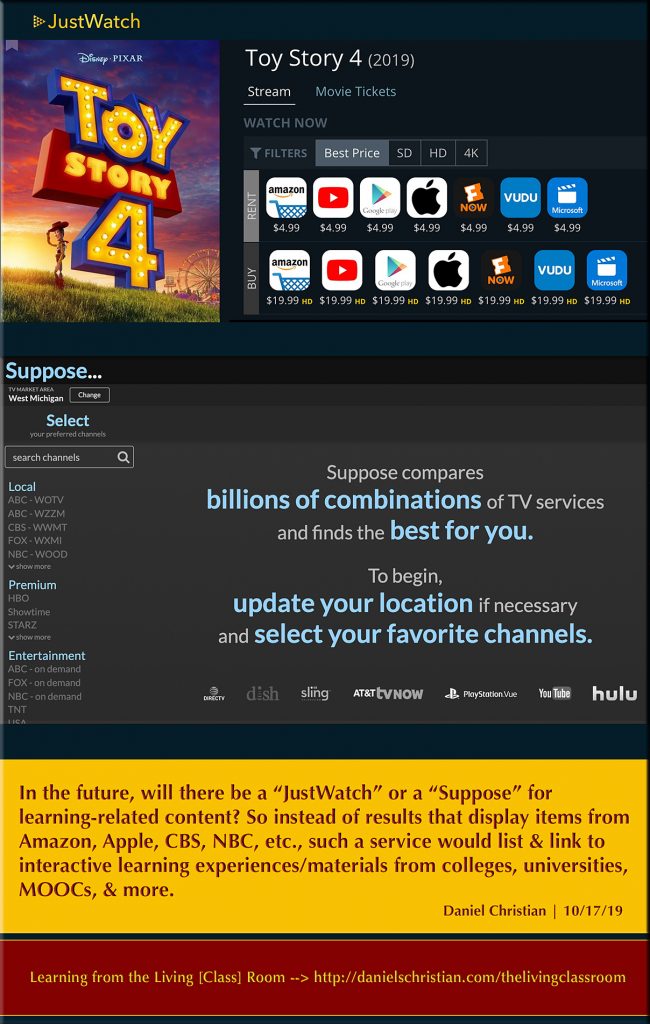
Though we aren’t quite there yet, the pieces continue to come together to build a next generation learning platform that will help people reinvent themselves quickly, efficiently, constantly, and cost-effectively.

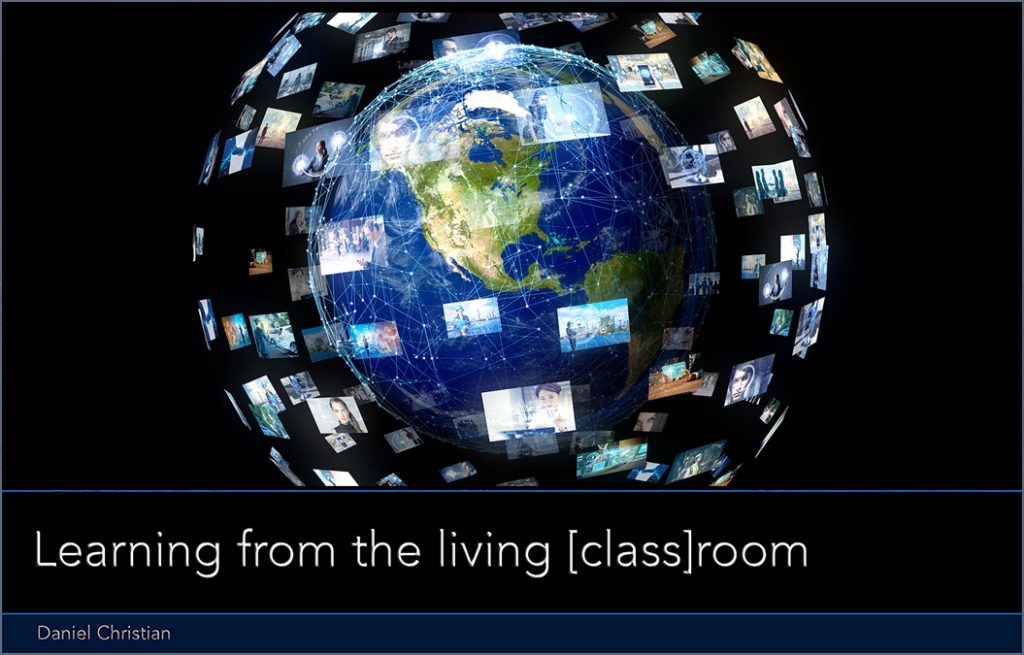
Learning from the living class room


Learning from the living class room


Learning from the living class room


FuturePod gathers voices from the international field of Futures and Foresight. Through a series of interviews, the founders of the field and emerging leaders share their stories, tools and experiences.

FuturePod gathers voices from the international field of Futures and Foresight. Through a series of podcast interviews, the founders of the field and emerging leaders share their stories, tools and experiences. The Futures and Foresight community comprises a remarkable and diverse group of individuals who span, academic, commercial and social interests.


120 AI predictions for 2020 — from forbes.com by Gil Press

Excerpt:

As for the universe, it is an open book for the 120 senior executives featured here, all involved with AI, delivering 2020 predictions for a wide range of topics: Autonomous vehicles, deepfakes, small data, voice and natural language processing, human and augmented intelligence, bias and explainability, edge and IoT processing, and many promising applications of artificial intelligence and machine learning technologies and tools. And there will be even more 2020 AI predictions, in a second installment to be posted here later this month.


Virtual access to legal assistance becoming mainstream is hopefully not far off!

From DSC:
Along these lines, we’ll likely see more bots and virtual legal assistants that we will be able to ask questions of.

#A2J #AccessToJustice #legal #lawyers #society #legaltech #bots #videoconferencing #AI #bots #VirtualAssistants

Along these lines, also see:

Innovative and inspired: How this US law school is improving access to justice — from studyinternational.com

Excerpt:

Though court and other government websites in the US provide legal information, knowing what to search for and understanding legal jargon can be difficult for lay people.

Spot, software that is being developed at the LIT Lab, aims to fix this.

“You know you have a housing problem. But very few people think about their housing problems in terms of something like constructive eviction,” explains David Colarusso, who heads the LIT Lab. “The idea is to have the tool be able to spot those issues based upon people’s own language.”

Developed by Colarusso and students, Spot uses a machine-based algorithm to understand legal queries posed by lay persons. With Spot, entering a question in plain English like “My apartment is so moldy I can’t stay there anymore. Is there anything I can do?” brings up search results that would direct users to the right legal issue. In this case, the query is highly likely to be related to a housing issue or, more specifically, to the legal term “constructive eviction.”


Lastly, here’s an excerpt from INSIGHT: What’s ‘Innovative’ in BigLaw? It’s More Than the Latest Tech Tools — from news.bloomberglaw.com by Ryan Steadman and Mark Brennan

Top Innovation Factors for Success

  • The first step is always to observe and listen.
  • True innovation is about rigorously defining a client problem and then addressing it through a combination of workflow process, technology, and people.
  • Leave aside the goal of wholesale transformation and focus instead on specific client use cases.

Before revving the engines in the innovation process, the safety check comes first. Successful innovation requires a deliberate, holistic approach that takes into consideration people, process, and technology. Firms and vendors that listen and learn before implementing significant change will stand apart from competitors—and help ensure long-term success.


The 20 top tech skills that employers want and that can help you find a job, according to recruiting site Indeed — from businessinsider.com by Rosalie Chan and Bani Sapra

Excerpt:

The job search site Indeed released a report this month about the top tech skills of 2019 based on job descriptions that are being posted.

Andrew Flowers, an economist at Indeed, says that in today’s job market, there are two major trends that drive the top skills in tech. The first is the rise of data science, machine learning, and artificial intelligence. The second is the rise of cloud computing.

“Python has had explosive growth,” Flowers told Business Insider. “If I’m around the dinner table and a nephew asks what should I learn? Having done this report, I would say, learn Python.”


Why AI is a threat to democracy – and what we can do to stop it — from asumetech.com by Lawrence Cole

Excerpts:

In the US, however, we also have a tragic lack of foresight. Instead of creating a grand strategy for AI or for our long-term futures, the federal government has removed the financing of scientific and technical research. The money must therefore come from the private sector. But investors also expect a certain return. That is a problem. You cannot plan your R&D breakthroughs when working on fundamental technology and research. It would be great if the big tech companies had the luxury of working very hard without having to organize an annual conference to show off their newest and best whiz bang thing. Instead, we now have countless examples of bad decisions made by someone in the G-MAFIA, probably because they worked quickly. We begin to see the negative effects of the tension between doing research that is in the interest of humanity and making investors happy.
…
The problem is that our technology has become increasingly sophisticated, but our thinking about what free speech is and what a free market economy looks like has not become that advanced. We tend to resort to very basic interpretations: free speech means that all speech is free, unless it conflicts with defamation laws, and that’s the end of the story. That is not the end of the story. We need to start a more sophisticated and intelligent conversation about our current laws, our emerging technology, and how we can make the two meet halfway.


So I absolutely believe that there is a way forward. But we have to come together and bridge the gap between Silicon Valley and DC, so that we can all steer the boat in the same direction.

— Amy Webb, futurist, NYU professor, founder of the Future Today Institute


Also see:

“FRONTLINE investigates the promise and perils of artificial intelligence, from fears about work and privacy to rivalry between the U.S. and China. The documentary traces a new industrial revolution that will reshape and disrupt our lives, our jobs and our world, and allow the emergence of the surveillance society.”

The film has five distinct messages about:

1. China’s AI Plan
2. The Promise of AI
3. The Future of Work
4. Surveillance Capitalism
5. The Surveillance State


Colleges see equity success with adaptive learning systems — from edtechmagazine.com by Shailaja Neelakantan
Powered by advanced algorithms, adaptive learning technologies boost completion rates and give students confidence.

“I used to teach one class of 100 students, but now I teach 100 classes of one student each,” said Doug Williams, the adaptive learning coordinator at Arizona State University, in the white paper, describing the effect of using such a technology-driven system to improve learning outcomes.


From DSC:
I post this item because I believe that this is the type of thing that will be a piece of our future learning ecosystems. Learning agents. Systems that accommodate each individual’s learning preferences. Real-time formative assessments…that impact what you see and experience next.  Intelligent systems. Intelligent tutoring.

People demonstrate mastery at different times — let that be part of our futures — versus this one-size fits all, hop-on-board-or-you-miss-the-train…a train that stops for no one.


Amazon’s new Fire TV Blaster works with Echo to control your TV, soundbar, cable box and more — from techcrunch.com by Sarah Perez

Excerpt:

Amazon already offers Alexa voice control to TV owners through its Fire TV devices, by way of a voice remote or by pairing an Echo device with a Fire TV, for hands-free voice commands. Now, it’s introducing a new device, the Fire TV Blaster, which extends that same hands-free voice control to your TV itself and other TV devices — like your soundbar, cable box, or A/V Receiver.

That means you’ll be able to say things like “Alexa, turn off the TV,” or “Alexa, switch to HDMI 1 on TV.” You can also control the volume and the playback.

And if you have other TV devices, you can control them hands-free as well, by saying things like “Alexa, turn up the soundbar volume,” or “Alexa tune to ESPN on cable.”


From DSC:
How might such Natural Language Processing (NLP) / voice recognition technologies impact future learning experiences and learning spaces? Will we enjoy more hands-free navigation around some cloud-based learning-related content? Will faculty members be able to use their voice to do the things that a Crestron Media Controller does today?

Parenthetically…when will we be able to speak to our routers (to shut off the kids’ internet connections/devices for example) and/or speak to our thermostats (to set the temperature(s) quickly for the remainder of the day)?


Six Examples of Augmented Reality in Performance Support — from learningsolutionsmag.com by Jeff Batt

Excerpt:

What do you think of when you hear the words “performance support”? We may all have our interpretation, but for me, performance support gives the learner instruction on how to perform actions while on the job and in the moment they need it. That has AR written all over it.

AR in performance support puts learning content in the context of what the learner is seeing. It enhances the real world, and it guides the learner through steps they need to take in the real world and even allows them to explore content they cannot easily access otherwise.

That has enormous potential for the learning and development space and gets me super excited about using AR. In this article, I’ll explore some possible scenarios for using AR in your performance support materials.


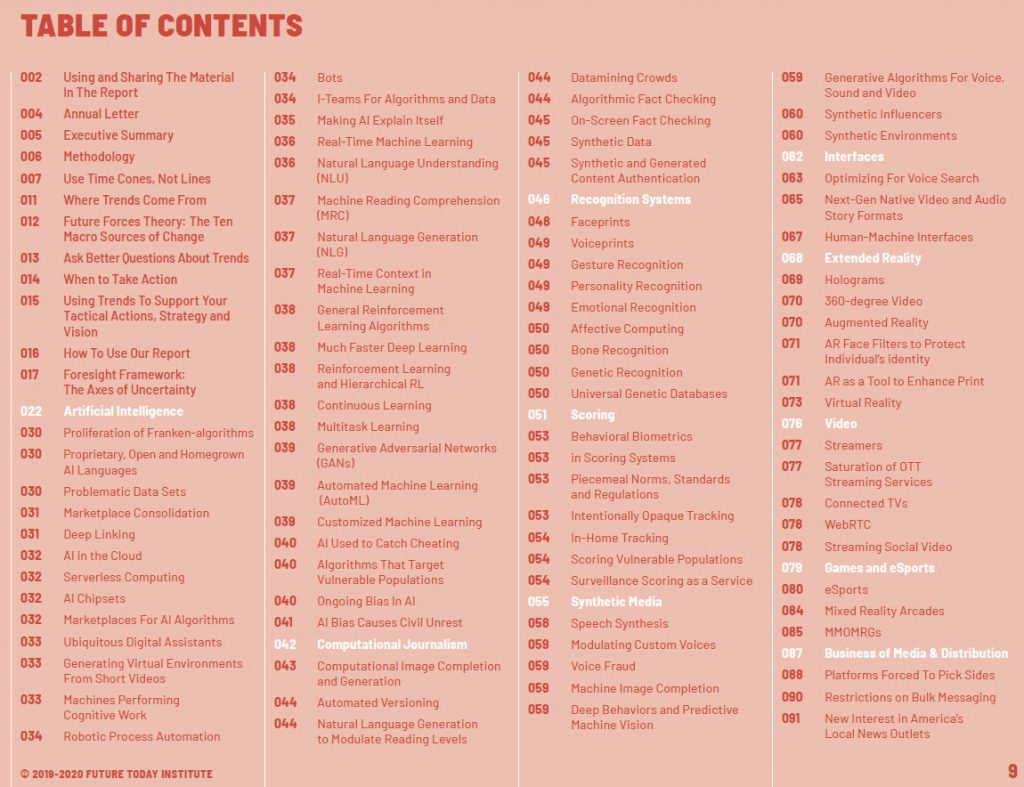
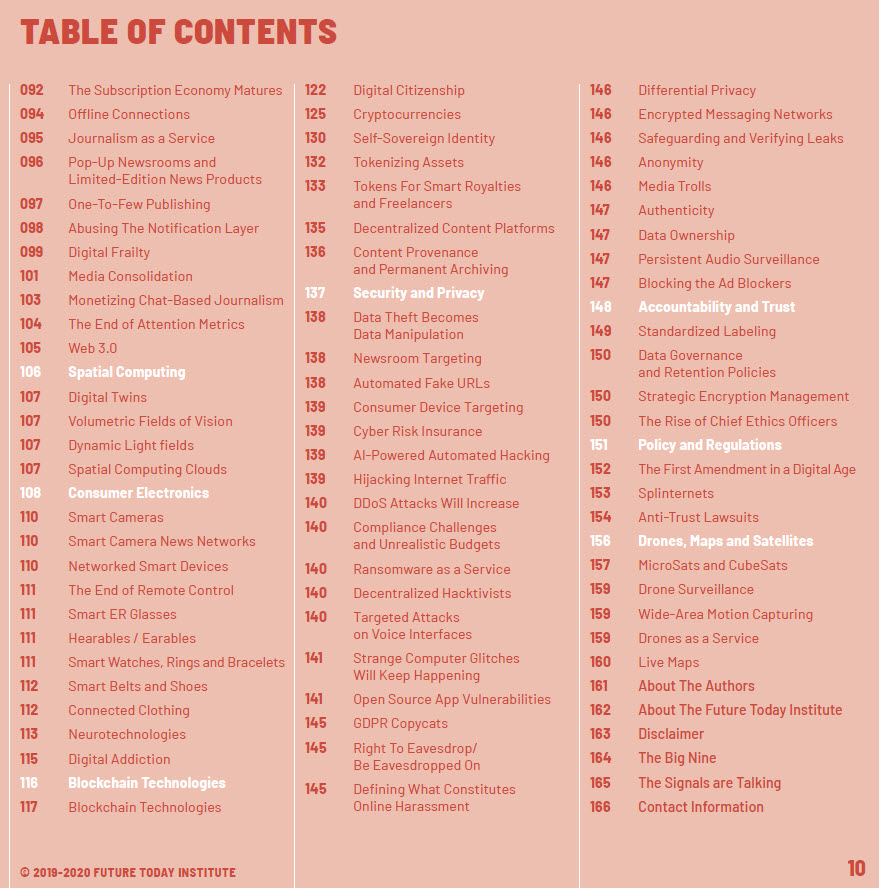
FTI 2020 Trend Report for Entertainment, Media, & Technology [FTI]


FTI 2020 Trend Report for Entertainment, Media, & Technology — from futuretodayinstitute.com

Our 3rd annual industry report on emerging entertainment, media and technology trends is now available.

  • 157 trends
  • 28 optimistic, pragmatic and catastrophic scenarios
  • 10 non-technical primers and glossaries
  • Overview of what events to anticipate in 2020
  • Actionable insights to use within your organization

KEY TAKEAWAYS

  • Synthetic media offers new opportunities and challenges.
  • Authenticating content is becoming more difficult.
  • Regulation is coming.
  • We’ve entered the post-fixed screen era.
  • Voice Search Optimization (VSO) is the new Search Engine Optimization (SEO).
  • Digital subscription models aren’t working.
  • Advancements in AI will mean greater efficiencies.


2020 Top 10 Issues: Simplify, Sustain, Innovate: The Drive to Digital Transformation Begins — from Educause by Susan Grajek

  1. Information security strategy
  2. Privacy
  3. Sustainable funding
  4. Digital integrations
  5. Student retention and completion
  6. Student-centric higher education
  7. Improved enrollment
  8. Higher education affordability
  9. Administrative simplification
  10. The integrative CIO

Also see:

The 30th National Survey of eLearning and Information Technology in US Higher Education — from campuscomputing.net
Hiring and Retaining Campus IT Talent Are Challenges; Many Campus Leaders Are Not Well-Informed About nor Engaged with Digital Issues

Excerpt:

New data from the fall 2019 Campus Computing Survey highlight the challenges that IT leaders across all sectors of US higher education confront in hiring and retaining IT talent. More than three-fourths (77 percent) of the CIOs and senior campus officials participating 2019 survey cite “hiring and retaining IT talent” as a top institutional IT priority. Similarly, 78 percent point to uncompetitive campus salaries and benefits as a major problem in the quest to hire and retain IT talent. And reflecting the campus financial challenges that affect hiring and staff retention efforts, fully two-thirds (67 percent) agree/strongly agree that institutional IT funding “has not recovered from the budget cuts” experienced by colleges and universities across all sectors of higher education since the “Great Recession of 2008.”


Are smart cities the pathway to blockchain and cryptocurrency adoption? — from forbes.com by Chrissa McFarlane

Excerpts:

At the recent Blockchain LIVE 2019 hosted annually in London, I had the pleasure of giving a talk on Next Generation Infrastructure: Building a Future for Smart Cities. What exactly is a “smart city?” The term refers to an overall blueprint for city designs of the future. Already half the world’s population lives in a city, which is expected to grow to sixty-five percent in the next five years. Tackling that growth takes more than just simple urban planning. The goal of smart cities is to incorporate technology as an infrastructure to alleviate many of these complexities. Green energy, forms of transportation, water and pollution management, universal identification (ID), wireless Internet systems, and promotion of local commerce are examples of current of smart city initiatives.

What’s most important to a smart city, however, is integration. None of the services mentioned above exist in a vacuum; they need to be put into a single system. Blockchain provides the technology to unite them into a single system that can track all aspects combined.


From DSC:
There are many examples of the efforts/goals of creating smart cities (throughout the globe) in the above article. Also see the article below.


There are major issues with AI. This article shows how far the legal realm is in wrestling with emerging technologies.

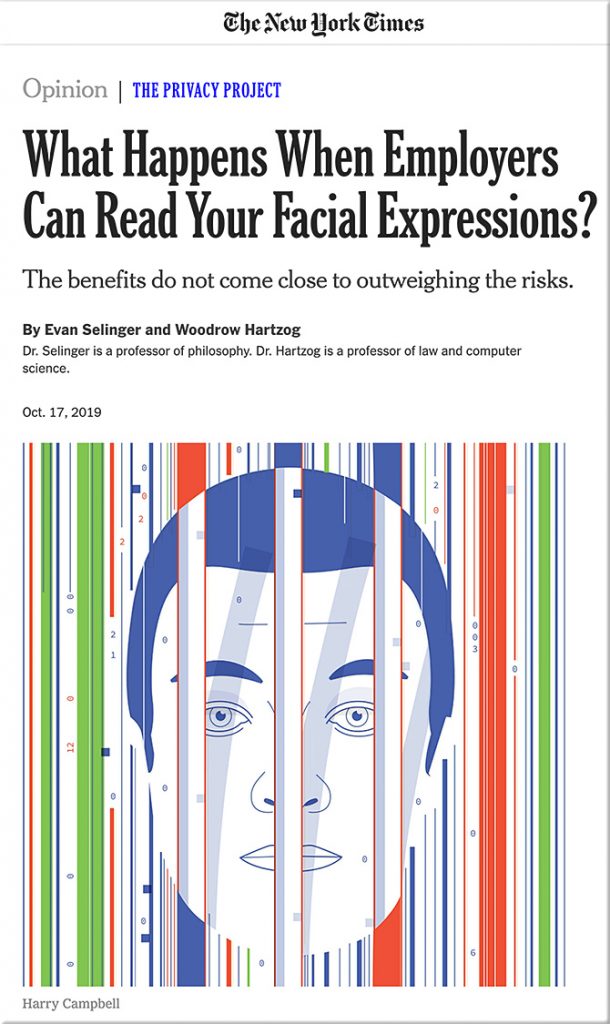
What happens when employers can read your facial expressions? — from nytimes.com by Evan Selinger and Woodrow Hartzog
The benefits do not come close to outweighing the risks.

Excerpts:

The essential and unavoidable risks of deploying these tools are becoming apparent. A majority of Americans have functionally been put in a perpetual police lineup simply for getting a driver’s license: Their D.M.V. images are turned into faceprints for government tracking with few limits. Immigration and Customs Enforcement officials are using facial recognition technology to scan state driver’s license databases without citizens’ knowing. Detroit aspires to use facial recognition for round-the-clock monitoring. Americans are losing due-process protections, and even law-abiding citizens cannot confidently engage in free association, free movement and free speech without fear of being tracked.

 “Notice and choice” has been an abysmal failure. Social media companies, airlines and retailers overhype the short-term benefits of facial recognition while using unreadable privacy policiesClose X and vague disclaimers that make it hard to understand how the technology endangers users’ privacy and freedom.


From DSC:
This article illustrates how far behind the legal realm is in the United States when we look at where our society is at with wrestling with emerging technologies. Dealing with this relatively new *exponential* pace of change is very difficult for many of our institutions to deal with (higher education and the legal realm come to my mind here).


© 2025 | Daniel Christian