With thanks to my sister, Sue Ellen Christian, for forwarding me Jeremy Caplan’s site/newsletter.

Also see:

…and this one as well:

Three words of advice that I wish I had heard when I first started teaching


From DSC:

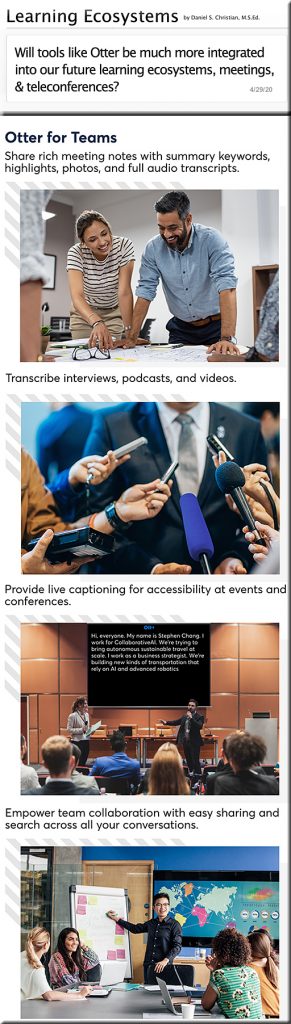
Will tools like Otter be much more integrated into our future learning ecosystems, meetings, & teleconferences?


Why education is a ‘wicked problem’ for learning engineers to solve — from edsurge.com by Rebecca Koenig

Excerpts (emphasis DSC):

So, back to the wicked problem: How do we make education that’s both quality education and at the same time accessible and affordable?

“Now, we are building a new technology that we call Agent Smith. It’s another AI technology— and we’re very excited about it—that builds [a] Jill Watson for you. And Agent Smith can build a Jill Watson for you in less than 10 percent of the hours.”
…
So one question for online education is, can we build a new set of tools—and I think that’s where AI is going to go, that learning engineering is going to go—where AI is not helping individual humans as much as AI is helping human-human interaction.

Huge ethical issues and something that learning engineering has not yet started focusing on in a serious manner. We are still in a phase of, “Look ma, no hands, I can ride a bike without hands.”
…
Technology should not be left to technologists.

Learning from the living class room


From DSC:
I’d like to thank Mr. Eric Osterberg — a fraternity brother and friend of mine — for sending me the following article. I wrote back to him. After thanking Eric for the article, I said:

Such an article makes me reflect on things — which is always a good thing for me to try to see my blindspots and/or to think about the good and bad of things. Technologies are becoming more powerful and integrated into our lives — for better at times and for worse at other times.

I’m wondering how the legal realm can assist and/or help create a positive future for societies throughout the globe…any thoughts?


Can computers ever replace the classroom? — from theguardian.com by Alex Beard
With 850 million children worldwide shut out of schools, tech evangelists claim now is the time for AI education. But as the technology’s power grows, so too do the dangers that come with it. 

Excerpts:

But it’s in China, where President Xi Jinping has called for the nation to lead the world in AI innovation by 2030, that the fastest progress is being made. In 2018 alone, Li told me, 60 new AI companies entered China’s private education market. Squirrel AI is part of this new generation of education start-ups. The company has already enrolled 2 million student users, opened 2,600 learning centres in 700 cities across China, and raised $150m from investors.
…
The supposed AI education revolution is not here yet, and it is likely that the majority of projects will collapse under the weight of their own hype.

The point, in short, is that AI doesn’t have to match the general intelligence of humans to be useful – or indeed powerful. This is both the promise of AI, and the danger it poses.

It was a reminder that Squirrel AI’s platform, like those of its competitors worldwide, doesn’t have to be better than the best human teachers – to improve people’s lives, it just needs to be good enough, at the right price, to supplement what we’ve got. The problem is that it is hard to see technology companies stopping there. For better and worse, their ambitions are bigger. “We could make a lot of geniuses,” Li told me.


How innovations in voice technology are reshaping education — from edsurge.com by Diana Lee
Voice is the most accessible form you can think of when you think about any interface. In education, it’s already started to take off.

It could be basic questions about, “Am I taking a class to become X?” or “How strong are my skills relative to other people?” An assistant can help with that. It could potentially be a coach, something that follows you the rest of your life for education. I’m excited about that. People that can’t normally get access to this kind of information will get access to it. That’s the future.

From DSC:
The use of voice will likely be a piece of a next-generation learning platform.

Voice will likely be a piece of the next generation learning platform


Facial recognition startup Clearview AI says its full client list was stolen — from engadget.com by Igor Bonifacic

Excerpt:

You might expect a high-profile (and controversial) facial recognition startup like Clearview AI would have its data locked down, but it turns out it’s just as vulnerable as almost any other company to malicious individuals. In a notification obtained by The Daily Beast, the company says a recent vulnerability allowed someone to gain “unauthorized access” to a list of all of its customers. Clearview works with approximately 600 law enforcement agencies across North America, including the Chicago Police Department.

Also see:


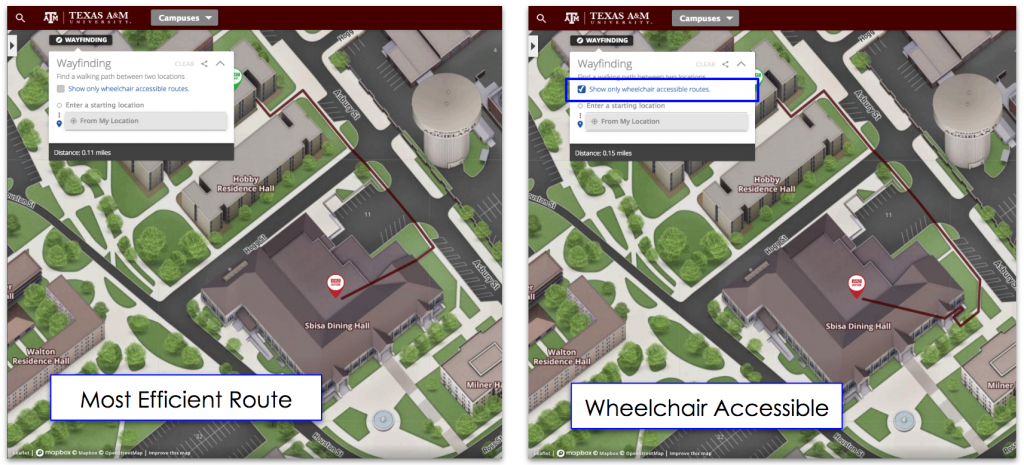
Concept3D introduces wheelchair wayfinding feature to support campus accessibility — from concept3d.echoscomm.com with thanks to Delaney Lanker for this resource
System makes wheelchair friendly campus routes easy to find and follow

Excerpt:

Concept3D, a leader in creating immersive online experiences with 3D modeling, interactive maps and virtual tour software, today announced the launch of a new wheelchair wayfinding feature that adds a new level of accessibility to the company’s interactive map and tour platform.

With the new wheelchair accessible route functionality, Concept3D clients are able to offer a separate set of wayfinding routes specifically designed to identify the most efficient and easiest routes.

Concept3D’s wayfinding system uses a weighted algorithm to determine the most efficient route between start and end points, and the new system was enhanced to factor in routing variables like stairs, curb cuts, steep inclines, and other areas that may impact accessibility.

Also see:

Wayfinding :: Wheelchair Accessible Routes — from concept3d.com

https://www.concept3d.com/blog/higher-ed/wayfinding-wheelchair-accessible-routes


6 Ed Tech Trends to Watch in 2020 — from campustechnology.com by Rhea Kelly with:

  • Bridget Burns, Executive Director, University Innovation Alliance
  • James Frazee, Chief Academic Technology Officer and Associate VP, Instructional Technology Services, San Diego State University
  • Ernie Perez
    Director, Educational Technology, Digital Learning & Innovation, Boston University

This year’s top issues in education technology reflect the bigger picture of a student’s pathway from individual courses all the way to graduation and career.

Topics include:

1) Workforce Readiness
2) Artificial Intelligence and Chatbots
3) Extended Reality (XR)
4) Video and Accessibility
5) Predictive Analytics and Advising
6) Industry Partnerships


How technology and law changes for career development — from lawtechnologytoday.org by Manan Ghadawala

Excerpt:

But things have been changing in technology and law over the years. Let us look at these developments in technology and law and also see how technology already [is] — and will — impact legal careers.
…
Joni Pirovich from Hall & Wilcox explained, “As technology trends are pervasive across all industries, it’s now incumbent upon law firms to ensure lawyers have a good starting language to interpret technology concepts and how they interact with legal principles.”

The increase in law firm technology did surprise some people. Forbes found out that there was a 713% jump in investments in technology for law firms in 2018—almost 1.63 billion USD—bolstered mostly by the arrival of eDiscovery, which is an electronic method for finding important information specific investigations or suits.

#Automation #MachineLearning #AI #BigData


Pearson Bets on Adaptive Learning (Again) With $25M Acquisition of Smart Sparrow — from edsurge.com by Tony Wan

Excerpt:

Smart Sparrow, which provides course-authoring tools for faculty and instructional designers to build adaptive courseware, has found a new home in a much bigger nest.

Last week, Pearson announced it paid $25 million to acquire Smart Sparrow’s technology, in a move that the publisher says will bolster the digital infrastructure that will soon support all its future higher-education offerings.

In recent years, Ben-Naim says his team has been building the next iteration of its adaptive course-creation tool. Called Aero, the platform has been in the works since 2017. And though Aero has not been publicly released or announced, that was the technology that attracted Pearson, he adds.


Juris announces launch of AI powered software to help people solve their own legal problems — from finance.yahoo.com

Excerpt:

Legal technology company Juris has announced the launch of their service, DepositLetter, an online tool built to recover illegally withheld security deposits on behalf of renters. Customers complete a five-minute online interview and Juris does the rest automatically to show their former landlord that they know their rights under the law, to demand their money back, and even threaten to sue. DepositLetter is the first service built on the Juris Virtual Legal Assistant platform, a law-powered A.I. expert system made to help people solve their own legal problems.

Also see:

Millennial lawyers demand mobility. Are law firms ready to provide it? from law.com by Alex Babin
Like it or not, remote work is coming to the legal world. Even among law firms, the development of policies to accommodate work performed away from the office appears to be a notable trend.

Excerpt:

Like it or not, remote work is coming to the legal world. Even among law firms, where I am repeatedly reminded that the adoption of technology tends to lag behind other workplaces and industries, the development of policies to accommodate work performed away from the office appears to be a notable trend. In part, this is being driven by increasing numbers of millennials in the legal workforce. According to a 2019 Deloitte survey, nearly 75% of millennials think a “work-from-home” or “work remotely” policy is important. But the changing perspective is also very likely a function of a broader transition in the legal industry toward technology-enabled efficiency.


Gartner: 10 ways technology will change what it means to be human — from campustechnology.com by Rhea Kelly

Excerpts:

Gartner’s top 10 strategic predictions for technology are:

  1. “By 2023, the number of people with disabilities employed will triple due to AI and emerging technologies, reducing barriers to access.”
  2. “By 2024, AI identification of emotions will influence more than half of the online advertisements you see.”
  3. “Through 2023, 30 percent of IT organizations will extend BYOD policies with ‘bring your own enhancement’ (BYOE) to address augmented humans in the workforce.”
  4. “By 2025, 50 percent of people with a smartphone but without a bank account will use a mobile-accessible cryptocurrency account.”
  5. “By 2023, a self-regulating association for oversight of AI and machine learning designers will be established in at least four of the G7 countries.”
  6. “By 2023, 40 percent of professional workers will orchestrate their business application experiences and capabilities like they do their music streaming experience.”
  7. “By 2023, up to 30 percent of world news and video content will be authenticated as real by blockchain countering deep fake technology.”
  8. “Through 2021, digital transformation initiatives will take large traditional enterprises on average twice as long and cost twice as much as anticipated.”
  9. “By 2023, individual activities will be tracked digitally by an ‘Internet of Behavior’ to influence benefit and service eligibility for 40 percent of people worldwide.”
  10. “By 2024, the World Health Organization will identify online shopping as an addictive disorder, as millions abuse digital commerce and encounter financial stress.”

Facial recognition, location tracking and big data will allow organizations to monitor individual behavior and link that behavior to other digital actions, Gartner said, noting that “The Internet of Things (IoT) – where physical things are directed to do a certain thing based on a set of observed operating parameters relative to a desired set of operating parameters — is now being extended to people, known as the Internet of Behavior (IoB).”


From DSC:
That last quote about the “Internet of Behavior (IoB)” should disturb us. I don’t want that kind of world for the next generation. 


The Future of Lawyers: Legal Tech, AI, Big Data And Online Courts — from forbes.com by Bernard Marr

Excerpts:

In his brand new book Online Courts and the Future of Justice, Richard argues that technology is going to bring about a fascinating decade of change in the legal sector and transform our court system. Although automating our old ways of working plays a part in this, even more, critical is that artificial intelligence and technology will help give more individuals access to justice.
…
The first generation is the idea that people who use the court system submit evidence and arguments to the judge online or through some form of electronic communication.
…
The second generation of using technology to transform the legal system would be what Richard calls “outcome thinking” to use technology to help solve disputes without requiring lawyers or the traditional court system.
…
Some of the biggest obstacles to an online court system are the political will to bring about such a transformation, the support of judges and lawyers, funding, as well as the method we’d apply. For example, decisions will need to be made whether the online system would be used for only certain cases or situations.

Ultimately, we have a grave access-to-justice problem. Technology can help improve our outcomes and give people a way to resolve public disputes in ways that previously weren’t possible. While this transformation might not solve all the struggles with the legal system or the access-to-justice issue, it can offer a dramatic improvement.


DC: Precursor to a next gen learning platform…? Another piece is falling into place.


Legal Tech’s Predictions for Artificial Intelligence in 2020 — from law.com by Zach Warren
We may not have robot lawyers, but lawyers and technologists agree that artificial intelligence will have a major impact on the legal profession in 2020.

Excerpts:

Alex Babin, CEO, Zero: “The biggest gains from automating legal practices will be time saved and improved workflow efficiencies as the AI ‘takes over’ more laborious tasks including litigation support, email, e-discovery, and the use of databases for case management. Lawyers will begin to trust in this process, letting AI perform these basic tasks such as auto-filing document and email for compliance. AI will enhance corporate and regulatory reporting and improves contract creation and management.”

Scott Forman, shareholder, Littler Mendelson and founder of Littler CaseSmart and Littler onDemand: “Data analytics and AI have already fundamentally changed the delivery of legal services, but I expect 2020 to bring a greater understanding of how these technologies enhance, rather than overtake, the work of lawyers. While robots and technology will never replace lawyers, they provide data and insight enabling lawyers to do their jobs faster and better. This includes automating aspects of the legal process—so that lawyers can focus on top-of-the-pyramid work—as well as synthesizing and serving up information that guides litigation strategy, identifies potential areas of risk and moves toward predicting legal outcomes.”


Learning from the living class room

 
© 2025 | Daniel Christian