Entrepreneur Education Platform GeniusU Raises $1.5M Seed Funding at $250M Valuation — from edtechreview.in ed by Stephen Soulunii

Excerpt (emphasis DSC):

Genius Group has recently announced that its EdTech arm, GeniusU Ltd, has raised $1.5 million in a seed round to support the development of its Genius Metaversity virtual learning plans.

With the fresh funding, GeniusU plans to extend its courses and programs to interactive learning environments in the metaverse, with students and faculty connecting and learning in global classrooms and virtual 3D environments. It also plans to integrate each student’s AI-based virtual assistant ‘Genie’ into the metaverse as 3D virtual assistants that accompany each student on their personalized journey and integrate its GEMs (Genius Education Merits) student credits into the metaverse. GEMs are earned by students as they learn and can be spent on products and services within GeniusU and counting towards their certifications.


Ransomware is already out of control. AI-powered ransomware could be ‘terrifying.’ — from protocol.com by Kyle Alspach
Hiring AI experts to automate ransomware could be the next step for well-endowed ransomware groups that are seeking to scale up their attacks.

Excerpt:

In the perpetual battle between cybercriminals and defenders, the latter have always had one largely unchallenged advantage: The use of AI and machine learning allows them to automate a lot of what they do, especially around detecting and responding to attacks. This leg-up hasn’t been nearly enough to keep ransomware at bay, but it has still been far more than what cybercriminals have ever been able to muster in terms of AI and automation.

That’s because deploying AI-powered ransomware would require AI expertise. And the ransomware gangs don’t have it. At least not yet.

But given the wealth accumulated by a number of ransomware gangs in recent years, it may not be long before attackers do bring aboard AI experts of their own, prominent cybersecurity authority Mikko Hyppönen said.

Also re: AI, see:

Nuance partners with The Academy to launch The AI Collaborative — from artificialintelligence-news.com by Ryan Daws

Excerpt:

Nuance has partnered with The Health Management Academy (The Academy) to launch The AI Collaborative, an industry group focused on advancing healthcare using artificial intelligence and machine learning.

Nuance became a household name for creating the speech engine recognition engine behind Siri. In recent years, the company has put a strong focus on AI solutions for healthcare and is now a full-service partner of 77 percent of US hospitals and is trusted by over 500,000 physicians daily.

Inflection AI, led by LinkedIn and DeepMind co-founders, raises $225M to transform computer-human interactions — from techcrunch.com by Kyle Wiggers

Excerpts:

Inflection AI, the machine learning startup headed by LinkedIn co-founder Reid Hoffman and founding DeepMind member Mustafa Suleyman, has secured $225 million in equity financing, according to a filing with the U.S. Securities and Exchange Commission.

“[Programming languages, mice, and other interfaces] are ways we simplify our ideas and reduce their complexity and in some ways their creativity and their uniqueness in order to get a machine to do something,” Suleyman told the publication. “It feels like we’re on the cusp of being able to generate language to pretty much human-level performance. It opens up a whole new suite of things that we can do in the product space.”


The Future of Work and the Jobs we might have in 2040 — from futurist.com by Nikolas Badminton & Marianne Powers

Excerpt:

So, let’s set our sights on a future horizon of 2040 and we can wonder what the future of work and the future of jobs for our children may be. The world may feel and look the same but underneath we’ll need people to transition to new careers to support the hyper-fast, data-obsessed world. Let’s take a look at the Future of Work and Jobs in 2040

  • Human-centred Designers and Ethicists
  • Artificial Intelligence Psychologists
  • Metaverse Architects
 

From DSC:
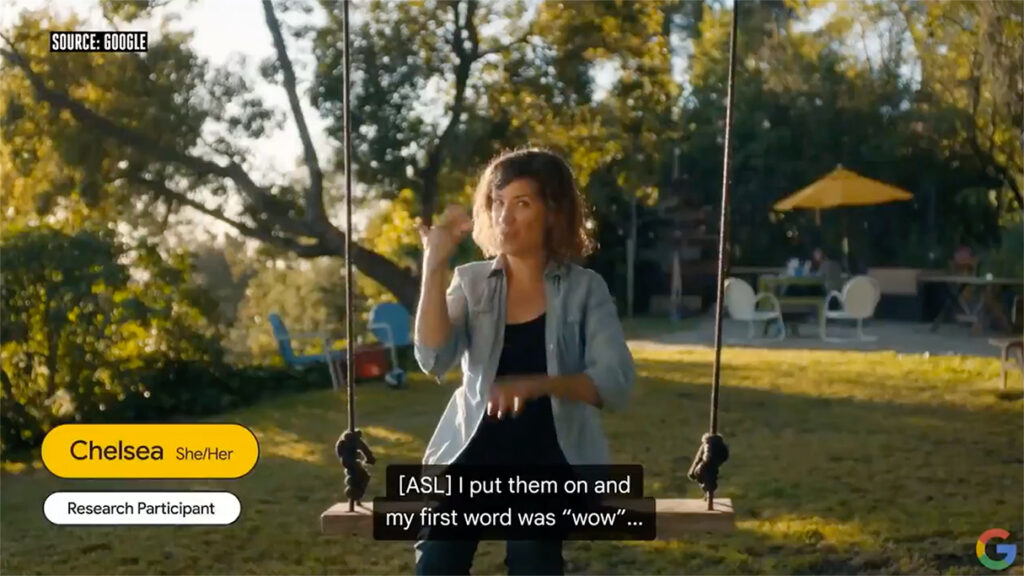
I love the parts about seeing instant language translations — including sign language! Very cool indeed!
(With thanks to Ori Inbar out on Twitter for this resource.)

Realtime American Sign Language translation via potential set of AR glasses from Google

Also see:


Airbnb’s design for employees to live and work anywhere — from news.airbnb.com; with thanks to Tom Barrett for this resource

Excerpt:

Airbnb is in the business of human connection above all else, and we believe that the most meaningful connections happen in person. Zoom is great for maintaining relationships, but it’s not the best way to deepen them. Additionally, some creative work and collaboration is best done when you’re in the same room. I’d like working at Airbnb to feel like you’re working at one of the most creative places on Earth, and this will only happen with some in-person collaboration time.

The right solution should combine the best of the digital world and the best of the physical world. It should have the efficiency of Zoom, while providing the meaningful human connection that only happens when people come together. We have a solution that we think combines the best of both worlds.

We’ve designed a way for you to live and work anywhere—while collaborating in a highly coordinated way, and experiencing the in-person connection that makes Airbnb special. Our design has five key features…

Now, a thought exercise on that item from Tom Barrett:

While you are there, extend the thought experiment and imagine the new policy for a school, college or university.

  1. You can work from home or the office
  2. You can move anywhere in the country you work in, and your compensation won’t change
  3. You have the flexibility to travel and work around the world
  4. We’ll meet up regularly for team gatherings, off-sites, and social events
  5. We’ll continue to work in a highly coordinated way

From DSC:
As a reflection on this thought experiment, this graphic comes to my mind again. Teachers, professors, trainers, staff, and students can be anywhere in the world:

Learning from the living class room


China is about to regulate AI—and the world is watching — from wired.com by Jennifer Conrad
Sweeping rules will cover algorithms that set prices, control search results, recommend videos, and filter content.

Excerpt:

Some provisions aim to address complaints about online services. Under the rules, for instance, companies will be prohibited from using personal characteristics to offer users different prices for a product; they also will be required to notify users, and allow them to opt out, when algorithms are used to make recommendations.

Companies that violate the rules could face fines, be barred from enrolling new users, have their business licenses pulled, or see their websites or apps shut down.

Some elements of the new regulations may prove difficult or impossible to enforce. It can be technically challenging to police the behavior of an algorithm that is continually changing due to new input, for instance.


The amazing opportunities of AI in the future of the educational metaverse [Darbinyan]

The amazing opportunities of AI in the future of the educational metaverse — from forbes.com by Rem Darbinyan

Excerpt:

Looking ahead, let’s go over several potential AI-backed applications of the metaverse that can empower the education industry in many ways.

Multilingual Learning Opportunities
Language differences may be a real challenge for students from different cultures as they may not be able to understand and keep up with the materials and assignments. Artificial intelligence, VR and AR technologies can enhance multilingual accessibility for learners no matter where they are in the world. Speech-to-text, text-to-speech and machine translation technologies enrich the learning process and create more immersive learning environments.

AI can process multiple languages simultaneously and provide real-time translations, enabling learners to engage with the materials in the language of their choice. With the ability to instantly transcribe speech across multiple languages, artificial intelligence removes any language barriers for students, enabling them to be potentially involved, learn and communicate in any language.

Artificial Intelligence (AI) in Education Market size exceeded USD 1 billion in 2020 and is expected to grow at a CAGR of over 40% between 2021 and 2027. (source)

Along the lines of innovation within our educational learning ecosystems, see:

3 Questions for Coursera’s Betty Vandenbosch & U-M’s Lauren Atkins Budde on XR — from insidehighered.com by Joshua Kiim
How might extended reality shape the future of learning?

Excerpts (emphasis DSC):

[Lauren Atkins Budde] “Being able to embed quality, effective extended reality experiences into online courses is exponentially a game-changer. One of the persistent constraints of online learning, especially at scale, is how do learners get hands-on practice? How do they experience specific contexts and situations? How do they learn things that are best experienced? XR provides that opportunity for actively doing different kinds of tasks, in various environments, in ways that would otherwise not be possible. It will open up  Lauren Atkins Buddeboth how we teach online and also what we teach online.”

These courses are really exciting and cover a broad range of disciplines, which is particularly important. To choose the right subjects, we did an extensive review of insights from industry partners, learners and market research on in-demand and emerging future-of-work skills and then paired that with content opportunities where immersive learning is really a value-add and creates what our learning experience designers call “embodied learning.”

Addendum on 5/1/22:
Can the Metaverse Improve Learning? New Research Finds Some Promise — from edsurge.com by Jeffrey R. Young

“The findings support a deeper understanding of how creating unique educational experiences that feel real (i.e., create a high level of presence) through immersive technology can influence learning through different affective and cognitive processes including enjoyment and interest,” Mayer and his colleagues write.


2022 Outlook: 6 Legal Trends and Predictions to Have on Your Radar — from jdsupra.com by Vivian Susko

Excerpt:

In January, 2020, we made some bold predictions about what would lie ahead for legal operations in the new decade. Let’s dive back into some of our top forecasts, survey our new landscape, and see which legal trends are currently impacting the industry in 2022. Mitratech expert, Justin Silverman, weighs in on what you can expect to see on the horizon for legal ops.

Points on a radar screen


K-12 education in America is like quickly moving trains that stop for no one.

K-12 education in America is like quickly moving trains that stop for no one.

From DSC:
A family member struggles with spelling — big time. This causes her major amounts of anxiety in school.

Another family member had some learning disabilities and reflects back on school with some bad memories.

Another family member struggles with social graces and learns at a much different pace than her peers — the move to her education being (predominantly) done via homeschooling has helped significantly.

A friend of mine has Dyslexia. He recently said that school was hell for him.

Another person I know doesn’t understand his daughter’s learning disabilities — at all. He’s asking a fish to climb the tree and yells at his daughter when she doesn’t produce like the other kids do. Her school is for college-bound learners, and there’s always pressure to maintain the school’s “blue-ribbon” status (i.e., sorry if you don’t fit in…but please board the train anyway, as it’s about to depart).

These people and stories about their educations got me to reflect on all the people who went through the school systems in the United States (over the last few decades) that didn’t work well for them. In fact, not only did the systems not work well for them, they were the sources of a great deal of pain, anxiety, depression, anger, frustration, and embarrassment.  Instead of being a place of wonder or joy, school was a painful, constant struggle to get through.

For those who can keep up or even excel at the pace that the trains travel at, school isn’t that much of a problem. There are likely different levels of engagement involved here, but school is manageable and it doesn’t cause nearly the stress for someone who struggles with it.

For those with learning disabilities, I’d like to apologize to you on behalf of all the people who legislated or created rigid, one-size-fits-all school systems that didn’t understand and/or meet your needs. (Why we allow legislators — who aren’t the ones on the front lines — to control so much of what happens in our school systems is beyond me.) I’d like to apologize on behalf of all of the teachers, administrators, and staff who just accept the systems as they are.

Please help us reinvent our school systems. Help us develop the future of education. Help us develop a more personalized, customized approach. For those who are working to provide that, thank you! Thank you! Thank you!

To everyone working within Pre-K through 12th grade, help us offer: More voice. More choice. More control. The status quo has to go. School should not be a constant source of pain and anxiety.

Learners need: More voice. More choice. More control. -- this image was created by Daniel Christian


We need to use more tools — that go beyond screen sharing — where we can collaborate regardless of where we’re at. [Christian]

From DSC:
Seeing the functionality in Freehand — it makes me once again think that we need to use more tools where faculty/staff/students can collaborate with each other REGARDLESS of where they’re coming in to partake in a learning experience (i.e., remotely or physically/locally). This is also true for trainers and employees, teachers and students, as well as in virtual tutoring types of situations. We need tools that offer functionalities that go beyond screen sharing in order to collaborate, design, present, discuss, and create things.  (more…)


Momentum builds behind a way to lower the cost of college: A degree in three years — from hechingerreport.org by Jon Marcus
Skepticism about the cost and duration of a higher education drives a need for speed

Excerpt:

A rare brand-new nonprofit university, NewU has a comparatively low $16,500-a-year price that’s locked in for a student’s entire education and majors with interchangeable requirements so students don’t fall behind if they switch.

But the feature that appears to be really winning over applicants is that NewU will offer bachelor’s degrees in three years instead of the customary four.

“We didn’t think the three-year bachelor’s degree was going to be the biggest draw,” said Stratsi Kulinski, president of the startup college. “But it has been, hands-down. Consumers are definitely ready for something different.”


What Does “Learner-Centered” Higher Ed Really Look Like? Insights from Leaders at SXSW EDU — from wgulabs.org by Nicole Barbaro

Excerpt (emphasis DSC):

What does the future of higher ed look like? Leaders from across the education sector dove deep into this question at the annual SXSW EDU conference that was held in Austin, Texas [last] month. During his keynote session, US Secretary of Education, Miguel Cardona, echoed the need for transformation by stating, “We’re closer to a reset in education than ever before. Let’s not build back something that wasn’t working for everyone.” 

So, how should higher ed build back?

As a “learner-centered” ecosystem. Leaders across education agree that we must put students at the center of our design. But what does it look like in practice to be learner-centered? 

A learner-centered future breaks down institutional silos and works in networks to innovate and support students. And with the ubiquity of online learning in today’s higher ed ecosystem, there’s no reason not to collaborate. “There is no possible future in which online education is not an integral part of higher ed.” affirmed Executive Director of the University Innovation Alliance, Bridget Burns during a panel discussion at SXSW EDU.


Law firms are entering the metaverse, here’s why — from web3law.center by Meagan Cline

Excerpt:

Lawyers and law firms are increasingly exploring web3 and the metaverse. The technology is here and likely will only become a greater part of our society. Therefore, lawyers must at least consider how their operations may need to evolve to meet the growing demand for web3 literate legal services.


In this episode, David Aird talks;

  • Diversity and Inclusion
  • Social Mobility in Legal IT
  • Security Matters and Cyber-threats
  • Technology as the Answer
  • Artificial Intelligence and the Future

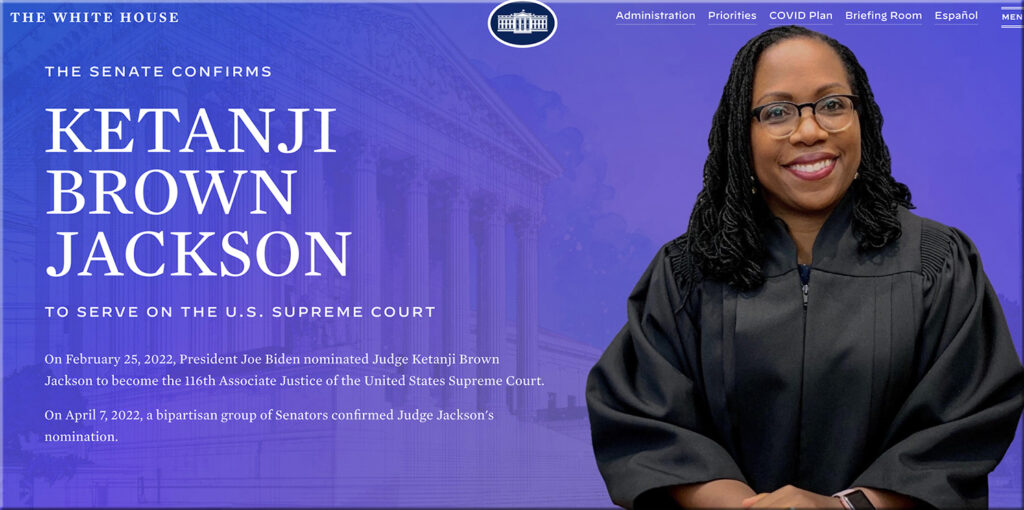
HUGE NEWS!

KETANJI BROWN JACKSON
TO SERVE ON THE U.S. SUPREME COURT

This Week’s Latest Additions to the LawNext Legal Technology Directory — from legaltechmonitor.com by Bob Ambrogi

This Week’s Latest Additions to the LawNext Legal Technology Directory -- by Bob Ambrogi

Photo Geotagging for Lawyers — from legaltechmonitor.com by Jim Calloway

How to automate your law office — from lawtechnologytoday.org

New Microsoft Study Reveals Work Changes: We Aren’t Going Back — from legaltechmonitor.com by Stephen Embry

https://www.lawtechnologytoday.org/2022/03/top-5-benefits-of-a-virtual-law-practice/

Reimagining Law: Embracing the Power of ‘No’ (Part 1) — from legaltechmonitor.com by 2civility

Reimagining Law: Embracing the Power of ‘No’ (Part 2) — from legaltechmonitor.com by 2civility

JUSTICE IN A CHANGING WORLD 2021 | ANNUAL REPORT — from iaals.du.edu

Another State Adopts Duty of Technology Competence for Lawyers, Bringing Total to 40 — from legaltechmonitor.com by Bob Ambrogi

IAALS Launches Allied Legal Professionals in an Effort to Increase Access to Quality Legal Services and Help Reduce Barriers to Representation — from iaals.du.edu by Kelsey Montague

Excerpt:

IAALS, the Institute for the Advancement of the American Legal System at the University of Denver, announced today that it is launching Allied Legal Professionals. With generous support from the Sturm Family Foundation, this project seeks to help standardize a new tier of legal professionals nationally—to increase the options for accessible and affordable legal help for the public.

Up and down the income scale, the legal needs of people in this country are going unmet. The inability to afford a lawyer, among other factors, has led to ballooning rates of self-representation in our justice system, with over 70 percent of civil and family cases including a party without a lawyer. People in these situations are not only facing life-altering challenges such as child custody hearings or landlord/tenant issues alone—they also face disproportionately bad outcomes in their cases.

Addendums on 4/8/22:


The Future of ID in an AI World — from learningsolutionsmag.com by Markus Bernhardt and Clark Quinn

Excerpt:

Recent advances in artificial intelligence (AI) are promising great things for learning. The potential here is impressive, but there also exist many questions and insecurities around deploying AI technology for learning: What can AI do? Where is it best utilized? What are the limits? And particularly: What does that leave for the instructional designer and other human roles in learning, such as coaching and training?

We want to suggest that these developments are for the benefit of everyone—from organizational development strategy devised in the C-suite, via content creation/curation by instructional designers, right through to the learners, as well as coaches and trainers who work with the learners.


© 2025 | Daniel Christian