A first look at how educators are really using Google Glass — from by Stephen Noonoo

Excerpts (emphasis DSC):

Per Andrew Vanden Heuvel:

What Glass does offer, Vanden Heuvel said, is a shift in perspective, particularly because teachers can use it as a tool to engage students faster and more easily than before. After returning from Geneva, Vanden Heuvel launched a YouTube channel devoted to his experiments with science–and Glass–called STEMBite. To date, in more than two dozen videos, he’s guided viewers through the physics of ball spin on the tennis court to the polarization of light through (appropriately enough) a pair of glasses.

“What I’m excited by making these videos is not only that they’re filmed with Google Glass, but they’re high engagement videos, so they’re meant to be really short and to get kids to think about how math and science is all around,” he said. “I suppose I could have done that before, but it’s just so easy now.”

Per Hanna Brown:

“I’ve had videos in my classroom before–that’s not a novel thing–but I’ve never been able to take a video from my eye perspective,” said Hannah Brown, another early Glass adopter who works as a high school art teacher at Electronic Classroom of Tomorrow, an all-online statewide charter school in Ohio.
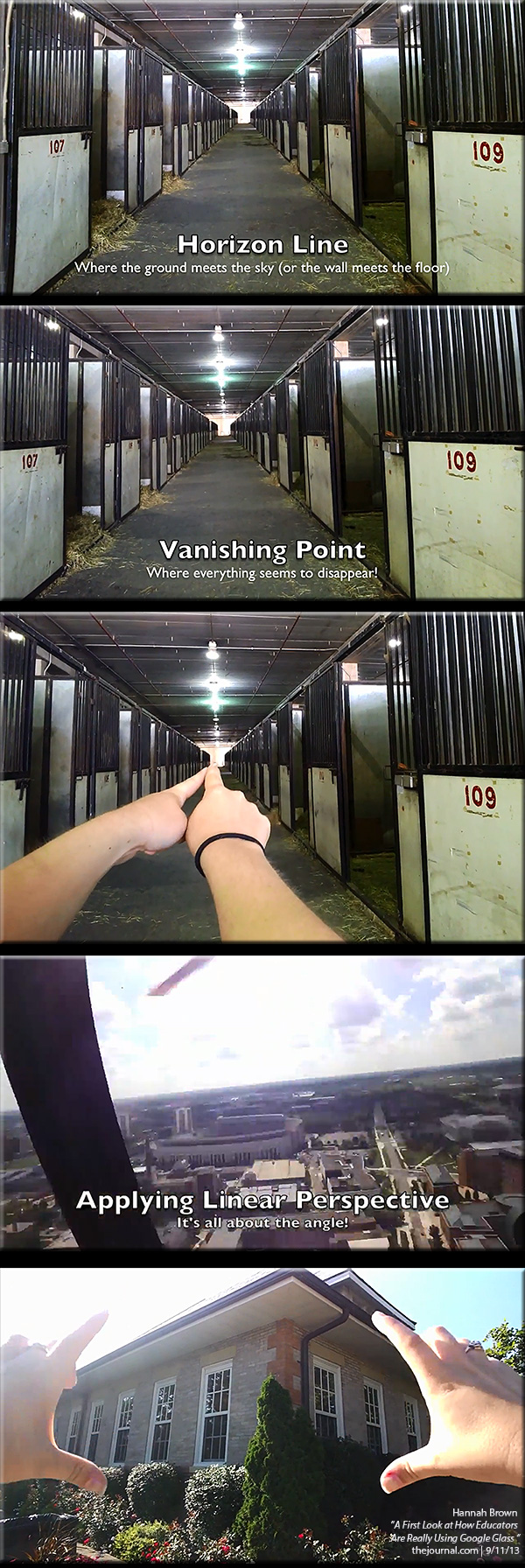
 

HannahBrown-9-11-13-Art-and-Google-Glass-thejournal


From DSC:
Virtual field trips, mobile learning, videoconferencing, web-based collaboration, Human Computer Interaction (HCI), and other topics come to my mind when I see this.
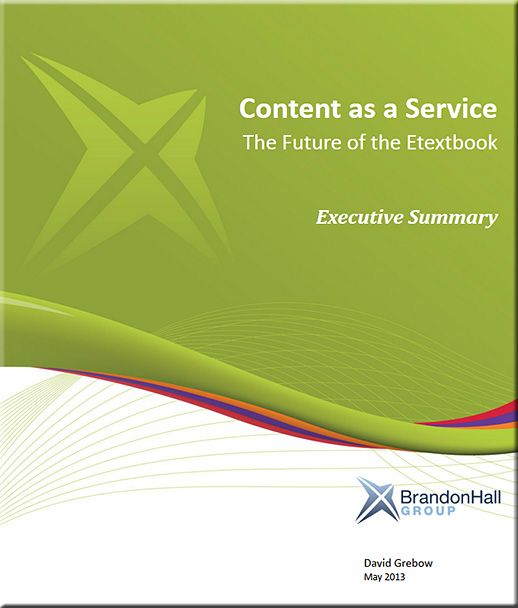


Content as a Service (CaaS) — from knowledgestarblog.wordpress.com by David Grebow

Excerpt:

The etextbook in 2018 will be dramatically different than the etextbook of today. It will be coupled to an app that will provide you with Content as a Service (CaaS). CaaS will include many of the following features (and more that have yet to be imagined):

  • Multimedia
  • Simulations
  • Educational Games
  • Animations
  • Pre- and post-tests
  • Formative and Summative Quizzes
  • Adaptive testing
  • Networked Social Learning
  • Study groups
  • Analytic Datasets
  • Virtual and Flipped classes
  • Communities of Learning and Practice
  • Virtual classes.


Also see:

.

ContentAsAService-Grebow-May2013


Twitter buys open source training company Marakana to power new “Twitter University” for engineers — from techcrunch.com by Ingrid Lunden

Excerpt:

Twitter today announced its latest acquisition, along with a move into offering richer resources to attract better engineering talent to the company. It has bought Marakana, an open-source technical training company; and in turn, Marakana will be the force behind a new effort called Twitter University. School mascot: a blue bird, not a whale.


From DSC:
I’ve asked from time to time if the corporate world would develop their own MOOCs…

I’ve suggested that if higher ed doesn’t get much more responsive to the needs of business — as well as to our government — alternatives may likely crop up….

…so I can’t help but wondering if this isn’t an example of that very type of thing occurring (i.e. the corporate world developing alternative paths to getting what they need).

It may not be MOOCs, but disruption will occur one way or another if higher ed doesn’t experiment and innovate with a much greater degree of intensity and fervency.  We need to be far more responsive!

The items in this posting are a great illustration of why I call this blog, Learning Ecosystems — how we learn and what we learn about is an ecosystem — both individually and corporately.  We have self-organizing systems for learning that constantly change — involving people, institutions, technologies, and more. Very few things are staying in place/the same these days — and the very pace of change has changed.  If we were to look at our learning ecosystems through a gigantic “microscope”, the organisms and nodes would be very active these days!


Also see:

.

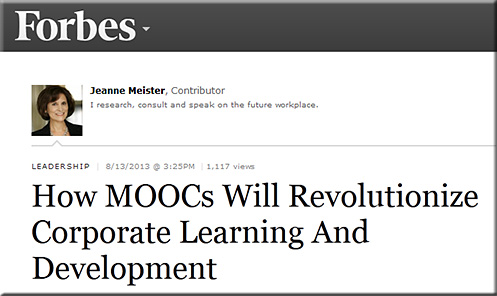
MOOCsRevCorpLandD-Forbes-Meister-Aug2013

 .

Excerpt (emphasis DSC):

To fix its problem, McAfee turned to a concept sweeping the education scene: Massive Open Online Courses, or MOOCs. By using a tenet of MOOCs called “flipping the classroom,” which means that the majority of learning happens not with a professor lecturing the students but by giving students access to course materials and having them probe, discuss, and debate issues with fellow learners as well as the professor. With that change, McAfee turned its training around in a way that both saved both time and produced more lucrative sales: its sales associates now attribute an average of $500,000 per year in sales to the skills they learned through the new training model.

But as MOOCs storm the academic world, the public discussion of their impact is ignoring what could become their most valuable application. Far from being limited to higher education reform, the new learning style’s most important legacy could be its impact on the world of corporate training – which is a $150 billion industry.


The $4 million teacher — from online.wsj.com by Amanda Ripley
South Korea’s students rank among the best in the world, and its top teachers can make a fortune. Can the U.S. learn from this academic superpower?

Excerpt:

[image]
SeongJoon Cho for The Wall Street Journal
Kim Ki-Hoon, who teaches in a private after-school academy,
earns most of his money from students who watch his lectures online.
‘The harder I work, the more I make,’ he says. ‘I like that.’

.

Kim Ki-hoon earns $4 million a year in South Korea, where he is known as a rock-star teacher—a combination of words not typically heard in the rest of the world. Mr. Kim has been teaching for over 20 years, all of them in the country’s private, after-school tutoring academies, known as hagwons. Unlike most teachers across the globe, he is paid according to the demand for his skills—and he is in high demand.


The $4 million teacher — from the Wall Street Journal by Amanda Ripley
South Korea’s students rank among the best in the world, and its top teachers can make a fortune. Can the U.S. learn from this academic superpower?

Excerpt (emphasis DSC):

Kim Ki-hoon earns $4 million a year in South Korea, where he is known as a rock-star teacher—a combination of words not typically heard in the rest of the world. Mr. Kim has been teaching for over 20 years, all of them in the country’s private, after-school tutoring academies, known as hagwons. Unlike most teachers across the globe, he is paid according to the demand for his skills—and he is in high demand.

Mr. Kim works about 60 hours a week teaching English, although he spends only three of those hours giving lectures. His classes are recorded on video, and the Internet has turned them into commodities, available for purchase online at the rate of $4 an hour. He spends most of his week responding to students’ online requests for help, developing lesson plans and writing accompanying textbooks and workbooks (some 200 to date).

“The harder I work, the more I make,” he says matter of factly. “I like that.”


How not to mint more engineers — from linkedin.com by Lynda Weinman

Excerpts (emphasis DSC):

Let’s tackle the economics of the situation head on — and not based on theory, but on experience. When lynda.com opened in 1997, it was a physical school that taught web design. We charged $1,500 per person for a single week of instruction. In those days, the world economy was robust and people came from every continent to study with us, enabling our business to grow and thrive. It was a heady time—until 2001, when the dotcom bubble burst and people and companies lost their budgets.

It was scary to witness the sudden demise of a business model that had worked so incredibly well up until then. In response, we could have simply raised our prices, and targeted a much smaller, more elite audience, hoping to keep our doors open. Instead, we did something crazy. We closed our eyes and leapt into something that was, at that time, unproven: We put our lessons online in video format for $25 per month.

While it took a few years to make as much money as the school did, it eventually far surpassed the earning power of the brick and mortar we started with. Instead of serving 80 people or so a week at our physical school, we started serving thousands in the virtual world, and today that number is in the millions every year.

The solution? Take the teachers who are experts and thought leaders and memorialize their lectures and materials via videos and other rich media to share those ideas broadly. Pay them royalties for this, the same as if they published a popular textbook. Leverage in-person class time for projects, collaborations, discussions, reviews, and presentations—the types of activities that are better experienced in person than online.


The New Storytelling Frontier — from huffingtonpost.ca by Katherine Brodsky

Excerpts (emphasis DSC):

Long gone are the days of static content. Consumers are looking for more and transmedia storytelling offers an increasingly popular approach for creating property-based universes. Transmedia content itself is also evolving. It’s becoming more dynamic, more interactive, offering greater opportunities to engage audiences with creative user-generated content that adds to the storytelling experience. It is becoming more communal.

Although traditional models allow for greater control of content, strategies that can engage fans more actively and allow them to express themselves and even contribute to the development of a show, get them more involved and, ultimately, more willing to buy in.


From DSC:
As the use of storytelling is a powerful tool for learning, I can’t help but wonder…

  • What might be some creative possibilities arising from the developing world of transmedia that students and/or educational organizations could develop?
  • In what ways could we build more interactivity and social networking into our “digital textbooks” and mobile-based applications?
  • Would transmedia-based content help maintain interest, engagement, attention?
  • Would it help establish longer term memories/recall?
  • How might it help build students creativity and foster more experimentation/play/participation?
  • What roles might students play? (Writer, videographer, sound designer, actress, programmer, game designer, project manager, entrepreneur, etc.)
  • What tools and skills would students need to create their own transmedia-based experiences?
  • What new forms of storytelling might evolve from these efforts?
  • Could transmedia work its way into blended learning models?
  • Are new opportunities for immersing oneself in a particular subject matter becoming more available through transmedia-based experiences?
  • Could streams of content be wrapped in transmedia-based experiences?


BII REPORT: Here’s why the “second screen” industry is set to explode — BusinessInsider.com

BII REPORT: Here’s why the “second screen” industry is set to explode — BusinessInsider.com

Excerpt:

Here’s why the second screen industry will ultimately succeed:

  • Usage is growing rapidly
  • And mass acceptance isn’t even necessary
  • Second screen isn’t really a new activity
  • Second screen apps and sites are bridges


From DSC:
As this article alludes to, I wouldn’t rule the living room out in terms of where interactive, multimedia-based, educationally-related, second screen-based applications will turn up (apps backed up by data mining, AI, and opportunities for social learning). This area is poised for some serious growth. 


The Living [Class] Room -- by Daniel Christian -- July 2012 -- a second device used in conjunction with a Smart/Connected TV


Key questions you should ask before you flip your class — from Flipped Learning by jbergmann

Excerpt:

I am preparing to do a workshop with Icelandic Educators this week and I was asked to give them a list of questions to consider as they begin to flip their classes.  As I wrote these I realized that many people could benefit from these questions.  It is no doubt an incomplete list.  If you have more questions that I should include, please comment and I will add them.

Case study: Flipped classrooms work for students. Period. — from knowledgestarblog.wordpress.com by David Grebow and Greg Green, principal at Clintondale High School in Clinton Township, Michigan.

Excerpt (emphasis DSC):

I’m a principal at Clintondale High, a financially challenged school near Detroit. I’m in charge of doing my best to make sure that Clintondale students get the best education possible when they walk through our doors.

There are constant hurdles to making this happen. We are a school of choice, so not all students come in with the same skill levels in reading, math, science or other subjects. Almost 75% of our students receive free or reduced-price lunch because of today’s economic climate, and a large part of our student population commutes from Detroit, which often times takes an hour or longer, especially if the bus is late.

Every year, our failure rates have been through the roof.  The students weren’t paying attention, they weren’t doing their homework, they were being disruptive, or they weren’t coming to school at all. Sadly, these issues are not that uncommon, particularly in this economic climate, where the percentage of students who fall into the poverty category is increasing by the day.

To watch this happen every day, where it is your responsibility to try to provide the very best you can for the students, is beyond frustrating. It’s heartbreaking.

Our staff agreed that our failure rates were not good. But how do you go about addressing these issues with no money, no additional resources and no clear solution from the experts who already know the system is broken?

How do you get your staff on board with change you want to implement, but no one else has ever tried it on a mass scale? How do you get your students excited about learning when they’ve never shown much interest before?

You flip it. Here’s how it works…


From DSC:


Thanks Techsmith for helping out here. You demonstrated that there can be a higher calling for business — helping out our fellow mankind with tangible/concrete/immediate assistance.


Back from March 2012:
Flipped learning: A response to five common criticisms — from November Learning by Alan November & Brian Mull


Also see:


http://novemberlearning.com/resources/

Flipped Learning #26: The Power of the Transformation with Jon Bergmann — from edreach.us by Troy Cockrum

Excerpt/description:

Troy has Flipped Learning pioneer Jon Bergmann on the final podcast of this calender year.   The two discuss Jon’s book “Flip Your Classroom”, as well as his upcoming book, the differences between Flipped Classroom and Flipped Learning, flipping a class vs. flipping a lesson, the powerful transformations teachers are making, FlipCon13, and more.

You can also catch up on a lot of resources from the Flipped Learning Network by going to www.flippedlearning.org.

SmartBoard, make way for Educreations — from blogs.kqed.org by Katrina Schwartz

Excerpt:

One of the biggest, fastest shifts in ed tech the last couple years has been the evolution from the use of large interactive whiteboards to the use of mobile, agile multi-purpose apps. Currently, there are at least six products, all competing to become teachers’ favorite. Replay Note, ScreenChomp, ShowMe, DoodleCast Pro, Knowmia, Explain Everything and Educreations all offer teachers the ability to record the visual and audio components of a “whiteboard” lesson on their iPads, and share it online.

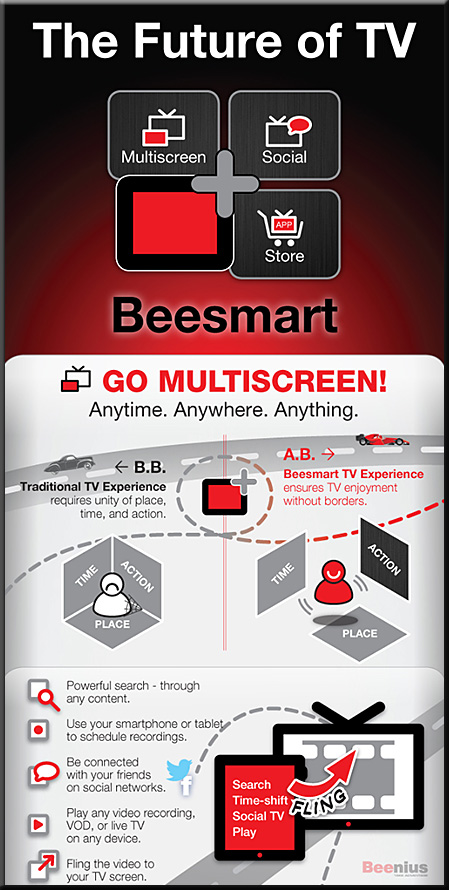
The Future of TV -- an infographic from Beesmart


From DSC:
The educational “store” part of this graphic could take several forms:

  • Online-based exchanges between buyers and sellers (teachers/professors and learners) — professors as their own brand
  • Institutional offerings/brands
  • Team-based content from newly-developed firms, organizations
  • Each of us puts up our own learning materials for others to take (for free or for a price)
  • Other


© 2025 | Daniel Christian