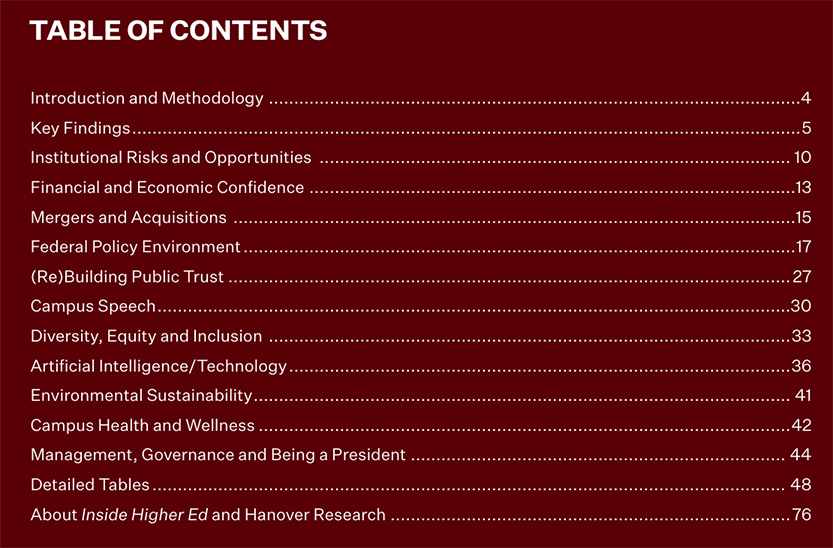
2026 Survey of College and University Presidents — from insidehighered.com, Liaison, & Jenzabar Download and explore exclusive insights from the 2026 Survey of College and University Presidents to see how these campus leaders are responding to financial volatility, political interference, rapid advances in AI, and where they believe the biggest risks and opportunities lie as they look toward 2030.
In this year’s survey, presidents share perspectives on:
How presidents assess the second Trump administration’s impact on higher education
Which emerging or evolving educational models they plan to add or expand in the coming years
How effective they believe higher education has been in shaping national conversations arout AI
The issues presidents expect will have the greatest impact on higher education by 2030
There used to be a time when starting a job meant being a little lost. You sat in on meetings you didn’t run. You watched someone else handle the difficult client, draft the tricky email, navigate the room when the room shifted. You made your first draft of something, and someone returned it bleeding red ink. And somehow — through the mess and the margin notes — you learned.
That time is vanishing.
In just the first seven months of 2025, generative AI adoption was linked to thousands of job cuts. But the headline number misses the quieter, more consequential story: it’s not just fewer jobs. It’s the disappearance of the work that teaches you how to work.
So here’s the uncomfortable question: if genAI is absorbing the entry-level doing, where does that formation happen now?
We have to answer that. Not theoretically. Practically. Because the ladder hasn’t disappeared — but we’ve removed the bottom rungs. And no employer is going to drop a newly minted graduate into a mid-career role and hope they figure it out.
For years, “ed tech” was an umbrella term grouping schools, online platforms, courses, credentials, and software under one idea: technology applied to education. That shorthand made it easier for investors, policymakers, and institutions to talk about innovation without rethinking how learning fits into the economy. Today, it no longer explains what’s happening.
That’s the central insight of “The European Learning & Work Funding Report” by Brighteye Ventures, a research and advisory firm tracking investment at the intersection of learning, work, and productivity. The report’s seventh edition shows that learning is no longer funded primarily as education. It is increasingly funded as part of how work gets done.
Across Europe, and increasingly the U.S., capital is flowing not toward courses or credentials but toward systems that are closer to production, including hiring platforms, staffing firms, clinical decision tools, payroll systems, and compliance software. These are not educational products, though learning is embedded throughout them.
In these systems, learning is not the point. Outcomes are.
Build hybrid institutions that erase boundaries. Stop forcing learners to navigate disconnected systems. Create partnerships that blend K-12 schools, community colleges, training providers, and employers into one integrated system, so students move through one coherent system, not four separate bureaucracies.
Something Big Is Happening— from shumer.dev by Matt Shumer; see below from the BIG Questions Institute, where I got this article from
I’ve spent six years building an AI startup and investing in the space. I live in this world. And I’m writing this for the people in my life who don’t… my family, my friends, the people I care about who keep asking me “so what’s the deal with AI?” and getting an answer that doesn’t do justice to what’s actually happening. I keep giving them the polite version. The cocktail-party version. Because the honest version sounds like I’ve lost my mind. And for a while, I told myself that was a good enough reason to keep what’s truly happening to myself. But the gap between what I’ve been saying and what is actually happening has gotten far too big. The people I care about deserve to hear what is coming, even if it sounds crazy.
…
They’ve now done it. And they’re moving on to everything else.
The experience that tech workers have had over the past year, of watching AI go from “helpful tool” to “does my job better than I do”, is the experience everyone else is about to have. Law, finance, medicine, accounting, consulting, writing, design, analysis, customer service.Not in ten years. The people building these systems say one to five years. Some say less. And given what I’ve seen in just the last couple of months, I think “less” is more likely.
…
The models available today are unrecognizable from what existed even six months ago. The debate about whether AI is “really getting better” or “hitting a wall” — which has been going on for over a year — is over. It’s done. Anyone still making that argument either hasn’t used the current models, has an incentive to downplay what’s happening, or is evaluating based on an experience from 2024 that is no longer relevant. I don’t say that to be dismissive. I say it because the gap between public perception and current reality is now enormous, and that gap is dangerous… because it’s preventing people from preparing.
What “Something Big Is Happening” Means for Schools — from/by the BIG Questions Institute
Matt Shumer’s newsletter post Something Big is Happening has been read over 80 million times within the week when it was published, on February 9.
…
Still, it’s worth reading Shumer’s post. Given the claims and warnings in Something Big Is Happening (and countless other articles), how would you truly, honestly respond to these questions:
What will the purpose of school be in 5 years?
What are we doing now that we must leave behind right away?
What can we leave behind gradually?
What does rigor look like in this AI-powered world?
Does our strategy look like making adjustments at the margins or are we preparing our students for a fundamental shift?
What is our definition of success? How do the the implications of AI and jobs (and other important forces, from geopolitical shifts and climate change, to mental health needs and shifting generational values) impact the outcomes we prioritize? What is the story of success we want to pass on to our students and wider community?
Ten years ago, we made a bet on relationships over replication. Instead of franchising a model, we chose to build an ecosystem—the CAPS Network—grounded in the belief that an entrepreneurial approach would create ripples of innovation with exponential scaling power. We believed that by harnessing the power of relationships for good, we could help more students discover who they are and where they belong in the world.
Today, with over 1,200 alumni voices captured in our 2025 Alumni Impact Study, we’re seeing those ripples turn into waves. And we believe these waves can and will be surfed by educators all across the globe. We are committed to the idea that our purpose (providing more students in more places the time and space for self-discovery) is more important than our brand. As such, we want our learnings to be leveraged by anyone and everyone to make a positive impact.
Confidence, Engagement, and Loveexplores the data we rarely track but desperately need. This piece argues that alumni confidence, sustained engagement, and a sense of being loved by their school communities are leading indicators of long-term success. It challenges K–12 systems to look beyond test scores and graduation rates and instead ask what happens after students leave, who stays connected, and how belonging shapes opportunity. The result is a call to rethink accountability around relationships, not just results.
Jim VandeHei’s note to his kids: Blunt AI talk — from axios.com by CEO Jim VandeHei Axios CEO Jim VandeHei wrote this note to his wife, Autumn, and their three kids. She suggested sharing it more broadly since so many families are wrestling with how to think and talk about AI. So here it is …
Dear Family: I want to put to words what I’m hearing, seeing, thinking and writing about AI.
Simply put, I’m now certain it will upend your work and life in ways more profound than the internet or possibly electricity. This will hit in months, not years.
The changes will be fast, wide, radical, disorienting and scary. No one will avoid its reach.
I’m not trying to frighten you. And I know your opinions range from wonderment to worry. That’s natural and OK. Our species isn’t wired for change of this speed or scale.
My conversations with the CEOs and builders of these LLMs, as well as my own deep experimentation with AI, have shaken and stirred me in ways I never imagined.
All of you must figure out how to master AI for any specific job or internship you hold or take. You’d be jeopardizing your future careers by not figuring out how to use AI to amplify and improve your work. You’d be wise to replace social media scrolling with LLM testing.
What if the biggest change in education isn’t a new app… but the end of the university monopoly on credibility?
Jensen Huang has framed AI as a platform shift—an industrial revolution that turns intelligence into infrastructure. And when intelligence becomes cheap, personal, and always available, education stops being a place you go… and becomes a system that follows you. The question isn’t whether universities will disappear. The question is whether the old model—high cost, slow updates, one-size-fits-all—can survive a world where every student can have a private tutor, a lab partner, and a curriculum designer on demand.
This video explores what AI has in store for education—and why traditional universities may need to reinvent themselves fast.
In this video you’ll discover:
How AI tutors could deliver personalized learning at scale
Why credentials may shift from “degrees” to proof-of-skill portfolios
What happens when the “middle” of studying becomes automated
How universities could evolve: research hubs, networks, and high-trust credentialing
The risks: cheating, dependency, bias, and widening inequality
The 3 skills that become priceless when information is everywhere: judgment, curiosity, and responsibility
From DSC:
There appears to be another, similar video, but with a different date and length of the video. So I’m including this other recording as well here:
What if universities don’t “disappear”… but lose their monopoly on learning, credentials, and opportunity?
AI is turning education into something radically different: personal, instant, adaptive, and always available. When every student can have a 24/7 tutor, a writing coach, a coding partner, and a study plan designed specifically for them, the old model—one professor, one curriculum, one pace for everyone—starts to look outdated. And the biggest disruption isn’t the classroom. It’s the credential. Because in an AI world, proof of skill can become more valuable than a piece of paper.
This video explores the end of universities as we know them: what AI is bringing, what will break, what will survive, and what replaces the traditional path.
In this video you’ll discover:
Why AI tutoring could outperform one-size-fits-all lectures
How “degrees” may shift into skill proof: portfolios, projects, and verified competency
What happens when the “middle” of studying becomes automated
How universities may evolve: research hubs, networks, high-trust credentialing
The dark side: cheating, dependency, inequality, and biased evaluation
The new advantage: judgment, creativity, and responsibility in a world of instant answers
There were 15% fewer entry-level and internship job postings in 2025 than the year before, according to Handshake, a job-search platform popular with college students; meanwhile, applications per posting rose 26%.
How much AI is to blame for the fragile entry-level job market is unclear. Several research studies show AI is hitting young college-educated workers disproportionately, but broader economic forces are part of the story, too.
As Christine Y. Cruzvergara, Handshake’s chief education strategy officer, told me, AI isn’t “taking” jobs so much as employers are “choosing” to replace parts of jobs with automation rather than redesign roles around workers. “They’re replacing people instead of enabling their workforce,” she said.
Today’s graduates are stuck in an in-between moment. Many started college before AI mattered and graduated into a labor market reshaped almost overnight, where entry-level roles are disappearing faster than students can adapt.
What 3 credit ratings agencies forecast for higher ed in 2026 — from highereddive.com by Ben Unglesbee Fitch Ratings, S&P Global and Moody’s Ratings all predicted a tough year ahead, pointing to deteriorating financial conditions and heightened uncertainty.
Fitch Ratings labeled its higher ed financial outlook for 2026 as “deteriorating” while Moody’s Ratings described an “increasingly difficult and shifting operating environment for colleges and universities.” Similarly, S&P Global Ratings said it expects“mounting operating pressures and uncertainty” ahead for the sector’s nonprofit institutions.
Analysts cited additional disruption and belt-tightening ahead in the new year, from predicted demographic declines to pressures on international enrollment to uncertainties about how Republicans’ big spending bill passed this summer will impact demand for college.
Below are the various takes on higher ed in 2026 by Moody’s, Fitch and S&P Global Ratings:
25 Big Ideas that will define 2026— from linkedin.com by LinkedIn News This year’s predictions capture a world in flux, where technology and humanity will press closer than ever, fueling new opportunities and tensions.
Blockchain: Blockchain technology will create new ways for creators to keep more of their revenue by enabling them to host their own content, bypassing traditional social media platforms that take a cut of their earnings.
3.AI: Artificial intelligence will enhance creators’ ability to scale their personal brands exponentially — producing more content, creating virtual influencers and expanding reach in ways we’ve never seen.
…
Laws around artificial intelligence in mental health care are set to change dramatically in 2026, in the wake of lawsuits alleging harm or “psychosis” linked to AI tools. After years of rapid adoption — and little oversight — regulators will move to treat therapy chatbots more like medical devices than lifestyle apps.
…
Small businesses — which make up 90% of companies globally — will be the top destination for young jobseekers in 2026.
…
Generative engine optimization (GEO) is set to replace search engine optimization (SEO) as the way brands get discovered in the year ahead. As consumers turn to AI chatbots, agentic workflows and answer engines, appearing prominently in generative outputs will matter more than ranking in search engines.
Highly Complementary Capabilities Will Create a Leading Technology Platform, Redefining Skills Discovery, Development, and Mastery for Learners and Organizations at Scale
Unites Udemy’s Dynamic AI-Powered Skills Development Marketplace with World-Class University and Industry Brands Under the Coursera Ecosystem, Expanding Value, Impact, and Choice Globally
Strengthens Combined Company’s Financial Profile with Pro Forma Annual Revenue of More Than $1.5 Billion and Anticipated Annual Run-Rate Cost Synergies of $115 Million Within 24 Months
“We’re at a pivotal moment in which AI is rapidly redefining the skills required for every job across every industry. Organizations and individuals around the world need a platform that is as agile as the new and emerging skills learners must master,” said Greg Hart, CEO of Coursera. “By combining the highly complementary strengths of Coursera and Udemy, we will be in an even stronger position to address the global talent transformation opportunity, unlock a faster pace of innovation, and deliver valuable experiences and outcomes for our learners and customers. Together, we will ensure our millions of learners, thousands of enterprise, university, and government customers, and expert instructors have a platform to keep pace with technology acceleration.”