Following up on yesterday’s posting, History Channel bringing online courses to higher ed, I wanted to thank Mr. Rob Kingyens, President at Qubed Education, for alerting me to some related work that Qubed Education is doing. Below is an example of that work:

The University of Southern California, Condé Nast and WIRED launch Master of Integrated Design, Business and Technology — from qubededucation.com
New Learning Model Combines Network and Access of WIRED with Academic Strength and Vision of the USC Roski School of Art and Design

Excerpt (emphasis DSC):

MARIN, Calif., October 1, 2014 – The University of Southern California, Condé Nast and WIRED today announced a partnership to create a new online Master’s degree in Integrated Design, Business and Technology. The partnership creates an unprecedented learning experience, combining the expertise of the editors, writers, and designers at WIRED with the academic rigor of USC, a leading research university known for its pioneering interdisciplinary programs. The aim of the 18-24 month degree is to educate creative thinkers and technologists to better equip them to transform the world of industry and enterprise. The first cohort is scheduled to begin in the 2015-2016 academic year.

…

“The pace of technology development requires higher education to continue to respond with programs that are flexible and adaptable, and that meet the needs of future cultural and business leaders,” said Dean Muhl.

“We’ve been thinking for years about what a university curriculum with WIRED would look like, and now we have a chance to build it with a terrific partner,” said Dadich. “Taking the best from USC and WIRED, we can teach discipline and disruption, business fundamentals, and the very latest innovation models from Silicon Valley. This is going to be thrilling.”

…

USC’s program development and build out will be powered by higher education partners Synergis Education and Qubed Education.


From Qubed’s website:

Qubed is the gateway for world-class, global brands to enter the education market with top tier universities.


From DSC:
I’ve long wondered if institutions of higher education will need to pool resources and/or form more partnerships and collaborations — either with other universities/colleges or with organizations outside of higher education. This reflection grows stronger for me when I:

  • Think that team-based content creation and delivery is pulling ahead of the pack
  • Hear about the financial situations of many institutions of higher education today (example1; example2)
  • See the momentum building up behind Competency Based Education (CBE)
  • Witness the growth of alternatives like Ideo Futures, Yieldr Academy, Lessons Go Where, ClassDo, Udemy, C-Suite TV.com and others
  • Hear about the potential advantages of learning analytics
  • See the pace of change accelerating — challenging higher education to keep up

For some institution(s) of higher education out there with deep pockets and a strong reputation, I could see them partnering up with an IBM (Watson), Google (Deepmind), Apple (Siri), Amazon (Echo), or Microsoft (Cortana) to create some next generation learning platforms. In fact, this is one of the areas I see occurring as lifelong learning/self-directed learning opportunities hit our living rooms. The underlying technologies these companies are working on could be powerful allies in the way people learn in the future — doing some heavy lifting to build the foundations in a variety of disciplines, and leaving the higher-order learning and the addressing of gaps to professors, teachers, trainers, and others.
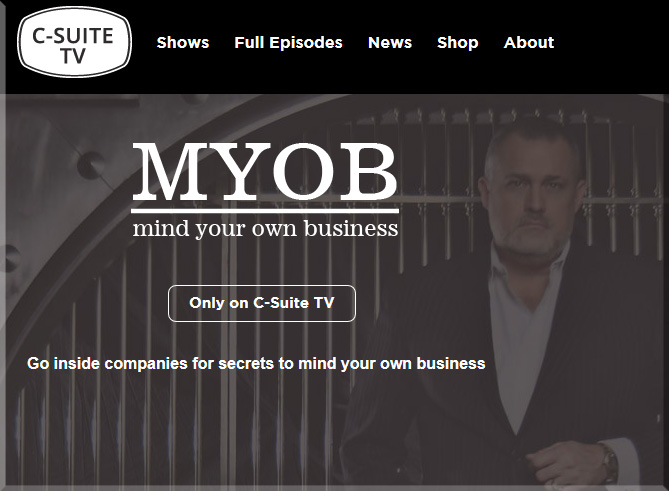


Reflections on “C-Suite TV debuts, offers advice for the boardroom” [Dreier]

C-Suite TV debuts, offers advice for the boardroom — from streamingmedia.com by Troy Dreier
Business leaders now have an on-demand video network to call their own, thanks to one Bloomberg host’s online venture.

Excerpt:

Bringing some business acumen to the world of online video, C-Suite TV is launching today. Created by Bloomberg TV host and author Jeffrey Hayzlett, the on-demand video network offers interviews with and shows about business execs. It promises inside information on business trends and the discussions taking place in the biggest boardrooms.


MYOB-July2014


The Future of TV is here for the C-Suite — from hayzlett.com by Jeffrey Hayzlett

Excerpt:

Rather than wait for networks or try and gain traction through the thousands of cat videos, we went out and built our own network.


See also:

  • Mind your own business
    From the About page:
    C-Suite TV is a web-based digital on-demand business channel featuring interviews and shows with business executives, thought leaders, authors and celebrities providing news and information for business leaders. C-Suite TV is your go-to resource to find out the inside track on trends and discussions taking place in businesses today. This online channel will be home to such shows as C-Suite with Jeffrey Hayzlett, MYOB – Mind Your Own Business and Bestseller TV with more shows to come.


From DSC:
The above items took me back to the concept of Learning from the Living [Class] Room.

Many of the following bullet points are already happening — but what I’m trying to influence/suggest is to bring all of them together in a powerful, global, 24 x 7 x 365, learning ecosystem:

  • When our “TVs” become more interactive…
  • When our mobile devices act as second screens and when second screen-based apps are numerous…
  • When discussion boards, forums, social media, assignments, assessments, and videoconferencing capabilities are embedded into our Smart/Connected TVs and are also available via our mobile devices…
  • When education is available 24 x 7 x 365…
  • When even the C-Suite taps into such platforms…
  • When education and entertainment are co-mingled…
  • When team-based educational content creation and delivery are mainstream…
  • When self-selecting Communities of Practice thrive online…
  • When Learning Hubs combine the best of both worlds (online and face-to-face)…
  • When Artificial Intelligence, powerful cognitive computing capabilities (i.e., IBM’s Watson), and robust reporting mechanisms are integrated into the backends…
  • When lifelong learners have their own cloud-based profiles…
  • When learners can use their “TVs” to tap into interactive, multimedia-based streams of content of their choice…
  • When recommendation engines are offered not just at Netflix but also at educationally-oriented sites…
  • When online tutoring and intelligent tutoring really take off…

…then I’d say we’ll have a powerful, engaging, responsive, global education platform.


The Living [Class] Room -- by Daniel Christian -- July 2012 -- a second device used in conjunction with a Smart/Connected TV


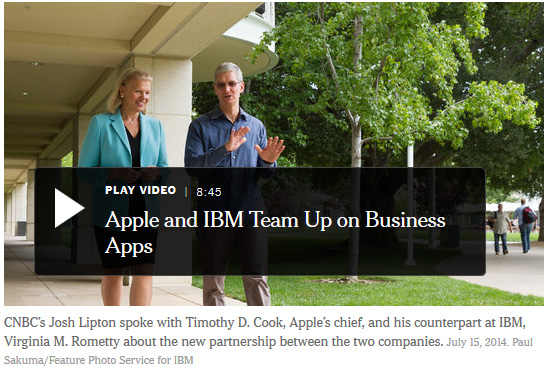
Apple joins with IBM on business software — from nytimes.com by Brian Chen and Steve Lohrjuly


AppleIBM-Partnership-July2014

Excerpt:

In a deal that could deepen Apple’s sales to corporations and strengthen IBM’s position in business software, the two companies announced a wide-ranging partnership intended to spread advanced mobile and data analysis technology in the corporate world.

IBM and Apple have been working together on the venture for several months, and they are jointly working on more than 100 business software programs developed exclusively for Apple’s iOS operating system and for use on iPhones and iPads. The applications will be tailored for use in industries including retail, health care, transportation, banking, insurance and telecommunications.


Apple and IBM forge global partnership to transform enterprise mobility — from apple.com

Excerpt:

CUPERTINO, California and ARMONK, New York—July 15, 2014—Apple® and IBM (NYSE: IBM) today announced an exclusive partnership that teams the market-leading strengths of each company to transform enterprise mobility through a new class of business apps—bringing IBM’s big data and analytics capabilities to iPhone® and iPad®.

The landmark partnership aims to redefine the way work will get done, address key industry mobility challenges and spark true mobile-led business change—grounded in four core capabilities…


The next level of enterprise mobility: where data meets engagement — from IBM.com


AppleIBM-Partnership-ICONS-July2014


Breaking down the Apple – IBM Announcement for our Ecosystem and Developers! — from socialbusinesssandy.com by Sandy Carter

Excerpt:

What did we announce? An exclusive partnership that teams the market-leading strengths of each company to transform enterprise mobility through a new class of business apps—bringing IBM’s big data and analytics capabilities to iPhone® and iPad®.


Apple-IBM: Infographic of announcements! — from socialbusinesssandy.com by Sandy Carter


Why the Apple-IBM deal matters more to banking than you might think — from by JJ Hornblass


Apple teams up with IBM for huge, expansive enterprise push — from techcrunch.com by Darrell Etherington


From DSC:
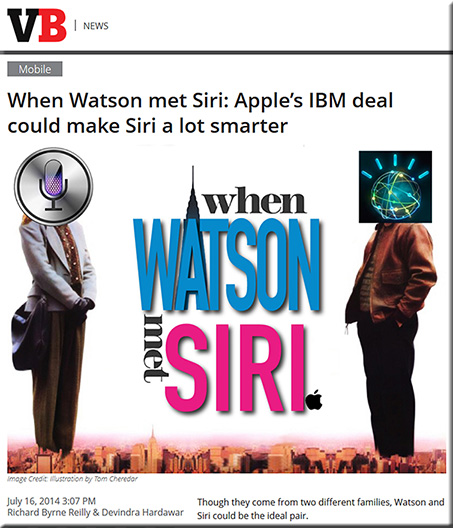
It would be very interesting times, indeed, if Watson merged with Siri! Here’s a posting to that effect:


WhenWatsonMetSiri-July2014


When Watson met Siri: Apple’s IBM deal could make Siri a lot smarter — from venturebeat.com by Richard Byrne Reilly & Devindra Hardawar

Excerpt:

One of the long-term results of Apple’s new partnership with IBM — which the two announced yesterday as a joint effort to give both a stronger standing in the mobile enterprise — could be an eventual union between Watson and Siri, a “cognitive” technology expert familiar with both tells VentureBeat.


—————–

Addendums:

Educating the ‘big data’ generation — from by Katherine Noyes
Classes—and even degree programs—focused on data analytics are cropping up all over the U.S. Behind them? Tech’s largest companies.

Report: Cognizant computing will have ‘immense’ impact on mobile computing — from by Joshua Bolkan

Excerpt:

Gartner has unveiled a new report forecasting that cognizant computing, which the company says is the next phase of the personal cloud movement, “will become one of the strongest forces in consumer-focused IT” in the next few years to “have an immense impact across a range of industries, including mobile devices, mobile apps, wearables, networking, services and cloud providers.”

…

With data analytics as its backbone, cognizant computing uses simple rules and data associated with an individual to create services and activities delivered across multiple devices. Examples include alarms, payments, health and fitness monitoring and management and context-specific advertisements.

—————–


The Internet of Things will radically change your Big Data strategy — from forbes.com by Mike Kavis

Excerpt (emphasis DSC):

Companies are jumping on the Internet of Things (IoT) bandwagon and for good reasons. McKinsey Global Institute reports that the IoT business will deliver $6.2 trillion of revenue by 2025. Many people wonder if companies are ready for this explosion of data generated for IoT. As with any new technology, security is always the first point of resistance. I agree that IoT brings a wave of new security concerns but the bigger concern is how woefully unprepared most data centers are for the massive amount of data coming from all of the “things” in the near future.

Some companies are still hanging on to the belief that they can manage their own data centers better than the various cloud providers out there. This state of denial should all but go away when the influx of petabyte scale data becomes a reality for enterprises. Enterprises are going to have to ask themselves, “Do we want to be in the infrastructure business?” because that is what it will take to provide the appropriate amount of bandwidth, disk storage, and compute power to keep up with the demand for data ingestion, storage, and real-time analytics that will serve the business needs. If there ever was a use case for the cloud, the IoT and Big Data is it.

…

Even if enterprises manage to make it past the data ingestion phase, the data storage phase presents another set of challenges. In this area, companies must learn new technologies like Hadoop, Map Reduce, etc. and be able to provision enough disk, network, and compute capacity to keep up with the influx of new data. There is a major skills shortage in the area which creates a serious challenge in the do-it-yourself (DIY) model.

…

In the DIY model, engineers need to acquire a broad range of skills in order to work with the underlying technologies.


From DSC:
The above item made be wonder:

  • What are institutions of higher education doing to equip our students with the skills needed to be effective working with the Internet of Things (IoT)? With Big Data?
  • Are we able to be responsive to these needs? If not, what changes do we need to make to be more responsive to market needs?


IBM’s Watson is ready to see you now — in your dermatologist’s office — from fastcompany.com by Neal Ungerleider
Among other new applications for its cognitive-computing platform, the company announced [on May 16th] that it’s licensing Watson as a diagnostic tool for dermatologists.


Reigniting the economy with computational thinking — from robotenomics.com b

Excerpt:

For those that want to improve their ability to understand and respond to the changing nature of technology, Computational Thinking can be a powerful way to bridge the gap between the problems of big data, robotics, artificial intelligence and cognitive assistants and improve practical decision making.


Deep learning’s role in the age of robots — from innovationinsights.wired.com by Julian Green

Excerpt:

Let’s examine the state of artificial intelligence through the lens of deep learning and see how we’re doing and whether we’re close to Skynet.


Seven of the nation’s leading technology institutions unveil cognitive computing courses leveraging IBM Watson — from IBM.com
In Fall, 2014, new courses will inspire university students to build apps infused with Watson’s intelligence while gaining the entrepreneurial vision to deliver their innovations into the marketplace. Announcement marks the newest step in IBM’s strategy to fuel an ecosystem of innovators who will make cognitive computing the new worldwide standard of computing.

Excerpt:

ARMONK, N.Y. – 07 May 2014: IBM (NYSE: IBM) is partnering with the country’s leading technology universities to launch cognitive computing courses that give students unprecedented access via the cloud to one of the Company’s most prized innovations: Watson.

For the first time, enrollment is now open for fall 2014 cognitive computing courses at Carnegie Mellon University, New York University (NYU), The Ohio State University, Rensselaer Polytechnic Institute (RPI), University of California, Berkeley, University of Michigan and the University of Texas in Austin.

Co-designed by the Watson Group and leading academic experts in fields such as Artificial Intelligence and Computer Science, the courses will empower students with the technical knowledge and hands-on learning required to develop new cognitive computing applications fueled by Watson’s intelligence.


IBM partners with universities on Watson projects — from abcnews.go.com by Bree Fowler

Excerpt:

Watson is going to college.

Students at seven of the country’s top computer science universities will get a chance to try out IBM’s famous cognitive computing system as part of new classes set for next fall.

The partnership between Armonk, New York-based IBM and the universities, which was set to be announced Wednesday, will let students use the “Jeopardy!” champion to develop new cognitive computing applications for a variety of industries ranging from health care to finance.

“If they’re interested in these kinds of technologies, when they graduate they’re going to have a natural proclivity to designing them,” says Michael Rhodin, IBM’s senior vice president overseeing Watson.

“The logic here is that the next generation of entrepreneurs is in universities today.”


When is Big Learning Data too Big? — from Learning TRENDS by Elliott Masie 

Excerpt from Update #822:

1) An interesting question arose in our conversations about Big Learning Data:

When is Big Learning Data too Big?
The question is framed around the ability of an individual or an organization to process really large amounts of data. Can a learning designer or even a learner, “handle” really large amounts of data? When is someone (or even an organization) handicapped by the size, scope and variety of data that is available to reflect learning patterns and outcomes? When do we want a tight summary vs. when we want to see a scattergram of many data points?

As we grow the size, volume and variety of Big Learning Data elements – we will also need to respect the ability (or challenge) of people to process the data. A parent may hear that their kid is a B- in mathematics – and want a lot more data. But, the same parent does not want 1,000 data elements covering 500 sub-competencies. The goal is to find a way to reflect Big Learning Data to an individual in a fashion that enables them to make better sense of the process – and have a “Continuum” that they can move to get more or less data as a situational choice.


Also related, an excerpt from Three Archetypes of the Future Post-Secondary Instructor — from evoLLLution.com by Chris Proulx

The Course Hacker
The last and perhaps most speculative role of the future online instructor will be the person who digs deep into the data that will be available from next generation learning systems to target specific learning interventions to specific students — at scale. The idea of the Course Hacker is based on the emerging role of the Growth Hacker at high-growth web businesses. Mining data from web traffic, social media, email campaigns, etc., the Growth Hacker is constantly iterating a web product or marketing campaign to seek rapid growth in users or revenue. Adapted to online education, the Course Hacker would be a faculty member with strong technical and statistical skills who would study data about which course assets were being used and by whom, which students worked more quickly or slowly, which questions caused the most problems on a quiz, who were the most socially active students in the course, who were the lurkers but getting high marks, etc.  Armed with those deep insights, they would be continually adapting course content, providing support and remedial help to targeted students, creating incentives to motivate people past critical blocks in the course, etc.


Added later on:

What do the ethical models look like? How are these models deployed rapidly — at the speed of technology? How are these models refined with time? We distilled the group discussions into a series of topics, including student awareness (or lack of awareness) of analytics, future algorithmic science, and the future of learning analytics as defined by business practices, student and faculty access to the data, and a redefinition of failure.

The arguments put forward here often take the form of rhetorical questions; the methodological purpose in presenting the argument in this way is to frame how ethical questioning might guide future developments.


Time to retire from online learning? – by Tony Bates

Excerpts:

Teaching in higher education is about to go through as major a revolution as one can imagine. This is not going to be easy; indeed it could get brutal.
…
…this is not a profession where you can be half in and half out. Dabbling in online learning is very dangerous (politicians please note).
…
Lastly, I am concerned that the computer scientists seem to be taking over online education. Ivy League MOOCs are being driven mainly by computer scientists, not educators. Politicians are looking to computer science to automate learning in order to save money. Computer scientists have much to offer, but they need more humility and a greater willingness to work with other professionals, such as psychologists and teachers, who understand better how learning operates. This is a battle that has always existed in educational technology, but it’s one I fear the educators are losing. The result could be disastrous, but that’s a theme for a whole set of blog posts.


From DSC:
I am very grateful for Tony’s work!  He has helped many, many people develop their own learning ecosystems in a variety of ways throughout these last 45 years.  As I, too, am passionate about online learning, I have really appreciated Tony’s insights and writings about topics that related to online and distance learning.  I was glad to hear that Tony will continue to write in the future.


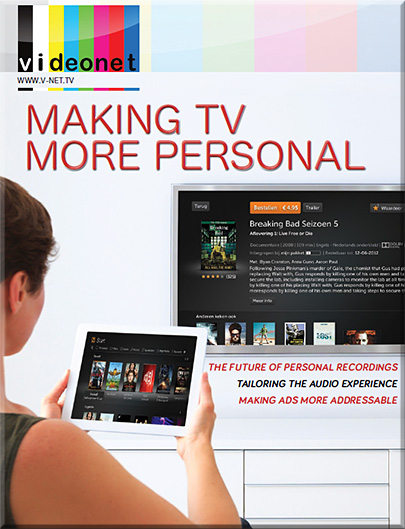
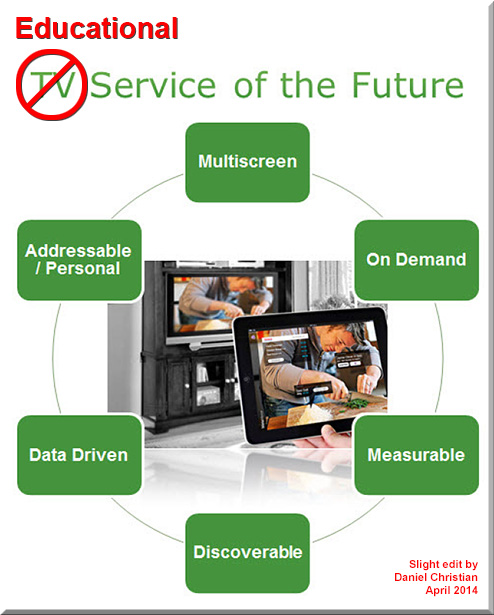
What educationally-related affordances might we enjoy from these TV-related developments?

MakingTVMorePersonal-V-NetTV-April2014


EducationServiceOfTheFutureApril2014


CONTENTS

  • Content discovery and synchronization
    With access to rich data about their subscribers and what they do, operators can improve recommendation, encourage social TV and exploit second screen synchronization.
  • Recordings get more personal
    One of the next big steps in multiscreen TV is giving people access to their personal recordings on every screen. This is the moment for nPVR to finally make its entrance.
  • Evolving the User Experience
    As service providers go beyond household level and address individuals, the role of log-ins or context will become important. There is a place for social TV and big data.
  • The role of audio in personalization
    Audio has a huge impact on how much we enjoy video services. Now it can help to personalize them. ‘Allegiance’ based audio choices are one possibility.
  • Making advertising more targeted
    Addressable advertising is in its infancy but has a bright future, helping to fund the growth of on-demand and multiscreen viewing.


Some excerpts from this report:

Good content should be matched by good content discovery , including recommendations. The current state-of -the-art is defined by Netflix.

…

Today’s TV experience is worlds apart from the one we were talking about even five years ago. We’ve witnessed exponential growth in services such as HD and have moved from a model in which one screen is watched by many, to many screens (and devices) being available to the individual viewer, what is today called TV Everywhere.  Having multiscreen access to content is driving the demand for a more personalised experience, in which the viewer can expect to see what they want, where, and when. While video on-demand (VOD) has been a great method for delivering compelling content to viewers, it is not always a truly seamless TV-like experience, and traditionally has been limited to the living room. The growing demand for the personalised experience is driving seismic change within the TV industry, and we’ve seen great strides made already, with time-shifted TV and nPVR as just two examples of how we in the industry can deliver content in the ways viewers want to watch. The next step is to move towards more advanced content discovery, effectively creating a personalised channel or playlist for the individual user.

…

As the tools become available to deliver personalized experiences to consumers, content owners can better create experiences that leverage their content. For example, for sports with multiple points of action, like motor racing, multiple camera angles and audio feeds will allow fans to follow the action that is relevant to their favourite racing team. And for movies, access to additional elements such as director’s commentaries, which have been available on Blu-ray discs for some time, can be made available over broadcast networks.


From DSC:
Some words and phrases that come to my mind:

  • Personalization.
  • Data driven.
  • Content discovery and recommendation engines (which could easily relate to educational playlists)
  • Training on demand
  • Learning agents
  • Web-based learner profiles
  • Learning hubs
  • What MOOCs morph into
  • More choice. More control.
  • Virtual tutoring
  • Interactivity and participation
  • Learning preferences
  • Lifelong learning
  • Reinventing oneself
  • Streams of content
  • Learning from The Living [Class] Room


The Living [Class] Room -- by Daniel Christian -- July 2012 -- a second device used in conjunction with a Smart/Connected TV


streams-of-content-blue-overlay


IT under pressure: McKinsey Global Survey results — from mckinsey.com by Naufal Khan and Johnson Sikes
Recognition of IT’s strategic importance is growing, but so is dissatisfaction with its effectiveness, according to our eighth annual survey on business and technology strategy.

Excerpts (emphasis DSC):

More and more executives are acknowledging the strategic value of IT to their businesses beyond merely cutting costs. But as they focus on and invest in the function’s ability to enable productivity, business efficiency, and product and service innovation, respondents are also homing in on the shortcomings many IT organizations suffer. Among the most substantial challenges are demonstrating effective leadership and finding, developing, and retaining IT talent.

These are among the key findings from our most recent survey on business technology, which asked executives from all functions about their companies’ priorities for, spending on, and satisfaction with IT. Overall, respondents are more negative about IT performance than they were in 2012 and, notably, IT executives judge their own effectiveness more harshly than their business counterparts do. Compared with executives from the business side, they are more than twice as likely to suggest replacing IT management as the best remedy.


From DSC:
It seems to me that an organization or team can’t expect to extract significant value from someone or something that they haven’t cultivated.  That is, a sports team shouldn’t expect a player who has sat on the bench most of the year to come in and light the world on fire.  That player needs actual time playing in the games/matches/meets/etc.   They need experience. They need practice in developing strategy as well as some experiments — to find out what’s working and what’s not. 

IT organizations are key these days; and becoming more important in leading the organizations that they function in.  It is short-sighted not to develop IT employees in both technical and business-related skills. As our world is increasingly being impacted by technological advances (occurring at exponential — not linear — trajectories), those companies who have leadership from the technical sides of the house should do quite well in the future.

Key  items to work on:

  • Creating tighter integrations with the rest of the business/organization; get more IT-based reps into situations where they can pull up chairs at more business-oriented tables/discussions/projects (product development/R&D, sales, marketing, customer service, other); affect the culture of the organization so that they can actually lead the organization
  • Develop innovative, strategic thinking — thinking BIG!
  • Understanding the changing landscapes and what opportunities might exist as a result of those changing landscapes
  • Ability to develop potential scenarios and form responses to those scenarios
  • Stop thinking about cutting costs, start using your skills/knowledge to develop new income streams, new products, and new markets!  Stop seeing IT departments as cost centers, but rather key revenue generators!
  • Moving more visionaries and those with the ability to persuade/sell into the IT organization
  • Create/give IT staff more chances to get in the game!


Regarding the graphic below:


IT-based personnel should be kicking out a lot more new, innovative products and services.  That’s where their new/additional value should come from.  But that doesn’t seem to be happening.

Why is that? Is the rest of the business so used to looking at IT in certain ways? Does IT have a seat at the senior-most level/table? Are folks in the business listening or even approaching IT for their input? Are some cultural changes necessary?

Also see:

CIO ‘confessions’: 5 critical attributes of the best IT leaders — from hp.com
A new book profiles leading CIOs to learn how they thrive. It’s not about technology—it’s about guts.

What: CIOs are taking on more and more responsibilities, and while technology matters, leadership makes all the difference.
Why: Tech trends come and go, but the challenge of bridging the gap between IT and the business—and demonstrating how IT can deliver real value—remain the heart of the job.
More: Read Confessions of a Successful CIO, set for March 2014 release.


By the way, all of this is true within the world of higher education as well. Consider, for example, the need for IT/technical leadership in the worlds of online learning, blended learning, distance education, as well as in creating new revenue streams based upon technologies and the affordances that these technologies provide.


Also see:

Top 10 Strategic Issues for Boards, 2013-2014 — from The Association of Governing Boards of Universities and Colleges
Excerpt (emphasis DSC):

Those top issues include:

  1. The Revenue Model
  2. Productivity and Efficiency
  3. Student Aid
  4. Educational Delivery
  5. Student Learning
  6. Student Success
  7. Market and Mission
  8. The Academic Workforce
  9. Globalization
  10. Institutional Risk


Top-Ten IT Issues, 2014: Be the Change You See — from educause.edu by Susan Grajek

Excerpt (emphasis DSC):

  1. Improving student outcomes through an institutional approach that strategically leverages technology
  2. Establishing a partnership between IT leadership and institutional leadership to develop a collective understanding of what information technology can deliver
  3. Assisting faculty with the instructional integration of information technology
  4. Developing an IT staffing and organizational model to accommodate the changing IT environment and facilitate openness and agility
  5. Using analytics to help drive critical institutional outcomes
  6. Changing IT funding models to sustain core service, support innovation, and facilitate growth
  7. Addressing access demand and the wireless and device explosion
  8. Sourcing technologies and services at scale to reduce costs (via cloud, greater centralization of institutional IT services and systems, cross-institutional collaborations, and so forth)
  9. Determining the role of online learning and developing a strategy for that role
  10. Implementing risk management and information security practices to protect institutional IT resources/data and respond to regulatory compliance mandates*
  1. Developing an enterprise IT architecture that can respond to changing conditions and new opportunities*

* Tie


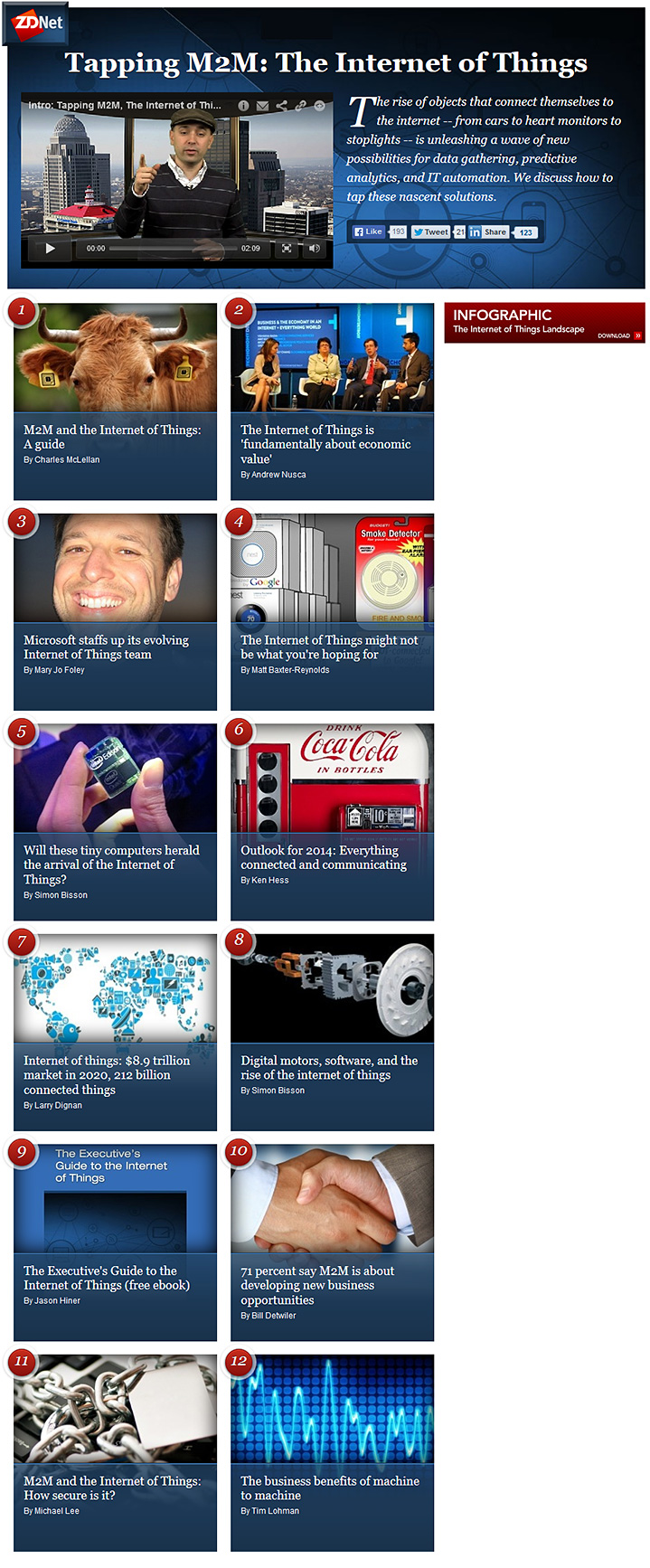
Tapping M2M: The Internet of Things — from zdnet.com

Excerpt:

The rise of objects that connect themselves to the internet — from cars to heart monitors to stoplights — is unleashing a wave of new possibilities for data gathering, predictive analytics, and IT automation. We discuss how to tap these nascent solutions.


TappingM2M-ZDNET-March2014


Speeding up on curves — from educause.edu by Bradley Wheeler

Excerpt:

Higher education faces a number of important curves, but I’ll focus first on just two:

  1. The finance of higher education is increasingly moving from a public to a private good, leading to increasing cost and price pressures (particularly for state-supported institutions).
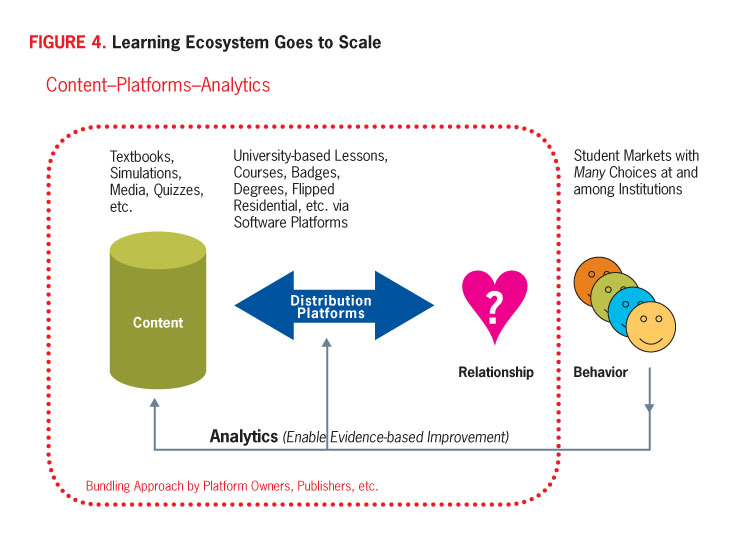
  2. The increasing digitization of education and research favors greater scale while it also enables potential new substitutes for colleges and universities.


figure 4


Also see:


I failed my online course — but learned a lot about Internet education — from readwrite.com by Selena Larson (by way of eduwire.com)
Massive open online courses, or “MOOCs,” require a lot of motivation—and sometimes, a thick skin.

Excerpts (comments via DSC):

He provided great insight, paired it with interesting required readings, and led Google Hangouts throughout the course, though only a handful of students were able to participate. Time zone differences and limited space ultimately resulted in a select few students receiving the opportunity to participate in this more intimate online setting.

(From DSC:  Last I knew, only 25 students can get into one of these sessions; this seems to be a major mistake to use Google Hangouts if you are talking MOOCs with thousands of students; Coursera should have required that the professor use a different tool.)

…

I’ll admit it: I had minimal motivation. Sure, I didn’t want to waste $49, but I certainly didn’t stay up all night finishing a 600-word essay—the goal of receiving a course completion certificate just wasn’t appealing enough.

…

The quizzes were easy—we were given multiple attempts to get a perfect score—but the essays were a different story. Since the professor was unable to grade them himself, each student was subject to peer reviews—five of them. And each review impacted your grade.

…

I failed my first essay. All but one reviewer gave me a failing grade, for reasons unknown.

…

In true Internet fashion, these peer reviews were totally anonymous. I couldn’t discuss with my reviewer why he or she thought my essay was lousy, and I couldn’t defend my link to Fox News. I felt uncomfortable and powerless. Stupid.

(From DSC: I don’t have a lot of confidence in asking other students, who aren’t trained in teaching/pedagogy/grading, to effectively use rubrics to grade other students’ papers. Though one could turn right around and say that of many faculty members as well, who often lack training in education-related courses. But in the case of professors, they often build up such expertise over time.)


How MOOCs Can Succeed
(from DSC, I’m paraphrasing below)

  • Get rid of  anonymous grading
  • Get the price point right
    (From DSC: This is tough though, as such a figure most likely differs for each student.)


From DSC:
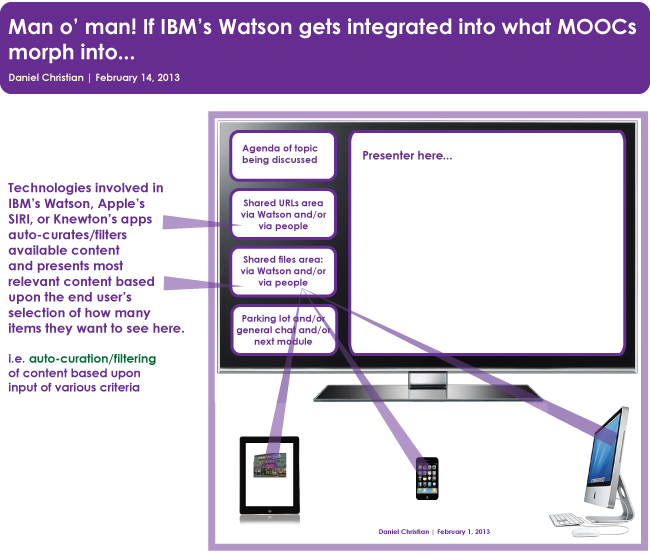
The graphic below attempts to relay the potential power of technologies such as IBM’s Watson in auto-curating content for MOOCs.  But there may be other uses for such technologies — such as if these technologies could be used to effectively grade papers, assignments, quizzes, etc. — then today’s MOOCs would be much more effective and would better address one of Selana’s key concerns.


Watson-MOOCs-NewTypesCollaboration-DChristian-2-14-13


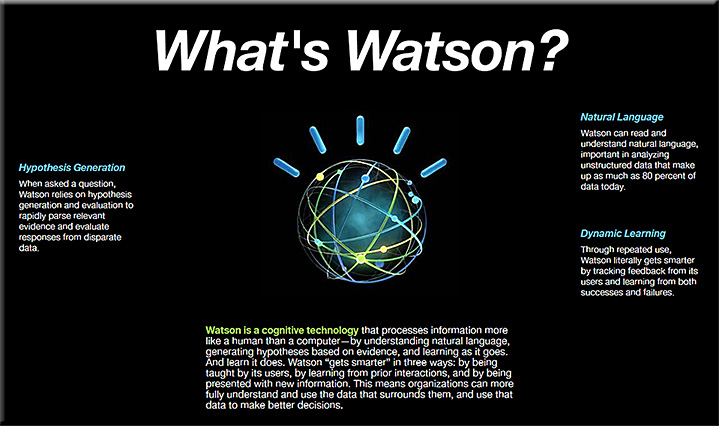
WhatsWatson-March2014


TVs are becoming the next app battleground — from by Emily Adler

Excerpt:

The app store phenomenon, centered on smartphones and tablets, has been the biggest story in software for the past five years.

Its next logical destination: the living room, via smart TVs and set-top boxes connected to the Internet.

…

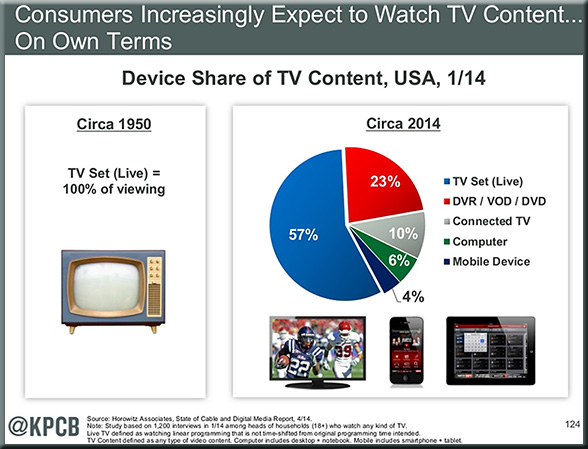
  • The smart TV app revolution is inevitable: People spend four hours in front of their TVs in the U.S., and 63% of all global ad spending goes to TVs. The old guard, represented by cable and entertainment conglomerates, will not be able to fend off improvements like those that apps are bringing to mobile phones.
    .
  • The smart TV revolution will not just be led by new TVs with built-in Internet connections, it will also result from consumer adoption of less expensive game consoles or set-top boxes like Roku and Apple TV, which transform traditional TVs into smart TVs with access to app stores. At least 20% of U.S. consumers already have their TVs connected in one of these ways.


From DSC:

  1. Keep an eye on the convergence of the telephone, the television, and the computer.
    .
  2. Start thinking of ways that you could provide learning/educationally-based experiences with second screen apps. What would that experience look and act like?
    .
  3. If such “channels” come to fruition — and happen to coincide with MOOCs and advances in cognitive computing (such as IBM’s Watson) — the word disruption comes to mind.
    .
  4. The trick, then, will be to offer streams of content that are relevant, and up-to-date.
    .
  5. Such a platform could be used in learning hubs throughout the world, as well as in hybrid/blended classrooms — while also addressing lifelong learners from their living rooms.
    .
  6. Such a platform could take Communities of Practice to an entirely new level.


The Living [Class] Room -- by Daniel Christian -- July 2012 -- a second device used in conjunction with a Smart/Connected TV


streams-of-content-blue-overlay


Addendum/also see:


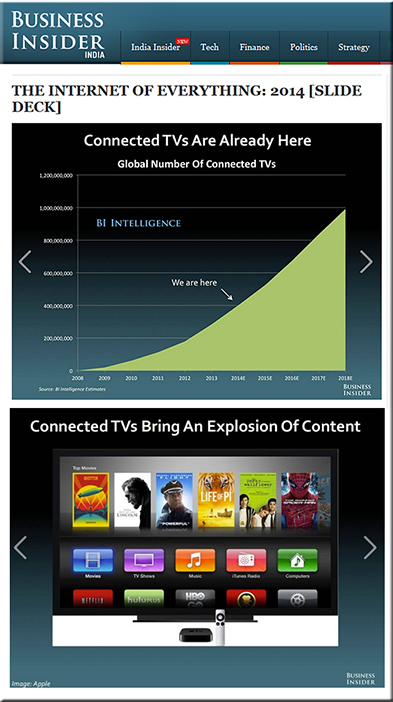
IoE-SmartTVs-Feb2014


© 2025 | Daniel Christian