New from Educause:
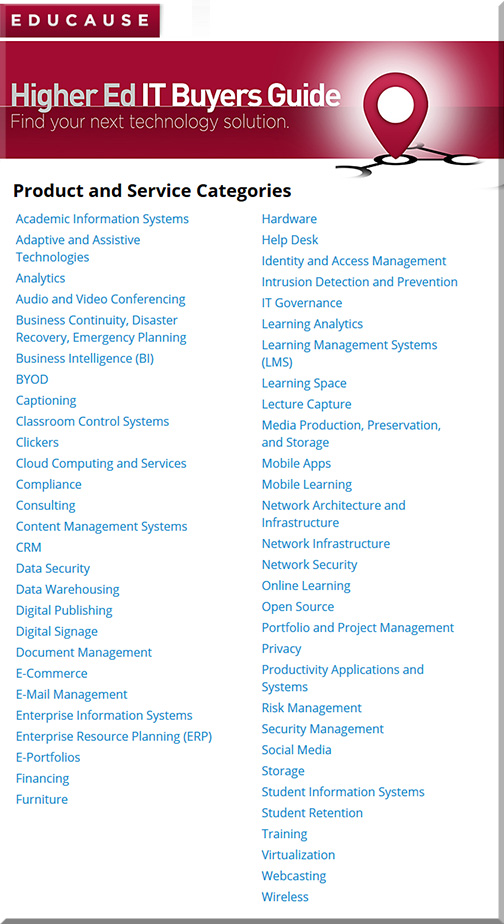
Higher Ed IT Buyers Guide


HEITBuyersGuideEducauseApril2015


Excerpt:

Quickly search 50+ product and service categories, access thousands of IT solutions specific to the higher ed community, and send multiple RFPs—all in one place. This new Buyers Guide provides a central, go-to online resource for supporting your key purchasing decisions as they relate to your campus’s strategic IT initiatives.

Find the Right Vendors for Higher Education’s Top Strategic Technologies

Three of the Top 10 Strategic Technologies identified by the higher education community this year are mobile computing, business intelligence, and business performance analytics.* The new Buyers Guide connects you to many of the IT vendors your campus can partner with in the following categories related to these leading technologies, as well as many more.

View all 50+ product and service categories.


What does ‘learning’ have to learn from Netflix? — from donaldclarkplanb.blogspot.com by Donald Clark

Excerpts:

Of course, young people are watching way less TV these days, TV is dying, and when they do watch stuff, it’s streamed, at a time that suits them. Education has to learn from this. I’m not saying that we need to replace all of our existing structures but moving towards understanding what the technology can deliver and what learners want (they shape each other) is worth investigation. Hence some reflections on Netflix.

Areas discussed:

  • Timeshifting
  • Data driven delivery — Netflix’ recommendations engine
  • Data driven content
  • Content that’s accessible via multiple kinds of devices
  • Going global


From DSC:
I just wanted to add a few thoughts here:

  1. The areas of micro-credentials, nano-degrees, services like stackup.net, big data, etc. may come to play a role with what Donald is talking about here.
  2. I appreciate Donald’s solid, insightful perspectives and his thinking out loud — some great thoughts in that posting (as usual)
  3. Various technologies seem to be making progress as we move towards a future where learning platforms will be able to deliver a personalized learning experience; as digital learning playlists and educationally-related recommendation engines become more available/sophisticated, highly-customized learning experiences should be within reach.
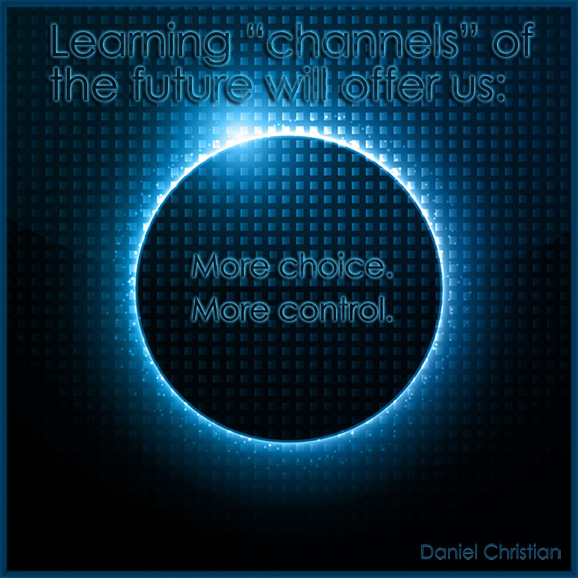
  4. At a recent Next Generation Learning Spaces Conference, one of the speakers stated, “People are control freaks — so let them have more control.”  Along these lines…ultimately, what makes this vision powerful is having more choice, more control.


MoreChoiceMoreControl-DSC


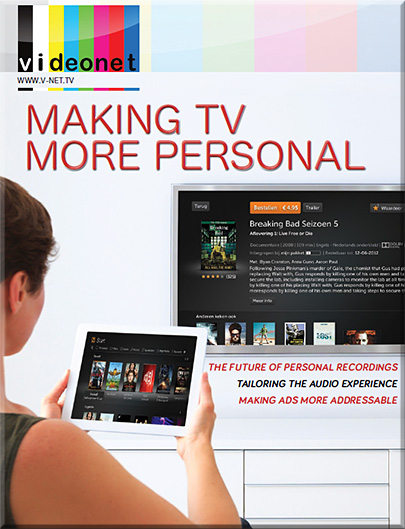
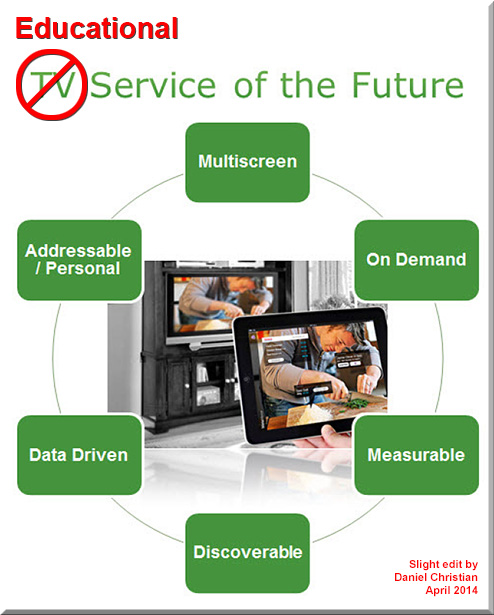
Also, some other graphics come to my mind:


MakingTVMorePersonal-V-NetTV-April2014


EducationServiceOfTheFutureApril2014


Part 3: Google Search will be your next brain — from medium.com by Steven Levy
Inside Google’s massive effort in Deep Learning, which could make already-smart search into scary-smart search

Excerpt:

But about ten years ago, in Hinton’s lab at the University of Toronto, he and some other researchers made a breakthrough that suddenly made neural nets the hottest thing in AI. Not only Google but other companies such as Facebook, Microsoft and IBM began frantically pursuing the relatively minuscule number of computer scientists versed in the black art of organizing several layers of artificial neurons so that the entire system could be trained, or even train itself, to divine coherence from random inputs, much in a way that a newborn learns to organize the data pouring into his or her virgin senses. With this newly effective process, dubbed Deep Learning, some of the long-standing logjams of computation (like being able to see, hear, and be unbeatable at Breakout) would finally be untangled. The age of intelligent computers systems?—?long awaited and long feared?—?would suddenly be breathing down our necks. And Google search would work a whole lot better.

This breakthrough will be crucial in Google Search’s next big step: understanding the real world to make a huge leap in accurately giving users the answers to their questions as well as spontaneously surfacing information to satisfy their needs. To keep search vital, Google must get even smarter.

This is very much in character for the Internet giant. From its earliest days, the company’s founders have been explicit that Google is an artificial intelligence company. It uses its AI not just in search?—?though its search engine is positively drenched with artificial intelligence techniques?—?but in its advertising systems, its self-driving cars, and its plans to put nanoparticles in the human bloodstream for early disease detection.

…

Indeed, as of now, all Google’s deep learning work has yet to make a big mark on Google search or other products. But that’s about to change.


Also see the other parts in this series:

Part 1: The never ending search

Excerpt:

Google’s flagship product has been part of our lives for so long that we take it for granted. But Google doesn’t. Part One of a study of Search’s quiet transformation.


Part 2: How Google knows what you want to know
Eight times a day Google asks test subjects about their information needs. Their replies can be sobering.

Excerpt:

Google search really isn’t threatened by competition from other search engines. But the people on the search team constantly worry that they may be falling short in satisfying the needs of their users. To address that problem, of course, Google needs to know what those needs are. One way to do this is by examining the logs to see what queries are unsatisfied. But there are lots of things people want to know that they aren’t asking Google about.

How does Google know what those needs are?

It asks them.

Every year since 2011 Google has run an annual study to learn what people really, really want to know, whether it’s something Google provides or not. It’s called Daily Information Needs, but the psychologists at Google involved with the project just call it DIN.


Part 4: The Deep Mind of Demis Hassabis — from medium.com by Steven Levy
Google’s prize AI prodigy tells all. In the race to recruit the best AI talent, Google scored a coup by getting the team led by a former video game guru and chess prodigy

Excerpt:

From the day in 2011 that Demis Hassabis co-founded DeepMind—with funding by the likes of Elon Musk—the UK-based artificial intelligence startup became the most coveted target of major tech companies. In June 2014, Hassabis and his co-founders, Shane Legg and Mustafa Suleyman, agreed to Google’s purchase offer of $400 million. Late last year, Hassabis sat down with Backchannel to discuss why his team went with Google—and why DeepMind is uniquely poised to push the frontiers of AI. The interview has been edited for length and clarity.


Addendum on 3/16/15:


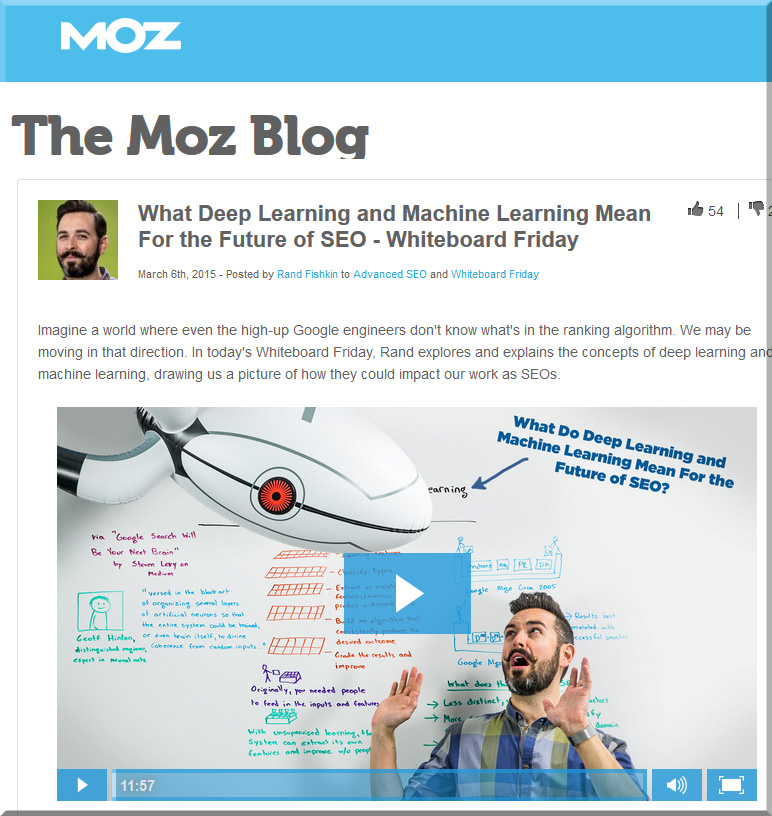
DeepLearning-Moz-March2015


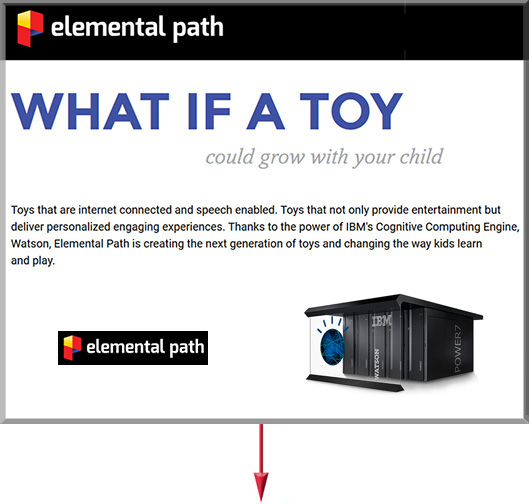
Cognitoy-ElementalPath-March2015
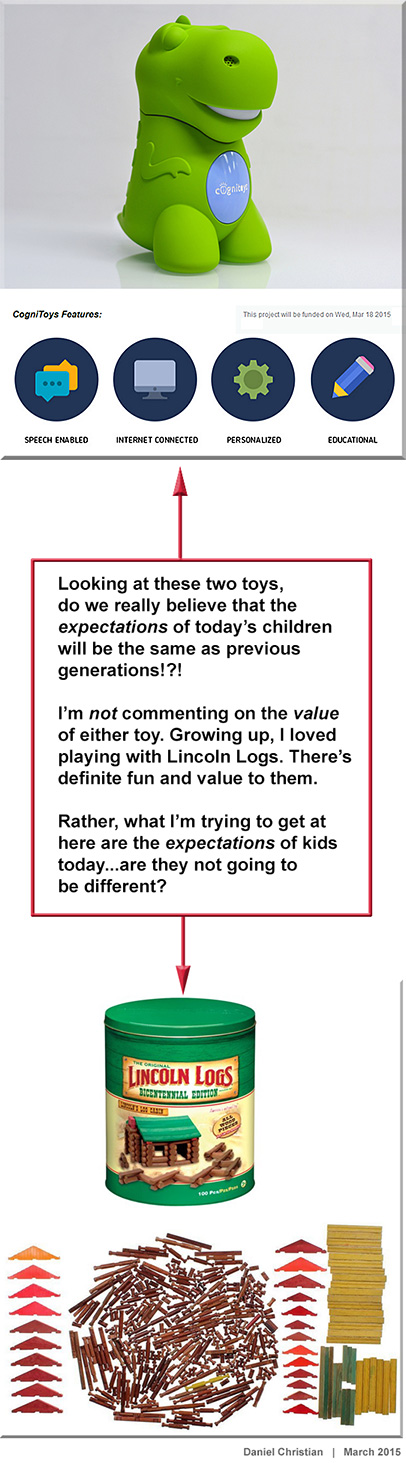
CognitoyFramed-March2015


From DSC:
Given the above…what are the ramifications of that in our/your work?


Also see:


A related addendum on 3/11/15
Look at the different expectations of the generations found in this article:


A related addendum on 3/17/15:

Excerpt:
The overall goal for DragonBot (which, as far as I can tell, is a common platform used for many different projects) is to develop “personalized learning companions” for children. In other words, MIT is finding ways in which robots like DragonBot can effectively help kids learn.

DragonBot isn’t intended to work like that IBM Watson-based dinosaur robot; it’s not a primary source of knowledge, and it’s not actively teaching a whole bunch of new facts to kids who use it. Rather, DragonBot is intended to help with the process of learning itself, encouraging kids to be interactively engaged in whatever they happen to be learning about.


Technology predictions for the second half of the decade — from techcrunch.com by Lance Smith

Excerpts:

  • Big Data and IoT evolve into automated information sharing
  • Self-driving vehicles become mainstream
  • The appearance of artificial intelligent assistants
  • Real-time agility through data virtualization


EdTech trends for the coming years — from edtechreview.in

Excerpts:

EdTech is about to explode. The coming technology and the new trends on the rise can’t but forecast an extensive technology adoption in schools all around the globe.

Specific apps, systems, codable gadgets and the adaptation of general use elements to the school environment are engaging teachers and opening up the way to new pedagogical approaches. And while we are scratching the surface of some of them, others have just started to buzz persistently.

  • Wearables + Nano/Micro Technology + the Internet of Things
  • 3D + 4D printing
  • Big Data + Data Mining
  • Mobile Learning
  • Coding
  • Artificial Intelligence + Deep Learning
    • Adaptative learning: based on a student’s behaviour and results, an intelligent assistant can predict and readapt the learning path to those necessities. Combined with biometrics and the ubiquitous persona (explained below) a student could have the best experience ever.
    • Automatic courses on the fly, with contents collected by intelligent searching systems (data mining).
    • Virtual tutors.
  • The Ubiquitous Persona + Gamification + Social Media Learning
  • Specialised Staff in Schools


Phones and wearables will spur tenfold growth in wireless data by 2019 — from recode.net

Excerpts:

Persistent growth in the use of smartphones, plus the adoption of wireless wearable devices, will cause the total amount of global wireless data traffic to rise by 10 times its current levels by 2019, according to a forecast by networking giant Cisco Systems out [on 2/3/15].

The forecast, which Cisco calls its Visual Networking Index, is based in part on the growth of wireless traffic during 2014, which Cisco says reached 30 exabytes, the equivalent of 30 billion gigabytes. If growth patterns remain consistent, Cisco’s analysts reckon, the wireless portion of traffic crossing the global Internet will reach 292 exabytes by the close of the decade.


9 ed tech trends to watch in 2015 — from the Jan/Feb edition of Campus Technology Magazine

  1. Learning spaces
  2. Badges
  3. Gamification
  4. Analytics
  5. 3D Printing
  6. Openness
  7. Digital
  8. Consumerization
  9. Adaptive & Personalized Learning


Even though I’ve mentioned it before, I’ll mention it again here because it fits the theme of this posting:

NMC Horizon Report > 2015 Higher Education Edition — from nmc.org

Excerpt:

What is on the five-year horizon for higher education institutions? Which trends and technologies will drive educational change? What are the challenges that we consider as solvable or difficult to overcome, and how can we strategize effective solutions? These questions and similar inquiries regarding technology adoption and educational change steered the collaborative research and discussions of a body of 56 experts to produce the NMC Horizon Report: 2015 Higher Education Edition, in partnership with the EDUCAUSE Learning Initiative (ELI). The NMC Horizon Report series charts the five-year horizon for the impact of emerging technologies in learning communities across the globe. With more than 13 years of research and publications, it can be regarded as the world’s longest-running exploration of emerging technology trends and uptake in education.


From DSC:
Speaking of trends…although this item isn’t necessarily technology related, I’m going to include it here anyway:

Career trends students should be watching in 2015 — from hackcollege.com by

Excerpt:

Students Need to Pay Attention to Broader Trends, and Get Ready.
For better or worse, the post-college world is changing.

According to a variety of analysis sites, including Forbes, Time, and Bing Predicts, more and more of the workforce will be impacted by increased entrepreneurship, freelancing, work-from-home trends, and non-traditional career paths.

These experts are saying that hiring practices will shift, meaning that students need to prepare LinkedIn profiles, online portfolio, work at internships, and to network to build relationships with potential future employers.

———-


Addendum on 3/6/15:
Self-driving car technology could end up in robots — from pcworld.com by Fred O’Connor

Excerpt:

The development of self-driving cars could spur advancements in robotics and cause other ripple effects, potentially benefitting society in a variety of ways.

Autonomous cars as well as robots rely on artificial intelligence, image recognition, GPS and processors, among other technologies, notes a report from consulting firm McKinsey. Some of the hardware used in self-driving cars could find its way into robots, lowering production costs and the price for consumers.

Self-driving cars could also help people grow accustomed to other machines, like robots, that can complete tasks without the need for human intervention.

Addendum on 3/6/15:

  • Top 5 Emerging Technologies In 2015 — from wtvox.com
    Excerpt:
    1) Robotics 2.0
    2) Neuromorphic Engineering
    3) Intelligent Nanobots – Drones
    4) 3D Printing
    5) Precision Medicine
 

Adaptivity Tops Gartner’s Strategic Tech List for Ed — from campustechnology.com by Dian Schaffhauser

Excerpt:

Even as education spending is projected to inch up two percent this year to reach $67.8 billion worldwide, the way in which school districts, colleges and universities are spending that money is evolving to reflect the growing digital nature of teaching and learning, according to Gartner. In a new report, “Top 10 Strategic Technologies Impacting Education in 2015,” the business IT consulting firm ranked 10 innovations and tech trends that it believes the education CIO should plan for in 2015.

Many of the technologies aren’t emerging from within education itself, said Gartner Vice President Jan-Martin Lowendahl. They’re being “driven by major forces such as digital business and the consumerization and industrialization of IT.”

…

1. Adaptive Learning
2. Adaptive Digital Textbooks
3. CRM
4. Big Data
5. and 6. Sourcing Strategies and ‘Exostructure’
7. Open ‘Microcredentials’
8. Digital Assessment
9. Mobile
10. Social Learning


Can technology identify China’s top graduates? — from bbc.com by John Sudworth, Shanghai

Excerpts (emphasis DSC):

Has the humble CV finally met its match?
…
[L’Oreal] has chosen the world’s biggest jobs market – China – to utter two words that would be music to the ears of beleaguered recruitment executives everywhere: “Goodbye CV”. This year, the 33,000 applicants for the 70 places on the company’s Chinese graduate recruitment scheme have been asked to save themselves the paper, the printer ink and the pain. Instead, they were asked to answer three simple questions via their smartphones.
…
“We have developed algorithms that can take the words that people use and derive context from them,” said Robin Young, the founder of Seedlink Tech.
…
Here’s how it works: students use their mobile phones to access L’Oreal’s website which prompts them to answer three open-ended questions.
…
The answers, which have to be at least 75 words long, are automatically fed into Seedlink’s database and the software gets to work. It analyses the language used and compares each candidate’s answers with the many thousands of others. Then, supposedly calibrated to mine for the specific personality traits that L’Oreal is looking for, it produces a ranking with, in theory, the person most suited for a career at L’Oreal at the top.


Excerpt from the March 1, 2015 edition of CIO Magazine (emphasis DSC):

The almighty algorithm is the fuel for today’s data-driven businesses. They stoke the data engines that recommend purchases, trade stocks, predict crime, spot medical conditions, monitor sleep apnea, find dating partners, calculate driving routes and so much more. “These math equations,” writes Managing Editor Kim S. Nash, “may someday run our lives.”

In the wrong application, they may someday ruin lives, as well.

The fascinating story that Nash unearthed will show you exactly why CIOs need to develop what one expert called “algorithmic accountability.”


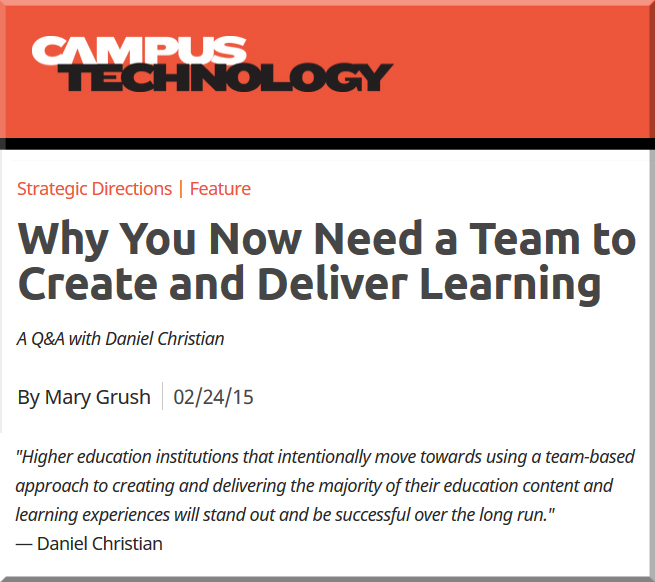
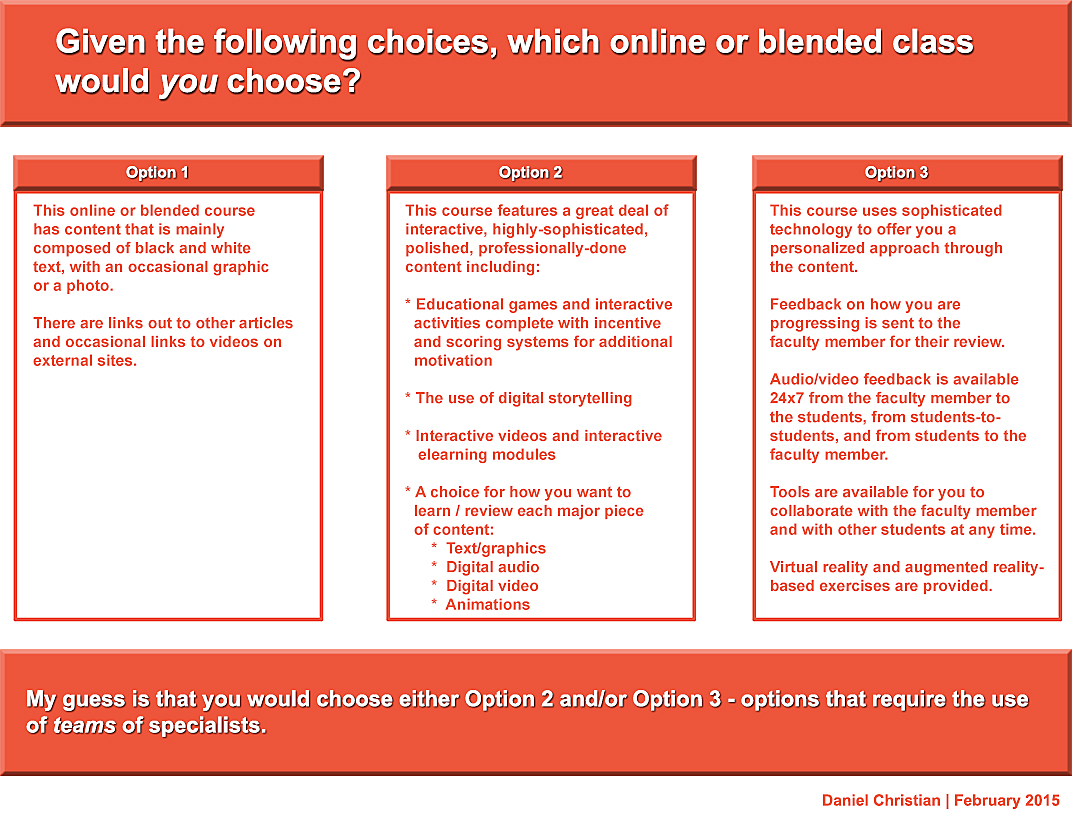
My thanks to Mary Grush at Campus Technology for her continued work in bringing relevant topics and discussions to light — so that our institutions of higher education will continue delivering on their missions well into the future. By doing so, learners will be able to continue to partake of the benefits of attending such institutions. But in order to do so, we must adapt, be responsive, and be willing to experiment. Towards that end, this Q&A with Mary relays some of my thoughts on the need to move more towards a team-based approach.

When you think about it, we need teams whether we’re talking about online learning, hybrid learning or face-to-face learning. In fact, I just came back from an excellent Next Generation Learning Space Conference and it was never so evident to me that you need a team of specialists to design the Next Generation Learning Space and to design/implement pedagogies that take advantage of the new affordances being offered by active learning environments.


DanielSChristian-CampusTechologyMagazine-2-24-15


DanielSChristian-CampusTechologyMagazine2-2-24-15


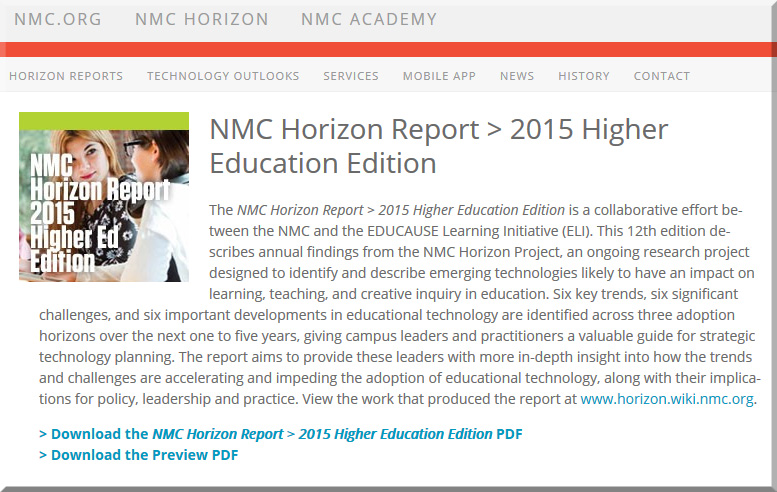
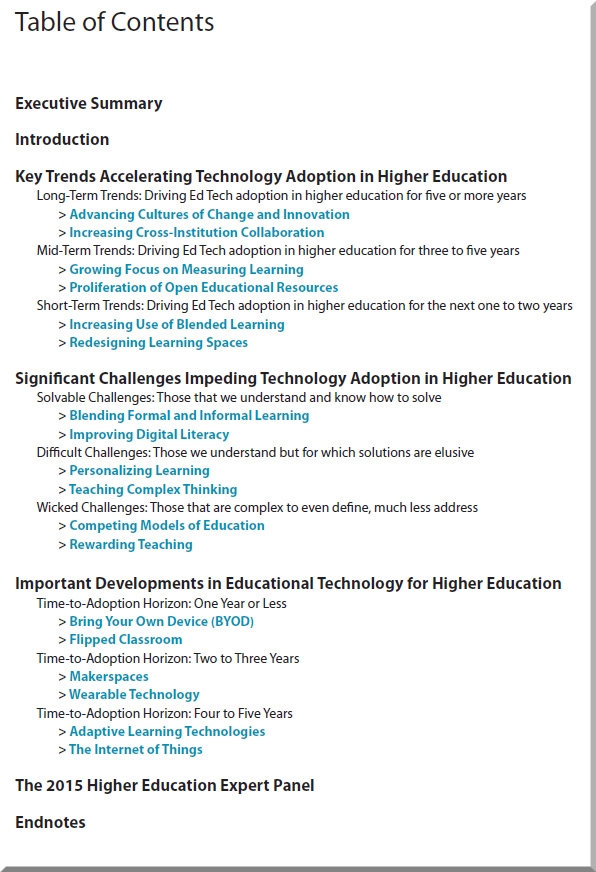
NMC Horizon Report > 2015 Higher Education Edition — from nmc.org

Excerpt:

What is on the five-year horizon for higher education institutions? Which trends and technologies will drive educational change? What are the challenges that we consider as solvable or difficult to overcome, and how can we strategize effective solutions? These questions and similar inquiries regarding technology adoption and educational change steered the collaborative research and discussions of a body of 56 experts to produce the NMC Horizon Report: 2015 Higher Education Edition, in partnership with the EDUCAUSE Learning Initiative (ELI). The NMC Horizon Report series charts the five-year horizon for the impact of emerging technologies in learning communities across the globe. With more than 13 years of research and publications, it can be regarded as the world’s longest-running exploration of emerging technology trends and uptake in education.


NMCHorizonReport-2015


NMCHorizonReport-2015-toc


I ran across a few items that may tie in with my Learning from the Living [Class] Room vision:


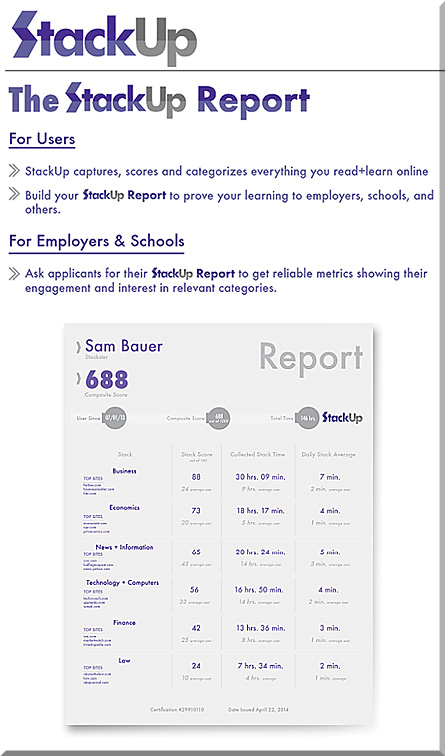
A very interesting concept at Stackup.net (@ScoreReporting)

Score everything you read + learn online. Use the StackUp Report to prove to employers that your dedication and interest make you the ideal candidate.


TheStackUpReport-Jan2015


From DSC:
This is big data — but this time, it’s being applied to the world of credentials. Is this part of how one will obtain employment in the future?  Will it work along with services like Beansprock (see below)?


Then there was spreecast: An interactive video platform that connects people:


spreecast-jan2015


From DSC:
A related item to these concepts:


The Future of Lifelong Learning — from knewton.com


The Future of Lifelong Learning

Created by Knewton and Knewton


—————


AI software that could score you the perfect job — from wired.com by Davey Alba

Excerpt:

Today, little more than two years later, Levy and Smith are launching a website called Beansprock that uses natural language processing and machine learning techniques to match you with a suitable job. In other words, they’re applying artificial intelligence to the career hunt. “It’s all about helping the job hunter find the best job in the job universe,” Levy says.

.

beansprock-feb2015


IBM Awards University of Texas at Austin Top Spot in Watson Competition — from indiaeducationdiary.in

Excerpts/applications (emphasis and numbering via DSC):

New York: IBM (NYSE: IBM) today announced the first winner of its Watson University Competition, part of the company’s partnership with top universities through its cognitive computing academic initiative. The winning team of student entrepreneurs from the University of Texas at Austin will receive $100,000 in total in seed funding to help launch a business based on their Watson app, which offers the promise of improved citizen services.
…
The University of Texas at Austin took home top honors with a new app called 1) CallScout, designed to give Texas residents fast and easy access to information about social services in their area. Many of Texas’ 27 million residents rely on the state’s social services – such as transportation, healthcare, nutrition programs and housing assistance – though they can have difficulty finding the right information.
…
“These academic competitions expose students to a new era of computing, helps them build valuable professional skills, and provides an opportunity for young entrepreneurs to bring their ideas to life.”

…
Two other innovative projects rounded out the top three finalists in the competition. Students from the University of Toronto took second place with 2) “Ross,” an app that allows users to ask Watson legal questions related to their case work, speeding research and guiding lawyers to pertinent information to help their case. In third place, students from the University of California, Berkeley, designed a new app called 3) “Patent Fox” that conceptualizes patent ideas, simplifies queries, streamlines filing processes and provides confidence-ranked, evidence-based results.
…
“Through this program we have been able to create a unique experience that not only enabled our students to develop skills in cognitive computing, app development and team work, but also in business development.”
 

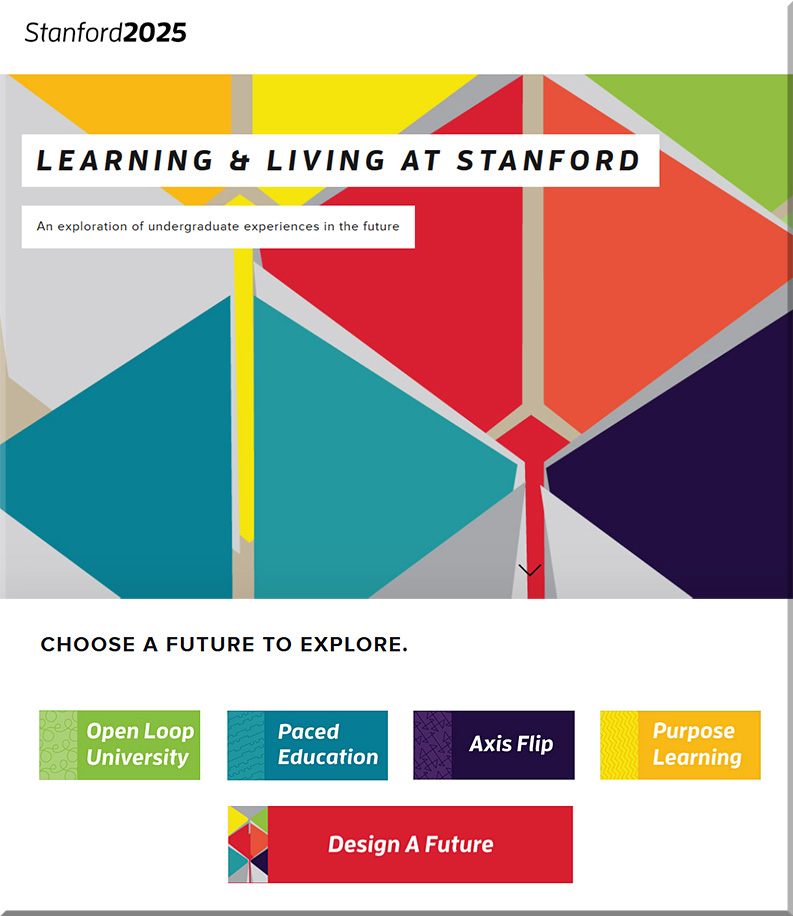
Stanford2025-AsOfJan2015

.


NYC students spark innovative ideas to improve higher education, city services using IBM Watson
CUNY and IBM announce winners in Student App Competition

3rd place –Education: Advyzr
A mobile app that would advise undergraduates and college counselors on ideal courses and schedules based on learning preferences, graduation requirements, majors, and career goals. It would seamlessly integrate academic targets and user preferences.

Also see:

Student teams to present final ideas — from baruch.cuny.edu
For CUNY-IBM Watson Case Competition | Watch Videos to Learn More About the Teams and Their Ideas


What if students made a school? — from nextgenlearning.org by Tom Carroll

Excerpts:

What would happen if we trusted students to design their schools? Student voice and choice are core principles of a personalized learning movement that is empowering today’s youth to take responsibility for the knowledge, skills and abilities they need to thrive in college, careers and life.

As new education models grow to support this movement, are we ready to take the next step: asking students to help us customize the staff, space, curriculum, tools, and time they need for deeper learning?
…
Although these competitions took place over a decade ago, the students developed five design concepts that are as relevant today as when they were originally drafted.

  1. Co-Created Curriculum
  2. Collaborative Learning
  3. Commitments from Capable Adults
  4. Connected Learning – Doing Real Work
  5. Comfortable, Customizable Learning Space


10 classroom ideas to try in 2015 — from blogs.edweek.org by Jennie Magiera


Karl Kapp “The Case of the Disengaged Learner” #ATDTK — from cammybean.kineo.com by Cammy Bean
These are my liveblogged notes from Karl Kapp’s session at ATD TechKnowledge, happening this week in Las Vegas. Forgive any typos or incoherencies.

Excerpt (emphasis DSC):

Start instruction with ACTION and not objectives.  Draw the learner in with action and encourage engagement. Make the learner do something. Have them identify something right away; make a decision right away; answer a question. Give them a complicated problem to solve. Confront a challenge. Create a curiosity gap — something you can do before hand that will raise a question that they want to know the answer to.

Law & Order (the tv) creates open loops — you HAVE to watch to the end to find out what happens. Leave them on a cliffhanger…it pulls you along.

In ID we create a closed loop: “by the end of this module, you will learn…”  Instead open with “Do you know the #1 method to close sales in our company. Find out in this module.”

Start with a question that pulls the learner in – this creates an OPEN LOOP that draws them into the instruction. Don’t lead with the objectives (you still need ’em to design your instruction).

Create a challenging experience. Don’t make it frustrating, but create some struggle to get to the answer. Our best experiences are when we have that ah-ha moment, that breakthrough.
…
Add novelty. New and different catches our attention.

Also see Karl’s slides of “The Case of the Disengaged Learner“


Excerpt from Cammy Bean’s posting:  David Kelly “Building a Learning Strategy from an Ecosystem of Resources” #ATDTK (emphasis DSC)

So what is a learning and performance ecosystem? It’s an organic entity that evolves over time. It’s finding the resources all around that support performance (not just training!). We’ve got multiple systems in our orgs — in a well-run org, those systems are all connected.

It’s a new mindset for those in L&D and training.


3 predictions for the future of jobs — from agenda.weforum.org by Kristel Van der Elst and Trudi Lan

  • A coming age of entrepreneurship:
    Advances in technology will make self-generated livelihoods increasingly more viable
  • Retire first, work later?
    In the future, our work-life duality patterns may change substantially
  • The new jobs robots can’t take:
    We will soon see a plethora of jobs that currently do not exist


Also see:
Global Strategic Foresight Community – Members’ Perspectives on Global Shifts
As an extension of its own Strategic Foresight practice, the World Economic Forum has established a new community initiative, the Global Strategic Foresight Community (GSFC). A diverse, multistakeholder group, it brings together eminent and forward-looking thought leaders and senior practitioners from leading public, private and civil society organizations. The purpose of the Global Strategic Foresight Community is to provide a peer network to compare and contrast insights as well as to positively shape future-related industry, regional and global agendas. Below you will find information about the members as well as their foresight perspectives  on “global shifts”. These shifts concern topics or issues which GSFC members believe should be highlighted now and added to the agendas of the Forum and relevant organizations to inspire constructive action for the future.


From Jobs of the future — from theguardian.com

Example job titles in 2020  — for education

  • Online education broker
    Tailors a bespoke learning package for the client, dovetailing relevant modules from courses and syllabuses around the world.
  • Space tour guide
    With Virgin Galactic planning commercial flights from 2011, space tourists will need cosmic enthusiasts to shed light on all that darkness.


What Are the Top Jobs and Skills of the Future? [Infographic] — from youtern.com


Ten Trends in Data Science 2015 — from linkedin.com by Kurt Cagle

Excerpt:

Data Science Teams
I see the emergence within organizations of data science teams. Typically, such teams will be made up of a number of different specialties:

  • Integrator. A programmer or DBA that specializes in data ingestion and ETL from multiple different sources. Their domain will tend to be services and databases, and as databases become data application platforms, their role primarily shifts from being responsible for schemas to being responsible for building APIs. Primary focus: Data Acquisition
  • Data Translation Specialist. This will typically be a person focused on Hadoop, Map/Reduce and similar intermediate processing necessary to take raw data and clean it, transform it, and simplify it. They will work with both integrators and ontologists, Primary Focus: Data Acquiisition
  • Ontologist. The ontologist is a data architect specializing in building canonical models, working with different models, and establishing relationships between data sets. They will often have semantics or UML backgrounds. Primary focus: Data Awareness.
  • Curators. These people are responsible for the long term management, sourcing and provenance of data. This role is often held by librarians or archivists. They will often work closely with the ontologists. Primary Focus: Data Awareness.
  • Stochastic Analyst (Data Scientist?). This role is becoming a specialist one, in which people versed with increasingly sophisticated stochastic and semantic analysis tools take the contextual data and extraction trends, patterns and anti-patterns from this. They usually have a strong mathematical or statistical background, and will typically work with domain experts. Primary Focus: Data Analysis
  • Domain Expert. Typically these are analysts who know their particular domain, but aren’t necessarily expert on informatics. These may be financial specialists, business analysts, researchers, and so forth, depending upon the specific enterprise focus. Primary Focus: Data Analysis
  • Visualizers. These are typically going to be web interface developers with skills in areas such as SVG or Canvas and the suites of visualization tools that are emerging in this area. Their role is typically to take the data at hand and turn it into usable, meaningful information. They will work closely with both domain experts and stochastic analysts, as well as with the ontologist to better coerce the information coming from the data systems into meaningful patterns. Primary Focus:Data Analysis
  • Data Science Manager. This person is responsible for managing the team, understanding all of the domains reasonably well enough to interface with the client, and coordinating efforts. This person also is frequently the point person for establishing governance. Primary Focus: All.


Infographic: What’s Hot in Data Science in 2015 — from data-informed.com; with thanks to Michael Caveretta’s tweet on this


Michigan State Wants a Big Data Professor on Campus — from edtechmagazine.com by D. Frank Smith; back from Nov 2014
Explosive growth in the data science field is pushing higher education to extend its analytics expertise.

Excerpt:

There is a torrent of information flooding today’s higher education institutions. Michigan State University is hoping to find Big Data experts to turn it into results.

Putting Big Data to use in an educational setting takes a special set of skills. MSU’s College of Communication Arts and Sciences recently held a search for an assistant professor of Big Data and health, a position that will lead courses on data analytics and IT in the Department of Media and Information.

“We seek a scholar conducting cutting-edge social and/or technical research utilizing big data approaches — including theory-building, analytics, applications, and effects,” according to MSU’s job listing, which has expired, but is still available on LinkedIn.


Is Data Science a buzzword? Modern Data Scientist defined — from marketingdistillery.com by Krzysztof Zawadzki


.       


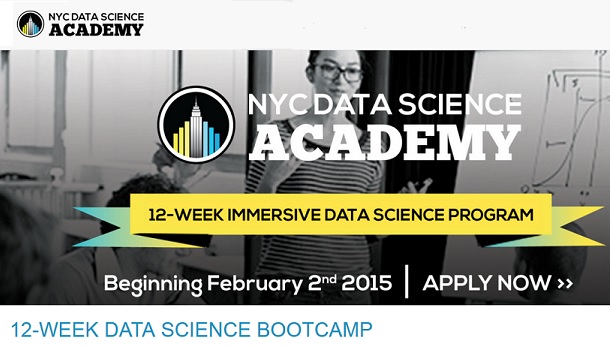
From DSC: Those working in higher ed – take note of this 12 week bootcamp:  

.

..   12week-boot-camp-data-scientist   .          
 .


Should Big Data Skills Be Taught in K–12 Classrooms? — from by D. Frank Smith
A new report recommends that schools begin preparing students to think like data scientists at an earlier age.

Excerpt:

The skills necessary for the data analytics jobs of tomorrow aren’t being taught in K–12 schools today, according to a new report released by the Education Development Center, Inc.’s (EDC) Oceans of Data Institute. The Profile of the Big-Data Enabled Specialist projects a workforce shortage for data-driven positions. Based on a 2011 McKinsey & Co. report cited by the Oceans of Data Institute, ”By 2018, the United States alone could face a shortage of 140,000 to 190,000 people with deep analytical skills as well as 1.5 million managers and analysts with the know-how to use the analysis of big data to make effective decisions.”              


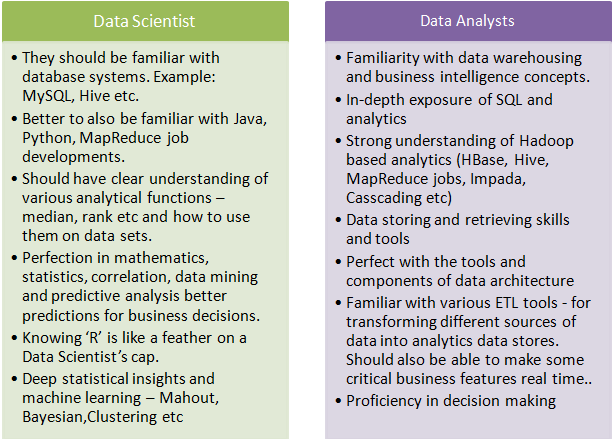
Difference between Data Scientist and Data Analyst — from edureka.co; again, with thanks to Michael Caveretta’s tweet on this

Excerpt: .

.  Qualifications of Data Scientist and Data Analyst
    .


The Data Scientist’s Toolbox — course from coursera.org
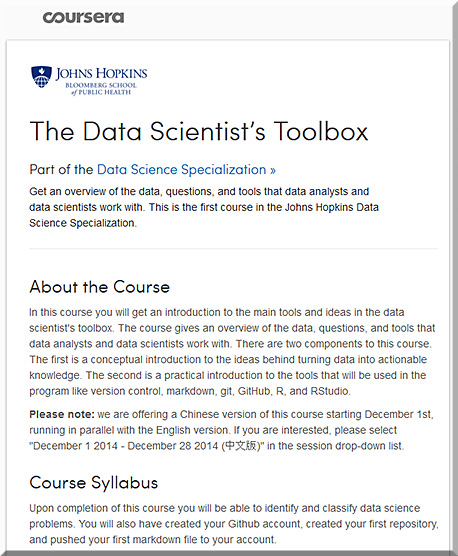
 

TheDataScientistToolbox-Coursera-Dec2014


The 25 Hottest Skills That Got People Hired in 2014 — from linkedin.com

Excerpts:

  • Statistical analysis and data mining
  • Business intelligence
  • Data engineering and data warehousing


16 analytic disciplines compared to data science — from datasciencecentral.com by Vincent Granville

Excerpt:

What are the differences between data science, data mining, machine learning, statistics, operations research, and so on?

Here I compare several analytic disciplines that overlap, to explain the differences and common denominators. Sometimes differences exist for nothing else other than historical reasons. Sometimes the differences are real and subtle. I also provide typical job titles, types of analyses, and industries traditionally attached to each discipline. Underlined domains are main sub-domains. It would be great if someone can add an historical perspective to my article.


Tech 2015: Deep Learning And Machine Intelligence Will Eat The World — from forbes.com by Anthony Wing Kosner; with thanks to Pedro for his tweet on this

Excerpt:

Despite what Stephen Hawking or Elon Musk say, hostile Artificial Intelligence is not going to destroy the world anytime soon. What is certain to happen, however, is the continued ascent of the practical applications of AI, namely deep learning and machine intelligence. The word is spreading in all corners of the tech industry that the biggest part of big data, the unstructured part, possesses learnable patterns that we now have the computing power and algorithmic leverage to discern—and in short order.

The effects of this technology will change the economics of virtually every industry.


The rise of machines that learn — from infoworld.com by Eric Knorr; with thanks to Oliver Hansen for his tweet on this
A new big data analytics startup, Adatao, reminds us that we’re just at the beginning of a new phase of computing when systems become much, much smarter


Shivon Zilis, Machine Intelligence Landscape


Data Science Dojo — @DataScienceDojo
Stanford startup focused on all things data science.


The 2 Types Of Data Scientists Everyone Should Know About — from datasciencecentroal.com by Bernard Marr

Excerpt:

It depends entirely on how broadly you categorize them. In reality, of course – there are as many “types” of data scientist as there are people working in data science. I’ve worked with a lot, and have yet to meet two who are identical.

But what I have done here is separate data scientists into groups, containing individuals who share similar skills, methods, outlooks and responsibilities. Then I grouped those groups together, again and again, until I was left with just two quite distinctly different groups.

I’ve decided to call these two types strategic data scientists and operational data scientists.


Deep learning Reading List — from jmozah.github.io


2014 Innovating Pedagogy Report

InnovatingPedagogy2014

Featured in 2014’s annual report:

  1. Massive open social learning
  2. Learning design informed by analytics
  3. Flipped classrooms
  4. Bring your own devices
  5. Learning to learn
  6. Dynamic assessment
  7. Event-based learning
  8. Learning through storytelling
  9. Threshold concepts
  10. Bricolage
 

IBM, Fluor and the University of South Carolina Team to Create Innovation Center — from finance.yahoo.com
Public-private partnership will center on analytics and higher education solutions

Excerpt:

COLUMBIA, S.C., Nov. 21, 2014 /PRNewswire/ — IBM (NYSE: IBM), the University of South Carolina (USC) and Fluor Corporation (FLR) today announced the formation of the Center for Applied Innovation. The Center will provide application services to both public and private sector organizations across North America with specialties in the areas of analytics and higher education industry solutions. As part of the initiative, the organizations will collaborate on tailored IT curricula and advanced analytic techniques for personalized learning

“The Center for Applied Innovation is the realization of the University of South Carolina’s vision to advance higher education through strong, public-private partnerships,” USC President Harris Pastides said. “Through this collaboration with IBM and Fluor, USC students will have unique opportunities to learn both in and outside the classroom and further hone their IT skills. By using advanced technologies and data analytics the collaboration will help students, educators and others in higher education make intelligent decisions that improve the student experience and enhance student achievement.”

The collaboration is part of an ongoing effort to expand student skills and understanding of applied computing to meet the growing demand for highly skilled IT professionals and business leaders. IBM and USC will develop internship opportunities that better link the classroom with career pathways as well as curricula to build analytics skills that support businesses both locally and across North America. IBM will work with the Darla Moore School of Business as well as USC’s College of Engineering and Computing to team with companies in the region on analytics solutions to their most pressing business challenges.

 
© 2025 | Daniel Christian