From DSC:
First of all, let me say again that I’m not suggesting that we replace professors with artificial intelligence, algorithms, and such.

However, given a variety of trends, we need to greatly lower the price of obtaining a degree and these types of technologies will help us do just that — while at the same time significantly increasing the productivity of each professor and/or team of specialists offering an online-based course (something institutions of higher education are currently attempting to do…big time). Not only will these types of technologies find their place in the higher education landscape, I predict that they will usher in a “New Amazon.com of Higher Education” — a new organization that will cause major disruption for traditional institutions of higher education. AI-powered MOOCs will find their place on the higher ed landscape; just how big they become remains to be seen, but this area of the landscape should be on our radars from here on out.

This type of development again points the need for team-based
approaches; s
uch approaches will likely dominate the future.


California State University East Bay partners with Cognii to offer artificial intelligence powered online learning — from prnewswire.com
Cognii’s Virtual Learning Assistant technology will provide intelligent tutoring and assessments to students in a chatbot-style conversation

Excerpt:

HAYWARD, Calif., April 14, 2017 /PRNewswire/ — Cal State East Bay, a top-tier public university, and Cognii Inc., a leading provider of artificial intelligence-based educational technologies, today announced a partnership. Cognii will work with Cal State East Bay to develop a new learning and assessment experience, powered by Cognii’s Virtual Learning Assistant technology.

Winner of the 2016 EdTech Innovation of the Year Award from Mass Technology Leadership Council for its unique use of conversational AI and Natural Language Processing technologies in education, Cognii VLA provides automatic grading to students’ open-response answers along with qualitative feedback that guides them towards conceptual mastery. Compared to the multiple choice tests, open-response questions are considered pedagogically superior for measuring students’ critical thinking and problem solving skills, essential for 21st century jobs.

Students at Cal State East Bay will use the Cognii-powered interactive tutorials starting in summer as part of the online transfer orientation course. The interactive questions and tutorials will be developed collaboratively by Cognii team and the eLearning specialists from the university’s office of the Online Campus. Students will interact with the questions in a chatbot-style natural language conversation during the formative assessment stage. As students practice the tutorials, Cognii will generate rich learning analytics and proficiency measurements for the course leaders.


The 82 Hottest EdTech Tools of 2017 According to Education Experts — from tutora.co.uk by Giorgio Cassella

Excerpt:

If you work in education, you’ll know there’s a HUGE array of applications, services, products and tools created to serve a multitude of functions in education.

Tools for teaching and learning, parent-teacher communication apps, lesson planning software, home-tutoring websites, revision blogs, SEN education information, professional development qualifications and more.

There are so many companies creating new products for education, though, that it can be difficult to keep up – especially with the massive volumes of planning and marking teachers have to do, never mind finding the time to actually teach!

So how do you know which ones are the best?

Well, as a team of people passionate about education and learning, we decided to do a bit of research to help you out.

We’ve asked some of the best and brightest in education for their opinions on the hottest EdTech of 2017. These guys are the real deal – experts in education, teaching and new tech from all over the world from England to India, to New York and San Francisco.

They’ve given us a list of 82 amazing, tried and tested tools…


From DSC:
The ones that I mentioned that Giorgio included in his excellent article were:

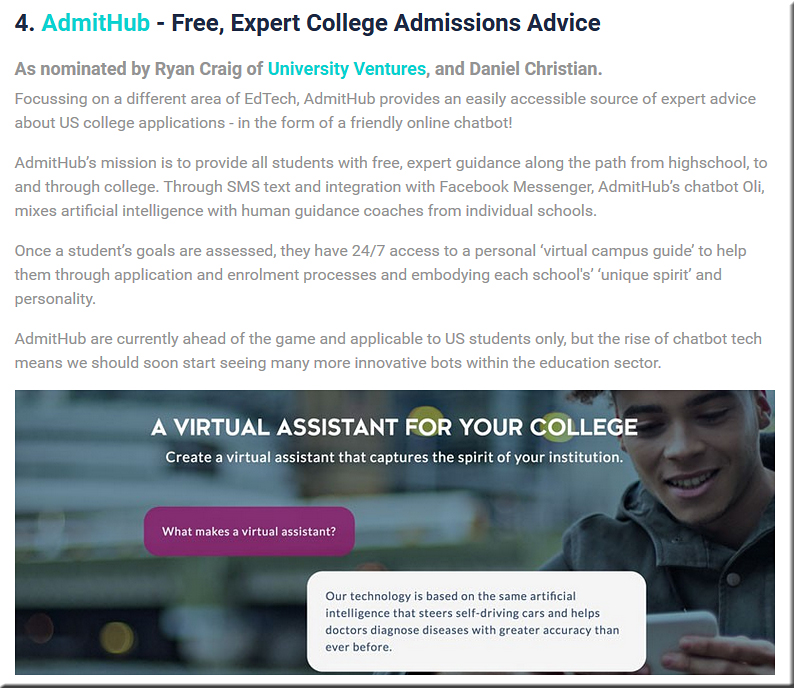
  • AdmitHub – Free, Expert College Admissions Advice
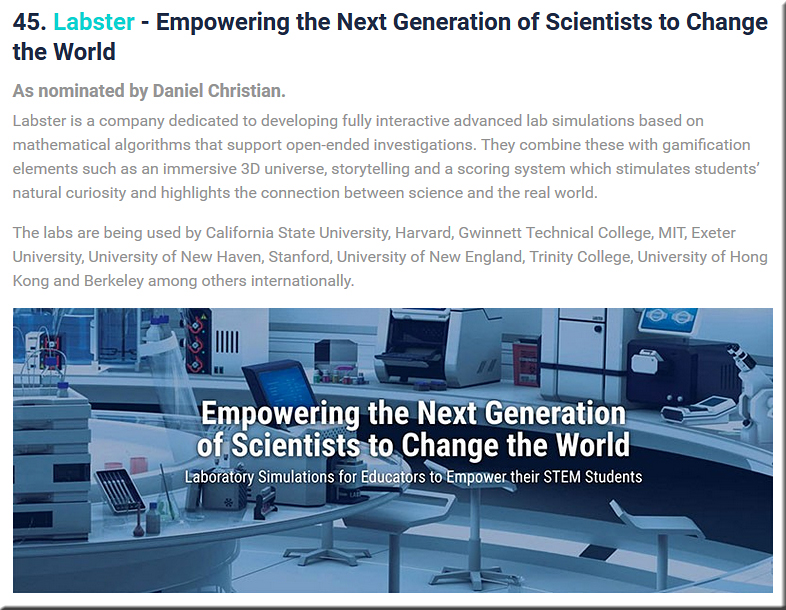
  • Labster – Empowering the Next Generation of Scientists to Change the World
  • Unimersiv – Virtual Reality Educational Experiences
  • Lifeliqe – Interactive 3D Models to Augment Classroom Learning


The Hidden Costs of Active Learning — from by Thomas Mennella
Flipped and active learning truly are a better way for students to learn, but they also may be a fast track to instructor burnout.

Excerpt:

The time has come for us to have a discussion about the hidden cost of active learning in higher education. Soon, gone will be the days of instructors arriving to a lecture hall, delivering a 75-minute speech and leaving. Gone will be the days of midterms and finals being the sole forms of assessing student learning. For me, these days have already passed, and good riddance. These are largely ineffective teaching and learning strategies. Today’s college classroom is becoming dynamic, active and student-centered. Additionally, the learning never stops because the dialogue between student and instructor persists endlessly over the internet. Trust me when I say that this can be exhausting. With constant ‘touch-points,’ ‘personalized learning opportunities’ and the like, the notion of a college instructor having 12 contact hours per week that even remotely total 12 hours is beyond unreasonable.

We need to reevaluate how we measure, assign and compensate faculty teaching loads within an active learning framework. We need to recognize that instructors teaching in these innovative ways are doing more, and spending more hours, than their more traditional colleagues. And we must accept that a failure to recognize and remedy these ‘new normals’ risks burning out a generation of dedicated and passionate instructors. Flipped learning works and active learning works, but they’re very challenging ways to teach. I still say I will never teach another way again … I’m just not sure for how much longer that can be.


From DSC:
The above article prompted me to revisit the question of how we might move towards using more team-based approaches…? Thomas Mennella seems to be doing an incredible job — but grading 344 assignments each week or 3,784 assignments this semester is most definitely a recipe for burnout.

Then, pondering this situation, an article came to my mind that discusses Thomas Frey’s prediction that the largest internet-based company of 2030 will be focused on education.

I wondered…who will be the Amazon.com of the future of education? 

Such an organization will likely utilize a team-based approach to create and deliver excellent learning experiences — and will also likely leverage the power of artificial intelligence/machine learning/deep learning as a piece of their strategy.


Tech giants grapple with the ethical concerns raised by the AI boom — from technologyreview.com by Tom Simonite
As machines take over more decisions from humans, new questions about fairness, ethics, and morality arise.

Excerpt:

With great power comes great responsibility—and artificial-intelligence technology is getting much more powerful. Companies in the vanguard of developing and deploying machine learning and AI are now starting to talk openly about ethical challenges raised by their increasingly smart creations.

“We’re here at an inflection point for AI,” said Eric Horvitz, managing director of Microsoft Research, at MIT Technology Review’s EmTech conference this week. “We have an ethical imperative to harness AI to protect and preserve over time.”

Horvitz spoke alongside researchers from IBM and Google pondering similar issues. One shared concern was that recent advances are leading companies to put software in positions with very direct control over humans—for example in health care.


21 bot experts make their predictions for 2017 — from venturebeat.com by Adelyn Zhou

Excerpt:

2016 was a huge year for bots, with major platforms like Facebook launching bots for Messenger, and Amazon and Google heavily pushing their digital assistants. Looking forward to 2017, we asked 21 bot experts, entrepreneurs, and executives to share their predictions for how bots will continue to evolve in the coming year.
…
From Jordi Torras, founder and CEO, Inbenta:
“Chatbots will get increasingly smarter, thanks to the adoption of sophisticated AI algorithms and machine learning. But also they will specialize more in specific tasks, like online purchases, customer support, or online advice. First attempts of chatbot interoperability will start to appear, with generalist chatbots, like Siri or Alexa, connecting to specialized enterprise chatbots to accomplish specific tasks. Functions traditionally performed by search engines will be increasingly performed by chatbots.”


From DSC:
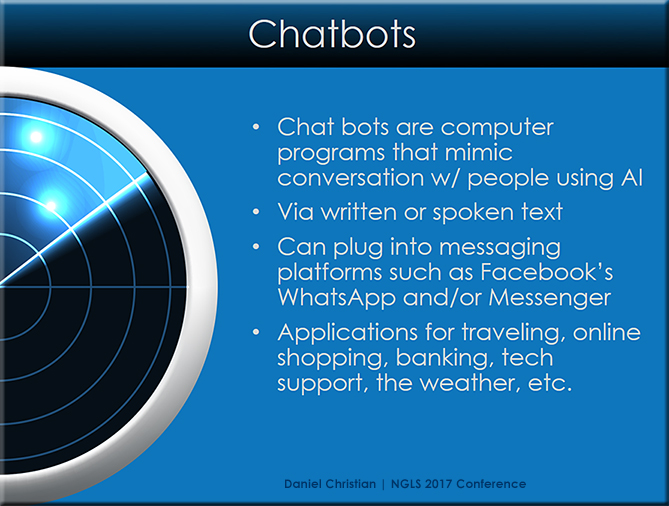
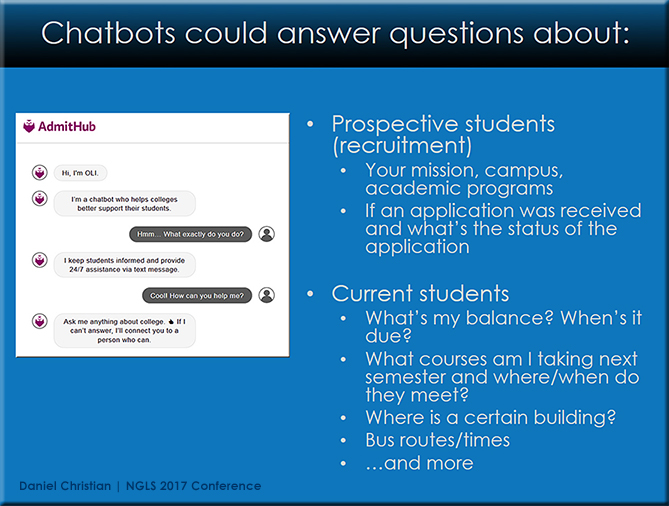
For those of us working within higher education, chatbots need to be on our radars. Here are 2 slides from my NGLS 2017 presentation.


The Enterprise Gets Smart
Companies are starting to leverage artificial intelligence and machine learning technologies to bolster customer experience, improve security and optimize operations.

Excerpt:

Assembling the right talent is another critical component of an AI initiative. While existing enterprise software platforms that add AI capabilities will make the technology accessible to mainstream business users, there will be a need to ramp up expertise in areas like data science, analytics and even nontraditional IT competencies, says Guarini.

“As we start to see the land grab for talent, there are some real gaps in emerging roles, and those that haven’t been as critical in the past,” Guarini  says, citing the need for people with expertise in disciplines like philosophy and linguistics, for example. “CIOs need to get in front of what they need in terms of capabilities and, in some cases, identify potential partners.”


Asilomar AI Principles

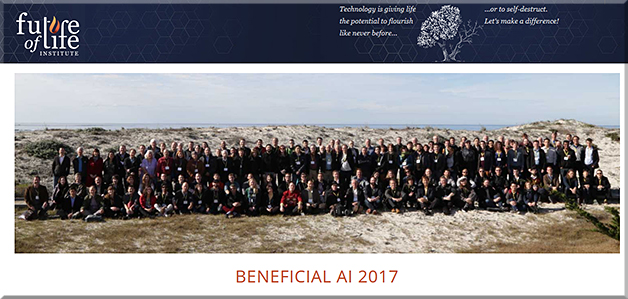
These principles were developed in conjunction with the 2017 Asilomar conference (videos here), through the process described here.

 

Artificial intelligence has already provided beneficial tools that are used every day by people around the world. Its continued development, guided by the following principles, will offer amazing opportunities to help and empower people in the decades and centuries ahead.

Research Issues


1) Research Goal: The goal of AI research should be to create not undirected intelligence, but beneficial intelligence.

2) Research Funding: Investments in AI should be accompanied by funding for research on ensuring its beneficial use, including thorny questions in computer science, economics, law, ethics, and social studies, such as:

  • How can we make future AI systems highly robust, so that they do what we want without malfunctioning or getting hacked?
  • How can we grow our prosperity through automation while maintaining people’s resources and purpose?
  • How can we update our legal systems to be more fair and efficient, to keep pace with AI, and to manage the risks associated with AI?
  • What set of values should AI be aligned with, and what legal and ethical status should it have?

3) Science-Policy Link: There should be constructive and healthy exchange between AI researchers and policy-makers.

4) Research Culture: A culture of cooperation, trust, and transparency should be fostered among researchers and developers of AI.

5) Race Avoidance: Teams developing AI systems should actively cooperate to avoid corner-cutting on safety standards.

Ethics and Values


6) Safety: AI systems should be safe and secure throughout their operational lifetime, and verifiably so where applicable and feasible.

7) Failure Transparency: If an AI system causes harm, it should be possible to ascertain why.

8) Judicial Transparency: Any involvement by an autonomous system in judicial decision-making should provide a satisfactory explanation auditable by a competent human authority.

9) Responsibility: Designers and builders of advanced AI systems are stakeholders in the moral implications of their use, misuse, and actions, with a responsibility and opportunity to shape those implications.

10) Value Alignment: Highly autonomous AI systems should be designed so that their goals and behaviors can be assured to align with human values throughout their operation.

11) Human Values: AI systems should be designed and operated so as to be compatible with ideals of human dignity, rights, freedoms, and cultural diversity.

12) Personal Privacy: People should have the right to access, manage and control the data they generate, given AI systems’ power to analyze and utilize that data.

13) Liberty and Privacy: The application of AI to personal data must not unreasonably curtail people’s real or perceived liberty.

14) Shared Benefit: AI technologies should benefit and empower as many people as possible.

15) Shared Prosperity: The economic prosperity created by AI should be shared broadly, to benefit all of humanity.

16) Human Control: Humans should choose how and whether to delegate decisions to AI systems, to accomplish human-chosen objectives.

17) Non-subversion: The power conferred by control of highly advanced AI systems should respect and improve, rather than subvert, the social and civic processes on which the health of society depends.

18) AI Arms Race: An arms race in lethal autonomous weapons should be avoided.

Longer-term Issues


19) Capability Caution: There being no consensus, we should avoid strong assumptions regarding upper limits on future AI capabilities.

20) Importance: Advanced AI could represent a profound change in the history of life on Earth, and should be planned for and managed with commensurate care and resources.

21) Risks: Risks posed by AI systems, especially catastrophic or existential risks, must be subject to planning and mitigation efforts commensurate with their expected impact.

22) Recursive Self-Improvement: AI systems designed to recursively self-improve or self-replicate in a manner that could lead to rapidly increasing quality or quantity must be subject to strict safety and control measures.

23) Common Good: Superintelligence should only be developed in the service of widely shared ethical ideals, and for the benefit of all humanity rather than one state or organization.


Excerpts:
Creating human-level AI: Will it happen, and if so, when and how? What key remaining obstacles can be identified? How can we make future AI systems more robust than today’s, so that they do what we want without crashing, malfunctioning or getting hacked?

  • Talks:
    • Demis Hassabis (DeepMind)
    • Ray Kurzweil (Google) (video)
    • Yann LeCun (Facebook/NYU) (pdf) (video)
  • Panel with Anca Dragan (Berkeley), Demis Hassabis (DeepMind), Guru Banavar (IBM), Oren Etzioni (Allen Institute), Tom Gruber (Apple), Jürgen Schmidhuber (Swiss AI Lab), Yann LeCun (Facebook/NYU), Yoshua Bengio (Montreal) (video)
  • Superintelligence: Science or fiction? If human level general AI is developed, then what are likely outcomes? What can we do now to maximize the probability of a positive outcome? (video)
    • Talks:
      • Shane Legg (DeepMind)
      • Nick Bostrom (Oxford) (pdf) (video)
      • Jaan Tallinn (CSER/FLI) (pdf) (video)
    • Panel with Bart Selman (Cornell), David Chalmers (NYU), Elon Musk (Tesla, SpaceX), Jaan Tallinn (CSER/FLI), Nick Bostrom (FHI), Ray Kurzweil (Google), Stuart Russell (Berkeley), Sam Harris, Demis Hassabis (DeepMind): If we succeed in building human-level AGI, then what are likely outcomes? What would we like to happen?
    • Panel with Dario Amodei (OpenAI), Nate Soares (MIRI), Shane Legg (DeepMind), Richard Mallah (FLI), Stefano Ermon (Stanford), Viktoriya Krakovna (DeepMind/FLI): Technical research agenda: What can we do now to maximize the chances of a good outcome? (video)
  • Law, policy & ethics: How can we update legal systems, international treaties and algorithms to be more fair, ethical and efficient and to keep pace with AI?
    • Talks:
      • Matt Scherer (pdf) (video)
      • Heather Roff-Perkins (Oxford)
    • Panel with Martin Rees (CSER/Cambridge), Heather Roff-Perkins, Jason Matheny (IARPA), Steve Goose (HRW), Irakli Beridze (UNICRI), Rao Kambhampati (AAAI, ASU), Anthony Romero (ACLU): Policy & Governance (video)
    • Panel with Kate Crawford (Microsoft/MIT), Matt Scherer, Ryan Calo (U. Washington), Kent Walker (Google), Sam Altman (OpenAI): AI & Law (video)
    • Panel with Kay Firth-Butterfield (IEEE, Austin-AI), Wendell Wallach (Yale), Francesca Rossi (IBM/Padova), Huw Price (Cambridge, CFI), Margaret Boden (Sussex): AI & Ethics (video)


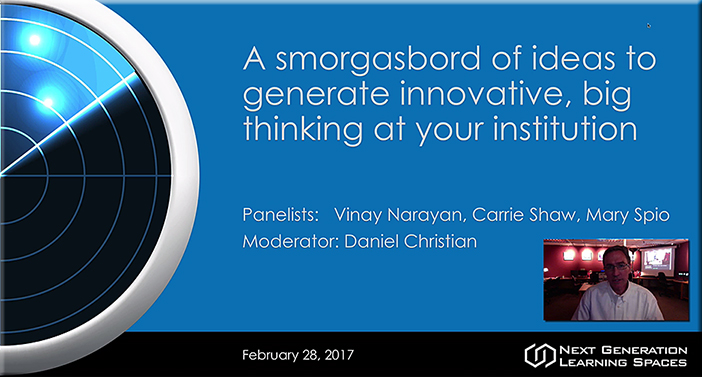
A smorgasboard of ideas to put on your organization’s radar! [Christian]

From DSC:
At the Next Generation Learning Spaces Conference, held recently in San Diego, CA, I moderated a panel discussion re: AR, VR, and MR.  I started off our panel discussion with some introductory ideas and remarks — meant to make sure that numerous ideas were on the radars at attendees’ organizations. Then Vinay and Carrie did a super job of addressing several topics and questions (Mary was unable to make it that day, as she got stuck in the UK due to transportation-related issues).

That said, I didn’t get a chance to finish the second part of the presentation which I’ve listed below in both 4:3 and 16:9 formats.  So I made a recording of these ideas, and I’m relaying it to you in the hopes that it can help you and your organization.


Presentations/recordings:


Audio/video recording (187 MB MP4 file)


Again, I hope you find this information helpful.

Thanks,
Daniel


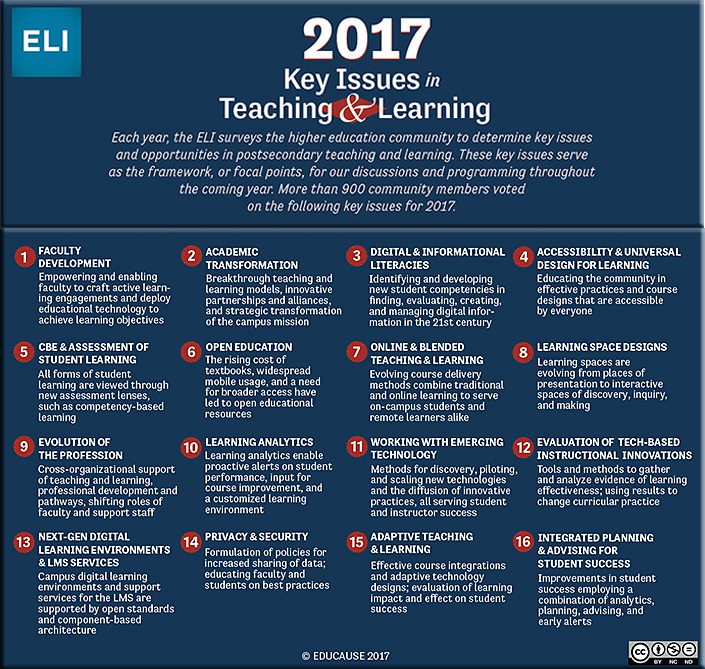
Key issues in teaching and learning 2017 — from Educause Learning Initiative (ELI)

Excerpt:

Since 2011, ELI has surveyed the higher education teaching and learning community to identify its key issues. The community is wide in scope: we solicit input from all those participating in the support of the teaching and learning mission, including professionals from the IT organization, the center for teaching and learning, the library, and the dean’s and provost’s offices.


HarvardX rolls out new adaptive learning feature in online course — from edscoop.com by Corinne Lestch
Students in MOOC adaptive learning experiment scored nearly 20 percent better than students using more traditional learning approaches.

Excerpt:

Online courses at Harvard University are adapting on the fly to students’ needs.

Officials at the Cambridge, Massachusetts, institution announced a new adaptive learning technology that was recently rolled out in a HarvardX online course. The feature offers tailored course material that directly correlates with student performance while the student is taking the class, as well as tailored assessment algorithms.

HarvardX is an independent university initiative that was launched in parallel with edX, the online learning platform that was created by Harvard and Massachusetts Institute of Technology. Both HarvardX and edX run massive open online courses. The new feature has never before been used in a HarvardX course, and has only been deployed in a small number of edX courses, according to officials.


From DSC:
Given the growth of AI, this is certainly radar worthy — something that’s definitely worth pulse-checking to see where opportunities exist to leverage these types of technologies.  What we now know of as adaptive learning will likely take an enormous step forward in the next decade.

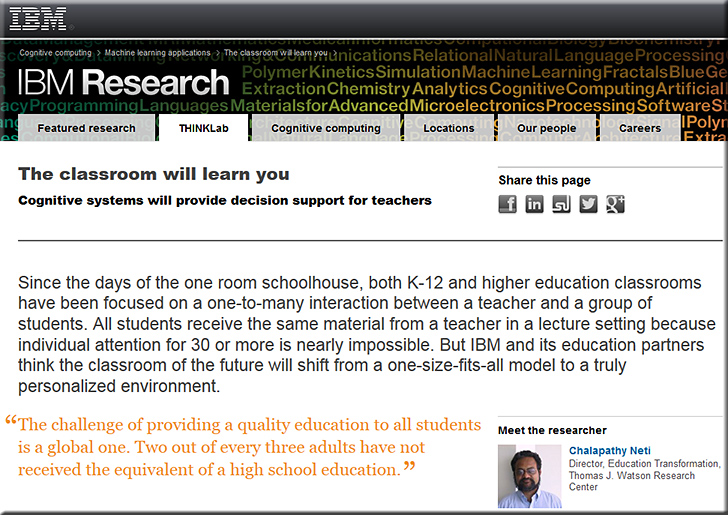
IBM’s assertion rings in my mind:


I’m cautiously hopeful that these types of technologies can extend beyond K-12 and help us deal with the current need to be lifelong learners, and the need to constantly reinvent ourselves — while providing us with more choice, more control over our learning. I’m hopeful that learners will be able to pursue their passions, and enlist the help of other learners and/or the (human) subject matter experts as needed.

I don’t see these types of technologies replacing any teachers, professors, or trainers. That said, these types of technologies should be able to help do some of the heavy teaching and learning lifting in order to help someone learn about a new topic.

Again, this is one piece of the Learning from the Living [Class] Room that we see developing.


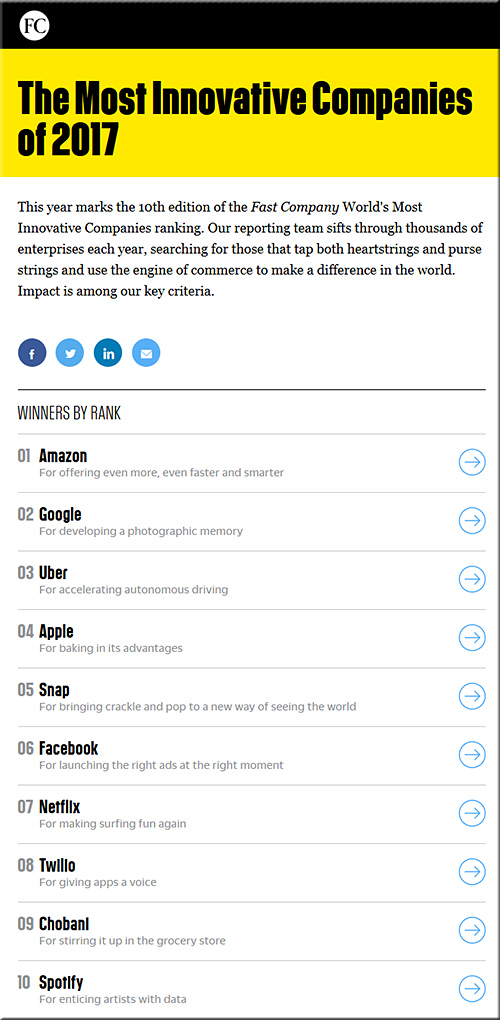
The Most Innovative Companies of 2017 — from fastcompany.com

Excerpt:

This year marks the 10th edition of the Fast Company World’s Most Innovative Companies ranking. Our reporting team sifts through thousands of enterprises each year, searching for those that tap both heartstrings and purse strings and use the engine of commerce to make a difference in the world. Impact is among our key criteria.


Speaking of innovation, this article is about innovation within the world of  higher education:

Crafting an Innovation Landscape — from er.educause.edu by Shirley Dugdale and Brian Strawn

Key Takeaways

  • As efforts to stimulate innovation spring up across campuses, institutions need a comprehensive planning framework for integrated planning of initiatives to support innovation.
  • Viewing the campus as an Innovation Landscape, settings for collaborative creative activity — both physical and virtual — infuse the campus fabric and become part of the daily experience of their users.
  • The Innovation Landscape Framework proposed here serves as a tool that can help coordinate physical planning with organizational initiatives, engage a wide range of stakeholders, and enable a culture of innovation across campus.


No hype, just fact: What artificial intelligence is – in simple business terms — from zdnet.com by Michael Krigsman
AI has become one of the great, meaningless buzzwords of our time. In this video, the Chief Data Scientist of Dun and Bradstreet explains AI in clear business terms.

Excerpt:

How do terms like machine learning, AI, and cognitive computing relate to one another?
They’re not synonymous. So, cognitive computing is very different than machine learning, and I will call both of them a type of AI. Just to try and describe those three. So, I would say artificial intelligence is all of that stuff I just described. It’s a collection of things designed to either mimic behavior, mimic thinking, behave intelligently, behave rationally, behave empathetically. Those are the systems and processes that are in the collection of soup that we call artificial intelligence.

Cognitive computing is primarily an IBM term. It’s a phenomenal approach to curating massive amounts of information that can be ingested into what’s called the cognitive stack. And then to be able to create connections among all of the ingested material, so that the user can discover a particular problem, or a particular question can be explored that hasn’t been anticipated.

Machine learning is almost the opposite of that. Where you have a goal function, you have something very specific that you try and define in the data. And, the machine learning will look at lots of disparate data, and try to create proximity to this goal function ? basically try to find what you told it to look for. Typically, you do that by either training the system, or by watching it behave, and turning knobs and buttons, so there’s unsupervised, supervised learning. And that’s very, very different than cognitive computing.


IBM to Train 25 Million Africans for Free to Build Workforce — from by Loni Prinsloo
* Tech giant seeking to bring, keep digital jobs in Africa
* Africa to have world’s largest workforce by 2040, IBM projects

Excerpt:

International Business Machines Corp. is ramping up its digital-skills training program to accommodate as many as 25 million Africans in the next five years, looking toward building a future workforce on the continent. The U.S. tech giant plans to make an initial investment of 945 million rand ($70 million) to roll out the training initiative in South Africa…


Also see:

IBM Unveils IT Learning Platform for African Youth — from investopedia.com by Tim Brugger

Excerpt (emphasis DSC):

Responding to concerns that artificial intelligence (A.I.) in the workplace will lead to companies laying off employees and shrinking their work forces, IBM (NYSE: IBM) CEO Ginni Rometty said in an interview with CNBC last month that A.I. wouldn’t replace humans, but rather open the door to “new collar” employment opportunities.

IBM describes new collar jobs as “careers that do not always require a four-year college degree but rather sought-after skills in cybersecurity, data science, artificial intelligence, cloud, and much more.”

In keeping with IBM’s promise to devote time and resources to preparing tomorrow’s new collar workers for those careers, it has announced a new “Digital-Nation Africa” initiative. IBM has committed $70 million to its cloud-based learning platform that will provide free skills development to as many as 25 million young people in Africa over the next five years.

The platform will include online learning opportunities for everything from basic IT skills to advanced training in social engagement, digital privacy, and cyber protection. IBM added that its A.I. computing wonder Watson will be used to analyze data from the online platform, adapt it, and help direct students to appropriate courses, as well as refine the curriculum to better suit specific needs.


From DSC:
That last part, about Watson being used to personalize learning and direct students to appropropriate courses, is one of the elements that I see in the Learning from the Living [Class]Room vision that I’ve been pulse-checking for the last several years. AI/cognitive computing will most assuredly be a part of our learning ecosystems in the future.  Amazon is currently building their own platform that adds 100 skills each day — and has 1000 people working on creating skills for Alexa.  This type of thing isn’t going away any time soon. Rather, I’d say that we haven’t seen anything yet!


The Living [Class] Room -- by Daniel Christian -- July 2012 -- a second device used in conjunction with a Smart/Connected TV


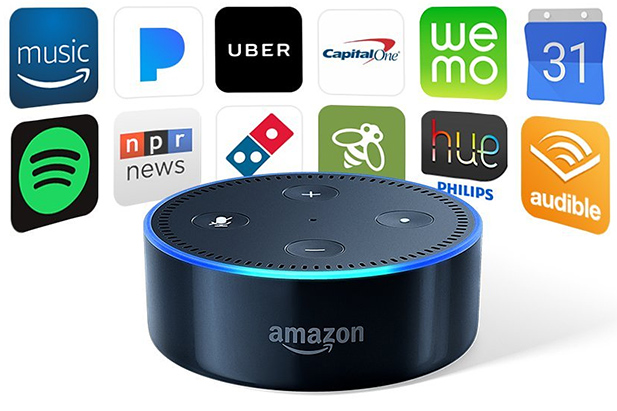
And Amazon has doubled down to develop Alexa’s “skills,” which are discrete voice-based applications that allow the system to carry out specific tasks (like ordering pizza for example). At launch, Alexa had just 20 skills, which has reportedly jumped to 5,200 today with the company adding about 100 skills per day.

In fact, Bezos has said, “We’ve been working behind the scenes for the last four years, we have more than 1,000 people working on Alexa and the Echo ecosystem … It’s just the tip of the iceberg.” Just last week, it launched a new website to help brands and developers create more skills for Alexa.

Source


Also see:


“We are trying to make education more personalised and cognitive through this partnership by creating a technology-driven personalised learning and tutoring,” Lula Mohanty, Vice President, Services at IBM, told ET. IBM will also use its cognitive technology platform, IBM Watson, as part of the partnership.

“We will use the IBM Watson data cloud as part of the deal, and access Watson education insight services, Watson library, student information insights — these are big data sets that have been created through collaboration and inputs with many universities. On top of this, we apply big data analytics,” Mohanty added.

Source


Also see:

  • Most People in Education are Just Looking for Faster Horses, But the Automobile is Coming — from etale.org by Bernard Bull
    Excerpt:
    Most people in education are looking for faster horses. It is too challenging, troubling, or beyond people’s sense of what is possible to really imagine a completely different way in which education happens in the world. That doesn’t mean, however, that the educational equivalent of the automobile is not on its way. I am confident that it is very much on its way. It might even arrive earlier than even the futurists expect. Consider the following prediction.


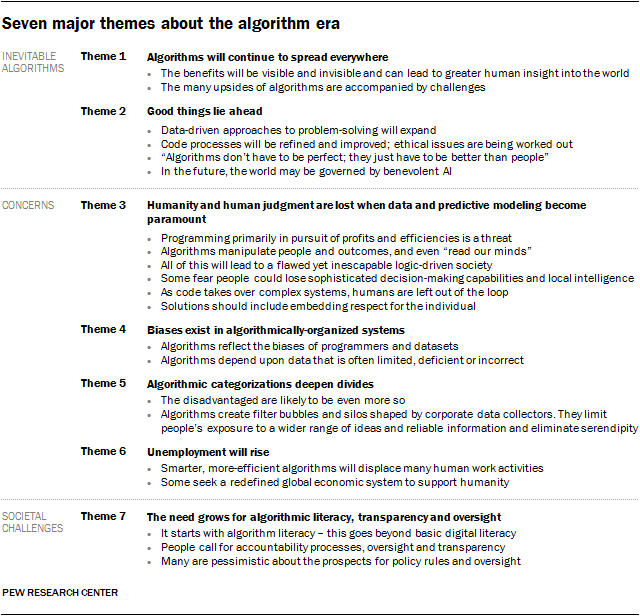
Code-Dependent: Pros and Cons of the Algorithm Age — from pewinternet.org by Lee Rainie and Janna Anderson
Algorithms are aimed at optimizing everything. They can save lives, make things easier and conquer chaos. Still, experts worry they can also put too much control in the hands of corporations and governments, perpetuate bias, create filter bubbles, cut choices, creativity and serendipity, and could result in greater unemployment

Excerpt:

Algorithms are instructions for solving a problem or completing a task. Recipes are algorithms, as are math equations. Computer code is algorithmic. The internet runs on algorithms and all online searching is accomplished through them. Email knows where to go thanks to algorithms. Smartphone apps are nothing but algorithms. Computer and video games are algorithmic storytelling. Online dating and book-recommendation and travel websites would not function without algorithms. GPS mapping systems get people from point A to point B via algorithms. Artificial intelligence (AI) is naught but algorithms. The material people see on social media is brought to them by algorithms. In fact, everything people see and do on the web is a product of algorithms. Every time someone sorts a column in a spreadsheet, algorithms are at play, and most financial transactions today are accomplished by algorithms. Algorithms help gadgets respond to voice commands, recognize faces, sort photos and build and drive cars. Hacking, cyberattacks and cryptographic code-breaking exploit algorithms. Self-learning and self-programming algorithms are now emerging, so it is possible that in the future algorithms will write many if not most algorithms.

Algorithms are often elegant and incredibly useful tools used to accomplish tasks. They are mostly invisible aids, augmenting human lives in increasingly incredible ways. However, sometimes the application of algorithms created with good intentions leads to unintended consequences. Recent news items tie to these concerns…


The use of algorithms is spreading as massive amounts of data are being created, captured and analyzed by businesses and governments. Some are calling this the Age of Algorithms and predicting that the future of algorithms is tied to machine learning and deep learning that will get better and better at an ever-faster pace.


Excerpt from Amazon fumbles earnings amidst high expectations (emphasis DSC):

Aside from AWS, Amazon Alexa-enabled devices were the top-selling products across all categories on Amazon.com throughout the holiday season and the company is reporting that Echo family sales are up over 9x compared to last season. Amazon aims to brand Alexa as a platform, something that has helped the product to gain capabilities faster than its competition. Developers and corporates released 4,000 new skills for the voice assistant in just the last quarter.


Alexa got 4,000 new skills in just the last quarter!

From DSC:
What are the teaching & learning ramifications of this?

By the way, I’m not saying for professors, teachers, & trainers to run for the hills (i.e., that they’ll be replaced by AI-based tools). But rather, I would like to suggest that we not only put this type of thing on our radars, but we should begin to actively experiment with such technologies to see if they might be able to help us do some heavy lifting for students learning about new topics.

 
© 2025 | Daniel Christian