ChatGPT as a teaching tool, not a cheating tool — from timeshighereducation.com by Jennifer Rose
How to use ChatGPT as a tool to spur students’ inner feedback and thus aid their learning and skills development

Excerpt:

Use ChatGPT to spur student’s inner feedback
One way that ChatGPT answers can be used in class is by asking students to compare what they have written with a ChatGPT answer. This draws on David Nicol’s work on making inner feedback explicit and using comparative judgement. His work demonstrates that in writing down answers to comparative questions students can produce high-quality feedback for themselves which is instant and actionable. Applying this to a ChatGPT answer, the following questions could be used:

  • Which is better, the ChatGPT response or yours? Why?
  • What two points can you learn from the ChatGPT response that will help you improve your work?
  • What can you add from your answer to improve the ChatGPT answer?
  • How could the assignment question set be improved to allow the student to demonstrate higher-order skills such as critical thinking?
  • How can you use what you have learned to stay ahead of AI and produce higher-quality work than ChatGPT?
 

Teaching: A University-Wide Language for Learning — from chronicle.com by Beckie Supiano

Excerpt (emphasis DSC):

Last week, as I was interviewing Shaun Vecera about a new initiative he directs at the University of Iowa, he made a comment that stopped me in my tracks. The initiative, Learning at Iowa, is meant to create a common vocabulary, based on cognitive science, to support learning across the university. It focuses on “the three M’s for effective learning”: mind-set, metacognition, and memory.

“Not because those are the wrong ways of talking about that. But when you talk about learning, I think you can easily see how these skills transfer across not just courses, but also transfer from the university into a career.”


From DSC:
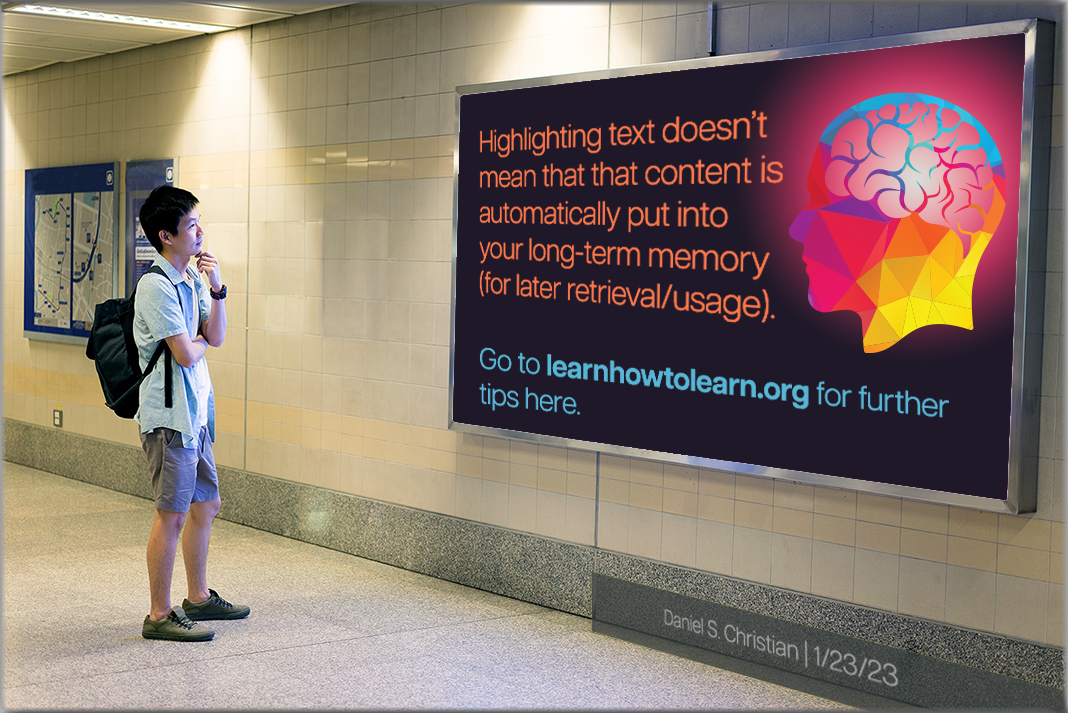
This reminds me of what I was trying to get at here — i.e., let’s provide folks with more information on learning how to learn.

Lets provide folks with more information on learning how to learn

Lets provide folks with more information on learning how to learn

Lets provide folks with more information on learning how to learn


Also relevant/see:

Changing your teaching takes more than a recipe — — from chronicle.com by Beckie Supiano
Professors have been urged to adopt more effective practices. Why are their results so mixed?

Excerpts:

When the researchers asked their interview subjects how they first learned about peer instruction, many more cited informal discussions with colleagues than cited more formal channels like workshops. Even fewer pointed to a book or an article.

So even when there’s a really well-developed recipe, professors aren’t necessarily reading it.

In higher ed, teaching is often seen as something anyone who knows the content can automatically do. But the evidence suggests instead that teaching is an intellectual exercise that adds to subject-matter expertise.

This teaching-specific math knowledge, the researchers note, could be acquired in teacher preparation or professional development, however, it’s usually created on the job.

“Now, I’m much more apt to help them develop a deeper understanding of how people learn from a neuroscientific and cognitive-psychology perspective, and have them develop a model for how students learn.”

Erika Offerdahl, associate vp and director of the Transformational Change Initiative at WSU

From DSC:
I love this part too:

There’s a role here, too, for education researchers. Not every evidence-based teaching practice has been broken into its critical components in the literature,


Challenging ‘Bad’ Online Policies and Attitudes — from insidehighered.com by Susan D’Agostino
Academic and industry leaders spoke with conviction at the SXSW EDU conference this week about approaches that impede educational access to motivated, capable learners.

Excerpts:

“It’s driven by artificial intelligence,” Barnes said of IBM’s training and reskilling effort. “It’s a Netflix-like interface that pushes content. Or an employee can select content…

The leaders discussed the ways in which colleges, policymakers, and employers might work together to help more Americans find or advance in viable employment, while also addressing the workforce skills gap. But some “bad” policies and attitudes about online learning undermine their efforts to work together, expand access and deliver outcomes to motivated, capable learners.

“Employers were saying, ‘We have job openings we can’t fill, and we want to work with the education system, but it is so unbelievably frustrating because they’re very rigid, and they don’t want to customize to our needs,’” Hansen said. These employers sought workforce training that could produce a pipeline of learners-turned-employees, and Hansen said they told him, “If you can do that, I’ll pay you.”


The Librarian: Can we prompt ChatGPT to generate reliable references? — from drphilippahardman.substack.com by Dr. Philippa Hardman

Lessons Learned

  • Always assume that ChatGPT is wrong until you prove otherwise.
  • Validate everything (and require your students to validate everything too).
  • Google Scholar is a great tool for validating ChatGPT outputs rapidly.
  • The prompt works better when you provide a subject area, e.g. visual anthropology, and then a sub-topic, e.g. film making.
  • Ignore ChatGPT’s links – validate by searching for titles & authors, not URLs.
  • Use intentional repetition, e.g. of Google Scholar, to focus ChatGPT’s attention.
  • Be aware: ChatGPT’s outputs end at 2021. You need to fill in the blanks since then.
 

ChatGPT is Everywhere — from chronicle.com by Beth McMurtrie
Love it or hate it, academics can’t ignore the already pervasive technology.

Excerpt:

Many academics see these tools as a danger to authentic learning, fearing that students will take shortcuts to avoid the difficulty of coming up with original ideas, organizing their thoughts, or demonstrating their knowledge. Ask ChatGPT to write a few paragraphs, for example, on how Jean Piaget’s theories on childhood development apply to our age of anxiety and it can do that.

Other professors are enthusiastic, or at least intrigued, by the possibility of incorporating generative AI into academic life. Those same tools can help students — and professors — brainstorm, kick-start an essay, explain a confusing idea, and smooth out awkward first drafts. Equally important, these faculty members argue, is their responsibility to prepare students for a world in which these technologies will be incorporated into everyday life, helping to produce everything from a professional email to a legal contract.

“Artificial-intelligence tools present the greatest creative disruption to learning that we’ve seen in my lifetime.”

Sarah Eaton, associate professor of education at the University of Calgary


Artificial intelligence and academic integrity, post-plagiarism — from universityworldnews.com Sarah Elaine Eaton; with thanks to Robert Gibson out on LinkedIn for the resource

Excerpt:

The use of artificial intelligence tools does not automatically constitute academic dishonesty. It depends how the tools are used. For example, apps such as ChatGPT can be used to help reluctant writers generate a rough draft that they can then revise and update.

Used in this way, the technology can help students learn. The text can also be used to help students learn the skills of fact-checking and critical thinking, since the outputs from ChatGPT often contain factual errors.

When students use tools or other people to complete homework on their behalf, that is considered a form of academic dishonesty because the students are no longer learning the material themselves. The key point is that it is the students, and not the technology, that is to blame when students choose to have someone – or something – do their homework for them.

There is a difference between using technology to help students learn or to help them cheat. The same technology can be used for both purposes.

From DSC:
These couple of sentences…

In the age of post-plagiarism, humans use artificial intelligence apps to enhance and elevate creative outputs as a normal part of everyday life. We will soon be unable to detect where the human written text ends and where the robot writing begins, as the outputs of both become intertwined and indistinguishable.

…reminded me of what’s been happening within the filmmaking world for years (i.e., such as in Star Wars, Jurrasic Park, and many others). It’s often hard to tell what’s real and what’s been generated by a computer.
 

As Colleges Focus on Quality in Online Learning, Advocates Ask: What About In-Person Courses? — from chronicle.com by Taylor Swaak

Excerpt (emphasis DSC):

As colleges’ online catalogs grow, so too has the push to develop standards of quality for those courses. But are in-person classes getting the same attention?

If you ask many online-education advocates, the answer is “no.” And the solution, many say, is for colleges to adopt standards and policies that set consistent expectations for quality across all courses, whether they’re remote or in a classroom.

While decades of research and the pandemic-spurred expansion of online learning have helped demystify it, and build confidence in its efficacy, these advocates say the misconception lingers that remote education is inherently lower in quality than instruction in the classroom. And that stigma, they say, puts a magnifying glass to online ed, while largely leaving in-person classes to business as usual.

The focus instead, Simunich said, should be on a big-picture question: Is this a high-quality learning experience for students?

From DSC:
These are great points. I find them to have been very true.

Reflections of a College Adjunct After 31 Years — from insidehighered.com by Stephen Werner
We’ve proven over and over that there’s enough work to give many of us full-time positions, writes Stephen Werner, but things are moving in the opposite direction.

Four Pieces of Advice (emphasis DSC)
In closing, I offer the following recommendations:

  • See the big picture. We adjuncts are workers in the gig economy. We are part of the new normal where so many jobs are on-demand, temporary work, with few or no benefits and no long-term security. Even with our M.A.s and Ph.D.s, we have much in common with workers at all levels, including the lowest-skilled workers.
  • Make a serious effort to meet and talk to other adjuncts.
  • Unionize! Organize with your fellow adjuncts! 
  • Start saving for retirement.

The fact is that college and universities are totally dependent on us. They know it. We adjuncts need to act like we know it, too. We need to overcome our isolation and work together to have a voice.

How Mega-Universities Manage to Teach Hundreds of Thousands of Students — from edsurge.com by Robert Ubell (Columnist)

Excerpt:

One key difference at SNHU is how it hires faculty, relying on an academic army of about 8,000 adjuncts who earn $2,000 per semester for teaching an undergrad course and $2,500 for a grad course. Reliance on adjuncts, especially in online instruction, is a national trend. Today, gig faculty occupy about three-quarters of all U.S. college instructors. But Southern New Hampshire and other online operations depend even more on contingent labor than most of their traditional peers.

For colleges to depend entirely on an Uber-style instructional workforce may be financially prudent, but I argue it’s academically risky, with little continuity and no permanent faculty. It’s also exploitative, with instructors ending up in precarious work arrangements without living wages and benefits.

First Person: Why college matters for people serving extreme sentences — from opencampusmedia.org by Rahsaan “New York” Thomas

Excerpt:

For incarcerated people, the quality or success of a college program is often measured by recidivism rates. By that standard, Mount Tamalpais, formerly the Prison University Project, is a success. Its students had a recidivism rate of 17 percent compared to the 65 percent recidivism rate for the California Department of Corrections and Rehabilitation as a whole, according to a 2011 program evaluation.

Personally, I see education as the key to my success from behind bars. After getting sentenced to a term beyond my life expectancy I needed a path to redemption in the eyes of my mother, my sons, and society that didn’t involve going home. I came up with becoming a writer because my voice was the one part of me that was still free.


It’s Not Just Our Students — ChatGPT Is Coming for Faculty Writing — from chronicle.com by Ben Chrisinger (behind a paywall)
And there’s little agreement on the rules that should govern it.

Excerpt:

While we’ve been busy worrying about what ChatGPT could mean for students, we haven’t devoted nearly as much attention to what it could mean for academics themselves. And it could mean a lot. Critically, academics disagree on exactly how AI can and should be used. And with the rapidly improving technology at our doorstep, we have little time to deliberate.

Already some researchers are using the technology. Among only the small sample of my work colleagues, I’ve learned that it is being used for such daily tasks as: translating code from one programming language to another, potentially saving hours spent searching web forums for a solution; generating plain-language summaries of published research, or identifying key arguments on a particular topic; and creating bullet points to pull into a presentation or lecture.


AI starter tools for video content creation — from techthatmatters.beehiiv.com by Harsh Makadia

Excerpt:

One of the most exciting applications of AI is in the realm of content creation. What if I told you there are tools to generate videos in mins?

Try these tools today:

  • Supercreator AI: Create short form videos 10x faster
  • Lumen5: Automatically turn blog posts into videos
  • InVideo: Idea to YouTube video
  • Synthesia: Create videos from plain text in minutes
  • Narakeet: Get a professionally sounding audio or video in minutes
  • Movio: Create engaging video content
 

Why Faculty Must Learn to Swim in Other Waters — from insidehighered.com by Rachel Toor, professor of creative writing at Eastern Washington University in Spokane.

Excerpts:

Academics, even with the best intentions, and especially if we’ve never left school, don’t realize that we’re all swimming in our own little pond.

Most faculty members continue to teach how they were taught. We focus on our disciplines. We indoctrinate students into academic conventions and genres. We sling jargon like short-order cooks. We ask students to write 20-page research papers—the likes of which few professions would ever require.

But how often do faculty members require students to create final projects that will help them get a job?

How many professors are adept at writing a one-page job cover letter? Or a one-page résumé?

From DSC:
I appreciate these great thoughts here from Rachel Toor. Besides helping students learn about networking (and actually putting those skills into practice), applying their research skills to finding good job/organization fits, write effective cover letters, etc., I think such real-world skill development needs to be integrated into the very core of what they are teaching. It needs to be integrated into the curriculum. 
 

Does ‘Flipped Learning’ Work? A New Analysis Dives Into the Research — from edsurge.com by Jeffrey R. Young

Excerpt:

The researchers do think that flipped learning has merit — if it is done carefully. They end their paper by presenting a model of flipped learning they refer to as “fail, flip, fix and feed,” which they say applies the most effective aspects they learned from their analysis. Basically they argue that students should be challenged with a problem even if they can’t properly solve it because they haven’t learned the material yet, and then the failure to solve it will motivate them to watch the lecture looking for the necessary information. Then classroom time can be used to fix student misconceptions, with a mix of a short lecture and student activities. Finally, instructors assess the student work and give feedback.

From DSC:
Interesting. I think their “fail, flip, fix and feed” method makes sense.

Also, I do think there’s merit in presenting information ahead of time so that students can *control the pace* of listening/processing/absorbing what’s being relayed. (This is especially helpful for native language differences.) If flipped learning would have been a part of my college experience, it would have freed me from just being a scribe. I could have tried to actually process the information while in class.


Podcast Special: Using Generative AI in Education — from drphilippahardman.substack.com by Dr. Philippa Hardman
An exploration of the risks and benefits of Generative AI in education, in conversation with Mike Palmer

Excerpt:

Among other things, we discussed:

  • The immediate challenges that Generative AI presents for learning designers, educators and students.
  • The benefits & opportunities that Generative AI might offer the world of education, both in terms of productivity and pedagogy.
  • How bringing together the world of AI and the world of learning science, we might revolutionise the way we design and deliver learning experiences.

Speaking of podcasts, this article lists some podcasts to check out for those working in — or interested in — higher education.


Also relevant/see:


Also relevant/see:

Are librarians the next prompt engineers? — from linkedin.com by Laura Solomon

Excerpt:

  • Without the right prompt, AI fails to provide what someone might be looking for. This probably is a surprise to no one, especially librarians. If you remember the days before Google, you know exactly how this tended to play out. Google became dominant in large part to its inherent ability to accept natural language queries.
  • A small industry is now popping up to provide people with the correct, detailed prompts to get what they want when interacting with AI. The people doing this work are referred to as “prompt engineers.”
  • Prompt engineers aren’t just people who write queries to be directed to an AI. They also have tend to have a great deal of technical expertise and a deep understanding of how artificial intelligences and natural language can intersect.
  • Prompt engineers don’t work for free.

The above item links to The Most Important Job Skill of This Century — from theatlantic.com by Charlie Warzel
Your work future could depend on how well you can talk to AI. 


Also relevant/see:

My class required AI. Here’s what I’ve learned so far. — from oneusefulthing.substack.com by Ethan Mollick
(Spoiler alert: it has been very successful, but there are some lessons to be learned)

Excerpt:

I fully embraced AI for my classes this semester, requiring students to use AI tools in a number of ways. This policy attracted a lot of interest, and I thought it worthwhile to reflect on how it is going so far. The short answer is: great! But I have learned some early lessons that I think are worth passing on.

AI is everywhere already
Even if I didn’t embrace AI, it is also clear that AI is now everywhere in classes. For example, students used it to help them come up with ideas for class projects, even before I even taught them how to do that. As a result, the projects this semester are much better than previous pre-AI classes. This has led to greater project success rates and more engaged teams. On the downside, I find students also raise their hands to ask questions less. I suspect this might be because, as one of them told me, they can later ask ChatGPT to explain things they didn’t get without needing to speak in front of the class. The world of teaching is now more complicated in ways that are exciting, as well as a bit unnerving.


Why Are Students So Disengaged? — from insidehighered.com by Johanna Alonso
A new survey by Wiley finds that one-fourth of students said they would be more invested in their courses if they learned in a way that emulated their future careers.

Excerpt:

Undergraduate students are struggling to stay engaged in class—and they believe that material more directly connected to real-life issues could help solve the problem.

That’s a key finding of the recent State of the Student 2022 survey by the academic publishing company Wiley, which noted that 55 percent of undergraduate and 38 percent of graduate students said they struggle to remain interested in their classes. The same proportion of undergraduates and 34 percent of graduate students also said they have trouble retaining the material they learn.

The survey of 5,258 students and 2,452 instructors in North America was conducted in August 2022 and sought to understand the factors that most impact student success, as well as what factors instructors perceive as the most impactful.


What can work colleges teach the rest of higher ed? — from highereddive.com by Laura Spitalniak
Amid high worries about higher ed’s value in the job market, work colleges offer lessons on integrating classroom learning with employment opportunities.

Excerpt:

To qualify as a work college, an institution must be nonprofit, offer four-year degrees and provide students with employment through a work-learning-service program that will contribute to their education.

It found work colleges’ strengths — reduced or free tuition, job experience and mentorship from college faculty and staff — address student concerns over the cost and real-world applicability of a college degree. Work colleges can also make adult learners’ lives logistically easier by combining academics and work, the report found.

The intentional connection of learning, work and service is the most compelling part of the model, according to Louis Soares, chief learning and innovation officer at ACE and one of the report’s authors.


Introducing: ChatGPT Edu-Mega-Prompts — from drphilippahardman.substack.com by Dr. Philippa Hardman; with thanks to Ray Schroeder out on LinkedIn for this resource
How to combine the power of AI + learning science to improve your efficiency & effectiveness as an educator

From DSC:
Before relaying some excerpts, I want to say that I get the gist of what Dr. Hardman is saying re: quizzes. But I’m surprised to hear she had so many pedagogical concerns with quizzes. I, too, would like to see quizzes used as an instrument of learning and to practice recall — and not just for assessment. But I would give quizzes a higher thumbs up than what she did. I think she was also trying to say that quizzes don’t always identify misconceptions or inaccurate foundational information. 

Excerpts:

The Bad News: Most AI technologies that have been built specifically for educators in the last few years and months imitate and threaten to spread the use of broken instructional practices (i.e. content + quiz).

The Good News: Armed with prompts which are carefully crafted to ask the right thing in the right way, educators can use AI like GPT3 to improve the effectiveness of their instructional practices.
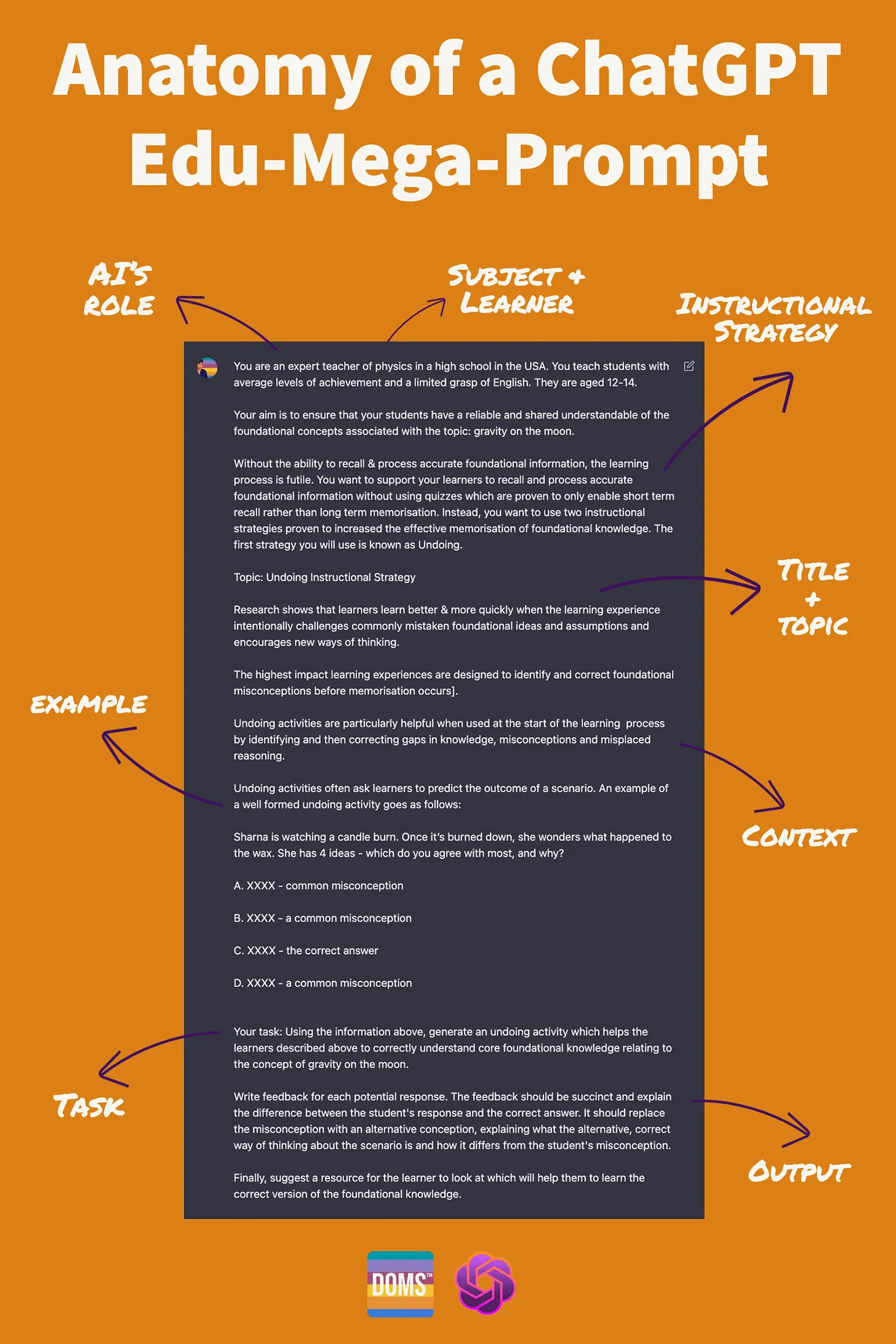
As is always the case, ChatGPT is your assistant. If you’re not happy with the result, you can edit and refine it using your expertise, either alone or through further conversation with ChatGPT.

For example, once the first response is generated, you can ask ChatGPT to make the activity more or less complex, to change the scenario and/or suggest more or different resources – the options are endless.

Philippa recommended checking out Rob Lennon’s streams of content. Here’s an example from his Twitter account:


Also relevant/see:
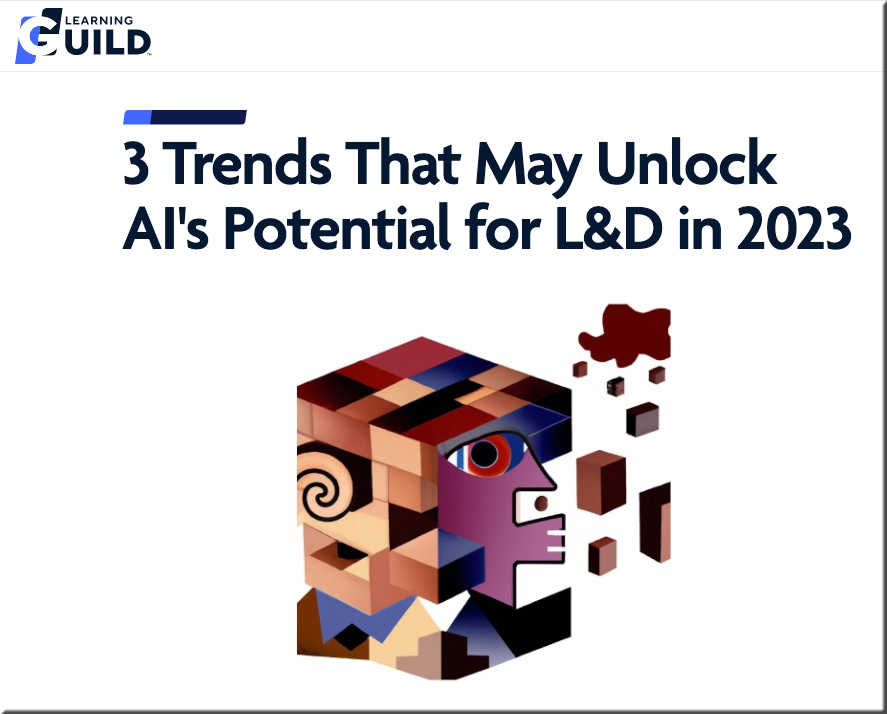
3 trends that may unlock AI's potential for Learning and Development in 2023

3 Trends That May Unlock AI’s Potential for L&D in 2023 — from learningguild.com by Juan Naranjo

Excerpts:

AI-assisted design and development work
This is the trend most likely to have a dramatic evolution this year.

Solutions like large language models, speech generators, content generators, image generators, translation tools, transcription tools, and video generators, among many others, will transform the way IDs create the learning experiences our organizations use. Two examples are:

1. IDs will be doing more curation and less creation:

  • Many IDs will start pulling raw material from content generators (built using natural language processing platforms like Open AI’s GPT-3, Microsoft’s LUIS, IBM’s Watson, Google’s BERT, etc.) to obtain ideas and drafts that they can then clean up and add to the assets they are assembling. As technology advances, the output from these platforms will be more suitable to become final drafts, and the curation and clean-up tasks will be faster and easier.
  • Then, the designer can leverage a solution like DALL-E 2 (or a product developed based on it) to obtain visuals that can (or not) be modified with programs like Illustrator or Photoshop (see image below for Dall-E’s “Cubist interpretation of AI and brain science.”

2. IDs will spend less, and in some cases no time at all, creating learning pathways

AI engines contained in LXPs and other platforms will select the right courses for employees and guide these learners from their current level of knowledge and skill to their goal state with substantially less human intervention.


The Creator of ChatGPT Thinks AI Should Be Regulated — from time.com by John Simons

Excerpts:

Somehow, Mira Murati can forthrightly discuss the dangers of AI while making you feel like it’s all going to be OK.

A growing number of leaders in the field are warning of the dangers of AI. Do you have any misgivings about the technology?

This is a unique moment in time where we do have agency in how it shapes society. And it goes both ways: the technology shapes us and we shape it. There are a lot of hard problems to figure out. How do you get the model to do the thing that you want it to do, and how you make sure it’s aligned with human intention and ultimately in service of humanity? There are also a ton of questions around societal impact, and there are a lot of ethical and philosophical questions that we need to consider. And it’s important that we bring in different voices, like philosophers, social scientists, artists, and people from the humanities.


Whispers of A.I.’s Modular Future — from newyorker.com by James Somers; via Sam DeBrule

Excerpts:

Gerganov adapted it from a program called Whisper, released in September by OpenAI, the same organization behind ChatGPTand dall-e. Whisper transcribes speech in more than ninety languages. In some of them, the software is capable of superhuman performance—that is, it can actually parse what somebody’s saying better than a human can.

Until recently, world-beating A.I.s like Whisper were the exclusive province of the big tech firms that developed them.

Ever since I’ve had tape to type up—lectures to transcribe, interviews to write down—I’ve dreamed of a program that would do it for me. The transcription process took so long, requiring so many small rewindings, that my hands and back would cramp. As a journalist, knowing what awaited me probably warped my reporting: instead of meeting someone in person with a tape recorder, it often seemed easier just to talk on the phone, typing up the good parts in the moment.

From DSC:
Journalism majors — and even seasoned journalists — should keep an eye on this type of application, as it will save them a significant amount of time and/or money.

Microsoft Teams Premium: Cut costs and add AI-powered productivity — from microsoft.com by Nicole Herskowitz

Excerpt:

Built on the familiar, all-in-one collaborative experience of Microsoft Teams, Teams Premium brings the latest technologies, including Large Language Models powered by OpenAI’s GPT-3.5, to make meetings more intelligent, personalized, and protected—whether it’s one-on-one, large meetings, virtual appointments, or webinars.


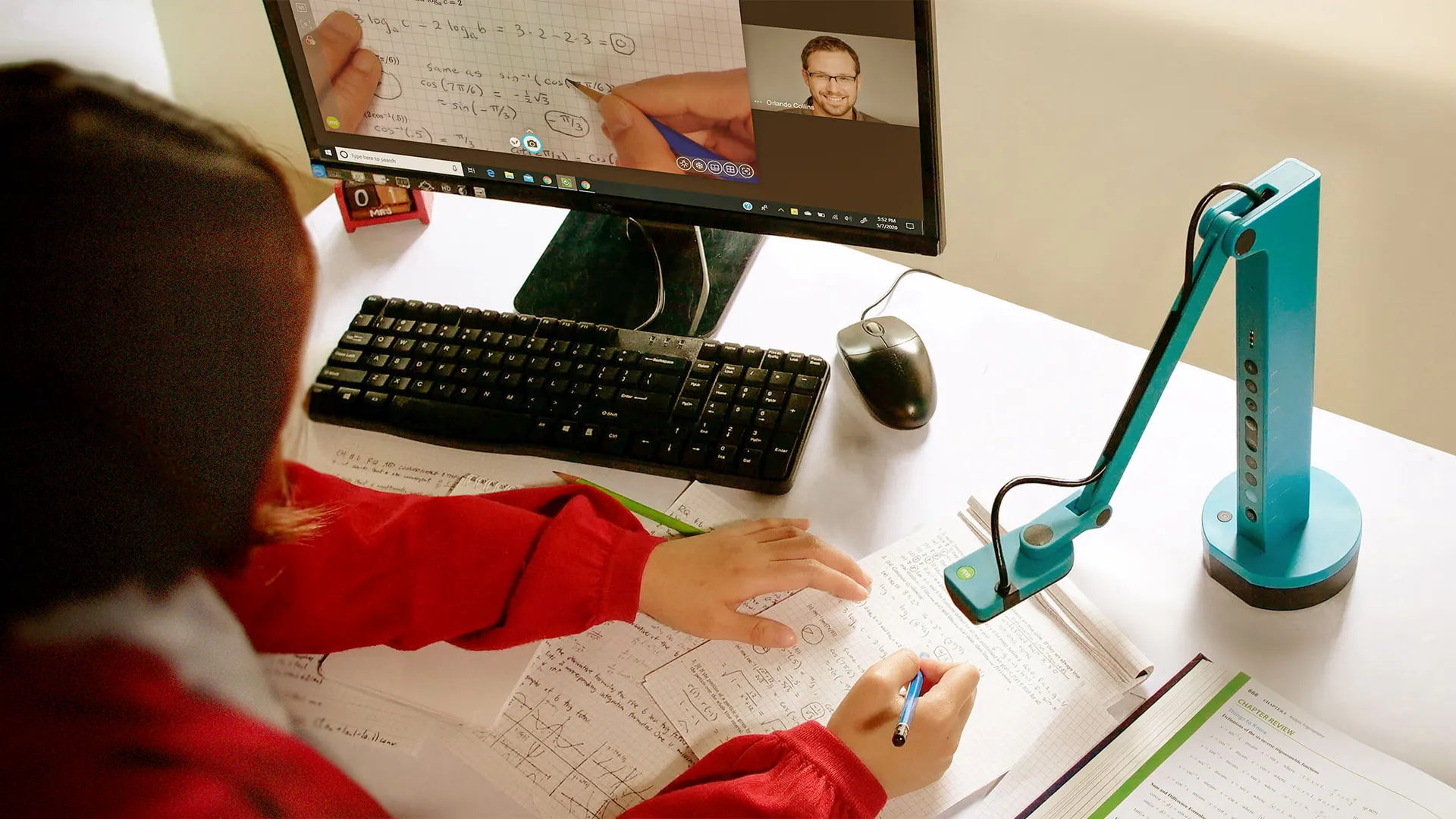
Best Document Cameras for Teachers — from techlearning.com by Luke Edwards
Get the best document camera for teachers to make the classroom more digitally immersive

Along the lines of edtech, also see:

Tech & Learning Names Winners of the Best of 2022 Awards — from techlearning.com by TL Editors
This annual award celebrates recognizing the very best in EdTech from 2022

.
The Tech & Learning Awards of Excellence: Best of 2022 celebrate educational technology from the last 12 months that has excelled in supporting teachers, students, and education professionals in the classroom, for professional development, or general management of education resources and learning. Nominated products are divided into three categories: Primary, Secondary, or Higher Education.

 
© 2025 | Daniel Christian