Educator considerations for ChatGPT — from platform.openai.com; with thanks to Anna Mills for this resource

Excerpt:

Streamlined and personalized teaching
Some examples of how we’ve seen educators exploring how to teach and learn with tools like ChatGPT:

  • Drafting and brainstorming for lesson plans and other activities
  • Help with design of quiz questions or other exercises
  • Experimenting with custom tutoring tools
  • Customizing materials for different preferences (simplifying language, adjusting to different reading levels, creating tailored activities for different interests)
  • Providing grammatical or structural feedback on portions of writing
  • Use in upskilling activities in areas like writing and coding (debugging code, revising writing, asking for explanations)
  • Critique AI generated text

While several of the above draw on ChatGPT’s potential to be explored as a tool for personalization, there are risks associated with such personalization as well, including student privacy, biased treatment, and development of unhealthy habits. Before students use tools that offer these services without direct supervision, they and their educators should understand the limitations of the tools outlined below.

Also relevant/see:

Excerpt (emphasis DSC):
David Wiley wrote a thoughtful post on the ways in which AI and Large Language Models (LLMs) can “provide instructional designers with first drafts of some of the work they do.” He says “imagine you’re an instructional designer who’s been paired with a faculty member to create a course in microeconomics. These tools might help you quickly create first drafts of” learning outcomes, discussion prompts, rubrics, and formative assessment items.  The point is that LLMs can quickly generate rough drafts that are mostly accurate drafts, that humans can then “review, augment, and polish,” potentially shifting the work of instructional designers from authors to editors. The post is well worth your time.

The question that I’d like to spend some time thinking about is the following: What new knowledge, capacities, and skills do  instructional designers need in their role as editors and users of LLMs?

This resonated with me. Instructional Designer positions are starting to require AI and ML chops. I’m introducing my grad students to AI and ChatGPT this semester. I have an assignment based on it.

(This ain’t your father’s instructional design…)

Robert Gibson


Take Your Words From Lecture to Page — from chronicle.com by Rachel Toor
What compelling lecturers do, and how their techniques can translate to good writing.

Excerpts:

Thing is, many of the moves that the best lecturers make on the stage can translate to the page and help you draw in readers. That is especially important in writing textbooks and other work for general readers. If you can bring the parts of yourself that work in the classroom to the prose, you will delight readers as much as you do your students.

Narrative can be key. Data and research aren’t enough in either the classroom or on the page. People like to be told stories. If you want to be persuasive in both realms, use narrative to make arguments. Don’t forget that much scholarly work is really a quest. What journey can you take a reader on?

It’s a performance on the page, too. A great lecture is a performance. So is great writing.

Raise real questions the reader will want answers to. 


ChatGPT can’t be credited as an author, says world’s largest academic publisher — from theverge.com by James Vincent; with thanks to Robert Gibson on LinkedIn for the resource
But Springer Nature, which publishes thousands of scientific journals, says it has no problem with AI being used to help write research — as long as its use is properly disclosed.

Excerpt:

Springer Nature, the world’s largest academic publisher, has clarified its policies on the use of AI writing tools in scientific papers. The company announced this week that software like ChatGPT can’t be credited as an author in papers published in its thousands of journals. However, Springer says it has no problem with scientists using AI to help write or generate ideas for research, as long as this contribution is properly disclosed by the authors.


On somewhat-related notes:

Uplevel your prompt craft in ChatGPT with the CREATE framework — from edte.ch by Tom Barrett

Excerpt:

The acronym “CREATE” is a helpful guide for crafting high-quality prompts for AI tools. Each letter represents an important step in the process.

The first four CREA are all part of prompt writing, where TE, the final two are a cycle of reviewing and editing your prompts.

Let’s look at each in more detail, with some examples from ChatGPT to help.

BuzzFeed to Use ChatGPT Creator OpenAI to Help Create Quizzes and Other Content — from wsj.com by Alexandra Bruell (behind paywall)
CEO Jonah Peretti intends for artificial intelligence to play a larger role in the company this year


Retrieval Practice, Scaffolding, and the Socratic Method — from scholarlyteacher.com by Todd Zakrajsek
Revisit the Socratic method by using it to enact retrieval practice and scaffolding in courses and refresh thinking about applying recommendations from the Scholarship of Teaching and Learning (SOTL)

Excerpt:

When students think they know course material because they have collected reams and reams of information, retrieval practice, much like Socratic questioning, forces students to stop, think, reflect, and reconsider. It meets students where they are (e.g., overwhelmed with information), encourages effortful struggle associated with learning (e.g., presents a desirable difficulty), and offers the discipline of practice (or, perhaps, the practice of discipline). The goal of retrieval practice, getting information out, reflects the goal of so many of Socrates’s questions, to make his interlocutors give an account of and become more aware of their thinking.

When faculty chunk up material, assist students as they move through Bloom’s taxonomy, model approaches to help students get started and maintain momentum, make the student an active participant in developing and reflecting on knowledge, they are incorporating key elements of some of the most important recommendations from the Scholarship of Teaching and Learning. All these techniques help students build or generate knowledge.


From DSC:
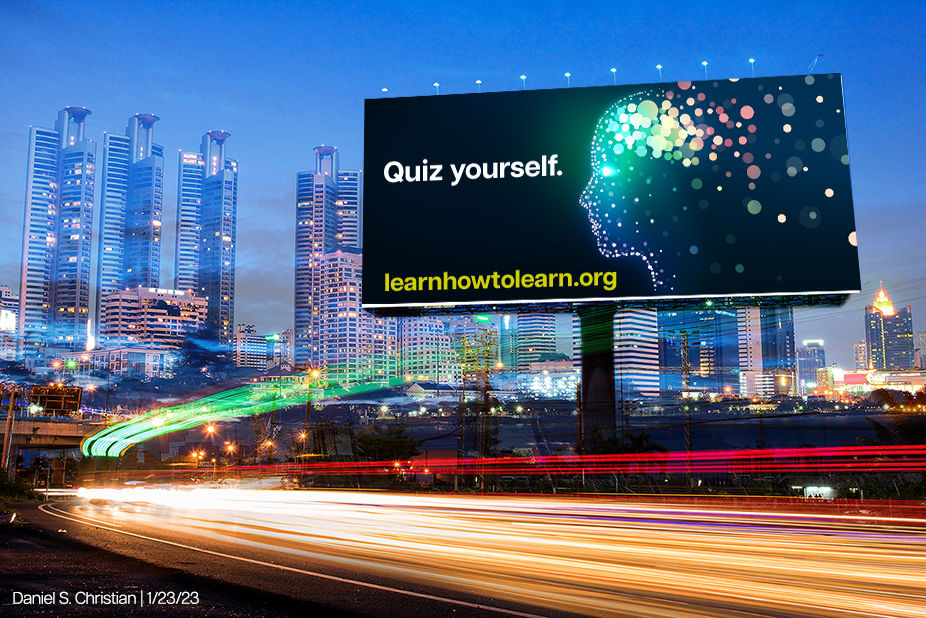
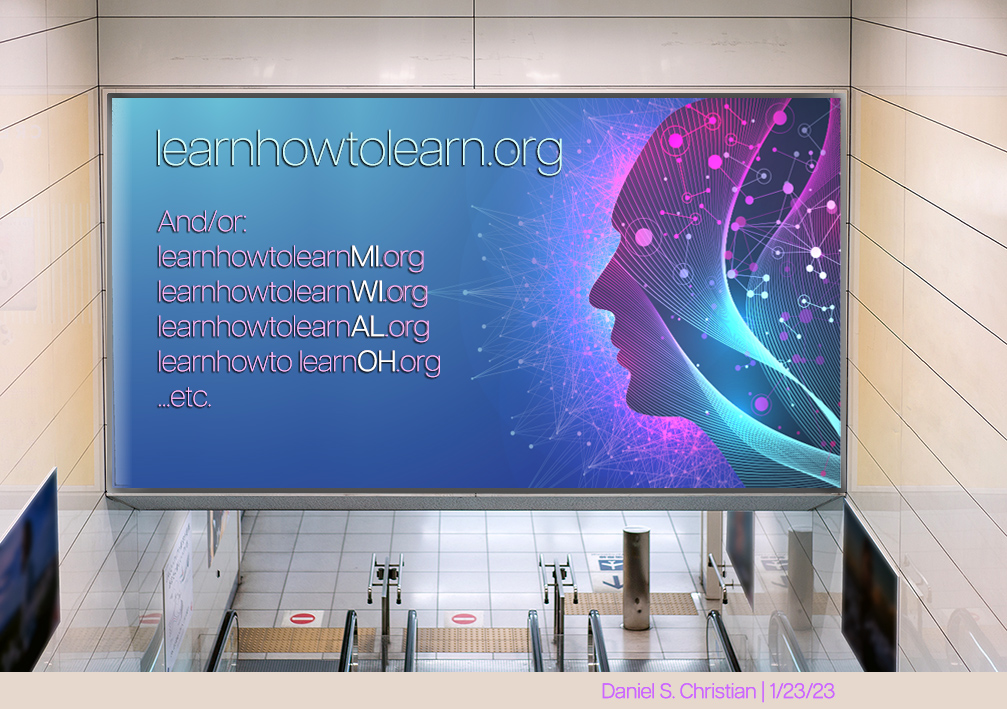
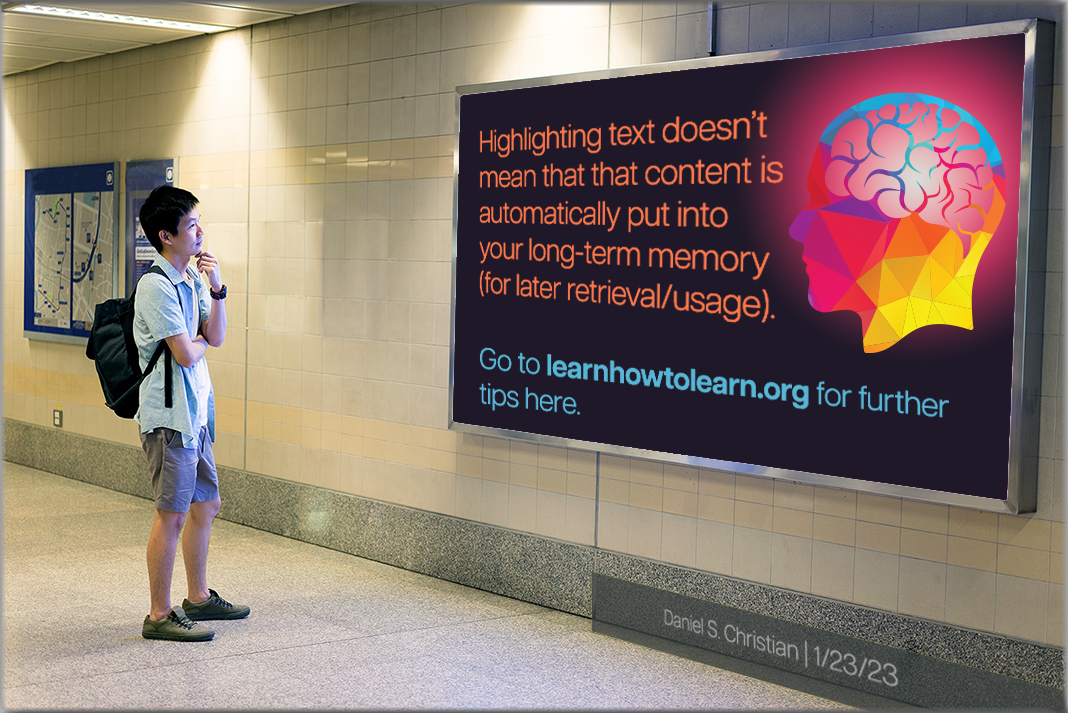
Let’s put together a nationwide campaign that would provide a website — or a series of websites if an agreement can’t be reached amongst the individual states — about learning how to learn. In business, there’s a “direct-to-consumer” approach. Well, we could provide a “direct-to-learner” approach — from cradle to grave. Seeing as how everyone is now required to be a lifelong learner, such a campaign would have enormous benefits to all of the United States. This campaign would be located in airports, subway stations, train stations, on billboards along major highways, in libraries, and in many more locations.

We could focus on things such as:

  • Quizzing yourself / retrieval practice
  • Spaced retrieval
  • Interleaving
  • Elaboration
  • Chunking
  • Cognitive load
  • Learning by doing (active learning)
  • Journaling
  • The growth mindset
  • Metacognition (thinking about one’s thinking)
  • Highlighting doesn’t equal learning
  • There is deeper learning in the struggle
  • …and more.

A learn how to learn campaign covering airports, billboards, subways, train stations, highways, and more


A learn how to learn campaign covering airports, billboards, subways, train stations, highways, and more


A learn how to learn campaign covering airports, billboards, subways, train stations, highways, and more


A learn how to learn campaign covering airports, billboards, subways, train stations, highways, and more


NOTE:
The URL I’m using above doesn’t exist, at least not at the time of this posting.
But I’m proposing that it should exist.


A group of institutions, organizations, and individuals could contribute to this. For example The Learning Scientists, Daniel Willingham, Donald Clark, James Lang, Derek Bruff, The Learning Agency Lab, Robert Talbert, Pooja Agarwal and Patrice Bain, Eva Keffenheim, Benedict Carey, Ken Bain, and many others.

Perhaps there could be:

  • discussion forums to provide for social interaction/learning
  • scheduled/upcoming webinars
  • how to apply the latest evidence-based research in the classroom
  • link(s) to learning-related platforms and/or resources
 

Some example components of a learning ecosystem [Christian]

A learning ecosystem is composed of people, tools, technologies, content, processes, culture, strategies, and any other resource that helps one learn. Learning ecosystems can be at an individual level as well as at an organizational level.

Some example components:

  • Subject Matter Experts (SMEs) such as faculty, staff, teachers, trainers, parents, coaches, directors, and others
  • Fellow employees
  • L&D/Training professionals
  • Managers
  • Instructional Designers
  • Librarians
  • Consultants
  • Types of learning
    • Active learning
    • Adult learning
    • PreK-12 education
    • Training/corporate learning
    • Vocational learning
    • Experiential learning
    • Competency-based learning
    • Self-directed learning (i.e., heutagogy)
    • Mobile learning
    • Online learning
    • Face-to-face-based learning
    • Hybrid/blended learning
    • Hyflex-based learning
    • Game-based learning
    • XR-based learning (AR, MR, and VR)
    • Informal learning
    • Formal learning
    • Lifelong learning
    • Microlearning
    • Personalized/customized learning
    • Play-based learning
  • Cloud-based learning apps
  • Coaching & mentoring
  • Peer feedback
  • Job aids/performance tools and other on-demand content
  • Websites
  • Conferences
  • Professional development
  • Professional organizations
  • Social networking
  • Social media – Twitter, LinkedIn, Facebook/Meta, other
  • Communities of practice
  • Artificial Intelligence (AI) — including ChatGPT, learning agents, learner profiles, 
  • LMS/CMS/Learning Experience Platforms
  • Tutorials
  • Videos — including on YouTube, Vimeo, other
  • Job-aids
  • E-learning-based resources
  • Books, digital textbooks, journals, and manuals
  • Enterprise social networks/tools
  • RSS feeds and blogging
  • Podcasts/vodcasts
  • Videoconferencing/audio-conferencing/virtual meetings
  • Capturing and sharing content
  • Tagging/rating/curating content
  • Decision support tools
  • Getting feedback
  • Webinars
  • In-person workshops
  • Discussion boards/forums
  • Chat/IM
  • VOIP
  • Online-based resources (periodicals, journals, magazines, newspapers, and others)
  • Learning spaces
  • Learning hubs
  • Learning preferences
  • Learning theories
  • Microschools
  • MOOCs
  • Open courseware
  • Portals
  • Wikis
  • Wikipedia
  • Slideshare
  • TED talks
  • …and many more components.

These people, tools, technologies, etc. are constantly morphing — as well as coming and going in and out of our lives.


Hard Truths That Higher Education Has Evaded for Too Long — from insidehighered.com by Steven Mintz
The brutal truths that institutions don’t want to acknowledge.

If we want to make higher education truly equitable and produce the learning outcomes that we claim to seek, then we must confront painful truths no matter how uncomfortable they make us.

Preaching to, and Challenging, the Liberal Arts Choir — from insidehighered.com by Doug Lederman
In a conversation with presidents of small private colleges, tech company executives praise graduates’ leadership and critical thinking ability but say they need to develop skills for a first job, too.

Excerpt:

In that more competitive landscape, Ferrick and others said, colleges should think in terms of “both-and”—delivering a four-year degree grounded in the liberal arts that remains the best preparation for a lifetime career, yes, but also building into their curricula more practical digital and other skills that can help graduates compete for a first job.

The Edge: Momentum Builds for ‘Credential as You Go’ — from chronicle.com by Goldie Blumenstyk

Excerpt:

A higher-ed credential system that’s ‘not all about degrees.’
Holly Zanville has a clear goal for the Credential as You Go initiative she co-leads: Shift the entire “degree-centric” model of postsecondary education to make it easier for people to develop skills and knowledge in shorter chunks while recognizing “meaningful learning along the way.”

Whatever you think of its prospects, you can hardly fault the effort for a lack of ambition.

Ideally, students will layer incremental credentials over a lifetime of learning.

Goldie Blumenstyk

Issue #11: Navigating the credential maze — from theview.substack.com by Gordon Macrae
Running to stand still.

Excerpt:

The credentials market for degree and non-degree programs is… complex.

A recent report from the non-profit Credential Engine identified 1,076,358 different credentials – from specialized certificates to bachelor’s degrees to PhDs.

Credential Engine started producing these reports in 2018. Back then there were “just” 334,114 credentials. In the last four years, the number of certifications has more than trebled. And from 2021 to 2022, there’s been a 38% increase in providers issuing certificates.

.

When you eyeball the largest higher ed institutions by enrollment comparing 2012 to today, it’s pretty clear that online degrees have driven – essentially – ALL of the growth.

Brandon Busteed commenting on Phil Hill’s posting (also listed below)

.

Fall 2021 Largest Institutions by Total Enrollment and DE Type — from philonedtech.com by Phil Hill

Excerpt:

Based on reader request after yesterday’s post, I’d like to share another view of largest US higher education institutions, this one ranked by total enrollment with color coding of distance education (DE) type. This chart combines undergrad and grad student enrollments.

Mental Health Is the Top Student Stressor — from insidehighered.com by Johanna Alonso

Excerpt:

Fifty percent of college students cited their own mental health struggles as their top stressor going into 2023, according to a survey of 1,200 students nationwide conducted by the virtual health services provider TimelyMD. Thirty-nine percent of respondents said they were most concerned about their personal finances, and 37 percent named academics, while mass shootings and inflation were each cited by 35 percent.


Shared Course Preparation Checklist — from facultyecommons.com

Excerpt:

Utilizing the same master shell between multiple faculty is a great way to ensure students have the same experience regardless of who is facilitating the course. When developing and facilitating the course, you may want to consider the following areas within the course design and adjust elements to meet your personal preferences. You’ll want to review the following pages of the course and ensure the elements are tailored to meet your expectations and needs.

Rubric for Quality Course Videos — from facultyecommons.com

Excerpt:

Are you concerned about the quality of your recorded videos for your online courses? The Course Video Scoring Rubric below provides you with additional guidance on how to improve the quality of your online course multimedia content.

The rubric is divided into four criteria: Content, Audio, Visuals (Camera), and Visuals (Screen Capture). Each of those criteria contain multiple standards for which you can review your existing content. These specific standards are graded on a scale of 0-2 points, for a total of 26 points.

Download the Video Scoring Rubric to begin analyzing the video content in your courses! For more information on creating quality video in your online course, check out our on-demand webinar Recording Video for Your Online Course.

15 Insights From Learning Science That Help You Master New Things Faster — from medium.com by Eva Keiffenheim

Excerpt (emphasis DSC):

Learning how to learn is the meta-skill that accelerates everything else you do.

Once you understand the fundamentals of learning science, you can save hours every time you learn something new. You become more strategic in approaching new subjects and skills instead of relying on often ineffective learning methods many pick up in school.

Below are key insights I’ve learned about how we learn. Every single one will help you understand how your brain learns. By doing so, you’ll make better decisions on your journey to wisdom.

How Instructors Are Adapting to a Rise in Student Disengagement — from edsurge.com by Jeffrey R. Young

Excerpt:

SAN MARCOS, Texas — Live lecture classes are back at most colleges after COVID-19 disruptions, but student engagement often hasn’t returned to normal.

In the past year, colleges have seen a rise in students skipping lectures, and some reports indicate that students are more prone to staring at TikTok or other distractions on their smartphones and laptops during lecture class.

To see what teaching is like on campus these days, I visited Texas State University in October and sat in on three large lecture classes in different subjects.

ChatGPT Advice Academics Can Use Now — from insidehighered.com by Susan D’Agostino
To harness the potential and avert the risks of OpenAI’s new chat bot, academics should think a few years out, invite students into the conversation and—most of all—experiment, not panic.

Excerpt:

Faculty members and administrators are now reckoning in real time with how—not if—ChatGPT will impact teaching and learning. Inside Higher Ed caught up with 11 academics to ask how to harness the potential and avert the risks of this game-changing technology. The following edited, condensed advice suggests that higher ed professionals should think a few years out, invite students into the conversation and—most of all—experiment, not panic.

Next, consider the tools relative to your course. What are the cognitive tasks students need to perform without AI assistance? When should students rely on AI assistance? Where can an AI aid facilitate a better outcome? Are there efficiencies in grading that can be gained? Are new rubrics and assignment descriptions needed? Will you add an AI writing code of conduct to your syllabus? Do these changes require structural shifts in timetabling, class size or number of teaching assistants?

From DSC:
Faculty members, librarians, academic support staff, instructional designers, and more are going to have to be given some time to maneuver through this new environment. Don’t expect them to instantly have answers. No one does. Or rather, let me say, no one should claim that they have all of the answers. 


What factors help active learning classrooms succeed? — from rtalbert.org Robert Talbert

Excerpt:

The idea that the space in which you do something, affects the thing you do is the basic premise behind active learning classrooms (ALCs).

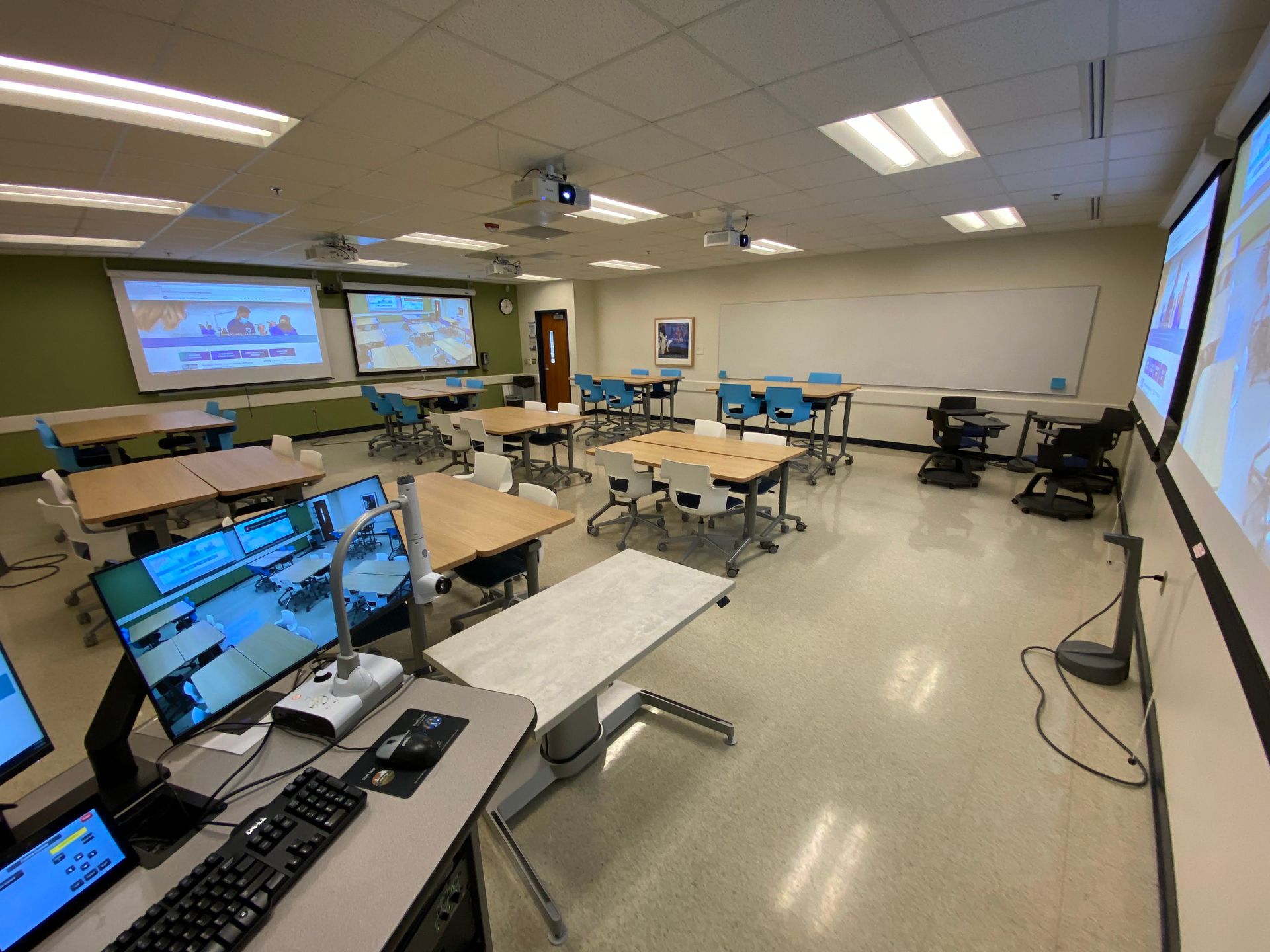
The biggest message I get from this study is that in order to have success with active learning classrooms, you can’t just build them — they have to be introduced as part of an ecosystem that touches almost all parts of the daily function of a university: faculty teaching, faculty development and support, facilities, and the Registrar’s Office to name a few. Without that ecosystem before you build an ALC, it seems hard to have success with students after it’s built. You’re more likely to have an expensive showcase that looks good but ultimately does not fulfill its main purpose: Promoting and amplifying active learning, and moving the culture of a campus toward active engagement in the classroom.

From DSC:
Thank you Robert for your article/posting here! And thank you for being one of the few faculty members who:

  • Regularly share information out on LinkedIn, Twitter, and your blog (something that is all too rare for faculty members throughout higher education)
  • Took a sabbatical to go work at a company that designs and develops numerous options for implementing active learning setups throughout the worlds of higher education, K12 education, and the corporate world as well. You are taking your skills to help contribute to the corporate world, while learning things out in the corporate world, and then  taking these learnings back into the world of higher education.

This presupposes something controversial: That the institution will take a stand on the issue that there is a preferred way to teach, namely active learning, and that the institution will be moving toward making active learning the default pedagogy at the institution. Putting this stake in the ground, and then investing not only in facilities but in professional development and faculty incentives to make it happen, again calls for vigorous, sustained leadership — at the top, and especially by the teaching/learning center director.

Robert Talbert


Teaching: Will ChatGPT Change the Way You Teach? — from Chronicle.com by Beth McMurtrie

Excerpt:

Want to get involved in the conversation around AI writing tools? Here are a few resources you might find helpful.

Anna Mills has put together several documents:

Elsewhere, a group of professors is compiling examples of how instructors are using text generation technologies in their assignments. The results will be published in an open-access collection. You can find out more about the project on this site, Teaching with Text Generation Technologies.

If you’re rather listen to a discussion, here are a couple of webinars:


Playing with ChatGPT: now I’m scared (a little) — from tonybates.ca by Tony Bates

Excerpt:

Over the holiday season, lots of people play games such as Scrabble, cards or crossword puzzles. I decided to play with ChatGPT by testing it in areas where I consider myself an expert. (For more about ChatGPT, go to Broom, 2022)

I will first of all show you the responses I got from ChatGPT, then I will discuss the results, comparing them to what I wrote about these topics in Teaching in a Digital Age.

Example questions that Tony asked (emphasis DSC):

  • What is the difference between synchronous and asynchronous learning? Give references.
  • What are the limitations of teaching chemistry online? Give references
  • What are the affordances of video in teaching? Give references
 

The Edge Newsletter from Goldie Blumenstyk

Subject: The Edge: Today’s Issues in Schools; Tomorrow’s Higher-Ed Challenges

Excerpts:

Issues like chronic absenteeism in big urban and rural districts, the impact of classroom shootings on kids, and schools’ struggles to handle teenagers’ mental-health challenges might not be day-to-day concerns for college leaders and those who work with them. But these will matter to higher ed in the not-so-distant future, as those K-to-12 students make their way to college. And they could matter even more if those students don’t ever even make it to college.

Words of wisdom:

Those of us who might be a little higher-ed siloed in our thinking on education would do well to widen our perspective. 

From DSC:
And it isn’t just about the impacts of COVID-19 either — though those things are very important. We would do well to get out of our siloes and practice some high-level design thinking to implement a cradle-to-grave, lifelong learning ecosystem. The vocational and corporate training worlds are highly relevant here as well.


Some Day In Higher Education: Predictions And Possibilities For A Jolly Academic New Year — from forbes.com by Ann Kirschner

Excerpt:

  • Partnering with the private sector. Some university will have a clear strategy and adequate staff to develop strategic partnerships with key regional economic players. These would include internship/apprenticeship student opportunities and curricular initiatives including part-time teaching roles for professors of practice in rapidly changing technologies.
  • Looking for presidential talent in new places. Some university will vet its new president for skills and experience as leaders of complex organizations in an era of disruption, with a Ph.D. as a optional nice-to-have. There just aren’t enough good ex-provosts and deans to go around.
  • An educated board of trustees. Some university will provide its trustees with a realistic understanding of the highly competitive and complex world of higher education today. Nostalgia for the good old days and a roomful of well-meaning financial experts can strangle innovation at a time when the university should be the leader in solving the world’s challenges, starting with the exploding need for advanced, scalable, affordable education.

Redefining the professoriate. Some university will reject the institutional shame of relying on overworked and underpaid adjunct faculty and on graduate students who are headed for those same dead-end adjunct positions. Some university will evolve the tenure process into one that celebrates and supports faculty as innovative teachers and rewards their critical role in student career development and service to the university.

 
© 2025 | Daniel Christian