


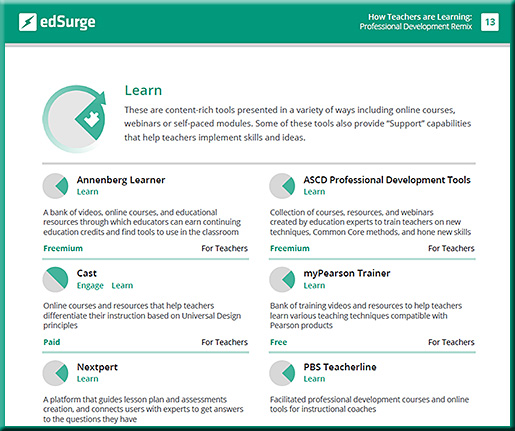
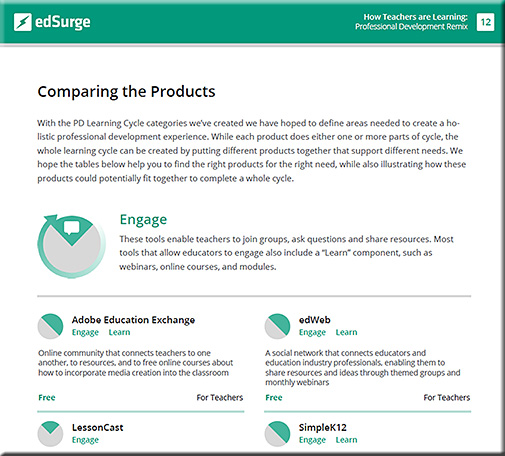
How teachers are learning: Professional development remix — from edSurge, June 2014
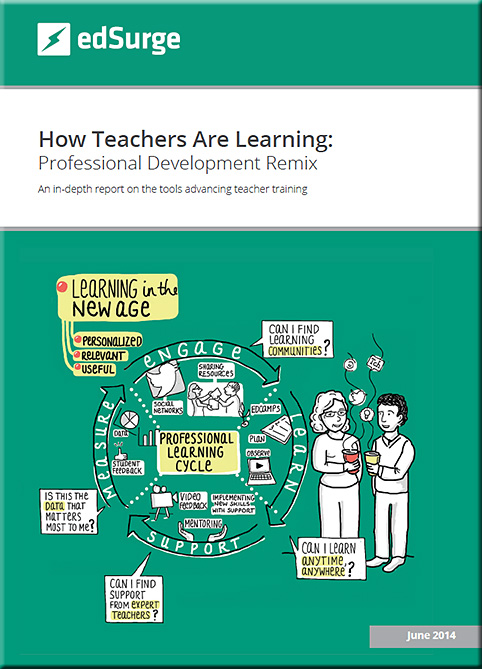
Excerpts:
Addendum, also from edSurge today:
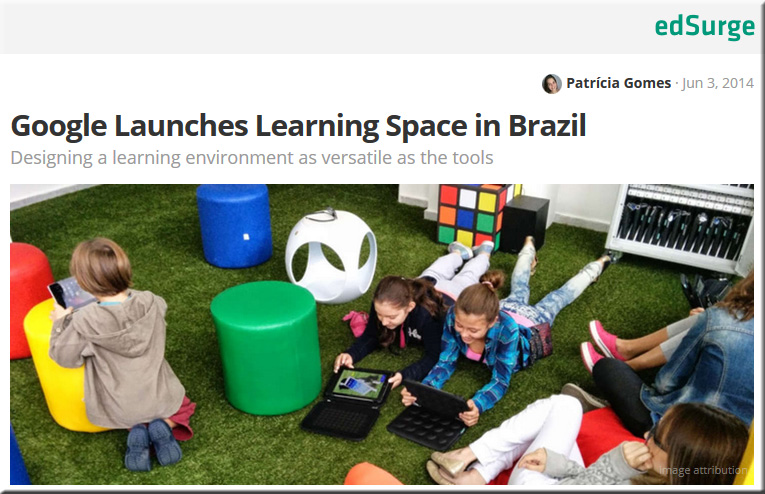
- Google Launches Learning Space in Brazil
Designing a learning environment as versatile as the tools
How teachers are learning: Professional development remix — from edSurge, June 2014
Excerpts:
Addendum, also from edSurge today:
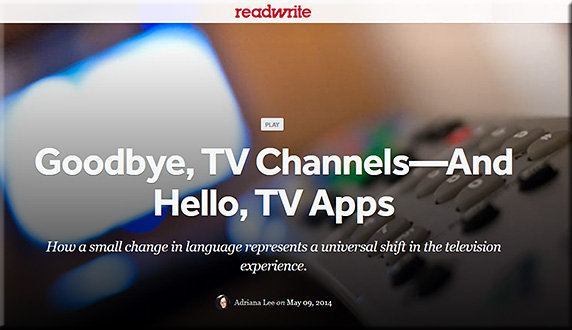
Goodbye, TV Channels—And Hello, TV Apps — from readwrite.com by Adriana Lee
How a small change in language represents a universal shift in the television experience.
Excerpt (emphasis DSC):
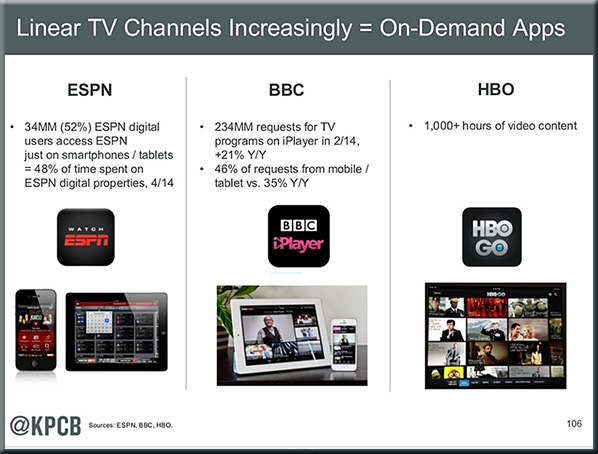
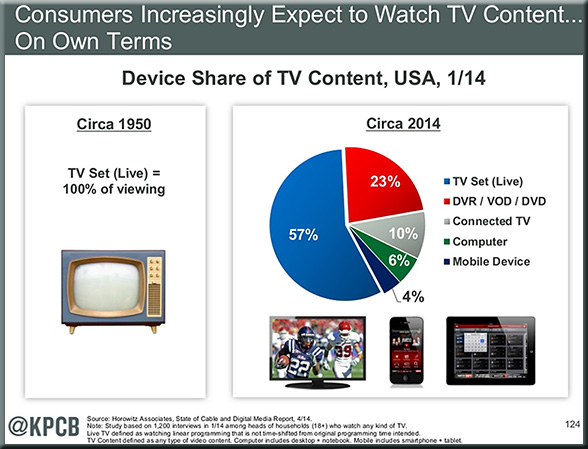
But television is evolving. Increasingly, it’s all about the apps now—browsable, downloadable, interactive TV applications. You can thank the swelling ranks of streaming services and devices for that.
The software applications they’re delivering to our living rooms are growing in number and prominence. And they’re starting to eclipse the passive, one-way broadcasts we once fought over for two-way, interactive experiences that let you share democratically among multiple users (née viewers) across mobile devices and computers.
…
According to research firm NPD Group, the smart television business has begun to boom. In the beginning of 2013, there were 140 million Internet-ready TVs in American homes. By 2015, it will grow 44 percent, to 202 million. And by that time, nearly two-thirds of them will actually be connected to the Internet, compared to just 56 percent now.
…
How they connect is important. When it comes to television, “apps” are where it’s at, not ye olde “TV channels.” It’s just a shift in language, true—but it’s also a shift in thinking.
In a multi-screen future, phones don’t control TVs, TVs control phones — from foxnews.com by Alex Tretbar
Excerpt:
Right now, most “second-screen” usage is more distracting than it is enriching, but that’s about to change. Soon your tablet will spring to life when you tune into your favorite show, and you’ll have more opportunities than ever to engage. The million-dollar buzzword here is Automatic Content Recognition, or ACR. But, before we get too far into that, let’s start at the beginning: the screen itself.
…
Navin wants his apps to automatically deliver content viewers might otherwise seek out manually. This might mean recommendations, related video, social-media discussions, or even a simple plot synopsis.
What television will look like in 2025, according to Netflix — from wired.com by Issie Lapowsky
Excerpts:
People have traditionally discovered new shows by tuning into the channels that were most aligned with their interests. Love news? Then CNN might be the channel for you. If it’s children’s programming you want, Nickelodeon has you covered. And yet, none of these channels can serve 100 percent of their customers what they want to watch 100 percent of the time.
According to Hunt, this will change with internet TV. He said Netflix is now working to perfect its personalization technology to the point where users will no longer have to choose what they want to watch from a grid of shows and movies. Instead, the recommendation engine will be so finely tuned that it will show users “one or two suggestions that perfectly fit what they want to watch now.”
“I think this vision is possible,” Hunt said. “We’ve come a long way towards it, and we have a ways to go still.” He said Netflix is now devoting as much time and energy to building out that personalization technology as the company put into building the infrastructure for delivering that content in the first place.
…
“The stories we watch today are not your parents’ TV,” Hunt said, “and the stories your kids watch in 2025 will blow your mind away.”
And by the year 2025, he told his audience, everyone will own a smart TV.
TV transformed by smart thinking — from theaustralian.com.au/ by
Excerpt:
As LG puts it, your apps to the right of the cards are “the future” — what you will watch, while the display of your recently used apps, to the left of the cards, is “the past” — so the launcher is an amalgam of your past, present and future viewing activity
From DSC:
“…everyone will own a smart TV by 2025.” Well, maybe not everyone, but many of us will have access to these Internet-connected “TV’s” (if they are even called TV’s at that point).
I hope that Netflix will license those personalization technologies to other vendors or, if not, that some other vendor will create them for educationally-related purposes.
Can you imagine a personalization engine — focused on education and/or training — that could provide the scaffolding necessary for learning about many topics? i.e. digital playlists of learning. Streams of content focused on education. Such engines would remember where you left off and what you still need to review…what you have mastered and what you are still struggling with…what you enjoy learning about…your learning preferences…and more.
![The Living [Class] Room -- by Daniel Christian -- July 2012 -- a second device used in conjunction with a Smart/Connected TV](http://danielschristian.com/learning-ecosystems/wp-content/uploads/2012/07/The-Living-Class-Room-Daniel-S-Christian-July-2012.jpg)
Addendum:
How Samsung is enabling the future of social TV — from lostremote.com by Natan Edelsburg
Innovation lessons from Google’s self-driving car — from game-changer.net by Jorge Barba
Excerpts (emphasis DSC):
Idealistic vision
In Google’s own language, this is a moonshot project. It’s something that will make a dent in the future, that is worth pursuing though it might not work. In the end, the results could be dramatic…
…
What are you changing and how will the world look like after you change it?
…
Where can we make the most initial impact in the least amount of time?
…
Unlike incremental ideas, really big ideas have no clear business case; only potential. And you have to find that potential in a very disciplined way.
…
Bottom line:
Innovation requires a different kind of leadership. One that understands that innovation requires trial and error. The rhetoric of innovation is often about fun and creativity, but the reality is that innovation is hard work and can be a very taxing, uncomfortable process, both emotionally and intellectually. We can learn valuable innovation lessons from Google, a true innovator, on what it takes to create the conditions for projects like these to happen and become real.
From DSC:

Institutions of higher education have developed some great products and services out there for creating solid scholars, thinkers, future citizens, and much more; however, such programs are increasingly out of reach for many people (or they come with a crushing weight that stays on a graduate’s back for years to come).
So I’d like to see those of us working within higher education take some lessons from the likes of Google: It’s time for some serious innovation and experimentation. Such a shift requires massive cultural changes throughout many of our institutions of higher education (not all, but many).
We need to continue to provide quality products and services, but at much more affordable prices. What we have now is NOT working for many people. It’s simply not working.
Towards that end, it’s time for TRIMTAB Groups, experimentation, and innovation throughout higher education.
NOTE:
With the affordances that come from technology, it isn’t always possible to put $$ figures on things like ROI’s. To see this immediately, think of the difficulty in trying to nail down any sort of accurate ROI from your email system or from your voicemail system or from your networking infrastructure. I don’t think it can be done. This is where bold, visionary, informed thinking comes into play. We can start small; then see what is and isn’t working.

From DSC, some related questions:
.
The seven habits of highly effective digital enterprises — from mckinsey.com by Tunde Olanrewaju, Kate Smaje, and Paul Willmott
To stay competitive, companies must stop experimenting with digital and commit to transforming themselves into full digital businesses. Here are seven habits that successful digital enterprises share.
Excerpt:
The age of experimentation with digital is over. In an often bleak landscape of slow economic recovery, digital continues to show healthy growth. E-commerce is growing at double-digit rates in the United States and most European countries, and it is booming across Asia. To take advantage of this momentum, companies need to move beyond experiments with digital and transform themselves into digital businesses. Yet many companies are stumbling as they try to turn their digital agendas into new business and operating models. The reason, we believe, is that digital transformation is uniquely challenging, touching every function and business unit while also demanding the rapid development of new skills and investments that are very different from business as usual. To succeed, management teams need to move beyond vague statements of intent and focus on “hard wiring” digital into their organization’s structures, processes, systems, and incentives.
From DSC:
“The age of experimentation with digital is over. … To take advantage of this momentum, companies need to move beyond experiments with digital and transform themselves into digital businesses.”
Though this may be true for the corporate world (the audience for whom this piece was written), the experimentation within higher education is just beginning. With that said, I still couldn’t help but wonder if some of these same habits might apply to the world of higher education. For example, three habits that the article mentioned jumped out at me as being highly relevant to those of us working within higher education:
1. Be unreasonably aspirational
4. Challenge everything
7. Be obsessed with the customer
Rising customer expectations continue to push businesses to improve the customer experience across all channels. Excellence in one channel is no longer sufficient; customers expect the same frictionless experience in a retail store as they do when shopping online, and vice versa.
A potentially-related item, at least from the perspective of the higher ed student of the near future:
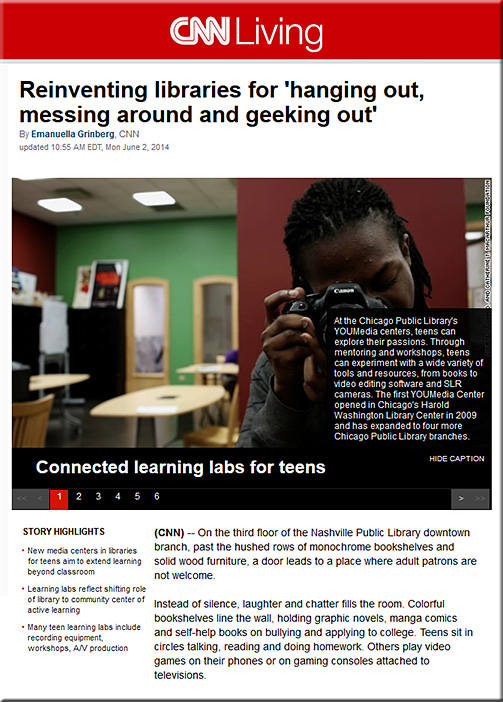
Reinventing libraries for ‘hanging out, messing around and geeking out’ — from CNN.com by Emanuella Grinberg
Excerpt:
The staff takes special pride in its mentor-led activities, offered in partnerships with various community organizations: a spoken word workshop, a video game program and a makerspace, or workshop, where teens create birdcages, duct tape wallets and other art projects.
It might be a library, but for 18-year-old Alexis Woodward, the atmosphere is more like a “family reunion,” she said.
“It’s always packed until it closes. Everybody goes to the library after school,” said Woodward, who began participating in the spoken word program when she was 14.
Business School, Disrupted — from nytimes.com by Jerry Useem
Excerpt:
The question: Should Harvard Business School enter the business of online education, and, if so, how?
Universities across the country are wrestling with the same question — call it the educator’s quandary — of whether to plunge into the rapidly growing realm of online teaching, at the risk of devaluing the on-campus education for which students pay tens of thousands of dollars, or to stand pat at the risk of being left behind.
“I actually don’t know any of the people you just mentioned . . .” — from Management & Strategy in Digital Higher Ed by Dr. Keith Hampson
Excerpt:
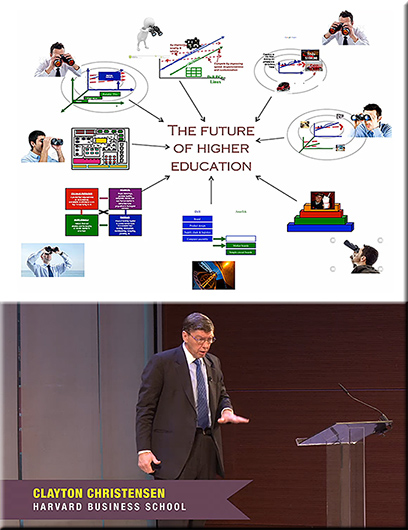
Colgate University hosted an event last week. “Innovation + Disruption Symposium“. The keynote was none other than Clay Christensen, the Godfather of Disruption Innovation. Following his talk, seven University Presidents of private universities fielded questions from the moderator.
…
But a few moments stood out; here’s my favourite. Clay Christensen – having done his bit on disruptive innovation in higher education – was sitting in the audience listening to the Presidents field questions. He rose and noted, half-jokingly, that everyone on the panel disagreed with everything he had just said about the coming disruption in higher education. Laughs ensued. He then asked the panel to imagine that a second panel was on stage with them. This second panel included the Founder of the Khan Academy, Paul Leblanc of Southern New Hampshire University, the President of Western Governors University, and others that are commonly believed to be leading the changes that are unfolding in higher education. Christensen asked the panel to consider what this second, imaginary panel might say that is different from what he had been hearing.
The response? David Oxtoby, President of Pomona College fielded the question: “I actually don’t know any of the people you just mentioned, but . . .”
You can’t make this stuff up. I don’t recall ever hearing or reading anything that so succinctly illustrates the existence of different worlds and perspectives within higher education.
Also see:
From DSC:
I love Keith’s line: “You can’t make this stuff up.” Then later on in his posting, “Yet, the President of a university – having accepted an invitation to an event to talk about disruptive innovation in higher education – has not heard of many of the people behind these changes. Wow. Just wow.” Thanks Keith — right on!
My comment is this:
Too many presidents and those in leadership waaaay underestimate what can be done online. They didn’t grow up with many of the technologies we have today and, quite frankly, they aren’t sold on them. Nor have many of them taken an online course recently (or ever) themselves, I’d guess.They also have very vested interests in keeping things the way they are; they have to guard/craft their public-facing words very carefully.
Many leaders throughout higher education also neglect to highlight/mention/recognize that online learning doesn’t come with multimillion dollar, physical plant-related expenses. Online learning can be expensive, depending upon the level of sophistication one wants to achieve. However, there are no buildings to maintain. There are no elevators to fix. There are no lawns to mow. There are no sidewalks to repair. There are no heating bills. There are no lightbulbs/fixtures to maintain…walls to paint…etc., etc. Adding additional storage space or purchasing a new server is much more affordable than developing a new building. Online learning doesn’t care much about the buildings “arms race.”
So I wonder, how will face-to-face learning be able to compete in the future? Or…is that not even the question? Many have asked another question, “Will only the very wealthy be able to afford an on-campus experience?”
From DSC:
The bolded text is what I want to highlight in this posting/reflection:
Ship your grain across the sea;
after many days you may receive a return.
2 Invest in seven ventures, yes, in eight;
you do not know what disaster may come upon the land.
3 If clouds are full of water,
they pour rain on the earth.
Whether a tree falls to the south or to the north,
in the place where it falls, there it will lie.
4 Whoever watches the wind will not plant;
whoever looks at the clouds will not reap.
5 As you do not know the path of the wind,
or how the body is formed[a] in a mother’s womb,
so you cannot understand the work of God,
the Maker of all things.
6 Sow your seed in the morning,
and at evening let your hands not be idle,
for you do not know which will succeed,
whether this or that,
or whether both will do equally well.
From DSC:
This advice may prove incredibly beneficial for businesspeople, entrepreneurs, freelancers, and innovators.
But I have it that these words could also apply to the future of education — especially to those of us trying to determine/influence the future of higher education. TRIMTAB Groups within higher ed will need to live by those words.
Augmented Reality: 32 resources about using it in education — from mediaspecialistsguide.blogspot.com by Julie Greller
Excerpt:
According to Webster’s Dictionary, augmented reality is “an enhanced version of reality created by the use of technology to overlay digital information on an image of something being viewed through a device (as a smartphone camera); also : the technology used to create augmented reality.” Think of it as a type of virtual reality, using the computer to copy your world. You are probably familiar with a tool created by Google which falls into this category: Google Glass. Although augmented reality has existed for a long time, we as teachers are only now grasping how to use it in the classroom. Let’s take a look below.
Example slides:
But from everlasting to everlasting the Lord’s love is with those who fear* him, and his righteousness with their children’s children— with those who keep his covenant and remember to obey his precepts.
* From DSC:
Fear = revere, respect, honor, listen to, obey
Harvard MOOCs up ante on production quality — from educationnews.org by Grace Smith
Excerpt (emphasis DSC):
It’s called HarvardX, a program begun two years ago, that films professors who are creating lessons that act as an adjunct to their coursework. The catch is, the production value is equally proportioned to the subject matter. The underproduced in-class lecture being filmed by a camera at the back of the lecture hall is being updated, in a big way.
Two video studios, 30 employees, producers, editors, videographers, composers, animators, typographers, and even a performance coach, make HarvardX a far cry from a talking head sort of online class.
The Harvard idea is to produce excellent videos, on subject matters that might be difficult to pull off in a lecture hall or class. Then, to bring these videos into the class for enrichment purposes. An example is Ulrich’s online class, “Tangible Things”.
Also see:
Sea change of technology: Education — from the Harvard Gazette, Christina Pazzanese, May 26, 2014
Excerpt (emphasis DSC):
After centuries of relative torpor, technology breakthroughs have begun to reshape teaching and learning in ways that have prompted paradigm shifts around pedagogy, assessment, and scholarly research, and have upended assumptions of how and where learning takes place, the student-teacher dynamic, the functions of libraries and museums, and the changing role of scholars as creators and curators of knowledge.
“There are massive changes happening right now,” said Robert A. Lue, the Richard L. Menschel Faculty Director of the Derek Bok Center for Teaching and Learning and faculty director of HarvardX (harvardx.harvard.edu). “What has brought it into particularly tight focus now is that the revolution in online education has raised a whole host of very important questions about: What do students do with faculty face-to-face; what is the value of the brick-and-mortar experience; and how does technology in general really support teaching and learning in exciting, new ways? It’s been a major catalyst, if you will, for a reconsideration of how we teach in the classroom.”
…
Classrooms of the future are likely to resemble the laboratory or studio model, as more disciplines abandon the passive lecture and seminar formats for dynamic, practice-based learning, Harvard academicians say.
“There’s a move away from using the amphitheater as a learning space … toward a room that looks more like a studio where students sit in groups around tables, and the focus is on them, not on the instructor, and the instructor becomes more the ‘guide outside’ rather than the ‘sage onstage,’ facilitating the learning process rather than simply teaching and hoping people will learn,” said Eric Mazur, Balkanski Professor of Physics and Applied Physics at the Harvard School of Engineering and Applied Sciences.
It’s a shift that’s changing teaching in the humanities as well. “It’s a project-based model where students learn by actually being engaged in a collaborative, team-based experience of actually creating original scholarship, developing a small piece of a larger mosaic — getting their hands dirty, working with digital media tools, making arguments in video, doing ethnographic work,” said Jeffrey Schnapp, founder and faculty director of metaLAB (at) Harvard, an arts and humanities research and teaching unit of the Berkman Center for Internet & Society.
From DSC:
HarvardX is a great example of using teams to create and deliver learning experiences.
Also, the “Sea change…” article reminded me of the concept of learning hubs — whereby some of the content is face-to-face around a physical table, and whereby some of the content is electronic (either being created by the students or being consumed/reviewed by the students). I also appreciated the work that Jeff Schnapp is doing to increase students’ new media literacy skills.
These 10 stats are taking higher ed’s breath away — from ecampusnews.com by Meris Stansbury
Excerpt:
5. Spending on instruction has remained flat.
…
9. Public and private university debt has nearly tripled from $54 billion to $151 billion over the last decade. Comparable data is not available for private universities, and for-profit data begins at 2010; in 2012, their debt amounted to an additional $95 billion.
10. Annual spending on interest payments per enrolled student nearly doubled at public four-year colleges from $488 in 2002 to $909 in 2012. Interest costs per enrolled student at community colleges increased from 273 percent of their 2002 level, from $166 to $452. Interest costs for private four-year colleges increased to 161 percent of their 2002 level from $990 to $1,589.
Also see:

Excerpt:
We have shown that financing costs per enrolled student have increased by 53 percent across the across the American higher education system while instructional and overall costs per enrolled student have remained flat. More research is needed to assess how these increases in financing costs do or do not impact policy objectives such as affordability, increased access, and college completion.
Excerpt (emphasis DSC — with thanks to Mr. Joe Byerwalter for this resource):
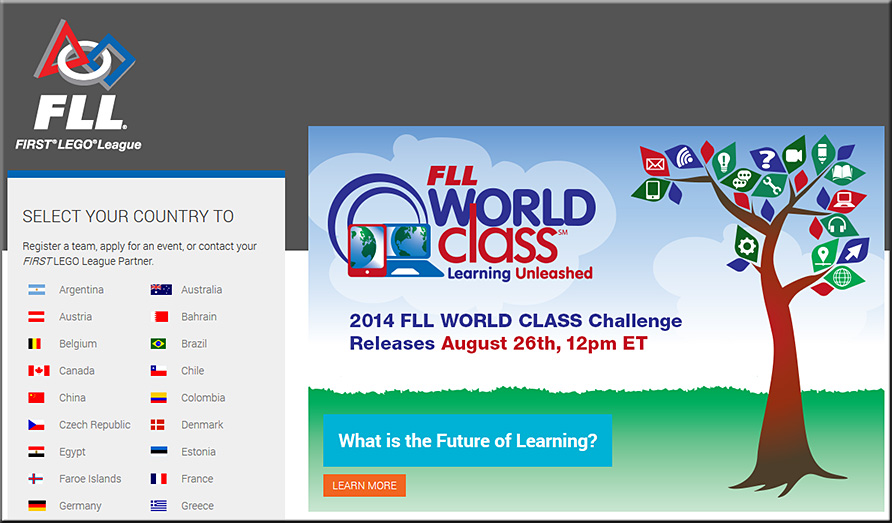
What is the future of learning? FIRST® LEGO® League teams will find the answers. In the 2014 FLL WORLD CLASS? Challenge, over 230,000 children ages 9 to 16* from over 70 countries will redesign how we gather knowledge and skills in the 21st century. Teams will teach adults about the ways that kids need and want to learn. Get ready for a whole new class – FLL WORLD CLASSSM!
FLL challenges kids to think like scientists and engineers. During FLL WORLD CLASSSM, teams will build, test, and program an autonomous robot using LEGO MINDSTORMS® to solve a set of missions in the Robot Game. They will also choose and solve a real-world question in the Project. Throughout their experience, teams will operate under FLL’s signature set of Core Values.
*9-14 in the US, Canada, and Mexico

Excerpt:
Everyone has a favorite blog. Odds are, that blogger has a favorite as well.
We’ve scoured the Internet for blogs that resonate with the intersection of higher education and technology. These are blogs that set themselves apart for a variety of reasons — they are leading voices in their fields, have hundreds if not thousands of fans and consistently raise the bar for conversation.
The majority of these blogs are new to EdTech: Focus on Higher Education’s honor roll. Some were nominated by our readers, and some are veterans of last year’s list that have stayed on top of our charts.
From DSC:
I would like to thank Frank Smith (@DFrank), Tara Buck (@TEBuckTMG), Jimmy Daily (@Jimmy_Daly), and all of the folks at Ed Tech Magazine (@EdTech_HigherEd) for including this Learning Ecosystems blog in this year’s Dean’s List.