From DSC:
I appreciated hearing the perspectives from Bruce Dixon and Will Richardson this morning, as I listed to a webinar that they recently offered. A few key takeaways for me from that webinar — and with a document that they shared — were:

  • The world has fundamentally changed. (Bruce and Will also mentioned the new pace of change; i.e., that it’s much faster.)
  • We need to have more urgency about the need to reimagine school, not to try to improve the existing model.
  • “Because of the advent of the Web and the technologies we use to access it, learning is, in a phrase, leaving the (school) building.”
  • There is a newfound capacity to take full control of one’s own learning; self-determined learning should be at the center of students’ and teachers’ work; co-constructed curriculum
  • And today, at a moment when learners of all ages have never had more agency over their own learning, schools must unlearn centuries old mindsets and practices and relearn them in ways that truly will serve every child living in the modern, connected world.
  • Will and Bruce believe that every educator — and district for that matter — should articulate their own “principles of learning”
  • Beliefs about how kids learn (powerfully and deeply) need to be articulated and consistently communicated and lived out
  • Everything we do as educators, administrators, etc. tells a story. What stories are we telling? (For example, what does the signage around your school building say? Is it about compliance? Is is about a love of learning? Wonder? What does the 20′ jumbo tron say about priorities? Etc.)
  • Bruce and Will covered a “story audit” and how to do one


“Learning is, in a phrase, leaving the (school) building.”

Richardson & Dixon


Also see:


These educators have decades worth of experience. They are pulse-checking their environments. They want to see students thrive both now and into the future. For these reasons, at least for me, their perspectives are highly worth reflecting upon.


Amazon’s TenMarks releases a new curriculum for educators that teaches kids writing using digital assistants, text messaging and more — from techcrunch.com by Sarah Perez

Excerpt:

Amazon is expanding its efforts in the education technology space [on 8/23/17] with the launch of a new curriculum from TenMarks, the company it acquired several years ago which previously only focused on math lessons and related activities. Now, the business is offering an online curriculum for teachers designed to help students learn how to be better writers. The program includes a writing coach that leverages natural language processing, a variety of resources for teachers, and something called “bursts,” which are short writing prompts kids will be familiar with because of their use of mobile apps.

These bursts, which can be used by teachers as warm-ups or supplemental activities, make writing seem less intimidating for students, as they’re similar to what kids might do online or on their smartphones.

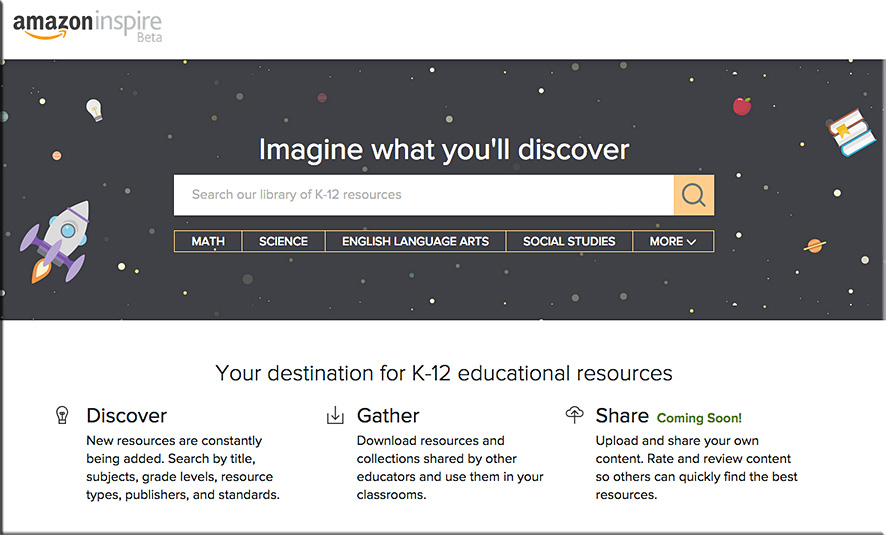
TenMarks is only one way that Amazon is aiming to insert itself into the classroom. The company also runs Amazon Inspire, still in beta, a collection of K-12 curriculum resources. Currently, educators can browse the content library and download those they want to use, but a sharing feature that will support uploads is soon to launch.


From DSC:
Readers of this Learning Ecosystems blog will recognize the following graphic:


I have long believed that each of us needs to draw from the relevant streams of content that are constantly flowing by us — and also that we should be contributing content to those streams as well. Such content can come from blogs, websites, Twitter, LinkedIn, podcasts, YouTube channels, Google Alerts, periodicals, and via other means.

I’m a big fan of blogging and using RSS feeds along with feed aggregators such as Feedly. I also find that Twitter, LinkedIn, and Google Alerts to be excellent means of tapping into — and contributing to — these streams of content. (See Jane Hart’s compilations to tap into other tools/means of learning as well.)

This perspective is echoed in the following article at the Harvard Business Review:

  • Help Employees Create Knowledge — Not Just Share It — from hbr.org by John Hagel III and John Seely Brown
    Excerpt:
    Without diminishing the value of knowledge sharing, we would suggest that the most valuable form of learning today is actually creating new knowledge. Organizations are increasingly being confronted with new and unexpected situations that go beyond the textbooks and operating manuals and require leaders to improvise on the spot, coming up with new approaches that haven’t been tried before. In the process, they develop new knowledge about what works and what doesn’t work in specific situations. We believe the old, “scalable efficiency” approach to knowledge needs to be replaced with a new, more nimble kind of “scalable learning.” To foster the latter, managers should understand five essential distinctions…


We need to be constantly challenging our assumptions and beliefs about what is required to achieve impact because, as the world changes, what used to work in the past may no longer work. 

— Hagel and Brown


So whether you are working or studying within the world of higher education, or whether you are in the corporate world, or working in a governmental office, or whether you are a student in K-12, you need to be drawing from — and contributing your voice/knowledge to — streams of content.

In fact, in my mind, that’s what Training/L&D Departments should shift their focus to, as employees are already self-motivated to build their own learning ecosystems. And in the world of higher education, that’s why I work to help students in my courses build their own online-based footprints, while encouraging them to draw from — contribute to — these streams of content. As more people are becoming freelancers and consultants, it makes even more sense to do this.


But when we recognize that the environment around us is rapidly changing, skills have a shorter and shorter half-life. While skills are still necessary for success, the focus should shift to cultivating the underlying capabilities that can accelerate learning so that new skills can be more rapidly acquired. These capabilities include curiosity, critical thinking, willingness to take risk, imagination, creativity, and social and emotional intelligence. If we can develop those learning capabilities, we should be able to rapidly evolve our skill sets in ways that keep us ahead of the game.

— Hagel and Brown


From DSC:
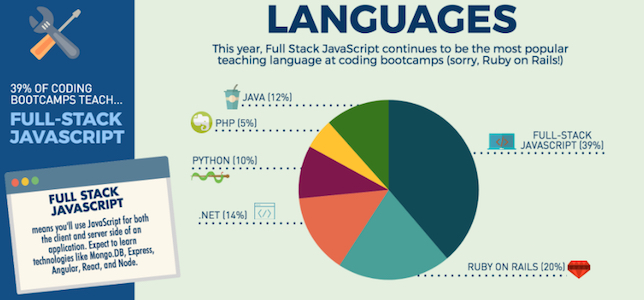
According to the article below, bootcamps appear to be filling several (perceived and/or real) gaps. Quoting from the article:

Why are students enrolling in coding bootcamps? One reason may be the adaptability of these accelerated computer science programs, where students are taught web and mobile development skills that align with industry demands. Programs are offered in-person or online, providing students with flexible learning options. The payoff is decent too: At a typical coding bootcamp, Course Report estimates average tuition is $11,400 for about 14 weeks of instruction, from which the majority students complete on-time and find relevant jobs.

Cost.

Time.

Responsiveness to industry demands.

Greater flexibility.

These are some of the things for traditional institutions of higher education to grapple with, and I would argue the sooner, the better — before this trend finds its legs and gains even more traction/momentum.

For example, in your own mind/thinking…how long do you think it will take bootcamps to begin offering programs that help learners develop content for augmented reality (AR), virtual reality (VR), and mixed reality (MR) — as compared to programs coming out of institutions of traditional higher education?

Whatever your answers are in regards to the reasons for that time difference are likely the exact sort of things institutions need to be working on. For me, at least one of the answers has to do with our current accreditation systems. Other reasons come to my mind as well, but I don’t have time to go there right now.


Study: 1 Coding Bootcamp Graduate for Every 3.5 University Grads — from campustechnology.com by Sri Ravipati

Excerpt:

The five-year coding bootcamp industry estimated at $266 million is rapidly expanding, according to a new market study from Course Report.

The study counted 94 full-time coding bootcamps across the United States and Canada (with programs in 74 U.S. cities). Compared to 2012, there will be 10 times as many graduates this year — or roughly one coding bootcamp graduate for every 3.5 graduates from a traditional university or college. Course Report estimates that 22,814 developers will graduate from coding bootcamps this year — an increase from 15,048 graduates last year.


In an AI-powered world, what are potential jobs of the future? — from readwrite.com

Excerpt:

With virtual assistants answering our emails and robots replacing humans on manufacturing assembly lines, mass unemployment due to widespread automation seems imminent. But it is easy to forget amid our growing unease that these systems are not “all-knowing” and fully competent.

As many of us have observed in our interactions with artificial intelligence, these systems perform repetitive, narrowly defined tasks very well but are quickly stymied when asked to go off script — often to great comical effect. As technological advances eliminate historic roles, previously unimaginable jobs will arise in the new economic reality. We combine these two ideas to map out potential new jobs that may arise in the highly automated economy of 2030.


Despite many claims to the contrary, designing a fully autonomous system is incredibly complex and remains far out of reach. For now, training a human is still much cheaper than developing robot replacement.


From DSC:


Moving forward, perhaps one of the key values/deliverables that higher education will bring to the table will be helping people decide which of the jobs out there are “safe for now and/or into the next decade” and which jobs students should steer clear of (as such positions are already disappearing or will soon be disappearing — to be replaced by robotics, algorithms, AI, and such).*

Along these lines, Tom Vander Ark’s recent posting (below) is akin to what I’m talking about:

Staying Ahead of the Robots: What Grads Should Know and Be Able To Do

Check out this excerpt from Tom’s article:

A recent Pew report on the future of jobs concluded:

Machines are eating humans’ job talents. And it’s not just about jobs that are repetitive and low-skill. Automation, robotics, algorithms and artificial intelligence (AI) in recent times have shown they can do equal or sometimes even better work than humans who are dermatologistsinsurance claims adjusterslawyersseismic testers in oil fieldssports journalists and financial reporterscrew members on guided-missile destroyershiring managerspsychological testersretail salespeople, and border patrol agents. Moreover, there is growing anxiety that technology developments on the near horizon will crush the jobs of the millions who drive cars and trucks, analyze medical tests and dataperform middle management choresdispense medicinetrade stocks and evaluate marketsfight on battlefieldsperform government functions, and even replace those who program software – that is, the creators of algorithms.

Now if only we could get our accrediting methods/agencies up to speed (i.e., to become far more responsive), this could be a very valuable service to provide for prospective students in the future.


*Addendum added on 8/24/17 — a relevant quote from Cathy Engelbert, Deloitte’s CEO, on 8/22/17

We ultimately need to help today’s workers—drivers, factory workers, and beyond—discover where demand for skills will be in five to 10 years and help them gain the necessary expertise and experience to do them well. Historically, wholesale job retraining has been challenging to scale, but the inexorable nature of this transition demands that we try to help them be productive in an even more digitized world economy. We already have a skills gap; we need to figure out how to digitize and skill those workers to match them with the demand for available jobs. There is a collective dialogue that should be engaged now so we can create meaningful, fulfilling, and productive opportunities for all.


Con Job: Hackers Target Millennials Looking for Work – from wsj.com by Kelsey Gee
Employment scams pose a growing threat as applications and interviews become more digital

Excerpt:

Hackers attempt to hook tens of thousands of people like Mr. Latif through job scams each year, according to U.S. Federal Trade Commission data, aiming to trick them into handing over personal or sensitive information, or to gain access to their corporate networks.

Employment fraud is nothing new, but as more companies shift to entirely-digital job application processes, Better Business Bureau director of communications Katherine Hutt said scams targeting job seekers pose a growing threat. Job candidates are now routinely invited to fill out applications, complete skill evaluations and interview—all on their smartphones, as employers seek to cast a wider net for applicants and improve the matchmaking process for entry-level hires.

Young people are a frequent target. Of the nearly 3,800 complaints the nonprofit has received from U.S. consumers on its scam report tracker in the past two years, people under 34 years old were the most susceptible to such scams, which frequently offer jobs requiring little to no prior experience, Ms. Hutt said.


Hackers are finding new ways to prey on young job seekers.


Major Coding Bootcamps Going Out of Business — from campustechnology.com by Sri Ravipati

Excerpt:

In a surprising turn of events, two major coding bootcamps, within the span of about a week, have announced they are shutting down all operations.

Most recently, after a four-year run, South Carolina-based The Iron Yard (TIY) revealed last Friday it would close its 15 campuses, including locations like Atlanta, Austin, Houston and Charleston where other coding bootcamps are flourishing.

Similarly, Dev Bootcamp (DBC) on July 12 announced via Facebook that it would shutdown operations at all six locations — Austin, Chicago, San Diego, San Francisco, Seattle and New York — by the end of the summer.


From DSC:
I can almost hear the snickering from a variety of people within higher education about this situation. If gloating had an audible sound associated with it, I’d likely have to go find some earplugs. But I have a message for those who are snickering and gloating right now — saying something along the lines of, “Ha! So much for these alternatives to traditional higher education! They’re nothing, and they’ll come to nothing!”

That may be so. Such relatively new alternatives to traditional institutions of higher education may come to nothing. But you know what? At least those organizations are trying to be much more responsive than many institutions of traditional higher education are being! They’ve recognized that there are unmet needs — gaps, if you will — arising from our current systems. Gaps in either the content that we’re providing and/or the manner in which we’re providing it. Gaps that thousands of students have signed up for in a relatively short time. Those gaps should be cause for action within traditional institutions of higher education. They should be cause for realizing that we aren’t responding nearly fast enough to today’s new pace of change.

The pace of change has changed. It is lightning fast these days. Don’t believe me? Go check out some of the descriptions for the hot jobs out there these days. Seriously. Go do it. Go find out which skills you need to get your foot in the door to acquire those types of positions. It’ll blow your mind!

And there are ramifications to this.

If our accreditation systems need to change, than so be it. Let’s identify those necessary changes and make ’em happen!

Because:

  • WE have some serious responsibility for the educations that we are providing to this next generation!!! 
  • WE need to prepare them for what they’ll need to be marketable in the future — so that they can put bread and butter on their tables throughout their careers.
  • WE need to act!
  • WE need to be responsive!

This is not a time for gloating. Rather, this is a time for some serious action.


Addendums on 8/2/17 and 8/3/17:


Jobs Report: 97 Percent of Flatiron School Graduates Land Jobs — from by Sri Ravipati

Excerpt:

While two major coding bootcamps shut down earlier this week, another released its latest jobs report and says it had the strongest student outcomes to date.

The Flatiron School based in New York, NY has released an independently verified jobs report every year since 2014 — “pioneering the concept of outcomes reporting and setting a standard of transparency in educational outcomes,” the latest report reads. It’s the company’s commitment to accessibility and transparency that have allowed its programs to stay open for five years now, says Adam Enbar, co-founder of the Flatiron School.


More bootcamps are quietly coming to a university near you — from edsurge.com by Sydney Johnson

Excerpt:

In the last two years, a surge of nonprofit, four-year institutions have hopped on the bootcamp bandwagon. These programs, often on skills such as software development or data analytics, have arrived in a number of ways—from universities partnering with local for-profit bootcamps, or colleges creating their own intensive training programs completely in-house.But while bootcamps are often associated with tech skills, it seems that traditional universities trying out the model are interested in more than just coding. An increasing number of traditional higher-ed institutions are now applying bootcamp trainings to other fields, such as healthcare, accounting and even civics and political science.


Amazon relaunches Inspire after a year of re-tooling — from edscoop.com/ by Emily Tate
The content repository offers tens of thousands of downloadable educational resources. The “upload and share” feature is expected to follow soon.

Excerpts:

More than a year after Amazon debuted — and then suddenly retracted — its free library of open educational resources, Amazon Inspire is back.

The content repository — seen by many as Amazon’s first major attempt to edge into the competitive education technology space that tech giants like Google and Microsoft now comfortably occupy — was quietly reintroduced to educators on Monday [7/17/17] as a way to store and find tens of thousands of downloadable educational materials that teachers can use in their classrooms.

Over the last year, groups across the country have been working with Amazon to vet digital content to ensure it complies with state standards, quality indicators and, perhaps most importantly, intellectual property and copyright laws.

Similarly, if you want to teach a lesson on Romeo and Juliet, for example, you could search Inspire by grade, subject, content format and standards to begin pulling “ingredients,” or resources, off the shelves and putting them in your “grocery cart,” or your collection.


Robots and AI are going to make social inequality even worse, says new report — from theverge.com by
Rich people are going to find it easier to adapt to automation

Excerpt:

Most economists agree that advances in robotics and AI over the next few decades are likely to lead to significant job losses. But what’s less often considered is how these changes could also impact social mobility. A new report from UK charity Sutton Trust explains the danger, noting that unless governments take action, the next wave of automation will dramatically increase inequality within societies, further entrenching the divide between rich and poor.

The are a number of reasons for this, say the report’s authors, including the ability of richer individuals to re-train for new jobs; the rising importance of “soft skills” like communication and confidence; and the reduction in the number of jobs used as “stepping stones” into professional industries.

For example, the demand for paralegals and similar professions is likely to be reduced over the coming years as artificial intelligence is trained to handle more administrative tasks. In the UK more than 350,000 paralegals, payroll managers, and bookkeepers could lose their jobs if automated systems can do the same work.


Re-training for new jobs will also become a crucial skill, and it’s individuals from wealthier backgrounds that are more able to do so, says the report. This can already be seen in the disparity in terms of post-graduate education, with individuals in the UK with working class or poorer backgrounds far less likely to re-train after university.


From DSC:
I can’t emphasize this enough. There are dangerous, tumultuous times ahead if we can’t figure out ways to help ALL people within the workforce reinvent themselves quickly, cost-effectively, and conveniently. Re-skilling/up-skilling ourselves is becoming increasingly important. And I’m not just talking about highly-educated people. I’m talking about people whose jobs are going to be disappearing in the near future — especially people whose stepping stones into brighter futures are going to wake up to a very different world. A very harsh world.

That’s why I’m so passionate about helping to develop a next generation learning platform. Higher education, as an industry, has some time left to figure out their part/contribution out in this new world. But the window of time could be closing, as another window of opportunity / era could be opening up for “the next Amazon.com of higher education.”

It’s up to current, traditional institutions of higher education as to how much they want to be a part of the solution. Some of the questions each institution ought to be asking are:

  1. Given our institutions mission/vision, what landscapes should we be pulse-checking?
  2. Do we have faculty/staff/members of administration looking at those landscapes that are highly applicable to our students and to their futures? How, specifically, are the insights from those employees fed into the strategic plans of our institution?
  3. What are some possible scenarios as a result of these changing landscapes? What would our response(s) be for each scenario?
  4. Are there obstacles from us innovating and being able to respond to the shifting landscapes, especially within the workforce?
  5. How do we remove those obstacles?
  6. On a scale of 0 (we don’t innovate at all) to 10 (highly innovative), where is our culture today? Where do we hope to be 5 years from now? How do we get there?

…and there are many other questions no doubt. But I don’t think we’re looking into the future nearly enough to see the massive needs — and real issues — ahead of us.


The report, which was carried out by the Boston Consulting Group and published this Wednesday [7/12/17], looks specifically at the UK, where it says some 15 million jobs are at risk of automation. But the Sutton Trust says its findings are also relevant to other developed nations, particularly the US, where social mobility is a major problem.


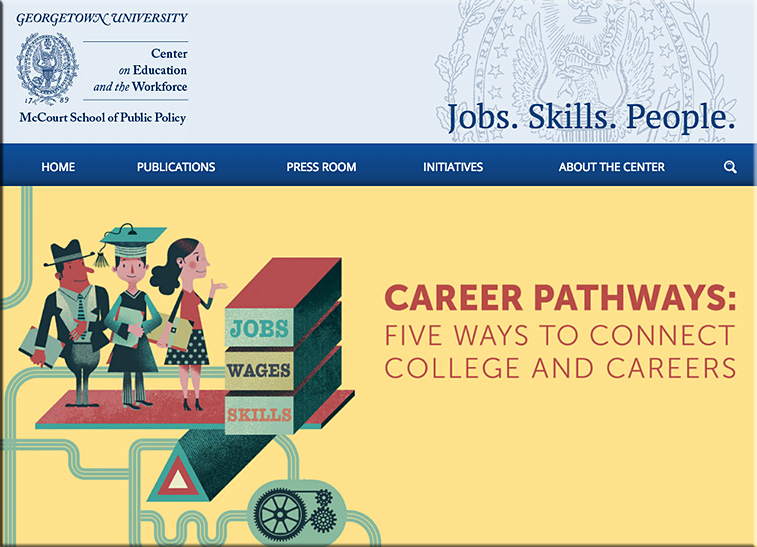
Career Pathways: Five Ways to Connect College and Careers calls for states to help students, their families, and employers unpack the meaning of postsecondary credentials and assess their value in the labor market.

Excerpt:

If students are investing more to go to college, they need to have answers to basic questions about the value of postsecondary education. They need better information to make decisions that have lifelong economic consequences.

Getting a college education is one of the biggest investments people will make in their lives, but the growing complexity of today’s economy makes it difficult for higher education to deliver efficiency and consistent quality. Today’s economy is more intricate than those of decades past.


From this press release:

It’s Time to Fix Higher Education’s Tower of Babel, Says Georgetown University Report
The lack of transparency around college and careers leads to costly, uninformed decisions

(Washington, D.C., July 11, 2017) — A new report from the Georgetown University Center on Education and the Workforce (Georgetown Center), Career Pathways: Five Ways to Connect College and Careers, calls for states to help students, their families, and employers unpack the meaning of postsecondary credentials and assess their value in the labor market.

Back when a high school-educated worker could find a good job with decent wages, the question was simply whether or not to go to college. That is no longer the case in today’s economy, which requires at least some college to enter the middle class. The study finds that:

  • The number of postsecondary programs of study more than quintupled between 1985 and 2010 — from 410 to 2,260;
  • The number of colleges and universities more than doubled from 1,850 to 4,720 between 1950 and 2014; and
  • The number of occupations grew from 270 in 1950 to 840 in 2010.

The variety of postsecondary credentials, providers, and online delivery mechanisms has also multiplied rapidly in recent years, underscoring the need for common, measurable outcomes.

College graduates are also showing buyer’s remorse. While they are generally happy with their decision to attend college, more than half would choose a different major, go to a different college, or pursue a different postsecondary credential if they had a chance.

The Georgetown study points out that the lack of information drives the higher education market toward mediocrity. The report argues that postsecondary education and training needs to be more closely aligned to careers to better equip learners and workers with the skills they need to succeed in the 21st century economy and close the skills gap.

The stakes couldn’t be higher for students to make the right decisions. Since 1980, tuition and fees at public four year colleges and universities have grown 19 times faster than family incomes. Students and families want — and need — to know the value they are getting for their investment.


Also see:

  • Trumping toward college transparency — from linkedin.com by Anthony Carnevale
    The perfect storm is gathering around the need to increase transparency around college and careers. And in accordance with how public policy generally comes about, it might just happen. 


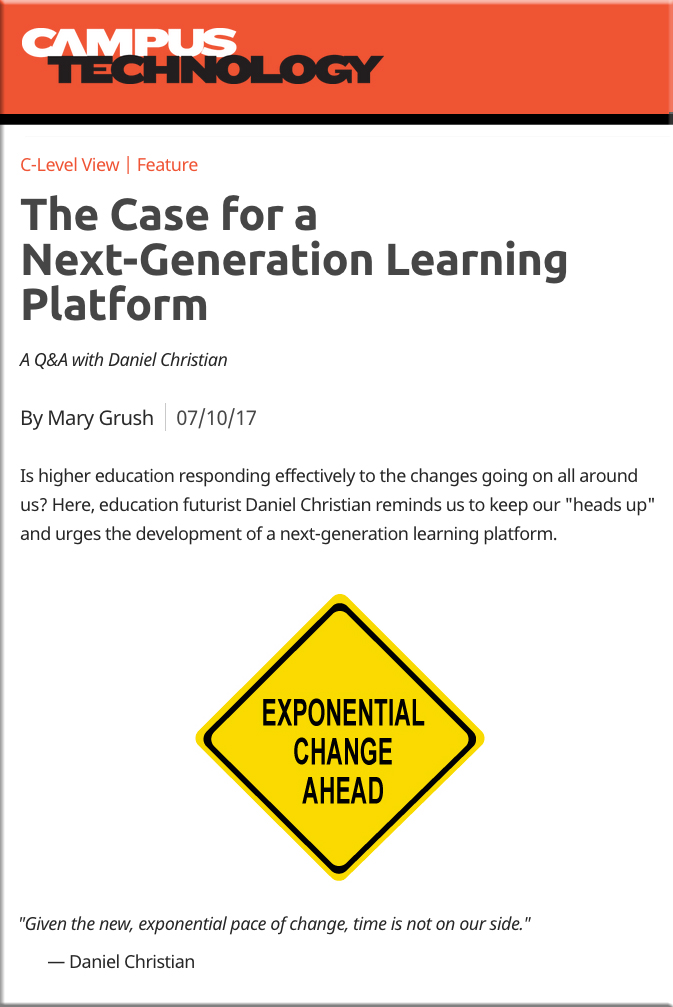
The case for a next generation learning platform [Grush & Christian]


The case for a next generation learning platform — from campustechnology.com by Mary Grush & Daniel Christian

Excerpt (emphasis DSC):

Grush: Then what are some of the implications you could draw from metrics like that one?

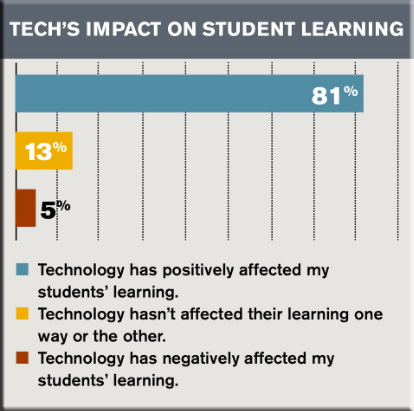
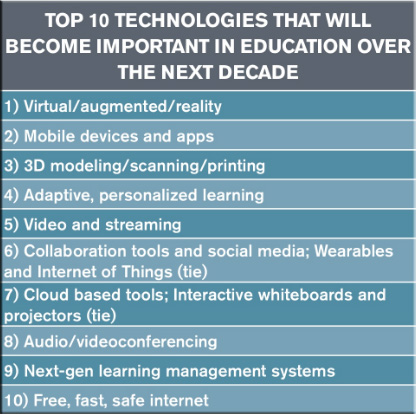
Christian: As we consider all the investment in those emerging technologies, the question many are beginning to ask is, “How will these technologies impact jobs and the makeup of our workforce in the future?”

While there are many thoughts and questions regarding the cumulative impact these technologies will have on our future workforce (e.g., “How many jobs will be displaced?”), the consensus seems to be that there will be massive change.

Whether our jobs are completely displaced or if we will be working alongside robots, chatbots, workbots, or some other forms of AI-backed personal assistants, all of us will need to become lifelong learners — to be constantly reinventing ourselves. This assertion is also made in the aforementioned study from McKinsey: “AI promises benefits, but also poses urgent challenges that cut across firms, developers, government, and workers. The workforce needs to be re-skilled to exploit AI rather than compete with it…”


A side note from DSC:
I began working on this vision prior to 2010…but I didn’t officially document it until 2012.


The Living [Class] Room -- by Daniel Christian -- July 2012 -- a second device used in conjunction with a Smart/Connected TV


Learning from the Living [Class] Room:

A global, powerful, next generation learning platform


What does the vision entail?

  • A new, global, collaborative learning platform that offers more choice, more control to learners of all ages – 24×7 – and could become the organization that futurist Thomas Frey discusses here with Business Insider:

“I’ve been predicting that by 2030 the largest company on the internet is going to be an education-based company that we haven’t heard of yet,” Frey, the senior futurist at the DaVinci Institute think tank, tells Business Insider.

  • A learner-centered platform that is enabled by – and reliant upon – human beings but is backed up by a powerful suite of technologies that work together in order to help people reinvent themselves quickly, conveniently, and extremely cost-effectively
  • A customizable learning environment that will offer up-to-date streams of regularly curated content (i.e., microlearning) as well as engaging learning experiences
  • Along these lines, a lifelong learner can opt to receive an RSS feed on a particular topic until they master that concept; periodic quizzes (i.e., spaced repetition) determines that mastery. Once mastered, the system will ask the learner whether they still want to receive that particular stream of content or not.
  • A Netflix-like interface to peruse and select plugins to extend the functionality of the core product
  • An AI-backed system of analyzing employment trends and opportunities will highlight those courses and streams of content that will help someone obtain the most in-demand skills
  • A system that tracks learning and, via Blockchain-based technologies, feeds all completed learning modules/courses into learners’ web-based learner profiles
  • A learning platform that provides customized, personalized recommendation lists – based upon the learner’s goals
  • A platform that delivers customized, personalized learning within a self-directed course (meant for those content creators who want to deliver more sophisticated courses/modules while moving people through the relevant Zones of Proximal Development)
  • Notifications and/or inspirational quotes will be available upon request to help provide motivation, encouragement, and accountability – helping learners establish habits of continual, lifelong-based learning
  • (Potentially) An online-based marketplace, matching learners with teachers, professors, and other such Subject Matter Experts (SMEs)
  • (Potentially) Direct access to popular job search sites
  • (Potentially) Direct access to resources that describe what other companies do/provide and descriptions of any particular company’s culture (as described by current and former employees and freelancers)
  • (Potentially) Integration with one-on-one tutoring services

Further details here >>


Addendum from DSC (regarding the resource mentioned below):
Note the voice recognition/control mechanisms on Westinghouse’s new product — also note the integration of Amazon’s Alexa into a “TV.”


Westinghouse’s Alexa-equipped Fire TV Edition smart TVs are now available — from theverge.com by Chaim Gartenberg


The key selling point, of course, is the built-in Amazon Fire TV, which is controlled with the bundled Voice Remote and features Amazon’s Alexa assistant.


Finally…also see:

  • NASA unveils a skill for Amazon’s Alexa that lets you ask questions about Mars — from geekwire.com by Kevin Lisota
  • Holographic storytelling — from jwtintelligence.com
    The stories of Holocaust survivors are brought to life with the help of interactive 3D technologies.
    New Dimensions in Testimony is a new way of preserving history for future generations. The project brings to life the stories of Holocaust survivors with 3D video, revealing raw first-hand accounts that are more interactive than learning through a history book.  Holocaust survivor Pinchas Gutter, the first subject of the project, was filmed answering over 1000 questions, generating approximately 25 hours of footage. By incorporating natural language processing from the USC Institute for Creative Technologies (ICT), people are able to ask Gutter’s projected image questions that trigger relevant responses.


Soft skills are permanent skills — from Harold Jarche

Excerpts:

HARD SKILLS
Cloud Computing Expertise
Data Mining and Statistical Analysis
Smartphone App Development
Data Storage Engineering and Management
User Interface Design
Network Security Expertise

SOFT SKILLS
Communication
Curiosity
Adaptability
Teamwork
Empathy
Time Management
Open-Mindedness


This requires a rethinking of how we categorize work, define jobs, attract and retain talent. And I mean talent, not labour. It also means a rethinking of our entire education system. These permanent (soft) skills are not developed through standardized curriculum based on temporary (hard) skills. It’s time to take the long-term view on human work and learning. Labour is a temporary skill for market and technological conditions. Talent is our long-term value as humans to each other.


The future of work: Death of the single skill set in the age of automation — from forbes.com by Jeanne Meister

Excerpt:

The future of work is here today, and the nature of both manufacturing and knowledge jobs will never be the same. According to a McKinsey analysis of 2,000 different work activities across 800 occupations, automation will change virtually every job across all occupations. Specifically, McKinsey found that in about 60% of occupations, 30% of tasks could be handed over to robots and bots. “More occupations will change,” the report concludes, “than will be automated away.”

Other sources have predicted that automation of professional knowledge economy jobs in the United States will be more than 10 times as large as the number of manufacturing jobs automated to date.


So how does one prepare for this volatile, uncertain, complex, and ambiguous world of work? I believe by understanding a simple fact: across many jobs there is a “death of a single skill set,” and what has made you employable today will not be enough to ensure you are employable tomorrow.


According to recent research by MIT,  90% of executives believe their businesses are being disrupted or reinvented by digital business models, and 70% believe they do not have the right skills.


© 2025 | Daniel Christian