The future of learning: Co-creating skills development strategies with employee preferences — from chieflearningofficer.com by Stacey Young Rivers
The limitations of developing just-in-time learning strategies perpetuate a paradigm where learning and development can appear ineffective for teams that have to move quickly and fail fast.

Excerpt:

I believe the future of learning will be a system where employees and learning teams co-create experiences. No longer will skills development programs be created in silos for employees to consume. Gone will be the days of conducting exhaustive needs analysis that can add layers of complexity for program delivery.

The limitations of developing just-in-time learning strategies perpetuate a paradigm where learning and development can appear ineffective for teams that have to move quickly and fail fast. Thinking about how to overcome these challenges conjures a solution similar to a metaverse, a persistent virtual world that is always open. One value proposition of a metaverse is that everyone can create their own adventure in an ecosystem supporting curiosity and experimentation, two areas undergirding skills development.

With this lens, understanding employee preferences for learning is the beginning of co-creating experiences, and one approach for how L&D leaders can begin to structure skills development programs. While conducting a study to engage employees in training, we uncovered new insights into where corporate L&D is headed in the future.

Also relevant here, see:

Workplace Learning: Still a Mess — from eliterate.us by Michael Feldstein

Excerpt:

There’s a mantra these days that higher education needs to get better at listening to industry so they can better prepare students for work. And while there is definitely some truth to that, it assumes that “industry” knows what it needs its workers to know. Former HP CEO Lew Platt once famously said, “If only Hewlett Packard knew what Hewlett Packard knows, we’d be three times more productive.”

In other words, a lot of vital know-how is locked up in pockets within the organization. It doesn’t reach either the training folks or the HR folks. So how are either universities or EdTech professional development companies supposed to serve an invisible need?

It’s not that they don’t know how to learn or they don’t like to learn online. It’s because their experience tells them that their valuable time spent “learning” might not equate to actual skills development.


Addendum on 8/15/22:


It’s Time to Rethink the ‘One Teacher, One Classroom’ Model — from edweek.org by Irene Chen & Stephanie Banchero
How to build a happier and more effective teaching force

Excerpt:

Let’s address this crisis by reenvisioning the traditional school staffing model, which has not changed in generations. We need innovative, differentiated staffing that creatively utilizes educators and plays to their strengths. This means schools must deploy adults to work collaboratively in response to the needs of individual students, rather than asking one teacher to meet the needs of all students in one classroom. This approach can address children’s specific skills gaps, while also diversifying the workforce, retaining the most effective teachers, and extending great teaching.


Coding Isn’t a Necessary Leadership Skill — But Digital Literacy Is — from hbr.org by Sophia Matveeva

Summary (emphasis DSC):

While most leaders now know that tech is a vital part of business, many are wondering what they really need to know about technology to succeed in the digital age. Coding bootcamps may appeal to some, but for many leaders, learning to code is simply not the best investment. It takes a long time to become a proficient coder, and it still doesn’t give you a holistic overview of how digital technologies get made. The good news is that most leaders don’t need to learn to code. Instead, they need to learn how to work with people who code. This means becoming a digital collaborator and learning how to work with developers, data scientists, user experience designers, and product managers — not completely retraining. The author presents four ways for non-technical leaders to become digital collaborators.


I think we’ve run out of time to effectively practice law in the United States of America [Christian]


From DSC:
Given:

  • the accelerating pace of change that’s been occurring over the last decade or more
  • the current setup of the legal field within the U.S. — and who can practice law
  • the number of emerging technologies now on the landscapes out there

…I think we’ve run out of time to effectively practice law in the U.S. — at least in terms of dealing with emerging technologies. Consider the following items/reflections.


Inside one of the nation’s few hybrid J.D. programs — from highereddive.com by Natalie Schwartz
Shannon Gardner, Syracuse law school’s associate dean for online education, talks about the program’s inaugural graduates and how it has evolved.

Excerpt (emphasis DSC):

In May, Syracuse University’s law school graduated its first class of students earning a Juris Doctor degree through a hybrid program, called JDinteractive, or JDi. The 45 class members were part of almost 200 Syracuse students who received a J.D. this year, according to a university announcement.

The private nonprofit, located in upstate New York, won approval from the American Bar Association in 2018 to offer the three-year hybrid program.

The ABA strictly limits distance education, requiring a waiver for colleges that wish to offer more than one-third of their credits online. To date, the ABA has only approved distance education J.D. programs at about a dozen schools, including Syracuse.

Many folks realize this is the future of legal education — not that it will replace traditional programs. It is one route to pursue a legal education that is here to stay. I did not see it as pressure, and I think, by all accounts, we have definitely proven that it is and can be a success.

Shannon Gardner, associate dean for online education  


From DSC:
It was March 2018. I just started working as a Director of Instructional Services at a law school. I had been involved with online-based learning since 2001.

I was absolutely shocked at how far behind law schools were in terms of offering 100% online-based programs. I was dismayed to find out that 20+ years after such undergraduate programs were made available — and whose effectiveness had been proven time and again — that there were no 100%-online based Juris Doctor (JD) programs in the U.S. (The JD degree is what you have to have to practice law in the U.S. Some folks go on to take further courses after obtaining that degree — that’s when Masters of Law programs like LLM programs kick in.)

Why was this I asked? Much of the answer lies with the extremely tight control that is exercised by the American Bar Association (ABA). They essentially lay down the rules for how much of a law student’s training can be online (normally not more than a third of one’s credit hours, by the way).

Did I say it’s 2022? And let me say the name of that organization again — the American Bar Association (ABA).

Graphic by Daniel S. Christian

Not to scare you (too much), but this is the organization that is supposed to be in charge of developing lawyers who are already having to deal with issues and legal concerns arising from the following technologies:

  • Artificial Intelligence (AI) — Machine Learning (ML), Natural Language Processing (NLP), algorithms, bots, and the like
  • The Internet of Things (IoT) and/or the Internet of Everything (IoE)
  • Extended Reality (XR) — Augmented Reality (AR), Mixed Reality (MR), Virtual Reality (VR)
  • Holographic communications
  • Big data
  • High-end robotics
  • The Metaverse
  • Cryptocurrencies
  • NFTs
  • Web3
  • Blockchain
  • …and the like

I don’t think there’s enough time for the ABA — and then law schools — to reinvent themselves. We no longer have that luxury. (And most existing/practicing lawyers don’t have the time to get up the steep learning curves involved here — in addition to their current responsibilities.)

The other option is to use teams of specialists, That’s our best hope. If the use of what’s called nonlawyers* doesn’t increase greatly, the U.S. has little hope of dealing with legal matters that are already arising from such emerging technologies. 

So let’s hope the legal field catches up with the pace of change that’s been accelerating for years now. If not, we’re in trouble.

* Nonlawyers — not a very complimentary term…
I hope they come up with something else.
Some use the term Paralegals.
I’m sure there are other terms as well. 


From DSC:
There is hope though. As Gabe Teninbaum just posted the resource below (out on Twitter). I just think the lack of responsiveness from the ABA has caught up with us. We’ve run out of time for doing “business as usual.”

Law students want more distance education classes, according to ABA findings — from abajournal.com by Stephanie Francis Ward

Excerpt:

A recent survey of 1,394 students in their third year of law school found that 68.65% wanted the ability to earn more distance education credits than what their schools offered.


Higher Ed Is Looking to Refill Jobs. But It’s Finding a ‘Shallow and Weak’ Candidate Pool. — from chronicle.com by Megan Zahneis

Excerpt (emphasis DSC):

While higher education has largely recovered nearly all of its pandemic-associated job losses, the task of recruiting and hiring administrators and staff members has become a daunting one, according to a Chronicle survey of college leaders, hiring managers, and administrators that was conducted with support from the Huron Consulting Group.

Nearly 80 percent of the 720 respondents said their campus has more open positions this year than last, and 84 percent said that hiring for administrative and staff jobs has been more difficult in the last year.

Those positions are harder than ever to fill, too: 78 percent of leaders said their campus had received fewer applications for open jobs in the last year, and 82 percent agreed that they’d fielded fewer applications from qualified candidates. Said one person who took the survey: “The pools have been shallow and weak.”

From DSC:
Ask any ***staff*** member who has been working within higher education these last 10-20 years if this development is surprising to them, and they would tell you, “No, this is not a surprise to me at all.” Working within higher education has lost much of its value and appeal:

  • Budgets have been shrinking for years — so important/engaging new projects get taken off the plate (or indefinitely postponed). So opportunities for personal growth and new knowledge for staff members have been majorly curtailed. Also, members of administrations may decide to outsource those exciting projects that do survive to external consultants.
  • Oftentimes, salaries don’t match inflation — and they were never stellar to begin with.
  • Staff are second-class citizens within the world of higher education
    • They aren’t part of the governing bodies (i.e., the Faculty Senates out there don’t include staff). Faculty members have much more say, control, and governance over things and get the opportunities to travel, learn, present, grow, share their knowledge, etc. much more so than staff members.
    • There are few — if any — sabbaticals for staff members.
    • Even those working within teaching and learning centers and instructional designers don’t have their hands on many steering wheels out there. Many faculty members prefer to hold their own steering wheels and they won’t listen to others who aren’t people they consider their “peers” (i.e., essentially other faculty members).
    • They often don’t get the chance to do research and to make money off that research, like faculty members do
  • Staffing levels are inadequate, so one takes on an ever-increasing amount of work for the same pay.

And others could add more items to this list. So no, this is not a surprise to me at all. In a potential future where team-based content creation may thrive, it appears that some team members are dropping out.


Now 2,627+ OPM, Bootcamp and Pathways Partnerships with Universities globally — from holoniq.com
Slower partnership growth for the first half of 2022 with 186 new OPM, Bootcamp or Pathways partnerships. Another ‘post-COVID’ transition?


‘Hologram patients’ and mixed reality headsets help train UK medical students in world first — from uk.news.yahoo.com

Excerpts:

Medical students in Cambridge, England are experiencing a new way of “hands-on learning” – featuring the use of holographic patients.

Through a mixed reality training system called HoloScenarios, students at Addenbrooke’s Hospital, part of the Cambridge University Hospitals NHS Foundation Trust, are now being trained via immersive holographic patient scenarios in a world first.

The new technology is aimed at providing a more affordable alternative to traditional immersive medical simulation training involving patient actors, which can demand a lot of resources.

Developers also hope the technology will help improve access to medical training worldwide.


From DSC:
Below are several observations re: our learning ecosystems — and some ideas on how we can continue to improve them.


It takes years to build up the knowledge and skills in order to be a solid teacher, faculty member, instructional designer, and/or trainer. It takes a lot of studying to effectively research how the brain works and how we learn. Then we retire…and the knowledge is often lost or not passed along. And the wheel gets reinvented all over again. And again. And again.

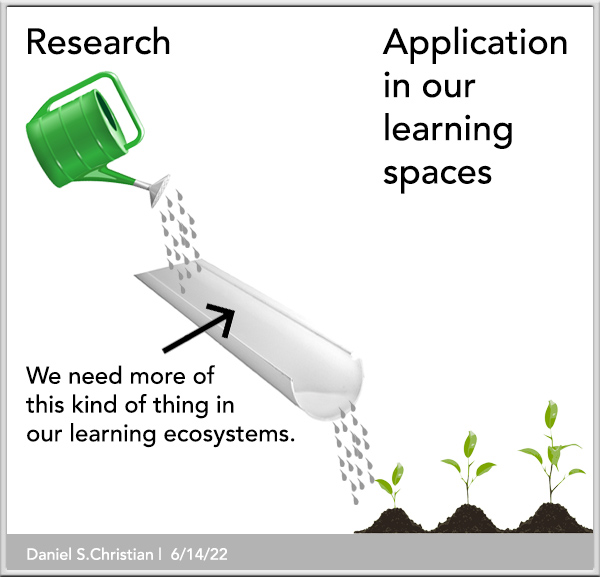
Along these lines — and though we’re making progress in this area — too often we separate the research from the practical application of that research. So we have folks working primarily in learning science, neuroscience, cognitive psychology, and related fields. But their research doesn’t always get practically applied within our learning spaces. We have researchers…and then we have practitioners. So I greatly appreciate the likes of Pooja Agarwal and Patrice Bain out at RetrievalPractice.org, Daniel Willingham, Eva Keiffenheim, The Learning Scientists, James Lang, and several others who bridge this gap.

We need to take more of the research from learning science and apply it in our learning spaces.

Perhaps more researchers, faculty members, teachers, trainers, instructional designers, principals, provosts, etc. could blog or be active out on social media.

***

Along these lines, we need to spend more time helping people know how best to study and to learn.
If that type of thing is ever to be learned, it seems like it’s often learned or discussed in the mid- to later years of one’s life…often after one’s primary and secondary days are long gone.

Instead, we should consider putting these easy-to-understand posters from the Learning Scientists in every K-12 school, college, and university in the nation — or something like them.

***

To provide the most effective engaging learning experiences, we should consider using more team-based approaches. As appropriate, that could include the students themselves.

***

We put way too much emphasis on grades — which produces gameplayers who seek only to do the minimum amount of work necessary to get the A’s.  Doing so creates systems whereby learning is not the goal — getting a 4.0+ is.

***
As we are now required to be lifelong learners, our quality of life as a whole goes waaaay up if we actually enjoy learning.  Many people discover later in life that they like to learn…they just didn’t like school. Perhaps we could place greater emphasis within K-16 on whether students enjoyed their learning experiences or not. And if not, what might have made that topic more enjoyable to them? Or what other topics would they like to dive into (that weren’t’ on the original learning menu)?

This could also apply in the corporate training/L&D space as well. Such efforts could go a long way in helping establish stronger learning cultures.

***

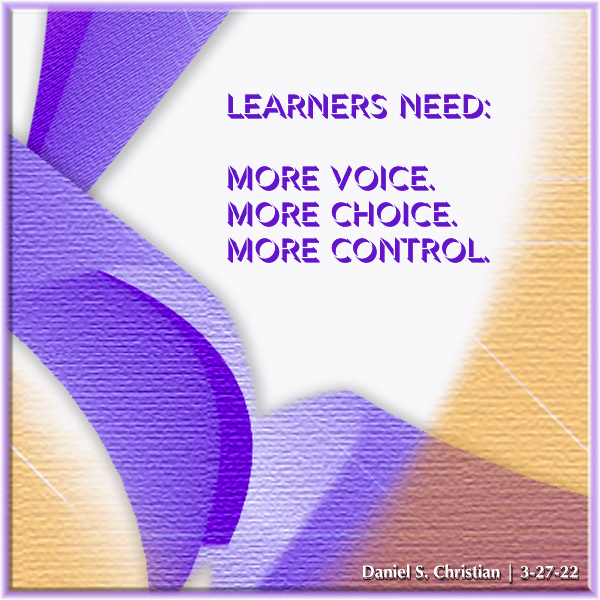
We don’t provide enough choice to our students. We need to do a better job of turning over more control to them in their learning journey. We turn students off to learning because we try to cram information that they don’t care about down their throats. So then we have to use the currency of grades to force them into doing the work that they could care less about doing. Their experience with learning/school can easily get soured.

Learners need: More voice. More choice. More control. -- this image was created by Daniel Christian

We need to be more responsive with our curricula. And we need to explain how the information we’re trying to relay is relevant in the real world and will be relevant in their futures.

***

So those are some ideas that I wanted to relay. Thanks for your time and for your shared interests here!


The Post-Covid New Normal is Looking Bipolar — from philonedtech.com by Phil Hill

Excerpt:

I think it is important to deal with evidence on enrollment trends on their own terms and not just in the context of Covid recovery, and not just based on pre-Covid trends. The data we’re seeing recently have some big implications for the health of institutions, for online and hybrid education, and for alternative educational programs (and even alternative scheduling of programs).

The observation that higher education fortunes differ between elites and more open access institutions is not new, but what is becoming clear is that increasing separation cannot be explained away by Covid.


Also relevant/see:

Supporting Students and Faculty in the New Normal — from campustechnology.com by Thomas Hoover, Richard Shrubb, Donna Johnson
As classrooms evolve to accommodate the flexibility and innovation of new learning models, it’s important to provide ample training and resources for all constituents. Here are three key areas to consider.


The Pandemic’s Lasting Lessons for Colleges, From Academic Innovation Leaders — from edsurge.com by Nadia Tamez-Robledo, Rebecca Koenig, and Jeffrey R. Young

Excerpts:

“Universities are in the business of knowledge, but universities do a very poor job of managing their own knowledge and strategy,” says Brian Fleming, associate vice chancellor of learning ecosystem development at Northeastern University. “You may have faculty members who study organizational development, but none of that gets applied to the university.”

University leaders should learn to think more like futurists, he argues, working to imagine scenarios that might need planning for but are beyond the usual one-year or five-year planning cycles.

The pandemic prompted more faculty to ask the question, “What do we actually want to use class time for?” says Tyler Roeger, director of the center for the enhancement of teaching and learning at Elgin Community College. And the answer many of them are landing on, he adds, is: “Actual face-to-face time can be dedicated to problem-working, and working in groups together.”


Why Improving Student Learning is So Hard — from opencontent.org by David Wiley

Excerpt:

2. Student behavior will normally change only in response to changes in faculty behavior – specifically, the assignments faculty give and the support faculty provide.

For many students, the things-they-do-to-learn are all located within the relatively small universe of things their faculty assign them to do – read chapters, complete homework assignments, etc. For a variety of reasons, and many of them perfectly good reasons, “students don’t do optional” – they only do what they’re going to be graded on.

Therefore, students will likely engage in more effective learning behaviors ONLY IF their faculty assign them more effective learning activities. Faculty can further increase the likelihood of students engaging in more effective learning activities if they support them appropriately throughout the process.

From DSC:
I can put an “Amen” to the above excerpt. For years I managed a Teaching & Learning Digital Studio. Most of the students didn’t come into the Studio for help, because most of the faculty members assigned the normal kinds of things (papers, quizzes, and such). Had there been more digitally-created means of showing what students knew, there would have been more usage of the T&L Digital Studio. 

Also, if we want to foster more creativity and innovation — as well as give our learners more choice and more control over their learning — we should occasionally get away from the traditional papers.

Another comment here is that it’s hard to change what faculty members do, when Instructional Designers can’t even get in the car to help faculty members navigate. We need more team-based efforts in designing our learning experiences.


8 Principles for Supporting Students with ADHD — from cultofpedagogy.com by Jennifer Gonzalez

Excerpt:

Regardless of the subject area or age you teach, you’re likely to have at least a few students with ADHD in your classroom every school year, so a good working knowledge of it should be part of any teacher’s professional training.

This slim book is not meant to be comprehensive or in-depth. Barkley states outright that he’s not going to spend time on narrative prose and extensive research citations; his goal is to simply explain ADHD so that busy teachers can understand it, and tell them what they can do to help students who have it. His message is “Trust me, I know this stuff. Do this, not that.” And while this obviously leaves him open to criticism, the book certainly delivers on its promises, and it’s a great starting point for any teacher who wants a crash course on ADHD.


We need to use more tools — that go beyond screen sharing — where we can collaborate regardless of where we’re at. [Christian]

From DSC:
Seeing the functionality in Freehand — it makes me once again think that we need to use more tools where faculty/staff/students can collaborate with each other REGARDLESS of where they’re coming in to partake in a learning experience (i.e., remotely or physically/locally). This is also true for trainers and employees, teachers and students, as well as in virtual tutoring types of situations. We need tools that offer functionalities that go beyond screen sharing in order to collaborate, design, present, discuss, and create things.  (more…)


Teaching: Fresh Approaches to Faculty Development — from chronicle.com by Beckie Supiano

Excerpt:

Baranovic can’t imagine returning to the old model: He’s sticking to panels in Zoom. Among the benefits, he says: “This arrangement breaks institutional silos, allows faculty to talk more about their experiences, shares effective practices from sources faculty trust (their peers), creates a stronger sense of community, makes it easy for panelists (they receive the questions ahead of time if they want to prepare, but because they’re speaking to experience, they don’t really have to prepare), and creates a form of support that works like therapy but doesn’t feel like therapy.”

Next, Baranovic hopes to turn the panels into a podcast format for professors unable to attend in real time.

From DSC:
As someone who had been involved with Teaching & Learning Centers for years, I can tell you that it’s very disheartening to put together a training session for faculty members and have very few — if any — people show up for it. It’s a waste of time and it leaves the T&L staff and/or IT staff members feeling discouraged and unvalued.

Over the years, I developed a preference for putting things into an asynchronous digital format for faculty members and adjunct faculty members to access per their own schedules. The institutions that I was working for got a greater ROI from those sessions and they were able to visit an internal “course” or website to reference those materials on-demand.

I also like the idea of podcasting here, but that takes a lot of time and effort — and isn’t always possible when you are one person trying to assist hundreds of faculty members (from a technical support and an LMS admin standpoint).

As an Instructional Designer, I also want to comment that it’s hard to help steer a car if you can’t even get into the car. Those institutions that are using team-based approaches will be far more successful in designing and developing more polished, effective, accessible learning experiences. Very few people can do it all.


From Instructional Design to Learning Experience Design: Understanding the Whole Student — a podcast out at campustechnology.com by Rhea Kelly, Mark Milliron, and Kim Round

Excerpt:

These days, we hear a lot about the “new normal” in higher education. Remote and hybrid learning is here to stay, offering students more flexibility in their learning journeys. But what if the new normal is not enough? It’s time to go beyond the new normal and consider the “new possible” — how to put together the best of face-to-face, online and hybrid to create powerful learning experiences based on a deep understanding of the whole student. We spoke to Mark Milliron, senior vice president of Western Governors University and executive dean of the Teachers College, and Kim Round, academic programs director and associate dean of the Teachers College, about their vision for reimagining education and why learning experience design is essential to student success.

Another interesting podcast:

 
© 2025 | Daniel Christian