5 trends poised to shake up higher education in 2018 — from educationdive.com by Autumn Arnett

Excerpts:

  1. Blurred lines: nonprofit and for-profit providers will work together toward new business model
  2. U.S. higher education as a top international export
  3. Re-imagining physical campus space
  4. More unbundling and microcredentials
  5. Continued focus on accelerating mobile apps


From DSC:
Regarding the article below…why did it take Udacity needing to team up with Infosys to offer this type of program and curriculum? Where are the programs in institutions of traditional higher education on this?  Are similar programs being developed? If so, how quickly will they come to market? I sure hope that such program development is in progress..and perhaps it is. But the article below goes to show us that alternatives to traditional higher education seem to be more responsive to the new, exponential pace of change that we now find ourselves in.

We have to pick up the pace! To do this, we need to identify any obstacles to our institutions adapting to this new pace of change — and then address them immediately. I see our current methods of accreditation as one of the areas that we need to address. We’ve got to get solid programs to market much faster!

And for those folks in higher ed who say change isn’t happening rapidly — that it’s all a bunch of hype — you likely still have a job. But you need to go talk with some people who don’t, or who’ve had their jobs recently impacted big time. Here are some suggestions of folks to talk with:

  • Taxi drivers who were impacted by Lyft and by Uber these last 5-10 years; they may still have their jobs, if they’re lucky. But they’ve been impacted big time…and are likely driving for Lyft and/or Uber as well as their former employers; they’re likely to have less bargaining power than they used to as the supply of drivers has skyrocketed. (By the way, the very existence of such organizations couldn’t have happened without the smartphone and mobile-related technologies/telecommunications.)
  • Current managers and former employees at hotels/motels about the impacts on their industry by AirBnB over a similar time frame
  • Hiring managers at law firms who’ve cut back on hiring entry-level lawyers…work that’s increasingly being done by software (example)
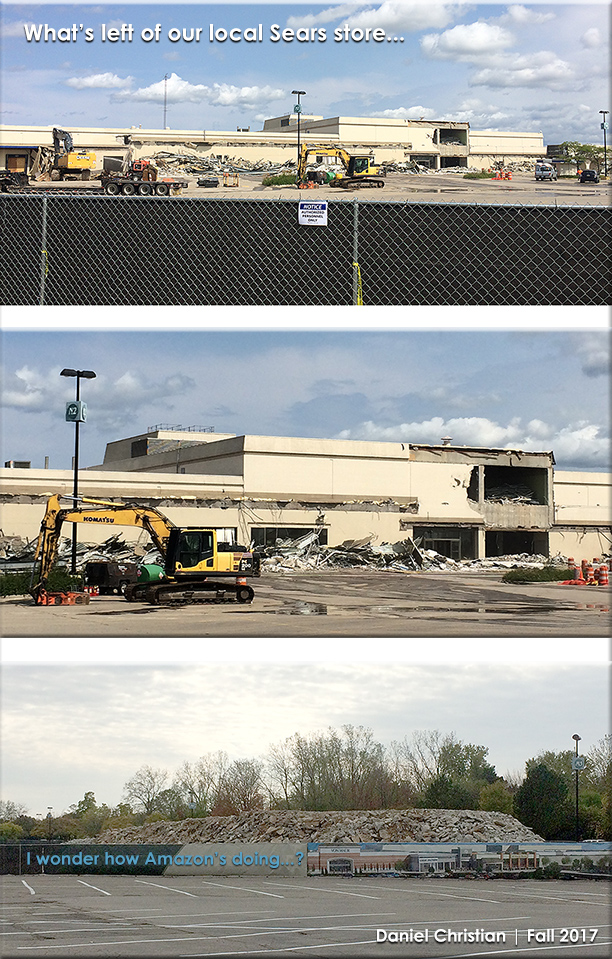
  • Employees who worked at brick and mortar retailers who have been crushed by Amazon.com’s online-based presence (in not that long of time, by the way). For example, below is what our local Sears store looks like these days…go find an employee who used to work at Sears or a Sears automotive-related store:

 

This is what our local Sears store looks like today

This picture is for those who say there is no disruption.
You call
this hype?!


The above example list — that’s admittedly woefully incomplete — doesn’t include the folks displaced by technology over the last several decades, such as:

  • Former bank tellers who lost their jobs to ATMs
  • Checkout clerks at the grocery stores who lost their jobs to self-service stations
  • Check-in agents at the airports who lost their jobs to self-service stations
  • Etc., etc., etc.

Institutions of traditional higher education
need to pick up the pace — big time!


Infosys and Udacity team up to train 500 engineers in autonomous technologies — from by Leah Brown
Infosys’ COO Ravi Kumar explains how these individuals can apply what they learn to other industries.

Excerpt (emphasis DSC):

Infosys, a global technology consulting firm, recently partnered with online learning platform Udacity to create a connected service that provides training for autonomous vehicles, and other services for B2B providers of autonomous vehicles.

TechRepublic’s Dan Patterson met with Infosys’ COO Ravi Kumar to discuss how autonomous technology can help create new industries.

Autonomous technology is going to be an emerging technology of the future, Kumar said. So Infosys and Udacity came together and developed a plan to train 500 engineers on autonomous technologies, and teach them how to apply it to other industries.


Per Wikipedia:
Udacity is a for-profit educational organization founded by Sebastian Thrun, David Stavens, and Mike Sokolsky offering massive open online courses (MOOCs). According to Thrun, the origin of the name Udacity comes from the company’s desire to be “audacious for you, the student.” While it originally focused on offering university-style courses, it now focuses more on vocational courses for professionals.


But times are changing. Artificial intelligence (AI) and robotics are facilitating the automation of a growing number of “doing” tasks. Today’s AI-enabled, information-rich tools are increasingly able to handle jobs that in the past have been exclusively done by people—think tax returns, language translations, accounting, even some kinds of surgery. These shifts will produce massive disruptions to employment and hold enormous implications for you as a business leader. (mckinsey.com)


Plan now to attend the 2018 Next Generation Learning Spaces Conference — tour USC’s campus!

From DSC:
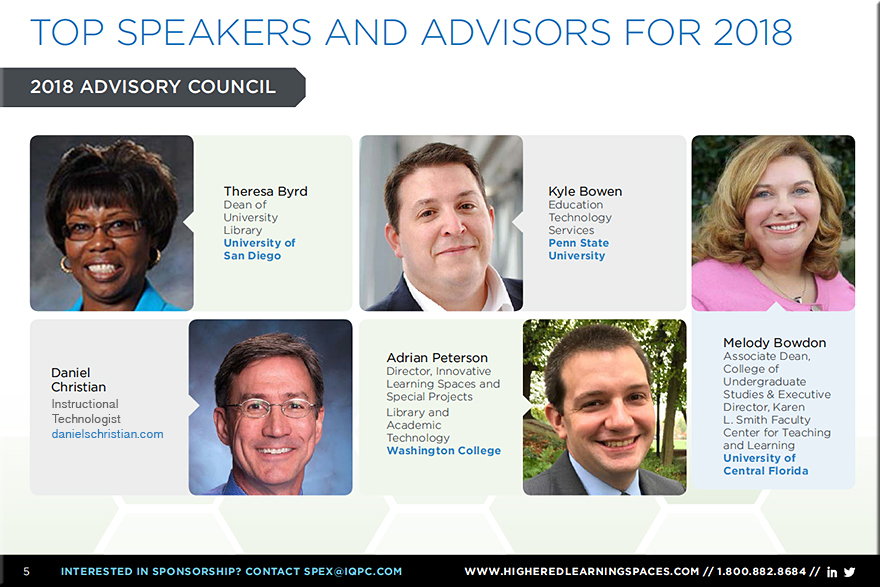
I am honored to be currently serving on the 2018 Advisory Council for the Next Generation Learning Spaces Conference with a great group of people. Missing — at least from my perspective — from the image below is Kristen Tadrous, Senior Program Director with the Corporate Learning Network. Kristen has done a great job these last few years planning and running this conference.


The Advisory Board for the 2018 Next Generation Learning Spaces Conference

NOTE:
The above graphic reflects a recent change for me. I am still an Adjunct Faculty Member
at Calvin College, but I am no longer a Senior Instructional Designer there.
My brand is centered around being an Instructional Technologist.


This national conference will be held in Los Angeles, CA on February 26-28, 2018. It is designed to help institutions of higher education develop highly-innovative cultures — something that’s needed in many institutions of traditional higher education right now.

I have attended the first 3 conferences and I moderated a panel at the most recent conference out in San Diego back in February/March of this year. I just want to say that this is a great conference and I encourage you to bring a group of people to it from your organization! I say a group of people because a group of 5 of us (from a variety of departments) went one year and the result of attending the NGLS Conference was a brand new Sandbox Classroom — an active-learning based, highly-collaborative learning space where faculty members can experiment with new pedagogies as well as with new technologies. The conference helped us discuss things as a diverse group, think out load, come up with some innovative ideas, and then build the momentum to move forward with some of those key ideas.

If you haven’t already attended this conference, I highly recommend that you check it out. You can obtain the agenda/brochure for the conference by providing some basic contact information here.


The 2018 Next Generational Learning Spaces Conference- to be held in Los Angeles on Feb 26-28, 2018


Tour the campus at UCLA

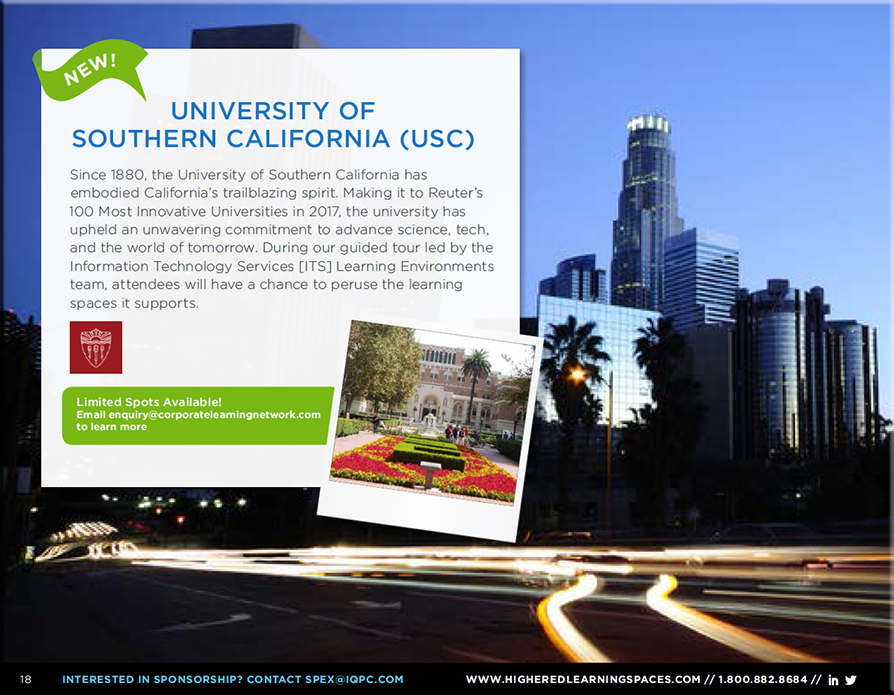
Per Kristen Tadrous, here’s why you want to check out USC:

  • A true leader in innovation: USC made it to the Top 20 of Reuter’s 100 Most Innovative Universities in 2017!
  • Detailed guided tour of leading spaces led by the Information Technology Services Learning Environments team
  • Benchmark your own learning environments by getting a ‘behind the scenes’ look at their state-of-the-art spaces
  • There are only 30 spots available for the site tour


Building Spaces to Inspire a Culture of Innovation — a core theme at the 4th Next Generation Learning Spaces summit, taking place this February 26-28 in Los Angeles. An invaluable opportunity to meet and hear from like-minded peers in higher education, and continue your path toward lifelong learning. #ngls2018 http://bit.ly/2yNkMLL


From DSC:
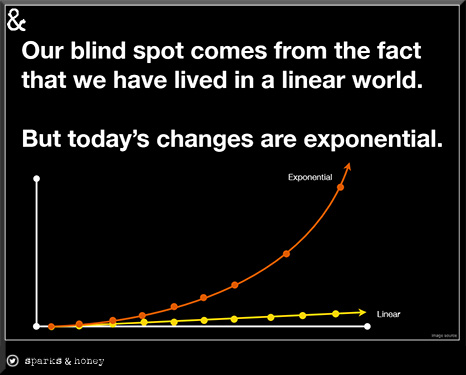
In Part I, I looked at the new, exponential pace of change that colleges, community colleges and universities now need to deal with – observing the enormous changes that are starting to occur throughout numerous societies around the globe. If we were to plot out the rate of change, we would see that we are no longer on a slow, steady, incremental type of linear pathway; but, instead, we would observe that we are now on an exponential trajectory (as the below graphic from sparks & honey very nicely illustrates).


How should colleges and universities deal with this new, exponential pace of change?

1) I suggest that you ensure that someone in your institution is lifting their gaze and peering out into the horizons, to see what’s coming down the pike. That person – or more ideally, persons – should also be looking around them, noticing what’s going on within the current landscapes of higher education. Regardless of how your institution tackles this task, given that we are currently moving at an incredibly fast pace, this trend analysis is very important. The results from this analysis should immediately be integrated into your strategic plan. Don’t wait 3-5 years to integrate these new findings into your plan. The new, exponential pace of change is going to reward those organizations who are nimble and responsive.

2) I recommend that you look at what programs you are offering and consider if you should be developing additional programs such as those that deal with:

  • Artificial Intelligence (Natural Language Processing, deep learning, machine learning, bots)
  • New forms of Human Computer Interaction such as Augmented Reality, Virtual Reality, and Mixed Reality
  • User Experience Design, User Interface Design, and/or Interaction Design
  • Big data, data science, working with data
  • The Internet of Things, machine-to-machine communications, sensors, beacons, etc.
  • Blockchain-based technologies/systems
  • The digital transformation of business
  • Freelancing / owning your own business / entrepreneurship (see this article for the massive changes happening now!)
  • …and more

3) If you are not already doing so, I recommend that you immediately move to offer a robust lineup of online-based programs. Why do I say this? Because:

  • Without them, your institution may pay a heavy price due to its diminishing credibility. Your enrollments could decline if learners (and their families) don’t think they will get solid jobs coming out of your institution. If the public perceives you as a dinosaur/out of touch with what the workplace requires, your enrollment/admissions groups may find meeting their quotas will get a lot harder as the years go on. You need to be sending some cars down the online/digital/virtual learning tracks. (Don’t get me wrong. We still need the liberal arts. However, even those institutions who offer liberal arts lineups will still need to have a healthy offering of online-based programs.)
  • Online-based learning methods can expand the reach of your faculty members while offering chances for individuals throughout the globe to learn from you, and you from them
  • Online-based learning programs can increase your enrollments, create new revenue streams, and develop/reach new markets
  • Online-based learning programs have been proven to offer the same learning gains – and sometimes better learning results than – what’s being achieved in face-to-face based classrooms
  • The majority of pedagogically-related innovations are occurring within the online/digital/virtual realm, and you will want to have built the prior experience, expertise, and foundations in order to leverage and benefit from them
  • Faculty take their learning/experiences from offering online-based courses back into their face-to-face courses
  • Due to the increasing price of obtaining a degree, students often need to work to help get them (at least part of the way) through school; thus, flexibility is becoming increasingly important and necessary for students
  • An increasing number of individuals within the K-12 world as well as the corporate world are learning via online-based means. This is true within higher education as well, as, according to a recent report from Digital Learning Compass states that “the number of higher education students taking at least one distance education course in 2015 now tops six million, about 30% of all enrollments.”
  • Families are looking very closely at their return on investments being made within the world of higher education. They want to see that their learners are being prepared for the ever-changing future that they will encounter. If people in the workforce often learn online, then current students should be getting practice in that area of their learning ecosystems as well.
  • As the (mostly) online-based Amazon.com is thriving and retail institutions such as Sears continue to close, people are in the process of forming more generalized expectations that could easily cross over into the realm of higher education. By the way, here’s how our local Sears building is looking these days…or what’s left of it.


4) I recommend that you move towards offering more opportunities for lifelong learning, as learners need to constantly add to their skillsets and knowledge base in order to remain marketable in today’s workforce. This is where adults greatly appreciate – and need – the greater flexibility offered by online-based means of learning. I’m not just talking about graduate programs or continuing studies types of programs here. Rather, I’m hoping that we can move towards providing streams of up-to-date content that learners can subscribe to at any time (and can drop their subscription to at any time). As a relevant side note here, keep your eyes on blockchain-based technologies here.

5) Consider the role of consortia and pooling resources. How might that fit into your strategic plan?

6) Consider why bootcamps continue to come onto the landscape.  What are traditional institutions of higher education missing here?

7) And lastly, if one doesn’t already exist, form a small, nimble, innovative group within your organization — what I call a TrimTab Group — to help identify what will and won’t work for your institution.


From DSC:
I appreciated hearing the perspectives from Bruce Dixon and Will Richardson this morning, as I listed to a webinar that they recently offered. A few key takeaways for me from that webinar — and with a document that they shared — were:

  • The world has fundamentally changed. (Bruce and Will also mentioned the new pace of change; i.e., that it’s much faster.)
  • We need to have more urgency about the need to reimagine school, not to try to improve the existing model.
  • “Because of the advent of the Web and the technologies we use to access it, learning is, in a phrase, leaving the (school) building.”
  • There is a newfound capacity to take full control of one’s own learning; self-determined learning should be at the center of students’ and teachers’ work; co-constructed curriculum
  • And today, at a moment when learners of all ages have never had more agency over their own learning, schools must unlearn centuries old mindsets and practices and relearn them in ways that truly will serve every child living in the modern, connected world.
  • Will and Bruce believe that every educator — and district for that matter — should articulate their own “principles of learning”
  • Beliefs about how kids learn (powerfully and deeply) need to be articulated and consistently communicated and lived out
  • Everything we do as educators, administrators, etc. tells a story. What stories are we telling? (For example, what does the signage around your school building say? Is it about compliance? Is is about a love of learning? Wonder? What does the 20′ jumbo tron say about priorities? Etc.)
  • Bruce and Will covered a “story audit” and how to do one


“Learning is, in a phrase, leaving the (school) building.”

Richardson & Dixon


Also see:


These educators have decades worth of experience. They are pulse-checking their environments. They want to see students thrive both now and into the future. For these reasons, at least for me, their perspectives are highly worth reflecting upon.


Report: Student loan debt reaches $1.4 trillion — from campustechnology.com by Joshua Bolkan

Excerpt:

Student loan debt in the United States has grown 149 percent over the last decade to reach $1.4 trillion, according to a new report from Experian. Over the same period, the average student loan debt per person went up 62 percent.

Held by 13.4 percent of Americans, student loan debt is the fastest growing debt segment and the largest non-household debt. But, counter-intuitively, fewer people make late payments on this type of debt than on other loans. In fact, the percentage of late payments on student debt has decreased 10.1 percent since 2009.

Other key findings of the report include…


From DSC:
The thing that makes this soooo difficult is that faculty members, staff, and members of administrations often don’t see this crushing development. It’s invisible to many of them! The growing, heavy gorillas on the backs of our graduates aren’t seen on campus. Students graduate and move on. But the realities and implications of those debts can be felt for decades!

Several major events in our graduates lives are likely to be increasingly postponed, such as:

  • Starting a family
  • Purchasing a new home
  • Investing in — or saving for — their retirement

The current models and methods of higher education must change! Prices MUST come down. If the traditional institutions of higher education don’t change, don’t be surprised when the alternatives keep picking up steam and eventually — and majorly — disrupt higher education.

This is a social justice issue for me.


From DSC:
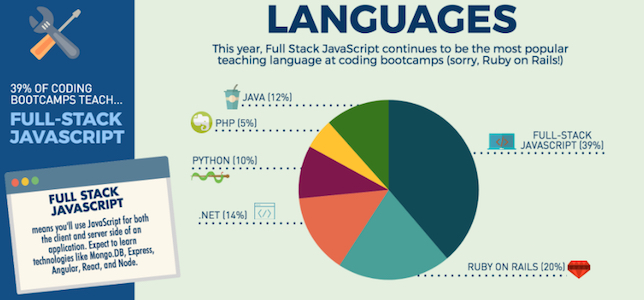
According to the article below, bootcamps appear to be filling several (perceived and/or real) gaps. Quoting from the article:

Why are students enrolling in coding bootcamps? One reason may be the adaptability of these accelerated computer science programs, where students are taught web and mobile development skills that align with industry demands. Programs are offered in-person or online, providing students with flexible learning options. The payoff is decent too: At a typical coding bootcamp, Course Report estimates average tuition is $11,400 for about 14 weeks of instruction, from which the majority students complete on-time and find relevant jobs.

Cost.

Time.

Responsiveness to industry demands.

Greater flexibility.

These are some of the things for traditional institutions of higher education to grapple with, and I would argue the sooner, the better — before this trend finds its legs and gains even more traction/momentum.

For example, in your own mind/thinking…how long do you think it will take bootcamps to begin offering programs that help learners develop content for augmented reality (AR), virtual reality (VR), and mixed reality (MR) — as compared to programs coming out of institutions of traditional higher education?

Whatever your answers are in regards to the reasons for that time difference are likely the exact sort of things institutions need to be working on. For me, at least one of the answers has to do with our current accreditation systems. Other reasons come to my mind as well, but I don’t have time to go there right now.


Study: 1 Coding Bootcamp Graduate for Every 3.5 University Grads — from campustechnology.com by Sri Ravipati

Excerpt:

The five-year coding bootcamp industry estimated at $266 million is rapidly expanding, according to a new market study from Course Report.

The study counted 94 full-time coding bootcamps across the United States and Canada (with programs in 74 U.S. cities). Compared to 2012, there will be 10 times as many graduates this year — or roughly one coding bootcamp graduate for every 3.5 graduates from a traditional university or college. Course Report estimates that 22,814 developers will graduate from coding bootcamps this year — an increase from 15,048 graduates last year.


Robots and AI are going to make social inequality even worse, says new report — from theverge.com by
Rich people are going to find it easier to adapt to automation

Excerpt:

Most economists agree that advances in robotics and AI over the next few decades are likely to lead to significant job losses. But what’s less often considered is how these changes could also impact social mobility. A new report from UK charity Sutton Trust explains the danger, noting that unless governments take action, the next wave of automation will dramatically increase inequality within societies, further entrenching the divide between rich and poor.

The are a number of reasons for this, say the report’s authors, including the ability of richer individuals to re-train for new jobs; the rising importance of “soft skills” like communication and confidence; and the reduction in the number of jobs used as “stepping stones” into professional industries.

For example, the demand for paralegals and similar professions is likely to be reduced over the coming years as artificial intelligence is trained to handle more administrative tasks. In the UK more than 350,000 paralegals, payroll managers, and bookkeepers could lose their jobs if automated systems can do the same work.


Re-training for new jobs will also become a crucial skill, and it’s individuals from wealthier backgrounds that are more able to do so, says the report. This can already be seen in the disparity in terms of post-graduate education, with individuals in the UK with working class or poorer backgrounds far less likely to re-train after university.


From DSC:
I can’t emphasize this enough. There are dangerous, tumultuous times ahead if we can’t figure out ways to help ALL people within the workforce reinvent themselves quickly, cost-effectively, and conveniently. Re-skilling/up-skilling ourselves is becoming increasingly important. And I’m not just talking about highly-educated people. I’m talking about people whose jobs are going to be disappearing in the near future — especially people whose stepping stones into brighter futures are going to wake up to a very different world. A very harsh world.

That’s why I’m so passionate about helping to develop a next generation learning platform. Higher education, as an industry, has some time left to figure out their part/contribution out in this new world. But the window of time could be closing, as another window of opportunity / era could be opening up for “the next Amazon.com of higher education.”

It’s up to current, traditional institutions of higher education as to how much they want to be a part of the solution. Some of the questions each institution ought to be asking are:

  1. Given our institutions mission/vision, what landscapes should we be pulse-checking?
  2. Do we have faculty/staff/members of administration looking at those landscapes that are highly applicable to our students and to their futures? How, specifically, are the insights from those employees fed into the strategic plans of our institution?
  3. What are some possible scenarios as a result of these changing landscapes? What would our response(s) be for each scenario?
  4. Are there obstacles from us innovating and being able to respond to the shifting landscapes, especially within the workforce?
  5. How do we remove those obstacles?
  6. On a scale of 0 (we don’t innovate at all) to 10 (highly innovative), where is our culture today? Where do we hope to be 5 years from now? How do we get there?

…and there are many other questions no doubt. But I don’t think we’re looking into the future nearly enough to see the massive needs — and real issues — ahead of us.


The report, which was carried out by the Boston Consulting Group and published this Wednesday [7/12/17], looks specifically at the UK, where it says some 15 million jobs are at risk of automation. But the Sutton Trust says its findings are also relevant to other developed nations, particularly the US, where social mobility is a major problem.


From DSC:
Though slightly older, this article has some solid advice that I think we in higher education need to heed as well.


The Importance of Continuing Education for Digital Leaders — from strategy-business.com by Chris Curran — with thanks to tweets by Cathryn Marsh and G Athanasakopoulos

Excerpt (emphasis DSC):

Whether you’re a newly minted MBA or an experienced leader, you’re always honing your skills and navigating change. And technology is one discipline in which you really can’t afford to stagnate. With digital transformation so central to strategy for most companies, all executives — especially CEOs — must embrace a learning mind-set. Gone are the days you can delegate the job of keeping up with technology to the IT staff.

Chief information officers (CIOs), of course, should regularly brief the management team and the board on new developments, demoing exciting new technology, bringing in external speakers and vendors, and using other tactics that promote tech learning and engagement. But keeping up on technology trends is also the responsibility of every executive. And while that can be daunting given the vast tech landscape and seemingly limitless avenues for learning, it’s also incredibly exciting.


Indeed, the art of continuous learning itself may be the most sought-after skill for tomorrow’s workforce as well as the key to solving tomorrow’s problems. 


From DSC:
Tapping into streams of content (via RSS feeds and/or with tools like Google Alerts) is key here. Developing your personal learning networks and your communities of practice are key here. The article also mentions MOOCs and online learning. which I would also add to the list of helpful tools/avenues to pursue.


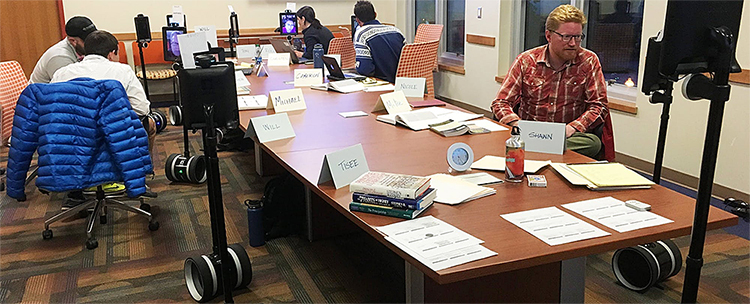
Robot students? College classrooms try letting far-away students attend via remote-control stand-in — from edsurge.com by Sydney Johnson

Excerpt:

Someone looking in on Bill McCaw’s educational leadership class at the University of Montana might see students talking in small groups, or peers helping each other on assignments. It’s an age-old classroom scene, except for one space-age detail: More than half of the students are robots.

Ok, to be more precise, nine of the fourteen students in the course are joining the class remotely by using a robot stand-in. The hope is that the approach will let students, who are working professionals, join from hundreds of miles away and feel more a part of the group than would be possible with standard videoconference links.

“The space in Montana is huge. That’s why this is really important for us,” says McCaw.


From DSC:
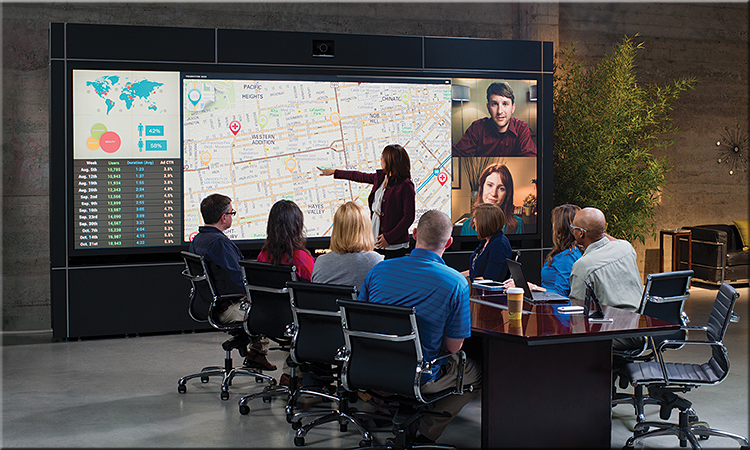
I appreciate the level of experimentation that’s going on here — it’s stretching the existing paradigms and asking how we might bring in remote learners into our face-to-face based classrooms. This is one approach.

Another approach uses tool like the ones below — which make having students be in the same physical learning space less important:


The 2017 Dean’s List: EdTech’s 50 Must-Read Higher Ed Blogs [Meghan Bogardus Cortez at edtechmagazine.com]


The 2017 Dean’s List: EdTech’s 50 Must-Read Higher Ed Blogs — from edtechmagazine.com by Meghan Bogardus Cortez
These administrative all-stars, IT gurus, teachers and community experts understand how the latest technology is changing the nature of education.

Excerpt:

With summer break almost here, we’ve got an idea for how you can use some of your spare time. Take a look at the Dean’s List, our compilation of the must-read blogs that seek to make sense of higher education in today’s digital world.

Follow these education trailblazers for not-to-be-missed analyses of the trends, challenges and opportunities that technology can provide.

If you’d like to check out the Must-Read IT blogs from previous years, view our lists from 2016, 2015, 2014 and 2013.


From DSC:
I would like to thank Tara Buck, Meghan Bogardus Cortez, D. Frank Smith, Meg Conlan, and Jimmy Daly and the rest of the staff at EdTech Magazine for their support of this Learning Ecosystems blog through the years — I really appreciate it. 

Thanks all for your encouragement through the years!


From DSC:
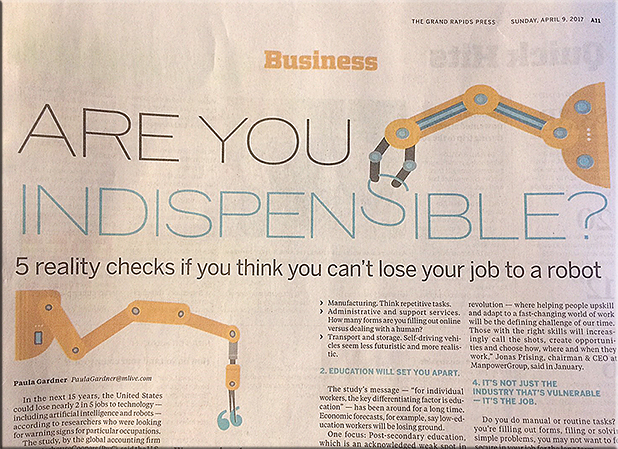
The recent pieces below made me once again reflect on the massive changes that are quickly approaching — and in some cases are already here — for a variety of nations throughout the world.

They caused me to reflect on:

  • What the potential ramifications for higher education might be regarding these changes that are just starting to take place in the workplace due to artificial intelligence (i.e., the increasing use of algorithms, machine learning, and deep learning, etc.), automation, & robotics?
  • The need for people to reinvent themselves quickly throughout their careers (if we can still call them careers)
  • How should we, as a nation, prepare for these massive changes so that there isn’t civil unrest due to soaring inequality and unemployment?

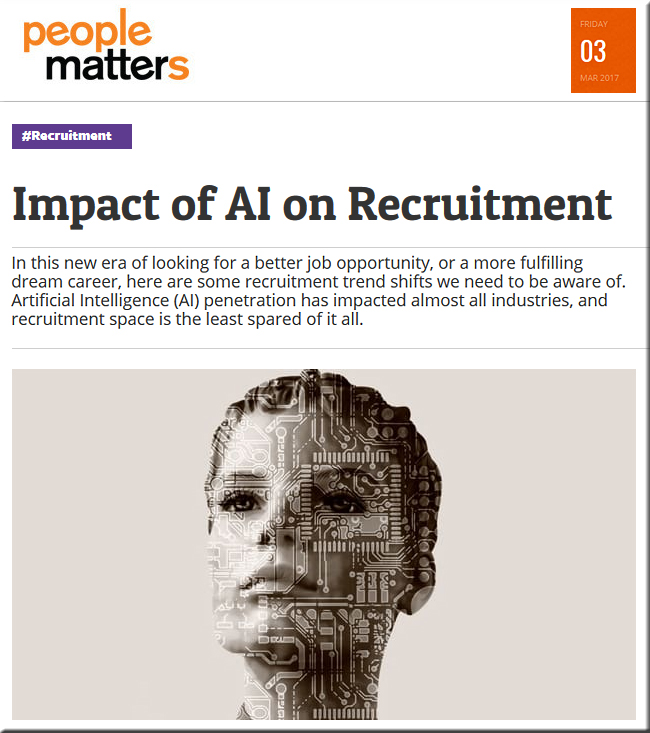
As found in the April 9th, 2017 edition of our local newspaper here:

When even our local newspaper is picking up on this trend, you know it is real and has some significance to it.


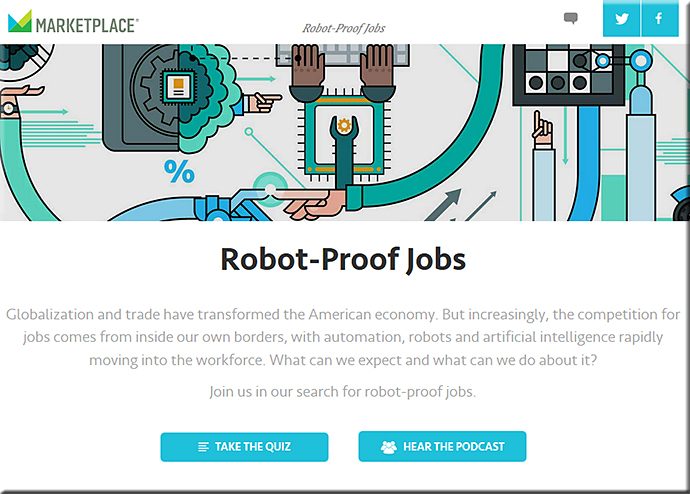
Then, as I was listening to the radio a day or two after seeing the above article, I heard of another related piece on NPR.  NPR is having a journalist travel across the country, trying to identify “robot-safe” jobs.  Here’s the feature on this from MarketPlace.org


What changes do institutions of traditional higher education
immediately need to begin planning for? Initiating?

What changes should be planned for and begin to be initiated
in the way(s) that we accredit new programs?


Keywords/ideas that come to my mind:

  • Change — to society, to people, to higher ed, to the workplace
  • Pace of technological change — no longer linear, but exponential
  • Career development
  • Staying relevant — as institutions, as individuals in the workplace
  • Reinventing ourselves over time — and having to do so quickly
  • Adapting, being nimble, willing to innovate — as institutions, as individuals
  • Game-changing environment
  • Lifelong learning — higher ed needs to put more emphasis on microlearning, heutagogy, and delivering constant/up-to-date streams of content and learning experiences. This could happen via the addition/use of smaller learning hubs, some even makeshift learning hubs that are taking place at locations that these institutions don’t even own…like your local Starbucks.
  • If we don’t get this right, there could be major civil unrest as inequality and unemployment soar
  • Traditional institutions of higher education have not been nearly as responsive to change as they have needed to be; this opens the door to alternatives. There’s a limited (and closing) window of time left to become more nimble and responsive before these alternatives majorly disrupt the current world of higher education.


Addendum from the corporate world (emphasis DSC):


From The Impact 2017 Conference:

The Role of HR in the Future of Work – A Town Hall

  • Josh Bersin, Principal and Founder, Bersin by Deloitte, Deloitte Consulting LLP
  • Nicola Vogel, Global Senior HR Director, Danfoss
  • Frank Møllerop, Chief Executive Officer, Questback
  • David Mallon, Head of Research, Bersin by Deloitte, Deloitte Consulting LLP

Massive changes spurred by new technologies such as artificial intelligence, mobile platforms, sensors and social collaboration have revolutionized the way we live, work and communicate – and the pace is only accelerating. Robots and cognitive technologies are making steady advances, particularly in jobs and tasks that follow set, standardized rules and logic. This reinforces a critical challenge for business and HR leaders—namely, the need to design, source, and manage the future of work.

In this Town Hall, we will discuss the role HR can play in leading the digital transformation that is shaping the future of work in organizations worldwide. We will explore the changes we see taking place in three areas:

  • Digital workforce: How can organizations drive new management practices, a culture of innovation and sharing, and a set of talent practices that facilitate a new network-based organization?
  • Digital workplace: How can organizations design a working environment that enables productivity; uses modern communication tools (such as Slack, Workplace by Facebook, Microsoft Teams, and many others); and promotes engagement, wellness, and a sense of purpose?
  • Digital HR: How can organizations change the HR function itself to operate in a digital way, use digital tools and apps to deliver solutions, and continuously experiment and innovate?
 

The Blockchain Revolution and Higher Education — from er.educause.edu by Don Tapscott and Alex Tapscott
The blockchain provides a rich, secure, and transparent platform on which to create a global network for higher learning. This Internet of value can help to reinvent higher education in a way the Internet of information alone could not.

Excerpt:

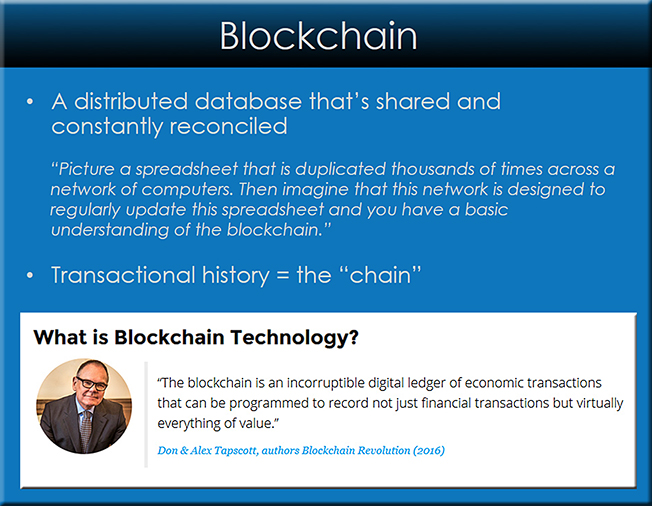
What will be the most important technology to change higher education? In our view, it’s not big data, the social web, MOOCs, virtual reality, or even artificial intelligence. We see these as components of something new, all enabled and transformed by an emerging technology called the blockchain.

OK, it’s not the most sonorous word ever, sounding more like a college football strategy than a transformative technology. Yet, sonorous or not, the blockchain represents nothing less than the second generation of the Internet, and it holds the potential to disrupt money, business, government, and yes, higher education.

The opportunities for innovators in higher education fall into four categories:

  • Identity and Student Records: How we identify students; protect their privacy; measure, record, and credential their accomplishments; and keep these records secure
  • New Pedagogy: How we customize teaching to each student and create new models of learning
  • Costs (Student Debt): How we value and fund education and reward students for the quality of their work
  • The Meta-University: How we design entirely new models of higher education so that former MIT President Chuck Vest’s dream can become a reality1

The blockchain may help us change the relationships among colleges and universities and, in turn, their relationship to society.

Let us explain.


What if there was an Internet of value — a global, distributed, highly secure platform, ledger, or database where we could store and exchange things of value and where we could trust each other without powerful intermediaries? That is the blockchain.


From DSC:
The quote…

In 2006, MIT President Emeritus Vest offered a tantalizing vision of what he called the meta-university. In the open-access movement, he saw “a transcendent, accessible, empowering, dynamic, communally constructed framework of open materials and platforms on which much of higher education worldwide can be constructed or enhanced.”

…made me wonder if this is where a vision that I’m tracking called Learning from the Living [Class] Room is heading. Also, along these lines, futurist Thomas Frey believes

“I’ve been predicting that by 2030 the largest company on the internet is going to be an education-based company that we haven’t heard of yet,” Frey, the senior futurist at the DaVinci Institute think tank, tells Business Insider. (source)

Blockchain could be a key piece of this vision.


The Living [Class] Room -- by Daniel Christian -- July 2012 -- a second device used in conjunction with a Smart/Connected TV


From DSC:
At the recent
Next Generation Learning Spaces Conference, in my introductory piece for our panel discussion, I relayed several ideas/areas that should be on our institutions’ radars. That is, at least someone at each of our institutions of higher education should be aware of these things and be pulse-checking them as time goes by.


One of these ideas/areas involved the use of blockchain technologies:


If #blockchain technologies are successful within the financial/banking world, then it’s highly likely that other use cases will be developed as well (i.e., the trust in blockchain-enabled applications will be there already).

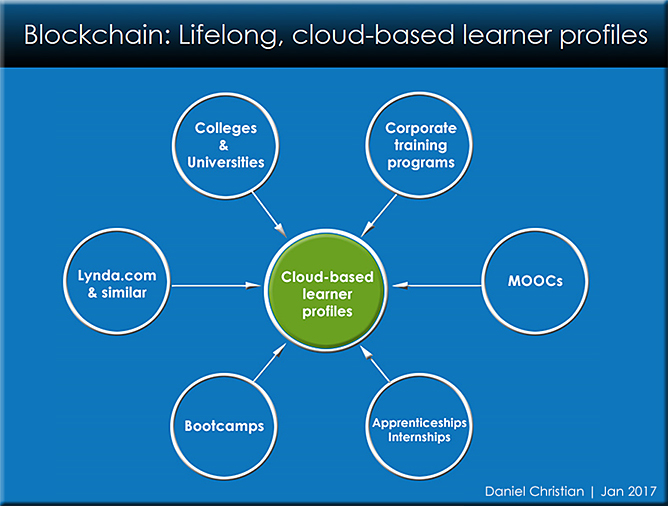
Along those lines, if that occurs, then colleges and universities are likely to become only 1 of the feeds into someone’s cloud-based, lifelong learning profile. I’ve listed several more sources of credentials below:


Given the trend towards more competency-based education (CBE) and the increased experimentation with badges, blockchain could increasingly move onto the scene.

In fact, I could see a day when an individual learner will be able to establish who can and can’t access their learner profile, and who can and can’t feed information and updates into it.

Artificial intelligence and big data also come to mind here…and I put Microsoft on my radar a while back in this regard; as Microsoft (via LinkedIn and Lynda.com) could easily create online-based marketplaces matching employers with employees/freelancers.


Along these lines, see:


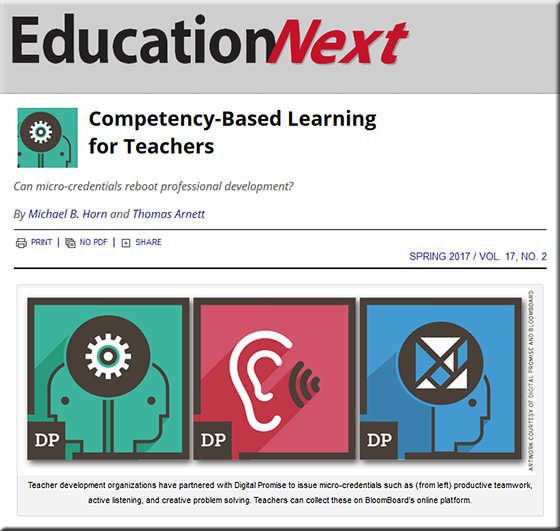
  • The Mainstreaming of Alternative Credentials in Postsecondary Education — from by Deborah Keyek-Franssen
    Excerpt:

    • The Context of Alternative Credentials
      The past few years have seen a proliferation of new learning credentials ranging from badges and bootcamp certifications to micro-degrees and MOOC certificates. Although alternative credentials have been part of the fabric of postsecondary education and professional development for decades—think prior learning assessments like Advanced Placement or International Baccalaureate exams, or industry certifications—postsecondary institutions are increasingly unbundling their degrees and validating smaller chunks of skills and learning to provide workplace value to traditional and non-traditional students alike.
      Many are experimenting with alternative credentials to counter the typical binary nature of a degree. Certifications of learning or skills are conferred after the completion of a course or a few short courses in a related field. Students do not have to wait until all requirements for a degree are met before receiving a certificate of learning, but instead can receive one after a much shorter period of study. “Stackable” credentials are combined to be the equivalent of an undergraduate or graduate certificate (a micro-degree), or even a degree.
    • The National Discussion of Alternative Credentials
      Discussions of alternative credentials are often responses to a persistent and growing critique of traditional higher educational institutions’ ability to meet workforce needs, especially because the cost to students for a four-year degree has grown dramatically over the past several decades. The increasing attention paid to alternative credentials brings to the fore questions such as what constitutes a postsecondary education, what role universities in particular should play vis-à-vis workforce development, and how we can assess learning and mastery.


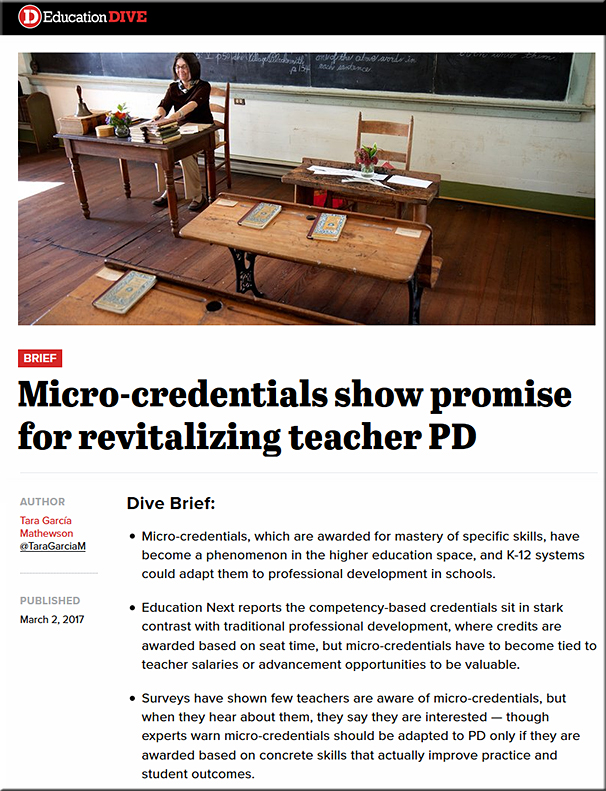
Addendums added on 3/4/17, that show that this topic isn’t just for higher education, but could involve K-12 as well:


Equipping people to stay ahead of technological change — from economist.com by
It is easy to say that people need to keep learning throughout their careers. The practicalities are daunting.

Excerpt (emphasis DSC):

WHEN education fails to keep pace with technology, the result is inequality. Without the skills to stay useful as innovations arrive, workers suffer—and if enough of them fall behind, society starts to fall apart. That fundamental insight seized reformers in the Industrial Revolution, heralding state-funded universal schooling. Later, automation in factories and offices called forth a surge in college graduates. The combination of education and innovation, spread over decades, led to a remarkable flowering of prosperity.

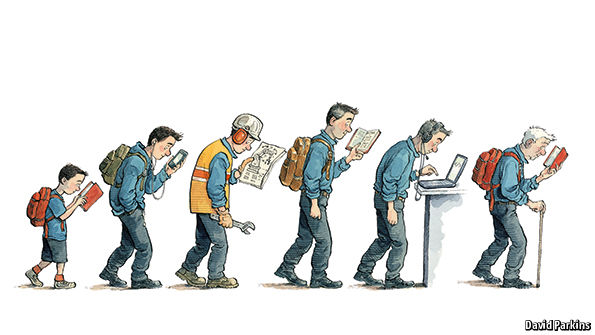
Today robotics and artificial intelligence call for another education revolution. This time, however, working lives are so lengthy and so fast-changing that simply cramming more schooling in at the start is not enough. People must also be able to acquire new skills throughout their careers.

Unfortunately, as our special report in this issue sets out, the lifelong learning that exists today mainly benefits high achievers—and is therefore more likely to exacerbate inequality than diminish it. If 21st-century economies are not to create a massive underclass, policymakers urgently need to work out how to help all their citizens learn while they earn. So far, their ambition has fallen pitifully short.

At the same time on-the-job training is shrinking. In America and Britain it has fallen by roughly half in the past two decades. Self-employment is spreading, leaving more people to take responsibility for their own skills. Taking time out later in life to pursue a formal qualification is an option, but it costs money and most colleges are geared towards youngsters.


The classic model of education—a burst at the start and top-ups through company training—is breaking down. One reason is the need for new, and constantly updated, skills.


Lifelong learning is becoming an economic imperative — from economist.com
Technological change demands stronger and more continuous connections between education and employment, says Andrew Palmer. The faint outlines of such a system are now emerging

Excerpt:

A college degree at the start of a working career does not answer the need for the continuous acquisition of new skills, especially as career spans are lengthening. Vocational training is good at giving people job-specific skills, but those, too, will need to be updated over and over again during a career lasting decades. “Germany is often lauded for its apprenticeships, but the economy has failed to adapt to the knowledge economy,” says Andreas Schleicher, head of the education directorate of the OECD, a club of mostly rich countries. “Vocational training has a role, but training someone early to do one thing all their lives is not the answer to lifelong learning.”

To remain competitive, and to give low- and high-skilled workers alike the best chance of success, economies need to offer training and career-focused education throughout people’s working lives. This special report will chart some of the efforts being made to connect education and employment in new ways, both by smoothing entry into the labour force and by enabling people to learn new skills throughout their careers. Many of these initiatives are still embryonic, but they offer a glimpse into the future and a guide to the problems raised by lifelong reskilling.


Individuals, too, increasingly seem to accept the need for continuous rebooting.


© 2025 | Daniel Christian