Why Professors Doubt Education Research — from edsurge.com by Jeff Young

Excerpts:

You found that professors really care about their teaching, and yet they are skeptical of education research. It sounds like a lot of people ended up teaching the way that they had been taught, or the way that they felt good as a student in classes they had had.

That’s right. People sometimes ignore the research precisely because they care about teaching. Different faculty arrive at the point where they’re teaching college students from wildly different experiences of their own. Some have wanted since they were small children to be professors at a university, and some fell into it later in a career.

For faculty who think that research is a good way to learn how to teach, they will devour the literature on learning sciences. They’ll reach out to experts across a number of disciplines and within their own discipline to try and learn what the best way to teach is

For faculty who believe that teaching is an art, that it is just something that you develop with experience and time, that you can’t learn from a book, you need to learn by doing more or learn from your students, no amount of exposure to learning science research is going to disrupt their sense that this is something they learn by doing, or that they need to follow their gut on.

…

Do you have any advice for someone who wants to change someone’s mind to either adopt or consider more of this evidence-based research?

People can always change their perspective. If you’re trying to communicate the value of a technology or an approach, or even of learning science or education research as a field, you have to start with the person you’re speaking to. They may come to that conversation with a sense of, “I know that people get PhDs in education. People get PhDs in curriculum design, and I’ve never even taken a class where we’ve talked about curriculum design. I would like to know what they know.”

Then there are people who will say, “I’ve been teaching since I was a graduate student. My students are very happy with the teaching. I feel pretty good about my teaching. I understand that you have a PhD in curriculum design, but I don’t really need that.”

You need to approach those two different faculty members differently, understanding that there are some people who are interested in hearing about evidence-based practices, and just pointing them towards the resources is great.
…

Excerpt from the question:
What about your own teaching? I’m curious. Are you someone that tries different techniques that are based on research?

There is so much literature, and there are so many right ways, and there are so many recommendations that incorporating all of them into your practice at the same time is literally impossible. Many of them are contradictory. You have to choose a suite that you’re adhering to, because you can’t do the others if you’re doing these. Trying to embody best practices while teaching is really complex. It’s a skillset that you develop. You develop with time, and instruction, and you can master, but you’re always going to have to continue to perfect it.


Also see:

Personalized Faculty Development: Engaging Networks, Empowering Individuals — from er.educause.edu by Jill Leafstedt

Excerpts:

During the meeting, I chose to spend my time focused solely on sessions in the Faculty Development and Engagement track. My goal: return to my home campus energized and ready to tackle the age-old problem of how to move faculty from being content experts into dynamic educators.
…
Luckily for me, I was not the only one looking for this inspiration. The faculty development sessions were packed with people trying to answer questions such as, “Why don’t faculty want help?” or “Why don’t faculty attend my workshops?” On the whole, the sessions reaffirmed my belief that faculty development does not happen in a workshop, nor does it happen through training. Improving teaching is a long, messy, reflective process that must be approached from multiple angles with many entry points.

Sound challenging? It is, but there is reason to be hopeful; our colleagues are working hard to find and share answers. Two themes came through loud and clear from the sessions I attended. First, meet faculty where they are. Don’t expect them to come to you ready to learn; go to them and start where they are. Second, build networks for ongoing learning.


From DSC:
Both of the above articles present a HUGE issue in terms of improving the level of teaching and learning. Both articles seem to be saying that anyone interested in really improving the teaching and learning that’s going on needs to meet with each individual faculty member in order to meet them where they are at. When you have hundreds of faculty members plus an over-flowing job plate that’s asking you to wear numerous hats, that’s a very tall order indeed.


Faculty Learning Communities: Making the Connection, Virtually — from by Angela Atwell, Cristina Cottom, Lisa Martino, and Sara Ombres

Excerpt (emphasis DSC):

Research has shown that interactions with peers promotes faculty engagement (McKenna, Johnson, Yoder, Guerra, & Pimmel, 2016). Faculty learning communities (FLC) have become very popular in recent years. FLCs focus on improving teaching and learning practice through collaboration and community building (Cox, 2001). Usually, FLCs are face-to-face meetings hosted at a physical location at a specific date and time. We understand the benefit of this type of experience. However, we recognize online instructors will likely find it difficult to participate in a traditional FLC. So, we set out to integrate FLC principles to provide our faculty, living and working all over the globe, a similar experience.

Recently, our Center for Teaching and Learning Excellence took the plunge and offered a Virtual Faculty Learning Community (V-FLC) for instructors at our Worldwide Campus. The first experience was open only to adjunct instructors teaching online. The experience was asynchronous, lasted eight weeks, and focused on best practices for online teaching and learning. Within our Learning Management System, faculty led and participated in discussions around the topics that were of interest to them. Most topics focused on teaching practices and ways to enhance the online experience. However, other topics bridged the gap between teaching online and general best teaching practices. 


How to Use Questions to Promote Student Learning — from scholarlyteacher.com by Spencer Benson

Excerpt:

Developing Faculty Generated Questions
Developing good questions that enhance student learning and engage all students is difficult. The challenge is constructing questions that engage learning and are “un-Googleable” meaning that students cannot find the answer with a simple online search engine. Some ways to help make questions “un-Googleable” are to

  • Avoid questions that simply ask for facts or definitions,
  • Ask the students to answer the questions based on their own personal experience,
  • Ask students for their personal opinion on an issue,
  • Ask students to describe the answer a different person might give, e.g., a relative, a famous person (historic or present), the textbook or assigned readings author, etc.


These three questions align with the various levels of Bloom’s cognitive taxonomy, “what” asks about facts and content (remembering), “how” asks about relationships (understanding and analyzing), and “why” asks about higher cognitive level skills (creating and evaluating).


EdX Quietly Developing ‘MicroBachelors’ Program — from edsurge.com by Jeff Young

Excerpt:

EdX, the nonprofit online-education group founded by MIT and Harvard, is quietly developing a “MicroBachelors” degree that is designed to break the undergraduate credential into Lego-like components.

In December, edX won a $700,000 grant from the Lumina Foundation to support the MicroBachelors effort with the organization’s university partners. Officials from edX declined to talk about the project, saying only that it is in the early stages. But at a higher-education innovation summit last month hosted by the U.S. Department of Education, Anant Agarwal, CEO of edX, listed the project as part of the group’s long-term vision that began with its MicroMasters program. And the organization has filed a trademark for the term “MicroBachelors” as well.


“Education in five to ten years will become modular, will become omnichannel, and will become lifelong,” Agarwal said at the meeting, later explaining that omnichannel meant offering courses either online or in person.


…

How would a MicroBachelors be different than, say, a two-year associate’s degree, which is arguably already half a bachelor’s degree? Sarma said that the idea behind both MicroMasters and MicroBachelors is that they are “about putting stuff that can be done online, online.” In other words, the big idea is offering a low-cost, low-risk way for students to start an undergraduate education even if they can’t get to a campus.


Also relevant/see:


Work From Home 2018: The Top 100 Companies For Remote Jobs — from forbes.com by Laura Shin

Excerpt:

The top sectors offering such work are health care, computer/IT, education/training, sales, customer service, finance and travel/hospitality of the 19 industries represented on the list. Five of the fastest-growing remote career categories are therapy, virtual administration, client services, tutoring, and state and local government. The 20 most common telecommuting job titles include teacher, writer, developer, analyst, sales representative, nurse, accountant and program manager. Five companies are fully remote, and 30 are newcomers to the list.


Also see:

20 Most Common Work-from-Home Job Titles — from by Jessica Howington

  1. Accountant
  2. Program Manager
  3. Teacher / Faculty
  4. Writer
  5. Consultant
  6. Engineer
  7. Project Manager
  8. Business Development Manager
  9. Account Manager / Account Executive
  10. Tutor
  11. Developer
  12. Customer Service Representative
  13. Sales Representative
  14. Analyst
  15. Editor
  16. Nurse
  17. Medical Coder
  18. Territory Sales Manager
  19. Case Manager
  20. Internet/Social Media Evaluator


Grade Increase: Tracking Distance Education in the United States
Julia E. Seaman, Ph.D. | Research Director, Babson Survey Research Group
I. Elaine Allen, Ph.D. | Professor of Biostatistics & Epidemiology, UCSF
Jeff Seaman, Ph.D. | Director, Babson Survey Research Group

Excerpt (emphasis DSC):

EXECUTIVE SUMMARY
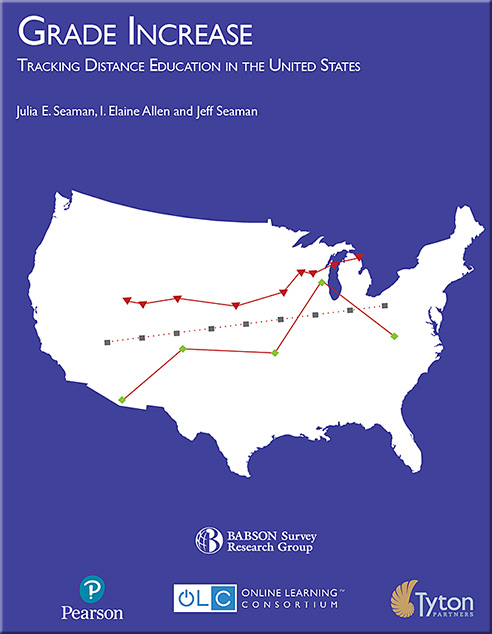
Distance education enrollments increased for the fourteenth straight year, growing faster than they have for the past several years. From 2002 to 2012 both distance and overall enrollments grew annually, but since 2012 distance growth has continued its steady increase in an environment that saw overall enrollments decline for four straight years and the largest for-profit distance education institutions continue to face serious issues and lose their enrollments.

The number of distance education students grew by 5.6% from Fall 2015 to Fall 2016 to reach 6,359,121 who are taking at least one distance course, representing 31.6% of all students. Total distance enrollments are composed of 14.9% of students (3,003,080) taking exclusively distance courses, and 16.7% (3,356,041) who are taking a combination of distance and non-distance courses.

Year-to-year changes in distance enrollments continue to be very uneven with different higher education sectors, with continued steady growth for public institutions, similar levels of growth (albeit on a much smaller base) for the private non-profit sector, and the continuation of the decline in total enrollments for the private for-profit sector for the fourth year in a row.

Distance education enrollments are highly concentrated in a relatively small number of institutions. Almost half of distance education students are concentrated in just five percent of institutions, while the top 47 institutions (just 1.0% of the total) enroll 22.4% (1,421,703) of all distance students. This level of concentration is most extreme among the for-profit sector, where 85.6% of the distance students are enrolled at the top 5% of institutions. Concentration rates for private not-for-profit institutions are lower, while public institutions show very low levels of concentration.

Distance enrollments remain local: 52.8% of all students who took at least one distance course also took an on-campus course, and of those who took only distance courses 56.1% reside in the same state as the institution at which they are enrolled. Virtually no distance enrollments are international: only 0.7% of all distance students are located outside of the United States.

The total number of students studying on campus (those not taking any distance course or taking a combination of distance and non-distance courses) dropped by over a million (1,173,805, or 6.4%) between 2012 and 2016. The largest declines came at for-profit institutions, which saw a 44.1% drop, while both private not-forprofit institutions (-4.5%) and public institutions (-4.2%) saw far smaller decreases.

The number of students who are not taking any distance courses declined even more from 2012 to 2016, down by 11.2% (1,737,955 students) by the end of the period. The private for-profit sector fared worse (down 50.5%) as compared to both private not-for-profit institutions (-9.5%) and public institutions (-7.7%).


TV is (finally) an app: The goods, the bads and the uglies for learning — from thejournal.com by Cathie Norris, Elliot Soloway

Excerpts:

Television. TV. There’s an app for that. Finally! TV — that is, live shows such as the news, specials, documentaries (and reality shows, if you must) — is now just like Candy Crunch and Facebook. TV apps (e.g., DirecTV Now) are available on all devices — smartphones, tablets, laptops, Chromebooks. Accessing streams upon streams of videos is, literally, now just a tap away.

…

Plain and simple: readily accessible video can be a really valuable resource for learners and learning.

…

Not everything that needs to be learned is on video. Instruction will need to balance the use of video with the use of printed materials. That balance, of course, needs to take in cost and accessibility.

…

Now for the 800 pound gorilla in the room: Of course, that TV app could be a huge distraction in the classroom. The TV app has just piled yet another classroom management challenge onto a teacher’s back.

…

That said, it is early days for TV as an app. For example, HD (High Definition) TV demands high bandwidth — and we can experience stuttering/skipping at times. But, when 5G comes around in 2020, just two years from now, POOF, that stuttering/skipping will disappear. “5G will be as much as 1,000 times faster than 4G.”  Yes, POOF!


From DSC:
Learning via apps is here to stay. “TV” as apps is here to stay. But what’s being described here is but one piece of the learning ecosystem that will be built over the next 5-15 years and will likely be revolutionary in its global impact on how people learn and grow. There will be opportunities for social-based learning, project-based learning, and more — with digital video being a component of the ecosystem, but is and will be insufficient to completely move someone through all of the levels of Bloom’s Taxonomy.

I will continue to track this developing learning ecosystem, but voice-driven personal assistants are already here. Algorithm-based recommendations are already here. Real-time language translation is already here.  The convergence of the telephone/computer/television continues to move forward.  AI-based bots will only get better in the future. Tapping into streams of up-to-date content will continue to move forward. Blockchain will likely bring us into the age of cloud-based learner profiles. And on and on it goes.

We’ll still need teachers, professors, and trainers. But this vision WILL occur. It IS where things are heading. It’s only a matter of time.


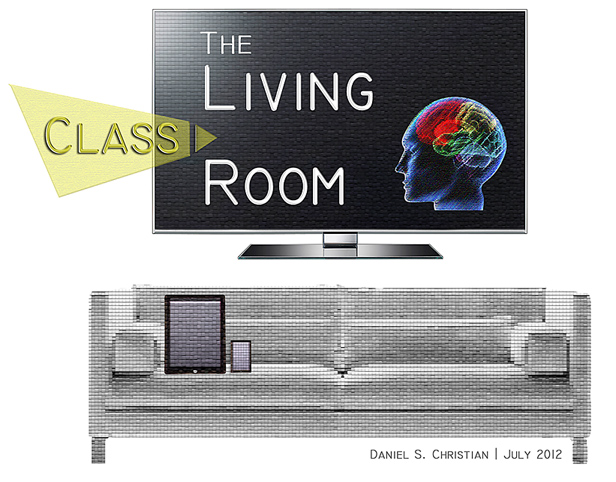
The Living [Class] Room -- by Daniel Christian -- July 2012 -- a second device used in conjunction with a Smart/Connected TV


DC: The next generation learning platform will likely offer us such virtual reality-enabled learning experiences such as this “flight simulator for teachers.”

Virtual reality simulates classroom environment for aspiring teachers — from phys.org by Charles Anzalone, University at Buffalo

Excerpt (emphasis DSC):

Two University at Buffalo education researchers have teamed up to create an interactive classroom environment in which state-of-the-art virtual reality simulates difficult student behavior, a training method its designers compare to a “flight simulator for teachers.”

The new program, already earning endorsements from teachers and administrators in an inner-city Buffalo school, ties into State University of New York Chancellor Nancy L. Zimpher’s call for innovative teaching experiences and “immersive” clinical experiences and teacher preparation.
…
The training simulator Lamb compared to a teacher flight simulator uses an emerging computer technology known as virtual reality. Becoming more popular and accessible commercially, virtual reality immerses the subject in what Lamb calls “three-dimensional environments in such a way where that environment is continuous around them.” An important characteristic of the best virtual reality environments is a convincing and powerful representation of the imaginary setting.


Also related/see:


  • TeachLive.org
    TLE TeachLivE™ is a mixed-reality classroom with simulated students that provides teachers the opportunity to develop their pedagogical practice in a safe environment that doesn’t place real students at risk.  This lab is currently the only one in the country using a mixed reality environment to prepare or retrain pre-service and in-service teachers. The use of TLE TeachLivE™ Lab has also been instrumental in developing transition skills for students with significant disabilities, providing immediate feedback through bug-in-ear technology to pre-service teachers, developing discrete trial skills in pre-service and in-service teachers, and preparing teachers in the use of STEM-related instructional strategies.


This start-up uses virtual reality to get your kids excited about learning chemistry — from Lora Kolodny and Erin Black

  • MEL Science raised $2.2 million in venture funding to bring virtual reality chemistry lessons to schools in the U.S.
  • Eighty-two percent of science teachers surveyed in the U.S. believe virtual reality content can help their students master their subjects.


This start-up uses virtual reality to get your kids excited about learning chemistry from CNBC.


From DSC:
It will be interesting to see all the “places” we will be able to go and interact within — all from the comfort of our living rooms! Next generation simulators should be something else for teaching/learning & training-related purposes!!!

The next gen learning platform will likely offer such virtual reality-enabled learning experiences, along with voice recognition/translation services and a slew of other technologies — such as AI, blockchain*, chatbots, data mining/analytics, web-based learner profiles, an online-based marketplace supported by the work of learning-based free agents, and others — running in the background. All of these elements will work to offer us personalized, up-to-date learning experiences — helping each of us stay relevant in the marketplace as well as simply enabling us to enjoy learning about new things.

But the potentially disruptive piece of all of this is that this next generation learning platform could create an Amazon.com of what we now refer to as “higher education.”  It could just as easily serve as a platform for offering learning experiences for learners in K-12 as well as the corporate learning & development space.


I’m tracking these developments at:
http://danielschristian.com/thelivingclassroom/


The Living [Class] Room -- by Daniel Christian -- July 2012 -- a second device used in conjunction with a Smart/Connected TV


*  Also see:


Blockchain, Bitcoin and the Tokenization of Learning — from edsurge.com by Sydney Johnson

Excerpt:

In 2014, Kings College in New York became the first university in the U.S. to accept Bitcoin for tuition payments, a move that seemed more of a PR stunt than the start of some new movement. Much has changed since then, including the value of Bitcoin itself, which skyrocketed to more than $19,000 earlier this month, catapulting cryptocurrencies into the mainstream.

A handful of other universities (and even preschools) now accept Bitcoin for tuition, but that’s hardly the extent of how blockchains and tokens are weaving their way into education: Educators and edtech entrepreneurs are now testing out everything from issuing degrees on the blockchain to paying people in cryptocurrency for their teaching.


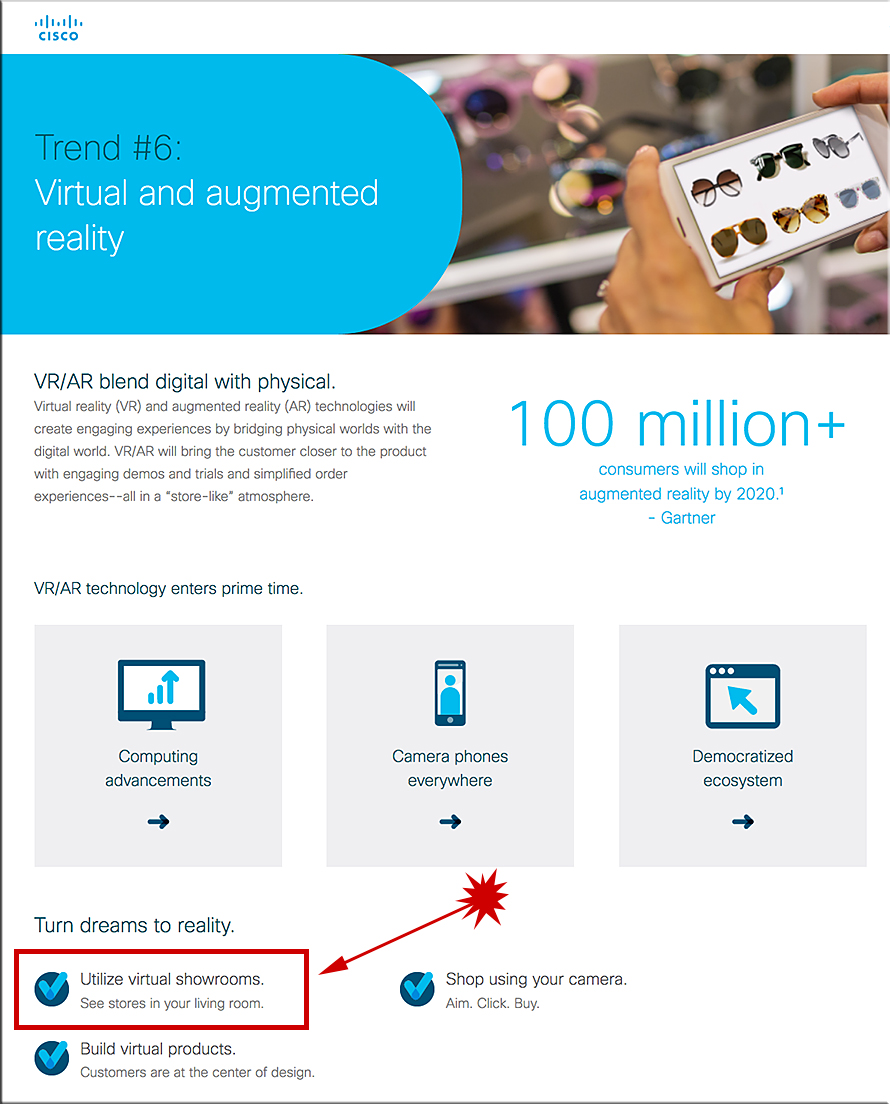
Cisco:
“Utilize virtual showrooms | See stores in your living room.”

DC:
If this is how retail could go, what might be the ramifications for learning-related environments & for learners’ expectations?

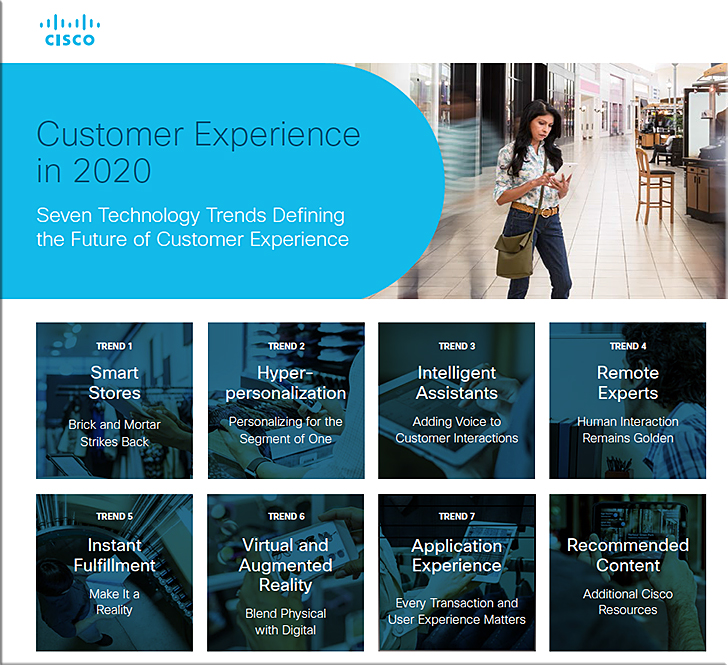
See Cisco’s whitepaper and the vision that I’m tracking along these lines.


Utilize virtual showrooms|See stores in your living room.


From DSC:
Looking at the trends below, again I wonder…how might learners’ expectations be impacted by these developments on the landscapes?


Customer Experience in 2020 according to Cisco


Also see:


The Living [Class] Room -- by Daniel Christian


How a Flipped Syllabus, Twitter and YouTube Made This Professor Teacher of the Year — from edsurge.com by Bruce Anderson

Excerpt:

A few years after John Boyer began teaching world geography at Virginia Tech, a survey revealed that 58 percent of college-aged Americans could not locate Japan on a map. Sixty-nine percent could not find the United Kingdom.

Boyer raced ahead undaunted. He loved the scope and implications of his subject. “The great thing about geography is . . . everything happens somewhere,” he explains. “Geography is the somewhere.”

Boyer is now a senior instructor and researcher at Virginia Tech. He took over World Regions, an entry-level geography class, while he was working on a master’s degree nearly 20 years ago. The class then had 50 students. Now the course is offered each semester and a whopping 3,000 students take it in any given school year.

What has made it so popular? Innovative pedagogy, for starters. Boyer uses a “flipped syllabus” in which students’ final grades are based on the points they’ve earned—not lost—throughout the semester. His legendary assignments range from reviewing films to tweeting on behalf of world leaders (more on that below). Mostly, Boyer himself has made the class a rite of passage for undergraduates, who typically find him funny, passionate, and consummately engaging. Boyer even created a comic alter ego called the Plaid Avenger, who has narrated textbooks and podcasts but is now largely retired—though Boyer still sports his famous plaid jackets and drives a plaid Scion.


Given the disparity in knowledge levels as well as the disparity in what they like to do in terms of work, whether that be watching international film or writing papers, I wanted to increase the flexibility of what the students could do to achieve a grade in this class.


Tell us about the Twitter World Leaders.
You can choose to be a true, real world leader. Of course, they’re fake accounts and we make sure everyone knows you’re the fake Donald Trump or the fake Angela Merkel of Germany. Once you take on that role, you will tweet as the world leader for the entire semester, and you have to tweet two to three times a day. And it’s not silly stuff. What is the chancellor of Germany working on right now? What other world leaders is Angela Merkel meeting with? What’s going on in Germany or the EEU?


From DSC:
I sat down for a cup of coffee the other day with an experienced, wise, elderly learning expert. He was virtually a walking encyclopedia of knowledge around matters related to training, teaching, and learning. It was such a gift to learn from his numerous years’ worth of experience and his hard earned knowledge!!!  I rarely use the phrase learning expert because it’s very difficult to be an expert when it comes to how people learn. But in this case, that phrase works just fine for me.

This elderly gentleman had years’ worth of experiences involving instructional design, coaching, teaching, and training behind him. He mentioned several things that I want to record and relay here, such as:

  • In terms of higher education, we need to move from a content orientation to a process orientation — i.e., helping our students learn how to learn (i.e., providing some effective methods/best practices such as this article and this study discuss for example).
    While
    I agree that this is a good call, I still think that we’ll need some level of content delivery though. As Daniel Willingham asserts in his book, Why don’t students like school?, students still need to have a base knowledge of a subject so that they can recall that information and integrate it into other situations. Per Willingham, we can’t expect learners to become experts and think like experts without that base level of knowledge in a subject. But if they never had that information in the first place, they couldn’t recall it or bring it up for application in another context. That said, I highly agree that students need to graduate from high school and college having a much better idea on how to learn. Such a skill will serve them very well over their lifetimes, especially in this new exponential pace of change that we’re now experiencing.


  • Speaking of contexts, this wise gentleman said that we need to move from being content driven to being concept driven and context driven.
    The trick here is how to implement this type of pedagogy within higher education. It’s hard to anticipate the myriad of potential contexts our students could find themselves in in the future. Perhaps we could provide 2-3 contexts as examples for them.


  • Students need to interact with the content. It won’t have any sort of lasting impact if it’s simply an information transmission model. This is why he practiced (what we today call) active learning based classrooms and project-based learning when he taught college students years ago. This is why he has attendees in his current training-related courses apply/practice what they’ve just been told. Along these lines, he also likes to use open-ended questions and allow for the process of discovery to occur.


  • The point of teaching is to make learning possible.


  • Learning is change. No change. No learning.
    An interesting, bold perspective that I appreciated hearing. What do you think of this assertion?


  • For each educational/training-related item, he asks 3 questions:
    • What does it mean?
    • Why is it important?
    • What am I going to do with it?


There was soooooo much knowledge in this wise man’s brain. I reflected on how much information and expertise we lose when instructional designers, teachers, professors, learning theorists (and many others) retire and leave their fields. I asked him if he was blogging to help pass this information along to the next generations, but he said no…there was too much on his plate (which I believe, as he was highly energetic, driven, and active). But I find that when one finally gets enough knowledge to even being close to being called an expert, then it’s time to retire. We often lose that knowledge and people end up reinventing the wheel all over again.

Again, it was such a pleasure to talk with an older gentleman with years of experience under his belt — one who had clearly put a great deal of time and effort into his learning about learning. In an age when America discards the elderly and worships youth, there is an important lesson here.

In an age when organizations are letting their older, more experienced employees go — only to hire much younger people at 1/2 the former wages — we should learn from some of the other nations and cultures who highly respect and lift up the more experienced employees — and the elderly — and who actively seek out their counsel and wisdom. Such people are often worth every penny of their wages.

—–

What do you think? Am I off base on some of my responses/reflections? How do these things strike you?

—–


Reaching All Learners by Leveraging Universal Design for Learning in Online Courses — from by Roy Bowery and Leonia Houston

Key Takeaways

  • An instructional design team at the University of Memphis focused on helping faculty create inclusive online classrooms, become aware of the diversity of their students’ learning needs, and adapt their instruction to reach all learners.
  • They did this by helping faculty employ the principles and guidelines of the Universal Design for Learning framework, which consists of three principles: Multiple Means of Engagement, Multiple Means of Representation, and Multiple Means of Action and Expression.
  • After two years, the UDL Implementation Plan, with its emphasis on experimentation, exploration, and inclusive instruction, yielded significant benefits for instructional effectiveness at the University of Memphis.

…

In an effort to bridge the success gap, our team focused on helping faculty employ the principles and guidelines of the Universal Design for Learning (UDL) framework. According to the National Center on Universal Design for Learning, the UDL framework consists of three principles: Multiple Means of Engagement, Multiple Means of Representation, and Multiple Means of Action and Expression.1 The principles within the framework focus on the what, how, and why of learning. Each of these key principles helped our faculty address learner variability and include guidelines for encouraging their learners to become more motivated, resourceful, and goal-directed. By incorporating the UDL principles and guidelines into their online program courses, faculty created inclusive learning environments and addressed learner variability. With their newfound skills, most could use the strategies within the framework to design and develop online courses with flexible goals, instructional methods, materials, and assessments.

To assist faculty, we created a UDL Implementation Plan designed to teach them how to gradually incorporate UDL principles into their online classrooms, address learner variability, and create inclusive online instruction. We could customize the framework to meet every course, faculty, or instructional need, and they did not have to follow the principles and guidelines within the framework in a specific order. Instead, faculty could identify instructional methods or assignments affecting success in their course(s) and use specific UDL principles or guidelines to solve their pedagogical issues.


Provosts, Pedagogy, and Digital Learning — from er.educause.edu by Kenneth Green, Charles Cook, Laura Niesen de Abruna and Patricia Rogers
Panel members from an EDUCAUSE 2017 Annual Conference session offer insights about the role of provosts and chief academic officers in digital courseware deployment and the challenges of using technology to advance teaching, learning, and student success.

Excerpt:

At the EDUCAUSE 2017 Annual Conference, Kenneth C. (Casey) Green moderated a panel discussion with two of the CAOs involved in the Association of Chief Academic Officers (ACAO) Digital Fellows Program and with the principal investigator on the Bill & Melinda Gates Foundation grant that created the year-long program. In this session, the three panel members offered their perspectives on campus IT investments, including what the panelists see as working—and what they see as missing—in instructional technology portfolios today.


Green: What about protection and support for faculty—especially young faculty? Often and disproportionately, younger faculty handle the heavy lifting for departments because, being younger, they’re supposed to “do the technology stuff.” Yet, when they do it—and I hear this at all types of institutions—they don’t get credit for the work in terms of review and promotion. The technology work doesn’t count, particularly at four-year colleges and research institutions.2 Young faculty are told: “Wait. Get tenured, get through the hurdle, get over the hump, then do it. Because this will not help your career—even if you’re being pressured to be the lead person on a digital learning initiative for your institution.”


Niesen de Abruna: …Now the CIO has to be a partner with the CAO. Their joint enterprise is to leverage learning in their community and to work together and translate things for one another, acting as partners in terms of trying to benefit from what’s happening in instructional design. It’s very exciting for CIOs and CAOs to have that sort of relationship.


Also see:

  • Insights from Campus Leaders on Current Challenges and Expectations of IT — from er.educause.edu by Kathryn Gates and Joan Cheverie
    IT’s role across a higher education institution is crucial, yet campus leaders typically understand IT challenges and opportunities based largely on their functional roles. Interviews with campus leaders offer insights into these views, as well as how to understand IT more broadly to better serve an institution’s mission.


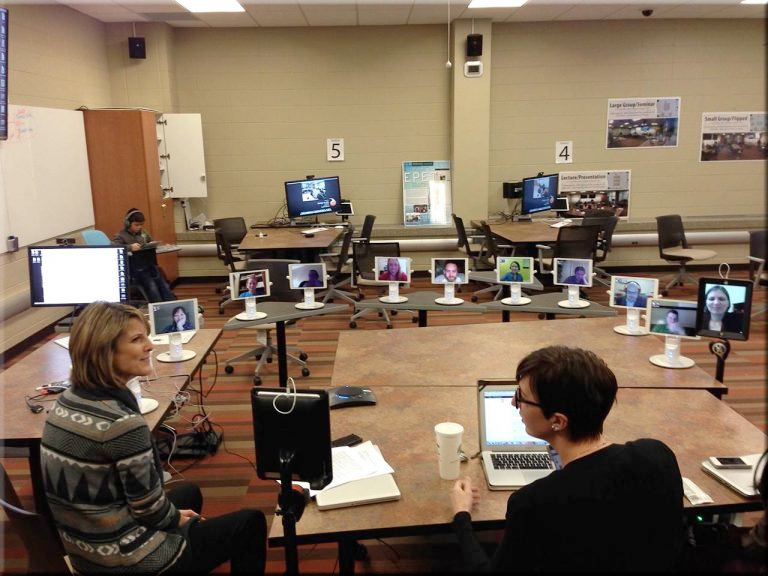
Robots in the Classroom: How a Program at Michigan State Is Taking Blended Learning to New Places — from news.elearninginside.com by Henry Kronk; with thanks to my friend and colleague, Mr. Dave Goodrich over at MSU, for his tweet on this.

Excerpt:

Like many higher education institutions, Michigan State University offers a wide array of online programs. But unlike most other online universities, some programs involve robots.

Here’s how it works: online and in-person students gather in the same classroom. Self-balancing robots mounted with computers roll around the room, displaying the face of one remote student. Each remote student streams in and controls one robot, which allows them to literally and figuratively take a seat at the table.

Professor Christine Greenhow, who teaches graduate level courses in MSU’s College of Education, first encountered these robots at an alumni event.

“I thought, ‘Oh I could use this technology in my classroom. I could use this to put visual and movement cues back into the environment,’” Greenhow said.


From DSC:
In my work to bring remote learners into face-to-face classrooms at Calvin College, I also worked with some of the tools shown/mentioned in that article — such as the Telepresence Robot from Double Robotics and the unit from Swivl.  I also introduced Blackboard Collaborate and Skype as other methods of bringing in remote students (hadn’t yet tried Zoom, but that’s another possibility).

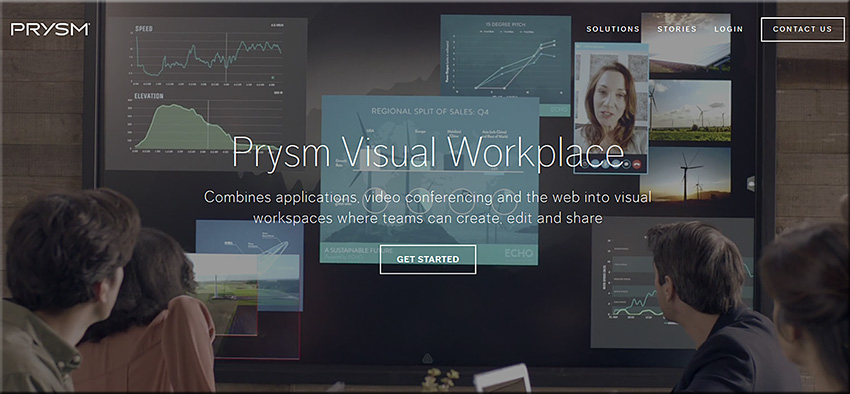
As one looks at the image above, one can’t help but wonder what such a picture will look like 5-10 years from now? Will it picture folks wearing VR-based headsets at their respective locations? Or perhaps some setups will feature the following types of tools within smaller “learning hubs” (which could also include one’s local Starbucks, Apple Store, etc.)?


From DSC:
I’m posting this in an effort to:

  • Help students learn how to learn
  • Help students achieve the greatest possible returns on their investments (both their $$ and their time) when they are trying to learn about new things

I’d like to thank Mr. William Knapp, Executive Director at GRCC for Distance Learning & Instructional Technology, for sharing this resource on Twitter.


A better way to study through self-testing and distributed practice — from kqed.org

Excerpts (emphasis DSC):

As I prepared to write this column, I relied on some pretty typical study techniques. First, as I’ve done since my student days, I generously highlighted key information in my background reading. Along the way, I took notes, many of them verbatim, which is a snap with digital copying and pasting. (Gotta love that command-C, command-V.) Then I reread my notes and highlights. Sound familiar? Students everywhere embrace these techniques and yet, as it turns out, they are not particularly good ways to absorb new material. At least not if that’s all you do.

Researchers have devoted decades to studying how to study. The research literature is frankly overwhelming. Luckily for all of us, the journal Psychological Science in the Public Interest published a review article a few years ago that remains the most comprehensive guide out there. Its 47 pages hold valuable lessons for learners of any age and any subject — especially now, with end-of-semester exams looming.

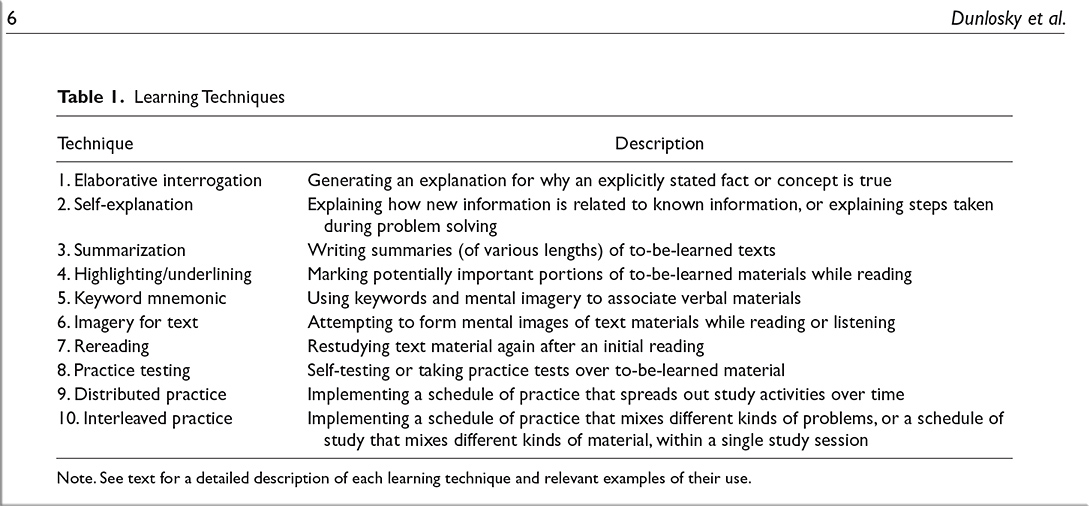
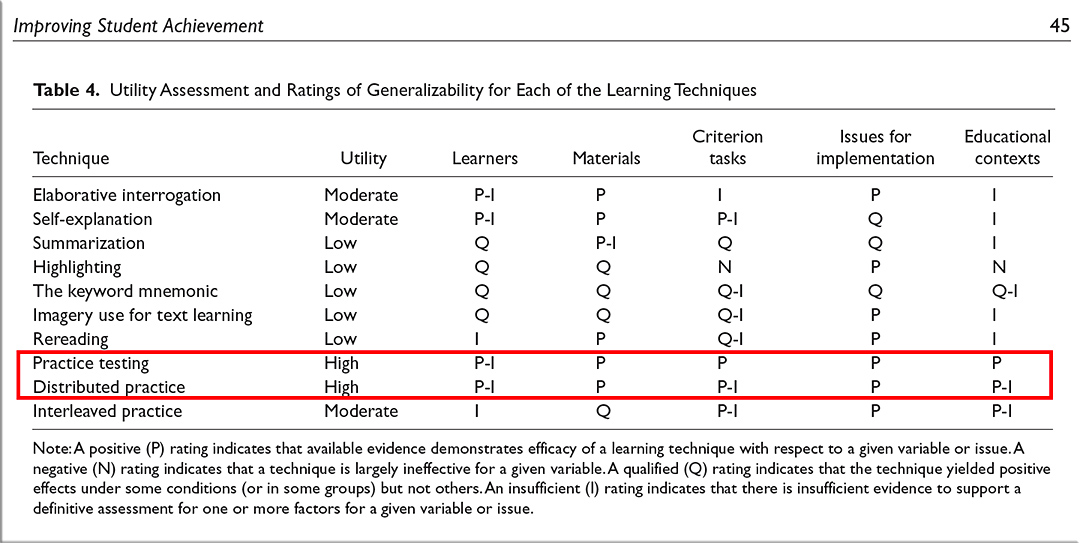
The authors examined ten different study techniques, including highlighting, rereading, taking practice tests, writing summaries, explaining the content to yourself or another person and using mnemonic devices. They drew on the results of nearly 400 prior studies. Then, in an act of boldness not often seen in academic research, they actually awarded ratings: high, low or moderate utility.

The study strategies that missed the top rating weren’t necessarily ineffective, explains the lead author John Dunlosky, a psychology professor at Kent State University, but they lacked sufficient evidence of efficacy, or were proven useful only in certain areas of study or with certain types of students. “We were trying to find strategies that have a broad impact across all domains for all students,” Dunlosky says, “so it was a pretty tough rating scale.”


In fact, only two techniques got the top rating: practice testing and “distributed practice,” which means scheduling study activities over a period of time — the opposite of cramming.

Practice testing can take many forms: flashcards, answering questions at the end of a textbook chapter, tackling review quizzes online. Research shows it works well for students from preschool through graduate and professional education.

Testing yourself works because you have to make the effort to pull information from your memory — something we don’t do when we merely review our notes or reread the textbook.

…
As for distributed practice vs. cramming, Dunlosky and his fellow authors write that “cramming is better than not studying at all,” but if you are going to devote four or five hours to studying for your biology mid-term, you would you be far better off spacing them out over a several days or weeks. “You get much more bang for your buck if you space,” Dunlosky told me.


Also see:

Improving Students’ Learning With Effective Learning Techniques — from journals.sagepub.com by John Dunlosky, Katherine A. Rawson, Elizabeth J. Marsh, Mitchell J. Nathan, and Daniel T. Willingham
Promising Directions From Cognitive and Educational Psychology

Excerpt:

In this monograph, we discuss 10 learning techniques in detail and offer recommendations about their relative utility. We selected techniques that were expected to be relatively easy to use and hence could be adopted by many students. Also, some techniques (e.g., highlighting and rereading) were selected because students report relying heavily on them, which makes it especially important to examine how well they work. The techniques include elaborative interrogation, self-explanation, summarization, highlighting (or underlining), the keyword mnemonic, imagery use for text learning, rereading, practice testing, distributed practice, and interleaved practice.


In fact, only two techniques got the top rating: practice testing and “distributed practice,” which means scheduling study activities over a period of time — the opposite of cramming.


From DSC:
This is yet another reason that I like the approach of using streams of content to help people learn something new. Because you can implement distributed practice, encourage recall, etc. when you put the content out there at regular intervals.


© 2025 | Daniel Christian