How online education went from teaching reform to economic necessity for colleges — from edsurge.com by Robert Ubell

Excerpt (emphasis DSC):

When online was first introduced as a pedagogical advance, faculty members often rose up against it—or more often, just ignored it, the most devastating form of resistance. If it weren’t for economic necessity, online might not have grown to the force it has today—these days a third of the nation’s higher ed students take courses online.

Millions of working adults must turn to digital degrees to improve their employability in a post-industrial economy that demands higher-level skills than on the assembly line. Corporations are being pressed to find agile, high-tech workers for their digital processes and products. Powerful new digital-recruitment techniques now make massive global markets open to any college with deep enough pockets.

From DSC:
The market will decide how colleges and universities will change — and which ones will survive. Presidents, provosts, members of administration, board members, and faculty members do not control this anymore (if they ever did).
 

How innovations in voice technology are reshaping education — from edsurge.com by Diana Lee
Voice is the most accessible form you can think of when you think about any interface. In education, it’s already started to take off.

It could be basic questions about, “Am I taking a class to become X?” or “How strong are my skills relative to other people?” An assistant can help with that. It could potentially be a coach, something that follows you the rest of your life for education. I’m excited about that. People that can’t normally get access to this kind of information will get access to it. That’s the future.

From DSC:
The use of voice will likely be a piece of a next-generation learning platform.

Voice will likely be a piece of the next generation learning platform


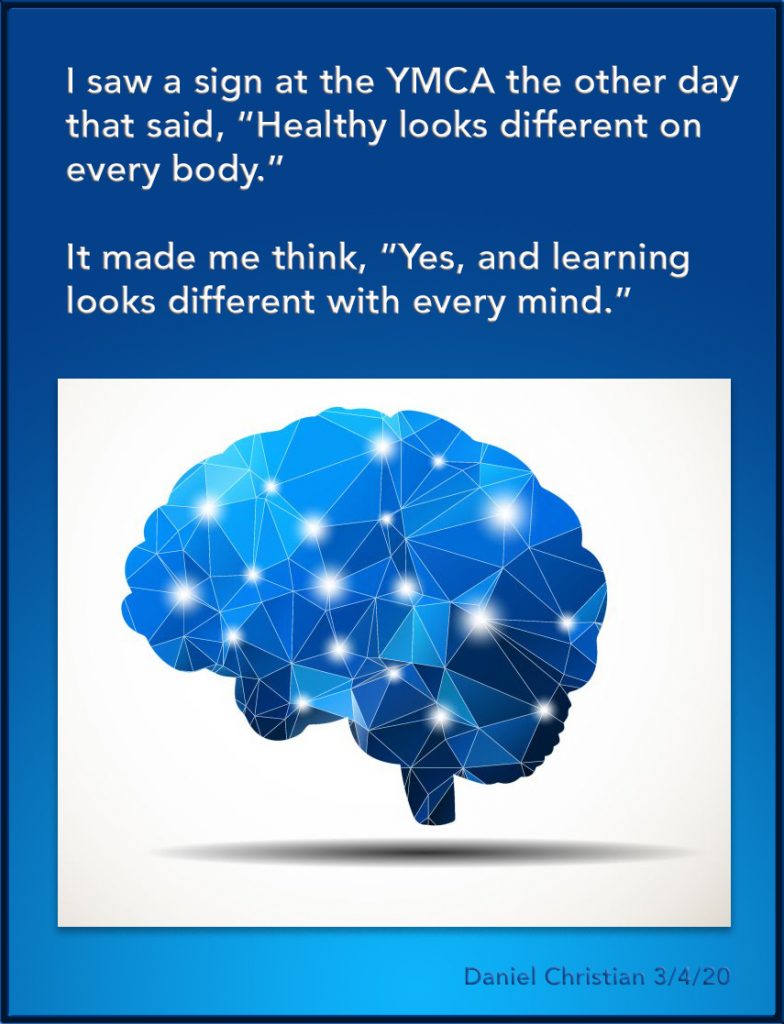
Healthy looks different on every body...and learning looks different with every mind.

From DSC:
What I mean by this is this:

While I certainly agree that research has produced excellent, proven, effective pedagogies that work with many students (the majority even), the fact is, learning is messy. When a child walks into a classroom, there isn’t even one other child with the exact same neural situation.

Nor is there even one other student with the exact same experiences, background, passions, motivations, interests, etc. I’ve experienced this with our daughter who isn’t a part of the 80% that the typical education train addresses. Look out if you are part of the 10% of either side of the bell curve! As your learning experiences are too costly to address and likely won’t be addressed in many cases.

All that said, I still agree that the teaching and learning strategies are still highly relevant across the masses. My point is that there is still a lot of diversity out there. They say that learning is messy for a reason. If you doubt that, go sit in on an IEP sometime.


Getting Campuses Ready for the Coronavirus — from insidehighered.com by Chuck Staben
What should leaders be doing to prepare their colleges if the situation worsens? Chuck Staben offers suggestions.

Colleges Prepare for Coronavirus Outbreaks on Campus — from wsj-com by Melissa Korn
Task forces map out prospects for quarantines, class cancellations as schools brace for virus spread

Teaching during a campus closure…— from linkedin.com by Bill Knapp
Here are some suggestions on preparing your on-campus students in the event of an unexpected campus closure (#COVID-19).

Coronavirus Forces Universities Online — from .insidehighered.com by Lindsay McKenzie
Compelled to close their campuses to limit the spread of coronavirus, U.S. universities with Chinese branches move at lightning speed to take teaching online.

NYU Response to Coronavirus Accelerates Digital Tool Adoption — from campustechnology.com by Dian Schaffhauser

Excerpt:

Instructors conducted some 700-plus sessions during the first week, using a multitude of tools to enable live feedback and interaction in both synchronous and asynchronous ways, including learning management system NYU Classes, media sharing service NYU Stream, web and audio conference tool NYU Zoom and commenting utility VoiceThread.

Keith Ross, dean of Engineering and Computer Science at NYU Shanghai, suggested that the health crisis has one silver lining: It’s bringing the faculty up to speed with online teaching tools in quick order. In a university article about the efforts, he mused that once the crisis has passed, faculty may choose to integrate the use of some of the tools into their traditional face-to-face courses.

NYU Stream and VoiceThread are letting students interact asynchronously. They can watch pre-recorded videos uploaded by instructors and then take quizzes, ask questions, make annotations and communicate with classmates using text, audio and video. Also available for use: NYU Web Publishing to publish and manage blogs; Slido and Piazza to conduct community voting and quizzes; Slack to support office hours; and Examity to proctor exams remotely.


How to Respond to Coronavirus: 6 Steps for Schools
— from edweek.org by Mark Lieberman


The Dangers of “Teaching the Way We Best Learn” — from scholarlyteacher.com by Todd Zakrajsek

Excerpts:

Not everyone sees the world as I do, and not everyone learns the way I do. Thinking of the implications of implicit bias is scary, but there is freedom in knowledge. Using evidence-based teaching allows faculty to overcome the adverse effects of teaching as we were taught.

We, as faculty members, are not passive recipients who choose a pedagogical strategy because we have no choice. We may select teaching approaches that work for ourselves as learners, not because we are consciously deciding to ignore the needs of others, but more so because we fail to understand effective alternatives exist.

This need not be an admonishment on our professional responsibility to educate others. It is merely a recognition that when we look at the world, we tend to see it from our perspective, the one with which we are most familiar. It takes effort to consider other perspectives.

The challenge is that teaching is not about our learning; it is about our learners. It is not the job of the server in a restaurant to offer only the food they most prefer, but instead to help you to navigate the menu to identify what works best for you, food allergies, preferences, and all.

I should not always “teach the way I best learned.” To do so will disadvantage students who are least like me, and those students deserve an opportunity to be successful.

If I primarily use the lecture method of teaching, I should add a “think-pair-share” at times. Perhaps even a jigsaw and problem-based learning sprinkled throughout the semester. If I get bold, I might also try a role-play in class.

From DSC:
I appreciate Todd’s reflections and insights in the above posting. I’d like to sprinkle in a couple of graphics to it.


Three thoughts on active learning and self-teaching — from rtalbert.org Robert Talbert
“The teacher isn’t teaching and I’m having to teach myself the material” has three embedded misconceptions that need to be addressed.

Excerpts:

First: Learning is a process, not an action that one person performs on another.

But in the end, an outside person cannot cause you to learn. This isn’t how learning works. Learning instead is a process that moves back and forth, sometimes focused on an instructor but other times focused on the learner or a group of learners together.

Second: Not being lectured to all the time is not the same thing as having to teach yourself.

Third: In any event, the skill of self-teaching is essential in college and needs to be developed.

But in general, we need to see — and we have work to do in communicating this to students — that self-teaching is a feature, not a bug.


Optimal Video Length for Student Engagement — from blog.edx.org by Candace Hazlett and Philip Guo

Excerpt:

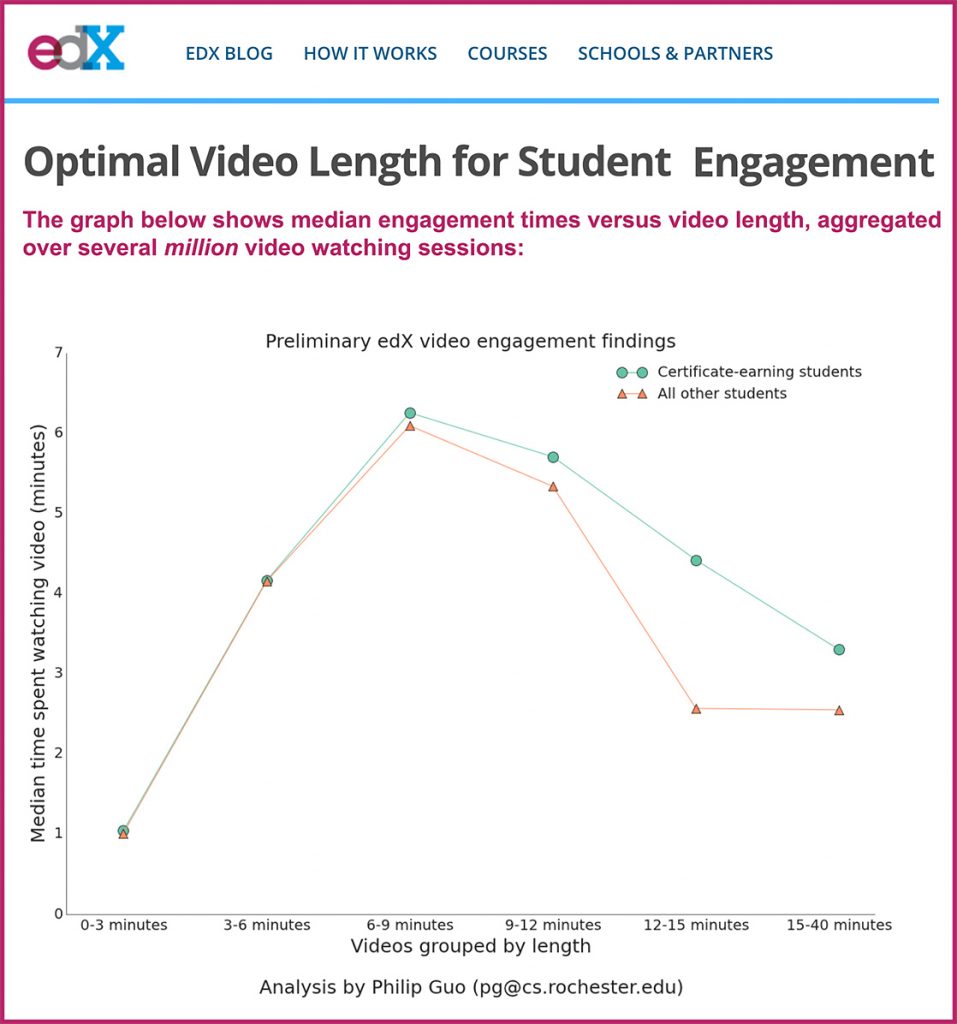
In this first post, I’ll share some preliminary results about video usage, obtained from initial analyses of a few edX math and science courses. Unsurprisingly, students engaged more with shorter videos. Traditional in-person lectures usually last an hour, but students have much shorter attention spans when watching educational videos online. The graph below shows median engagement times versus video length, aggregated over several million video watching sessions:

From DSC:
If you have access to a tool like Canvas Studio, then you can probably extend the length of your videos if you are interspersing your videos with a healthy dose of interactivity — i.e., inserting quiz questions every few minutes.


From DSC:
I wonder if this patent — or these types of technologies — might enable remote learners to select/control more of their preferred viewing angles?!

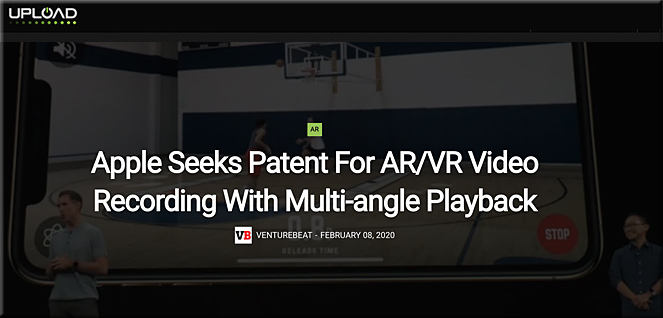
Apple Seeks Patent For AR/VR Video Recording With Multi-angle Playback — from uploadvr.com by Jeremy Horwitz

Excerpt (emphasis DSC):

If you’ve watched YouTube streams of conventional 2D videos — such as commentaries on games, TV shows, movies, or trailers — you know that the streams are visually flat: video of the content, sometimes with a person’s face superimposed in the corner for added discussion. But Apple appears set to change that paradigm for augmented and virtual reality streaming. A just-published patent application reveals that it’s been working on compositing multiple streams in a way that could let AR and VR viewers watch streamed content from their choice of angles.


From DSC:
If you are using a tool like Cisco Webex in your school, consider implementing the idea below.
I’d like to thank Mr. Steve Grant and Mr. Nelson Miller from the WMU-Cooley Law School for their work in implementing/recommending this approach.

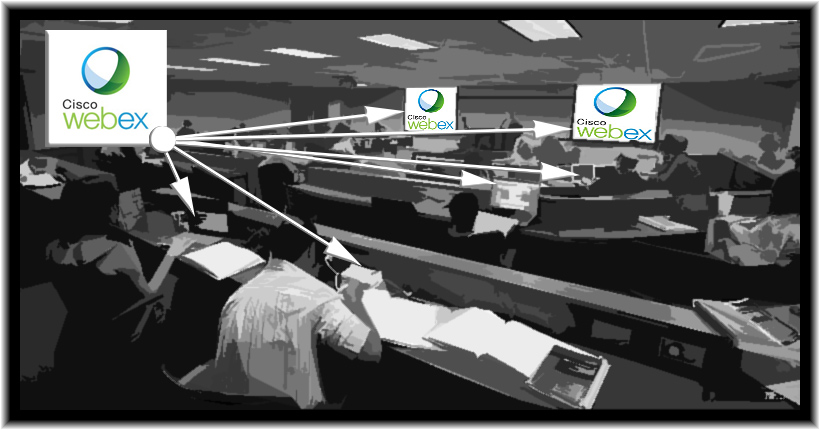
If you are using a tool like Cisco Webex, you can use it to share content to displays, laptops, smartphones, and tablets. If the professor starts a Cisco Webex Meeting Center session using their own personal room, the students can then join that meeting via their devices. (To eliminate noise and confusion — as well as to reduce bandwidth — the students should mute their microphones and choose not to send the video from their webcams.)

If you were doing a think-pair-share, for example, and you really liked what a certain pair of students had going on, one of the students could share their work with the rest of the class. By doing so, whatever was going on on that student’s device could be displayed by any projectors in the room, as well as on any other devices that were connected to the Cisco Webex Meeting Room.

“So you could project any student’s work as students proceed with in-class exercises. Projecting student work adds another level of accountability, excitement, and concentration to in-class exercises.” 

*********

Also, using the Cisco Webex Meeting Center in your face-to-face classroom not only opens up that sort of collaboration channel, but, via the chat feature, it can also open up a running backchannel to draw out your more introverted students, or those students who have questions but don’t want to have the spotlight thrown on them. 

*********


How to lead students to engage in higher order thinking — from edutopia.org by Karen Harris
Asking students a series of essential questions at the start of a course signals that deep engagement is a requirement.

Excerpt:

Essential questions—a staple of project-based learning—call on students’ higher order thinking and connect their lived experience with important texts and ideas. A thinking inventory is a carefully curated set of about 10 essential questions of various types, and completing one the first thing I ask students to do in every course I teach.

Although a thinking inventory is made up of questions, it’s more than a questionnaire. When we say we’re “taking inventory”—whether we’re in a warehouse or a relationship—we mean we’re taking stock of where things stand at a given moment in time, with the understanding that those things are fluid and provisional. With a thinking inventory, we’re taking stock of students’ thinking, experiences, and sense-making at the beginning of the course.


Below are some thoughts from Michal Borkowski, CEO and Co-Founder of Brainly, regarding some emerging edtech-related trends for 2020.

2020 is coming at us fast, and it’s bringing a haul of exciting EdTech trends along with it. A new decade means new learning opportunities created to cater to the individual rather than a collective hive. There are more than one or two ways of learning — by not embracing all of the ways to teach, we risk leaving students behind in subjects they may need extra help in.

Michal Borkowski, CEO and Co-Founder of Brainly– the world’s largest online learning platform with 150 million monthly users in 35 countries– has his finger on the pulse of global education trends. He was selected to speak at Disrupt Berlin, the world’s leading authority in debuting revolutionary startups and technologies, this year and has some insightful predictions on the emerging trends 2020 will bring in EdTech.

  1. Customized learning via AI
    AI systems with customizable settings will allow students to learn based on their personal strengths and weaknesses. This stylized learning takes into account that not every student absorbs information in the same way. In turn, it helps teachers understand what each individual student needs, spend more time teaching new material, and receive higher classroom results.
  2. Responsible technological integration
    Students today are more fluent in technology than older generations. Integrating tech through digital resources, textbooks, game-style lessons, and interactive learning are efficient ways to captivate students and teach them responsible usage of technology.
  3. Expansive peer-to-peer learning
    Allowing students access to a platform where they can view different student’s educational interpretations, and one specific perspective may help information click, is invaluable. These learning platforms break down barriers, encourage active learning anywhere, and cultivate a sense of community between students all over the world.
  4. From STEM to STEAM
    Science, technology, engineering, and math curriculums have been the major educational focus of the decade, but 2020 will see more integration of classical liberal arts into educational modules, turning STEM into STEAM. Incorporating the arts into a tech-based curriculum enables students to create important connections to the world and allows them to have a well-rounded education.
  5. Options in learning environments
    Who says learning has to take place in a classroom? Advancements in EdTech has provided new and exciting avenues where educators can experiment. Grade and high school level teachers are experimenting with webinars, online tutorials, and other forms of tech-based instruction to connect to students in environments where they are more inclined to learn.

2020 is the year that education forms itself around each student’s individual needs rather than leaving kids behind who don’t benefit from traditional instruction.


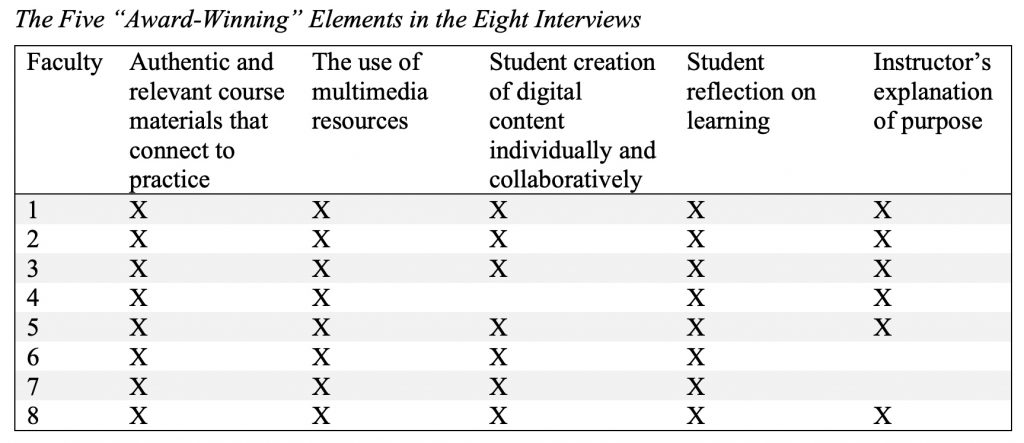
5 proven ways to make your good online course great — from campustechnology.com

Excerpt:

Recent research uncovered just a handful of distinct elements that set great online teaching apart from the merely good. The findings came out of interviews with eight faculty members who have won awards for their online teaching from three professional associations: the Online Learning Consortium, the Association for Educational Communications & Technology and the United States Distance Learning Association.

Again, the report is here.


Accessibility at a Crossroads: Balancing Legal Requirements, Frivolous Lawsuits, and Legitimate Needs — from er.educause.edu by Martin LaGrow

Excerpt:

Changes in legal requirements for IT accessibility have prompted some to pursue self-serving legal actions. To increase access to users of all abilities, colleges and universities should articulate their commitment to accessibility and focus on changing institutional culture.


Per RetrievalPractice.org:

Download ALL our free guides, research, and resources!

We’re here to make your life easier. In order to unleash the science of learning, we strive to make it easy to access and quick to implement.

That’s why we really want you to download everything from our library, including free practice guides, book club resources, research, and more.

 
© 2025 | Daniel Christian