Steps toward excellence: The power of learning objectives — from rtalbert.org by Robert Talbert
Making clear and measurable learning objectives for both the course and individual course modules. 

Excerpt:

How to write a clear, measurable learning objective

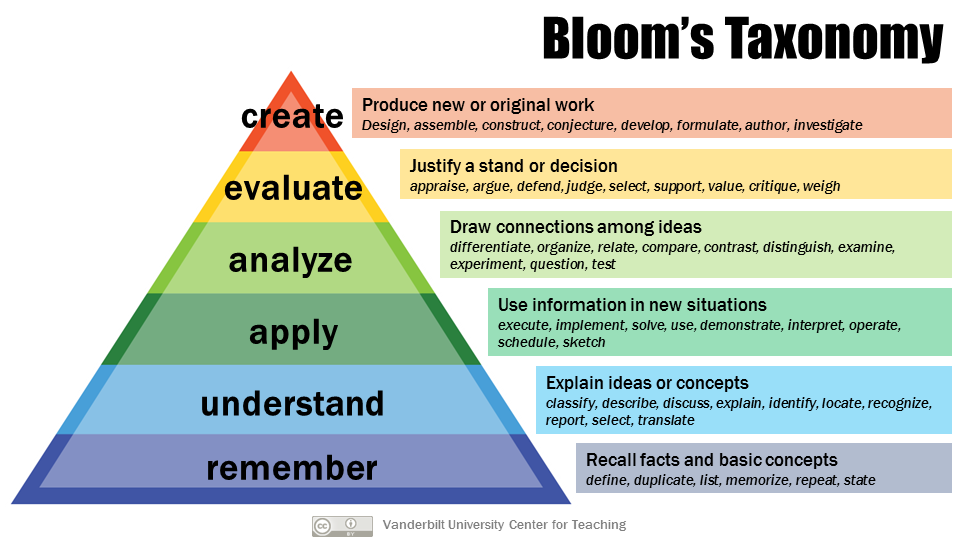
Allow me to (re-)introduce you to Bloom’s Taxonomy:

Each of the six levels of the taxonomy corresponds to a category of cognitive tasks, and in most of these diagrams of the taxonomy you will find action verbs attached to each level. The key to writing a clear, measurable learning objective is to focus on two questions at both the macro and micro levels:

What is it that I want students to learn? And,

What action with a measurable outcome can a student perform that will allow me to decide whether they have learned it?

Then it’s a matter of expressing that action as a declarative statement anchored to a concrete action verb at the appropriate Bloom level.

Also see Robert’s second posting here, entitled:


From DSC:
On the positive side…

What I appreciate about ‘s article is that it’s asking us to think about future scenarios in regards to higher education. Then, it’s proposing some potential action steps to take now to address those potential scenarios if they come to fruition. It isn’t looking at the hood when we’re traveling 180 mph. Rather, it’s looking out into the horizon to see what’s coming down the pike. 

6 Steps to Prepare for an Online Fall Semester — from chronicle.com b

Excerpt (emphasis DSC):

Plan for a multiyear impact. If colleges are forced to maintain online-only instruction in the fall and to defer reopening their campuses to in-person instruction to January 2021, the impact will be felt for years. College leaders should start thinking now about how to manage and potentially adjust spring-2021 (and beyond) course offerings, course sequencing, and degree requirements to avoid saddling students with graduation delays and the accompanying direct and indirect financial costs. In addition, colleges should anticipate a smaller-than-normal entering first-year class in fall 2020 (and thus a larger-than-normal enrollment a year later) and devise strategies to help mitigate the resulting stresses on admission rates and classroom and dorm capacity for first-year students entering in fall 2021 and beyond.

If instruction remains online-only in the fall, colleges won’t be able to afford that sort of inefficiency. College departments should start now to identify opportunities for collaborations that would draw on the collective wisdom and labor of faculty members from multiple institutions who are teaching similar courses. This would lessen the burden of migrating teaching materials and techniques to an online format.

From DSC:
I’ve often wondered about the place of consortiums within higher ed…i.e., pooling resources. Will the impacts of the Coronavirus change this area of higher ed? Not sure. Perhaps.

On the negative side…

I take issue with some of John’s perspectives, which are so common amongst the writers and academics out there. For example:

Conversely, an entire generation of current college students is now learning that it can be pretty boring to be one of several hundred people simultaneously watching a Zoom lecture.

You know what? I did that very same thingover and over again — at Northwestern University (NU), but in a face-to-face format. And quite frankly, it’s a better view on videoconferencing. It’s far more close up, more intimate online. I agree it’s a different experience. But our auditoriums were large and having 100-200+ students in a classroom was common. There was no interaction amongst the students. There were no breakout groups. The faculty members didn’t know most of our names and I highly doubt that the well-paid researchers at Northwestern — who were never taught how to teach in the first place nor did they or NU regard the practice of teaching and learning highly anyway — gave a rat’s ass about body language. Reading the confusion in the auditorium? Really? I highly doubt it. And those TA’s that we paid good money for? Most likely, they were never taught how to teach either. The well-paid researchers often offloaded much of the teaching responsibilities onto the teacher assistants’ backs. 

Bottom line:
Face-to-face learning is getting waaaay more credit than it sometimes deserves — though sometimes it IS warranted. And online-based learning — especially when it’s done right — isn’t getting nearly enough credit. 


Addendum: Another example of practicing futures thinking in higher ed:


Q: For those who prefer or need to handwrite their essays, what are some ways/methods that students can use to scan in — and then submit — their essays into Canvas?

A:  Below are a few different options, potential solutions, and resources:


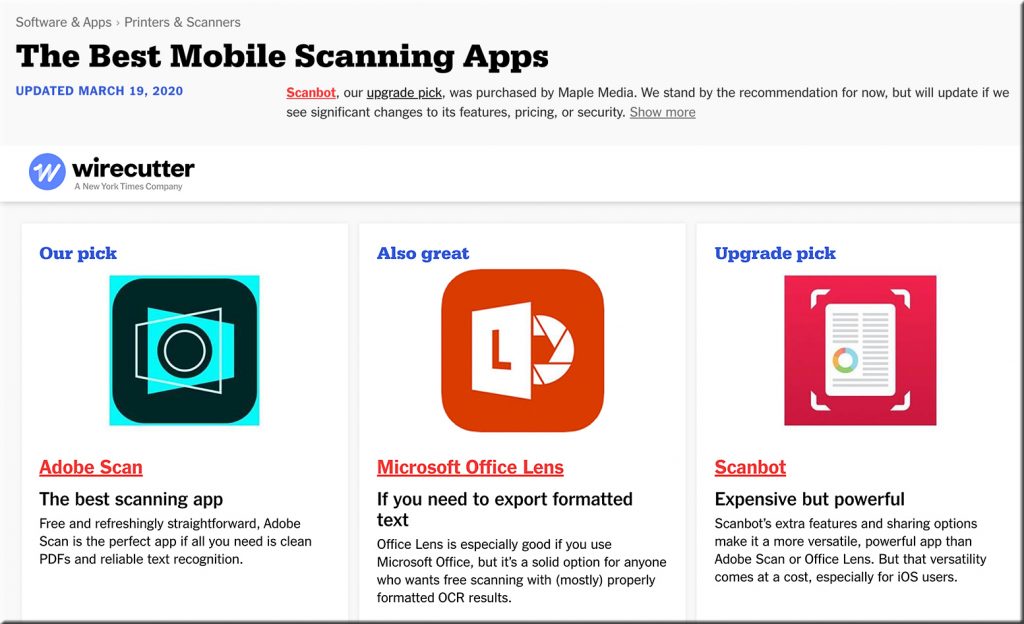
The Best Mobile Scanning Apps -- 2020


  • Students can also scan in their essays via most combination printers/scanners these days. Then they can insert those scans into a Word doc and submit it.
  • A Google search presents many different ways to scan in items into a Word document. That Word doc can then be submitted or saved as a PDF file (and then be submitted as as PDF file).
  • Also see How to create a PDF of handwritten assignments — from Canvas @ Yale. Yale recommended the following apps:

Yale recommends Scannable


Yale recommends Genius Scan for Android devices -- i.e., for scanning documents


Also see:

  • The new Office app now generally available for Android and iOS — from microsoft.com by the Microsoft 365 team
    Excerpt:
    Integrating our Lens technology to unlock the power of the camera with capabilities like converting images into editable Word and Excel documents, scanning PDFs, and capturing whiteboards with automatic digital enhancements to make the content easier to read.
 

From DSC:
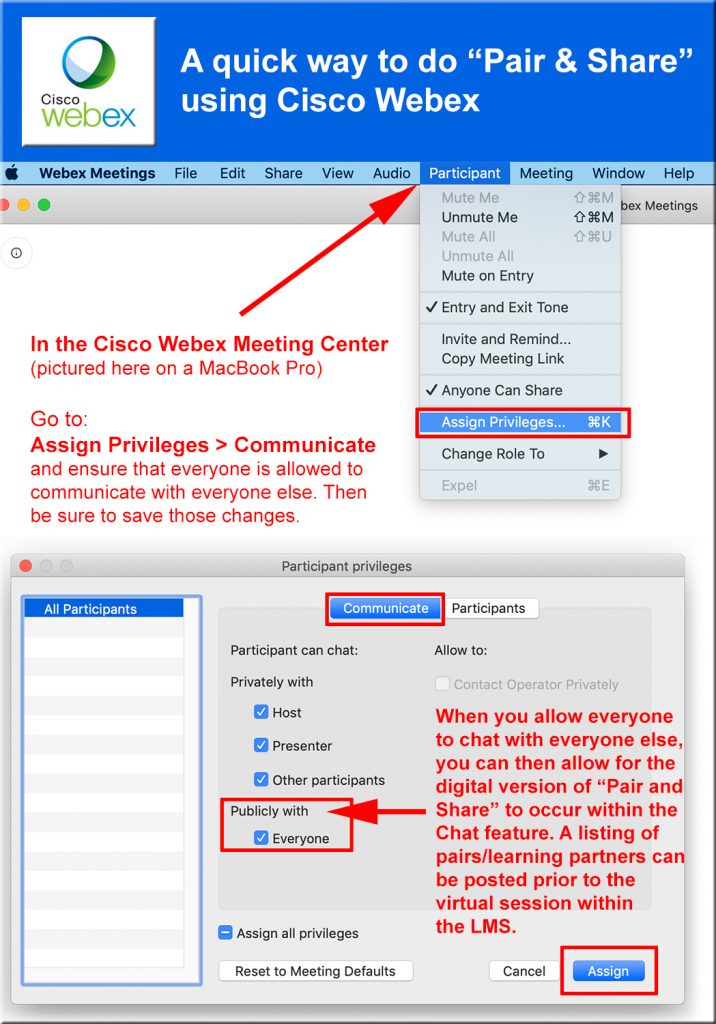
The “Pair & Share” method allows students to find a fellow student to talk about the question/topic at hand. Then, depending upon time and your learning objectives/lesson plans, some students can report back to the larger classroom about what they discussed. In the digital, synchronous realm, one can achieve this with private chat rooms — given that you’ve changed a setting to allow this to occur. Posting the pairings ahead of time should help establish a quick, smooth transition.

(The graphic below is for the Cisco Webex Meeting Center on a MacBook Pro).

Providing a quick pair and share method using the Cisco Webex Meeting Center product


Are you marking the boundaries between remote and online learning? — from linkedin.com by Amrit Ahluwalia

Excerpt:

As we shift from a three-stage life model to a 100-Year Life model, ongoing and continuing education is going to become a standard part of the lives of every student currently pursuing a degree, and for almost every adult currently in the workforce.

It’s really important that this experience doesn’t taint their perspective of online learning, because it’s more than likely that they’ll need to leverage online learning to maintain their career progression later in life.

In the early stages of the transition, however, it looks like both learners and faculty might be really embracing the possibilities offered by remote learning technologies.


The shift to remote learning: The human element — from insidehighered.com by Doug Lederman & Company

The current response is triage. We are adapting to maintain as much of the familiar learning and community engagement as we can in the short term. Yes, we should adopt the technologies and strategies that support effective online learning. To that end, we will benefit from the excellent prior work of online education researchers. Right now, we need the simplest and most effective methods for our students to achieve the resolution they desire, as we seek to sustain the community and connections we have formed in residence.

It’s one thing to do this online when you are already starting from that premise — where your community has self-selected for that environment. It’s quite another when your community hasn’t. 

Kristen Eshleman

Making change in higher ed is typically a daunting prospect because of these silos, but they have been broken down now in ways that I hope will be long lasting and will lead to effective responses, programs, policies and networks in the future.

Joshua R. Eyler

It will be interesting to see if this embrace of flexibility sparks a broader shift in higher education. For too long we have mistaken rigor for academic integrity when in fact, from a definitional standpoint, rigor simply means rigidity, severity and harshness — the exact opposite of the flexibility we so need during this crisis.

Penelope Adams Moon


Per Techcrunch article:

The world is vulnerable to a new type of trolling as people turn to Zoom video calls to feel connected amidst quarantines. Jerks are using Zoom’s screensharing feature to blast other viewers with the most awful videos from across the internet, from violence to shocking pornography.


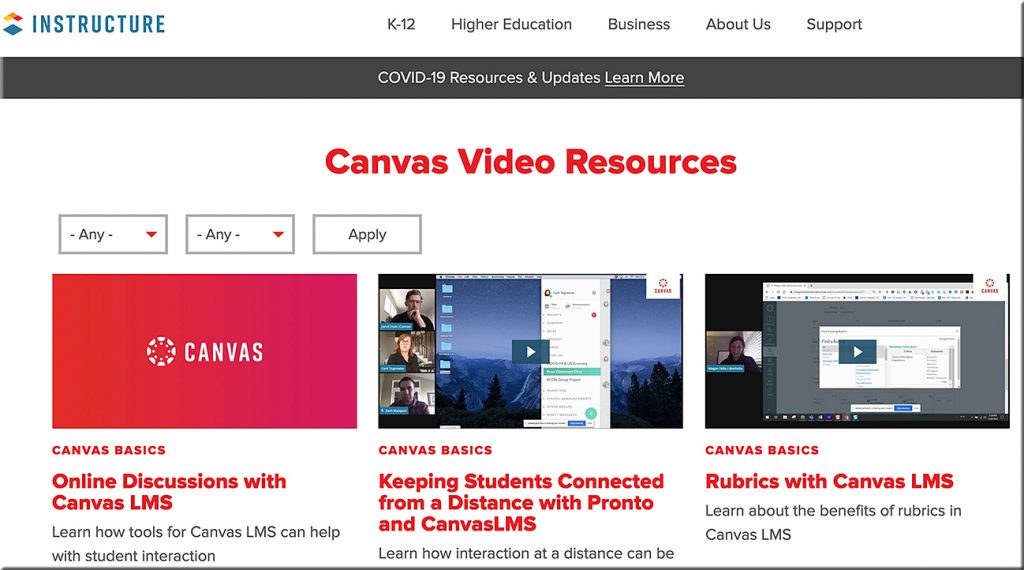
Canvas Video Resources — from instructure.com

Are you in the middle of #remotelearning, and could you use a refresher on how to do certain things w/Canvas LMS? Don’t worry, a group of community members came together & produced videos about key features to help you get moving.  


#edtech #onlinelearning #coronavirus #education #highered #k12 #CMS #LMS #Canvas


Learning ecosystems across the globe are going through massive changes! [Christian]

Learning ecosystems are going through massive changes!


From DSC:

Due to the impacts of the Coronavirus, learning ecosystems across the globe are going through massive changes!

Each of us has our own learning ecosystem, and the organizations that we work for have their own learning ecosystems as well. Numerous teachers, professors, and trainers around the world are now teaching online. Their toolboxes are expanding with the addition of several new tools and some new knowledge. I believe that will be one of the silver linings from the very tough situations/times that we find ourselves in.

Expanding our teaching toolboxes


At the WMU-Cooley Law School, our learning ecosystem is also fluid and continues to morph.
This blog posting speaks to those changes.

https://info.cooley.edu/blog/learning-ecosystem-simply-defined-sources-for-learning


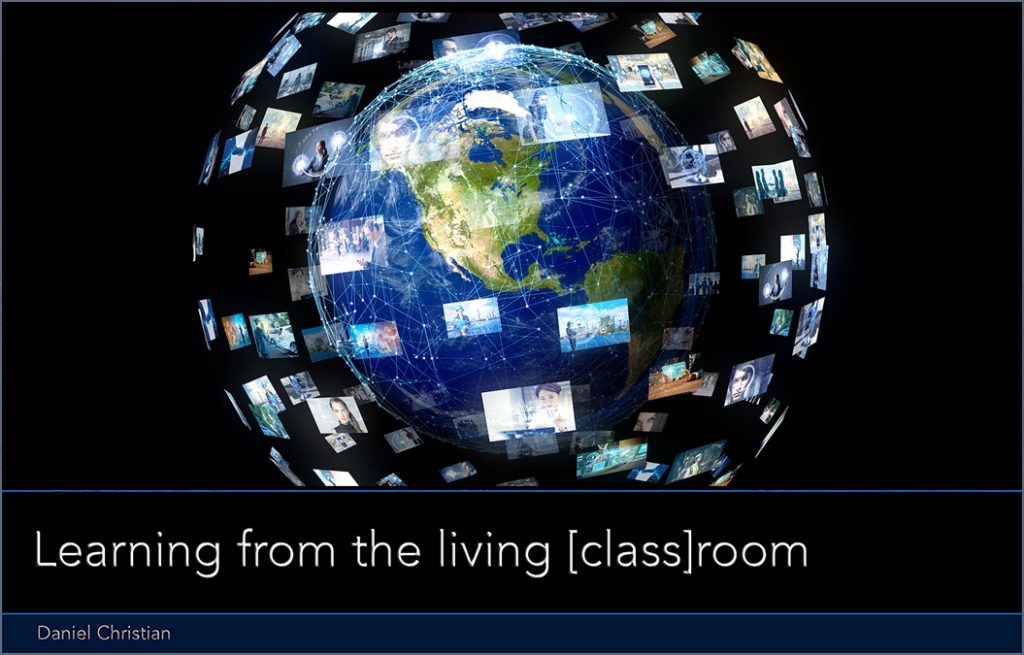
Learning from the Living [Class] Room: Due to the impacts from the Coronavirus, this is happening today across many countries. But this vision is just beginning to develop. We haven’t seen anything yet.


From DSC:
With a shout out to a colleague of mine for these resources:


Also see:


 Coronavirus has led to a rush of online teaching. Here’s some advice for newly remote instructors — from edsurge.com by Jeff Young & Bonni Stachowiak

Excerpt:

The simplest way to go online is to shift to a video conference platform
Stachowiak says that just lecturing to a webcam instead of an in-person class isn’t the best way to teach online, but it is the easiest way to switch. Under the circumstances, it is better than nothing. “I’d rather that you do that for your students, for yourself than to cancel all the classes,” she argues.

Think shorter
If it’s hard to hold students’ attention in person, it’s even harder online, says Stachowiak: “You’ll want to think about shortening that experience. The online environment tends to have shorter, more-compact opportunities and then other things to do that are more engaging than just sitting and listening.”


Coronavirus school cancellations lead to education tech surge – from finance.yahoo.com by Reggie Wade

Excerpt:

Online learning tools like Zoom (ZM), Instructure’s (INST) Canvas, Cisco System’s (CSCO) WebEx and a host of other ed tech companies are coming to the aid of schools across the U.S. as they suspend or shift classes online due to the coronavirus outbreak.

Columbia University, Amherst College, the University of Washington, and Harvard University are among the growing list of universities that have announced that they will provide online classes, as campuses temporarily shut down in response to the contagion. More than 500 K-12 schools have also made the shift.

Jamie Candee, CEO of Edmentum, tells Yahoo Finance that since the outbreak of the coronavirus in the U.S. in January, the company has seen a surge in interest in its online educational tools. On March 9, the company had over 140 districts register for its online platform in under an hour.


Top Learning Tools when School is Closed — from cyber-kap.blogspot.com
Here is a list of suggested tools that can be used to keep the learning happening when schools are closed…

From DSC:
Some of these tools might also useful for some homeschooling situations I would think.

What Katrina Taught Us About Online Delivery — from insidehighered.com by Ray Schroeder
In 2005, more than 120 U.S. universities came to the aid of some 20 colleges and universities that had been impacted by Hurricane Katrina through shared online classes.

Cisco, Google Hangouts follow Zoom’s lead in offering free video conferencing features amid coronavirus outbreak — from bizjournals.com

Coronavirus causes work-from-home technology use to skyrocket — from foxbusiness.com
Microsoft usage in China increasing because more people are working remotely, company VP says


From DSC:
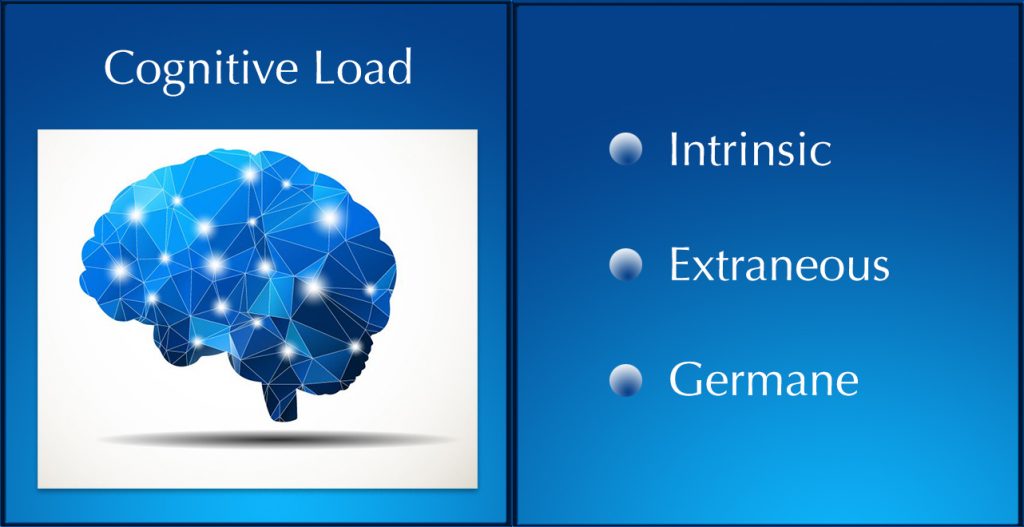
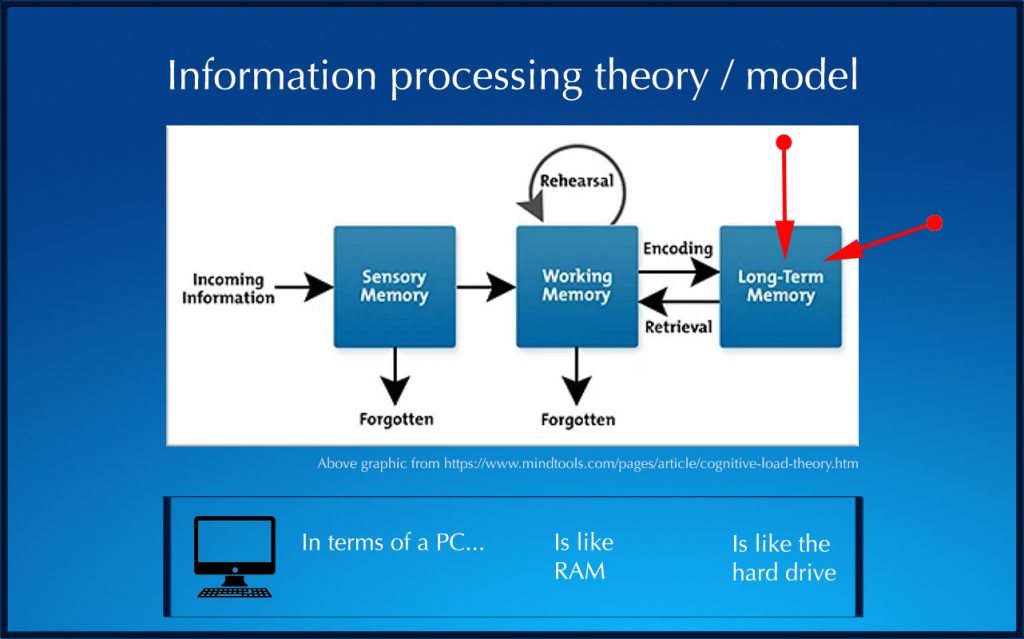
For those of you who teach and/or give presentations, you might be interested in a new video that I put together regarding cognitive load. It addresses at least two main questions:

  1. What is cognitive load?
    and
  2. Why should I care about it?


What is cognitive load? And why should I care about it?

What is cognitive load? And why should I care about it?

Transcript here.


How do I put it into practice?

  • Simplify the explanations of what you’re presenting as much as possible and break down complex tasks into smaller parts
  • Don’t place a large amount of text on a slide and then talk about it at the same time — doing so requires much more processing than most people can deal with.
  • Consider creating two versions of your PowerPoint files:
    • A text-light version that can be used for presenting that content to students
    • A text-heavy version — which can be posted to your LMS for the learners to go through at their own pace — and without trying to process so much information (voice and text, for example) at one time.
  • Design-wise:
    • Don’t use decorative graphics — everything on a slide should be there for a reason
    • Don’t use too many fonts or colors — this can be distracting
    • Don’t use background music when you are trying to explain something
 
© 2025 | Daniel Christian