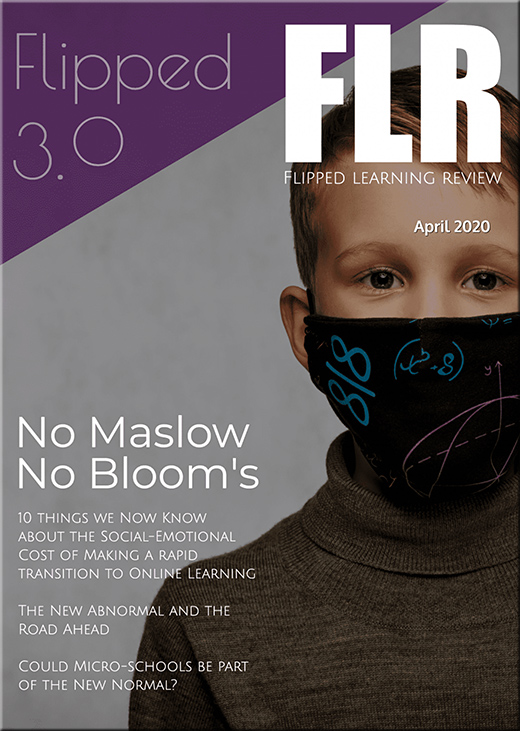
Flipped Learning -- April 2020 -- from flr.flglobal.org

The April issue of FLR looks at how we’re all managing the social-emotional cost of making a rapid transition to online learning.

Featured articles include:

  • Teaching From Home Is Exhausting: How Are You Keeping Your Spirits Up?
  • Why Is Online Teaching and Learning So Awesome and So Awful?
  • 10 Ways to Help Students Cope With How COVID-19 Is Disrupting School Life.
  • What Teachers Need From Administrators While Shifting to Remote Learning.
  • Why the Two Most Important Online Teaching Skills Today Are Grace and Choice.
  • We Miss Seeing Our Students, How Can We Fill That Hole in Our Soul?
  • Unmasking the Social-emotional Cost of Going Online Overnight?
  • Teaching During a Pandemic Is Fragile: Self-care Is Good, Self-compassion Is Better.
 

How the research on learning can drive change — from gettingsmart.com by Chris Sturgis

Excerpt (emphasis DSC):

#2 Learning results from the interplay of cognition, emotion, and motivation.
The brain does not clearly separate cognitive from emotional functioning so that optimal learning environments will engage both. It’s important that students feel safe if learning is to be optimized. When we are afraid, our amygdala becomes activated making it harder to learn. Do students feel valued? Relationships matter in creating a culture of inclusivity and belonging. Are schools designed so that teachers and professors have the opportunity to build strong relationships with students? Do students feel that the school and teachers want them to be successful? Do they have chances to receive feedback and revise or do grading practices simply judge them?


From DSC:
Two instances — plus a simmering question — instantly stand out in my mind when I read the above paragraph.

First instance:
It was years ago and I was working at a Fortune 500 company outside of Chicago. I was given the chance to learn how to program in one of the divisions of this company. I was in a conference room with my brand new boss. I had asked him a question about a piece of code, which clearly must have let him know I had some serious misunderstandings.

But instead of being patient, he grew increasingly frustrated at my lack of understanding. The madder he got, the worse my learning became. My focus shifted from processing the expected syntax of the code — and the content/instruction overall that he was trying to relay — to almost completely being concerned with his anger. My processing shut down and things deteriorated from there.

Second instance:
My mom was a classical piano teacher for decades. Though she was often loved by her students, she could be very tough, strong, and forceful. (This was true of several of my siblings’ music teachers as well.) Most of the time, she developed wonderful, strong relationships with the vast majority of her students, many of which came back to our house around Christmastime / New Year’s to visit with her (even long after “graduating”).

I mention that as background to a different context…when I observed my mom trying to teach one of my nieces how to do a math problem in the kitchen of our old house. Again, the teacher in this case kept getting increasingly frustrated, while the student kept shrinking back into their shell…trying to deflect the increasingly hot anger coming at them. The cognitive processing stopped. The amount of actual learning taking place quickly declined. I finally intervened to say that they should come back to this topic later on.

(The counselors/therapists out there would probably rightly connect these two scenarios for what was happening in my mind (i.e., not wanting to deal with the other person’s growing anger). But this applies to many more of us than just me, I’m afraid.)

A simmering question involving law schools and a common teaching method:
In law schools, one of the long-standing teaching methods is the Socratic Method.

Depending upon the professor and their teaching style, one student could be under intense pressure to address the facts, rules, the legal principles of a case, and much more. They often have to stand up in front of the class.

In those instances, I wonder how much capacity to actually process information gets instantly reduced within many of the students’ brains when they get the spotlight shown on them? Do the more introverted and/or less confident students start to sweat? Do their fear levels and heart rates increase? With the issue of having other students attempting to learn from this grilling aside, I wonder what happens to the amygdalas of the students that were called upon?

You can probably tell that I’m not a big fan of the Socratic Method IF it begins to involve too much emotion…too much anger or fear. Not good. The amount of learning taking place can be significantly impacted.

A professor, teacher, or trainer can’t know all of the underlying background, psychology, personality differences, emotional makeup, and experiences of each learner. But getting back to the article, I appreciate what the author was saying about the importance of establishing a SAFE learning environment. The more fear, anger, and a sense of being threatened or scared are involved, the less learning/processing can occur.
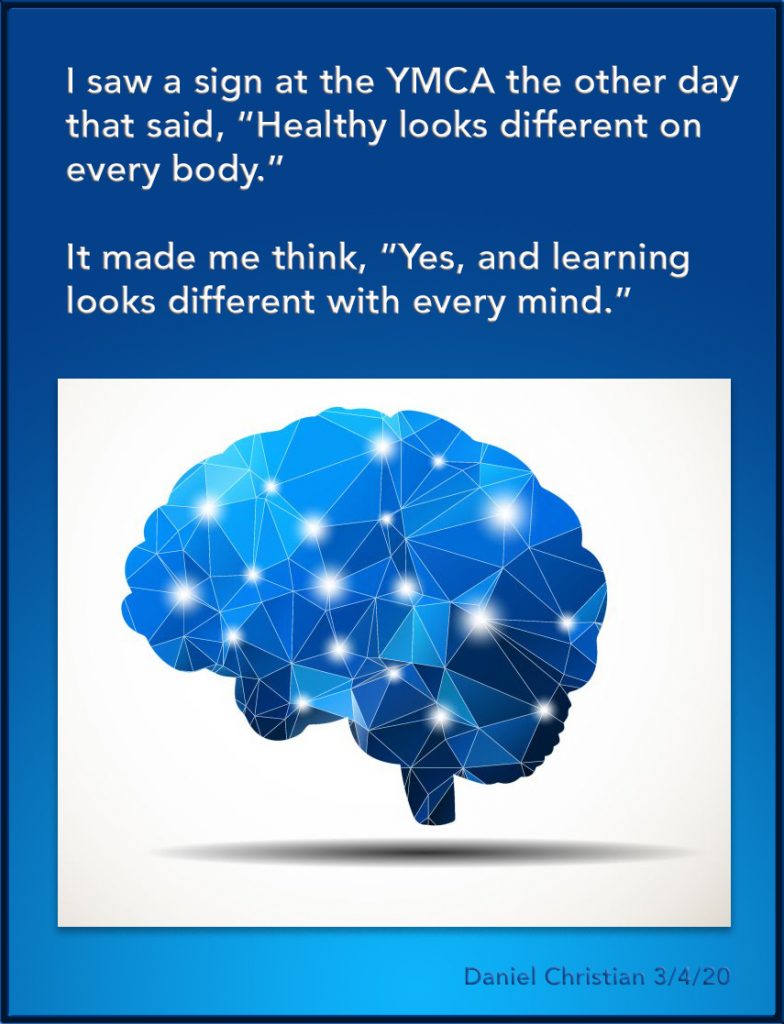
 

Healthy looks different on every body...and learning looks different with every mind.


Setting Expectations for Remote Learning — from evoLLLution.com (where LLL stands for lifelong learning) by Robin Robinson

Excerpt:

Evo: How important is it to clearly differentiate remote learning and online education?

RR: You need to set expectations. Normally, if someone is going to produce an online course, they’re going to spend at least a semester building out the appropriate course map and alignments to their course objectives. In this situation, with remote learning, you’re trying to meet the same objective as you would in a regular face-to-face class, but online learning is completely different. Your head space needs to reflect that, and you need to consider the things in this environment that can’t be done in a face-to-face environment. We’re drawing on what people understand as good teaching and trying to emulate that experience online as much as possible.

Remote delivery requires using a lot of the synchronous tools. Online learning is about combining the best of both worlds.

Faculty who were skeptical have now adopted online learning. Many of them are amazed at how well they can get to know their students and how well they can track their performances in school.

What I’m concerned about is the digital divide. We want a very inclusive and diverse university, but that means recognizing that there are students at a disadvantage.


OLC Innovate™ 2020 Conference Moves to June with All-Virtual Format — from prweb.com
Produced by the Online Learning Consortium, in partnership with MERLOT, OLC Innovate 2020 Virtual will gather digital learning leaders and practitioners, online, June 15-26, to focus on innovation in digital, blended and online learning.

Excerpt:

BOSTON (PRWEB) MAY 01, 2020
The Online Learning Consortium (OLC) announced today that its annual OLC Innovate™ Conference is moving to an all-virtual format for 2020. OLC and conference partner MERLOT will gather the digital learning community, online, June 15-26, for OLC Innovate™ 2020 Virtual Conference (#OLCInnovate). This year’s theme, “Building Bridges in Digital, Blended and Online Learning,” frames a 10-day online program that highlights inspiring innovators and thought leaders from higher education, K-12, military, health care and workforce education.


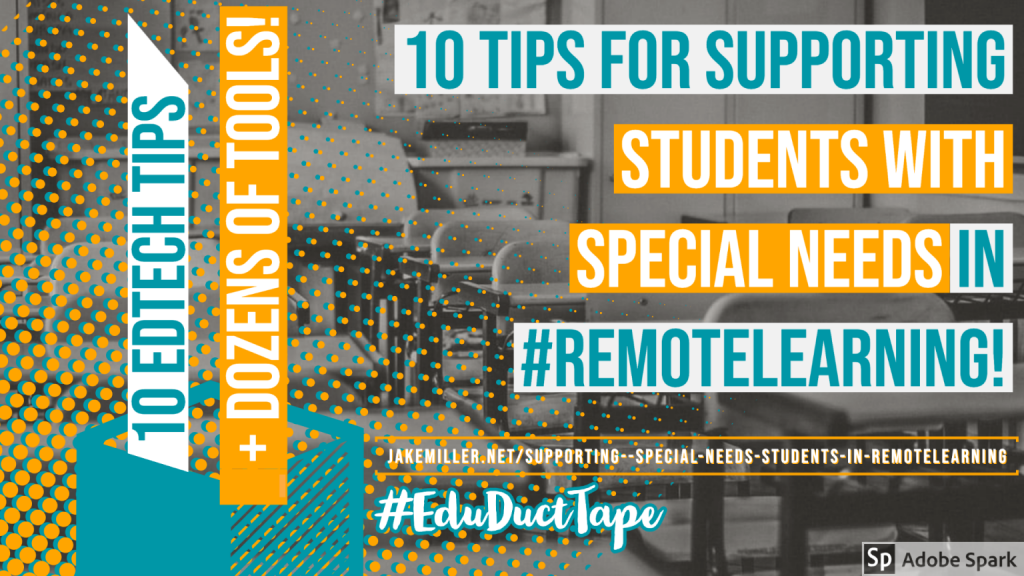
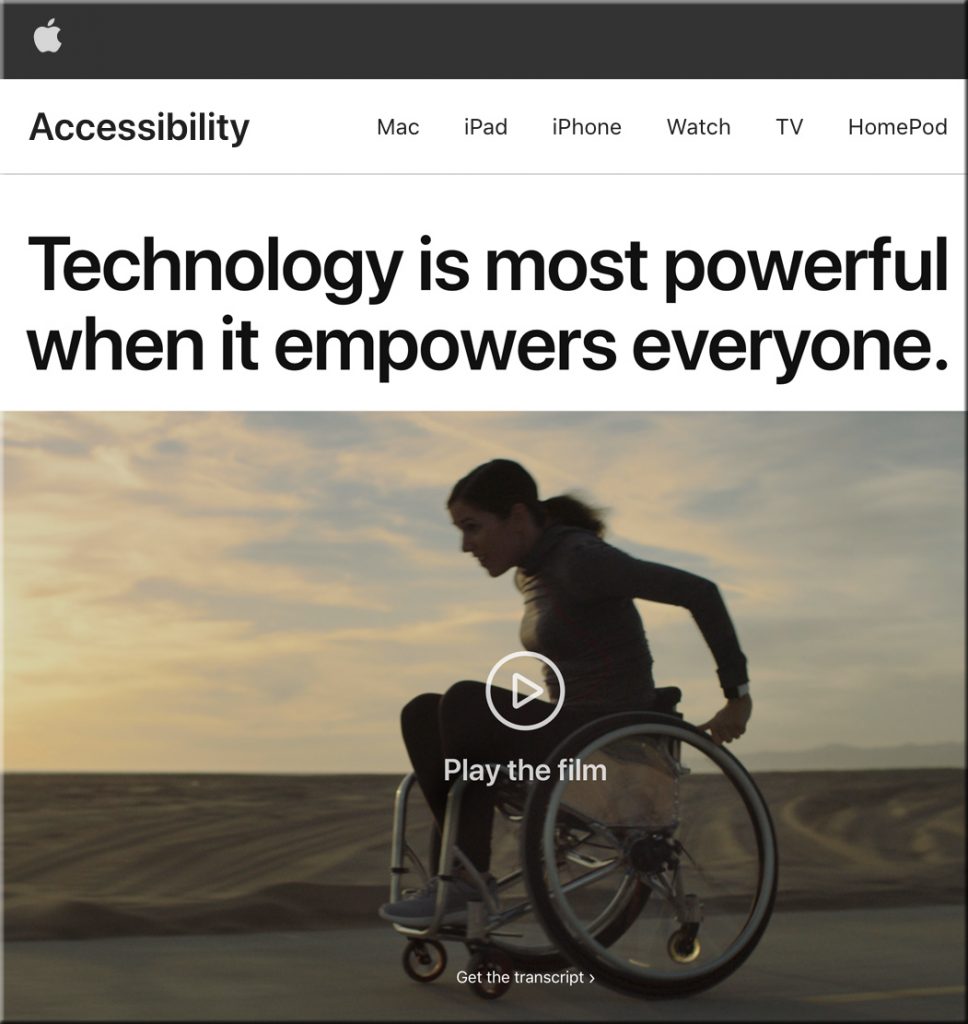
10 Tips for Supporting Students with Special Needs in #RemoteLearning — from jakemiller.net by Jake Miller

Excerpt:

How can we support learners with special needs in remote learning?

While, certainly, some educators are doing great things to support these students, from my observations, this has taken a backseat to other elements of remote learning.  And these students NEED OUR HELP.

Unfortunately, I am not an expert in special education, accessibility features or assistive technology. I am, however, skilled at asking other people to share their expertise. ? So, in episode 40 of the Educational Duct Tape podcast and in the 4.8.20 #EduDuctTape Twitter Chat I asked educators one simple question:

How can we support learners with special needs in remote learning?

And they DELIVERED. I mean, the awesome suggestions and resources, all from a perspective of support rather than judgment, POURED in. And so, here they are.

10 Tips for Supporting Students with Special Needs in Remote Learning


Student-Centered Remote Teaching: Lessons Learned from Online Education — from  er.educause.edu by Shannon Riggs

Excerpt:

Student-content interaction is all about having students DO something with the course content or topic. Reading and listening to lectures will be part of many classes, but the passive receipt of information isn’t sufficient to help students engage with the course and meet course learning outcomes. Instead, we should create opportunities for active learning, which is when students DO something meaningful related to the course content and then reflect on their learning.

After students complete a course reading, ask them to do a follow-up assignment. Here are a few examples:

  • Write a summary.
  • Create an annotated visual on a PowerPoint slide that shows your key take-away from the reading.
  • List five of your take-aways and one question you have based on the reading.
  • Identify what you as a reader find to be the clearest point in the reading and the muddiest point
  • Diagram a process.
  • Make an infographic.
  • Write an op-ed based on the content.

After students attend a synchronous lecture via web conference, ask them to complete a follow-up activity:

  • Participate in a “think-pair-share” activity: The instructor poses a question, asks students to jot some notes down independently to form initial thoughts, distributes students into breakout rooms to discuss, and then pulls the class back together as a group to discuss and synthesize.
  • Complete a poll to check comprehension.
  • Illustrate ideas on the web conference whiteboard.
  • Flip the web conference “lecture” by asking students to come prepared to discuss topics they have already read up on.
  • Give students the opportunity to lead a discussion.
 

From DSC:
Some of the areas likely to see such tools integrated into their arenas, operations, and ecosystems:


From DSC:
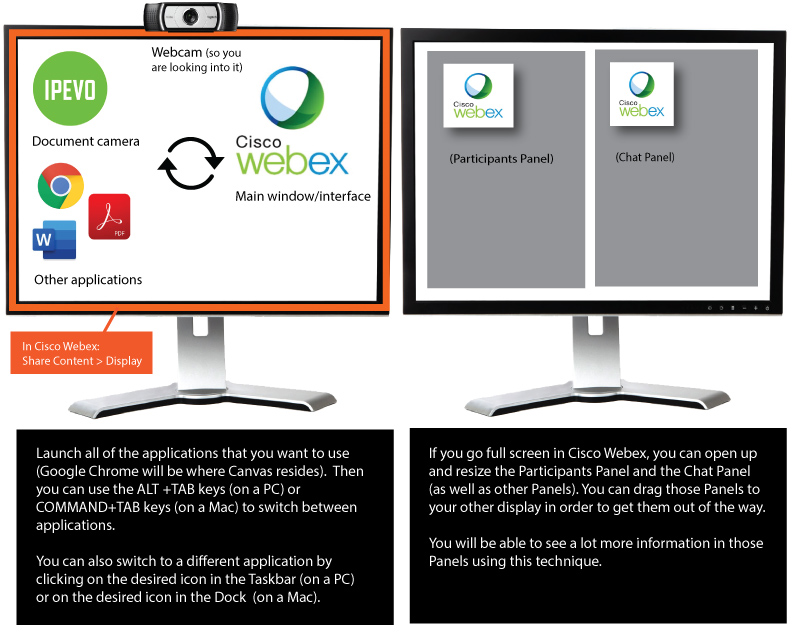
If you are teaching from home and you have two displays (which is highly recommended)… 

The link to the PDF file (below) presents a printable graphic that relays a great way to organize your applications as well as the panels within Cisco Webex. The printable graphic also relays two quick, easy, and effective methods of switching between applications. 


Setting up your apps with two displays (printable graphic in this PDF file).


4 items on Instructure’s to-do list after the sale of the Canvas LMS provider — from edsurge.com by Wade Tyler Millward

Excerpt:

Even without a pandemic, Instructure faced a transformative 2020. The learning management system provider—best known for its Canvas product popular among colleges—is officially under private equity ownership.


Virtual classroom engagement tactics for COVID-19 pandemic — from learningsolutionsmag.com by Bill Brandon

Excerpts:

In the two previous articles in this series (see “ICYMI” at the end of this article), I listed 10 resources for virtual classroom design and delivery, published in the past in Learning Solutions. In this article, I wrap up the series with an additional five that are more tactical in nature.

Tips for great delivery in the virtual classroom
Five Essential Skills for Virtual Classroom Facilitators: Cindy Huggett discusses “five key competencies” for virtual classroom delivery that she has identified in her research and through experience. Mastering these skills is essential to facilitating live virtual classroom sessions that are engaging, polished, and professional. Karen Hyder gives tips for “owning your message” through practice and preparation that will ensure authentic delivery.


5 easy ways to infuse learning science into remote teaching — from campustechnology.com by Andrea Hendricks
These practices will help engage students and improve outcomes throughout the online learning process.

Excerpt:

Here again, good organization is essential. I organize my content by units that are aligned to tests, so my students always have a clear learning goal in mind. If I have six tests in a semester, I divide the content into six units. Each unit contains an overview for the module, a submodule for each section, a review of the key concepts from the unit, a set of review problems for the unit, and a test. Within section submodules, I give an overview of the objectives, activities for students to engage with and learn the content (reading assignments, videos, animations, homework problems), and a discussion question. I also include modules on getting started with the course, the technology we’ll be using as well as tutoring information and resources.


From DSC:
Let’s hope that Cisco Webex learns from Zoom, Blackboard Collaborate, and likely other products/vendors as well — in terms of providing easy-to-setup and use, seamless breakout rooms.

The breakout rooms in the Cisco Webex’ Training Center product are audio-only, which represents a major gap/disadvantage for numerous courses out there. (And, last I knew, there aren’t breakout rooms in the Cisco WebEx Meeting Center product.) The idea of community, presence, and collaboration is supported by providing audio and video. Video is critically important in certain courses.

Plus we are finding at WMU-Cooley that we need to create main rooms PLUS additional breakout rooms and assign students to each breakout room. But then, audio and video issues abound. Such a complex setup requires that the faculty member (i.e., the host) of such meetings needs to be pretty savvy in order to make things work well. 

The transitions of going from the main meeting room to breakout rooms needs to be quick and easy. Bb Collaborate did a great job with this, and I hear Zoom does a good job with this as well. Cisco Webex does not.

Cisco — if you’re going to be in the world of higher ed and in the K-12 world, you need to fix this ASAP. 

Flipping things around…Zoom, you had better learn from Cisco Webex if you want to play in the worlds of education as well. Your “Zoombombing” and security-related issues are not good.

Also see:


© 2025 | Daniel Christian