Collaborative innovation — from marketoonist.com

Disney alum Paul Williams once shared the brainstorming method developed by Walt Disney. Disney used to separate the act of coming up with and executing ideas into three distinct steps (and associated mindsets): The Dreamer, The Realist, and The Spoiler.

As Paul wrote:

“By compartmentalizing the stages, Walt didn’t let reality get in the way of the dream step. The realist was allowed to work without the harsh filter of a spoiler. And, the spoiler spends time examining a well-thought idea… something with a bit more structure.

“When we brainstorm alone and in groups – too often – we tend to fill the room with a dreamer or two, a few realists, and a bunch of spoilers. In these conditions, dream ideas don’t stand a chance.”

The Dreamer mentality specializes in blue sky thinking without constraints, the Realist mentality puts practical structure to the ideas, and the Spoiler asks the hard questions and kicks the tires. We need all three mindsets. But we need those mindsets at the right time and in the right way.


From DSC:
How true this is! I’m the Dreamer in the room…and have been shut down more times than I can count. For all of you Visionaries and Dreamers out there, keep trying! And consider establishing something like Walt Disney did.


Fresh Voices on Legal Tech with Mathew Kerbis — from legaltalknetwork.com by Mathew Kerbis, Dennis Kennedy, and Tom Mighell

New approaches to legal service delivery are propelling us into the future. Don’t get left behind! AI and automations are making alternative service delivery easier and more efficient than ever. Dennis & Tom welcome Mathew Kerbis to learn more about his expertise in subscription-based legal services.


The Business Case For Legal Tech — from lexology.com

What a strong business case includes
A credible business case has three core elements: a clear problem statement, a defined solution, and a robust analysis of expected impact. It should also demonstrate that legal has done its homework and thought beyond implementation.

  1. Problem definition
  2. Current state analysis
  3. Solution overview
  4. Impact assessment
  5. Implementation plan
  6. Cost summary and ROI
  7. Strategic alignment

How AI is Revolutionizing Legal Technology in 2025 — from itmunch.com by Gaurav Uttamchandani

Table of Contents

  • What is AI in Legal Technology?
  • Key Use Cases of AI in the Legal Industry
    • 1. Contract Review & Management
    • 2. Legal Research & Case Analysis
    • 3. Litigation Prediction & Risk Assessment
    • 4. E-Discovery
    • 5. Legal Chatbots & Virtual Assistants
  • Benefits of AI in Legal Tech
  • Real-World Example: AI in Action
  • Implementing AI in Your Law Firm: Step-by-Step
  • Addressing Concerns Around AI in Law
  • LegalTech Trends to Watch in 2025
  • Final Thoughts
  • Call-to-Action (CTA)


Transform Public Speaking with Yoodli: Your AI Coach — from rdene915.com by Paula Johnson

Yoodli is an AI tool designed to help users improve their public speaking skills. It analyzes your speech in real-time or after a recording and gives you feedback on things like:

    • Filler words (“um,” “like,” “you know”)
    • Pacing (Are you sprinting or sedating your audience?)
    • Word choice and sentence complexity
    • Eye contact and body language (with video)
    • And yes, even your “uhhh” to actual word ratio

Yoodli gives you a transcript and a confidence score, plus suggestions that range from helpful to brutally honest. It’s basically Simon Cowell with AI ethics and a smiley face interface.


[What’s] going on with AI and education? — from theneuron.ai by Grant Harvey
With students and teachers alike using AI, schools are facing an “assessment crisis” where the line between tool and cheating has blurred, forcing a shift away from a broken knowledge economy toward a new focus on building human judgment through strategic struggle.

What to do about it: The future belongs to the “judgment economy,” where knowledge is commoditized but taste, agency, and learning velocity become the new human moats. Use the “Struggle-First” principle: wrestle with problems for 20-30 minutes before turning to AI, then use AI as a sparring partner (not a ghostwriter) to deepen understanding. The goal isn’t to avoid AI, but to strategically choose when to embrace “desirable difficulties” that build genuine expertise versus when to leverage AI for efficiency.

The Alpha-School Program in brief:

    • Students complete core academics in just 2 hours using AI tutors, freeing up 4+ hours for life skills, passion projects, and real-world experiences.
    • The school claims students learn at least 2x faster than their peers in traditional school.
    • The top 20% of students show 6.5x growth. Classes score in the top 1-2% nationally across the board.
    • Claims are based on NWEA’s Measures of Academic Progress (MAP) assessments… with data only available to the school. Hmm…

Austen Allred shared a story about the school, which put it on our radar.


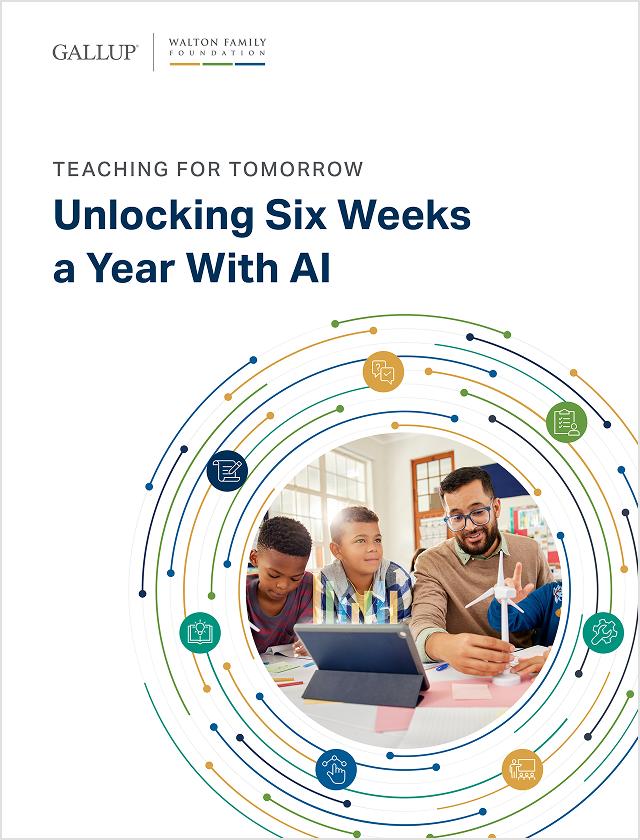
Featured Report:  Teaching for Tomorrow: Unlocking Six Weeks a Year With AI — from gallup.com
.

.
In the latest installment of Gallup and the Walton Family Foundation’s research on education, K-12 teachers reveal how AI tools are transforming their workloads, instructional quality and classroom optimism. The report finds that 60% of teachers used an AI tool during the 2024–25 school year. Weekly AI users report reclaiming nearly six hours per week — equivalent to six weeks per year — which they reinvest in more personalized instruction, deeper student feedback and better parent communication.

Despite this emerging “AI dividend,” adoption is uneven: 40% of teachers aren’t using AI at all, and only 19% report their school has a formal AI policy. Teachers with access to policies and support save significantly more time.

Educators also say AI improves their work. Most report higher-quality lesson plans, assessments and student feedback. And teachers who regularly use AI are more optimistic about its benefits for student engagement and accessibility — mirroring themes from the Voices of Gen Z: How American Youth View and Use Artificial Intelligence report, which found students hesitant but curious about AI’s classroom role. As AI tools grow more embedded in education, both teachers and students will need the training and support to use them effectively.

Also see:

  • 2-Hour Learning
    • What if children could crush academics in 2 hours, 2x faster? 
    • What if children could get back their most valuable resource, which is time?
    • What if children could pursue the things they want during their afternoons and develop life skills?

Amira Learning: Teaching With The AI-Powered Reading Tool — from techlearning.com by Erik Ofgang
Amira Learning is a research-backed AI reading tutor that incorporates the science of reading into its features.

What Is Amira Learning?
Amira Learning’s system is built upon research led by Jack Mostow, a professor at Carnegie Mellon who helped pioneer AI literacy education. Amira uses Claude AI to power its AI features, but these features are different than many other AI tools on the market. Instead of focusing on chat and generative response, Amira’s key feature is its advanced speech recognition and natural language processing capabilities, which allow the app to “hear” when a student is struggling and tailor suggestions to that student’s particular mistakes.

Though it’s not meant to replace a teacher, Amira provides real-time feedback and also helps teachers pinpoint where a student is struggling. For these reasons, Amira Learning is a favorite of education scientists and advocates for science of reading-based literacy instruction. The tool currently is used by more than 4 million students worldwide and across the U.S.


What enterprise leaders can learn from LinkedIn’s success with AI agents — from venturebeat.com by Taryn Plumb

LinkedIn is taking a multi-agent approach, using what Agarwal described as a collection of agents collaborating to get the job done. A supervisor agent orchestrates all the tasks among other agents, including intake and sourcing agents that are “good at one and only one job.”

All communication occurs through the supervisor agent, which receives input from human users regarding role qualifications and other details. That agent then provides context to a sourcing agent, which culls through recruiter search stacks and sources candidates along with descriptions on why they might be a good fit for the job. That information is then returned to the supervisor agent, which begins actively interacting with the human user.

“Then you can collaborate with it, right?” said Agarwal. “You can modify it. No longer do you have to talk to the platform in keywords. You can talk to the platform in natural language, and it’s going to answer you back, it’s going to have a conversation with you.”


How Do You Build a Learner-Centered Ecosystem? — from gettingsmart.com by Bobbi Macdonald and Alin Bennett

Key Points

  • It’s not just about redesigning public education—it’s about rethinking how, where and with whom learning happens. Communities across the United States are shaping learner-centered ecosystems and gathering insights along the way.
  • What does it take to build a learner-centered ecosystem? A shared vision. Distributed leadership. Place-based experiences.  Repurposed resources. And more. This piece unpacks 10 real-world insights from pilots in action.
    .

We believe the path forward is through the cultivation of learner-centered ecosystems — adaptive, networked structures that offer a transformed way of organizing, supporting, and credentialing community-wide learning. These ecosystems break down barriers between schools, communities, and industries, creating flexible, real-world learning experiences that tap into the full range of opportunities a community has to offer.

Last year, we announced our Learner-Centered Ecosystem Lab, a collaborative effort to create a community of practice consisting of twelve diverse sites across the country — from the streets of Brooklyn to the mountains of Ojai — that are demonstrating or piloting ecosystemic approaches. Since then, we’ve been gathering together, learning from one another, and facing the challenges and opportunities of trying to transform public education. And while there is still much more work to be done, we’ve begun to observe a deeper pattern language — one that aligns with our ten-point Ecosystem Readiness Framework, and one that, we hope, can help all communities start to think more practically and creatively about how to transform their own systems of learning.

So while it’s still early, we suspect that the way to establish a healthy learner-centered ecosystem is by paying close attention to the following ten conditions:


The 2025 Global Skills Report— from coursera.org
Discover in-demand skills and credentials trends across 100+ countries and six regions to deliver impactful industry-aligned learning programs.

GenAI adoption fuels global skill demands
In 2023, early adopters flocked to GenAI, with approximately one person per minute enrolling in a GenAI course on Coursera —a rate that rose to eight per minute in 2024.  Since then, GenAI has continued to see exceptional growth, with global enrollment in GenAI courses surging 195% year-over-year—maintaining its position as one of the most rapidly growing skill domains on our platform. To date, Coursera has recorded over 8 million GenAI enrollments, with 12 learners per minute signing up for GenAI content in 2025 across our catalog of nearly 700 GenAI courses.

Driving this surge, 94% of employers say they’re likely to hire candidates with GenAI credentials, while 75% prefer hiring less-experienced candidates with GenAI skills over more experienced ones without these capabilities.8 Demand for roles such as AI and Machine Learning Specialists is projected to grow by up to 40% in the next four years.9 Mastering AI fundamentals—from prompt engineering to large language model (LLM) applications—is essential to remaining competitive in today’s rapidly evolving economy.

Countries leading our new AI Maturity Index— which highlights regions best equipped to harness AI innovation and translate skills into real-world applications—include global frontrunners such as Singapore, Switzerland, and the United States.

Insights in action

Businesses
Integrate role-specific GenAI modules into employee development programs, enabling teams to leverage AI for efficiency and innovation.

Governments
Scale GenAI literacy initiatives—especially in emerging economies—to address talent shortages and foster human-machine capabilities needed to future-proof digital jobs.

Higher education
Embed credit-eligible GenAI learning into curricula, ensuring graduates enter the workforce job-ready.

Learners
Focus on GenAI courses offering real-world projects (e.g., prompt engineering) that help build skills for in-demand roles.


Boys Are Struggling in School. What Can Be Done? — from edweek.org by Rick Hess
Scholar Richard Reeves says it’s time to take a hard look at gender equity

Rick: What kinds of strategies do you think would help?

Richard: In education, we should expand the use of male-friendly teaching methods, such as more hands-on and active learning approaches. We should also consider redshirting boys—starting them in school a year later—to account for developmental differences between boys and girls. We should also introduce more male mentors and role models in schools, particularly in elementary education, where male teachers are scarce. In the workforce, apprenticeship and vocational training programs need to be expanded to create pathways into stable employment for young men who may not pursue a four-year degree. Career counseling should also emphasize diverse pathways to ensure that boys who may not thrive in a traditional academic setting still have opportunities for success. Additionally, fatherhood policies should recognize the importance of male engagement in family life, supporting fathers in their role as caregivers and providers.


While on the topic of K12 education, also see:

How Electives Help All Students Succeed — from edutopia.org by Miriam Plotinsky
Giving students a choice of electives increases engagement and allows them to develop skills outside of core academic subjects.

I recently conducted a student focus group on the topic of school attendance. One of the participants, a high school junior who admitted to being frequently late or absent, explained why she still came to school: “I never want to miss Drama. My teacher is awesome. Her class is the reason I show up every day.” As the rest of the focus group chimed in with similar thoughts, I reflected on the power that elective courses hold for students of all ages.

These courses, from jazz band to yoga, cement students’ sense of self not just in their primary and secondary years, but also in their journey toward adulthood. In these tight economic times, schools or districts often slash electives to save money on staffing, which is highly detrimental to student success. Instead, not only should budget cuts be made elsewhere, but also elective offerings should increase to heighten student choice and well-being.


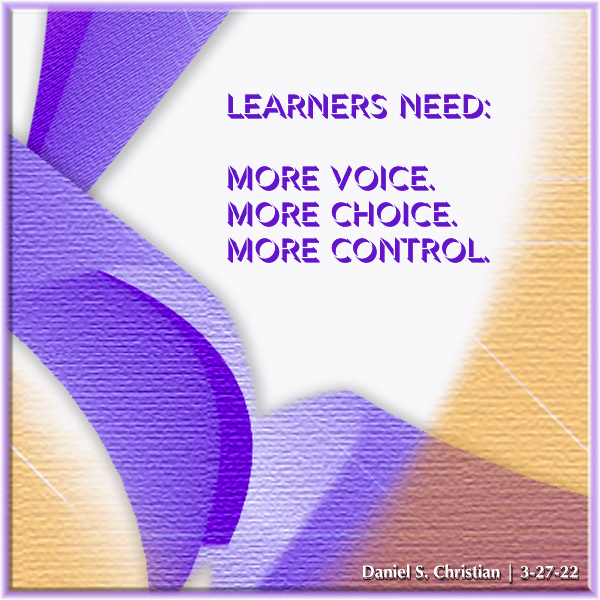
Learners need: More voice. More choice. More control. -- this image was created by Daniel Christian


The Public Microschool Playbook — from gettingsmart.com

School systems today face a complex challenge: how to personalize learning while responding to the rapidly shifting needs of students, families, and communities. Enter the Public Microschool Playbook—a new, field-tested resource co-created by Getting Smart, Learner-Centered Collaborative, and Transcend to help public education leaders reimagine learning from the ground up.

This isn’t just about launching new schools. It’s about designing dynamic, student-centered ecosystems that live inside our public systems and reflect the aspirations of the communities they serve. With an intentional focus on access and opportunity, microschools offer more than just flexibility—they offer a path to more relevant, sustainable, and empowering learning for all.

Grounded in three key phases—Planning, Designing, and Implementing—the Playbook equips district leaders, charter networks, and innovators with real-world tools and insights to launch microschools that meet local needs and drive systemic transformation. From policy navigation and budgeting to learner-centered design elements like advisory, PBL, and multi-age cohorts, this guide is a blueprint for creating purpose-built environments that make learning personal and powerful.


Also from Getting Smart, see:

The Reboot of Readiness: It’s Time to Take Action in Renovating CTE from the Ground Up — from gettingsmart.com by Adam Kulaas

Key points:

  • CTE programs need to move beyond traditional frameworks and adopt the Career Clusters Framework to better prepare students for real-world opportunities.
  • It’s crucial to integrate career readiness into the entire educational experience, making it an intentional and structured pathway from early education through high school.


Rethinking Accreditation for Emerging Models — from permissionlessed.substack.com by Raphael Gang

What’s Next: Middle States’ Next Generation Accreditation
Inspired by the Iowa project, we teamed up with the Middle States Association (MSA)—a national accreditor that shared our belief that the process had become more of a hurdle than a help.

Together with partners like the National Microschooling CenterKaipod, and Getting Smart, we’ve built something new: Next Generation Accreditation (NGA)—a faster, more flexible, more affordable process that respects school founders’ time, budgets, and models.

  • Flexible evidence: Schools can demonstrate quality in ways that fit their model.
  • More relevant standards: Built for founders, not bureaucrats.
  • Affordable: Annual dues of $650–$775 and a flat $500 site visit fee—no upsells or hidden costs.
  • Narrative-driven: Focused on how schools serve families and students, not just ticking boxes.
  • Fast: We’re piloting this in 2025, aiming to accredit schools in time for ESA eligibility for the 2026–27 school year.
 

DC: I’m not necessarily recommending this, but the next two items point out how the use of agents continues to move forward:

The Future is Here: Visa Announces New Era of Commerce Featuring AI

  • Global leader brings its trusted brand and powerful network to enable payments with new technologies
  • Launches new innovations and partnerships to drive flexibility, security and acceptance

SAN FRANCISCO–(BUSINESS WIRE)–The future of commerce is on display at the Visa Global Product Drop with powerful AI-enabled advancements allowing consumers to find and buy with AI plus the introduction of new strategic partnerships and product innovations.

Also related/see:

Find and Buy with AI: Visa Unveils New Era of Commerce — from businesswire.com

  • Collaborates with Anthropic, IBM, Microsoft, Mistral AI, OpenAI, Perplexity, Samsung, Stripe and more
  • Will make shopping experiences more personal, more secure and more convenient as they become powered by AI

Introduced [on April 30th] at the Visa Global Product Drop, Visa Intelligent Commerce enables AI to find and buy. It is a groundbreaking new initiative that opens Visa’s payment network to the developers and engineers building the foundational AI agents transforming commerce.


AI agents are the new buyers. How can you market to them? — from aiwithallie.beehiiv.com by Allie Miller
You’re optimizing for people. But the next buyers are bots.

In today’s newsletter, I’m unpacking why your next major buyers won’t be people at all. They’ll be AI agents, and your brand might already be invisible to them. We’ll dig into why traditional marketing strategies are breaking down in the age of autonomous AI shoppers, what “AI optimization” (AIO) really means, and the practical steps you can take right now to make sure your business stays visible and competitive as the new digital gatekeepers take over more digital tasks.

AI platforms and AI agents—the digital assistants that browse and actually do things powered by models like GPT-4o, Claude 3.7 Sonnet, and Gemini 2.5 Pro—are increasingly becoming the gatekeepers between your business and potential customers.

“AI is the new front door to your business for millions of consumers.”

The 40-Point (ish) AI Agent Marketing Playbook 
Here’s the longer list. I went ahead and broke these into four categories so you can more easily assign owners: Content, Structure & Design, Technical & Dev, and AI Strategy & Testing. I look forward to seeing how this space, and by extension my advice, changes in the coming months.


Microsoft CEO says up to 30% of the company’s code was written by AI — from techcrunch.com by Maxwell Zeff

During a fireside chat with Meta CEO Mark Zuckerberg at Meta’s LlamaCon conference on Tuesday, Microsoft CEO Satya Nadella said that 20% to 30% of code inside the company’s repositories was “written by software” — meaning AI.


The Top 100Gen AI Consumer Apps — from a16z.com

In just six months, the consumer AI landscape has been redrawn. Some products surged, others stalled, and a few unexpected players rewrote the leaderboard overnight. Deepseek rocketed from obscurity to a leading ChatGPT challenger. AI video models advanced from experimental to fairly dependable (at least for short clips!). And so-called “vibe coding” is changing who can create with AI, not just who can use it. The competition is tighter, the stakes are higher, and the winners aren’t just launching, they’re sticking.

We turned to the data to answer: Which AI apps are people actively using? What’s actually making money, beyond being popular? And which tools are moving beyond curiosity-driven dabbling to become daily staples?

This is the fourth installment of the Top 100 Gen AI Consumer Apps, our bi-annual ranking of the top 50 AI-first web products (by unique monthly visits, per Similarweb) and top 50 AI-first mobile apps (by monthly active users, per Sensor Tower). Since our last report in August 2024, 17 new companies have entered the rankings of top AI-first web products.


Deep Research with AI: 9 Ways to Get Started — from wondertools.substack.com by Jeremy Caplan
Practical strategies for thorough, citation-rich AI research

The AI search landscape is transforming at breakneck speed. New “Deep Research” tools from ChatGPT, Gemini and Perplexity autonomously search and gather information from dozens — even hundreds — of sites, then analyze and synthesize it to produce comprehensive reports. While a human might take days or weeks to produce these 30-page citation-backed reports, AI Deep Research reports are ready in minutes.

What’s in this post

    • Examples of each report type I generated for my research, so you can form your own impressions.
    • Tips on why & how to use Deep Research and how to craft effective queries.
    • Comparison of key features and strengths/limitations of the top platforms

AI Agents Are Here—So Are the Threats: Unit 42 Unveils the Top 10 AI Agent Security Risks — from marktechpost.com

As AI agents transition from experimental systems to production-scale applications, their growing autonomy introduces novel security challenges. In a comprehensive new report, AI Agents Are Here. So Are the Threats,” Palo Alto Networks’ Unit 42 reveals how today’s agentic architectures—despite their innovation—are vulnerable to a wide range of attacks, most of which stem not from the frameworks themselves, but from the way agents are designed, deployed, and connected to external tools.

To evaluate the breadth of these risks, Unit 42 researchers constructed two functionally identical AI agents—one built using CrewAI and the other with AutoGen. Despite architectural differences, both systems exhibited the same vulnerabilities, confirming that the underlying issues are not framework-specific. Instead, the threats arise from misconfigurations, insecure prompt design, and insufficiently hardened tool integrations—issues that transcend implementation choices.


LLMs Can Learn Complex Math from Just One Example: Researchers from University of Washington, Microsoft, and USC Unlock the Power of 1-Shot Reinforcement Learning with Verifiable Reward — from marktechpost.com by Sana Hassan


2025 EDUCAUSE Teaching and Learning Workforce in Higher Education — from library.educause.edu

This report is the first in a series that examines three distinct workforce domains in higher education in 2025 (teaching and learning, cybersecurity and privacy, and IT leadership) to determine the priorities and challenges facing the profession. The findings in this report, taken from a survey of teaching and learning professionals in higher education, highlight their perspectives on a range of topics:

  • Flexible work arrangements
  • Integration of technologies
  • Workload and staffing
  • Job satisfaction and transition/succession planning
  • Mental health and well-being
  • Culture of belonging
  • Professional development


Encouraging Students’ Curiosity With Animal Observations — from edutopia.org by Shelby Guthrie
Watching animals—either outdoors or via an online live cam—is an engaging way for students to build their critical thinking skills.

A moment of stillness can spark a lifetime of curiosity. Watching animals—whether it’s a bird outside or a zoo cam online—helps learners slow down, notice patterns, and ask questions. Structured observation builds patience, critical thinking, and a stronger connection to nature.

More than just engaging, these small moments contribute to bigger ideas—like understanding ecosystems, animal behavior, and the ever-changing world. Observation teaches learners to care, question, and conserve. These skills are foundational not only for scientific thinking but also for fostering empathy and awareness. When students observe closely, they begin to notice patterns, ask better questions, and connect deeply with the natural world. This kind of curiosity-driven learning empowers them to take informed action, whether that means advocating for a local habitat, participating in citizen science, or simply seeing their environment through a more thoughtful lens.


3 Ways to Help Students Build Attention Stamina — from edutopia.org by Donna Phillips
These simple tools and strategies can improve focus in the classroom.

I set out to create some helpful tools and strategies for my students, who have diverse learning profiles, including processing delays, anxiety, attention challenges, and autism. I knew going in that whatever I came up with needed to be flexible. The goal was never perfection; it was access and agency.

What’s resulted are three classroom strategies that don’t feel like extra work for students. Instead, they help students own their attention. I named the strategies “The Listening Gym,” “The Noise Diet,” and “Focus GPS.”


Keeping Students Engaged During Long Class Periods — from edutopia.org by Maggie Espinola
By chunking class time using gradual release of responsibility, teachers can vary their teaching strategies to help students maintain focus.

For a new teacher, figuring out how to manage a long class period can feel particularly daunting. In order to maximize the attention of your students during longer class periods, consider the following tips.

Creating a Student Leadership Program — from edutopia.org by Danica Derksen
These strategies for building leadership skills can be implemented as an elective or by creating other opportunities for students.

Running an effective student leadership program takes structure and vision from all levels of a school. When we create opportunities for students to lead, we are building competencies that they will take with them for the rest of their lives.

I currently co-teach a middle school student leadership elective each semester. I am passionate about teaching my students to lead by example, find solutions to problems, and make their school a place where all students know they belong. Here are four ideas to create a strong student leadership program or other student leadership opportunities.


2025: The Year the Frontier Firm Is Born — from Microsoft

We are entering a new reality—one in which AI can reason and solve problems in remarkable ways. This intelligence on tap will rewrite the rules of business and transform knowledge work as we know it. Organizations today must navigate the challenge of preparing for an AI-enhanced future, where AI agents will gain increasing levels of capability over time that humans will need to harness as they redesign their business. Human ambition, creativity, and ingenuity will continue to create new economic value and opportunity as we redefine work and workflows.

As a result, a new organizational blueprint is emerging, one that blends machine intelligence with human judgment, building systems that are AI-operated but human-led. Like the Industrial Revolution and the internet era, this transformation will take decades to reach its full promise and involve broad technological, societal, and economic change.

To help leaders understand how knowledge work will evolve, Microsoft analyzed survey data from 31,000 workers across 31 countries, LinkedIn labor market trends, and trillions of Microsoft 365 productivity signals. We also spoke with AI-native startups, academics, economists, scientists, and thought leaders to explore what work could become. The data and insights point to the emergence of an entirely new organization, a Frontier Firm that looks markedly different from those we know today. Structured around on-demand intelligence and powered by “hybrid” teams of humans + agents, these companies scale rapidly, operate with agility, and generate value faster.

Frontier Firms are already taking shape, and within the next 2–5 years we expect that every organization will be on their journey to becoming one. 82% of leaders say this is a pivotal year to rethink key aspects of strategy and operations, and 81% say they expect agents to be moderately or extensively integrated into their company’s AI strategy in the next 12–18 months. Adoption is accelerating: 24% of leaders say their companies have already deployed AI organization-wide, while just 12% remain in pilot mode.

The time to act is now. The question for every leader and employee is: how will you adapt?


On a somewhat related note, also see:

Exclusive: Anthropic warns fully AI employees are a year away — from axios.com by Sam Sabin

Anthropic expects AI-powered virtual employees to begin roaming corporate networks in the next year, the company’s top security leader told Axios in an interview this week.

Why it matters: Managing those AI identities will require companies to reassess their cybersecurity strategies or risk exposing their networks to major security breaches.

The big picture: Virtual employees could be the next AI innovation hotbed, Jason Clinton, the company’s chief information security officer, told Axios.


Higher Ed Institutions Rely Less on OPMs While Increasingly Hiring Fee-For-Service Models — from iblnews.org

market report from Validated Insights released this month notes that fewer colleges and universities hire external online program management (OPM) companies to develop their courses.

For 2024, higher education institutions launched only 81 new partnerships with OPMs —  a drop of 42% and the lowest number since 2016.

The report showed that institutions increasingly pay OPMs a fee-for-service instead of following a revenue-sharing model with big service bundles and profit splits.

Experts say revenue-sharing models, which critics denounce as predatory arrangements, incentivize service providers to use aggressive recruiting tactics to increase enrollments and maximize tuition revenue.

According to the report, fee-for-service has become the dominant business model for OPMs.


6 Online Edtech Professional Learning Communities & Resources for Teachers — from techlearning.com by Stephanie Smith Budhai, Ph.D.
These resources can help provide training, best practices, and advice, for using digital tools such as Canva, Curipod, Kahoot!, and more

While school-led professional development can be helpful, there are online professional learning communities on various edtech websites that can be leveraged. Also, some of these community spaces offer the chance to monetize your work.

Here is a summary of six online edtech professional learning spaces.

 
© 2025 | Daniel Christian