


On 04/10/2017,
in A/V -- audio/visual, Apple, digital audio, digital storytelling, digital video, media/film, mobile learning, multimedia, new media literacies, story, storytelling, tools,
by Daniel Christian
On 04/06/2017,
in 21st century, 3D, adjunct faculty, analytics, animation, Artificial Intelligence/Agents/LLMs/and Related, assessment, Augmented Reality (AR), Australia, blogs / blogging / vlogging, bots, business side of he, Canada, change, chemistry, cloud-based computing / apps / other cloud-related, collaboration, colleges, communications, community colleges, computer science, creativity, Daniel S. Christian, digital audio, digital learning, digital photography, digital video, e-publishing related items (EPUB and more), education technology, educational games / serious games, emerging technologies, engagement / engaging students, Europe, higher education, homeschooling/homeschoolers, human-computer interaction (HCI), India, innovation, interactivity, internet, K-12 related, languages and translation, learning, learning ecosystem, mathematics, media/film, memory, mobile learning, multimedia, online learning, participation, pedagogy, platforms, play, productivity / tips and tricks, programming, robotics, science, story, storytelling, student teaching/teacher education, student-related, teachers, technologies for your home, tools, UK, United States, universities, vendors, virtual field trips, Virtual Reality (VR) / worlds / learning, writing, youth,
by Daniel Christian
The 82 Hottest EdTech Tools of 2017 According to Education Experts — from tutora.co.uk by Giorgio Cassella
Excerpt:
If you work in education, you’ll know there’s a HUGE array of applications, services, products and tools created to serve a multitude of functions in education.
Tools for teaching and learning, parent-teacher communication apps, lesson planning software, home-tutoring websites, revision blogs, SEN education information, professional development qualifications and more.
There are so many companies creating new products for education, though, that it can be difficult to keep up – especially with the massive volumes of planning and marking teachers have to do, never mind finding the time to actually teach!
So how do you know which ones are the best?
Well, as a team of people passionate about education and learning, we decided to do a bit of research to help you out.
We’ve asked some of the best and brightest in education for their opinions on the hottest EdTech of 2017. These guys are the real deal – experts in education, teaching and new tech from all over the world from England to India, to New York and San Francisco.
They’ve given us a list of 82 amazing, tried and tested tools…
From DSC:
The ones that I mentioned that Giorgio included in his excellent article were:
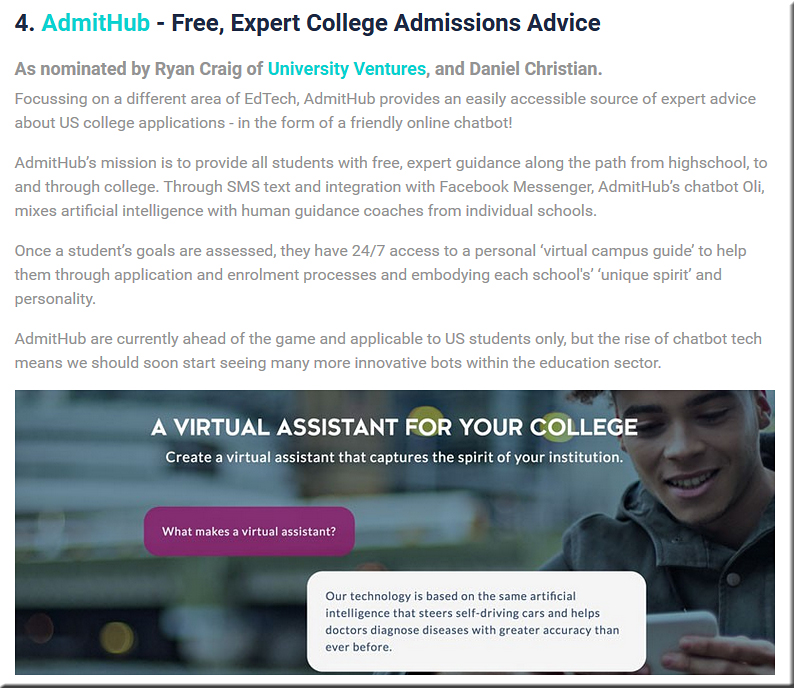
- AdmitHub – Free, Expert College Admissions Advice
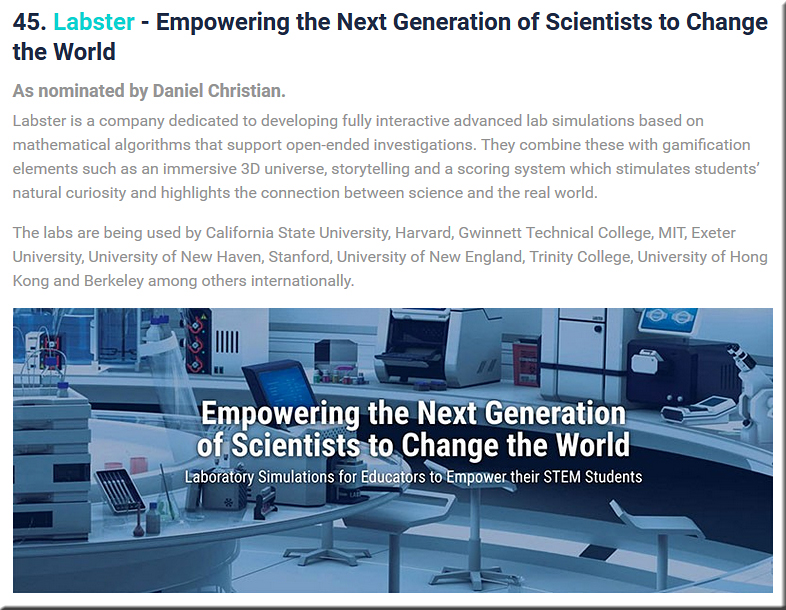
- Labster – Empowering the Next Generation of Scientists to Change the World
- Unimersiv – Virtual Reality Educational Experiences
- Lifeliqe – Interactive 3D Models to Augment Classroom Learning
On 11/30/2016,
in 21st century, business, corporate / business world, corporate universities / corporate training, digital storytelling, education technology, emerging technologies, engagement / engaging students, microlearning, story, storytelling, tools, trends, United States, Virtual Reality (VR) / worlds / learning, workplace,
by Daniel Christian
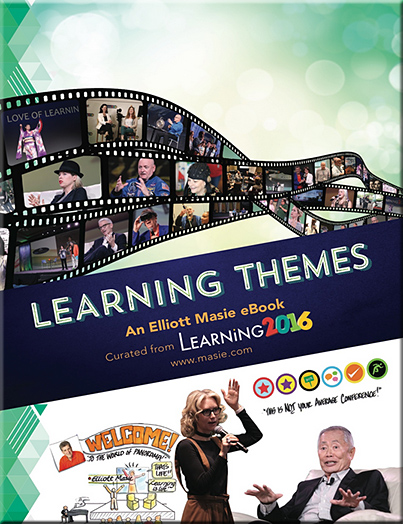
Learning Themes
Curated Content from Learning 2016
Open Source eBook – No Cost
http://www.masie.com/eBookL16
From an email from Elliott Masie and the Masie Center:
This 35-page eBook is packed with content, context, conversations, video links, and curated resources that include:
- Learning Perspectives from Anderson Cooper, Scott Kelly, Tiffany Shlain, George Takei, Richard Culatta, Karl Kapp, Nancy DeViney, and other Learning 2016 Keynotes
- Graphic Illustrations from Deirdre Crowley, Crowley & Co.
- Video Links for Content Segments
- Learning Perspectives from Elliott Masie
- Segments focusing on:
- Brain & Cognitive Science
- Gamification & Gaming
- Micro-Learning
- Visual Storytelling
- Connected & Flipped Classrooms
- Compliance & Learning
- Engagement in Virtual Learning
- Video & Learning
- Virtual Reality & Learning
- And much more!
We have created this as an open source, shareable resource that will extend the learning from Learning 2016 to our colleagues around the world. We are using the Open Creative Commons license, so feel free to share!
We believe that CURATION, focusing on extending and organizing follow-up content, is a growing and critical dimension of any learning event. We hope that you find your eBook of value!
On 09/26/2016,
in A/V -- audio/visual, attention, Augmented Reality (AR), computer science, digital audio, digital learning, digital storytelling, digital video, education technology, emerging technologies, engagement / engaging students, future, Google, health, higher education, homeschooling/homeschoolers, human-computer interaction (HCI), ideas, immersion, innovation, interactivity, journalism, K-12 related, learning, learning ecosystem, Microsoft, Mixed Reality (MR), mobile technologies, online learning, online media, programming, society, story, storytelling, UK, user experience (UX), vendors, virtual field trips, Virtual Reality (VR) / worlds / learning,
by Daniel Christian
10 Incredible Uses of Virtual Reality — from fortune.com by Rose Leadem
It’s not just for video games.
Excerpt:
Virtual reality technology holds enormous potential to change the future for a number of fields, from medicine, business, architecture to manufacturing.
Psychologists and other medical professionals are using VR to heighten traditional therapy methods and find effective solutions for treatments of PTSD, anxiety and social disorders. Doctors are employing VR to train medical students in surgery, treat patients’ pains and even help paraplegics regain body functions.
In business, a variety of industries are benefiting from VR. Carmakers are creating safer vehicles, architects are constructing stronger buildings and even travel agencies are using it to simplify vacation planning.
Check out these 10 amazing uses of VR.
Visit the U.K. Prime Minister’s Home in This Virtual 10 Downing Street Experience — from uploadvr.com by
Excerpt:
Google has unveiled a new interactive online exhibit that take users on a tour of 10 Downing street in London — home of the U.K. Prime Minister.
The building has served as home to countless British political leaders, from Winston Churchill and Margaret Thatcher through to Tony Blair and — as of a few months ago — Theresa May. But, as you’d expect in today’s security-conscious age, gaining access to the residence isn’t easy; the street itself is gated off from the public. This is why the 10 Downing Street exhibit may capture the imagination of politics aficionados and history buffs from around the world.
The tour features 360-degree views of the various rooms, punctuated by photos and audio and video clips.

Microsoft’s HoloLens Now Helps Elevator Technicians Work Smarter — from uploadvr.com by Charles Singletary
Excerpt:
In a slightly more grounded environment, the HoloLens is being used to assist technicians in elevator repairs.
Traversal via elevator is such a regular part of our lifestyles, its importance is rarely recognized…until they’re not working as they should be. ThyssenKrupp AG, one of the largest suppliers for elevators, recognizes how essential they are as well as how the simplest malfunctions can deter the lives of millions. Announced on their blog, Microsoft is partnering with Thyssenkrupp to equip 24,000 of their technicians with HoloLens.
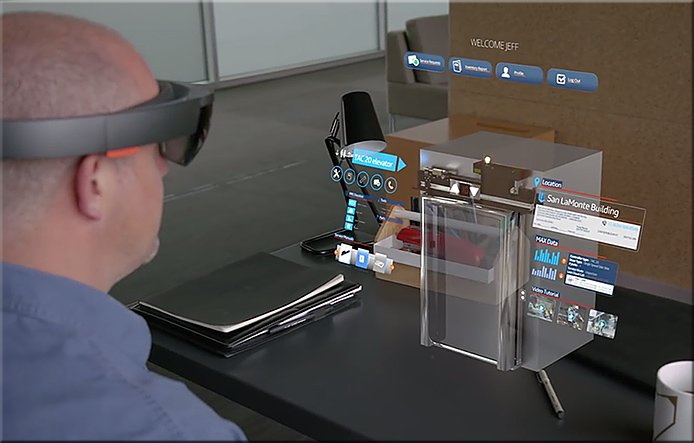
Insert from DSC re: the above piece re: HoloLens:
Will technical communicators need to augment their skillsets? It appears so.
Phiona: A Virtual Reality Portrait of ‘Queen of Katwe’ — from abcnews.com by Angel Canales and Adam Rivera

Get a front-row seat in Harvard’s largest class, thanks to virtual reality — from medium.freecodecamp.com by Dhawal Shah

Intro video here: This is CS50 2016
The future of mobile video is virtual reality — from techcrunch.com by Mike Wadhera
Excerpt:
But in a world where no moment is too small to record with a mobile sensor, and one in which time spent in virtual reality keeps going up, interesting parallels start to emerge with our smartphones and headsets.
Let’s look at how the future could play out in the real world by observing three key drivers: VR video adoption, mobile-video user needs and the smartphone camera rising tide.
Now, a virtual reality programme to improve social skills in autistic kids — from cio.economictimes.indiatimes.com by
The VR training platform creates a safe place for participants to practice social situations without the intense fear of consequence.
Excerpt:
“Individuals with autism may become overwhelmed and anxious in social situations,” research clinician Dr Nyaz Didehbani said.
“The virtual reality training platform creates a safe place for participants to practice social situations without the intense fear of consequence,” said Didehbani.
The participants who completed the training demonstrated improved social cognition skills and reported better relationships, researchers said.
Also see:
- The Top 10 Companies Working on Education in Virtual Reality and Augmented Reality — from touchstoneresearch.com by Drew Lewis
On 09/16/2016,
in 24x7x365 access, A/V -- audio/visual, attention, blended learning, corporate / business world, corporate universities / corporate training, creativity, Daniel S. Christian, design, digital audio, digital learning, digital photography, digital storytelling, digital video, drama/theater, education technology, educational games / serious games, elearning, emerging technologies, engagement / engaging students, experimentation, hybrid learning, ideas, innovation, interaction design, interactivity, online learning, pedagogy, play, story, storytelling, teaching & learning, tools, training / L&D, user experience (UX), user interface design, using teams, vendors, vision/possibilities,
by Daniel Christian
From DSC:
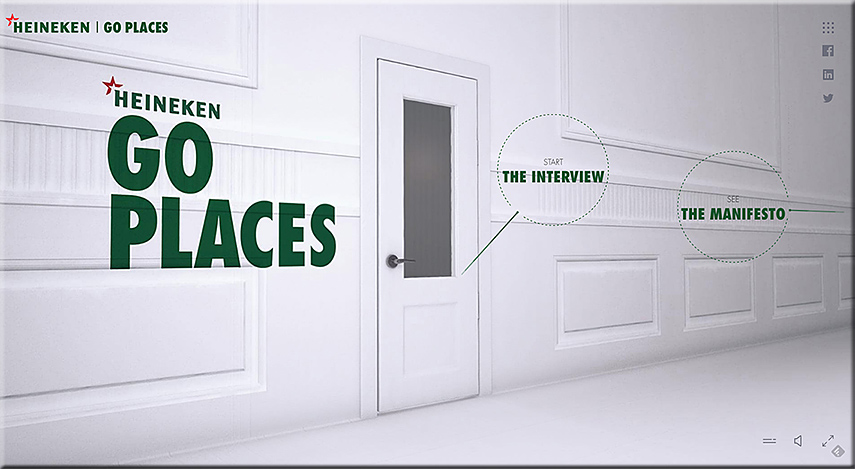
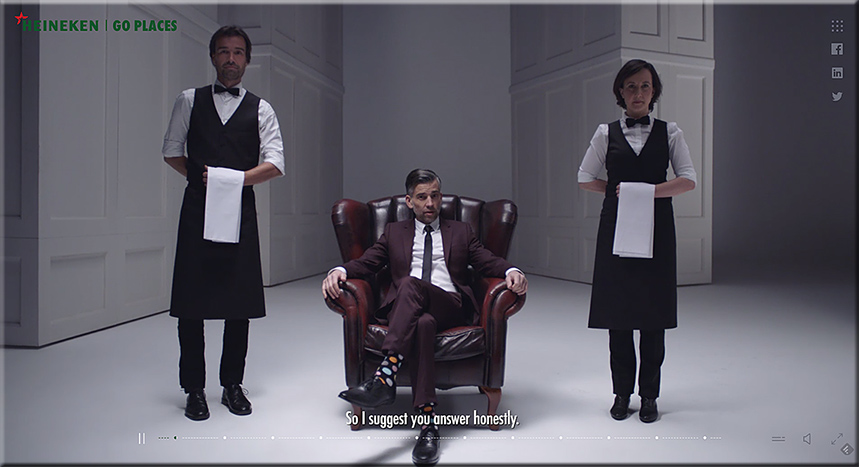
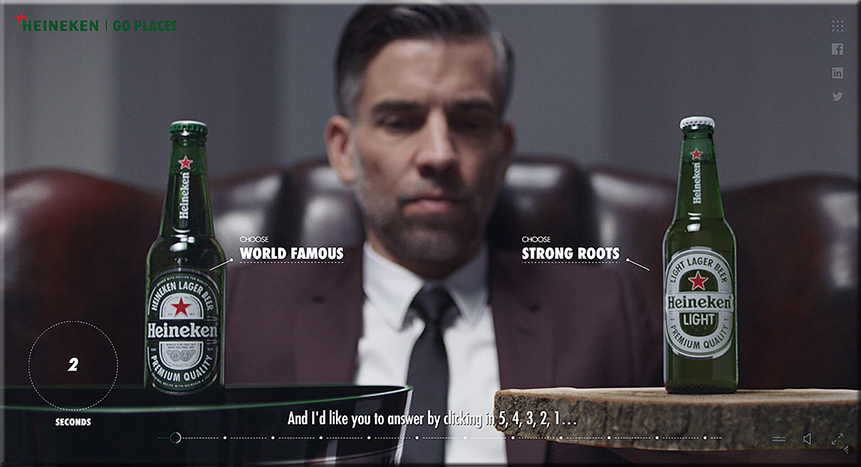
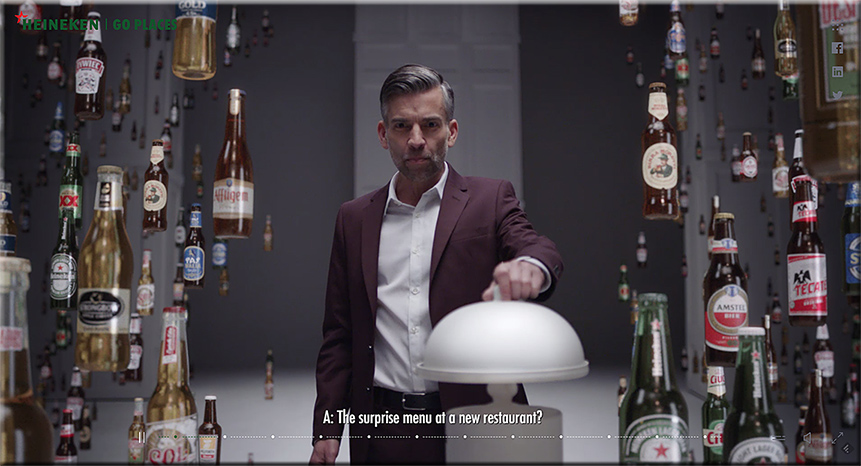
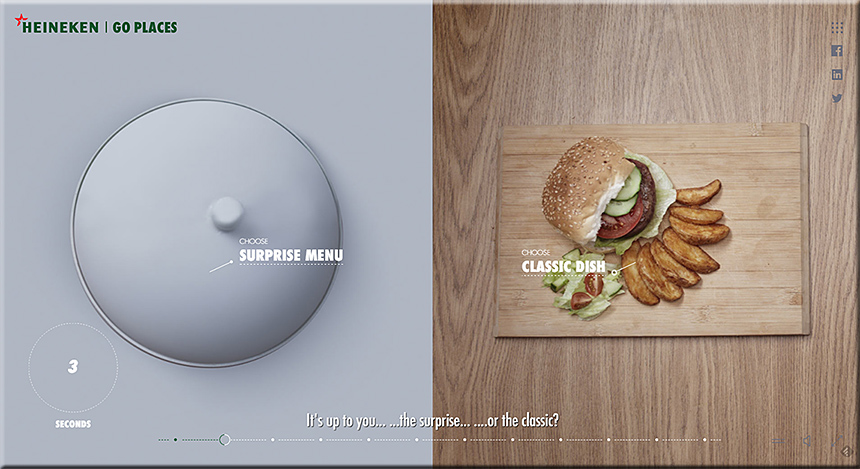
Interactive video — a potentially very powerful medium to use, especially for blended and online-based courses or training-related materials! This interactive piece from Heineken is very well done, even remembering how you answered and coming up with their evaluation of you from their 12-question “interview.”
But notice again, a TEAM of specialists are needed to create such a piece. Neither a faculty member, a trainer, nor an instructional designer can do something like this all on their own. Some of the positions I could imagine here are:
- Script writer(s)
- Editor(s)
- Actors and actresses
- Those skilled in stage lighting and sound / audio recording
- Digital video editors
- Programmers
- Graphic designers
- Web designers
- Producers
- Product marketers
- …and perhaps others
This is the kind of work that I wish we saw more of in the world of online and blended courses! Also, I appreciated their use of humor. Overall, a very engaging, fun, and informative piece!

On 08/26/2016,
in 21st century, Artificial Intelligence/Agents/LLMs/and Related, career development, change, content development, aggregation, repositories, corporate / business world, creativity, design, emerging technologies, engineering, ethics, future, higher education, ideas, internet, K-12 related, Microsoft, morals/values, pace of change, professional development, reinvent, robotics, staying relevant, story, storytelling, strategy, student-related, surviving, UK, workplace, youth,
by Daniel Christian
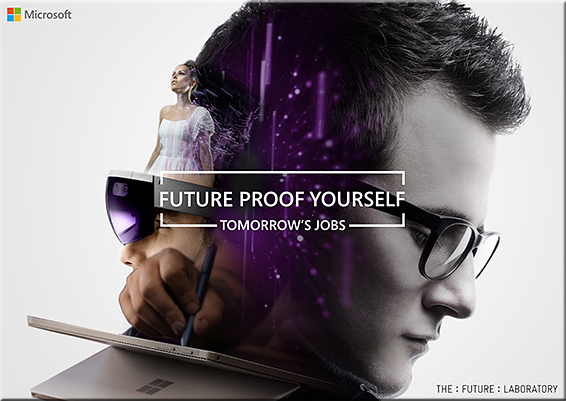
Future proof yourselves — from Microsoft & The Future Laboratory
Excerpt (emphasis DSC):
Executive Summary
Explore the world of work in 2025 in a revealing evidence-based report by future consultants The Future Laboratory and Microsoft, which identifies and investigates ten exciting, inspiring and astounding jobs for the graduates of tomorrow – but that don’t exist yet.
Introduction
Tomorrow’s university graduates will be taking a journey into the professional unknown guided by a single, mind-blowing statistic: 65% of today’s students will be doing jobs that don’t even exist yet.
Technological change, economic turbulence and societal transformation are disrupting old career certainties and it is increasingly difficult to judge which degrees and qualifications will be a passport to a well-paid and fulfilling job in the decades ahead.
A new wave of automation, with the advent of true artificial intelligence, robots and driverless cars, threatens the future of traditional jobs, from truck drivers to lawyers and bankers.
But, by 2025, this same technological revolution will open up inspiring and exciting new career opportunities in sectors that are only in their infancy today.
The trick for graduates is to start to develop the necessary skills today in order to ensure they future proof their careers.
This report by future consultants The Future Laboratory attempts to show them how to do just that in a research collaboration with Microsoft, whose Surface technology deploys the precision and versatility of pen and touch to power creative industries ranging from graphic design and photography to architecture and engineering.
In this study, we use extensive desk research and in-depth interviews with technologists, academics, industry commentators and analysts to unveil 10 new creative job categories that will be recruiting tomorrow’s university students.
These future jobs demonstrate a whole new world of potential applications for the technology of today, as we design astonishing virtual habitats and cure deadly diseases from the comfort of our own sofas. It is a world that will need a new approach to training and career planning.
Welcome to tomorrow’s jobs…
65% of today’s students will be doing jobs that don’t even exist yet.
One of the jobs mentioned was the Ethical Technology Advocate — check out this video clip:

“Over the next decade, the long-awaited era of robots will dawn and become part of everyday life. It will be important to set out the moral and ethical rules under which they operate…”
On 06/29/2016,
in 24x7x365 access, A/V -- audio/visual, change, communications, digital learning, digital storytelling, health, hearts -- matters of the heart, higher education, human-computer interaction (HCI), ideas, immersion, innovation, journalism, learning, learning ecosystem, platforms, psychology, relationships, research, society, story, storytelling, surviving, United States, universities, user experience (UX), virtual field trips, Virtual Reality (VR) / worlds / learning,
by Daniel Christian
Stanford’s virtual reality lab cultivates empathy for the homeless — from kqed.org by Rachael Myrow

Excerpt:
The burgeoning field of Virtual Reality — or VR as it is commonly known — is a vehicle for telling stories through 360-degree visuals and sound that put you right in the middle of the action, be it at a crowded Syrian refugee camp, or inside the body of an 85-year-old with a bad hip and cataracts. Because of VR’s immersive properties, some people describe the medium as “the ultimate empathy machine.” But can it make people care about something as fraught and multi-faceted as homelessness?
A study in progress at Stanford’s Virtual Human Interaction Lab explores that question, and I strapped on an Oculus Rift headset (one of the most popular devices people currently use to experience VR) to look for an answer.
A new way of understanding homelessness
The study, called Empathy at Scale, puts participants in a variety of scenes designed to help them imagine the experience of being homeless themselves.
On 06/15/2016,
in 21st century, 3D, A/V -- audio/visual, Artificial Intelligence/Agents/LLMs/and Related, attention, communications, digital audio, digital learning, digital storytelling, digital video, education technology, emerging technologies, engagement / engaging students, higher education, history, human-computer interaction (HCI), ideas, innovation, intelligent systems, intelligent tutoring, interaction design, interactivity, learning ecosystem, Microsoft, Mixed Reality (MR), platforms, story, storytelling, United States, universities, user experience (UX),
by Daniel Christian
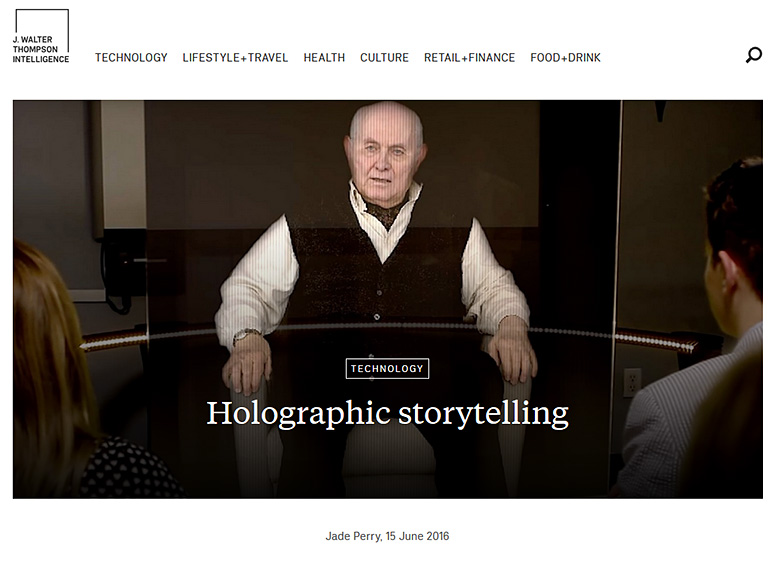
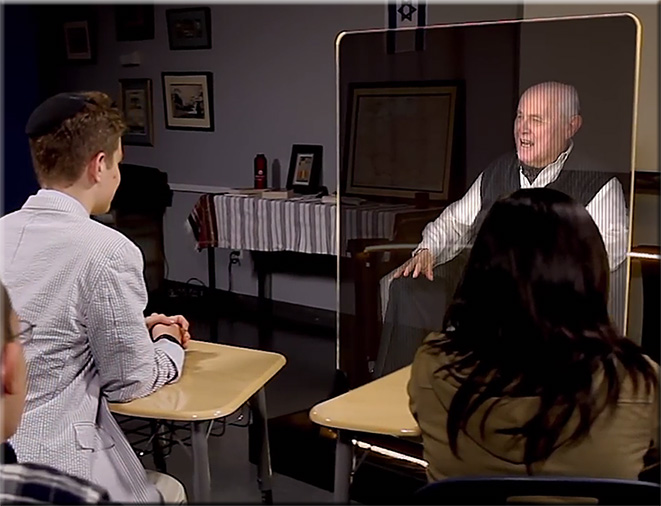
Holographic storytelling — from jwtintelligence.com by Jade Perry
Excerpt (emphasis DSC):
The stories of Holocaust survivors are brought to life with the help of interactive 3D technologies.
‘New Dimensions in Testimony’ is a new way of preserving history for future generations. The project brings to life the stories of Holocaust survivors with 3D video, revealing raw first-hand accounts that are more interactive than learning through a history book.
Holocaust survivor Pinchas Gutter, the first subject of the project, was filmed answering over 1000 questions, generating approximately 25 hours of footage. By incorporating natural language processing from Conscience Display, viewers were able to ask Gutter’s holographic image questions that triggered relevant responses.
From DSC:
I wonder…is this an example of a next generation, visually-based chatbot*?
With the growth of artificial intelligence (AI), intelligent systems, and new types of human computer interaction (HCI), this type of concept could offer an on-demand learning approach that’s highly engaging — and accessible from face-to-face settings as well as from online-based learning environments. (If it could be made to take in some of the context of a particular learner and where a learner is in the relevant Zone of Proximal Development (via web-based learner profiles/data), it would be even better.)
As an aside, is this how we will obtain
customer service from the businesses of the future? See below.
*The complete beginner’s guide to chatbots — from chatbotsmagazine.com by Matt Schlicht
Everything you need to know.
Excerpt (emphasis DSC):
What are chatbots? Why are they such a big opportunity? How do they work? How can I build one? How can I meet other people interested in chatbots?
These are the questions we’re going to answer for you right now.
…
What is a chatbot?
A chatbot is a service, powered by rules and sometimes artificial intelligence, that you interact with via a chat interface. The service could be any number of things, ranging from functional to fun, and it could live in any major chat product (Facebook Messenger, Slack, Telegram, Text Messages, etc.).
…
A chatbot is a service, powered by rules and sometimes artificial intelligence, that you interact with via a chat interface.
Examples of chatbots
Weather bot. Get the weather whenever you ask.
Grocery bot. Help me pick out and order groceries for the week.
News bot. Ask it to tell you when ever something interesting happens.
Life advice bot. I’ll tell it my problems and it helps me think of solutions.
Personal finance bot. It helps me manage my money better.
Scheduling bot. Get me a meeting with someone on the Messenger team at Facebook.
A bot that’s your friend. In China there is a bot called Xiaoice, built by Microsoft, that over 20 million people talk to.
On 05/19/2016,
in adjunct faculty, colleges, community colleges, creativity, digital audio, digital learning, digital photography, digital storytelling, digital video, experimentation, faculty/staff, media/film, pedagogy, project-based learning, story, storytelling, teachers, teaching & learning, writing,
by Daniel Christian
Teaching while learning: What I learned when I asked my students to make video essays — from chronicle.com by Janine Utell, Professor of English at Widener University
Excerpt:
This is not exactly a post about how to teach the video essay (or the audiovisual essay, or the essay video, or the scholarly video). At the end I share some resources for those interested in teaching the form: the different ways we might define the form, some of the theoretical/conceptual ideas undergirding the form, how it allows us to make different kinds of arguments, and some elements of design, assignment and otherwise.
What I’m interested in here is reflecting on what this particular teaching moment has taught me. It’s a moment still in progress/process. These reflections might pertain to any teaching moment where you’re trying something new, where you’re learning as the students are learning, where everyone in the room is slightly uncomfortable (in a good, stretching kind of way), where failure is possible but totally okay, and where you’re able to bring in a new interest of your own and share it with the students.
…
Take two: I tried this again in an upper-level narrative film course, and the suggestions made by students in the previous semester paid off. With the additional guidance, students felt comfortable enough being challenged with the task of making the video; a number of them shared that they liked having the opportunity to learn a new skill, and that it was stimulating to have to think about new ways of making choices around what they wanted to say. Every step of realizing their storyboard and outline required some problem-solving, and they were able to articulate the work of critical thinking in surprising ways (I think they themselves were a little surprised, too).
…
Some resources on the video essay/scholarly video:
- “How to Make Video Essays: Resources for Teachers and Students,” by Catherine Grant, The Audiovisual Essay
- “Teaching the Scholarly Video,” by Christian Keathley, Frames Cinema Journal
- “On the Origin of the Video Essay,” by John Bresland, Blackbird: An Online Journal of Literature and Arts
- “Resources: [in]Transition,” A MediaCommons/Cinema Journal Project
From DSC:
A couple of comments that I wanted to make here include:
- I greatly appreciate Janine’s humility, her wonderful spirit of experimentation, and her willingness to learn something right along with her students. She expressed to her students that she had never done this before and that they all were learning together. She asked them for feedback along the way and incorporated that feedback in subsequent attempts at using this exercise. Students and faculty members need to realize/acknowledge/accept that few people know it all these days — experts are a dying breed in many fields, as the pace of change renders it thus.
.
- Helping students along with their new media literacy skills is critical these days. Janine did a great job in this regard! Unfortunately, she is in an enormous minority. I run a Digital Studio on our campus, and so often I enter the room with dismay…a bit of sorrow creeps back into me again, as too many times our students are not learning some of the skills that will serve them so well once they graduate (not to mention how much they would benefit from being able to craft multimedia-based messages and put such messages online in their studies while in college). Such skills will serve students well in whatever future vocation they go into. Knowing some of the tools of the trade, working with digital audio and video, storyboarding, working with graphics, typography, and more — are excellent skills and knowledge to have in order to powerfully communicate one’s message.
On 04/22/2016,
in 3D, career development, cloud-based computing / apps / other cloud-related, education technology, engagement / engaging students, K-12 related, learning, productivity / tips and tricks, reading, story, student-related, tools, vendors, writing,
by Daniel Christian
4 writing apps to help students conquer the blank page — from geiendorsed.com by Lani Aquino
When writer’s block strikes, these 4 apps can get students back on track.
Excerpt:
Staring at a blank page can be daunting. Add a reluctant writer to the mix, and what should be a great opportunity for personal expression becomes a personal nightmare. These 4 apps will strengthen students’ writing skills and turn written composition from a chore into an engaging learning activity.
6 key apps to develop kids’ reading fluency — from educatorstechnology.com
Excerpt:
Below is a collection of some very good iPad apps to use with your kids and young learners to help them develop their reading fluency. The apps provide a wide variety of reading materials that include interactive stories, engaging activities and games, quizzes and many more. And because reading is a composite skill, using these apps will also enable kids to practice a number of key subskills related to reading including: pronunciation, vocabulary, phonics, word recognition, and spelling. Check them out and share with us your feedback. Enjoy.
Microsoft Announces Minecraft: Education Edition Beta, Release — from educationnews.org
Excerpt:
Microsoft has announced beta testing of Minecraft: Education Edition, which is the company’s education-focused suite for Minecraft that integrates tools for teachers and students to help them use the game more effectively in the classroom.
The education-centered offshoot of was first revealed in January of this year. This May, a closed beta of the game will involve more than 100 schools in 30 countries, reports Pradeep of MS Power User. By June, any school will be able to access the Education Edition for free as long as teachers have a fully updated operating system and an Office 365 Education account. Eventually, Microsoft plans to charge $5 per user each year.
Minecraft: Education Edition is specifically tailored to teach the skills that Minecraft cultivates – namely collaboration, navigation, social skills, and empathy.
Cool Tool | Schoold App — from edtechdigest.wordpress.com
Excerpt:
High school students take note: here’s a cool tool in the form of an app. The free app runs on iOS and Android and just got launched last month pulling almost 5 out of 5 stars after several thousand reviews. For the 20 million college-bound students and 30 million parents, we know you’re drowning in a sea of data scattered all over for the more than 4,000 U.S. colleges and universities. So, Schoold is like Zillow for college hunting – or perhaps match.com for students and universities. It’s a one-stop-shop for everything you need to know, want to know, and have to line up.
15 of the best educational apps for improved reading comprehension — from teachthought.com
Excerpt:
Reading comprehension is a matter of decoding, reading speed, and critical thinking about the text, all of which can improve with tiered practice. (See 50 apps for struggling readers.)
So below, in an order of general complexity, are 15 apps for improved reading comprehension, ranging from word and sentence fluency, to recall, to critical thinking skills, to reading speed.
By the nature of reading and literacy progress, most are indeed for K-5 and SLP, but the latter apps, especially Reading Trainer, Compare Twist, and Enchanted Dictionary, can be used through high school in the right context. Let us know on our facebook page what we missed.
The 5 best new 3D tools for April — from creativebloq.com by Rob Redman
We select the best new tools for 3D and VFX artists this month.
Excerpt:
This time of year can often be a quiet one for those of us working in 3D art and visual effects, with developers gearing up for the events season and new releases being a bit thin on the ground.
However there are a few notable updates and newcomers, so have a read below to see what could help you improve your work or help you be more efficient.

Addendum on 4/25/16:
- Recommended Music Apps for Kids — from balefirelabs.com
On 04/06/2016,
in 21st century, A/V -- audio/visual, assessment, blogs / blogging / vlogging, cloud-based computing / apps / other cloud-related, CMS/LMS, collaboration, digital storytelling, e-publishing related items (EPUB and more), e-readers, education technology, Google, K-12 related, learning ecosystem, mathematics, Microsoft, mobile learning, mobile technologies, music, open courseware and systems, platforms, productivity / tips and tricks, story, storytelling, teachers, teaching & learning, technologies for your home, tools, vendors, web-based collaboration, writing,
by Daniel Christian
20 awesome BYOD and mobile learning apps — from edutopia.org by Vicki Davis; updated 2/4/16
Excerpt:
We have now been Bring Your Own Device (BYOD) for three years, and boy, do the students bring it. They bring it all! We have iPads, Surface, iPhones, Droids, Chromebooks, Macs, and PC laptops. Here’s my current thinking.
7 best Google apps and tools — from interestingengineering.com
- Google Keep
- Google Scholar
- Gmailify
- Google Lego
- Google Mars
- Google Developers
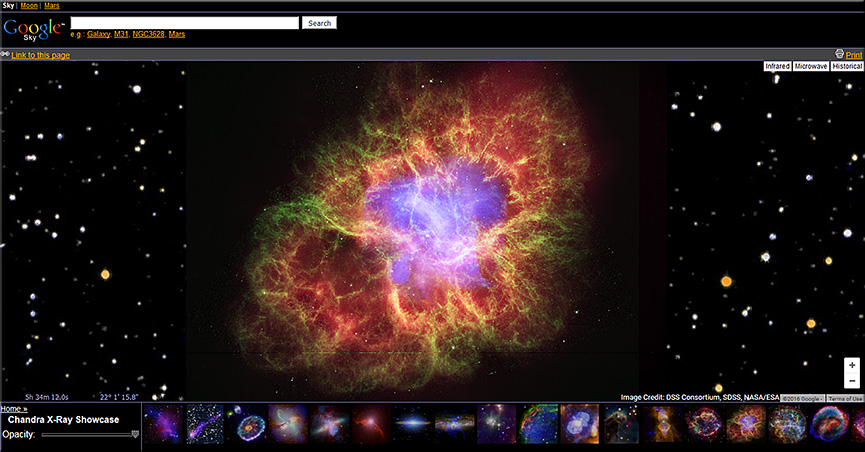
- Google Sky
Excerpt:
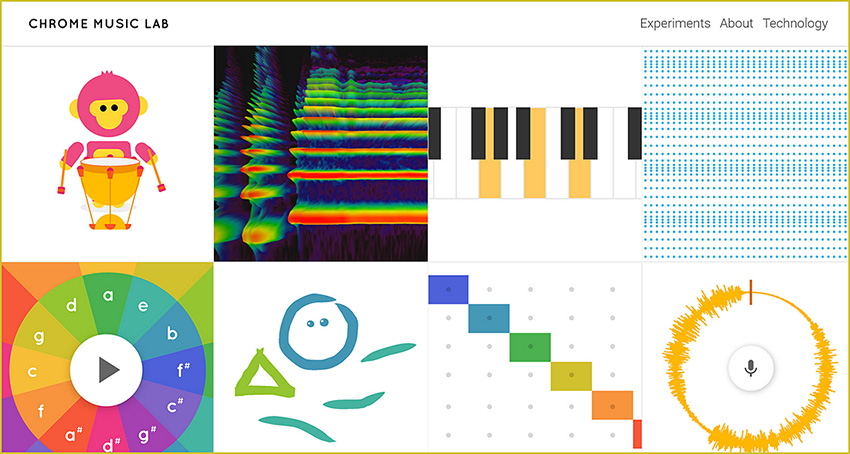
Music is for everyone. So this year for Music In Our Schools month, we wanted to make learning music a bit more accessible to everyone by using technology that’s open to everyone: the web. Chrome Music Lab is a collection of experiments that let anyone, at any age, explore how music works. They’re collaborations between musicians and coders, all built with the freely available Web Audio API. These experiments are just a start. Check out each experiment to find open-source code you can use to build your own.
My challenge to you – 8 things all teachers should learn about #edtech — from ictevangelist.com by Mark Anderson
Excerpt:
I love the School Report scheme that the BBC run via Newsround. We all remember the Newsrounds of our youth. For me it was John Craven who made me watch it whenever it was on. It was this report I saw recently on eight things teachers should learn, which got me thinking about eight things I thought teachers should learn about edtech.
My work sees me regularly helping teachers learn different things related to the use of technology and so in this post, I’m going to talk about the eight things I think teachers should learn with #edtech to help support their use of technology to enhance learning in the classroom.
Mark mentions: Google, Padlet, Kahoot, Socrative, Camera, Microphone, Twitter, Videoconferencing software
Quiz accommodations for students in Canvas and Moodle — from thejournal.com by Emmett Dulaney03/16/16
Excerpt:
As we move toward interacting more with students who have an individualized education program (IEP) indicating that they need additional time on tests and quizzes or just need to deal with life issues, it is imperative that the learning management system (LMS) depended upon by an instructor and student alike be properly configured for such accommodations. Canvas and Moodle are currently two of the most popular learning management systems, and both offer the ability to make adjustments to quiz functions within the course without compromising the overall structure of the course. In this article, we will examine how to do so and offer some tips on situations where they are relevant.
Use these Chrome apps to unleash students’ creativity — from educatorstechnology.com
Excerpt:
[The] Chrome web store is packed full of all kinds of educational apps and extensions some of which are also integrated with Google Drive. For those of you looking for a handy resource of Chrome apps to use with students in class, check out this comprehensive chart. In today’s post we are sharing with you a collection of some practical Chrome extensions to unleash learners creativity. Using these resources, students will be able to engage in a number of creative literacy activities that will allow them to multimodally communicate their thoughts, share their ideas and develop new learning skills.
Integrating technology and literacy — from edutopia.org by Frank Ward
Excerpt:
How do you work technology into the pedagogy, instead of just using something cool? That task can be especially daunting in language arts literacy classrooms where reading and writing skill development is the crux of daily lessons. However, as 1:1 technology initiatives roll out, integrating technology into the classroom is our reality.
With hundreds of sites, apps, Chrome extensions, and platforms available, choosing the right ones can seem overwhelming. As an eighth-grade language arts teacher, I’ve experienced this myself. Following are four tools that can help provide immediate formative assessment data as well as top-of-the-rotation feedback to help students develop personal learning goals.
If, like my school, you’re in a “Chromebook District,” these suggested tools will work well because all integrate perfectly when you sign in with your Google ID, limiting the need for multiple passwords. This saves a lot of student confusion, too.
Teachers are using theater and dance to teach math — and it’s working — from washingtonpost.com by Moriah Balingit
Excerpt:
This giggly play session actually was a serious math lesson about big and small and non-standard measurements. Dreamed up by Richardson and kindergarten teacher Carol Hunt, it aims to get the children to think of animal steps as units of measurement, using them to mark how many it takes each animal to get from a starting line to the target.
Teachers call such melding of art and traditional subjects “art integration,” and it’s a new and increasingly popular way of bringing the arts into the classroom. Instead of art as a stand-alone subject, teachers are using dance, drama and the visual arts to teach a variety of academic subjects in a more engaging way.
Some older items include:
Tech Tip: Using Nearpod for math instruction — from smartblogs.com
Storytelling app a hit; launches a new chapter in transmedia — from blogs.vancouversun.com
Excerpt:
Paul Pattison and Luke Minaker knew they were onto something when they got an email from the mother of a nine-year-old who read the first instalment of their interactive story, Weirdwood Manor.
“She wrote that she couldn’t get her son to pick up a book,” said Pattison, technical director of All Play No Work, producer of the iPad app. “She got the app for her son and he went through it in two nights. He finished both books.
“And then because we don’t have book 3 out yet, unprompted by her he went over to the bookshelf and pulled off a paperback and started reading chapter books again.”
.

On 03/17/2016,
in art, digital learning, digital storytelling, drama/theater, emerging technologies, engagement / engaging students, Europe, innovation, media/film, society, story, storytelling, user experience (UX), Virtual Reality (VR) / worlds / learning,
by Daniel Christian
The world’s first virtual reality cinema has opened in Amsterdam — from springwise.com
The VR Cinema gives movie-goers an immersive experience via Samsung Gear VR, headphones, and 360 degree chairs.
Excerpt:
At the beginning of this month, the world’s first VR Cinema opened in Amsterdam.
The idea originated as a pop-up cinema touring cities in the Netherlands, Germany and Switzerland. Unlike a traditional cinema, the theatre uses Samsung Gear VR, combined with a Samsung Galaxy S6 and a 360 degree chair to allow people to look around freely through the film. This is combined with immersive headphones to give a full VR experience to those watching the films.
Now showing:
- In Your Face (&samhoud media, 2016)
Barely containing our excitement, we present Europe’s first feature film in virtual reality in world’s first VR cinema! In Your Face is a production of director Jip Samhoud and was written by renowned Dutch author Ronald Giphart. The film explores the moral dilemma that the ongoing refugee crisis brings along: to what extent would you really take action and help? This is the question that award-winning actors Hadewych Minis and Tibor Lukács encounter when a TV show drops off a Syrian refugee unannounced. What would you do?
Addendum on 3/17/16:
- Sky Announces Virtual Reality Production Studio — from vrguru.com by Constantin Sumanariu
Excerpt:
European pay TV giant Sky has launched a Virtual Reality production unit, Sky VR Studio, as it steps up its commitment to VR programming. The first pieces of fully-immersive VR content to be produced by the unit will be released on Friday — two films shot during Formula One testing in Barcelona, which will put viewers in the pit lane, the team garages and out onto the track.
On 02/03/2016,
in active learning, adjunct faculty, attention, blended learning, blogs / blogging / vlogging, change, curriculum, digital learning, digital video, engagement / engaging students, faculty/staff, flipping -- inverted learning, hybrid learning, ideas, Michigan, pedagogy, social learning / networks, social media, STEAM-related, story, storytelling, student teaching/teacher education, student-related, teachers, United States,
by Daniel Christian
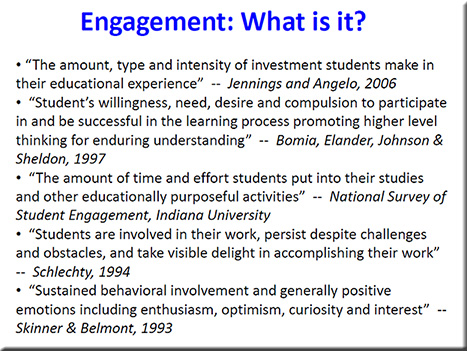
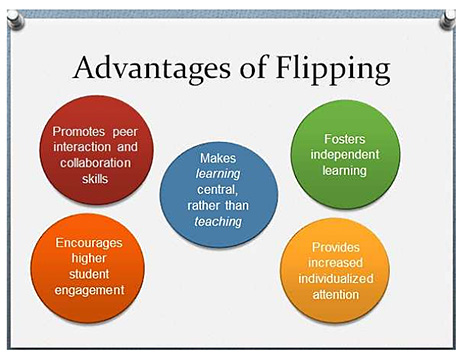
Example slides from one of the presentations at the Flipped Classroom Conference 2016
[Held at Harvey Mudd College in January; with special thanks to Mr. Jeremy VanAntwerp,
Professor of Engineering at Calvin College for this resource]
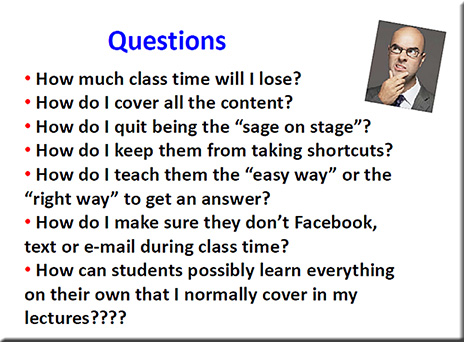
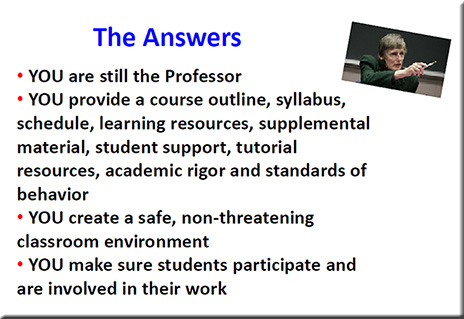
Three reasons for switching to flipped learning — from rtalbert.org by Robert Talbert, Mathematics Professor at Grand Valley State University in Michigan [USA]
Excerpt:
- The argument from pedagogy: We use flipped learning because it puts the best-known/best-available practices for teaching and learning in the spotlight, including active learning of all kinds, student-centered instruction, constructivist techniques, differentiated instruction, spaced repetition, Vygotsky’s zone of proximal development idea, self-regulated learning, and the like. Whereas these things can be featured in a traditional classroom but it feels unnatural, like the wrong tool for the job.
- The argument from logistics…
- The argument from relationships…
Peer instruction for active learning — by Harvard University Prof. Eric Mazur on difficulties of beginners, teaching each other, and making sense of information

Also see Eric’s presentation out at Auburn University from back in September 2014:
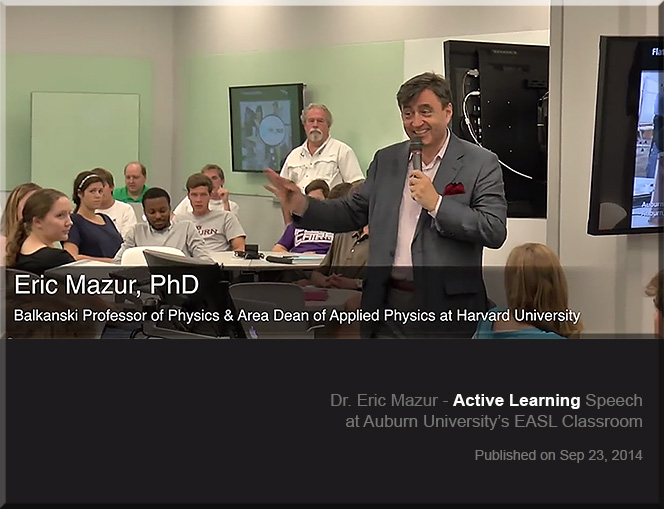
Why are we so slow to change the way we teach? — from facultyfocus.com by Maryellen Weimer, PhD
Excerpt:
However, lecture isn’t the only example of where we’re slow to change. Many aspects of teaching—course design, approaches to testing, assignments, and grading—have also changed little. Granted, some faculty do change, a lot and regularly, but not the majority. The question is, “Why?” Here are some possibilities I’ve been considering.
Crafting questions that drive projects — from learninginhand.com by Tony Vincent
Excerpt:
Not only does project based learning motivate students because it is an authentic use of technology, it facilitates active learning, critical thinking, collaboration, and creativity. Projects begin with a driving question—an open-ended question that sets the stage for the project by creating interest and curiosity. Writing an effective driving question is surprisingly challenging. You want the question to be intriguing and irresistible to students, which makes it very different from the typical questions they encounter on tests.
A Driving Force
Like many educators, I call the “mission statement” of a project a driving question. It captures the heart of the project by providing purpose using clear and compelling language. With so many different flavors of project based learning (including problem based learning, challenge based learning, student centered learning, exploration, student driven inquiry, and authentic learning), it’s not surprising that we have a variety of other terms for a question or statement that is the project’s driving force. These terms include essential question, challenge, prime question, WILD HOG question, focus question, and smart question. I’ll stick with driving question, but do know that sometimes the driving question is not interrogative. It might be a statement, but I’ll still refer to is as a question.

Literacy help: Alan Peat story bags – How to develop story writing and literacy skills in younger children. — from hubpages.com
Excerpt:
There is no getting away from the fact that the more a child has been read to and the more they try to read themselves then the better their literacy skills are going to be. Parents have a massive influence on this. As a parent myself I considered reading to and teaching my daughter to read the one most important thing I could do to aid her life at school.
Sadly this is not always the case and too many students we teach read rarely at home or in rare cases don’t even own a book. Sad I know and to be honest I can’t imagine a house without books in it. I jokingly refer to my daughters collection ‘her library’ because she has so many which are updated as she reads through them.
But lets be fair, it is not only the students who struggle with reading that need help with story writing. A lot of students will benefit from this approach including your high flyers. I have taught this in year 3, although i would consider it to be more a KS1 activity, but in year 3 they do need certain aspects of a KS1 curriculum to help there development as it is a hard transitional year. Saying that I have seen other teachers use it in higher years than that and why not if it will benefit their writing.
…
On the front of each bag, so every child can read it easily should be the questions:
- Who?
- Where?
- Where next?
- Why?
- What goes wrong?
- Who helps?
- Where last?
- Feelings?

Simple tips to create a blended learning classroom — from blog.edmentum.com by Jasmine Auger
Excerpt:
We’ve compiled this list of five easy ways to start incorporating technology into your classroom and building a blended environment!
Blogging
Social Media
Virtual Presentations
Infographics
Video
Other somewhat related items:
Full STEAM ahead: Why arts are essential in a STEM education — from edutopia.org by Mary Beth Hertz
Excerpt:
The connection is also obvious for anyone who has ever worked in any traditional STEM career. Everyone from software engineers and aerospace technicians to biotechnical engineers, professional mathematicians, and laboratory scientists knows that building great things and solving real problems requires a measure of creativity. More and more, professional artists themselves are incorporating technological tools and scientific processes to their art.
Also see:
STEM to STEAM: Resources Toolkit — from edutopia.org | Originally Published: 5/21/14 | Updated: 1/20/16
Whether you are looking for resources on integrating science, technology, engineering, and math or on infusing the arts to transform STEM into STEAM, these curated compilations will help you plan different approaches to integrated studies.
…and a related item re: curriculum, but at the collegiate level:
What is the value of an education in the humanities? — from npr.org by Adam Frank
Excerpt:
In spite of being a scientist, I strongly believe an education that fails to place a heavy emphasis on the humanities is a missed opportunity. Without a base in humanities, both the students — and the democratic society these students must enter as informed citizens — are denied a full view of the heritage and critical habits of mind that make civilization worth the effort.
…
So, these are my traditional answers to the traditional questions about the value of humanities and arts education vs. science and engineering. From my standpoint as a scholar, I’ll stand by them and defend what they represent to the last breath.
But the world has changed and, I believe, these answers are no longer enough.
It’s not just the high cost of college that alters the equation. It’s also vast changes that have swept through society with the advent of a world run on information (i.e., on data). So, with that mind, here is my updated — beyond the traditional — response to the value of the humanities in education: The key is balance.
It is no longer enough for students to focus on either science/engineering or the humanities/arts.
On 11/16/2015,
in 21st century, accessibility / UDL, Augmented Reality (AR), digital storytelling, engagement / engaging students, Europe, story, storytelling,
by Daniel Christian
Augmented reality: A great story triggers the mind — from arjenvanberkum.nl by Arjen van Berkum
Excerpts:
Augmented reality brings learning to life. Augmented reality enriches a live view of a real-life environment – the so called reality – with computer-generated input, that can consist out of sound, graphics, text, video, and GPS information. In other words, AR provides us with an enhanced view of the real world.
…
As Gaia Dempsey, Managing Director of DAQRI International, explains, “80% of the information that the brain takes is visual. So by providing information in a visual medium that also has the spatial nature of augmented reality, you’re giving the brain a very intuitive way of accessing knowledge.”
On 11/03/2015,
in 3D, A/V -- audio/visual, animation, Apple, cloud-based computing / apps / other cloud-related, digital storytelling, e-publishing related items (EPUB and more), education technology, educational games / serious games, innovation, interactivity, multimedia, new media literacies, participation, reading, story, storytelling, writing, youth,
by Daniel Christian
Storytelling app a hit; launches a new chapter in transmedia — from blogs.vancouversun.com by Gillian Shaw
Excerpt (emphasis DSC):
Paul Pattison and Luke Minaker knew they were onto something when they got an email from the mother of a nine-year-old who read the first instalment of their interactive story, Weirdwood Manor.
“She wrote that she couldn’t get her son to pick up a book,” said Pattison, technical director of All Play No Work, producer of the iPad app. “She got the app for her son and he went through it in two nights. He finished both books.
“And then because we don’t have book 3 out yet, unprompted by her he went over to the bookshelf and pulled off a paperback and started reading chapter books again.”
While the storytelling app had already shot to ‘Best New App’ in Apple’s app store, chalking up 5,000 downloads in the first two weeks after it was released, the realization that it converted a reluctant nine-year-old to an avid reader confirmed for Pattison and Minaker they were on the right track.
“It is a common theme we have been hearing,” said Pattison. “They get to this age range of eight to 12 and they stop being interested in reading. Video games, Snapchat – all these other things dominate.
“Although we’re an app in digital, what we really wanted to do is re-engage kids in reading, tap into their imagination, have them rediscover that.”