Speaking of higher education…

Higher Ed in 4 charts — from jeffselingo-14576223.hs-sites.com by Jeff Selingo

  1. We’ve reached the peak of high-school graduates.
  2. The colleges in the best financial shape educate only 600,000 students. 
  3. and two others…
 

ILTACON 2024: Selling legal tech’s monorail — from abajournal.com by Nicole Black

The bottom line: The promise of GenAI for our profession is great, but all signs point to the realization of its potential being six months out or more. So the question remains: Will generative AI change the legal landscape, ushering in an era of frictionless, seamless legal work? Or have we reached the pinnacle of its development, left only with empty promises? I think it’s the former since there is so much potential, and many companies are investing significantly in AI development, but only time will tell.


From LegalZoom to AI-Powered Platforms: The Rise of Smart Legal Services — from tmcnet.com by Artem Vialykh

In today’s digital age, almost every industry is undergoing a transformation driven by technological innovation, and the legal field is no exception. Traditional legal services, often characterized by high fees, time-consuming processes, and complex paperwork, are increasingly being challenged by more accessible, efficient, and cost-effective alternatives.

LegalZoom, one of the pioneers in offering online legal services, revolutionized the way individuals and small businesses accessed legal assistance. However, with the advent of artificial intelligence (AI) and smart technologies, we are witnessing the rise of even more sophisticated platforms that are poised to reshape the legal landscape further.

The Rise of AI-Powered Legal Platforms
AI-powered legal platforms represent the next frontier in legal services. These platforms leverage the power of artificial intelligence, machine learning, and natural language processing to provide legal services that are not only more efficient but also more accurate and tailored to the needs of the user.

AI-powered platforms offer many advantages, with one of them being their ability to rapidly process and analyze large amounts of data quickly. This capability allows them to provide users with precise legal advice and document generation in a fraction of the time it would take a human attorney. For example, AI-driven platforms can review and analyze contracts, identify potential legal risks, and even suggest revisions, all in real-time. This level of automation significantly reduces the time and cost associated with traditional legal services.


AI, Market Dynamics, and the Future of Legal Services with Harbor’s Zena Applebaum — from geeklawblog.com by Greg Lambert

Zena talks about the integration of generative AI (Gen AI) into legal research tools, particularly at Thomson Reuters, where she previously worked. She emphasizes the challenges in managing expectations around AI’s capabilities while ensuring that the products deliver on their promises. The legal industry has high expectations for AI to simplify the time-consuming and complex nature of legal research. However, Applebaum highlights the need for balance, as legal research remains inherently challenging, and overpromising on AI’s potential could lead to dissatisfaction among users.

Zena shares her outlook on the future of the legal industry, particularly the growing sophistication of in-house legal departments and the increasing competition for legal talent. She predicts that as AI continues to enhance efficiency and drive changes in the industry, the demand for skilled legal professionals will rise. Law firms will need to adapt to these shifts by embracing new technologies and rethinking their strategies to remain competitive in a rapidly evolving market.


Future of the Delivery of Legal Services — from americanbar.org
The legal profession is in the midst of unprecedented change. Learn what might be next for the industry and your bar.


What. Just. Happened? (Post-ILTACon Emails Week of 08-19-2024) — from geeklawblog.com by Greg Lambert

Here’s this week’s edition of What. Just. Happened? Remember, you can track these daily with the AI Lawyer Talking Tech podcast (Spotify or Apple) which covers legal tech news and summarizes stories.


From DSC:
And although this next one is not necessarily legaltech-related, I wanted to include it here anyway — as I’m
always looking to reduce the costs of obtaining a degree.

Improve the Diversity of the Profession By Addressing the Costs of Becoming a Lawyer — from lssse.indiana.edu by Joan Howarth

Not surprisingly, then, research shows that economic assets are a significant factor in bar passage. And LSSSE research shows us the connections between the excessive expense of becoming a lawyer and the persistent racial and ethnic disparities in bar passage rate.

The racial and ethnic bar passage disparities are extreme. For example, the national ABA statistics for first time passers in 2023-24 show White candidates passing at 83%, compared to Black candidates (57%) with Asians and Hispanics in the middle (75% and 69%, respectively).

These disturbing figures are very related to the expense of becoming a lawyer.

Finally, though, after decades of stability — or stagnation — in attorney licensing, change is here. And some of the changes, such as the new pathway to licensure in Oregon based on supervised practice instead of a traditional bar exam, or the Nevada Plan in which most of the requirements can be satisfied during law school, should significantly decrease the costs of licensure and add flexibility for candidates with responsibilities beyond studying for a bar exam.  These reforms are long overdue.


Thomson Reuters acquires Safe Sign Technologies — from legaltechnology.com by Caroline Hill

Thomson Reuters today (21 August) announced it has acquired Safe Sign Technologies (SST), a UK-based startup that is developing legal-specific large language models (LLMs) and as of just eight months ago was operating in stealth mode.


From DSC:
On a macro scale…this is on my heart these days.

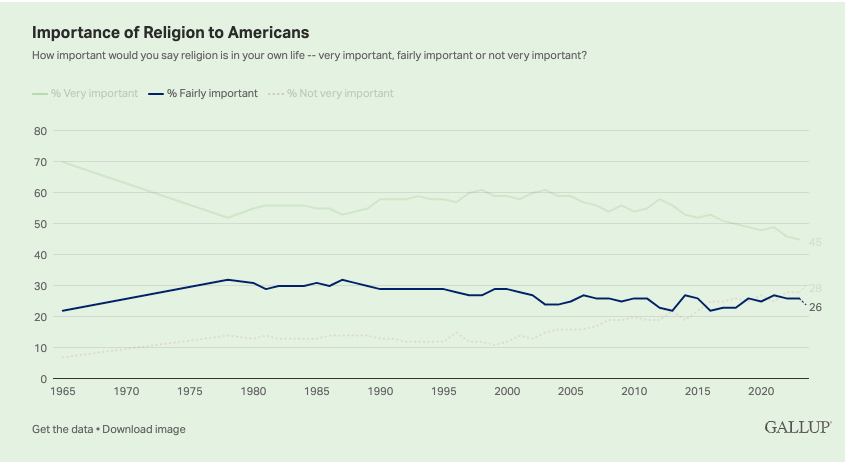
I ran across some troubling but informative items re: religion in America from item #5 at Rex Woodbury’s 10 Charts That Capture How the World Is Changing:

  • How Religious Are Americans? — from news.gallup.com
    • The long-term decline in church attendance is linked to a drop in religious identification in general — particularly for Protestant religions — but also to decreasing weekly attendance among U.S. Catholics.
    • Steep Decline in U.S. Church Membership
      Additionally, less than half of Americans, 45%, belong to a formal house of worship. Church membership has been below the majority level each of the past four years. When Gallup first asked the question in 1937, 73% were members of a church, and as recently as 1999, 70% were. The decline in formal church membership has largely been driven by younger generations of Americans. Slightly more than one-third of U.S. young adults have no religious affiliation. Further, many young adults who do identify with a religion do not belong to a church. But even older adults who have a religious preference are less likely to belong to a church today than in the past.

.

I’ve known about this decline for years now, but Rex’ posting and graphs were disheartening nonetheless. And Samuel Abrams’ article contains many reflections that I’ve had as well.

The Christian journey is about transformation — our hearts and minds are changed so that we become more like Jesus Christ (the pioneer and perfecter of [our] faith, per Hebrews 12:2). This transformation involves how we see and experience the world as well as how we are supposed to treat others. We receive new “glasses” if you will — new lenses on the world. In fact, Jesus said in Matthew 22:37-40:

37 Jesus replied: “‘Love the Lord your God with all your heart and with all your soul and with all your mind.’ 38 This is the first and greatest commandment. 39 And the second is like it: ‘Love your neighbor as yourself.’ 40 All the Law and the Prophets hang on these two commandments.”

So Christians are taught to love our neighbors. I/we mess up on this constantly, but many of us are trying to get better at it.

But what happens when we don’t love — or even care for/about — our neighbor? Do you know that if you are living in the United States right now, you are already feeling and experiencing the impact of this in an enormous way?

Here are a few ways that you can see this playing out — even from a secular/business standpoint:

  • Numerous businesses don’t care at all if their products harm you, your family, or your future. For example, food companies don’t care if their products aren’t good for you — they just want your repeat business. They are concerned FAR more about Wall Street and their shareholders than about your health. With knowing that I am a chief sinner, I could also point to those businesses pushing marijuana/cannabis (especially right next to universities and colleges), cigarettes, gambling, and others. There are some dubious folks within the healthcare and pharmaceutical industries as well.
  • Many businesses lie to you when you call into their 800 #’s and they tell you that they care about you and your business. Again we see that they greatly appreciate your money, but they really don’t care about you or your time. They often put you in a long queue.  The worst voice response units are programmed to make it extremely difficult — if not impossible — to let you talk to a live person.
  • Many businesses have embarked on the shrinkification of their products: offering smaller amounts but charging the same.
  • Many businesses don’t care if our youth are being negatively impacted (social media companies may come to some peoples’ minds. Disclaimer: I use Twitter/X and LinkedIn frequently).
  • Many businesses don’t care if their technologies are beneficial to society. They don’t stop to think about whether they should design and produce their products…just whether or not they can. Little to no wisdom is being displayed here.
  • …and I — and you — could list many more here.

So you and I are already being impacted when we push God out of our lives and out of our institutions. When we Americans look around these days..how’s that going for us? In my own life, the further I get away from God, the worse things get.

Also, we could talk about mental health*, shootings in our schools and on our streets, and several other things.

Do we care? I do. I think about this kind of thing more and more these days. LORD, forgive us. We need your help.

* I realize that Christians can struggle with mental health too
 

Some of the Best Online Learning Games for Kids — from nytimes.com by Courtney Schley

If you’re looking for apps and games that not only keep young kids occupied but also encourage them to explore, learn, and express themselves, we have some great suggestions.

The apps we cover in this guide are good learning apps not because they’re designed to make kids smarter, to drill facts, or to replace in-school learning, but because they each offer something fun, unique, and interesting for kids and adults.

As with our guides to STEM and learning toys, we didn’t test scores of apps to try to find the “best” ones. Rather, most of our favorite apps have been chosen by teachers for their students in classrooms, used by Wirecutter parents and their kids, or recommended by the experts and educators we spoke with.


SATs Have Never Been About Equity — from insidehighered.com by Pepper Stetler
The history of the SAT raises questions about how we value and measure intelligence, Pepper Stetler writes.

Excerpts (emphasis DSC):

Even though the overwhelming majority (about 80 percent) of the country’s colleges and universities will remain test optional for the Class of 2029, our national conversation about the role of standardized admissions tests in higher education focuses almost exclusively on elite colleges, whose enrollments represent only 1 percent of students. Such a myopic perspective will do little to increase access to higher education. Real change would require us to reckon with the history of standardized tests and how they have persistently disadvantaged large numbers of students, particularly students of color and students with disabilities.

One hundred years later, academic success is defined as the capacity to do well on a standardized test. It does not just predict a person’s academic ability. It defines academic ability. And those who have the most time and resources to devote to the test are the ones who will succeed.


Top EdTech Trends Shaping Education in 2024-2025 — from edmentum.com

  • Trend #1: Schools Are Using Career Technical Education to Increase Student Engagement
  • Trend #2: Districts Are Looking to Scale Up Tutoring
  • Trend #3: Virtual Learning Solutions Can Help Address Teacher Shortages

Understood.com | Everyone deserves to be understood
Understood is the leading nonprofit empowering the 70 million people with learning and thinking differences in the United States.


7.2M Americans Over 50 Hold Student Debt, New Report Shows — from insidehighered.com by Jessica Blake
Urban Institute researchers say the financial burden not only puts a strain on the borrowers themselves but also the social welfare programs designed to be their safety net.

However, a recent series of reports and blog posts published by Urban Institute shows that older adults are also struggling to pay back their student loans.

By analyzing a nationally representative sample of credit records from roughly four million adults aged 50 and older, Urban Institute’s report concludes that as of August 2022, approximately 6 percent of older adults—or 7.2 million Americans—have yet to pay off their student loans. Among those same borrowers, 8 percent, or 580,000 individuals, are behind on payments. The median amount of delinquent debt was approximately $11,500.

“These disadvantages can compound over decades within and across generations, making these borrowers less able to repay their loans on time,” wrote Mingli Zhong, an Urban Institute senior research associate who specializes in borrowing behavior. “Over all, older adults are carrying more debt, not just student loan debt but all kinds of debt [medical, mortgage, etc.] into retirement,” she later told Inside Higher Ed.


The Role of the Law Library in Serving Incarcerated Individuals — from sr.ithaka.org by Tammy Ortiz & Ess Pokornowski
Announcing a New IMLS-Funded Project

In a new project funded by the Institute of Museum and Library Services (IMLS), we will examine the national landscape of access to legal information for people who are incarcerated and the current state of the field of law librarianship in facilitating access to the law for the justice-impacted population. This project will build on exploratory research to document the different types of libraries involved in providing services to incarcerated patrons and the challenges and opportunities they face.

We will explore the following research questions:

  • What legal services and information can individuals who are incarcerated currently access?
  • What are the benefits and costs of increasing access to the law for persons who are incarcerated and their communities?
  • What role do institutions play when providing or allowing access to the law for individuals who are incarcerated?
  • How do policies and practices in place disrupt or promote access?
  • How can we design services and model solutions that incorporate best practices and overcome barriers that limit access to and use of legal resources and information?
 

Researchers develop VR training to tackle racial disparity — from inavateonthenet.net

Researchers at the University of Illinois Urbana-Champaign have developed a VR training system for physicians, aimed at tackling racial and class health disparities.

“Ultimately, this virtual reality training system could become a viable tool for practicing communication with diverse patients across different types of health care professions. “There’s no reason why nurses couldn’t also use this across different health care contexts — not just for Black maternal health, but chronic pain, diabetes or some of these other health issues in which we know that there are disparities based on markers of difference such as race or class”.

Two additional VR training modules are under development, aimed at promoting self-reflection by helping medical students to identify their own biases and learn how to mitigate them. The third module will focus on students practicing intercultural communication skills through interactions with a virtual patient, an approach that is seen by the researchers as more cost-effective than recruiting people for role playing with medical students.


From DSC:
I’ve often thought that VR could be used to help us walk in someone else’s shoes….to experience things as THEY experience things.


Is College Worth It? Poll Finds Only 36% of Americans Have Confidence in Higher Education — from usnews.com by Associated Press
A new poll finds Americans are increasingly skeptical about the value and cost of college

Americans are increasingly skeptical about the value and cost of college, with most saying they feel the U.S. higher education system is headed in the “wrong direction,” according to a new poll.

Overall, only 36% of adults say they have a “great deal” or “quite a lot” of confidence in higher education, according to the report released Monday by Gallup and the Lumina Foundation. That confidence level has declined steadily from 57% in 2015.


From DSC:
I realize I lose a lot of readers on this Learning Ecosystems blog because I choose to talk about my faith and integrate scripture into these postings. So I have stayed silent on matters of politics — as I’ve been hesitant to lose even more people. But I can no longer stay silent re: Donald Trump.

I, too, fear for our democracy if Donald Trump becomes our next President. He is dangerous to our democracy.

Also, I can see now how Hitler came to power.

And look out other countries that Trump doesn’t like. He is dangerous to you as well.

He doesn’t care about the people of the United States (nor any other nation). He cares only about himself and gaining power. Look out if he becomes our next president. 


From Stefan Bauschard:

Unlimited Presidential power. According to Trump vs the US, the “President may not be prosecuted for exercising his core constitutional powers, and he is entitled to at least presumptive immunity from prosecution for his official acts.” Justice Sotomayor says this makes the President a “king.” This power + surveillance + AGI/autonomous weapons mean the President is now the most powerful king in the history of the world.

Democracy is only 200 years old.


Career and Technical Education Clears New Pathways to Opportunity — from educationnext.org by Bruno V. Manno; via Ryan Craig
A student’s post-secondary options need not be binary

Many Americans, including the last wave of Gen Z-ers now entering high schools, want schools to offer more education and training options for young people like career and technical education, or CTE. They broadly agree that the K–12 goal of “college for all” over the last several decades has not served all students well. It should be replaced with “opportunity pluralism,” or the recognition that a college degree is one of many pathways to post-secondary success.

School-based CTE programs (there are also programs for adults) typically prepare middle and high school students for a range of high-wage, high-skill, and high-demand careers. These include fields like advanced manufacturing, health sciences, and information technology which often do not require a two- or four-year college degree. CTE programs award students recognized credentials like industry certifications and licenses.


From DSC:
As I can’t embed his posting, I’m copying/pasting Jeff’s posting on LinkedIn:


According to Flighty, I logged more than 2,220 flight miles in the last 5 days traveling to three conferences to give keynotes and spend time with housing officers in Milwaukee, college presidents in Mackinac Island, MI, and enrollment and marketing leaders in Raleigh.

Before I rest, I wanted to post some quick thoughts about what I learned. Thank you to everyone who shared their wisdom these past few days:

  • We need to think about the “why” and “how” of AI in higher ed. The “why” shouldn’t be just because everyone else is doing it. Rather, the “why” is to reposition higher ed for a different future of competitors. The “how” shouldn’t be to just seek efficiency and cut jobs. Rather we should use AI to learn from its users to create a better experience going forward.
  • Residence halls are not just infrastructure. They are part and parcel of the student experience and critical to student success. Almost half of students living on campus say it increases their sense of belonging, according to research by the Association of College & University Housing Officers.
  • How do we extend the “residential experience”? More than half of traditional undergraduates who live on campus now take at least once course online. As students increasingly spend time off campus – or move off campus as early as their second year in college – we need to help continue to make the connections for them that they would in a dorm. Why? 47% of college students believe living in a college residence hall enhanced their ability to resolve conflicts.
  • Career must be at the core of the student experience for colleges to thrive in the future, says Andy Chan. Yes, some people might see that as too narrow of a view of higher ed or might not want to provide cogs for the wheel of the workforce, but without the job, none of the other benefits of college follow–citizenship, health, engagement.
  • A “triple threat grad”–someone who has an internship, a semester-long project, and an industry credential (think Salesforce or Adobe in addition to their degree–matters more in the job market than major or institution, says Brandon Busteed.
  • Every faculty member should think of themselves as an ambassador for the institution. Yes, care about their discipline/department, but that doesn’t survive if the rest of the institution falls down around them.
  • Presidents need to place bigger bets rather than spend pennies and dimes on a bunch of new strategies. That means to free up resources they need to stop doing things.
  • Higher ed needs a new business model. Institutions can’t make money just from tuition, and new products like certificates, are pennies on the dollars of degrees.
  • Boards aren’t ready for the future. They are over-indexed on philanthropy and alumni and not enough on the expertise needed for leading higher ed.

From DSC:
As I can’t embed his posting, I’m copying/pasting Jeff’s posting on LinkedIn:


It’s the stat that still gnaws at me: 62%.

That’s the percentage of high school graduates going right on to college. A decade ago it was around 70%. So for all the bellyaching about the demographic cliff in higher ed, just imagine if today we were close to that 70% number? We’d be talking a few hundred thousand more students in the system.

As I told a gathering of presidents of small colleges and universities last night on Mackinac Island — the first time I had to take [numerous modes of transportation] to get to a conference — being small isn’t distinctive anymore.

There are many reasons undergrad enrollment is down, but they all come down to two interrelated trends: jobs and affordability.

The job has become so central to what students want out of the experience. It’s almost as if colleges now need to guarantee a job.

These institutions will need to rethink the learner relationship with work. Instead of college with work on the side, we might need to move to more of a mindset of work with college on the side by:

  • Making campus jobs more meaningful. Why can’t we have accounting and finance majors work in the CFO office, liberal arts majors work in IT on platforms such as Salesforce and Workday, which are skills needed in the workplace, etc.?
  • Apprenticeships are not just for the trades anymore. Integrate work-based learning into the undergrad experience in a much bigger way than internships and even co-ops.
  • Credentials within the degree. Every graduate should leave college with more than just a BA but also a certified credential in things like data viz, project management, the Adobe suite, Alteryx, etc.
  • The curriculum needs to be more flexible for students to combine work and learning — not only for the experience but also money for college — so more availability of online courses, hybrid courses, and flexible semesters.

How else can we think about learning and earning?


Microschooling Movement’s Latest Wave of Major National Media Coverage — from microschoolingcenter.org by Don Soifer

Today’s microschooling movement continues to attract major coverage in national and local media outlets around the country. This week saw important new feature articles highlighting microschools in two of the most influential.

The New York Times ran this piece by its lead national education reporter Dana Goldstein, who visited several Georgia microschools and conducted research and interviews with leaders there and around the country. “…The appeal goes beyond the Republican base and includes many working- or middle-class Black and Latino parents — especially those whose children are disabled, and who feel public schools are not meeting their needs,” the article found. The National Microschooling Center was pleased to see several of the Times’ explanations and background about our exciting movement cited in our own published research.

Also this week, The Hill, Congress’ own daily newspaper, published its own article, “What Are Microschools? The Small Classrooms Growing Large in the School Choice Movement.”


Also relevant, see:

Maine’s Microschooling Movement: As New Wave of Schools Launch, Many Old Ones Are Redefining Themselves — from the74million.org by Kerry McDonald; via GSV
McDonald: Founders across the state see a growing movement toward smaller, simpler, more holistic educational models.

It’s part of a growing trend, both in Maine and nationally, of new schools and spaces offering smaller, more individualized, more flexible learning options that parents and teachers desire. Many of these programs, including School Around Us, are part of the VELA Founder Network that supports alternative education environments across the U.S. with grants and entrepreneurial resources.

According to the new Johns Hopkins UniversityHomeschool Hub, homeschooling numbers now hover around six percent of the total K-12 school-age population, a dramatic increase from pre-pandemic estimates. Maine has seen its homeschooling numbersremainhigh since 2020. 


Public Schools Violate Their Sacred Mission When They Turn Students Away — from the74million.org by Tim DeRoche
DeRoche: There needs to be more legal oversight of school and district enrollment policies to ensure that public education is truly open to all.

Some readers may be surprised to learn that many U.S. high schools deny entry to legally eligible students. It is, after all, conventional wisdom that public schools are open to all families and that they eagerly seek to serve all potential students.

Available to All launched in early 2023 as a nonpartisan watchdog defending equal access to public schools. We have documented many cases in which schools turn away students, either unfairly or illegally, based on discriminatory criteria…

Families should have the legal right to apply to any public school, and the school should be required to publish a formal letter of denial if a child is rejected, explaining the legal basis for the decision. Every public school should be required to publish application and enrollment data, and every American family should have the right to appeal denial of enrollment to a neutral third party (as families already do in a handful of states, including California and Arkansas).


And speaking of homeschooling…

Outschool Launches Courses to Support Increased Interest in Homeschooling and Alternative Education — from prnewswire.com by Outschool

SAN FRANCISCO, June 19, 2024/PRNewswire/ — Leading online learning platform, Outschool announced today the launch of Courses, new classes and features designed specifically for homeschool and alternative education families. Outschool’s Courses is designed to empower homeschooling families and power-users of Outschool to craft their own individualized education with expert teachers, unique and engaging classes, easy scheduling, and progress tracking. Outschool Courses has been created to help families put their learner’s unique educational needs first.


A Record Number of Kids Are in Special Education—and It’s Getting Harder to Help Them All — from wsj.com by Sara Randazzo and Matt Barnum (behind a paywall)
What’s driving a rise in special education: pandemic disruptions, a shrinking stigma

More American children than ever are qualifying for special education, but schools are struggling to find enough teachers to meet their needs.

A record 7.5 million students accessed special-education services in U.S. schools as of 2022-2023, including children with autism, speech impairments and attention-deficit hyperactivity disorder. That is 15.2% of the public-school student population…

From DSC:
For anyone who really believes that teaching is easy, try attending a few Individualized Education Plan (IEP) meetings. You’ll be blown away about how intricate and challenging teaching can be.


The future of career exploration is virtual — from fastcompany.com by Bharani Rajakumar
Maximizing our investment and reinvigorating the workforce will take a whole new approach to educating students about the paths that await.

A PUSH TOWARD EXPERIENTIAL LEARNING
There is an answer to our narrow-view career exploration, and it starts with experiential learning.

Over the last decade, educational institutions have been reaping the rewards of more engrossing learning experiences. As Independent School magazine wrote a decade ago, when experiential learning was becoming more popular, by setting young people “loose to solve real-world problems, we are helping students find that essential spark not only to build their academic résumés, but also to be creative, caring, capable, engaged human beings.”

Rather than take students on field trips, we have the technology to create extended reality (XR) experiences that take students on a journey of what various careers actually look like in action.


NYC High School Reimagines Career & Technical Education for the 21st Century — from the74million.org by Andrew Bauld
Thomas A. Edison High School is providing students with the skills to succeed in both college and career in an unusually creative way.

From DSC:
Very interesting to see the mention of an R&D department here! Very cool.

Baker said ninth graders in the R&D department designed the essential skills rubric for their grade so that regardless of what content classes students take, they all get the same immersion into critical career skills. Student voice is now so integrated into Edison’s core that teachers work with student designers to plan their units. And he said teachers are becoming comfortable with the language of career-centered learning and essential skills while students appreciate the engagement and develop a new level of confidence.

The R&D department has grown to include teachers from every department working with students to figure out how to integrate essential skills into core academic classes. In this way, they’re applying one of the XQ Institute’s crucial Design Principles for innovative high schools: Youth Voice and Choice.
.

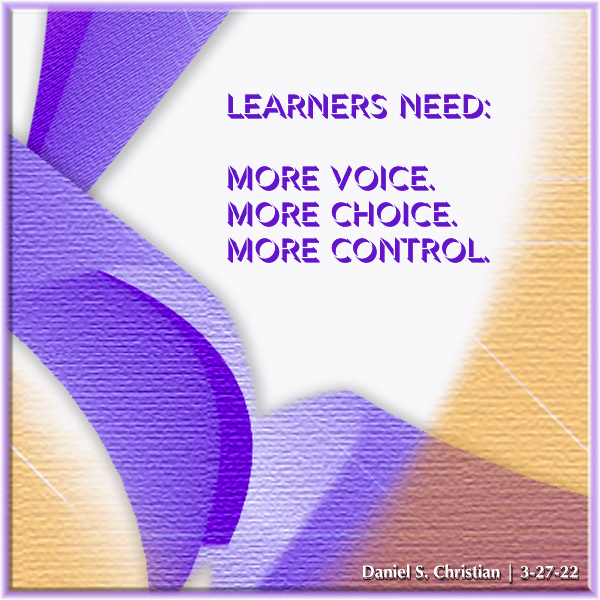
Learners need: More voice. More choice. More control. -- this image was created by Daniel Christian


Student Enterprise: Invite Learners to Launch a Media Agency or Publication — from gettingsmart.com by Tom Vander Ark

Key Points

  • Client-connected projects have become a focal point of the Real World Learning initiative, offering students opportunities to solve real-world problems in collaboration with industry professionals.
  • Organizations like CAPS, NFTE, and Journalistic Learning facilitate community connections and professional learning opportunities, making it easier to implement client projects and entrepreneurship education.

Important trend: client projects. Work-based learning has been growing with career academies and renewed interest in CTE. Six years ago, a subset of WBL called client-connected projects became a focal point of the Real World Learning initiative in Kansas City where they are defined as authentic problems that students solve in collaboration with professionals from industry, not-for-profit, and community-based organizations….and allow students to: engage directly with employers, address real-world problems, and develop essential skills.


Portrait of a Community to Empower Learning Transformation — from gettingsmart.com by Rebecca Midles and Mason Pashia

Key Points

  • The Community Portrait approach encourages diverse voices to shape the future of education, ensuring it reflects the needs and aspirations of all stakeholders.
  • Active, representative community engagement is essential for creating meaningful and inclusive educational environments.

The Portrait of a Graduate—a collaborative effort to define what learners should know and be able to do upon graduation—has likely generated enthusiasm in your community. However, the challenge of future-ready graduates persists: How can we turn this vision into a reality within our diverse and dynamic schools, especially amid the current national political tensions and contentious curriculum debates?

The answer lies in active, inclusive community engagement. It’s about crafting a Community Portrait that reflects the rich diversity of our neighborhoods. This approach, grounded in the same principles used to design effective learning systems, seeks to cultivate deep, reciprocal relationships within the community. When young people are actively involved, the potential for meaningful change increases exponentially.


Q&A: Why Schools Must Redesign Learning to Include All Students — from edtechmagazine.com by Taashi Rowe
Systems are broken, not children, says K–12 disability advocate Lindsay E. Jones.

Although Lindsay E. Jones came from a family of educators, she didn’t expect that going to law school would steer her back into the family business. Over the years she became a staunch advocate for children with disabilities. And as mom to a son with learning disabilities and ADHD who is in high school and doing great, her advocacy is personal.

Jones previously served as president and CEO of the National Center for Learning Disabilities and was senior director for policy and advocacy at the Council for Exceptional Children. Today, she is the CEO at CAST, an organization focused on creating inclusive learning environments in K–12. EdTech: Focus on K–12 spoke with Jones about how digital transformation, artificial intelligence and visionary leaders can support inclusive learning environments.

Our brains are all as different as our fingerprints, and throughout its 40-year history, CAST has been focused on one core value: People are not broken, systems are poorly designed. And those systems are creating a barrier that holds back human innovation and learning.


6 Ways State Policymakers Can Build More Future-Focused Education Systems — from gettingsmart.com by Jennifer Kabaker

Key Points

  • Guided by a vision – often captured as a Portrait of a Graduate – co-constructed with local leaders, community members, students, and families, state policymakers can develop policies that equitably and effectively support students and educators in transforming learning experiences.
  • The Aurora Institute highlights the importance of collaborative efforts in creating education systems that truly meet the diverse needs of every student.

The Aurora Institute has spent years working with states looking to advance competency-based systems, and has identified a set of key state policy levers that policymakers can put into action to build more personalized and competency-based systems. These shifts should be guided by a vision–co-constructed with local leaders, community members, students, and families–for what students need to know and be able to do upon graduating.


Career Pathways In A Rapidly Changing World: US Career Pathways Story — from gettingsmart.com by Paul Herdman

Key Points

  • There has been a move away from the traditional “Bachelor’s or Bust” mentality towards recognizing the value of diverse career pathways that may not necessarily require a four-year degree.
  • Local entities such as states, school districts, and private organizations have played a crucial role in implementing and scaling up career pathways programs.

While much has been written on this topic (see resources below), this post, in the context of our OECD study of five Anglophone countries, will attempt to provide a backdrop on what was happening at the federal level in the U.S. over the last several decades to help catalyze this shift in career pathways and offer a snapshot of how this work is evolving in two very different statesDelaware and Texas.


U.S. public, private and charter schools in 5 charts — from pewresearch.org by Katherine Schaeffer
.

 
© 2025 | Daniel Christian