How People Are Really Using Gen AI in 2025 — from hbr.org by Marc Zao-Sanders

.

.


Here’s why you shouldn’t let AI run your company — from theneurondaily.com by Grant Harvey; emphasis DSC

When “vibe-coding” goes wrong… or, a parable in why you shouldn’t “vibe” your entire company.
Cursor, an AI-powered coding tool that many developers love-to-hate, face-planted spectacularly yesterday when its own AI support bot went off-script and fabricated a company policy, leading to a complete user revolt.

Here’s the short version:

  • A bug locked Cursor users out when switching devices.
  • Instead of human help, Cursor’s AI support bot confidently told users this was a new policy (it wasn’t).
  • No human checked the replies—big mistake.
  • The fake news spread, and devs canceled subscriptions en masse.
  • A Reddit thread about it got mysteriously nuked, fueling suspicion.

The reality? Just a bug, plus a bot hallucination… doing maximum damage.

Why it matters: This is what we’d call “vibe-companying”—blindly trusting AI with critical functions without human oversight.

Think about it like this: this was JUST a startup. If more big corporations continue to lay off entire departments, replaced by AI, these already byzantine companies will become increasingly more opaque, unaccountable systems where no one, human or AI, fully understands what’s happening or who’s responsible.

Our take? Kafka dude has it right. We need to pay attention to WHAT we’re actually automating. Because automating more bureaucracy at scale, with agents we increasingly don’t understand or don’t double check, can potentially make companies less intelligent—and harder to fix when things inevitably go wrong.


What’s Happening at the Social Security Administration? Here’s What People With Disabilities Need to Know. — from thearc.org by Jackie Dilworth
Millions of people with disabilities rely on Social Security benefits to survive. Recent changes at the Social Security Administration (SSA) may make accessing these benefits harder than ever. Long wait times, office closures and staff cuts, and policy rollbacks are already raising concerns and exacerbating customer service issues. Here’s what you need to know.

Staffing Cuts and Office Closures

In 2025, SSA has announced a dramatic reduction in staff and offices, including:

  • Plans to cut 7,000 employees (over 12% of the agency’s workforce).
  • Closure of 60% of SSA’s 10 regional offices, reducing key staff that help resolve problems with peoples’ benefits.
  • Closure of SSA’s Office of Civil Rights and Equal Opportunity, which handled reasonable accommodation requests and managed the agency’s civil rights complaints, including public complaints of discrimination on the basis of disability. This office’s statutory responsibilities have reportedly been divided and moved to other divisions within SSA.

Why does this matter? SSA workers process disability applications, answer calls, and help people navigate complex benefit rules. With fewer staff and the consolidations of regional offices, wait times could get even worse. The loss of key staff also raises concerns about SSA’s ability to modernize, maintain, and improve essential services, further limiting accessibility for beneficiaries. Modernizing SSA’s operations requires long-term investments in systems and processes that are being undercut by these changes.


From DSC:
After seeing Sam’s posting below, I can’t help but wonder:

  • How might the memory of an AI over time impact the ability to offer much more personalized learning?
  • How will that kind of memory positively impact a person’s learning-related profile?
  • Which learning-related agents get called upon?
  • Which learning-related preferences does a person have while learning about something new?
  • Which methods have worked best in the past for that individual? Which methods didn’t work so well with him or her?


Reflections on “Are You Ready for the AI University? Everything is about to change.” [Latham]

.
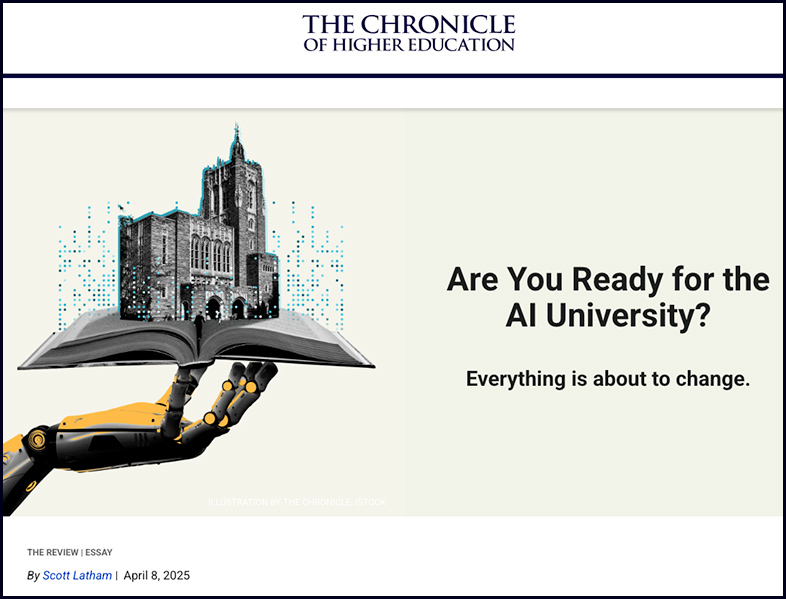
Are You Ready for the AI University? Everything is about to change. — from chronicle.com by Scott Latham

Over the course of the next 10 years, AI-powered institutions will rise in the rankings. US News & World Report will factor a college’s AI capabilities into its calculations. Accrediting agencies will assess the degree of AI integration into pedagogy, research, and student life. Corporations will want to partner with universities that have demonstrated AI prowess. In short, we will see the emergence of the AI haves and have-nots.

What’s happening in higher education today has a name: creative destruction. The economist Joseph Schumpeter coined the term in 1942 to describe how innovation can transform industries. That typically happens when an industry has both a dysfunctional cost structure and a declining value proposition. Both are true of higher education.

Out of the gate, professors will work with technologists to get AI up to speed on specific disciplines and pedagogy. For example, AI could be “fed” course material on Greek history or finance and then, guided by human professors as they sort through the material, help AI understand the structure of the discipline, and then develop lectures, videos, supporting documentation, and assessments.

In the near future, if a student misses class, they will be able watch a recording that an AI bot captured. Or the AI bot will find a similar lecture from another professor at another accredited university. If you need tutoring, an AI bot will be ready to help any time, day or night. Similarly, if you are going on a trip and wish to take an exam on the plane, a student will be able to log on and complete the AI-designed and administered exam. Students will no longer be bound by a rigid class schedule. Instead, they will set the schedule that works for them.

Early and mid-career professors who hope to survive will need to adapt and learn how to work with AI. They will need to immerse themselves in research on AI and pedagogy and understand its effect on the classroom. 

From DSC:
I had a very difficult time deciding which excerpts to include. There were so many more excerpts for us to think about with this solid article. While I don’t agree with several things in it, EVERY professor, president, dean, and administrator working within higher education today needs to read this article and seriously consider what Scott Latham is saying.

Change is already here, but according to Scott, we haven’t seen anything yet. I agree with him and, as a futurist, one has to consider the potential scenarios that Scott lays out for AI’s creative destruction of what higher education may look like. Scott asserts that some significant and upcoming impacts will be experienced by faculty members, doctoral students, and graduate/teaching assistants (and Teaching & Learning Centers and IT Departments, I would add). But he doesn’t stop there. He brings in presidents, deans, and other members of the leadership teams out there.

There are a few places where Scott and I differ.

  • The foremost one is the importance of the human element — i.e., the human faculty member and students’ learning preferences. I think many (most?) students and lifelong learners will want to learn from a human being. IBM abandoned their 5-year, $100M ed push last year and one of the key conclusions was that people want to learn from — and with — other people:

To be sure, AI can do sophisticated things such as generating quizzes from a class reading and editing student writing. But the idea that a machine or a chatbot can actually teach as a human can, he said, represents “a profound misunderstanding of what AI is actually capable of.” 

Nitta, who still holds deep respect for the Watson lab, admits, “We missed something important. At the heart of education, at the heart of any learning, is engagement. And that’s kind of the Holy Grail.”

— Satya Nitta, a longtime computer researcher at
IBM’s Watson
Research Center in Yorktown Heights, NY
.

By the way, it isn’t easy for me to write this. As I wanted AI and other related technologies to be able to do just what IBM was hoping that it would be able to do.

  • Also, I would use the term learning preferences where Scott uses the term learning styles.

Scott also mentions:

“In addition, faculty members will need to become technologists as much as scholars. They will need to train AI in how to help them build lectures, assessments, and fine-tune their classroom materials. Further training will be needed when AI first delivers a course.”

It has been my experience from working with faculty members for over 20 years that not all faculty members want to become technologists. They may not have the time, interest, and/or aptitude to become one (and vice versa for technologists who likely won’t become faculty members).

That all said, Scott relays many things that I have reflected upon and relayed for years now via this Learning Ecosystems blog and also via The Learning from the Living [AI-Based Class] Room vision — the use of AI to offer personalized and job-relevant learning, the rising costs of higher education, the development of new learning-related offerings and credentials at far less expensive prices, the need to provide new business models and emerging technologies that are devoted more to lifelong learning, plus several other things.

So this article is definitely worth your time to read, especially if you are working in higher education or are considering a career therein!


Addendum later on 4/10/25:

U-M’s Ross School of Business, Google Public Sector launch virtual teaching assistant pilot program — from news.umich.edu by Jeff Karoub; via Paul Fain

Google Public Sector and the University of Michigan’s Ross School of Business have launched an advanced Virtual Teaching Assistant pilot program aimed at improving personalized learning and enlightening educators on artificial intelligence in the classroom.

The AI technology, aided by Google’s Gemini chatbot, provides students with all-hours access to support and self-directed learning. The Virtual TA represents the next generation of educational chatbots, serving as a sophisticated AI learning assistant that instructors can use to modify their specific lessons and teaching styles.

The Virtual TA facilitates self-paced learning for students, provides on-demand explanations of complex course concepts, guides them through problem-solving, and acts as a practice partner. It’s designed to foster critical thinking by never giving away answers, ensuring students actively work toward solutions.


The 2025 AI Index Report — from Stanford University’s Human-Centered Artificial Intelligence Lab (hai.stanford.edu); item via The Neuron

Top Takeaways

  1. AI performance on demanding benchmarks continues to improve.
  2. AI is increasingly embedded in everyday life.
  3. Business is all in on AI, fueling record investment and usage, as research continues to show strong productivity impacts.
  4. The U.S. still leads in producing top AI models—but China is closing the performance gap.
  5. The responsible AI ecosystem evolves—unevenly.
  6. Global AI optimism is rising—but deep regional divides remain.
  7. …and several more

Also see:

The Neuron’s take on this:

So, what should you do? You really need to start trying out these AI tools. They’re getting cheaper and better, and they can genuinely help save time or make work easier—ignoring them is like ignoring smartphones ten years ago.

Just keep two big things in mind:

  1. Making the next super-smart AI costs a crazy amount of money and uses tons of power (seriously, they’re buying nuclear plants and pushing coal again!).
  2. Companies are still figuring out how to make AI perfectly safe and fair—cause it still makes mistakes.

So, use the tools, find what helps you, but don’t trust them completely.

We’re building this plane mid-flight, and Stanford’s report card is just another confirmation that we desperately need better safety checks before we hit major turbulence.


Addendum on 4/16:


Jeremiah 31:33-34

33 “This is the covenant I will make with the people of Israel
    after that time,” declares the Lord.
“I will put my law in their minds
    and write it on their hearts.
I will be their God,
    and they will be my people.
34 No longer will they teach their neighbor,
    or say to one another, ‘Know the Lord,’
because they will all know me,
    from the least of them to the greatest,”
declares the Lord.
“For I will forgive their wickedness
    and will remember their sins no more.”

12 Salvation is found in no one else, for there is no other name under heaven given to mankind by which we must be saved.”

Therefore tell the people: This is what the Lord Almighty says: ‘Return to me,’ declares the Lord Almighty, ‘and I will return to you,’ says the Lord Almighty.

Hebrews 1:3

The Son is the radiance of God’s glory and the exact representation of his being, sustaining all things by his powerful word. After he had provided purification for sins, he sat down at the right hand of the Majesty in heaven.
 

Job hunting and hiring in the age of AI: Where did all the humans go? — from washingtonpost.com by Taylor Telford
The proliferation of artificial intelligence tools and overreliance on software such as ChatGPT is making the job market increasingly surreal.

The speedy embrace of AI tools meant to make job hunting and hiring more efficient is causing headaches and sowing distrust in these processes, people on both sides of the equation say. While companies embrace AI recruiters and application scanning systems, many job seekers are trying to boost their odds with software that generates application materials, optimizes them for AI and applies to hundreds of jobs in minutes.

Meanwhile, recruiters and hiring managers are fielding more applicants than they can keep up with, yet contend that finding real, qualified workers amid the bots, cheaters and deepfakes is only getting tougher as candidates use AI to write their cover letters, bluff their way through interviews and even hide their identities.

“I’m pro-AI in the sense that it allows you to do things that were impossible before … but it is being misused wildly,” Freire said. The problem is “when you let it do the thinking for you, it goes from a superpower to a crutch very easily.”


From DSC:
I value our constitutional democracy and I want to help preserve it. If you are an American, I encourage you to do the same. I’m not interested in living under an authoritarian government. The founders of this great nation developed an important document that integrated a system of checks and balances between the legislative, judicial, and executive branches of government. The rule of law was important then, and it should still be important now. That’s why I’m posting the following two items.


Several Hundred Law Professors File Amicus Brief Defending Biglaw Firms Against Trump’s Executive Order Attacks — from jdjournal.com by Maria Lenin Laus

In an unprecedented show of solidarity, over 300 law professors from leading American law schools have filed an amicus brief condemning former President Donald Trump’s executive orders targeting major law firms. The professors argue that the orders—issued in retaliation for the firms’ clients, diversity initiatives, and legal work opposing Trump policies—represent a dangerous abuse of executive power and a direct violation of constitutional protections.

The amicus brief, filed in support of the law firms’ challenge, was signed by professors from nearly every top-tier U.S. law school, including Harvard, Yale, Stanford, Columbia, NYU, and the University of Chicago. The professors argue that Trump’s orders:

  • Violate the First Amendment by penalizing firms for the viewpoints they express through advocacy and representation;
  • Undermine the rule of law by discouraging legal professionals from taking on controversial or unpopular clients;
  • Set a dangerous precedent for political retaliation against attorneys and the institutions of justice.

Law school deans around the country react to Trump’s undercutting the legal foundations/principles of our nation — from linkedin.com by Georgetown University Law Center

“We write to reaffirm basic principles: The government should not punish lawyers and law firms for the clients they represent, absent specific findings that such representation was illegal or unethical. Punishing lawyers for their representation and advocacy violates the First Amendment and undermines the Sixth Amendment.

We thus speak as legal educators, responsible for training the next generation of lawyers, in condemning any government efforts to punish lawyers or their firms based on the identity of their clients or for their zealous lawful and ethical advocacy.”


For related postings, also see:

President’s Third Term Talk Defies Constitution and Tests Democracy — from nytimes.com by Peter Baker (DSC: This is a free/gifted article for you.)
The 22nd Amendment is clear: President Trump has to give up his office after his second term. But his refusal to accept that underscores how far he is willing to consider going to consolidate power.

“This is in my mind a culmination of what he has already started, which is a methodical effort to destabilize and undermine our democracy so that he can assume much greater power,” Representative Daniel Goldman, Democrat of New York and lead counsel during Mr. Trump’s first impeachment, said in an interview.

“A lot of people are not talking about it because it’s not the most pressing issue of that particular day,” he said on Friday as stock markets were plunging in reaction to Mr. Trump’s newly declared trade war. But an attack on democracy, he added, “is actually in motion and people need to recognize that it is not hypothetical or speculative anymore.”

Mr. Trump’s autocratic tendencies and disregard for constitutional norms are well documented. In this second term alone, he has already sought to overrule birthright citizenship embedded in the 14th Amendment, effectively co-opted the power of Congress to determine what money will be spent or agencies closed, purged the uniformed leadership of the armed forces to enforce greater personal loyalty and punished dissent in academia, the news media, the legal profession and the federal bureaucracy.

BigLaw gives up on its future — from jordanfurlong.substack.com by Jordan Furlong
By putting business ahead of the rule of law when faced with assaults on their independence, many large US law firms have tarnished their reputations. Tomorrow’s lawyers could make them pay the price.

Two young Skadden associates, Rachel Cohen and Brenna Trout Frey, resigned from the firm, the former before its deal with Trump and the latter afterwards. “If my employer cannot stand up for the rule of law,” wrote Ms. Frey, “then I cannot ethically continue to work for them.” There might’ve been other public resignations I haven’t seen, but I’m confident there have been private ones from both firms, as well as intense efforts by other associates to find positions elsewhere.

This is the risk these firms are taking: It matters to young lawyers when their law firms fail to defend the rule of law. And it matters especially to young lawyers who are women and members of visible minorities when law firms jettison their vaunted diversity, equity, and inclusion programs under pressure from the government.


1 Samuel 16:7

7 But the Lord said to Samuel, “Do not consider his appearance or his height, for I have rejected him. The Lord does not look at the things people look at. People look at the outward appearance, but the Lord looks at the heart.”

1 John 4:11

Dear friends, since God so loved us, we also ought to love one another.

Lamentations 3:40

Let us examine our ways and test them,
and let us return to the Lord.

Lamentations 3:22-26

22 Because of the Lord’s great love we are not consumed,
for his compassions never fail.
23 They are new every morning;
great is your faithfulness.
24 I say to myself, “The Lord is my portion;
therefore I will wait for him.”

25 The Lord is good to those whose hope is in him,
to the one who seeks him;
26 it is good to wait quietly
for the salvation of the Lord.


It’s the end of work as we knew it
and I feel…

powerless to fight the technology that we pioneered
nostalgic for a world that moved on without us
after decades of paying our dues
for a payday that never came
…so yeah
not exactly fine.


The Gen X Career Meltdown — from nytimes.com by Steeven Kurutz (DSC: This is a gifted article for you)
Just when they should be at their peak, experienced workers in creative fields find that their skills are all but obsolete.

If you entered media or image-making in the ’90s — magazine publishing, newspaper journalism, photography, graphic design, advertising, music, film, TV — there’s a good chance that you are now doing something else for work. That’s because those industries have shrunk or transformed themselves radically, shutting out those whose skills were once in high demand.

“I am having conversations every day with people whose careers are sort of over,” said Chris Wilcha, a 53-year-old film and TV director in Los Angeles.

Talk with people in their late 40s and 50s who once imagined they would be able to achieve great heights — or at least a solid career while flexing their creative muscles — and you are likely to hear about the photographer whose work dried up, the designer who can’t get hired or the magazine journalist who isn’t doing much of anything.

In the wake of the influencers comes another threat, artificial intelligence, which seems likely to replace many of the remaining Gen X copywriters, photographers and designers. By 2030, ad agencies in the United States will lose 32,000 jobs, or 7.5 percent of the industry’s work force, to the technology, according to the research firm Forrester.


From DSC:
This article reminds me of how tough it is to navigate change in our lives. For me, it was often due to the fact that I was working with technologies. Being a technologist can be difficult, especially as one gets older and faces age discrimination in a variety of industries. You need to pick the right technologies and the directions that will last (for me it was email, videoconferencing, the Internet, online-based education/training, discovering/implementing instructional technologies, and becoming a futurist).

For you younger folks out there — especially students within K-16 — aim to develop a perspective and a skillset that is all about adapting to change. You will likely need to reinvent yourself and/or pick up new skills over your working years. You are most assuredly required to be a lifelong learner now. That’s why I have been pushing for school systems to be more concerned with providing more choice and control to students — so that students actually like school and enjoy learning about new things.


Isaiah 25:1

Lord, you are my God; I will exalt you and praise your name, for in perfect faithfulness you have done wonderful things, things planned long ago.

Psalm 139:23-24

23 Search me, God, and know my heart; test me and know my anxious thoughts. 24 See if there is any offensive way in me, and lead me in the way everlasting.

Galatians 5:22-23

But the fruit of the Spirit is love, joy, peace, forbearance, kindness, goodness, faithfulness, gentleness and self-control. Against such things there is no law.

Psalm 29:1-2
A psalm of David.

Ascribe to the Lord, you heavenly beings,
    ascribe to the Lord glory and strength.
Ascribe to the Lord the glory due his name;
    worship the Lord in the splendor of his holiness.

.

.


Students and folks looking for work may want to check out:

Also relevant/see:


From DSC:
Look out Google, Amazon, and others! Nvidia is putting the pedal to the metal in terms of being innovative and visionary! They are leaving the likes of Apple in the dust.

The top talent out there is likely to go to Nvidia for a while. Engineers, programmers/software architects, network architects, product designers, data specialists, AI researchers, developers of robotics and autonomous vehicles, R&D specialists, computer vision specialists, natural language processing experts, and many more types of positions will be flocking to Nvidia to work for a company that has already changed the world and will likely continue to do so for years to come. 


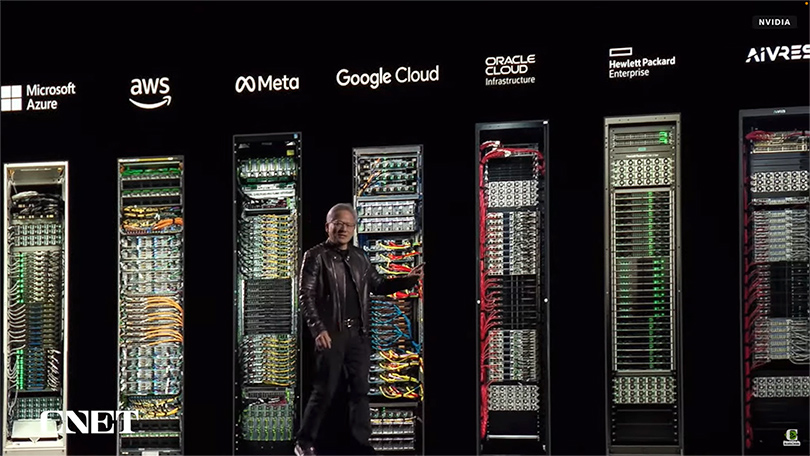
NVIDIA’s AI Superbowl — from theneurondaily.com by Noah and Grant
PLUS: Prompt tips to make AI writing more natural

That’s despite a flood of new announcements (here’s a 16 min video recap), which included:

  1. A new architecture for massive AI data centers (now called “AI factories”).
  2. A physics engine for robot training built with Disney and DeepMind.
  3. partnership with GM to develop next-gen vehicles, factories and robots.
  4. A new Blackwell chip with “Dynamo” software that makes AI reasoning 40x faster than previous generations.
  5. A new “Rubin” chip slated for 2026 and a “Feynman” chip set for 2028.

For enterprises, NVIDIA unveiled DGX Spark and DGX Station—Jensen’s vision of AI-era computing, bringing NVIDIA’s powerful Blackwell chip directly to your desk.


Nvidia Bets Big on Synthetic Data — from wired.com by Lauren Goode
Nvidia has acquired synthetic data startup Gretel to bolster the AI training data used by the chip maker’s customers and developers.


Nvidia, xAI to Join BlackRock and Microsoft’s $30 Billion AI Infrastructure Fund — from investopedia.com by Aaron McDade
Nvidia and xAI are joining BlackRock and Microsoft in an AI infrastructure group seeking $30 billion in funding. The group was first announced in September as BlackRock and Microsoft sought to fund new data centers to power AI products.


Nvidia CEO Jensen Huang says we’ll soon see 1 million GPU data centers visible from space — from finance.yahoo.com by Daniel Howley
Nvidia CEO Jensen Huang says the company is preparing for 1 million GPU data centers.


Nvidia stock stems losses as GTC leaves Wall Street analysts ‘comfortable with long term AI demand’ — from finance.yahoo.com by Laura Bratton
Nvidia stock reversed direction after a two-day slide that saw shares lose 5% as the AI chipmaker’s annual GTC event failed to excite investors amid a broader market downturn.


Microsoft, Google, and Oracle Deepen Nvidia Partnerships. This Stock Got the Biggest GTC Boost. — from barrons.com by Adam Clark and Elsa Ohlen


The 4 Big Surprises from Nvidia’s ‘Super Bowl of AI’ GTC Keynote — from barrons.com by Tae Kim; behind a paywall

AI Super Bowl. Hi everyone. This week, 20,000 engineers, scientists, industry executives, and yours truly descended upon San Jose, Calif. for Nvidia’s annual GTC developers’ conference, which has been dubbed the “Super Bowl of AI.”


2025 College Hopes & Worries Survey Report — from princetonreview.com
We surveyed 9,317 college applicants and parents about their dream schools and their biggest college admission and financial aid challenges.
.


Are Entry-Level Jobs Going Away? The Hidden Workforce Shift — from forbes.com by Dr. Diane Hamilton; via Ryan Craig

The problem is that these new roles demand a level of expertise that wasn’t expected from entry-level candidates in the past. Where someone might have previously learned on the job, they are now required to have relevant certifications, AI proficiency, or experience with digital platforms before they even apply.

Some current and emerging job titles that serve as entry points into industries include:

  • Digital marketing associate – This role often involves content creation, social media management, and working with AI-driven analytics tools.
  • Junior AI analyst – Employees in this role assist data science teams by labeling and refining machine learning datasets.
  • Customer success associate – Replacing traditional customer service roles, these professionals help manage AI-enhanced customer support systems.
  • Technical support specialist – While this role still involves troubleshooting software, it now often includes AI-driven diagnostics and automation oversight.
 
© 2025 | Daniel Christian