Isaiah 53:5

But he was pierced for our transgressions,
he was crushed for our iniquities;
the punishment that brought us peace was on him,
and by his wounds we are healed.

1 Chronicles 29:11

Yours, Lord, is the greatness and the power and the glory and the majesty and the splendor, for everything in heaven and earth is yours. Yours, Lord, is the kingdom; you are exalted as head over all.

Colossians 3:13

Bear with each other and forgive one another if any of you has a grievance against someone. Forgive as the Lord forgave you.


So much for saving the planet. Climate careers, and many others, evaporate for class of 2025 — from hechingerreport.org by Lawrence Lanahan
The Trump administration is disrupting career paths for new graduates hoping to work in climate and sustainability, international aid, public service and the sciences

As the class of 2025 enters the workforce, the Trump administration has dismantled career pathways for graduates interested in climate and sustainability work, international aid, public service and research across the natural, behavioral and social sciences. Federal jobs are disappearing, and the administration is eliminating grants and agency divisions that sustain university research programs and nonprofits that are crucial to launching careers.

The National Science Foundation, for example, halved graduate research fellowships, canceled some undergraduate research grants, stopped awarding new grants, froze funding for existing ones, and eliminated several hundred grants for focusing on diversity, equity and inclusion. In March, Robert F. Kennedy Jr. announced 10,000 layoffs at his agency, the Department of Health and Human Services; earlier buyouts and firings had already cut another 10,000 jobs.


“The AI-enhanced learning ecosystem” [Jennings] + other items re: AI in our learning ecosystems

The AI-enhanced learning ecosystem: A case study in collaborative innovation — from chieflearningofficer.com by Kevin Jennings
How artificial intelligence can serve as a tool and collaborative partner in reimagining content development and management.

Learning and development professionals face unprecedented challenges in today’s rapidly evolving business landscape. According to LinkedIn’s 2025 Workplace Learning Report, 67 percent of L&D professionals report being “maxed out” on capacity, while 66 percent have experienced budget reductions in the past year.

Despite these constraints, 87 percent agree their organizations need to develop employees faster to keep pace with business demands. These statistics paint a clear picture of the pressure L&D teams face: do more, with less, faster.

This article explores how one L&D leader’s strategic partnership with artificial intelligence transformed these persistent challenges into opportunities, creating a responsive learning ecosystem that addresses the modern demands of rapid product evolution and diverse audience needs. With 71 percent of L&D professionals now identifying AI as a high or very high priority for their learning strategy, this case study demonstrates how AI can serve not merely as a tool but as a collaborative partner in reimagining content development and management.
.


How we use GenAI and AR to improve students’ design skills — from timeshighereducation.com by Antonio Juarez, Lesly Pliego and Jordi Rábago who are professors of architecture at Monterrey Institute of Technology in Mexico; Tomas Pachajoa is a professor of architecture at the El Bosque University in Colombia; & Carlos Hinrichsen and Marietta Castro are educators at San Sebastián University in Chile.
Guidance on using generative AI and augmented reality to enhance student creativity, spatial awareness and interdisciplinary collaboration

Blend traditional skills development with AI use
For subjects that require students to develop drawing and modelling skills, have students create initial design sketches or models manually to ensure they practise these skills. Then, introduce GenAI tools such as Midjourney, Leonardo AI and ChatGPT to help students explore new ideas based on their original concepts. Using AI at this stage broadens their creative horizons and introduces innovative perspectives, which are crucial in a rapidly evolving creative industry.

Provide step-by-step tutorials, including both written guides and video demonstrations, to illustrate how initial sketches can be effectively translated into AI-generated concepts. Offer example prompts to demonstrate diverse design possibilities and help students build confidence using GenAI.

Integrating generative AI and AR consistently enhanced student engagement, creativity and spatial understanding on our course. 


How Texas is Preparing Higher Education for AI — from the74million.org by Kate McGee
TX colleges are thinking about how to prepare students for a changing workforce and an already overburdened faculty for new challenges in classrooms.

“It doesn’t matter if you enter the health industry, banking, oil and gas, or national security enterprises like we have here in San Antonio,” Eighmy told The Texas Tribune. “Everybody’s asking for competency around AI.”

It’s one of the reasons the public university, which serves 34,000 students, announced earlier this year that it is creating a new college dedicated to AI, cyber security, computing and data science. The new college, which is still in the planning phase, would be one of the first of its kind in the country. UTSA wants to launch the new college by fall 2025.

But many state higher education leaders are thinking beyond that. As AI becomes a part of everyday life in new, unpredictable ways, universities across Texas and the country are also starting to consider how to ensure faculty are keeping up with the new technology and students are ready to use it when they enter the workforce.


In the Room Where It Happens: Generative AI Policy Creation in Higher Education — from er.educause.edu by Esther Brandon, Lance Eaton, Dana Gavin, and Allison Papini

To develop a robust policy for generative artificial intelligence use in higher education, institutional leaders must first create “a room” where diverse perspectives are welcome and included in the process.


Q&A: Artificial Intelligence in Education and What Lies Ahead — from usnews.com by Sarah Wood
Research indicates that AI is becoming an essential skill to learn for students to succeed in the workplace.

Q: How do you expect to see AI embraced more in the future in college and the workplace?
I do believe it’s going to become a permanent fixture for multiple reasons. I think the national security imperative associated with AI as a result of competing against other nations is going to drive a lot of energy and support for AI education. We also see shifts across every field and discipline regarding the usage of AI beyond college. We see this in a broad array of fields, including health care and the field of law. I think it’s here to stay and I think that means we’re going to see AI literacy being taught at most colleges and universities, and more faculty leveraging AI to help improve the quality of their instruction. I feel like we’re just at the beginning of a transition. In fact, I often describe our current moment as the ‘Ask Jeeves’ phase of the growth of AI. There’s a lot of change still ahead of us. AI, for better or worse, it’s here to stay.


AI-Generated Podcasts Outperform Textbooks in Landmark Education Study — form linkedin.com by David Borish

A new study from Drexel University and Google has demonstrated that AI-generated educational podcasts can significantly enhance both student engagement and learning outcomes compared to traditional textbooks. The research, involving 180 college students across the United States, represents one of the first systematic investigations into how artificial intelligence can transform educational content delivery in real-time.


What can we do about generative AI in our teaching?  — from linkedin.com by Kristina Peterson

So what can we do?

  • Interrogate the Process: We can ask ourselves if we I built in enough checkpoints. Steps that can’t be faked. Things like quick writes, question floods, in-person feedback, revision logs.
  • Reframe AI: We can let students use AI as a partner. We can show them how to prompt better, revise harder, and build from it rather than submit it. Show them the difference between using a tool and being used by one.
  • Design Assignments for Curiosity, Not Compliance: Even the best of our assignments need to adapt. Mine needs more checkpoints, more reflective questions along the way, more explanation of why my students made the choices they did.

Teachers Are Not OK — from 404media.co by Jason Koebler

The response from teachers and university professors was overwhelming. In my entire career, I’ve rarely gotten so many email responses to a single article, and I have never gotten so many thoughtful and comprehensive responses.

One thing is clear: teachers are not OK.

In addition, universities are contracting with companies like Microsoft, Adobe, and Google for digital services, and those companies are constantly pushing their AI tools. So a student might hear “don’t use generative AI” from a prof but then log on to the university’s Microsoft suite, which then suggests using Copilot to sum up readings or help draft writing. It’s inconsistent and confusing.

I am sick to my stomach as I write this because I’ve spent 20 years developing a pedagogy that’s about wrestling with big ideas through writing and discussion, and that whole project has been evaporated by for-profit corporations who built their systems on stolen work. It’s demoralizing.


NAMLE 2025 Conference
Join us for the largest professional development conference dedicated to media literacy education in the U.S. on July 11-12, 2025.

From Pre-K to Higher Education, Community Education and Libraries, the conference provides valuable resources, technology, teacher practice and pedagogy, assessments, and core concepts of media literacy education.


Astronaut one day, artist the next: How to help children explore the world of careers — from apnews.com by Cathy Bussewitz

Sometimes career paths follow a straight line, with early life ambitions setting us on a clear path to training or a degree and a specific profession. Just as often, circumstance, luck, exposure and a willingness to adapt to change influence what we do for a living.

Developmental psychologists and career counselors recommend exposing children to a wide variety of career paths at a young age.

“It’s not so that they’ll pick a career, but that they will realize that there’s lots of opportunities and not limit themselves out of careers,” said Jennifer Curry, a Louisiana State University professor who researches career and college readiness.

Preparing for a world of AI
In addition to exposing children to career routes through early conversations and school courses, experts recommend teaching children about artificial intelligence and how it is reshaping the world and work.


Cultivating a responsible innovation mindset among future tech leaders — from timeshighereducation.com by Andreas Alexiou from the University of Southampton
The classroom is a perfect place to discuss the messy, real-world consequences of technological discoveries, writes Andreas Alexiou. Beyond ‘How?’, students should be asking ‘Should we…?’ and ‘What if…?’ questions around ethics and responsibility

University educators play a crucial role in guiding students to think about the next big invention and its implications for privacy, the environment and social equity. To truly make a difference, we need to bring ethics and responsibility into the classroom in a way that resonates with students. Here’s how.

Debating with industry pioneers on incorporating ethical frameworks in innovation, product development or technology adoption is eye-opening because it can lead to students confronting assumptions they hadn’t questioned before.

Students need more than just skills; they need a mindset that sticks with them long after graduation. By making ethics and responsibility a key part of the learning process, educators are doing more than preparing students for a career; they’re preparing them to navigate a world shaped by their choices.


The 2025 Global Skills Report— from coursera.org
Discover in-demand skills and credentials trends across 100+ countries and six regions to deliver impactful industry-aligned learning programs.

GenAI adoption fuels global skill demands
In 2023, early adopters flocked to GenAI, with approximately one person per minute enrolling in a GenAI course on Coursera —a rate that rose to eight per minute in 2024.  Since then, GenAI has continued to see exceptional growth, with global enrollment in GenAI courses surging 195% year-over-year—maintaining its position as one of the most rapidly growing skill domains on our platform. To date, Coursera has recorded over 8 million GenAI enrollments, with 12 learners per minute signing up for GenAI content in 2025 across our catalog of nearly 700 GenAI courses.

Driving this surge, 94% of employers say they’re likely to hire candidates with GenAI credentials, while 75% prefer hiring less-experienced candidates with GenAI skills over more experienced ones without these capabilities.8 Demand for roles such as AI and Machine Learning Specialists is projected to grow by up to 40% in the next four years.9 Mastering AI fundamentals—from prompt engineering to large language model (LLM) applications—is essential to remaining competitive in today’s rapidly evolving economy.

Countries leading our new AI Maturity Index— which highlights regions best equipped to harness AI innovation and translate skills into real-world applications—include global frontrunners such as Singapore, Switzerland, and the United States.

Insights in action

Businesses
Integrate role-specific GenAI modules into employee development programs, enabling teams to leverage AI for efficiency and innovation.

Governments
Scale GenAI literacy initiatives—especially in emerging economies—to address talent shortages and foster human-machine capabilities needed to future-proof digital jobs.

Higher education
Embed credit-eligible GenAI learning into curricula, ensuring graduates enter the workforce job-ready.

Learners
Focus on GenAI courses offering real-world projects (e.g., prompt engineering) that help build skills for in-demand roles.


Scientific breakthrough: artificial blood for all blood groups — from getsuperintel.com by Kim “Chubby” Isenberg
Japan’s universal artificial blood could revolutionize emergency medicine and global healthcare resilience.

They all show that we are on the threshold of a new era – one in which technological systems are no longer just tools, but independent players in medical, cognitive and infrastructural change.

This paradigm shift means that AI will no longer be limited to static training data, but will learn through open exploration, similar to biological organisms. This is nothing less than the beginning of an era of autonomous cognition.


From DSC:
While there are some promising developments involving AI these days, we need to look at what the potential downsides might be of AI becoming independent players, don’t you think? Otherwise, what could possibly go wrong?


These parents are ‘unschooling’ their kids. What does that mean? — from usatoday.com by Adrianna Rodriguez

“My goal for them is for them to love learning,” Franco said. “It’s realizing you can educate your child beyond the school model.”

Some parents say their children are thriving in the unschooling environment, fueling their confidence and desire to learn.

But not all students find success in unschooling. Some former students say the lack of structure and accountability can lead to educational neglect if parents don’t have the resources to make it work. Some kids who were unschooled feel they were left unprepared for adulthood and had fewer career opportunities.


What Is ‘Unschooling’ and Why Are More Parents Doing It? — from bckonline.com byTiffany Silva

Unschooling is a growing alternative education movement where children learn through life experiences instead of traditional classroom instruction. As more parents seek personalized and flexible learning paths, unschooling is gaining popularity across the U.S. and here’s what you need to know!

So, just what exactly is unschooling? Well, Unschooling is a form of homeschooling that breaks away from the idea of following a set curriculum. Instead, it centers the child’s interests, passions, and pace.

The belief is that learning doesn’t have to be separate from life because it is life. Unschooling functions on the premise that when kids are given the freedom to explore, they develop deep, authentic understanding and a lifelong love of learning.


John 3:17

For God did not send his Son into the world to condemn the world, but to save the world through him.

1 Timothy 4:8

For physical training is of some value, but godliness has value for all things, holding promise for both the present life and the life to come.

From DSC: LORD, you know I need help on these two areas (and many more as well). Don’t give up on the work of your hands please!

Psalms 51:10-12

10 Create in me a pure heart, O God,
and renew a steadfast spirit within me.
11 Do not cast me from your presence
or take your Holy Spirit from me.
12 Restore to me the joy of your salvation
and grant me a willing spirit, to sustain me.

Psalms 51:1-3
For the director of music. A psalm of David. When the prophet Nathan came to him after David had committed adultery with Bathsheba.

1 Have mercy on me, O God,
according to your unfailing love;
according to your great compassion
blot out my transgressions.
2 Wash away all my iniquity
and cleanse me from my sin.
3 For I know my transgressions,
and my sin is always before me.

Psalms 52:1-8
For the director of music. A maskil[b] of David. When Doeg the Edomite had gone to Saul and told him: “David has gone to the house of Ahimelek.”

1 Why do you boast of evil, you mighty hero?
Why do you boast all day long,
you who are a disgrace in the eyes of God?
2 You who practice deceit,
your tongue plots destruction;
it is like a sharpened razor.
3 You love evil rather than good,
falsehood rather than speaking the truth.[c]
4 You love every harmful word,
you deceitful tongue!
5 Surely God will bring you down to everlasting ruin:
    He will snatch you up and pluck you from your tent;
    he will uproot you from the land of the living.
The righteous will see and fear;
    they will laugh at you, saying,
“Here now is the man
    who did not make God his stronghold
but trusted in his great wealth
    and grew strong by destroying others!”

From DSC:
Anyone come to mind on this last one?


Also relevant/see:


Report: 93% of Students Believe Gen AI Training Belongs in Degree Programs — from campustechnology.com by Rhea Kelly

The vast majority of today’s college students — 93% — believe generative AI training should be included in degree programs, according to a recent Coursera report. What’s more, 86% of students consider gen AI the most crucial technical skill for career preparation, prioritizing it above in-demand skills such as data strategy and software development. And 94% agree that microcredentials help build the essential skills they need to achieve career success.

For its Microcredentials Impact Report 2025, Coursera surveyed more than 1,200 learners and 1,000 employers around the globe to better understand the demand for microcredentials and their impact on workforce readiness and hiring trends.


1 in 4 employers say they’ll eliminate degree requirements by year’s end — from hrdive.com by Carolyn Crist
Companies that recently removed degree requirements reported a surge in applications, a more diverse applicant pool and the ability to offer lower salaries.

A quarter of employers surveyed said they will remove bachelor’s degree requirements for some roles by the end of 2025, according to a May 20 report from Resume Templates.

In addition, 7 in 10 hiring managers said their company looks at relevant experience over a bachelor’s degree while making hiring decisions.

In the survey of 1,000 hiring managers, 84% of companies that recently removed degree requirements said it has been a successful move. Companies without degree requirements also reported a surge in applications, a more diverse applicant pool and the ability to offer lower salaries.


Why AI literacy is now a core competency in education — from weforum.org by Tanya Milberg

  • Education systems must go beyond digital literacy and embrace AI literacy as a core educational priority.
  • A new AI Literacy Framework (AILit) aims to empower learners to navigate an AI-integrated world with confidence and purpose.
  • Here’s what you need to know about the AILit Framework – and how to get involved in making it a success.

Also from Allison Salisbury, see:


American Microschools: A Sector Analysis 2025 — from microschoolingcenter.org by Don Soifer and Ashley Soifer

Among the report’s findings:

  • 74 percent of microschools have annual tuition and fees at or below $10,000, with 65 percent offering sliding scale tuition and discounts;
  • Among microschools that track academic growth data of students over time, 81 percent reported between 1 and 2 years of academic gains during one school year;
  • Children receive letter grades in just 29 percent of microschools, while observation-based reporting, portfolios, and tracking mastery are the most prevalent methods of tracking their impact;
  • The most important student outcomes for currently-operating microschools are growth in nonacademic learning, children’s happiness in their microschool, skills perceived as needed for future, and academic growth.
 

Republican Bill Would Limit Judges’ Contempt Power — from nytimes.com by Michael Gold (this is a gifted article)
Democrats have argued that House Republicans’ measure would rob courts of their power by stripping away any consequences for officials who ignore judges’ rulings.

The sprawling domestic policy bill Republicans pushed through the House [last] Thursday would limit the power of federal judges to hold people in contempt, potentially shielding President Trump and members of his administration from the consequences of violating court orders.

Republicans tucked the provision into the tax and spending cut bill at a time when they have moved aggressively to curb the power of federal courts to issue injunctions blocking Mr. Trump’s executive actions. It comes as federal judges have opened inquiries about whether to hold the Trump administration in contempt for violating their orders in cases related to its aggressive deportation efforts.


From DSC:
This is deeply disappointing to see that this sneaky little provision was tucked away in a 1,000+ page bill. It’s highly likely that it’s from Donald Trump himself — as he stands in contempt of court from a Supreme Court ruling from several weeks ago. But what is equally troubling is that the Republican “leadership” is good with it too, evidently. Shame on them. This isn’t leadership. This is tyranny and a blatant disregard for the rule of law.

What’s even more troubling about the whole Trump situation is that just over half of America put him there. For those who put him in office, I’m not sure how they can tell their children not to lie. Because if a person voted for Donald Trump, they no longer care about someone telling the truth.

Character matters. Ethics and morals matter. The Constitution matters. People matter. America matters. The rule of law matters. Justice matters.  We need to take a serious look in the mirror.


Opinions | This Baltimore program shows how to fight generational poverty – from washingtonpost.com by Leana S. Wen; this is a gifted article
How one grassroots organization is teaching young people leadership skills and giving them hope.

She recognized their desperation and felt called to return and use what she had learned to help them realize a different future. So she set up an organization, HeartSmiles, to do just that — one young person at a time.

Holifield’s experience is one that city officials and public health workers can learn from. If they want to disrupt the generational cycle of poverty, trauma and hopelessness that afflicts so many communities, a good place to focus their efforts is children.

How can communities overcome inertia and resignation? Holifield’s organization starts with two core interventions. The first is career and leadership development. Children as young as 8 go to the HeartSmiles center to participate in facilitated sessions on youth entrepreneurship, budgeting and conflict resolution. Those who want to explore certain career paths are matched with professionals in these fields.

The second part of her vision is youth-led mentorship, which involves pairing young people with those not much older than they are. 


Also relevant/see:

Lost boys, trapped men, and the role of lifers in prison education — from college-inside.beehiiv.com by Charlotte West

This week, we’re publishing Part 2 of a Q&A with Erik Maloney, a lifer in Arizona, and Kevin Wright, a criminal justice professor at Arizona State University. They co-authored Imprisoned Minds, a book about trauma and healing published in December 2024, over the course of seven years. Check out Part 1 of the Q&A.

West: The fact that you created your own curriculum to accompany the book makes me think about the role of lifers in creating educational opportunities in prisons. What do you see as the role of lifers in filling some of these gaps?

Maloney
: I’ve said for years that lifers are so underutilized in prison. It’s all about punishment for what you’re in for, and [the prison system] overlooks us as a resource. We are people who, if allowed to be educated properly, can teach courses indefinitely while also being a role model for those with shorter sentences. This gives the lifer meaning and purpose to do good again. He serves as a mentor, whether he likes it or not, to [those] people coming into the prisons. When they see him doing well, it inspires others to want to do well.

But if it’s all about punishment, and a person has no meaning and no purpose in life, then all they have is hopelessness. With hopelessness comes despair, and with despair, you have rampant drug and alcohol abuse in prison, and violence stems from that.


Michiganders in these 25 cities have the most student loan debt, ranking says — from mlive.com by Jackie Smith; this is a gifted article

Millions of former students and college graduates across the U.S. are weighed down with student loan debt, but with exactly how much may depend on where you live.

An analysis from WalletHub was released earlier this month, listing high averages student loan debts of residents in more than 2,500 American cities, including 83 in Michigan.

Student loans are the second highest form of household debt after mortgages, according to WalletHub, totaling more than $1.6 tillion, or averaging $38,000 per borrower. 

The above article links to:

Cities with the Most & Least Student Debt (2025) — from wallethub.com by Adam McCann

High balances combined with a payoff timeline that lasts into middle age force many graduates to significantly delay or forgo other financial goals such as saving for retirement or buying a home. Paying back student loans has also become even more difficult due to high inflation putting a strain on Americans’ finances.

While we have a big student-loan crisis as a country, student-loan debts are more unsustainable in some places than others. To determine where borrowers are burdened the most, WalletHub compared the median student-loan balance against the median earnings of adults ages 25 and older with a bachelor’s degree in more than 2,500 U.S. cities.

If you are considering borrowing money for college or you’re in danger of defaulting, we advise using a student loan calculator to determine an affordable payment amount and realistic payoff timeline.


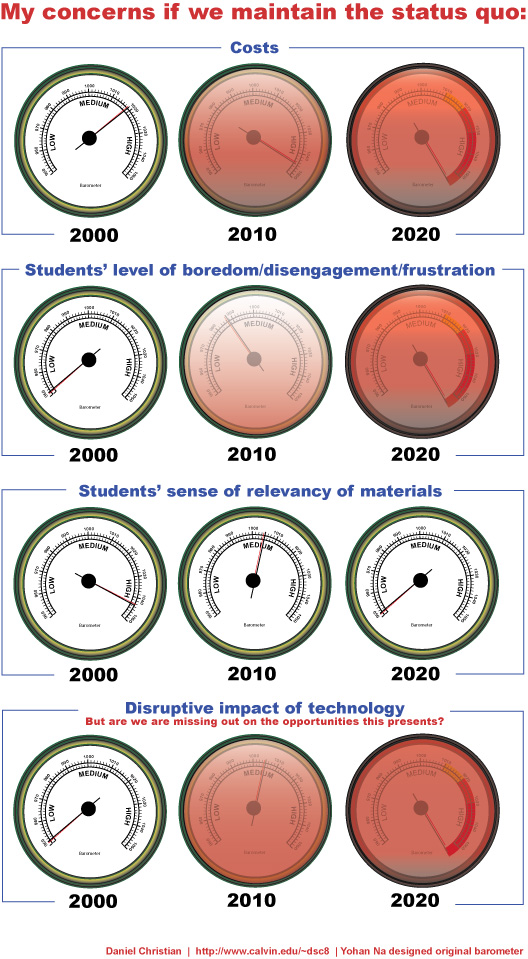
Again, this graphic from 2009 comes to mind:
.


© 2025 | Daniel Christian