What Google’s new open-source software means for artificial-intelligence research — from chronicle.com by Ellen Wexler

Excerpt:

Google wants the artificial-intelligence software that drives the company’s Internet searches to become the standard platform for computer-science scholars in their own experiments.

On Monday, Google announced it would turn its machine-learning software, called TensorFlow, into open-source code, so anyone can use it.

“We hope this will let the machine-learning community — everyone from academic researchers, to engineers, to hobbyists — exchange ideas much more quickly, through working code rather than just research papers,” Google announced on its website.

Until now, researchers have had access to similar open-source software: Torch, built by researchers at New York University, as well as Caffe and Theano, are also open to everyone. TensorFlow is meant to combine the best of the three, Jeff Dean, a top engineer at Google, told Wired.


Also see:

Cognitive technologies: The real opportunities for business
Instructor: David Schatsky
A free course from Deloitte University Press | October 19, 2015 – December 8, 2015

Excerpt of description:

Artificial intelligence (AI) may sound like science fiction, but it is real, and becoming increasingly important to companies in every sector. The field of artificial intelligence has produced a wide variety of “cognitive technologies” that simulate human reasoning and perceptual skills, giving businesses entirely new capabilities and enabling organizations to break prevailing tradeoffs between speed, cost, and quality.

Aimed at a general business audience, this course demystifies artificial intelligence, provides an overview of a wide range of cognitive technologies, and offers a framework to help you understand their business implications. Some experts have called artificial intelligence “more important than anything since the industrial revolution.” That makes this course essential for professionals working in business, operations, strategy, IT, and other disciplines. Throughout the course, participants will build a knowledge base on cognitive technologies to equip them to engage in discussions with colleagues, customers, and suppliers and help them shape cognitive technology strategy in their organization.
 

FutureOfTV-Apple-Oct2015


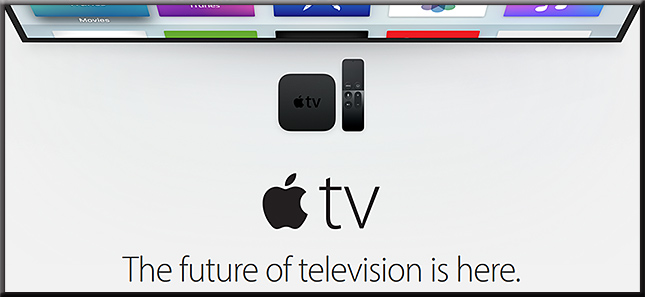
The New Apple TV Invigorates the Set-Top Box — from nytimes.com by Brian Chen

Excerpt:

I NEVER imagined I would get hooked on reading comic books on a TV screen. That changed last week after I picked up a new Apple TV.

The new device, which is similar to a set-top box and brings video and music from the Internet to a television, now has an app store. So I downloaded Madefire, one of the first apps available for the new device. Madefire adds a twist to digital comics with sound effects, music and motion, bringing the panels to life on the big screen. Within minutes, I was bingeing on a series about Superman turning into a corrupt dictator.

Playing with apps is just one new feature of the revamped Apple TV, which will ship this week. It’s that plethora of innovations and apps that leads me to conclude that the upgraded $149 box is now the best TV streaming device you can get for your money.


Apple TV challenges developers to take apps to the big screen — from http://finance.yahoo.com by Julia Love

Excerpt:

(Reuters) – Apple’s loyal army of software developers is joining the tech giant in its bid to conquer the living room with a new version of Apple TV, creating apps for the big screen that they hope will attract users and unlock a rich source of revenue.

A long-awaited update to Apple TV, which launched in 2007, will start shipping in 80 countries on Friday.

Apple views apps as the future of television. An App Store is the centerpiece of the new device, and hundreds of apps will be ready at launch, including gaming, shopping and photography.

Although developers have already been able to make apps for smart TV rivals, Apple’s vast base of developers will set the device apart, analysts say. And developers say they relish the opportunity to reach users in a more intimate setting.


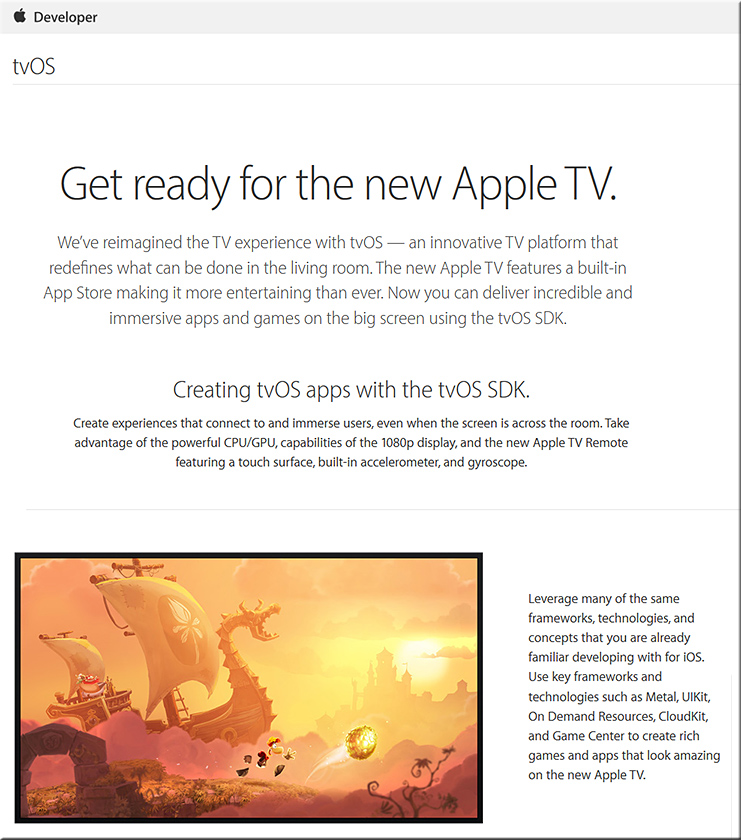
tvOS > Developer information


AppleTV-tvOS-Oct2015


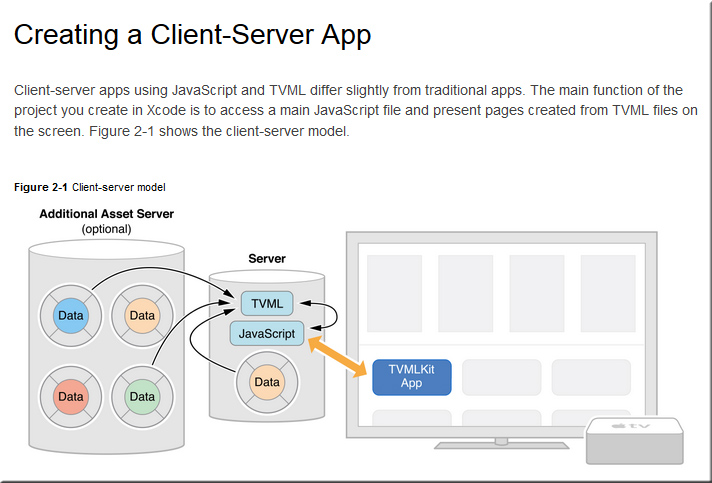
Building Apple TV Apps > Creating a Client-Server App


ClientServerApp-tvOS-Oct2015


Which Apple TV Should You Buy? — from wired.com

Excerpt:

Pre-orders for the new Apple TV have begun. Well, technically, the new Apple TVs; the latest model comes in two sizes. Oh, and the previous version remains available too. For the first time in Apple TV history, you’ve got options. Now it’s time to figure out which one’s right for you.


‘Aerial’ brings beautiful Apple TV video screensavers to your Mac — from 9to5mac.com


screensavers-oct2015


Addendum:


The 50 Most Popular MOOCs of All Time — from onlinecoursereport.com, via Jordan Hall

Excerpt:

MOOCs – or Massive Open Online Courses – are picking up momentum in popularity – at least in terms of initial enrollment.

Unlike regular college/ university courses, MOOCs can attract many thousands of enrollees around the world. They can come in the form of active course sessions with participant interaction, or as archived content for self-paced study. MOOCs can be free, or there can be a charge – either on a subscription basis or a one-time charge. Free MOOCs sometimes have a paid “verified certificate” option. There are now thousands of MOOCs available worldwide from several hundred colleges, universities and other institutions of higher learning. For your convenience, we’ve compiled a list of 50 of the most popular MOOCs, based on enrollment figures for all sessions of a course. The ranking is based on filtering enrollment data for 185 free MOOCs on various elearning platforms.


Google teams up with Udacity to introduce a new tech entrepreneurship nanodegree — from thetechportal.in by Mir Juned Hussain

Excerpt (emphasis DSC):

Google, during its I/O 2015 developer conference in May had announced a partnership with Udacity to launch a six-course Android Development Nanodegree. The company wanted to allow developers to learn how to write apps for Google’s mobile operating system. 

Surprisingly, these new Nanodegrees turned out to the most popular ones by Udacity, attracting more than 300,000 people to enrol in the courses. The web giant wanted anyone, technical or not, to learn not just the basics of how to build Android, iOS, and web apps, but also to explain what it takes to design, validate, prototype, monetize, and market app ideas.

As a part of that initiative, Google has now introduced a new Nanodegree, which will consist of a Tech Entrepreneurship certificate, access to coaches, guidance on your project, help staying on track and career counseling. If all you want is the content, quizzes, and projects, all of that is available online for free at udacity.com/google.


From DSC:
This item made me wonder:

Will setting up nanodegrees become a trend for OS providers?  That is, will Google be more successful in the marketplace than either Apple or Microsoft if they develop a series of nanodegrees?  In fact, taking that one step further…will doing so become a competitive necessity for OS providers?  For other software-related vendors?

Hmmm….


Ginni Rometty: Forget digital—cognitive business is the future — from fortune.com by Laura Lorenzetti
A new era of cognitive business is here.

Excerpt:

IBM Chairman and CEO Ginni Rometty said that a new technological era is upon us, one that marries digital business with digital intelligence. It’s what’s known as cognitive business.

“Digital is the wires, but digital intelligence, or artificial intelligence as some people call it, is about much more than that,”…

Also see:


Addendum on 10/15/15:


Everything You Need To Know From Microsoft’s Massive Hardware Event — from techcrunch.com by Alex Wilhelm

Excerpt:

Microsoft [on 10/6/15] announced a grip of new hardware, including Surface products, high-end smartphones, a wearable, Windows 10 for the Xbox One and its first laptop.

The laptop, called the Surface Book, stunned in an event marked largely by products Microsoft watchers were expecting.


Introducing Surface Book & Surface Pro 4 — from microsoft.com


SurfacePro-MS-10-6-2015


Microsoft’s HoloLens Developer Edition Gets Date and Price — from vrfocus.com by Jamie Feltham

Excerpt:

Speaking at a Windows 10 briefing [on10/6/15] the company confirmed that applications for a HoloLens development kit are now open. Successful applicants will be able to pick up a kit for some $3,000 USD, and it will be arriving in the first quarter of 2016.

.


First HoloLens Prototypes Showcased — from vrfocus.com by Jamie Feltham

Excerpt:

Microsoft’s HoloLens mixed reality (MR) head-mounted display (HMD) is still a relatively new concept, having only been revealed to the public in January 2015. The device has remained shrouded in mystery since that time, making a handful of showings at events such as E3. The company has revealed a lot more about the kit [on 10/6/15], though, confirming that the anticipated Development Edition will be arriving in Q1 2016 for applicants in the USA and Canada at a price of $3,000 USD. Now a new video has been revealed giving a glimpse at the kit’s origins.


The new Microsoft Band offers Cortana integration, VO2 monitoring and Golf cards — from digitaltrends.com by David Curry

Excerpt:

Microsoft announced the second generation of the Microsoft Band at its event [on 10/6/15], a small update adding a new, more functional design and two sensors to track elevation and VO2 monitoring.


Addendum on 10/9/15:


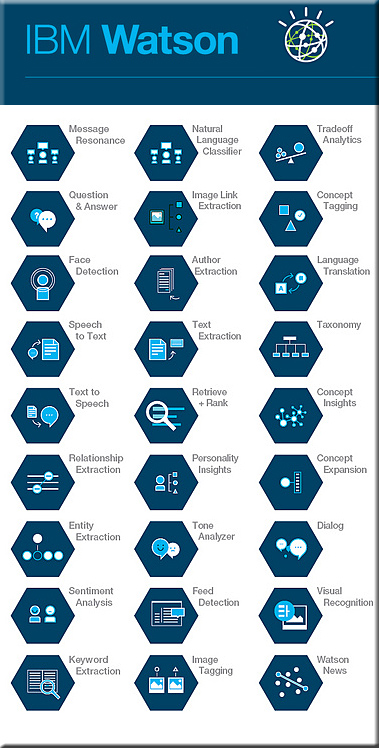
IBM Expands Watson Platform for Next Generation of Builders; Extends Industry’s Largest Portfolio of Cognitive APIs — from ibm.com

– New APIs Broaden Watson’s Language, Vision and Speech Capabilities
– Developer Tools Simplify Combining APIs and Data
– Upcoming Platform Innovations Previewed including Industry Data Sets & Robotics Integration
– New Watson Hub to Open in San Francisco

Excerpt:

SAN FRANCISCO – 24 Sep 2015: IBM (NYSE: IBM) today expanded the industry’s largest and most diverse set of cognitive APIs, technologies and tools for developers who are creating products, services and applications embedded with Watson.

The announcement was made by IBM during its forum on cognitive computing and Artificial Intelligence, where the company announced a new Watson location in San Francisco. IBM also previewed new platform innovations and research projects that will extend its industry-leading cognitive portfolio.


Excerpts from IBM Watson Ecosystem Partners in Market Building Businesses:

Student Career Counseling: Carney Labs is an education technology company that provides a platform embedded with Watson language capabilities to help schools learn about a student’s personality characteristics in order to build them a career roadmap. The Commonwealth of Virginia adopted a policy for all high schools in the state to leverage this app to use with students entering their freshman year.

Knowledge Management: Bloomfire  is a cloud-based knowledge network platform that helps employees within a company easily find the information they need to do their jobs. By scanning posts within the platform and automatically creating tags via the Watson data insights API, employees at companies including Whole Foods, Dun & Bradstreet and Etsy spend less time searching for information and more time doing meaningful work to improve company performance.

Research & Development: Inno360, an enterprise research and innovation management platform provider, is embedding a powerful combination of 7 Watson APIs for language and data insights into its SaaS platform to transform the way its clients, including Fortune 50 companies, conduct research and process big data. Inno360 is able to provide its clients advanced analysis of their R&D data to resolve product issues quickly and bring new products to market more rapidly.

Talent Sourcing and Matching: UnitesUs is a cloud based hiring & recruitment platform utilizing cognitive computing and big data analysis to match prospective employees to hiring organizations based on personality, company cultural fit, and core qualifications. By analyzing the personalities of job candidates leveraging Watson language capabilities and characterizing a company’s work environment, UnitesUs uses proprietary, automated matching algorithms to help companies, including imaging and electronics company Ricoh USA and fitness gym chain 24 Hour Fitness, make better hiring decisions.


ibmwatson-sept2015


From DSC:
The following app looks to be something that the “makers” of the programming world might be interested in. Also, it could be great for those learners interested in engineering, robotics, and/or machine-to-machine communications; using this app could help start them down a very promising path/future.


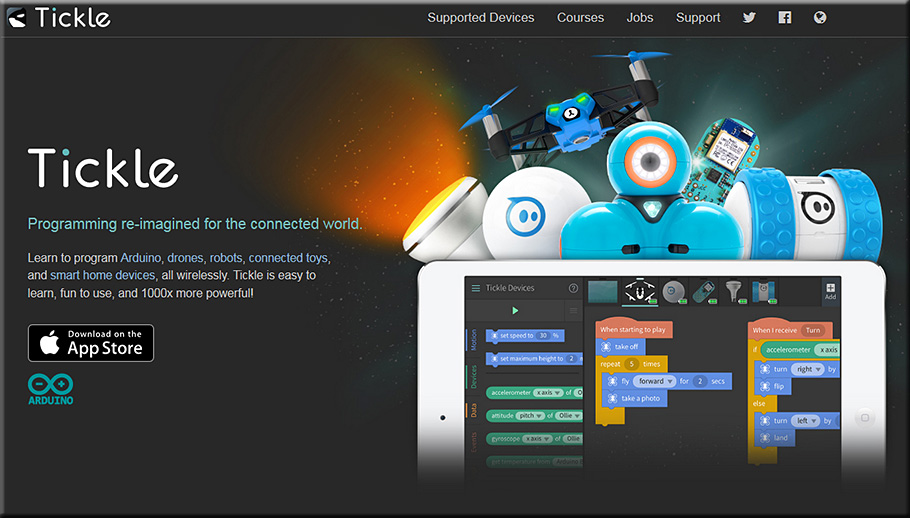
Tickle-Sept2015

From their website:

Programming re-imagined for the connected world.
Learn to program Arduino, drones, robots, connected toys, and smart home devices, all wirelessly. Tickle is easy to learn, fun to use, and 1000x more powerful!

Easy to learn, yet incredibly powerful!
Start learning programming the same way as Computer Science courses at Harvard and UC Berkeley. Tickle is used by makers and designers around the world to create custom robots and interactive projects, including Stanford University computer scientists.

Spark your imagination.
Create stunning games and interactive stories using our library of animated characters and sounds. With the ability to program devices to interact with other devices and virtual characters, the possibilities are limitless.

1000X the super (programming) power.
If you’ve tried Scratch, Hopscotch, Tynker, Blockly, Scratch Jr, Kodable, Pyonkee, mBlock, or Code.org, now you can go beyond the screen and program your own connected future.


Networks and the Nature of the Firm — from medium.com by Tim O’Reilly
The discussion around companies like Uber and Airbnb is too narrow. The issue isn’t just employment, but a huge economic shift led by software and connectedness.

Excerpt:

One of the themes we’re exploring at the Next:Economy summit is the way that networks trump traditional forms of corporate organization, and how they are changing traditional ways of managing that organization. Uber and Airbnb are textbook examples of this trend. Uber has ambitious plans to manage hundreds of thousands?—?eventually even millions?—?of independent drivers with a small core of employees building a technology platform that manages those workers. Airbnb is on track to have more rooms on offer than large hotel chains, with under a thousand employees.

…

But the Internet takes the networked firm to a new level. Google, the company that ended up as the prime gateway to the World Wide Web, provides access to a universe of content that it doesn’t own yet has become the largest media company in the world. 13–24 years olds already watch more video on YouTube, much of it user-contributed, than they watch on television. And Amazon just surpassed WalMart as the world’s most valuable retailer by offering virtually unlimited selection, including marketplace items from ordinary individuals and small businesses


From DSC:
Are we neglecting to ask some key questions within higher education? I’ll get to those questions in a moment, the ones that came to my mind after seeing the following posting:


The robots are coming for your job! Why digital literacy is so important for the jobs of the future — from theconversation.com

Excerpt (emphasis DSC):

In a report released this week, the Foundation for Young Australians (FYA) claims that up to 70% of young people are preparing for jobs that will no longer exist in the future. The report also raises concerns about decreasing entry-level occupations for school leavers and the impacts of automation.

In another recent report, the Committee for Economic Development of Australia predicts that:

almost five million Australian jobs – around 40% of the workforce – face the high probability of being replaced by computers in the next 10 to 15 years.

…

The FYA report also makes the case for increased emphasis on developing digital literacy and the implementation of a digital technologies curriculum in primary school.

Digital literacy includes skills such as coding, data synthesis and manipulation, as well as the design, use and management of computerised, digital and automated systems. Success in the new work order requires these skills alongside lateral thinking, innovation, problem-solving, collaboration and entrepreneurship. Add these to the traditional literacy skills of reading and writing and you have a very complex picture of what literacy is.


With automation a real threat to future jobs, school curricula have to keep up with the times.


From DSC:
The article raises an important point: “At the same time, the question of how we are preparing students in our schools for the new work order also bears serious consideration.”

I couldn’t agree more, as there are enormous ramifications to this topic/question: Are we, in fact, preparing our students for the future that they will inherit? 

I suppose I could have also titled this posting, “More reasons to support the liberal arts,” as the liberal arts lay a strong foundation for many of the twists and turns that our students (and ourselves) will encounter down the road. 

However, I fear that even within our liberal arts programs, we aren’t offering quite enough new courses that would help our students deal with a rapidly changing world.  For example, I would like to see more courses on futurism offered — training students to look up and pulse check a variety of items that could impact them, their families, or their businesses in the future. Also, I don’t think they are going to know how to run their own businesses or to effectively freelance, something that 30-50% of them are going to need to do (depending upon which articles and reports one reads).

Also, why aren’t we offering more online-based opportunities for students to encounter learning opportunities and discussions that involve people from all over the globe? Won’t they be on project teams like that in the future? Isn’t that occurring already?

What do you think…how are we doing here? How are things in your city, state, or country?


The 3 instructional shifts that will redefine the college professor — from edsurge.com by Ryan Craig

Excerpts:

As faculty at colleges and universities are all too aware, it’s hard to do two jobs at the same time. Since the advent of the modern research university over a century ago, faculty have effectively held down two jobs: conducting (and publishing) research and teaching students.

Arguments for the dual-role professor seem logical. Knowledge production should make one a better instructor. Students should benefit from teachers producing the latest knowledge. But there’s precious little data to support that adding the research job to the instruction job improves student outcomes.

The downside is that both jobs require significant expertise and commitment to do well.
…
There is an emerging consensus as to what works best for onground instruction. It’s called the Dynamic Classroom, and it looks like this:

  • Flip classroom so “transfer of information” occurs ahead of class
  • Incorporate technology in the classroom (handheld clickers or smartphone apps) to quickly ascertain whether students have understood key concepts
  • Integrate active learning techniques to improve understanding of key concepts, including peer learning, group problem solving, project-based learning and experiential learning via studios and workshops
  • Include “perspective transformation” exercises wherein students change their frames of reference by critically reflecting on their assumptions


From DSC:
First of all, I second the idea of splitting up the responsibilities of researching and teaching. Both roles are full-time jobs and require different skillsets. With students paying ever higher tuition bills, students deserve to take their courses from professors who know how to teach (not an easy job by the way!). 

But the unbundling doesn’t — and shouldn’t — stop with the splitting up of the teaching and research roles.

Let’s look at another of the instructional shifts that Ryan considers — and that is the move towards the use of smartphones and apps:

In this environment, we can imagine one app for Economics 101 and another for Psychology 110. They are also the ideal platform for simulations and gamified learning and can tailor the user experience further by incorporating real-world inputs (e.g., location of the student) into the material. But, like the dynamic classroom, apps require an unparalleled level of development and instructional expertise—a full-time job for faculty who will be teaching online.

I think there’s some serious potential with this approach, especially given the trend towards more mobile computing and the affordances that come with using mobile technologies.

However, when we start delivering teaching and learning experiences that involve the digital/virtual realm like this, we’re instantly catapulted into a world that requires additional skills. As such, I highly doubt that the majority of faculty members have the time, interests, passions, or the abilities/gifts to code such apps.  They would have to simultaneously be (or become) a programmer/developer, an instructional designer, a graphic designer, a copyright expert, an expert in accessibility, instantly knowledgeable in user interface and user experience design, as well as continue to serve as the Subject Matter Expert (SME) — and I could list other roles as well. That is why we need TEAMS of specialists. If the trends towards moving more of our teaching and learning experiences online and/or into such digital realms continue, then our current models simply won’t cut it anymore, at least in the majority of cases.

I appreciate Ryan’s article and second the main idea of splitting up the teaching and researching responsibilities. But again, when we’re talking developing apps, we had better be talking employing the use of teams — or the students will likely not be better off.

—–

A related quote from “In Sign of the Times for Teaching, More Colleges Set Up Video-Recording Studios” — from The Chronicle

At some colleges, media teams sit down with professors ahead of time and lay out long-term strategies to determine how video may enhance the learning experience of students in their courses.
…

The media team offers instructors a number of planning worksheets to encourage them to think more about the purpose of videos in their courses.


 —–


Hackathons as a new pedagogy — from edutopia.org by Brandon Zoras

Excerpts:

Students are coming out of school expected to solve 21st-century problems and enter into occupations that haven’t even been imagined yet. Schooling is not designed in this manner, so we wanted to give students an opportunity to solve problems in authentic contexts, using 21st-century skills and collaboration techniques. We wanted to break down walls between classrooms and have students use interdisciplinary skills to solve problems with teams of their peers, with mentors, and with industry professionals.

Why a Hackathon?
Hackathons have become a new way of doing business, creating products, advancing healthcare, and innovation. The energy is high, and so are the stakes. Can you turn an idea into a product over the course of a weekend? But let’s move beyond that. Let’s look at the teaching and learning within a hackathon. Hackathons are really the ultimate classroom.
…
It is within hackathons that students are utilizing their skills and knowledge to solve problems. It’s project-based learning, inquiry-based learning, and STEM all wrapped up into one activity! It’s about design thinking and truly a 21st-century learning opportunity. Students are working collaboratively within mixed-ability groups to examine problems and come up with solutions.
…
Benefits For Students
A huge learning factor is failure. Often, school protects students from failure, and students always manage to mix A with B to get C. The hackathon, though, enables a support system where, once an obstacle or failure throws a wrench in students’ plans, they work as a team to get around it.


So you want to be a data scientist: A guide for college grads — from datanami.com by Alex Woodie

Excerpt:

The first piece of advice for budding data scientists is not to get frustrated by the job requirements. No recent college grad can fill is simultaneously a math/statistics genius, an expert in marketing/derivatives /cybersecurity, and a pro Python/Java/R coder. (Hint: That’s why data scientists are called unicorns—because they don’t exist!)

“There are many skills under the umbrella of data science, and we should not expect any one single person to be a master of them all,” says Kirk Borne, a data scientist with Booz Allen Hamilton. “The best solution to the data science talent shortage is a team of data scientists. So I suggest that you become expert in two or more skill areas, but also have a working knowledge of the others.”

According to Borne, you’ll do well by yourself to bone up on core data science skills such as machine learning, information retrieval, statistics, and data and information visualization. You’ll also want to know your way around a databases and data structures and have at least some programming languages under your belt, such as Python, R, SAS, or Spark. Familiarity with graph analysis, natural language processing, and optimization also looks good on your data science resume, as do data modeling and simulation.

“The good news for physics, biology, astronomy, chemistry, and other science students is that they can easily translate their science skills into a data science profession,” he says.


25 impact opportunities in U.S. K-12 education — by Getting Smart in partnership with Vulcan, Inc.

Excerpt:

With support from Vulcan Inc, a Paul Allen company, Getting Smart conducted a series of expert interviews with education and philanthropy leaders, and led a design workshop, to identify and vet impact investment strategies in U.S. K-12 education. This resulting report outlines opportunities where organizations can participate in making significant shifts in the American education landscape, ultimately improving student outcomes.

Through our research and interviews, approximately four dozen impact opportunities were identified in the following 10 categories and are described within the report:

  1. Student-Centered Learning
  2. New School Development
  3. Professional Learning & Development
  4. Next-Gen Assessment
  5. Entrepreneurship Education
  6. Portable Data & Parent Engagement
  7. Learning Resources
  8. Social-Emotional Learning
  9. Early Learning
  10. STEM, Coding & Computer Science


Also see:

EdTech 10: When impact potential is ripe — from gettingsmart.com

Excerpts:

1. Microschool, big impact. We’ve seen how microschools could, in most cities, accelerate the transition to next-gen learning. That’s why we were so excited to see AltSchool highlighted in a video on CBS News This Morning.
…
4. Mind the gap. Closing the Achievement at Three Virtual Academies, is a new report from K12 that highlights the progress of Texas Virtual Academy (leaders in Course Access in the Lone Star State), Arizona Virtual Academy, and Georgia Cyber Academy in creating opportunities for low-income students.


Everything you need to know from today’s Apple WWDC Keynote — from techcrunch.com by Greg Kumparak

Excerpts:

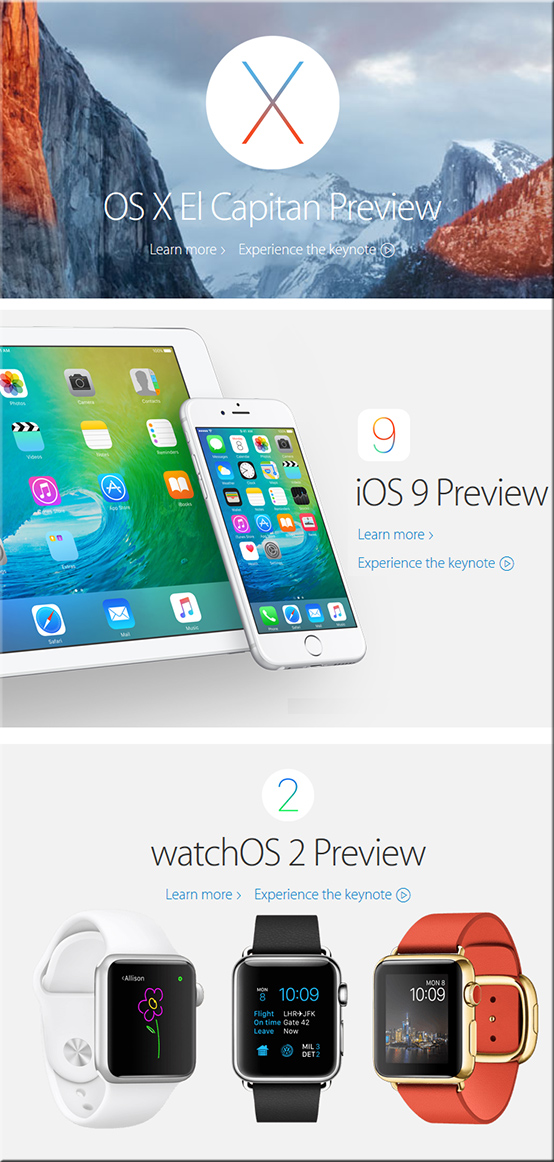
  • The Next Version Of OS X — Apple announced OS X 10.11, or “OS X El Capitan”.
  • iOS 9
  • Siri is getting smarter
  • Split Screen iPad Apps: Perhaps the biggest feature of all, and something that has been rumored for ages: the iPad is getting split screen apps. You’ll now be able to run two apps at once, side by side. (Split screen iPad apps are limited to the latest/most powerful iPad hardware: the iPad Air 2)
  • Picture in picture video
  • CarPlay goes wireless
  • Swift 2: Apple also announce Swift 2, the second iteration of their new programming language.
  • watchOS 2
  • Apple Music: As long rumored, Apple is launching a Spotify/Rdio competitor. It’s $9.99 per month, or $14.99 on a family plan (with support for up to 6 accounts)


The Apple Watch just got a lot more useful — from fastcompany.com by John Paul Titlow
Apple’s WatchOS 2 is here and it will let developers build native, much more capable apps.

If you had your doubts about the Apple Watch, Cupertino just made it much more interesting. At the Worldwide Developers Conference this morning, Apple announced WatchOS 2, a new version of the watch’s operating system that lets developers build native apps for the device.

Watch OS 2 will also ship with a number of new features, like the ability to set photo watch faces, reply to email, take FaceTime audio calls, use Apple Pay’s new virtual loyalty cards, and get mass transit directions.


Apple introduces “News”: An old idea with big potential — from fastcompany.com by John Paul Titlow
WWDC 2015 Update: Apple just unveiled News, a Flipboard-Style news aggregation app that will ship with iOS 9.

Excerpt:

Apple is now a Flipboard competitor. When iOS 9 ships in the fall, it will include a new app called News, a newspaper, magazine, and blog aggregator that will feel very familiar to anyone who’s ever used Flipboard, Pulse, or one of the many other apps of this nature. The new app was unveiled by Apple’s vice president of Product Marketing, Susan Prescott, this afternoon at the company’s Worldwide Developers Conference.


Apple Maps in iOS 9 adds public transit, local business search — from cio.com by Marco Tabini


Apple-6-8-15


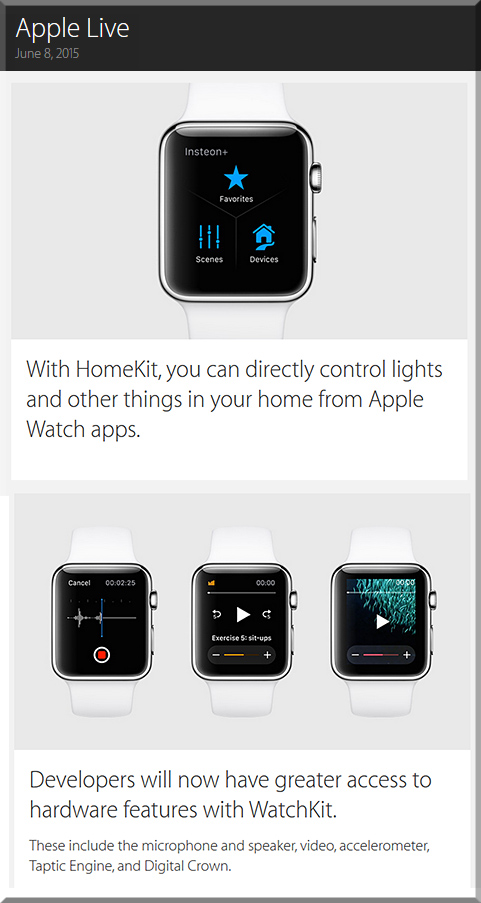
AppleHomekit-Watch-6-8-15


Kevin shows some of the great things developers can do with the new version of WatchKit.

 
© 2025 | Daniel Christian