Is the Legal Profession Ready to Win the AI Race? America’s AI Action Plan Has Fired the Starting Gun — from denniskennedy.com by Dennis Kennedy
The Starting Gun for Legal AI Has Fired. Who in Our Profession is on the Starting Line?

The legal profession’s “wait and see” approach to artificial intelligence is now officially obsolete.

This isn’t hyperbole. This is a direct consequence of the White House’s new Winning the Race: America’s AI Action Plan. …This is the starting gun for a race that will define the next fifty years of our profession, and I’m concerned that most of us aren’t even in the stadium, let alone in the starting blocks.

If the Socratic Method truly means anything, isn’t it time we applied its rigorous questioning to ourselves? We must question our foundational assumptions about the billable hour, the partnership track, our resistance to new forms of legal service delivery, and the very definition of what it means to be “practice-ready” in the 21st century. What do our clients, our students, and users of the legal system need?

The AI Action Plan forces a fundamental re-imagining of our industry’s core jobs.

The New Job of Legal Education: Producing AI-Capable Counsel
The plan’s focus on a “worker-centric approach” is a direct challenge to legal academia. The new job of legal education is no longer just to teach students how to think like a lawyer, but how to perform as an AI-augmented one. This means producing graduates who are not only familiar with the law but are also capable of leveraging AI tools to deliver legal services more efficiently, ethically, and effectively. Even more importnat, it means we must develop lawyers who can give the advice needed to individuals and companies already at work trying to win the AI race.


Ben Bernanke and Janet Yellen: The Fed Must Be Independent — an opinion from nytimes.com by Ben Bernanke and Janet Yellen; this is a gifted article

As former chairs of the Federal Reserve, we know from our experiences and our reading of history that the ability of the central bank to act independently is essential for its effective stewardship of the economy. Recent attempts to compromise that independence, including the president’s demands for a radical reduction in interest rates and his threats to fire its chair, Jerome Powell, if the Fed does not comply, risk lasting and serious economic harm. They undermine not only Mr. Powell but also all future chairs and, indeed, the credibility of the central bank itself.

Independence for the Federal Reserve to set interest rates does not imply a lack of democratic accountability. Congress has set in law the goals that the Fed must aim to achieve — maximum employment and stable prices — and Fed leaders report regularly to congressional committees on their progress toward those goals. Rather, independence means that monetary policymakers are permitted to use fact-based analysis and their best professional judgment in determining how best to reach their mandated goals, without regard to short-term political pressures.

Of course, Fed policymakers, being human, make mistakes. But an overwhelming amount of evidence, drawn from the experiences of both the United States and other countries, has shown that keeping politics out of monetary policy decisions leads to better economic outcomes.


Digital Accessibility in 2025: A Screen Reader User’s Honest Take — from blog.usablenet.com by Michael Taylor

In this post, part of the UsableNet 25th anniversary series, I’m taking a look at where things stand in 2025. I’ll discuss the areas that have improved—such as online shopping, banking, and social media—and the ones that still make it challenging to perform basic tasks, including travel, healthcare, and mobile apps. I hope that by sharing what works and what doesn’t, I can help paint a clearer picture of the digital world as it stands today.


Why EAA Compliance and Legal Trends Are Shaping Accessibility in 2025 — from blog.usablenet.com by Jason Taylor

On June 28, 2025, the European Accessibility Act (EAA) officially became enforceable across the European Union. This law requires digital products and services—including websites, mobile apps, e-commerce platforms, and software to meet the defined accessibility standards outlined in EN 301 549, which aligns with the WCAG 2.1 Level AA.

Companies that serve EU consumers must be able to demonstrate that accessibility is built into the design, development, testing, and maintenance of their digital products and services.

This milestone also arrives as UsableNet celebrates 25 years of accessibility leadership—a moment to reflect on how far we’ve come and what digital teams must do next.


Trump officials accused of defying 1 in 3 judges who ruled against him — from washingtonpost.com by Justin Jouvenal
A comprehensive analysis of hundreds of lawsuits against Trump policies shows dozens of examples of defiance, delay and dishonesty, which experts say pose an unprecedented threat to the U.S. legal system.

President Donald Trump and his appointees have been accused of flouting courts in a third of the more than 160 lawsuits against the administration in which a judge has issued a substantive ruling, a Washington Post analysis has found, suggesting widespread noncompliance with America’s legal system.

Plaintiffs say Justice Department lawyers and the agencies they represent are snubbing rulings, providing false information, failing to turn over evidence, quietly working around court orders and inventing pretexts to carry out actions that have been blocked.

.

The Post examined 337 lawsuits filed against the administration since Trump returned to the White House and began a rapid-fire effort to reshape government programs and policy. As of mid-July, courts had ruled against the administration in 165 of the lawsuits. The Post found that the administration is accused of defying or frustrating court oversight in 57 of those cases — almost 35 percent.


DC: How is making a mockery of the justice system making America great again? I don’t think any one of us would benefit from living in a land with no laws. It would be absolute chaos.


From DSC:
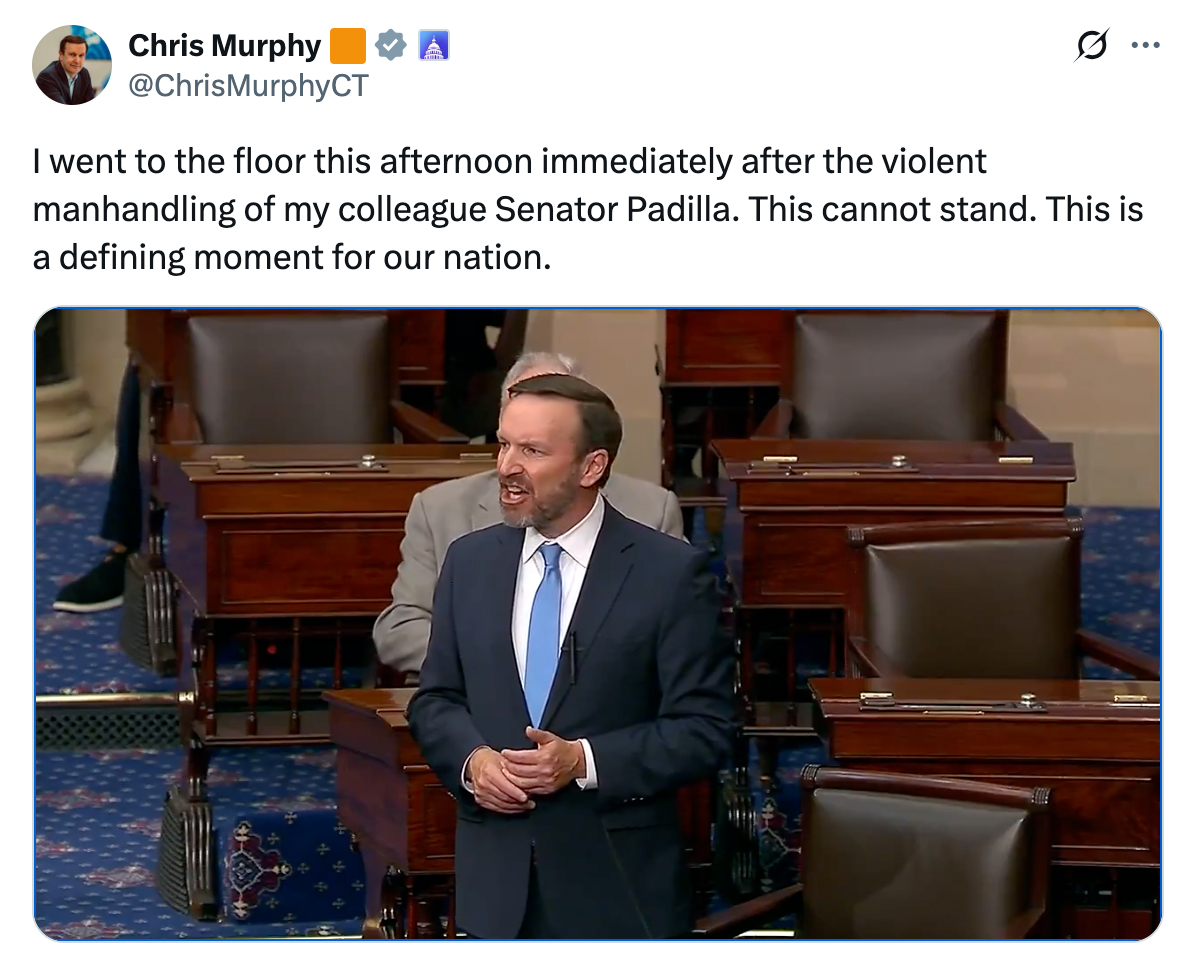
As you can see and hear below, Senator Alex Padilla had been trying to get answers for several weeks now from Homeland Security, but wasn’t hearing much back. So he heard that the Secretary of Homeland Security, Kristi Noem, was holding a press conference down the hallway and he attended it to see if he could get some answers to his questions. And while I don’t have all the details on how this situation unfolded, there is NO WAY that a U.S. Senator should be pushed out of a conference room and then pushed to the ground and handcuffed for trying to get answers for his constituents! No way!

As others in the videos below assert, a line has been crossed in our country!

Let’s move to impeach Donald Trump and also rid his administration of these incompetent individuals who are destroying our democracy! If they don’t like the Constitution and how our country has been governed for over 200 years, then perhaps they should consider leaving this country. 

The actions they are taking are NOT making America great again. They are making America the stench of the world.

And it’s not just Donald Trump and members of his administration that should be held accountable. Let’s also start holding Donald’s instruments of power — such as his ICE Agents and others who behave like them — accountable. To any ICE agents out there, take those damn masks off. You shouldn’t be hiding behind masks.

By the way, the silence from the Republicans is deafening.
.


Calif. Senator Forcibly Removed and Handcuffed After Interrupting Noem — from nytimes.com by Shawn Hubler, Jennifer Medina, and Jill Cowan (this is a gifted article)
Alex Padilla, Democrat of California, was shoved out of a room and handcuffed after he tried to question Kristi Noem, the homeland security secretary, during a news conference.

In the tense hyperpartisanship of the moment, the episode quickly swelled into a cause célèbre for both parties. Democratic senators, House members and governors rushed to denounce the treatment of a sitting senator, framing it as the latest escalation in authoritarian actions by the Trump administration. It followed the indictment on Tuesday of Representative LaMonica McIver of New Jersey and the arrest of Mayor Ras Baraka of Newark, after the officials, both Democrats, tried to visit a new immigration detention facility in the city.

Republicans just as eagerly tried to frame Mr. Padilla’s behavior as in line with what they have called the lawlessness of the political left as President Trump tries to combat illegal immigration.


“The AI-enhanced learning ecosystem” [Jennings] + other items re: AI in our learning ecosystems

The AI-enhanced learning ecosystem: A case study in collaborative innovation — from chieflearningofficer.com by Kevin Jennings
How artificial intelligence can serve as a tool and collaborative partner in reimagining content development and management.

Learning and development professionals face unprecedented challenges in today’s rapidly evolving business landscape. According to LinkedIn’s 2025 Workplace Learning Report, 67 percent of L&D professionals report being “maxed out” on capacity, while 66 percent have experienced budget reductions in the past year.

Despite these constraints, 87 percent agree their organizations need to develop employees faster to keep pace with business demands. These statistics paint a clear picture of the pressure L&D teams face: do more, with less, faster.

This article explores how one L&D leader’s strategic partnership with artificial intelligence transformed these persistent challenges into opportunities, creating a responsive learning ecosystem that addresses the modern demands of rapid product evolution and diverse audience needs. With 71 percent of L&D professionals now identifying AI as a high or very high priority for their learning strategy, this case study demonstrates how AI can serve not merely as a tool but as a collaborative partner in reimagining content development and management.
.


How we use GenAI and AR to improve students’ design skills — from timeshighereducation.com by Antonio Juarez, Lesly Pliego and Jordi Rábago who are professors of architecture at Monterrey Institute of Technology in Mexico; Tomas Pachajoa is a professor of architecture at the El Bosque University in Colombia; & Carlos Hinrichsen and Marietta Castro are educators at San Sebastián University in Chile.
Guidance on using generative AI and augmented reality to enhance student creativity, spatial awareness and interdisciplinary collaboration

Blend traditional skills development with AI use
For subjects that require students to develop drawing and modelling skills, have students create initial design sketches or models manually to ensure they practise these skills. Then, introduce GenAI tools such as Midjourney, Leonardo AI and ChatGPT to help students explore new ideas based on their original concepts. Using AI at this stage broadens their creative horizons and introduces innovative perspectives, which are crucial in a rapidly evolving creative industry.

Provide step-by-step tutorials, including both written guides and video demonstrations, to illustrate how initial sketches can be effectively translated into AI-generated concepts. Offer example prompts to demonstrate diverse design possibilities and help students build confidence using GenAI.

Integrating generative AI and AR consistently enhanced student engagement, creativity and spatial understanding on our course. 


How Texas is Preparing Higher Education for AI — from the74million.org by Kate McGee
TX colleges are thinking about how to prepare students for a changing workforce and an already overburdened faculty for new challenges in classrooms.

“It doesn’t matter if you enter the health industry, banking, oil and gas, or national security enterprises like we have here in San Antonio,” Eighmy told The Texas Tribune. “Everybody’s asking for competency around AI.”

It’s one of the reasons the public university, which serves 34,000 students, announced earlier this year that it is creating a new college dedicated to AI, cyber security, computing and data science. The new college, which is still in the planning phase, would be one of the first of its kind in the country. UTSA wants to launch the new college by fall 2025.

But many state higher education leaders are thinking beyond that. As AI becomes a part of everyday life in new, unpredictable ways, universities across Texas and the country are also starting to consider how to ensure faculty are keeping up with the new technology and students are ready to use it when they enter the workforce.


In the Room Where It Happens: Generative AI Policy Creation in Higher Education — from er.educause.edu by Esther Brandon, Lance Eaton, Dana Gavin, and Allison Papini

To develop a robust policy for generative artificial intelligence use in higher education, institutional leaders must first create “a room” where diverse perspectives are welcome and included in the process.


Q&A: Artificial Intelligence in Education and What Lies Ahead — from usnews.com by Sarah Wood
Research indicates that AI is becoming an essential skill to learn for students to succeed in the workplace.

Q: How do you expect to see AI embraced more in the future in college and the workplace?
I do believe it’s going to become a permanent fixture for multiple reasons. I think the national security imperative associated with AI as a result of competing against other nations is going to drive a lot of energy and support for AI education. We also see shifts across every field and discipline regarding the usage of AI beyond college. We see this in a broad array of fields, including health care and the field of law. I think it’s here to stay and I think that means we’re going to see AI literacy being taught at most colleges and universities, and more faculty leveraging AI to help improve the quality of their instruction. I feel like we’re just at the beginning of a transition. In fact, I often describe our current moment as the ‘Ask Jeeves’ phase of the growth of AI. There’s a lot of change still ahead of us. AI, for better or worse, it’s here to stay.


AI-Generated Podcasts Outperform Textbooks in Landmark Education Study — form linkedin.com by David Borish

A new study from Drexel University and Google has demonstrated that AI-generated educational podcasts can significantly enhance both student engagement and learning outcomes compared to traditional textbooks. The research, involving 180 college students across the United States, represents one of the first systematic investigations into how artificial intelligence can transform educational content delivery in real-time.


What can we do about generative AI in our teaching?  — from linkedin.com by Kristina Peterson

So what can we do?

  • Interrogate the Process: We can ask ourselves if we I built in enough checkpoints. Steps that can’t be faked. Things like quick writes, question floods, in-person feedback, revision logs.
  • Reframe AI: We can let students use AI as a partner. We can show them how to prompt better, revise harder, and build from it rather than submit it. Show them the difference between using a tool and being used by one.
  • Design Assignments for Curiosity, Not Compliance: Even the best of our assignments need to adapt. Mine needs more checkpoints, more reflective questions along the way, more explanation of why my students made the choices they did.

Teachers Are Not OK — from 404media.co by Jason Koebler

The response from teachers and university professors was overwhelming. In my entire career, I’ve rarely gotten so many email responses to a single article, and I have never gotten so many thoughtful and comprehensive responses.

One thing is clear: teachers are not OK.

In addition, universities are contracting with companies like Microsoft, Adobe, and Google for digital services, and those companies are constantly pushing their AI tools. So a student might hear “don’t use generative AI” from a prof but then log on to the university’s Microsoft suite, which then suggests using Copilot to sum up readings or help draft writing. It’s inconsistent and confusing.

I am sick to my stomach as I write this because I’ve spent 20 years developing a pedagogy that’s about wrestling with big ideas through writing and discussion, and that whole project has been evaporated by for-profit corporations who built their systems on stolen work. It’s demoralizing.


Republican Bill Would Limit Judges’ Contempt Power — from nytimes.com by Michael Gold (this is a gifted article)
Democrats have argued that House Republicans’ measure would rob courts of their power by stripping away any consequences for officials who ignore judges’ rulings.

The sprawling domestic policy bill Republicans pushed through the House [last] Thursday would limit the power of federal judges to hold people in contempt, potentially shielding President Trump and members of his administration from the consequences of violating court orders.

Republicans tucked the provision into the tax and spending cut bill at a time when they have moved aggressively to curb the power of federal courts to issue injunctions blocking Mr. Trump’s executive actions. It comes as federal judges have opened inquiries about whether to hold the Trump administration in contempt for violating their orders in cases related to its aggressive deportation efforts.


From DSC:
This is deeply disappointing to see that this sneaky little provision was tucked away in a 1,000+ page bill. It’s highly likely that it’s from Donald Trump himself — as he stands in contempt of court from a Supreme Court ruling from several weeks ago. But what is equally troubling is that the Republican “leadership” is good with it too, evidently. Shame on them. This isn’t leadership. This is tyranny and a blatant disregard for the rule of law.

What’s even more troubling about the whole Trump situation is that just over half of America put him there. For those who put him in office, I’m not sure how they can tell their children not to lie. Because if a person voted for Donald Trump, they no longer care about someone telling the truth.

Character matters. Ethics and morals matter. The Constitution matters. People matter. America matters. The rule of law matters. Justice matters.  We need to take a serious look in the mirror.


We Visited Rumeysa Ozturk in Detention. What We Saw Was a Warning to Us All. — from nytimes.com by Edward J. Markey, Jim McGovern, and Ayanna Pressley. This is a gifted article.

When we met Ms. Ozturk in Basile, she told us she feared for her life when she was taken off the streets of her neighborhood, not knowing who had grabbed her or where they were taking her. She said that at each step of her transit — from Massachusetts to New Hampshire to Vermont to Louisiana — her repeated requests to contact her lawyer were denied. Inside the detention center, she was inadequately fed, kept in facilities with extremely cold temperatures and denied personal necessities and religious accommodations. She suffered asthma attacks for which she lacked her prescribed medication. Despite all this — and despite being far away from her loved ones — we were struck by her unwavering spirit.

Why did the Trump administration target her? By all accounts, it’s because she was one of the authors of an opinion essay for The Tufts Daily criticizing her university’s response to resolutions that the Tufts student senate passed regarding Israel and Gaza.

This is not immigration enforcement. This is repression. This is authoritarianism.
.

.


Fight the Trump Administration’s Defiance of the Constitution and Courts — from 5calls.org

On April 14th, the Trump administration openly defied a unanimous order from the Supreme Court by refusing to bring back a person they knowingly sent to a torture prison in El Salvador by mistake.

Since Day 1, the Trump administration has been consistently eroding the constitutional separation of powers and system of checks and balances. They have…


From DSC:
Be more like Harvard.

Harvard sues the Trump administration in escalating confrontation — from washingtonpost.com by Susan Svrluga and Danielle Douglas-Gabriel
Lawsuit argues that government actions, including freezing $2.2 billion in federal funding, violated the First Amendment and didn’t follow legal procedures.

Harvard University sued the Trump administration in federal court Monday, the latest move in the escalating feud between the nation’s wealthiest school and the White House.

The lawsuit, filed in U.S. District Court in Massachusetts against multiple federal agencies, seeks to block the Trump administration from withholding federal funding “as leverage to gain control of academic decision making at Harvard.”

Alan M. Garber, the president of Harvard, said in a message to the university community Monday that the Trump administration’s actions are unlawful and beyond the government’s authority.

From DSC:
Trump has WAAAAY overstepped his jurisdiction and has crossed boundaries left and right. He has single-handedly wreaked havoc across the world — especially with the trade wars and by undermining the Federal Reserve. But he has also trampled on the rights of people living in America. Perhaps we need to write or revisit the job description of a President of the USA. But that’s not really going to help. He wouldn’t listen to it or read it anyway.


Outdated Microschool Laws Turn Parents into Criminals — from educationnext.org by Erica Smith Ewing
By over-regulating the pandemic-era schooling alternative, states ignore families’ constitutional rights

Public schools do not work for everyone. But options have increased since 1922, when Oregon tried to ban private education. The Supreme Court shut down that scheme fast. But now, after more than 100 years, political insiders are rallying again to stop a new source of choice.

The target this time is microschooling, a Covid-era alternative that has outlasted the pandemic. Key players in the movement will gather May 8–9, 2025, at the International Microschools Conference in Washington, D.C. I will join them.

Most likely, I will meet educators running all kinds of programs in all kinds of community spaces. Microschools blur the lines between home, public, and private schooling—combining elements from all three models.

The result is a fourth category of schooling that hinges on flexibility. Some parents pool their resources and hire outside instructors. Other groups rotate teaching duties among themselves, gathering daily or perhaps only once or twice per week. These are the do-it-yourselfers. Professionals also get involved with standalone enterprises and national networks.


4 ways community colleges can boost workforce development — from highereddive.com by Natalie Schwartz
Higher education leaders at this week’s ASU+GSV Summit gave advice for how two-year institutions can boost the economic mobility of their students.

SAN DIEGO — How can community colleges deliver economic mobility to their students?

College leaders at this week’s ASU+GSV Summit, an annual education and technology conference, got a glimpse into that answer as they heard how community colleges are building support from business and industry and strengthening workforce development.

These types of initiatives may be helping to boost public perception of the value of community colleges vs. four-year institutions.


The 2025 AI Index Report — from Stanford University’s Human-Centered Artificial Intelligence Lab (hai.stanford.edu); item via The Neuron

Top Takeaways

  1. AI performance on demanding benchmarks continues to improve.
  2. AI is increasingly embedded in everyday life.
  3. Business is all in on AI, fueling record investment and usage, as research continues to show strong productivity impacts.
  4. The U.S. still leads in producing top AI models—but China is closing the performance gap.
  5. The responsible AI ecosystem evolves—unevenly.
  6. Global AI optimism is rising—but deep regional divides remain.
  7. …and several more

Also see:

The Neuron’s take on this:

So, what should you do? You really need to start trying out these AI tools. They’re getting cheaper and better, and they can genuinely help save time or make work easier—ignoring them is like ignoring smartphones ten years ago.

Just keep two big things in mind:

  1. Making the next super-smart AI costs a crazy amount of money and uses tons of power (seriously, they’re buying nuclear plants and pushing coal again!).
  2. Companies are still figuring out how to make AI perfectly safe and fair—cause it still makes mistakes.

So, use the tools, find what helps you, but don’t trust them completely.

We’re building this plane mid-flight, and Stanford’s report card is just another confirmation that we desperately need better safety checks before we hit major turbulence.


Addendum on 4/16:


From DSC:
This is unbelievable to me! I’m posting this item from Will Richardson because I agree with him 100%. I’m embarrassed to be an American right now. Again, this is unbelievable. Our nation is in an extremely dangerous situation. Donald Trump and his Republican Administration have made a mockery of justice and Donald has now put his thumb to his face and doesn’t even listen to the orders from the Justice Department anymore*.

To the Republican Leadership in our nation, may you be held accountable for your actions — and may they be remembered in the future.

And for our neighbors in Canada — as well as in other nations: Please forgive us. We are one messed-up country these days. This is NOT how many of us want our nation to be and to act. 


The following posting is here on linkedin.com and here is the article that Will links out to at The Guardian


It was surreal listening to my friends recount everything they had done to get me out: working with lawyers, reaching out to the media, making endless calls to detention centers, desperately trying to get through to Ice or anyone who could help. They said the entire system felt rigged, designed to make it nearly impossible for anyone to get out.

The reality became clear: Ice detention isn’t just a bureaucratic nightmare. It’s a business. These facilities are privately owned and run for profit.

Companies like CoreCivic and GEO Group receive government funding based on the number of people they detain, which is why they lobby for stricter immigration policies. It’s a lucrative business: CoreCivic made over $560m from Ice contracts in a single year. In 2024, GEO Group made more than $763m from Ice contracts.

— Jasmine Mooney


Also see (below excerpted from this list of articles/items):

Canadian Who Was in an ‘American Pie’ Video Says ICE Held Her for 12 Days — from nytimes.com by Neil Vigdor
Jasmine Mooney, 35, said she was put “in chains” after immigration enforcement officers flagged her visa application paperwork. The former actress was finally allowed to return to Vancouver.

Jasmine Mooney’s Immigration Lawyer Sounds US Alarm— from newsweek.com by Billal Rahman

U.S. immigration lawyer Jim Hacking says Mooney’s case is part of a rising number of incidents in the past 10 days where individuals with different immigration statuses— including one with a permanent resident card—have been detained or deported in unprecedented ways.

Hacking says he has been advising non-citizens to avoid leaving the United States, as he believes there is a growing risk they may not be allowed to return.

This warning also applies to Canadians with current or past work visas or other forms of immigration status, he adds.


* Here are but a few articles re: Trump attacking or outright disregarding the Justice Department:

Defiance and Threats in Deportation Case Renew Fear of Constitutional Crisis — from nytimes.com by Adam Liptak (DSC: This is a GIFTED article)
Legal scholars say that the nation has reached a tipping point and that the right question is not whether there is a crisis, but rather how much damage it will cause.

Over the weekend, the Trump administration ignored a federal judge’s order not to deport a group of Venezuelan men, violating an instruction that could not have been plainer or more direct.

The line between arguments in support of a claimed right to disobey court orders and outright defiance has become gossamer thin, they said, again raising the question of whether the latest clash between President Trump and the judiciary amounts to a constitutional crisis.

Legal scholars say that is no longer the right inquiry. Mr. Trump is already undercutting the separation of powers at the heart of the constitutional system, they say, and the right question now is how it will transform the nation.

Judge Grants the Government Another Day to Share Details on Deportation Flights — from nytimes.com by Alan Feuer (DSC: This is a GIFTED article)
Judge James Boasberg has asked the government to tell him what time two planes took off from U.S. soil and from where, what time they left U.S. airspace and what time they landed in El Salvador.

Earlier this week, department lawyers sought to cancel a hearing where they were supposed to talk about the flights in open court and then, in a highly unusual move, tried to have Judge Boasberg removed from the case altogether.

When they filed their emergency request asking for a stay on Wednesday morning, the court papers used bombastic language attacking Judge Boasberg, who has already faced calls for impeachment by President Trump and some of his congressional allies. 

It’s Trump vs. the Courts, and It Won’t End Well for Trump —  (DSC: This is a GIFTED article) — it is an opinion piece out at The New York Times by J. Michael Luttig (Judge Luttig was appointed by President George H.W. Bush and served on the U.S. Court of Appeals for the Fourth Circuit from 1991 to 2006.)

President Trump has wasted no time in his second term in declaring war on the nation’s federal judiciary, the country’s legal profession and the rule of law. He has provoked a constitutional crisis with his stunning frontal assault on the third branch of government and the American system of justice. The casualty could well be the constitutional democracy Americans fought for in the Revolutionary War against the British monarchy 250 years ago.

The bill of particulars against Mr. Trump is long and foreboding. For years Mr. Trump has viciously attacked judges and threatened their safety. Recently he called for the impeachment of a federal judge who has ruled against his administration. He has issued patently unconstitutional orders targeting law firms and lawyers who represent clients he views as enemies. He has vowed to weaponize the Department of Justice against his political opponents. He has blithely ignored judicial orders that he is bound by the Constitution to follow and enforce.


Blind Spot on AI — from the-job.beehiiv.com by Paul Fain
Office tasks are being automated now, but nobody has answers on how education and worker upskilling should change.

Students and workers will need help adjusting to a labor market that appears to be on the verge of a historic disruption as many business processes are automated. Yet job projections and policy ideas are sorely lacking.

The benefits of agentic AI are already clear for a wide range of organizations, including small nonprofits like CareerVillage. But the ability to automate a broad range of business processes means that education programs and skills training for knowledge workers will need to change. And as Chung writes in a must-read essay, we have a blind spot with predicting the impacts of agentic AI on the labor market.

“Without robust projections,” he writes, “policymakers, businesses, and educators won’t be able to come to terms with how rapidly we need to start this upskilling.”


2025 Survey of College and University Presidents
Learn about presidents’ takes on topics such as financial confidence, the 2024 election’s impact on higher ed & more.

Inside Higher Ed’s 2025 Survey of College and University Presidents was conducted by Hanover Research. The survey asked presidents from 298 public and private, largely nonprofit two- and four-year institutions timely questions on the following issues:

  • General financial and economic confidence, plus mergers and acquisitions
  • Politics, policy and the 2024 election’s impact on higher education
  • Public perceptions of higher ed and the value of a degree
  • Campus speech
  • Race on campus
  • Artificial intelligence
  • Environmental sustainability goals
  • Campus health and wellness, including student mental health
  • Management, governance and the hardest part about being a president
 
© 2025 | Daniel Christian