WE ARE NOT READY FOR THIS! Per Forrester Research: In US, a net loss of 7% of jobs to automation — *in 2018*!

Forrester predicts that AI-enabled automation will eliminate 9% of US jobs in 2018 — from forbes.com by Gil Press

Excerpt (emphasis DSC):

A new Forrester Research report, Predictions 2018: Automation Alters The Global Workforce, outlines 10 predictions about the impact of AI and automation on jobs, work processes and tasks, business success and failure, and software development, cybersecurity, and regulatory compliance.

We will see a surge in white-collar automation, half a million new digital workers (bots) in the US, and a shift from manual to automated IT and data management. “Companies that master automation will dominate their industries,” Forrester says. Here’s my summary of what Forrester predicts will be the impact of automation in 2018:

Automation will eliminate 9% of US jobs but will create 2% more.
In 2018, 9% of US jobs will be lost to automation, partly offset by a 2% growth in jobs supporting the “automation economy.” Specifically impacted will be back-office and administrative, sales, and call center employees. A wide range of technologies, from robotic process automation and AI to customer self-service and physical robots will impact hiring and staffing strategies as well as create a need for new skills.


Your next entry-level compliance staffer will be a robot.


From DSC:

Are we ready for a net loss of 7% of jobs in our workforce due to automation — *next year*? Last I checked, it was November 2017, and 2018 will be here before we know it.


***Are we ready for this?! ***


AS OF TODAY, can we reinvent ourselves fast enough given our current educational systems, offerings, infrastructures, and methods of learning?


My answer: No, we can’t. But we need to be able to — and very soon!


There are all kinds of major issues and ramifications when people lose their jobs — especially this many people and jobs! The ripple effects will be enormous and very negative unless we introduce new ways for how people can learn new things — and quickly!

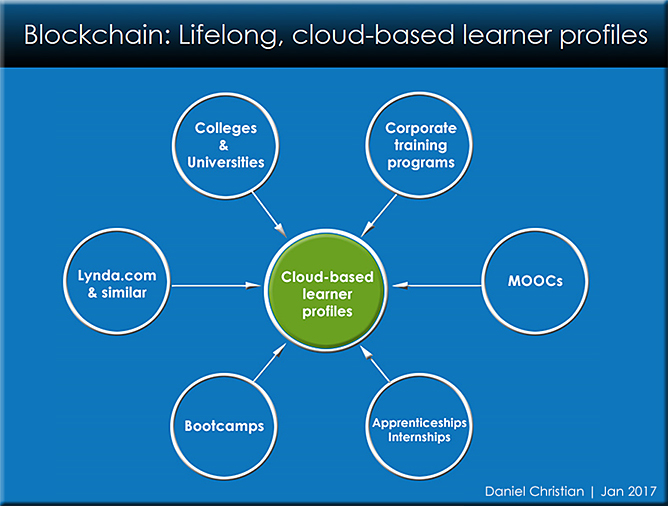
That’s why I’m big on trying to establish a next generation learning platform, such as the one that I’ve been tracking and proposing out at Learning from the Living [Class] Room. It’s meant to provide societies around the globe with a powerful, next generation learning platform — one that can help people reinvent themselves quickly, cost-effectively, conveniently, & consistently! It involves providing, relevant, up-to-date streams of content that people can subscribe to — and drop at any time. It involves working in conjunction with subject matter experts who work with teams of specialists, backed up by suites of powerful technologies. It involves learning with others, at any time, from any place, at any pace. It involves more choice, more control. It involves blockchain-based technologies to feed cloud-based learner profiles and more.

But likely, bringing such a vision to fruition will require a significant amount of collaboration. In my mind, some of the organizations that should be at the table here include:

  • Some of the largest players in the tech world, such as Amazon, Google, Apple, IBM, Microsoft, and/or Facebook
  • Some of the vendors that already operate within the higher ed space — such as Salesforce.com, Ellucian, and/or Blackboard
  • Some of the most innovative institutions of higher education — including their faculty members, instructional technologists, instructional designers, members of administration, librarians, A/V specialists, and more
  • The U.S. Federal Government — for additional funding and the development of policies to make this vision a reality


The Living [Class] Room -- by Daniel Christian -- July 2012 -- a second device used in conjunction with a Smart/Connected TV


Some reflections on students owning their own learning — from DSC:
Sometimes when students are introduced to a new method of learning something — say when a professor introduces a new pedagogy into an active learning-based classroom — they may not like it. It not only looks and feels different, but at times this new method of learning may require additional time and/or effort from them. For example, this could occur with a flipped/inverted classroom approach. In that model of learning, the students are supposed to review some learning-related materials online ahead of time so that their face-to-face time in the (physical) classroom can be used for group discussions, group work, problem solving, debates, etc.  Coming to class prepared may take some additional time and/or effort. Also, to think of where the gaps are in one’s understanding — a metacognitive activity — requires effort, time, and reflection.

Students may balk at having to do these things. These methods don’t match up to their histories…to the ways things have always been done. In fact, a student may ask, ‘Why should I do these things? It’s a lot more work than listening to the lectures in class, then doing the homework outside of class. I’ve/We’ve never done it this way before.”

Here are some of my answers to that WHY question:

  • You need to OWN your OWN learning and be open to new ways of learning. Your future will require it.
  • You need to be active — and even proactive — in your own learning. Intentionally build your own learning ecosystem and make adjustments to it as necessary.
  • To stay marketable and relevant today, each of us is now required to be a lifelong learner. No longer is it a situation of going to college for four years and calling it good. You need to learn how to learn.
  • When you graduate, it’s likely no one will be there to give you a Betty Crocker list of next steps. You need to think of and own those decisions.
  • When you get into your first job, you will likely get some training (if the company or organization is any good). But there will be times when the training isn’t enough to get you ready to take the next step in your career (and I’m not talking about a job ladder, which often doesn’t even exist anymore). In fact, you could easily be laid off from that first job due to a new direction that the company decided to take. Or you could be let go because the company was acquired by another organization — and you have to move or lose your job (which happened to me…twice). Or perhaps your group is being let go due to a decline in sales. Or perhaps some technological changes were made by everyone else in your industry — except your company — and now your company is being blown out of the water by its competition. There are a myriad of reasons you could lose your job. Then, what will you do? No one is there to spoon feed you. You need to be able to pivot, think for yourself, practice real-life problem solving, reflect on your values and where you want to contribute, etc.  This will be on YOU, and no one else. You need to be able to learn new things.

Also, it’s not just what you know. It’s what you can do with what you know. “Yeh, yeh, yeh…blah, blah, blah…I’ve heard it all before” (I can hear some of you saying.) B.S.! This is serious business. Wake up! Let me give you some concrete, real-world motivation then that relates to whether you will be able to put some bread and butter on your table, and whether or not you will be able to pay your bills, and whether or not you will be able to pay for decent housing and medical care, and whether or not you will be able to save enough money for retirement, and more:

  • You didn’t get that software developer position because, though you knew a lot about programming, your applications were uninspiring/weak/not very useful and they weren’t easy to use.
  • You didn’t get that User Experience Design position because, although you had a UX degree from ___, the app that you submitted on your application was hard to use and not very intuitive.
  • You didn’t get that new sales job because your previous sales didn’t match the other applicants’ sales figures.
  • You didn’t get that marketing position because your competitions’ marketing campaigns were far better, more polished, and more effective than yours was.
  • You didn’t get that web developer position because your web sites didn’t employ the latest and greatest designs, colors, navigation methods, scripting, extended technologies, and more.
  • You didn’t get that editor position because, although your writing was grammatically correct, was boring and verbose. We need sharp, concise, engaging copy!
  • Etc., etc., etc.

There’s your bottom line. Not only do you need to know things — you need to be able to do good, solid work with what you know.

So, you need to own your own learning — you want to own your own learning. Now!


Some potential/relevant hashtags for this posting might be (even if they don’t currently exist):
#stayingrelevant | #surviving | #reinvent | #heutagogy | #lifelonglearning | #nomorespoonfeeding
#motivation | #ownyourlearning | #adaptingtochange | #paceofchange | #beingabletopayyourbills


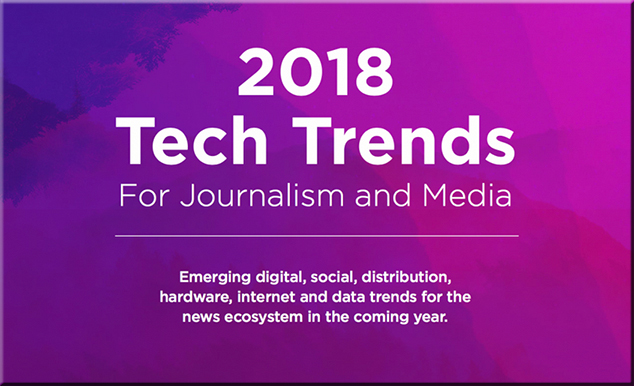
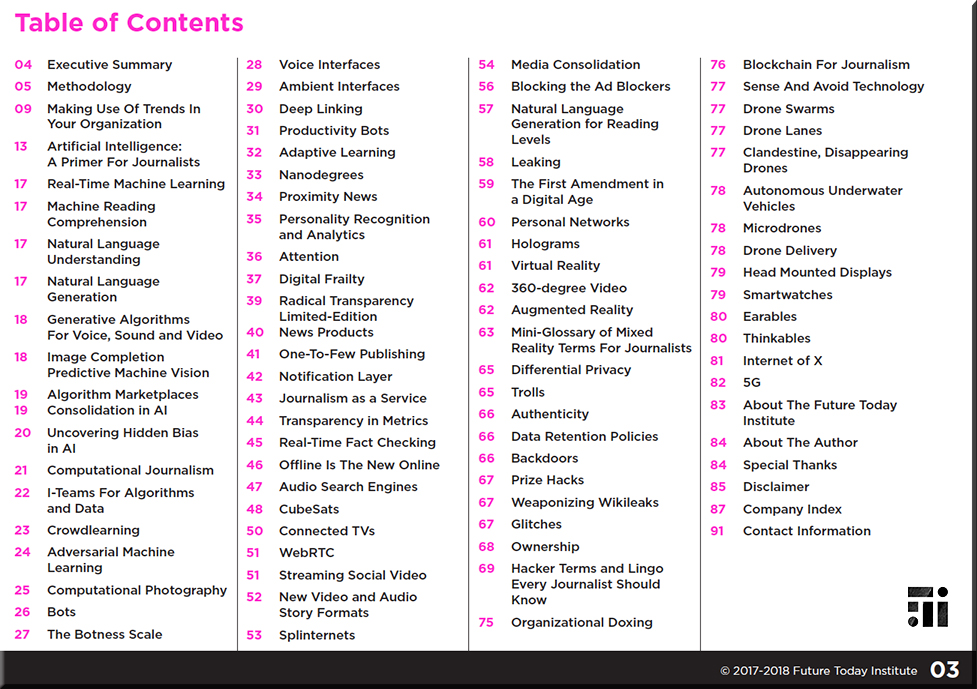
2018 Tech Trends for Journalism & Media Report + the 2017 Tech Trends Annual Report that I missed from the Future Today Institute


2018 Tech Trends For Journalism Report — from the Future Today Institute

Key Takeaways

  • 2018 marks the beginning of the end of smartphones in the world’s largest economies. What’s coming next are conversational interfaces with zero-UIs. This will radically change the media landscape, and now is the best time to start thinking through future scenarios.
  • In 2018, a critical mass of emerging technologies will converge finding advanced uses beyond initial testing and applied research. That’s a signal worth paying attention to. News organizations should devote attention to emerging trends in voice interfaces, the decentralization of content, mixed reality, new types of search, and hardware (such as CubeSats and smart cameras).
  • Journalists need to understand what artificial intelligence is, what it is not, and what it means for the future of news. AI research has advanced enough that it is now a core component of our work at FTI. You will see the AI ecosystem represented in many of the trends in this report, and it is vitally important that all decision-makers within news organizations familiarize themselves with the current and emerging AI landscapes. We have included an AI Primer For Journalists in our Trend Report this year to aid in that effort.
  • Decentralization emerged as a key theme for 2018. Among the companies and organizations FTI covers, we discovered a new emphasis on restricted peer-to-peer networks to detect harassment, share resources and connect with sources. There is also a push by some democratic governments around the world to divide internet access and to restrict certain content, effectively creating dozens of “splinternets.”
  • Consolidation is also a key theme for 2018. News brands, broadcast spectrum, and artificial intelligence startups will continue to be merged with and acquired by relatively few corporations. Pending legislation and policy in the U.S., E.U. and in parts of Asia could further concentrate the power among a small cadre of information and technology organizations in the year ahead.
  • To understand the future of news, you must pay attention to the future of many industries and research areas in the coming year. When journalists think about the future, they should broaden the usual scope to consider developments from myriad other fields also participating in the knowledge economy. Technology begets technology. We are witnessing an explosion in slow motion.

Those in the news ecosystem should factor the trends in this report into their strategic thinking for the coming year, and adjust their planning, operations and business models accordingly.


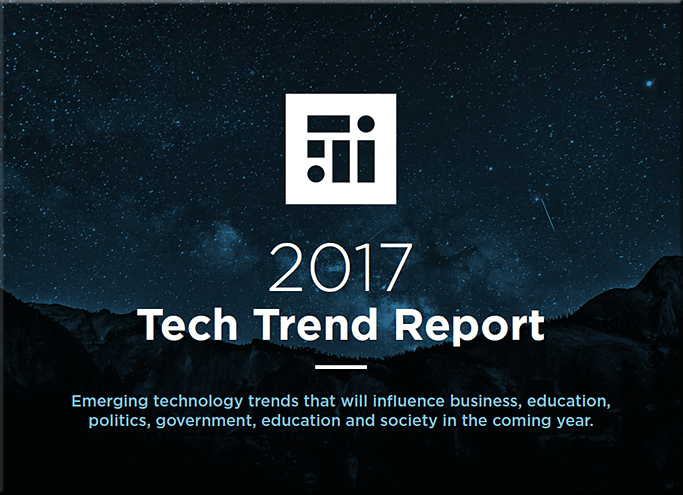
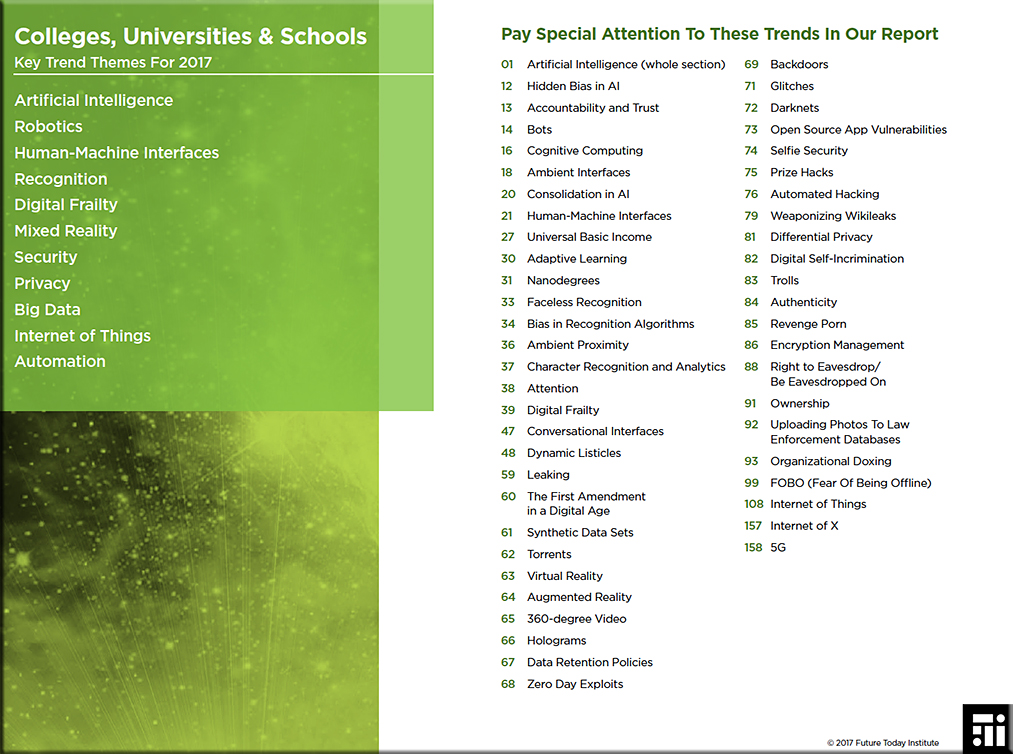
2017 Tech Trends Annual Report — from the Future Today Institute; this is the first I’ve seen this solid report

Excerpts:

This year’s report has 159 trends.
This is mostly due to the fact that 2016 was the year that many areas of science and technology finally started to converge. As a result we’re seeing a sort of slow-motion explosion––we will undoubtedly look back on the last part of this decade as a pivotal moment in our history on this planet.

Our 2017 Trend Report reveals strategic opportunities and challenges for your organization in the coming year. The Future Today Institute’s annual Trend Report prepares leaders and organizations for the year ahead, so that you are better positioned to see emerging technology and adjust your strategy accordingly. Use our report to identify near-future business disruption and competitive threats while simultaneously finding new collaborators and partners. Most importantly, use our report as a jumping off point for deeper strategic planning.


Also see:

Emerging eLearning Tools and Platforms Improve Results — from learningsolutionsmag.com

  • Augmented and virtual reality offer ways to immerse learners in experiences that can aid training in processes and procedures, provide realistic simulations to deepen empathy and build communication skills, or provide in-the-workflow support for skilled technicians performing complex procedures.
  • Badges and other digital credentials provide new ways to assess and validate employees’ skills and mark their eLearning achievements, even if their learning takes place informally or outside of the corporate framework.
  • Chatbots are proving an excellent tool for spaced learning, review of course materials, guiding new hires through onboarding, and supporting new managers with coaching and tips.
  • Content curation enables L&D professionals to provide information and educational materials from trusted sources that can deepen learners’ knowledge and help them build skills.
  • eBooks, a relative newcomer to the eLearning arena, offer rich features for portable on-demand content that learners can explore, review, and revisit as needed.
  • Interactive videos provide branching scenarios, quiz learners on newly introduced concepts and terms, offer prompts for small-group discussions, and do much more to engage learners.
  • Podcasts can turn drive time into productive time, allowing learners to enjoy a story built around eLearning content.
  • Smartphone apps, available wherever learners take their phones or tablets, can be designed to offer product support, info for sales personnel, up-to-date information for repair technicians, and games and drills for teaching and reviewing content; the possibilities are limited only by designers’ imagination.
  • Social platforms like Slack, Yammer, or Instagram facilitate collaboration, sharing of ideas, networking, and social learning. Adopting social learning platforms encourages learners to develop their skills and contribute to their communities of practice, whether inside their companies or more broadly.
  • xAPI turns any experience into a learning experience. Adding xAPI capability to any suitable tool or platform means you can record learner activity and progress in a learning record store (LRS) and track it.


DevLearn Attendees Learn How to ‘Think Like a Futurist’ — from learningsolutionsmag.com

Excerpt:

How does all of this relate to eLearning? Again, Webb anticipated the question. Her response gave hope to some—and terrified others. She presented three possible future scenarios:

  • Everyone in the learning arena learns to recognize weak signals; they work with technologists to refine artificial intelligence to instill values. Future machines learn not only to identify correct and incorrect answers; they also learn right and wrong. Webb said that she gives this optimistic scenario a 25 percent chance of occurring.
  • Everyone present is inspired by her talk but they, and the rest of the learning world, do nothing. Artificial intelligence continues to develop as it has in the past, learning to identify correct answers but lacking values. Webb’s prediction is that this pragmatic optimistic scenario has a 50 percent chance of occurring.
  • Learning and artificial intelligence continue to develop on separate tracks. Future artificial intelligence and machine learning projects incorporate real biases that affect what and how people learn and how knowledge is transferred. Webb said that she gives this catastrophic scenario a 25 percent chance of occurring.

In an attempt to end on a strong positive note, Webb said that “the future hasn’t happened yet—we think” and encouraged attendees to take action. “To build the future of learning that you want, listen to weak signals now.”


From DSC:
Some of the largest waves of change that are hitting the beaches of numerous societies throughout the globe are coming from technological changes such as:

  • Artificial intelligence (which includes things like machine learning, deep learning, natural language processing, personal assistants, bots, algorithms, and the like)
  • Big data and analytics
  • Robotics
  • The digital transformation of businesses
  • New forms of human computer interaction such as virtual reality, augmented reality and mixed reality
  • Mobile computing
  • Cloud computing
  • The Internet of Things
  • Wearables
  • …and more

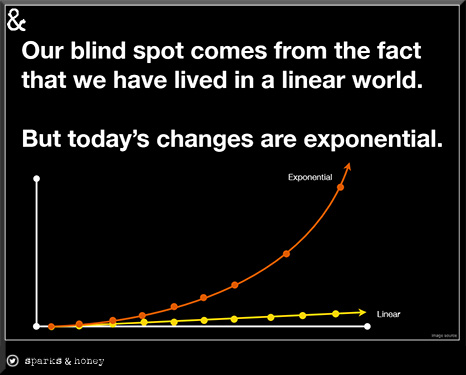
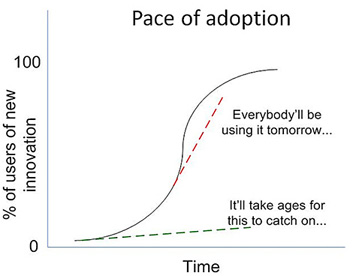
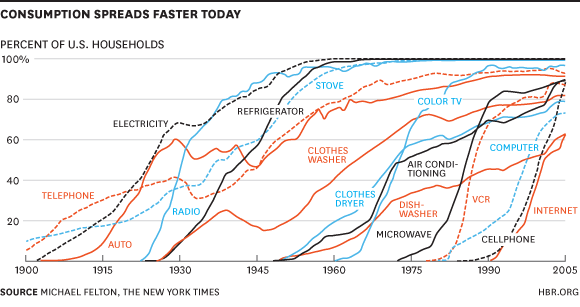
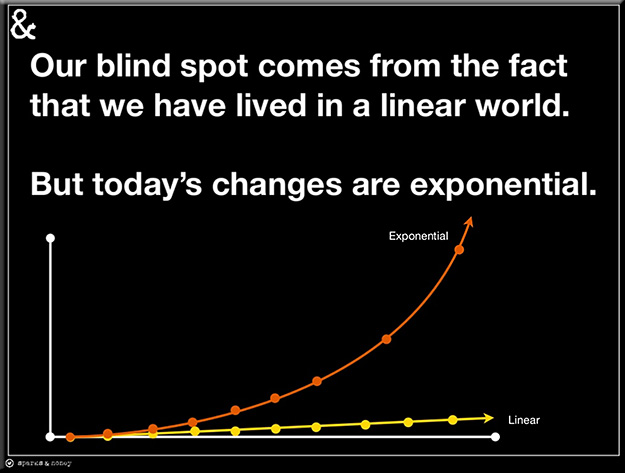
But in all of these developments, what is common amongst them is that the pace of change has changed. It’s much faster now. In fact, we are no longer on a linear path of slow, steady, incremental changes. We are now on an exponential trajectory – or pace – of change.


This new pace of change is starting to have profound implications for societies, individuals, institutions of higher education, and workforces throughout the globe. Some of these ramifications include:

  • Profound modifications to the existing workforce; in some cases, staff reductions
  • New fields, new positions
  • New skillsets that require highly-educated individuals as well as a massive amount of additional training for existing employees
  • New methods of learning and the requirement for lifelong, constant learning from here on out
  • The need to become more responsive and nimble
  • The need to pulse-check a variety of landscapes to ascertain the best potential strategies to pursue (in light of the potential upcoming scenarios)

Yet the changes aren’t just arising from technological changes. For institutions of higher education, there have been other areas of change that bring with them significant impact, such as:

  • Decreases in state funding
  • The increasing costs of healthcare and benefits for faculty, staff, and administrators
  • Headwinds from demographic-related declines (depending upon one’s geographic location)
  • Aging facilities and infrastructures
  • …and more.

Navigating these rough waters is not easy. But the key questions now are:

  • Is your institution poised to ride the waves of change or is it about to get crushed by these same waves?


  • Is someone at your organization looking out for these oncoming waves?
    That is, is someone pulse-checking a variety of landscapes to ascertain the trends that are developing, trends that could significantly impact your institution and/or your students?


  • What are some of the ways that your organization could respond to these waves of change to positively impact the following parties?
    • Your organization
      What new programs could be offered at your institution? How is the level of responsiveness at your institution to these changes?
    • Your students
      Many jobs that your students will have in their futures haven’t even been invented yet. How can you best develop them to be ready for the new, exponential pace of change? How are you helping your graduates who (increasingly) need to come back to your institution and reinvent themselves – quickly, conveniently, and cost-effectively?
    • Your employees
      Given all of this change, the professional growth of your own faculty members, staff, and members of your administration is extremely important. How are you looking after their growth?


  • Would you use the word “innovative” to describe the culture of your organization? That is, is your institution willing to experiment and take some calculated risks? To take no action or risks in the current environment is likely the biggest risk of all.


From DSC:
In Part I, I looked at the new, exponential pace of change that colleges, community colleges and universities now need to deal with – observing the enormous changes that are starting to occur throughout numerous societies around the globe. If we were to plot out the rate of change, we would see that we are no longer on a slow, steady, incremental type of linear pathway; but, instead, we would observe that we are now on an exponential trajectory (as the below graphic from sparks & honey very nicely illustrates).


How should colleges and universities deal with this new, exponential pace of change?

1) I suggest that you ensure that someone in your institution is lifting their gaze and peering out into the horizons, to see what’s coming down the pike. That person – or more ideally, persons – should also be looking around them, noticing what’s going on within the current landscapes of higher education. Regardless of how your institution tackles this task, given that we are currently moving at an incredibly fast pace, this trend analysis is very important. The results from this analysis should immediately be integrated into your strategic plan. Don’t wait 3-5 years to integrate these new findings into your plan. The new, exponential pace of change is going to reward those organizations who are nimble and responsive.

2) I recommend that you look at what programs you are offering and consider if you should be developing additional programs such as those that deal with:

  • Artificial Intelligence (Natural Language Processing, deep learning, machine learning, bots)
  • New forms of Human Computer Interaction such as Augmented Reality, Virtual Reality, and Mixed Reality
  • User Experience Design, User Interface Design, and/or Interaction Design
  • Big data, data science, working with data
  • The Internet of Things, machine-to-machine communications, sensors, beacons, etc.
  • Blockchain-based technologies/systems
  • The digital transformation of business
  • Freelancing / owning your own business / entrepreneurship (see this article for the massive changes happening now!)
  • …and more

3) If you are not already doing so, I recommend that you immediately move to offer a robust lineup of online-based programs. Why do I say this? Because:

  • Without them, your institution may pay a heavy price due to its diminishing credibility. Your enrollments could decline if learners (and their families) don’t think they will get solid jobs coming out of your institution. If the public perceives you as a dinosaur/out of touch with what the workplace requires, your enrollment/admissions groups may find meeting their quotas will get a lot harder as the years go on. You need to be sending some cars down the online/digital/virtual learning tracks. (Don’t get me wrong. We still need the liberal arts. However, even those institutions who offer liberal arts lineups will still need to have a healthy offering of online-based programs.)
  • Online-based learning methods can expand the reach of your faculty members while offering chances for individuals throughout the globe to learn from you, and you from them
  • Online-based learning programs can increase your enrollments, create new revenue streams, and develop/reach new markets
  • Online-based learning programs have been proven to offer the same learning gains – and sometimes better learning results than – what’s being achieved in face-to-face based classrooms
  • The majority of pedagogically-related innovations are occurring within the online/digital/virtual realm, and you will want to have built the prior experience, expertise, and foundations in order to leverage and benefit from them
  • Faculty take their learning/experiences from offering online-based courses back into their face-to-face courses
  • Due to the increasing price of obtaining a degree, students often need to work to help get them (at least part of the way) through school; thus, flexibility is becoming increasingly important and necessary for students
  • An increasing number of individuals within the K-12 world as well as the corporate world are learning via online-based means. This is true within higher education as well, as, according to a recent report from Digital Learning Compass states that “the number of higher education students taking at least one distance education course in 2015 now tops six million, about 30% of all enrollments.”
  • Families are looking very closely at their return on investments being made within the world of higher education. They want to see that their learners are being prepared for the ever-changing future that they will encounter. If people in the workforce often learn online, then current students should be getting practice in that area of their learning ecosystems as well.
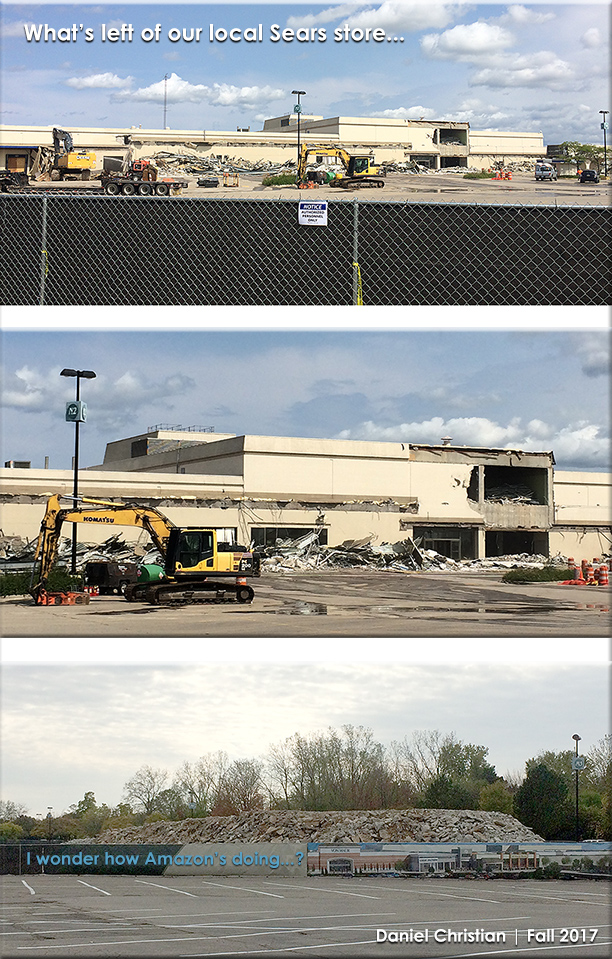
  • As the (mostly) online-based Amazon.com is thriving and retail institutions such as Sears continue to close, people are in the process of forming more generalized expectations that could easily cross over into the realm of higher education. By the way, here’s how our local Sears building is looking these days…or what’s left of it.


4) I recommend that you move towards offering more opportunities for lifelong learning, as learners need to constantly add to their skillsets and knowledge base in order to remain marketable in today’s workforce. This is where adults greatly appreciate – and need – the greater flexibility offered by online-based means of learning. I’m not just talking about graduate programs or continuing studies types of programs here. Rather, I’m hoping that we can move towards providing streams of up-to-date content that learners can subscribe to at any time (and can drop their subscription to at any time). As a relevant side note here, keep your eyes on blockchain-based technologies here.

5) Consider the role of consortia and pooling resources. How might that fit into your strategic plan?

6) Consider why bootcamps continue to come onto the landscape.  What are traditional institutions of higher education missing here?

7) And lastly, if one doesn’t already exist, form a small, nimble, innovative group within your organization — what I call a TrimTab Group — to help identify what will and won’t work for your institution.


From DSC:
I know Quentin Schultze from our years working together at Calvin College, in Grand Rapids, Michigan (USA). I have come to greatly appreciate Quin as a person of faith, as an innovative/entrepreneurial professor, as a mentor to his former students, and as an excellent communicator. 

Quin has written a very concise, wisdom-packed book that I would like to recommend to those people who are seeking to be better communicators, leaders, and servants. But I would especially like to recommend this book to the leadership at Google, Amazon, Apple, Microsoft, IBM, Facebook, Nvidia, the major companies developing robots, and other high-tech companies. Why do I list these organizations? Because given the exponential pace of technological change, these organizations — and their leaders — have an enormous responsibility to make sure that the technologies that they are developing result in positive changes for societies throughout the globe. They need wisdom, especially as they are working on emerging technologies such as Artificial Intelligence (AI), personal assistants and bots, algorithms, robotics, the Internet of Things, big data, blockchain and more. These technologies continue to exert an increasingly powerful influence on numerous societies throughout the globe today. And we haven’t seen anything yet! Just because we can develop and implement something, doesn’t mean that we should. Again, we need wisdom here.

But as Quin states, it’s not just about knowledge, the mind and our thoughts. It’s about our hearts as well. That is, we need leaders who care about others, who can listen well to others, who can serve others well while avoiding gimmicks, embracing diversity, building trust, fostering compromise and developing/exhibiting many of the other qualities that Quin writes about in his book. Our societies desperately need leaders who care about others and who seek to serve others well.

I highly recommend you pick up a copy of Quin’s book. There are few people who can communicate as much in as few words as Quin can. In fact, I wish that more writing on the web and more articles/research coming out of academia would be as concisely and powerfully written as Quin’s book, Communicate Like a True Leader: 30 Days of Life-Changing Wisdom.


To lead is to accept responsibility and act responsibly.
Quentin Schultze


Robots and AI are going to make social inequality even worse, says new report — from theverge.com by
Rich people are going to find it easier to adapt to automation

Excerpt:

Most economists agree that advances in robotics and AI over the next few decades are likely to lead to significant job losses. But what’s less often considered is how these changes could also impact social mobility. A new report from UK charity Sutton Trust explains the danger, noting that unless governments take action, the next wave of automation will dramatically increase inequality within societies, further entrenching the divide between rich and poor.

The are a number of reasons for this, say the report’s authors, including the ability of richer individuals to re-train for new jobs; the rising importance of “soft skills” like communication and confidence; and the reduction in the number of jobs used as “stepping stones” into professional industries.

For example, the demand for paralegals and similar professions is likely to be reduced over the coming years as artificial intelligence is trained to handle more administrative tasks. In the UK more than 350,000 paralegals, payroll managers, and bookkeepers could lose their jobs if automated systems can do the same work.


Re-training for new jobs will also become a crucial skill, and it’s individuals from wealthier backgrounds that are more able to do so, says the report. This can already be seen in the disparity in terms of post-graduate education, with individuals in the UK with working class or poorer backgrounds far less likely to re-train after university.


From DSC:
I can’t emphasize this enough. There are dangerous, tumultuous times ahead if we can’t figure out ways to help ALL people within the workforce reinvent themselves quickly, cost-effectively, and conveniently. Re-skilling/up-skilling ourselves is becoming increasingly important. And I’m not just talking about highly-educated people. I’m talking about people whose jobs are going to be disappearing in the near future — especially people whose stepping stones into brighter futures are going to wake up to a very different world. A very harsh world.

That’s why I’m so passionate about helping to develop a next generation learning platform. Higher education, as an industry, has some time left to figure out their part/contribution out in this new world. But the window of time could be closing, as another window of opportunity / era could be opening up for “the next Amazon.com of higher education.”

It’s up to current, traditional institutions of higher education as to how much they want to be a part of the solution. Some of the questions each institution ought to be asking are:

  1. Given our institutions mission/vision, what landscapes should we be pulse-checking?
  2. Do we have faculty/staff/members of administration looking at those landscapes that are highly applicable to our students and to their futures? How, specifically, are the insights from those employees fed into the strategic plans of our institution?
  3. What are some possible scenarios as a result of these changing landscapes? What would our response(s) be for each scenario?
  4. Are there obstacles from us innovating and being able to respond to the shifting landscapes, especially within the workforce?
  5. How do we remove those obstacles?
  6. On a scale of 0 (we don’t innovate at all) to 10 (highly innovative), where is our culture today? Where do we hope to be 5 years from now? How do we get there?

…and there are many other questions no doubt. But I don’t think we’re looking into the future nearly enough to see the massive needs — and real issues — ahead of us.


The report, which was carried out by the Boston Consulting Group and published this Wednesday [7/12/17], looks specifically at the UK, where it says some 15 million jobs are at risk of automation. But the Sutton Trust says its findings are also relevant to other developed nations, particularly the US, where social mobility is a major problem.


The Higher Education Technology Paradox — from edtechmagazine.com by Hank Lucas
The academic rewards system will continue to stymie technology adoption unless higher ed administrators promote organizational change.

Excerpts:

The number one paradox in higher education is that technology is both transforming and disrupting universities around the world. Institutions that adapt to the technology and become content producers will survive and flourish; those confined to being content consumers will struggle to stay in business.

What does it take for a university to develop the kind of materials described above? Obviously, it requires money, but more than money it needs a motivated and committed faculty. The reward system in most institutions and the inherent conservatism of faculty members create a huge barrier to adopting new technologies for education. (Many faculty members are in denial that the technology can improve student learning and that it will be widely implemented.)

How does the reward system impact technology adoption?

  • Assistant professors at research universities are rewarded for publishing scholarly articles and books, which they must do to be granted tenure. They cannot risk the time needed to master the new technologies.
  • Tenured faculty can largely do what they want, and by the time they have received tenure have fallen into a rhythm of research and teaching; once tenured they are expected to undertake more service to the institution. Where does the time come from to adopt a new approach to the classroom?
  • Non-tenure track instructors are employed because they are good, or at least adequate, teachers. Adopting new technology in the classroom is risky and could result in lower student evaluations, which in turn could affect their employment status.


From DSC:
This is one of the reasons why I believe that a new organization will arise in the future that uses a solid, team-based approach from day 1. They will have teams of experts from a variety of fields/disciplines — and they will have the types of incentive systems that one would expect to see in startup companies. They will value innovation and will see to it that ideas can be grown and supported.

Anybody come to mind? How about Amazon.com? 

Also, faculty members — like all of us — have a limited amount of time and energy. The current workplace has loaded up faculty members’ job plates — they don’t have much time to experiment with new technologies. Also — again, like all of us — they have a variety of skills and interests. Many times, those skills and interest don’t involve working with technology. 

Look for more team-based approaches to dominate the future of higher education.


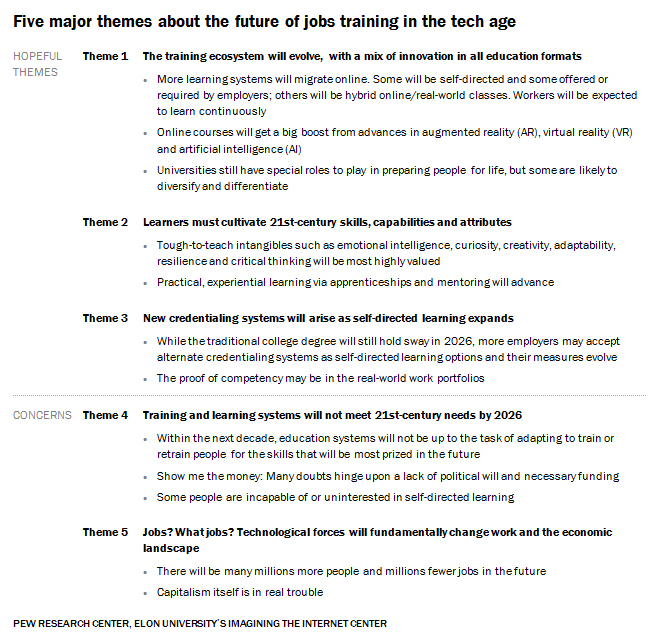
The Future of Jobs and Jobs Training — from by Lee Rainie and Janna Anderson
As robots, automation and artificial intelligence perform more tasks and there is massive disruption of jobs, experts say a wider array of education and skills-building programs will be created to meet new demands. There are two uncertainties: Will well-prepared workers be able to keep up in the race with AI tools? And will market capitalism survive?

Excerpt:

Machines are eating humans’ jobs talents. And it’s not just about jobs that are repetitive and low-skill. Automation, robotics, algorithms and artificial intelligence (AI) in recent times have shown they can do equal or sometimes even better work than humans who are dermatologists, insurance claims adjusters, lawyers, seismic testers in oil fields, sports journalists and financial reporters, crew members on guided-missile destroyers, hiring managers, psychological testers, retail salespeople, and border patrol agents. Moreover, there is growing anxiety that technology developments on the near horizon will crush the jobs of the millions who drive cars and trucks, analyze medical tests and data, perform middle management chores, dispense medicine, trade stocks and evaluate markets, fight on battlefields, perform government functions, and even replace those who program software – that is, the creators of algorithms.

Several policy and market-based solutions have been promoted to address the loss of employment and wages forecast by technologists and economists. A key idea emerging from many conversations, including one of the lynchpin discussions at the World Economic Forum in 2016, is that changes in educational and learning environments are necessary to help people stay employable in the labor force of the future. Among the six overall findings in a new 184-page report from the National Academies of Sciences, the experts recommended: “The education system will need to adapt to prepare individuals for the changing labor market. At the same time, recent IT advances offer new and potentially more widely accessible ways to access education.”


In the next 10 years, do you think we will see the emergence of new educational and training programs that can successfully train large numbers of workers in the skills they will need to perform the jobs of the future?


From DSC:
The following questions (from the article) might be fodder for initial conversations regarding what changes need to immediately occur within higher education. Those changes might be to establish teams/task forces/etc. charged with answering these kinds of questions.

  • What are the most important skills needed to succeed in the workforce of the future?
  • Which of these skills can be taught effectively via online systems – especially those that are self-directed – and other nontraditional settings?
  • Which skills will be most difficult to teach at scale?
  • Will employers be accepting of applicants who rely on new types of credentialing systems, or will they be viewed as less qualified than those who have attended traditional four-year and graduate programs?

The following section further supports a vision that I’ve been tracking entitled, “Learning from the Living [Class] Room” — where I see the “New Amazon.com of Higher Education” unfolding. Blockchain-based technologies will likely be involved here.

A diversifying education and credentialing ecosystem: Most of these experts expect the education marketplace – especially online learning platforms – to continue to change in an effort to accommodate the widespread needs.  Some predict employers will step up their own efforts to train and retrain workers. Many foresee a significant number of self-teaching  efforts by jobholders themselves as they take advantage of proliferating online opportunities.

Respondents see a new education and training ecosystem emerging in which some job preparation functions are performed by formal educational institutions in fairly traditional classroom settings, some elements are offered online, some are created by for-profit firms, some are free, some exploit augmented and virtual reality elements and gaming sensibilities, and a lot of real-time learning takes place in formats that job seekers pursue on their own.

A considerable number of respondents to this canvassing focused on the likelihood that the best education programs will teach people how to be lifelong learners. Accordingly, some say alternative credentialing mechanisms will arise to assess and vouch for the skills people acquire along the way.


DC: Many societies around the globe are looking at massive change coming at them. What changes should those of us working in higher education begin to make — immediately? In the longer term?


These respondents suggest that workers of the future will learn to deeply cultivate and exploit creativity, collaborative activity, abstract and systems thinking, complex communication, and the ability to thrive in diverse environments.


Addendum on 5/6/17:

  • How to Prepare for an Automated Future — from nytimes.com by Claire Cain Miller
    Excerpt:
    We don’t know how quickly machines will displace people’s jobs, or how many they’ll take, but we know it’s happening — not just to factory workers but also to money managers, dermatologists and retail workers. The logical response seems to be to educate people differently, so they’re prepared to work alongside the robots or do the jobs that machines can’t. But how to do that, and whether training can outpace automation, are open questions.


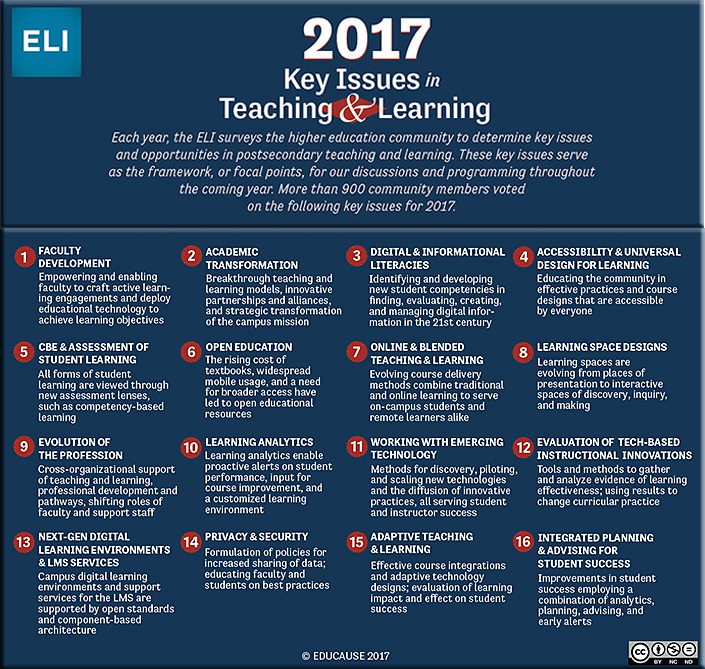
Key issues in teaching and learning 2017 — from Educause Learning Initiative (ELI)

Excerpt:

Since 2011, ELI has surveyed the higher education teaching and learning community to identify its key issues. The community is wide in scope: we solicit input from all those participating in the support of the teaching and learning mission, including professionals from the IT organization, the center for teaching and learning, the library, and the dean’s and provost’s offices.


From DSC:
When I turned on the TV the other day, our local news station was playing a piece re: the closing of several stores in Michigan, some within our area. Some of the national retail stores/chains mentioned were:

  • Macy’s
    • Macy’s closing 100 stores, including 4 in Michigan
      Excerpt:
      Four Macy’s stores in Michigan are permanently closing in a series of company cuts expected to cost 6,200 jobs. Macy’s announced 68 of the 100 stores it plans to shutter Wednesday, according to CNBC. On the list is the Macy’s at Lakeview Square Mall in Battle Creek. CNBC reports the store opened in 1983 and employs 51 associates. Also on the chopping block is the Macy’s in Lansing, Westland and the Eastland Center in Harper Woods. All four Michigan stores are slated to close by the end of 2017.
    • Sears and Kmart closing 150 stores — from money.cnn.com by Paul La Monica
      Sears is shutting down 150 more stores, yet another sign of how tough it is for former kings of the retail industry to compete in a world now dominated by Amazon.
      .
  • Sears
    • Internet is the new anchor: Woodland Mall Sears closing
      Big box and anchor stores a vanishing species in West Michigan
      Excerpt:
      Despite the best economy in a decade and a nearly 4 percent increase in consumer spending this holiday, the kind of retailers that used to be the draws for shopping malls and plazas are feeling the continuing impact of the internet. The most notable recent victim of the trend is the Sears that has served as an anchor store at Woodland Mall for decades. “We hear rumors every week about what’s going on, but we don’t want to hear that — we’re working there, we don’t want to hear that kind of thing. We didn’t think that was going to happen to us. We were doing pretty good,” said 52-year-old Marty Kruizenga, who worked at the Sears Automotive at Woodland Mall. He was told Wednesday morning his store was closing.
      .
  • The Limited
    • The Limited just shut all of its stores — from money.cnn.com by Jackie Wattles
      Excerpt (emphasis DSC):
      American malls just got emptier.
      The Limited, a once-popular women’s clothing brand that offers casual attire and workwear, no longer has any storefronts. On Saturday [1/7/17], a message on the store’s website read, “We’re sad to say that all The Limited stores nationwide have officially closed their doors. But this isn’t goodbye.” The website will still be up and running and will continue to ship nationwide, the company said.

      The Limited is among a long list of brick-and-mortar retailers that once thrived in malls and strip shopping centers — but are now suffering at the hands of digital commerce giants like Amazon (AMZN, Tech30) and fast fashion stores such as H&M and Forever 21.
      .
  • And another chain that I don’t recall…

Here’s a snapshot I took of the television screen at the end of their piece:
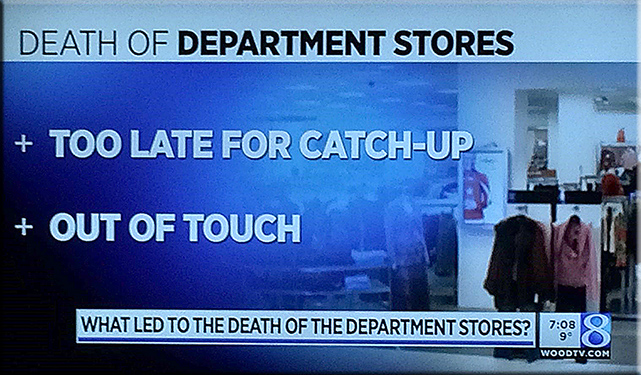
 

The warnings were there but people didn’t want to address them:

 

Amazon is taking an increasing share of the US apparel market, according to Morgan Stanley. 


Also regarding Amazon, see this interesting prediction from Jack Uldrich:
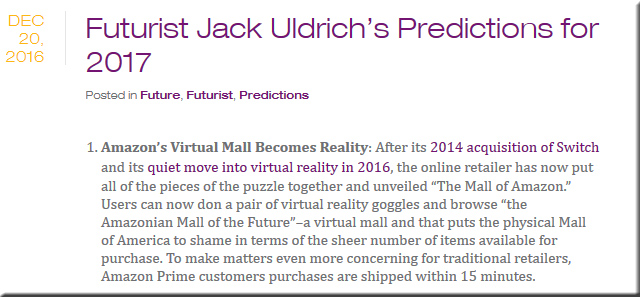


Below is a quote from a Forbes.com article entitled “Here’s What’s Wrong With Department Stores

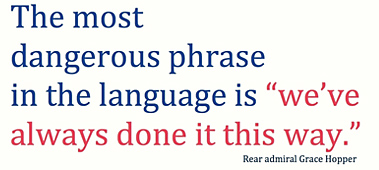
Are Department Stores Dead?  Not yet. But they could kill themselves, under the weight of “we’ve always done it this way”. Tweaks in omni-channel strategy aren’t going to be enough to address the fundamental issues at department stores. Not with the way these trends are heading.


Along the lines of the above items, many of us can remember the Blockbuster stores closing in our areas not that long ago — having been blown out of the water by Netflix.



Although there are several lines of thought that could be pursued here (one of which might be to discuss the loss of jobs, especially to our students, as many of them work within retail)… some of the key questions that come to my mind are:

  • Could this closing of many brick and mortar-based facilities happen within higher education?
    .
  • With the advent of artificial intelligence and cognitive computing, will the innovations that take place on the Internet blow away what’s happening in the face-to-face (F2F) classrooms? As Thomas Frey asserts, by 2030, will the largest company on the internet be an education-based company that we haven’t heard of yet?
    (NOTE: “Frey doesn’t go so far as to argue education bots will replace traditional schooling outright. He sees them more as a supplement, perhaps as a kind of tutor.”)

    .
  • Or, because people enjoy learning together in a F2F environment, will F2F classrooms augment what they are doing with what’s available online/digitally?
    .
  • Will the discussion not revolve around online vs F2F, but rather will the topic at hand be more focused on how innovative/responsive one’s institution is?


Also relevant/see:

Attention University Presidents: A Press Release From the Near Future — from futurist Jack Uldrich
(Emphasis added below by DSC)

(Editor’s Note: Change is difficult. This is especially true in organizations that have heretofore been immune to the broader forces of disruption–such as institutions of higher learning. To shake presidents, administrators, and faculty out of their stupor I have drafted the following fictional press release. I encourage all university and college presidents and their boards to read it and then discuss how they can–and must–adapt in order to remain competitive in the future.)

PRESS RELEASE (Fictional Scenario: For Internal Discussion Only)

(Note: All links in the press release highlight real advances in the field of higher education).

State College to Close at End of 2021-2022 Academic Year
Washington, DC – December 16, 2021 — State College, one of the country’s leading public universities, has decided to cease academic operations at the end of the 2021-22 school year.

rest of fictional press release here –>


Last comment from DSC:
I don’t post this to be a fear monger. Rather,  I post it to have those of us working with higher education take some time to reflect on this situation — because we need to be far more responsive to change than we are being. Given the increasingly rapid pace of change occurring in our world today, people will have to continue to reinvent themselves. But the difference in the near future will be in the number of times people have to reinvent themselves and how quickly they need to do it. They won’t be able to take 2-4 years off to do it.

Let’s not get blown out of the water by some alternative. Let’s respond while we still have the chance. Let’s be in touch with the changing landscapes and needs out there.


Addendums:

Colleges need to adapt to meet the changing demographics and needs of students, rather than expect them to conform to a tradition-loving system.

“Unless we become more nimble in our approach and more scalable in our solutions, we will miss out on an opportunity to embrace and serve the majority of students who will need higher education and postsecondary learning,” says the report. Later it underscores that “higher education has never mattered so much to those who seek it. It drives social mobility, energizes our economy, and underpins our democracy.”


WHEN education fails to keep pace with technology, the result is inequality. Without the skills to stay useful as innovations arrive, workers suffer—and if enough of them fall behind, society starts to fall apart. That fundamental insight seized reformers in the Industrial Revolution, heralding state-funded universal schooling. Later, automation in factories and offices called forth a surge in college graduates. The combination of education and innovation, spread over decades, led to a remarkable flowering of prosperity.

Today robotics and artificial intelligence call for another education revolution. This time, however, working lives are so lengthy and so fast-changing that simply cramming more schooling in at the start is not enough. People must also be able to acquire new skills throughout their careers.
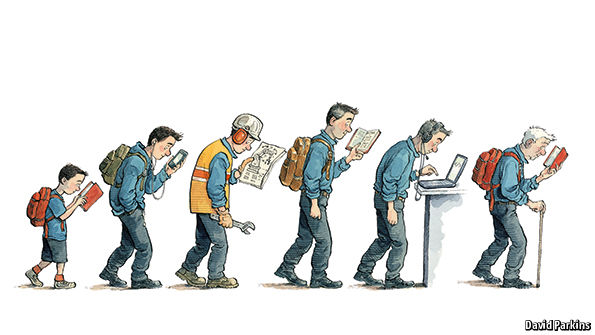


Amazon is going to kill more American jobs than China did — from marketwatch.com
Millions of retail jobs are threatened as Amazon’s share of online purchases keeps climbing


The Few, The Proud, the Unusual — by Jack Uldrich

Excerpt:

An army of ants is an awe-inspiring and efficient force of nature. While each ant is individually small, collectively they accomplish amazing things—provided they have a sufficient source of food. The same is true of today’s modern corporation—if it has a profitable source of revenue. Alas, when the food or the money dries up, both the army and the corporation are endangered.

To protect themselves, ants rely on a unique sub-group of “pioneer ants.” Their sole job is to move out away from the main army in search of the next source of food. In this way, the pioneers act as a hedge against the possibility of being caught without a future source of food.

Every organization should also have at least a few “pioneers ants” whose single job is to identify future opportunities. To ensure these individuals have the best chance of success, I have outlined a series of unusual characteristics that I believe will bolster their odds of success–and, thus, your success…


Every organization should also have at least a few “pioneers ants” whose single job is to identify future opportunities.


LinkedIn announced several things yesterday (9/22/16). Below are some links to these announcements:


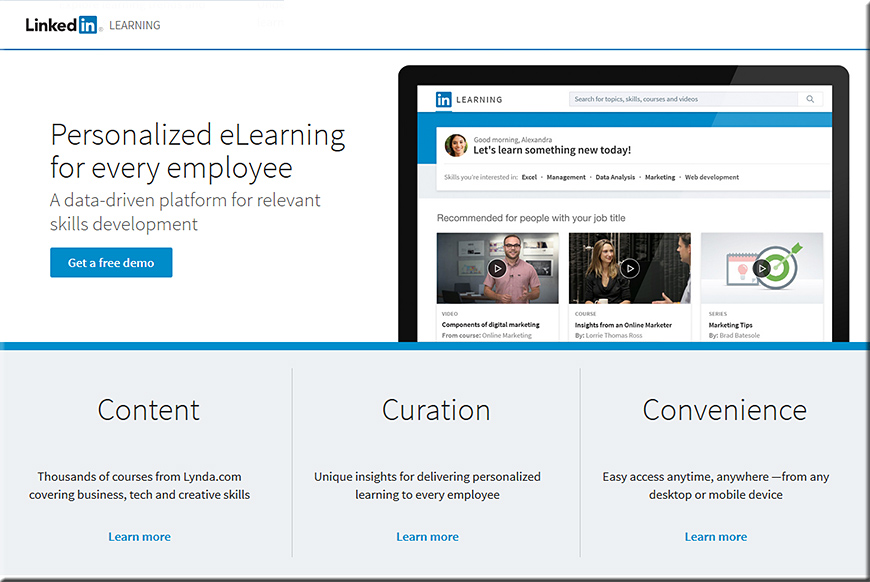
Introducing LinkedIn Learning, a Better Way to Develop Skills and Talent — from learning.linkedin.com

Excerpt (emphasis DSC):

Today, we are thrilled to announce the launch of LinkedIn Learning, an online learning platform enabling individuals and organizations to achieve their objectives and aspirations. Our goal is to help people discover and develop the skills they need through a personalized, data-driven learning experience.

LinkedIn Learning combines the industry-leading content from Lynda.com with LinkedIn’s professional data and network. With more than 450 million member profiles and billions of engagements, we have a unique view of how jobs, industries, organizations and skills evolve over time. From this, we can identify the skills you need and deliver expert-led courses to help you obtain those skills. We’re taking the guesswork out of learning.

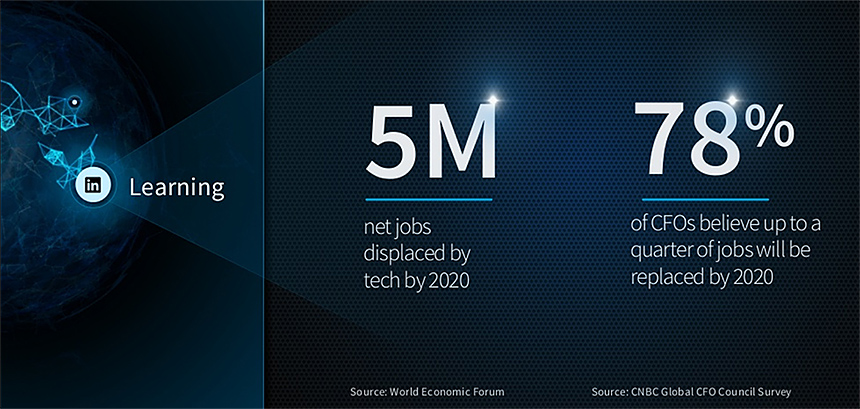
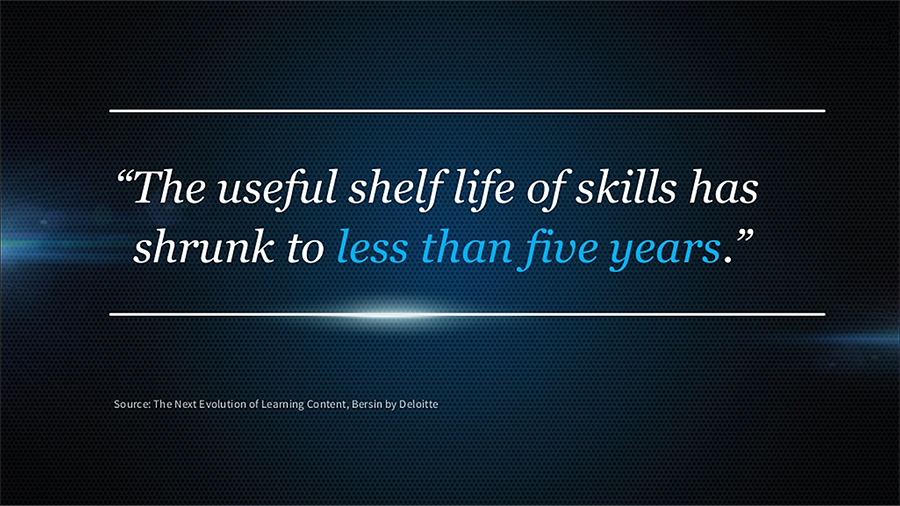
The pressure on individuals and organizations to adapt to change has never been greater. The skills that got you to where you are today are not the skills to prepare you for tomorrow. In fact, the shelf-life of skills is less than five years, and many of today’s fastest growing job categories didn’t even exist five years ago.

To tackle these challenges, LinkedIn Learning is built on three core pillars:

Data-driven personalization: We get the right course in front of you at the right time. Using the intelligence that comes with our network, LinkedIn Learning creates personalized recommendations, so learners can efficiently discover which courses are most relevant to their goals or job function. Organizations can use LinkedIn insights to customize multi-course Learning Paths to meet their specific needs. We also provide robust analytics and reporting to help you measure learning effectiveness.


linkedinlearning-announced-9-22-16


LinkedIn’s first big move since the $26.2 billion Microsoft acquisition is basically a ‘school’ for getting a better job — from finance.yahoo.com

Excerpt:

Today, LinkedIn has launched LinkedIn Learning — its first major product launch since the news last June that Microsoft would be snapping up the social network for $26.2 billion in a deal that has yet to close.

LinkedIn Learning takes the online skills training classes the company got in its 2015 acquisition of Lynda.com for $1.5 billion.

The idea, says LinkedIn CEO Jeff Weiner, is to help its 433 million-plus members get the skills they need to stay relevant in a world that’s increasingly reliant on digital skills.


LinkedIn’s New Learning Platform to Recommend Lynda Courses for Professionals — from edsurge.com by Marguerite McNeal

Excerpt:

Companies will also be able to create their own “learning paths”—bundles of courses around a particular topic—to train employees. A chief learning officer, for instance, might compile a package of courses in product management and ask 10 employees to complete the assignments over the course of a few months.

LinkedIn is also targeting higher-education institutions with the new offering. It is marketing the solution as a professional development tool that can help faculty learn how to use classroom tools such as Moodle, Adobe Captivate and learning management systems.


“Increasingly predictions of tech displacing workers are coming to fruition,” he added. “The idea that you can study a skill once and have a job for the rest of your life—those days are over.”


LinkedIn Learning for higher education


Accelerating LinkedIn’s Vision Through Innovation — from slideshare.net

linkeinlearning-sept2016


linkeinlearning2-sept2016


LinkedIn adding new training features, news feeds and ‘bots’ — from finance.yahoo.com

Excerpt:

LinkedIn is also adding more personalized features to its news feed, where members can see articles and announcements posted by their professional contacts. A new “Interest Feed” will offer a collection of articles, posts and opinion pieces on major news events or current issues.


If you doubt that we are on an exponential pace of change, you need to check these articles out! [Christian]

exponentialpaceofchange-danielchristiansep2016


From DSC:
The articles listed in
this PDF document demonstrate the exponential pace of technological change that many nations across the globe are currently experiencing and will likely be experiencing for the foreseeable future. As we are no longer on a linear trajectory, we need to consider what this new trajectory means for how we:

  • Educate and prepare our youth in K-12
  • Educate and prepare our young men and women studying within higher education
  • Restructure/re-envision our corporate training/L&D departments
  • Equip our freelancers and others to find work
  • Help people in the workforce remain relevant/marketable/properly skilled
  • Encourage and better enable lifelong learning
  • Attempt to keep up w/ this pace of change — legally, ethically, morally, and psychologically


PDF file here


One thought that comes to mind…when we’re moving this fast, we need to be looking upwards and outwards into the horizons — constantly pulse-checking the landscapes. We can’t be looking down or be so buried in our current positions/tasks that we aren’t noticing the changes that are happening around us.


Thinking about the future of work to make better decisions about learning today — from er.edcause.edu by Marina Gorbis
By looking at historical patterns and identifying signals of change around us today, we can better prepare for the transformations occurring in both work and learning.

Excerpt:

Instead of debating whether learning is for learning’s sake or as a means for earning a living, we need to think about the forces and signals of transformation and what they mean for higher education today and tomorrow.

So let’s explore these deeper transformations.1 From our experience of doing forecasting work for nearly fifty years, we at the IFTF believe that it is usually not one technology or one trend that drives transformative shifts. Rather, a cluster of interrelated technologies, often acting in concert with demographic and cultural changes, is responsible for dramatic changes and disruptions. Technologies coevolve with society and cultural norms—or as Marshall McLuhan is often quoted as having said: “We shape our tools and afterwards our tools shape us.” Nowhere does this apply more critically today than in the world of work and labor. Here, I focus on four clusters of technologies that are particularly important in shaping the changes in the world of work and learning: smart machines; coordination economies; immersive collaboration; and the maker mindset.


From DSC:
I appreciate this article — thanks Marina.

Marina’s article — and the work of The Institute for the Future (IFTF) — illustrates how important is it to examine the current and developing future landscapes — trying to ascertain the trends and potential transformations underway.  Such a practice is becoming increasingly relevant and important.

Why?

Because we’re now traveling at exponential rates, not linear rates.


SparksAndHoney-ExpVsLinear2013


We’re zooming down the highway at 180mph — so our gaze needs to be on the horizons — not on the hoods of our cars.


The pace has changed significantly and quickly


Institutions of higher education, boot camps, badging organizations, etc. need to start offering more courses and streams of content regarding futurism — and teaching people how to look up.

Not only is this type of perspective/practice helpful for organizations, but it’s becoming increasingly key for us as individuals.

You don’t want to be the person who gets tapped on the shoulder and is told, “I’m sorry…but your services won’t be necessary here anymore. Please join me in the conference room down the hall.”  You then walk down the hall, and as you approach the conference room, you notice that newly placed cardboard is covering the glass — and no one can see into the conference room anymore. You walk in, they shut the door, give you your last pay check and your “pink slip” (so to speak).  Then they give you 5 minutes to gather your belongings.  A security escort walks you to the front door.

Game over.

Pulse checking a variety of landscapes can contribute
towards keeping your bread and butter on the table.


Also see:

  • Credentials reform: How technology and the changing needs of the workforce will create the higher education system of the future — from er.educause.edu by Jamie Merisotis
    The shift in postsecondary credentialing and the needs of the 21st-century workforce will revolutionize higher education. Colleges and universities have vast potential to be positive agents of this change.
    .
  • New workers, new skills — from er.edcause.edu by Marina Gorbis
    What are the most important skills—the work skills and the life skills—that students should acquire from their educational experience, and what is the best way to teach those skills?Excerpt:
    We found that the following short list of skills not only continues to be relevant but also is even more important as meta-skills in the changing worlds of work:
  • Sense-making: the ability to determine the deeper meaning or significance of what is being expressed
  • Social intelligence: the ability to connect to others in a deep and direct way and to sense and stimulate reactions and desired interactions
  • Novel and adaptive thinking: a proficiency in coming up with solutions and responses beyond those that are rote or rule-based
  • Cross-cultural competency: the ability to operate in different cultural settings, not just geographical but also those that require an adaptability to changing circumstances and an ability to sense and respond to new contexts
  • Computational thinking: the ability to translate vast amounts of data into abstract concepts and to understand data-based reasoning
  • Media literacy: the ability to critically assess and develop content that uses new media forms and to leverage these media forms for persuasive communication
  • Transdisciplinarity: a literacy in, and the ability to understand, concepts across multiple disciplines
  • Design mindset: the ability to represent and develop tasks and work processes for desired outcomes
  • Cognitive load management: the ability to discern and filter data for importance and to understand how to maximize cognitive functioning using a variety of tools and techniques
  • Virtual collaboration: the ability to work productively, drive engagement, and demonstrate presence as a member of a virtual team

While we believe that these ten skills continue to be important, two additional skills have emerged from our ethnographic interviews for these new worker categories: networking IQ and hustle.


Thinking about the future is like taking a jog: we can always find something to do instead, but we will be better off later if we take time to do it.


© 2025 | Daniel Christian