.
.
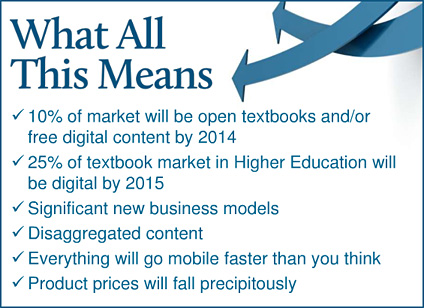
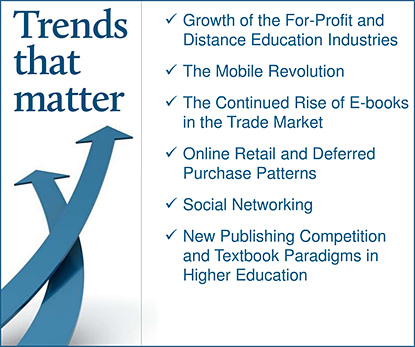
This is a presentation prepared for the “What College Students Think: Making Information Pay for Higher Ed Publishing” conference sponsored by the Book Industry Study Group on February 9.
.
.
This is a presentation prepared for the “What College Students Think: Making Information Pay for Higher Ed Publishing” conference sponsored by the Book Industry Study Group on February 9.
 |
| The ten most widely read online EDUCAUSE Review articles from 2010 focused on innovation, current IT issues, individual/collaborative learning, attention, openness, the future campus, scholarly publishing, and libraries.
In case you missed them in 2010:
|
IEEE Transactions on Learning Technologies TLT is a scholarly archival journal published quarterly using a delayed open access publication model.

The Web revolution, the popularity of on-line learning, and the broad availability of computers in schools, colleges, universities, workplaces and in other social settings has caused a qualitative change in the field of learning technologies. Both the variety and the complexity of e-learning tools have increased dramatically over the last 10 years. A number of new conferences emerged to provide a forum for researchers and practitioners in the field of learning technologies to discuss their work. Yet, there are very few journals, which embrace the field as a whole and provide a space to publish archival quality papers. The goal of IEEE Transactions on Learning Technologies (TLT) is to bridge this gap.TLT covers all advances in learning technologies, including but not limited to the following topics:
IEEE Transactions on Learning Technologies
The IEEE Transactions on Learning Technologies will publish archival research papers and critical survey papers. Topics within the scope include technology advances in online learning systems; intelligent tutors; educational software applications and games; simulation systems for education and training; collaborative learning tools, devices and interfaces for learning; interactive techniques for learning; tools for formative and summative assessment; ontologies for learning systems; standards and web services that support learning; authoring tools for learning materials; computer support for peer tutoring and learning via discovery or project work or field or lab work; and creation and management of learning objects. A paper must either describe original research or offer a critical review of the state of the art in a particular area. Papers concerned with evaluation of technology are only appropriate if the technology itself is novel or if significant technical insights are provided. In order to best serve the community, the TLT will be published online, using a delayed open-access policy under which paying subscribers and per-article purchasers have access to newly published content, and then 12 months after the publication of each issue, all readers will have access to the content, free of charge.
.
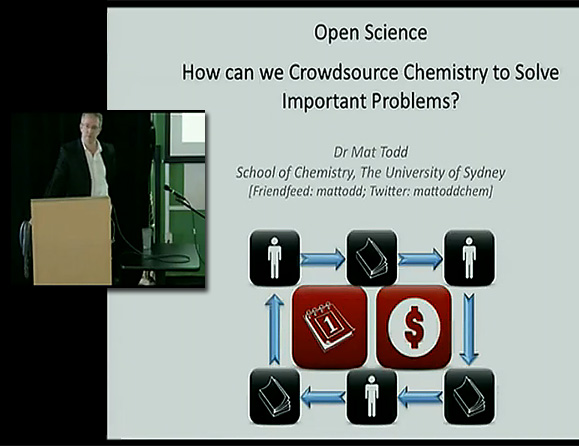
Google Tech Talk
April 6, 2010
ABSTRACT
Presented by Dr Matthew Todd, School of Chemistry, University of Sydney.
Science shaped itself in the founding days of learned societies: individuals or teams competed, in secret, with paper-based communication in subscription journals. Why are we all still doing science like this? The internet has had a major impact in our sharing of data by traditional means, but it has not yet radically changed the way we actually perform science.
.
.
Here’s a list of the projects mentioned in the video:
Praziquantel is being used in the treatment of schistosomiasis, a parasitic infection spread by freshwater snails in sub-Saharan Africa.
The Gates Foundation is funding an operational research program – SCORE to control and eliminate Neglected Tropical Diseases.
This operates out of Imperial College, London and is led by Professor Alan Fenwick OBE.
The Cathedral model is where a professor and students conduct funded research to develop a solution whereas the Bazaar model invites other people to collaborate in an Open source way to develop a solution. Firefox, Chrome, Wikipedia are all Bazaar models.
Open Science involves publishing in real time and letting people respond as they see fit and then collaborate in real time.
The UsefulChem Project led by the Jean Claude Bradley at Drexel University – aimed at producing molecules that will be used to treat malaria. Bradley is a proponent of and practises Open Notebook Science.
Open Source Drug Discovery: http://www.osdd.net/ – OSDD is a CSIR Team India Consortium with Global Partnership with a vision to provide affordable healthcare to the developing world.
Open WetWare: http://openwetware.org/wiki/OpenWetWare:About – OpenWetWare is an effort to promote the sharing of information, know-how, and wisdom among researchers and groups who are working in biology & biological engineering.
The Open Dinosaur Project: http://opendino.wordpress.com/ (founded to involve scientists and the public alike in developing a comprehensive database of dinosaur limb bone).
Chemspider: http://www.chemspider.com/ – ChemSpider links together compound information across the web, providing free text and structure search access of millions of chemical structures.
Foldit is a revolutionary new computer game enabling you to contribute to important scientific research.
NCBI (National Center for Biotechnology Information): http://www.ncbi.nlm.nih.gov/ – advances science and health by providing access to biomedical and genomic information.
GenBank: http://www.ncbi.nlm.nih.gov/genbank/ – is the NIH genetic sequence database, an annotated collection of all publicly available DNA sequences.
The Tropical Disease Initiative aims to apply an open-source collaborative approach to biological and medical research for tropical diseases.
The Synaptic Leap: – Open Source Biomedical Research.
Stack Overflow allows you to post code and ask for help on a problem.
Chempedia is a free service for uniquely identifying and naming chemical substances.
CML (Chemical Markup Language) is an open standard for representing molecular and other chemical data. It includes XML Schema, source code for working with CML data, and was devised by Peter Murray-Rust who worked with Microsoft to develop a Chem Word Add-in enabling a Word document to be searched and the chemical information in it to be automatically annotated and extracted. When you hover over a word, you get a structure and you can change the structure.
Chemicalize.org – a public web resource developed by ChemAxon.
Who needs textbooks? — from Newsweek.com
How Washington State is redesigning textbooks for the digital age.

Jessie Sellers, a student at Tacoma Community College in Washington state, was puzzled when he logged onto his school’s website last December to figure out which book he needed for his upcoming English class. Whereas for all his previous courses, the 24-year-old education major could simply click on a link to view the name of the required textbook, this time there were no books listed at all. It was no mistake: thanks to an ambitious pilot program aimed at reducing the cost of textbooks at public colleges, Sellers and hundreds of other students across the state won’t have to buy textbooks for more than three dozen courses offered this winter.
Washington’s Open Course Library is the largest state-funded effort in the nation to make core college course materials available on the Web for $30 or less per class. Financed with $750,000 from the state of Washington and a matching grant from the Bill & Melinda Gates Foundation, the goal isn’t just to reduce student costs, says program architect Cable Green. It’s also to create engaging, interactive learning materials that will help improve course completion rates. By the time the project is completed in 2012, digitized textbook equivalents for some 81 high-enrollment classes will be available online for the more than 400,000 students enrolled in Washington’s network of community and technical colleges. Even better, the materials can be shared across the globe, largely for free, because they will be published in an open format that avoids the most onerous licensing restrictions. To keep costs at a minimum, the teachers developing the materials are relying primarily on either existing material in the public domain or embarking on the painstaking task of developing materials from scratch.
Who wants a self-paced, free, world class education? — from OpenSesame.com
From DSC:
I work within higher education…so why am I posting this? For several reasons:
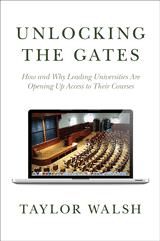
Unlocking the Gates:
How and Why Leading Universities Are Opening Up Access to Their Courses
Taylor Walsh
With a foreword by William G. Bowen
.
Unlocking the Gates: Interview with Author, Taylor Walsh — from Higher Education Management Group
$2-billion federal program could be ‘windfall’ for open online learning — from The Chronicle by Marc Parry
Royalty Free Music and EmbedPlus — from The Thinking Stick by Jeff Utecht
Excerpt on EmbedPlus:
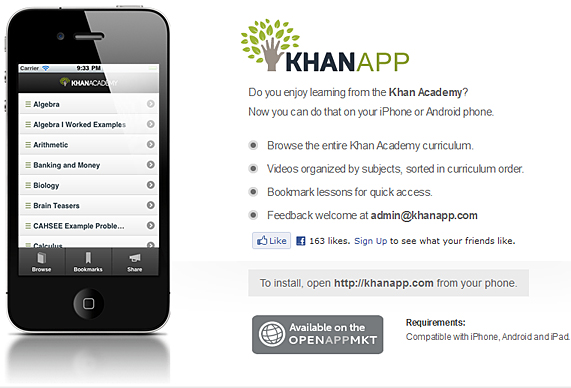
“You can set times in the video to skip to, you can slow the video down, and rewind. Some pretty cool extra features….and all for free.”
.
— originally from Richard Byrne’s Free Technology for Teachers blog
— from DSC: I couldn’t get the actual video files to load on my iPhone, perhaps I missed a step
e-learning outlook for 2011 — from Tony Bates
Tony discusses course redesigns, mobility, open educational resources (OER), multimedia, learning analytics, and shared services.
Half of Detroit’s schools may close — from good.is

Financial mismanagement and declining enrollment are ringing a death knell for Detroit’s schools. According to Detroit Public School Emergency Manager Robert Bobb, to close a $327 million budget deficit, he’ll need to shut half of the city’s campuses over the next two years.
Under the plan, the 142 current schools in the district would be reduced to 72 by the 2012-13 school year. What will happen to the students attending those schools? Bobb plans to shift them over to the remaining campuses, raising class sizes to 62 students per teacher.
From DSC:
Seriously…this is crazy and completely unfair! Those of us who have more resources need to step in and help out. But how can we best do this? How can folks outside of the Detroit area make a solid, helpful impact? Coming from the tech side of the house, I’d like to see us offer FREE materials…online.
That assistance could come from private corporations, individuals, colleges, universities or for-profit organizations such as K12 Inc. Another idea along the lines of individuals, is to allocate $1-$5 billion from the amounts being donated by some of the nation’s wealthiest people. Use those funds to make outstanding educational materials that engage our youth. Then we could offer those incredibly-well done, multimedia-based, interactive, engaging, highly-sophisticated materials FREELY to anyone who wants access to them — whether inside or outside the United States. This would be a massive undertaking from a curricular, instructional design, programming, production, etc. standpoint. But WOW! What a difference it could make to level the playing field!
Perhaps working with vendors, some of the funding could be used for loaning out the devices needed to “play” and interact with the materials, and perhaps some other funding could be allocated to the city of Detroit to provide wireless access throughout the city and surrounding suburbs.
Also see:
The $600 billion challenge– from Fortune
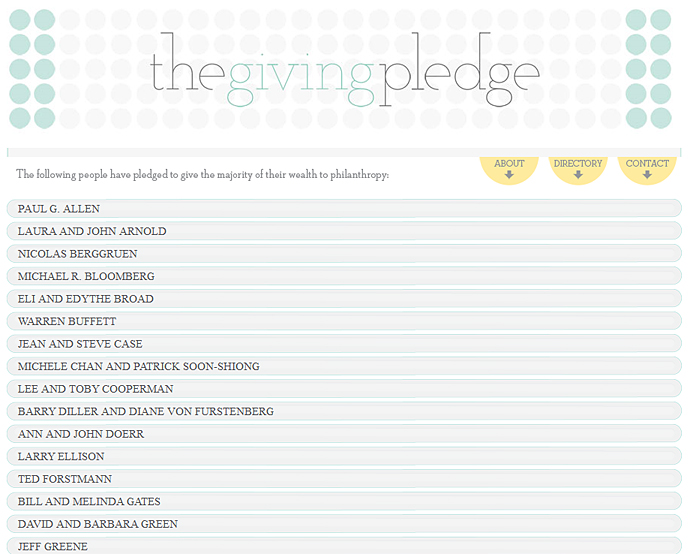
Bill Gates, Melinda Gates, and Warren Buffett are asking the nation’s billionaires to pledge to give at least half their net worth to charity, in their lifetimes or at death. If their campaign succeeds, it could change the face of philanthropy.
100+ online resources that are transforming education — from Mashable

.
From DSC:
If you doubt that…read on…
The New Normal: Universities Sponsoring Online High Schools — from EdReformer.com
K12 announced today that they are partnering with George Washington University to launch The George Washington University Online High School. This private high school will serve students from the US and countries around the world January 2011.
Students are constantly trying to find options that will set them apart from others and participating in this rigorous college preparatory program could be the key. In addition to the curriculum, students who attend an online high school connected to a University such as GWUOHS will have college counseling, personalized learning tools, test preparation, even guidance through the scholarship process.
GWU is not the only university sponsoring online high schools. Stanford has the EPGY Online High School. University of Missouri High School and The University of Oklahoma offer year-round and dual enrollment courses. Whether public or private schools, the possibilities are endless for students. Training for sports, starting a business, volunteering, working in the arts, all can become easier by signing in to your online courses from the nearest computer.
Through major universities in partnership with online providers, students are reaping the benefits of university resources online high schools. It is interesting that we do not see this type of partnership more often.
MIT tries new approach for some OpenCourseWare (OCW) — from The Chronicle by Jeff Young
New MIT OpenCourseWare Initiative Aims to Improve Independent Online Learning — from the NYT by Aurey Watters of ReadWriteWeb
MIT OpenCourseWare is launching five new courses today that mark a new model for one of the world’s premier open educational resources. These OCW Scholar courses are designed for use by independent learners, and like the other material made available through MIT OCW, are freely available for anyone to pursue. These aren’t distance learning classes – there is no instructor, no contact with MIT, no credit. But the courses are meant to be stand-alone offerings, not requiring any additional materials for learning.
Technology Empowering Online Learning at Post-Secondary Level — from TMCNet by Beecher Tuttle
Times have changed, however. With lower budgets, limited physical space and new insight into the effectiveness of online learning, a myriad of highly regarded public and private colleges and universities have begun transitioning their curriculum to a digital world. In fact, the University of North Carolina at Chapel Hill, one of the most well thought-of state institutions on the East Coast, recently announced its plans to offer its prestigious MBA program completely online. The business school’s dean told Mashable that the university made the move because it did not see online learning as a lesser form of education, if delivered properly.
Quick aside from DSC:
Re: that last sentence…please…let’s stop asking the question if online learning is as good as face-to-face learning. That question has been answered time and again.
The question now is, how will face-to-face learning begin to keep up and measure up to online learning as online learning begins to hit its real stride? We haven’t seen anything yet; and at this point, innovation is happening at much faster speeds in the online world. Those professors, teachers, and trainers used to working solely in the face-to-face teaching and learning environments better really start asking themselves how they will innovate, and how they will respond to the K-12 students (and employees) that are changing right in front of our eyes!
New Web Venture Offers ‘Syndicated Courses’ — from The Chronicle by Tusher Rae
Omnicademy, a for-profit institution conceived at Louisiana State University, hopes to allow professors to syndicate their courses this fall.
The company’s system will let professors upload material from courses they’re already teaching and offer the courses to students at other colleges through the Omnicademy site, said the company’s founder, Stacey Simmons, associate director for economic development at Louisiana’s Center for Computation and Technology.
Universities can review the courses and decide which ones they want to adopt and offer credit for. When students log into Omnicademy—using a .edu e-mail address—they will only be allowed to select from courses that have been approved by their institution.
If a student wishes to take a course offered through Omnicademy that is not on the list approved by his or her university, Omnicademy will negotiate on behalf of that student with the university, Ms. Simmons added.
2020 Vision — from neXtedu
The MEGATRENDS I see changing the Education Industry are:
1) The Knowledge Economy:
Prediction: By 2020, Assessment becomes the currency for the Knowledge Economy, not where you went to school. In other words, opportunity will truly be driven by what you know, not by where your degree is from.
2) Globalization:
Prediction: By 2020, there will be Global Schools like Avenues and Mosaica in the primary and secondary market and an acceleration of Global Universities will be driven by online offerings. Moreover, study abroad will become a standard part of a college education (up from 1% of the students currently) and will even be an important feature for top-tier private K-12 schools.
3) The Internet: …Web 2.0 is truly about “democratizing” education, not only increasing access and lowering cost but also improving quality.
Prediction: By 2020, all college students will have a “blended” or “hybrid” learning experience, as will nearly all high school students. Virtual School operators such as K12, Connections Academy and Florida Virtual have millions of students and Arizona State University Online becomes the largest University in the World. The information that is made readily available by new media education sites such as Center for Education Reform’s “Media Bullpen” and the Education Breakthrough Network create a “dismantling of the Berlin Wall” moment for school choice, with a flood of opportunities coming to parents and students throughout the United States.
4) Outsourcing:
Prediction: By 2020, students in Charter Schools will have more than tripled from 3% to 10% of America’s student body, and it will become standard to integrate specialists, from foreign languages to mathematics, into the “traditional” school. Teach for America becomes a “for profit” as does KIPP, eliminating the ongoing need to raise tens of millions of dollars every year and instead utilize investor capital to sustain and grow their businesses. I predict over 25% of Universities will have partnerships with outsourced providers to manage their online offering. Several states will decide to “privatize” their public university system.
5) Consolidation:
Prediction: By 2020, the trend of less power and money from local coupled with a rationalization of the market will see many districts consolidate under either regional or state governance. As many as 1/3 of the private colleges and universities will either “merge” with other universities or go away.
6) Demographics:
Prediction: By 2020, Education is the #1 national issue driven by minorities understanding that equal access to education is key to their future — and zip code shouldn’t determine a student’s earnings power. Early stage childcare becomes much more of a national priority with leaders such as Bright Horizons being the model for how corporations and parents work together to provide the early learning needed to be “school ready”. Gaming will be a standard component of core curriculum and supplementary learning with companies like Dreambox, Tabula Digita , Knewton and Grockit creating powerful adaptive platforms.
7) Network Effects:
Prediction: By 2020, large learning networks are created in K12, Higher Ed and the Corporate Marketplace driven by gigantic network effects. Platforms that support “apps” such as digital content, assessment, and social collaboration are supported by three or four large players.
8) Freemium:
Prediction: By 2020 some of the largest education companies will be “freemium” models with revenues driven by premium services, sponsorships and ads. In a world where “assessment is the currency” for opportunity, freemium models that deliver high value knowledge at no cost or a fraction of the cost (like Academic Earth) will be very disruptive to high cost providers.
9) Open:
Prediction: By 2020, most colleges and universities have abandoned their captive LMS and have adopted open solutions, and service providers such as RSmart and Moodle Rooms are thriving.
10) Brands:
Prediction: By 2020, institutions with substantial brand equity will have multiple partners to leverage into cash to supplement endowments and flattish tuitions. As with case studies from other sectors that have created network effects with freemium models, GLOBAL MEGABRANDS will be created with a number of education companies obtaining $10 billion plus market caps.
Arizona State University’s Education Innovation Network
The Education Innovation Network is an open innovation platform where entrepreneurs can find the resources to validate concepts, accelerate growth and reach transformative scale.
From DSC:
Again…do you hear the waves of change crashing on our shores? Do you sense the increased speeds of the “cars on the racetrack”?