The Benefits of an Innovative Culture at Smaller Colleges — from evolllution.com with Shane Garrison | Vice President of Enrollment, Campbellsville University
Smaller institutions are under more pressure than ever to innovate or collapse—weathering the storm is simply no longer an option for most institutions. This requires leaders and staff across the institution to have a creative mindset, and be willing to experiment and evolve.

Excerpt:

There is the reality that if you don’t diversify, if you fail to be creative, if you fail to try new things, you’re on the verge of folding. In Kentucky, two faith-based colleges folded within a span of about three years, and I think that created an urgency to avoid that fate. We have to be willing to try, create and experiment to survive, and that means doing things that we’ve never done before.

Evo: How can an innovative and experiment-focused culture help smaller institutions overcome some of those obstacles?

SG: I think you have to be willing to experiment for short periods of time with strategies that do not fit inside the traditional bubble. For example, for us, our online presence has been fairly strong for about 12 years. However, we had to experiment with placing a good number of full four-year bachelor’s degree programs online, something our university had never done. We had associate programs, we had graduate programs but we had to add bachelor programs online. We did it for three or four years in the experimental phase and noticed these were actually strong and it was building a beautiful pathway between our associate two-year programs and the four-year programs and continuing into graduate programs.

We are experimenting now with an international recruiting partnership and giving it two to three years to see what happens. It has been very successful thus far. This model has created a culture where we can experiment.


The Future of Coding Bootcamps — from edsurge.com by Jeff Young

Excerpt:

EdSurge set out to answer some of those questions with a series of articles about the future of coding bootcamps. We’ll be adding to the series over the next few weeks, and let us know if you have particular questions you want us to pursue.


Coding Boot Camps Won’t Save Us All — from edsurge.com by Jeff Young

Excerpt:

That doesn’t mean the rest of the boot camps are doomed. In fact, there are at least 95 other coding boot camp companies in the U.S., and some say they are still growing. But it should bring a dose of realism to what had been a narrative of unending growth and the idea that somehow boot camps were a silver bullet for what ails higher education.


More bootcamps are quietly coming to a university near you — from edsurge.com by Sydney Johnson

Excerpt:

In the last two years, a surge of nonprofit, four-year institutions have hopped on the bootcamp bandwagon. These programs, often on skills such as software development or data analytics, have arrived in a number of ways—from universities partnering with local for-profit bootcamps, or colleges creating their own intensive training programs completely in-house.But while bootcamps are often associated with tech skills, it seems that traditional universities trying out the model are interested in more than just coding. An increasing number of traditional higher-ed institutions are now applying bootcamp trainings to other fields, such as healthcare, accounting and even civics and political science.


Online learning startup Codecademy launches paid Pro courses — from techcrunch.com by Ryan Lawler

Excerpt:

Codecademy has spent the last several years building a large community of learners with free lessons aimed at teaching its users the basics of how to code. But now it’s betting that many of them will be willing to pay for more intensive courses.

When Codecademy founder and CEO Zach Sims founded the company in  2011, he did so with the hope of allowing more people interested in programming to gain access to educational content they’d need to get started.


Major Coding Bootcamps Going Out of Business — from campustechnology.com by Sri Ravipati

Excerpt:

In a surprising turn of events, two major coding bootcamps, within the span of about a week, have announced they are shutting down all operations.

Most recently, after a four-year run, South Carolina-based The Iron Yard (TIY) revealed last Friday it would close its 15 campuses, including locations like Atlanta, Austin, Houston and Charleston where other coding bootcamps are flourishing.

Similarly, Dev Bootcamp (DBC) on July 12 announced via Facebook that it would shutdown operations at all six locations — Austin, Chicago, San Diego, San Francisco, Seattle and New York — by the end of the summer.


From DSC:
I can almost hear the snickering from a variety of people within higher education about this situation. If gloating had an audible sound associated with it, I’d likely have to go find some earplugs. But I have a message for those who are snickering and gloating right now — saying something along the lines of, “Ha! So much for these alternatives to traditional higher education! They’re nothing, and they’ll come to nothing!”

That may be so. Such relatively new alternatives to traditional institutions of higher education may come to nothing. But you know what? At least those organizations are trying to be much more responsive than many institutions of traditional higher education are being! They’ve recognized that there are unmet needs — gaps, if you will — arising from our current systems. Gaps in either the content that we’re providing and/or the manner in which we’re providing it. Gaps that thousands of students have signed up for in a relatively short time. Those gaps should be cause for action within traditional institutions of higher education. They should be cause for realizing that we aren’t responding nearly fast enough to today’s new pace of change.

The pace of change has changed. It is lightning fast these days. Don’t believe me? Go check out some of the descriptions for the hot jobs out there these days. Seriously. Go do it. Go find out which skills you need to get your foot in the door to acquire those types of positions. It’ll blow your mind!

And there are ramifications to this.

If our accreditation systems need to change, than so be it. Let’s identify those necessary changes and make ’em happen!

Because:

  • WE have some serious responsibility for the educations that we are providing to this next generation!!! 
  • WE need to prepare them for what they’ll need to be marketable in the future — so that they can put bread and butter on their tables throughout their careers.
  • WE need to act!
  • WE need to be responsive!

This is not a time for gloating. Rather, this is a time for some serious action.


Addendums on 8/2/17 and 8/3/17:


Jobs Report: 97 Percent of Flatiron School Graduates Land Jobs — from by Sri Ravipati

Excerpt:

While two major coding bootcamps shut down earlier this week, another released its latest jobs report and says it had the strongest student outcomes to date.

The Flatiron School based in New York, NY has released an independently verified jobs report every year since 2014 — “pioneering the concept of outcomes reporting and setting a standard of transparency in educational outcomes,” the latest report reads. It’s the company’s commitment to accessibility and transparency that have allowed its programs to stay open for five years now, says Adam Enbar, co-founder of the Flatiron School.


More bootcamps are quietly coming to a university near you — from edsurge.com by Sydney Johnson

Excerpt:

In the last two years, a surge of nonprofit, four-year institutions have hopped on the bootcamp bandwagon. These programs, often on skills such as software development or data analytics, have arrived in a number of ways—from universities partnering with local for-profit bootcamps, or colleges creating their own intensive training programs completely in-house.But while bootcamps are often associated with tech skills, it seems that traditional universities trying out the model are interested in more than just coding. An increasing number of traditional higher-ed institutions are now applying bootcamp trainings to other fields, such as healthcare, accounting and even civics and political science.


The Business of Artificial Intelligence — from hbr.org by Erik Brynjolfsson & Andrew McAfee

Excerpts (emphasis DSC):

The most important general-purpose technology of our era is artificial intelligence, particularly machine learning (ML) — that is, the machine’s ability to keep improving its performance without humans having to explain exactly how to accomplish all the tasks it’s given. Within just the past few years machine learning has become far more effective and widely available. We can now build systems that learn how to perform tasks on their own.

Why is this such a big deal? Two reasons. First, we humans know more than we can tell: We can’t explain exactly how we’re able to do a lot of things — from recognizing a face to making a smart move in the ancient Asian strategy game of Go. Prior to ML, this inability to articulate our own knowledge meant that we couldn’t automate many tasks. Now we can.

Second, ML systems are often excellent learners. They can achieve superhuman performance in a wide range of activities, including detecting fraud and diagnosing disease. Excellent digital learners are being deployed across the economy, and their impact will be profound.

In the sphere of business, AI is poised have a transformational impact, on the scale of earlier general-purpose technologies. Although it is already in use in thousands of companies around the world, most big opportunities have not yet been tapped. The effects of AI will be magnified in the coming decade, as manufacturing, retailing, transportation, finance, health care, law, advertising, insurance, entertainment, education, and virtually every other industry transform their core processes and business models to take advantage of machine learning. The bottleneck now is in management, implementation, and business imagination.

The machine learns from examples, rather than being explicitly programmed for a particular outcome.


Let’s start by exploring what AI is already doing and how quickly it is improving. The biggest advances have been in two broad areas: perception and cognition. …For instance, Aptonomy and Sanbot, makers respectively of drones and robots, are using improved vision systems to automate much of the work of security guards. 


Machine learning is driving changes at three levels: tasks and occupations, business processes, and business models. 


You may have noticed that Facebook and other apps now recognize many of your friends’ faces in posted photos and prompt you to tag them with their names.


The case for a next generation learning platform [Grush & Christian]


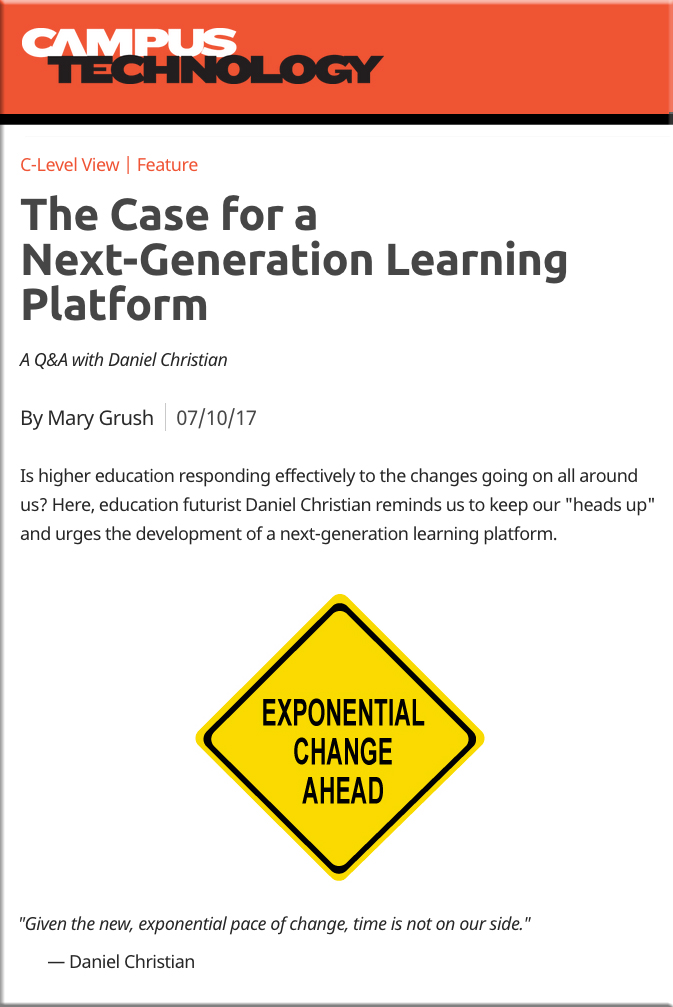
The case for a next generation learning platform — from campustechnology.com by Mary Grush & Daniel Christian

Excerpt (emphasis DSC):

Grush: Then what are some of the implications you could draw from metrics like that one?

Christian: As we consider all the investment in those emerging technologies, the question many are beginning to ask is, “How will these technologies impact jobs and the makeup of our workforce in the future?”

While there are many thoughts and questions regarding the cumulative impact these technologies will have on our future workforce (e.g., “How many jobs will be displaced?”), the consensus seems to be that there will be massive change.

Whether our jobs are completely displaced or if we will be working alongside robots, chatbots, workbots, or some other forms of AI-backed personal assistants, all of us will need to become lifelong learners — to be constantly reinventing ourselves. This assertion is also made in the aforementioned study from McKinsey: “AI promises benefits, but also poses urgent challenges that cut across firms, developers, government, and workers. The workforce needs to be re-skilled to exploit AI rather than compete with it…”


A side note from DSC:
I began working on this vision prior to 2010…but I didn’t officially document it until 2012.


The Living [Class] Room -- by Daniel Christian -- July 2012 -- a second device used in conjunction with a Smart/Connected TV


Learning from the Living [Class] Room:

A global, powerful, next generation learning platform


What does the vision entail?

  • A new, global, collaborative learning platform that offers more choice, more control to learners of all ages – 24×7 – and could become the organization that futurist Thomas Frey discusses here with Business Insider:

“I’ve been predicting that by 2030 the largest company on the internet is going to be an education-based company that we haven’t heard of yet,” Frey, the senior futurist at the DaVinci Institute think tank, tells Business Insider.

  • A learner-centered platform that is enabled by – and reliant upon – human beings but is backed up by a powerful suite of technologies that work together in order to help people reinvent themselves quickly, conveniently, and extremely cost-effectively
  • A customizable learning environment that will offer up-to-date streams of regularly curated content (i.e., microlearning) as well as engaging learning experiences
  • Along these lines, a lifelong learner can opt to receive an RSS feed on a particular topic until they master that concept; periodic quizzes (i.e., spaced repetition) determines that mastery. Once mastered, the system will ask the learner whether they still want to receive that particular stream of content or not.
  • A Netflix-like interface to peruse and select plugins to extend the functionality of the core product
  • An AI-backed system of analyzing employment trends and opportunities will highlight those courses and streams of content that will help someone obtain the most in-demand skills
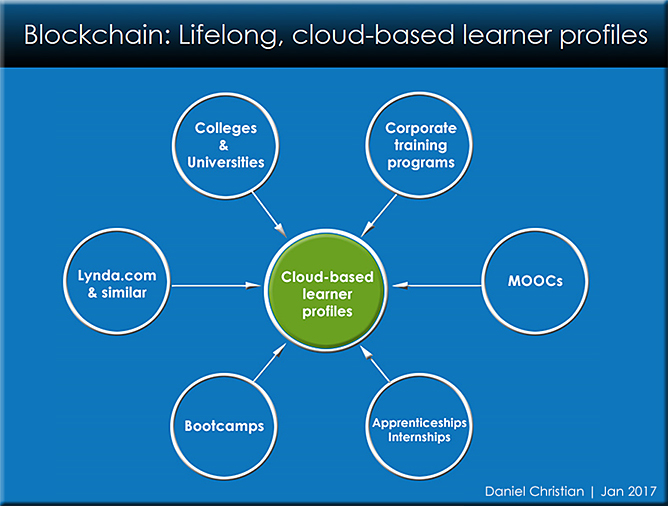
  • A system that tracks learning and, via Blockchain-based technologies, feeds all completed learning modules/courses into learners’ web-based learner profiles
  • A learning platform that provides customized, personalized recommendation lists – based upon the learner’s goals
  • A platform that delivers customized, personalized learning within a self-directed course (meant for those content creators who want to deliver more sophisticated courses/modules while moving people through the relevant Zones of Proximal Development)
  • Notifications and/or inspirational quotes will be available upon request to help provide motivation, encouragement, and accountability – helping learners establish habits of continual, lifelong-based learning
  • (Potentially) An online-based marketplace, matching learners with teachers, professors, and other such Subject Matter Experts (SMEs)
  • (Potentially) Direct access to popular job search sites
  • (Potentially) Direct access to resources that describe what other companies do/provide and descriptions of any particular company’s culture (as described by current and former employees and freelancers)
  • (Potentially) Integration with one-on-one tutoring services

Further details here >>


Addendum from DSC (regarding the resource mentioned below):
Note the voice recognition/control mechanisms on Westinghouse’s new product — also note the integration of Amazon’s Alexa into a “TV.”


Westinghouse’s Alexa-equipped Fire TV Edition smart TVs are now available — from theverge.com by Chaim Gartenberg


The key selling point, of course, is the built-in Amazon Fire TV, which is controlled with the bundled Voice Remote and features Amazon’s Alexa assistant.


Finally…also see:

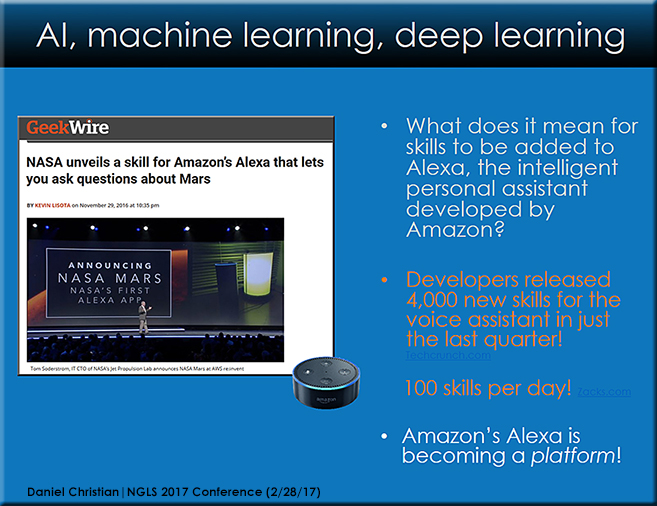
  • NASA unveils a skill for Amazon’s Alexa that lets you ask questions about Mars — from geekwire.com by Kevin Lisota
  • Holographic storytelling — from jwtintelligence.com
    The stories of Holocaust survivors are brought to life with the help of interactive 3D technologies.
    New Dimensions in Testimony is a new way of preserving history for future generations. The project brings to life the stories of Holocaust survivors with 3D video, revealing raw first-hand accounts that are more interactive than learning through a history book.  Holocaust survivor Pinchas Gutter, the first subject of the project, was filmed answering over 1000 questions, generating approximately 25 hours of footage. By incorporating natural language processing from the USC Institute for Creative Technologies (ICT), people are able to ask Gutter’s projected image questions that trigger relevant responses.


What a future, powerful, global learning platform will look & act like [Christian]


Learning from the Living [Class] Room:
A vision for a global, powerful, next generation learning platform

By Daniel Christian

NOTE: Having recently lost my Senior Instructional Designer position due to a staff reduction program, I am looking to help build such a platform as this. So if you are working on such a platform or know of someone who is, please let me know: danielchristian55@gmail.com.

I want to help people reinvent themselves quickly, efficiently, and cost-effectively — while providing more choice, more control to lifelong learners. This will become critically important as artificial intelligence, robotics, algorithms, and automation continue to impact the workplace.


The Living [Class] Room -- by Daniel Christian -- July 2012 -- a second device used in conjunction with a Smart/Connected TV


Learning from the Living [Class] Room:
A global, powerful, next generation learning platform


What does the vision entail?

  • A new, global, collaborative learning platform that offers more choice, more control to learners of all ages – 24×7 – and could become the organization that futurist Thomas Frey discusses here with Business Insider:

“I’ve been predicting that by 2030 the largest company on the internet is going to be an education-based company that we haven’t heard of yet,” Frey, the senior futurist at the DaVinci Institute think tank, tells Business Insider.

  • A learner-centered platform that is enabled by – and reliant upon – human beings but is backed up by a powerful suite of technologies that work together in order to help people reinvent themselves quickly, conveniently, and extremely cost-effectively
  • An AI-backed system of analyzing employment trends and opportunities will highlight those courses and “streams of content” that will help someone obtain the most in-demand skills
  • A system that tracks learning and, via Blockchain-based technologies, feeds all completed learning modules/courses into learners’ web-based learner profiles
  • A learning platform that provides customized, personalized recommendation lists – based upon the learner’s goals
  • A platform that delivers customized, personalized learning within a self-directed course (meant for those content creators who want to deliver more sophisticated courses/modules while moving people through the relevant Zones of Proximal Development)
  • Notifications and/or inspirational quotes will be available upon request to help provide motivation, encouragement, and accountability – helping learners establish habits of continual, lifelong-based learning
  • (Potentially) An online-based marketplace, matching learners with teachers, professors, and other such Subject Matter Experts (SMEs)
  • (Potentially) Direct access to popular job search sites
  • (Potentially) Direct access to resources that describe what other companies do/provide and descriptions of any particular company’s culture (as described by current and former employees and freelancers)

Further details:
While basic courses will be accessible via mobile devices, the optimal learning experience will leverage two or more displays/devices. So while smaller smartphones, laptops, and/or desktop workstations will be used to communicate synchronously or asynchronously with other learners, the larger displays will deliver an excellent learning environment for times when there is:

  • A Subject Matter Expert (SME) giving a talk or making a presentation on any given topic
  • A need to display multiple things going on at once, such as:
  • The SME(s)
  • An application or multiple applications that the SME(s) are using
  • Content/resources that learners are submitting in real-time (think Bluescape, T1V, Prysm, other)
  • The ability to annotate on top of the application(s) and point to things w/in the app(s)
  • Media being used to support the presentation such as pictures, graphics, graphs, videos, simulations, animations, audio, links to other resources, GPS coordinates for an app such as Google Earth, other
  • Other attendees (think Google Hangouts, Skype, Polycom, or other videoconferencing tools)
  • An (optional) representation of the Personal Assistant (such as today’s Alexa, Siri, M, Google Assistant, etc.) that’s being employed via the use of Artificial Intelligence (AI)

This new learning platform will also feature:

  • Voice-based commands to drive the system (via Natural Language Processing (NLP))
  • Language translation (using techs similar to what’s being used in Translate One2One, an earpiece powered by IBM Watson)
  • Speech-to-text capabilities for use w/ chatbots, messaging, inserting discussion board postings
  • Text-to-speech capabilities as an assistive technology and also for everyone to be able to be mobile while listening to what’s been typed
  • Chatbots
    • For learning how to use the system
    • For asking questions of – and addressing any issues with – the organization owning the system (credentials, payments, obtaining technical support, etc.)
    • For asking questions within a course
  • As many profiles as needed per household
  • (Optional) Machine-to-machine-based communications to automatically launch the correct profile when the system is initiated (from one’s smartphone, laptop, workstation, and/or tablet to a receiver for the system)
  • (Optional) Voice recognition to efficiently launch the desired profile
  • (Optional) Facial recognition to efficiently launch the desired profile
  • (Optional) Upon system launch, to immediately return to where the learner previously left off
  • The capability of the webcam to recognize objects and bring up relevant resources for that object
  • A built in RSS feed aggregator – or a similar technology – to enable learners to tap into the relevant “streams of content” that are constantly flowing by them
  • Social media dashboards/portals – providing quick access to multiple sources of content and whereby learners can contribute their own “streams of content”

In the future, new forms of Human Computer Interaction (HCI) such as Augmented Reality (AR), Virtual Reality (VR), and Mixed Reality (MR) will be integrated into this new learning environment – providing entirely new means of collaborating with one another.

Likely players:

  • Amazon – personal assistance via Alexa
  • Apple – personal assistance via Siri
  • Google – personal assistance via Google Assistant; language translation
  • Facebook — personal assistance via M
  • Microsoft – personal assistance via Cortana; language translation
  • IBM Watson – cognitive computing; language translation
  • Polycom – videoconferencing
  • Blackboard – videoconferencing, application sharing, chat, interactive whiteboard
  • T1V, Prsym, and/or Bluescape – submitting content to a digital canvas/workspace
  • Samsung, Sharp, LCD, and others – for large displays with integrated microphones, speakers, webcams, etc.
  • Feedly – RSS aggregator
  • _________ – for providing backchannels
  • _________ – for tools to create videocasts and interactive videos
  • _________ – for blogs, wikis, podcasts, journals
  • _________ – for quizzes/assessments
  • _________ – for discussion boards/forums
  • _________ – for creating AR, MR, and/or VR-based content


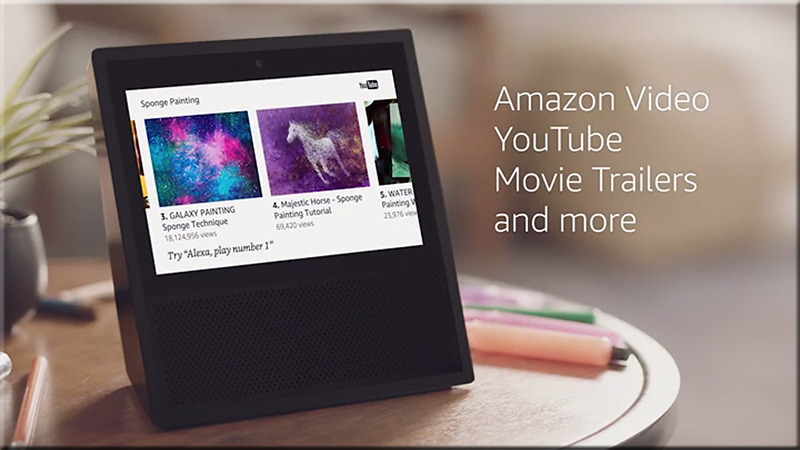
Amazon introduces Echo Show

The description reads:

  • Echo Show brings you everything you love about Alexa, and now she can show you things. Watch video flash briefings and YouTube, see music lyrics, security cameras, photos, weather forecasts, to-do and shopping lists, and more. All hands-free—just ask.
  • Introducing a new way to be together. Make hands-free video calls to friends and family who have an Echo Show or the Alexa App, and make voice calls to anyone who has an Echo or Echo Dot.
  • See lyrics on-screen with Amazon Music. Just ask to play a song, artist or genre, and stream over Wi-Fi. Also, stream music on Pandora, Spotify, TuneIn, iHeartRadio, and more.
  • Powerful, room-filling speakers with Dolby processing for crisp vocals and extended bass response
  • Ask Alexa to show you the front door or monitor the baby’s room with compatible cameras from Ring and Arlo. Turn on lights, control thermostats and more with WeMo, Philips Hue, ecobee, and other compatible smart home devices.
  • With eight microphones, beam-forming technology, and noise cancellation, Echo Show hears you from any direction—even while music is playing
  • Always getting smarter and adding new features, plus thousands of skills like Uber, Jeopardy!, Allrecipes, CNN, and more


From DSC:

Now we’re seeing a major competition between the heavy-hitters to own one’s living room, kitchen, and more. Voice controlled artificial intelligence. But now, add the ability to show videos, text, graphics, and more. Play music. Control the lights and the thermostat. Communicate with others via hands-free video calls.

Hmmm….very interesting times indeed.


Developers and corporates released 4,000 new skills for the voice assistant in just the last quarter. (source)


…with the company adding about 100 skills per day. (source)


The Living [Class] Room -- by Daniel Christian -- July 2012 -- a second device used in conjunction with a Smart/Connected TV


Addendum on 5/10/17:


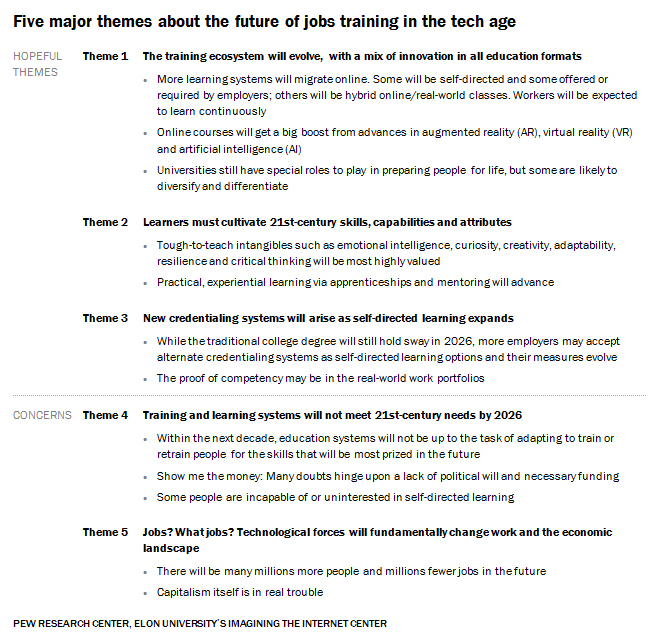
The Future of Jobs and Jobs Training — from by Lee Rainie and Janna Anderson
As robots, automation and artificial intelligence perform more tasks and there is massive disruption of jobs, experts say a wider array of education and skills-building programs will be created to meet new demands. There are two uncertainties: Will well-prepared workers be able to keep up in the race with AI tools? And will market capitalism survive?

Excerpt:

Machines are eating humans’ jobs talents. And it’s not just about jobs that are repetitive and low-skill. Automation, robotics, algorithms and artificial intelligence (AI) in recent times have shown they can do equal or sometimes even better work than humans who are dermatologists, insurance claims adjusters, lawyers, seismic testers in oil fields, sports journalists and financial reporters, crew members on guided-missile destroyers, hiring managers, psychological testers, retail salespeople, and border patrol agents. Moreover, there is growing anxiety that technology developments on the near horizon will crush the jobs of the millions who drive cars and trucks, analyze medical tests and data, perform middle management chores, dispense medicine, trade stocks and evaluate markets, fight on battlefields, perform government functions, and even replace those who program software – that is, the creators of algorithms.

Several policy and market-based solutions have been promoted to address the loss of employment and wages forecast by technologists and economists. A key idea emerging from many conversations, including one of the lynchpin discussions at the World Economic Forum in 2016, is that changes in educational and learning environments are necessary to help people stay employable in the labor force of the future. Among the six overall findings in a new 184-page report from the National Academies of Sciences, the experts recommended: “The education system will need to adapt to prepare individuals for the changing labor market. At the same time, recent IT advances offer new and potentially more widely accessible ways to access education.”


In the next 10 years, do you think we will see the emergence of new educational and training programs that can successfully train large numbers of workers in the skills they will need to perform the jobs of the future?


From DSC:
The following questions (from the article) might be fodder for initial conversations regarding what changes need to immediately occur within higher education. Those changes might be to establish teams/task forces/etc. charged with answering these kinds of questions.

  • What are the most important skills needed to succeed in the workforce of the future?
  • Which of these skills can be taught effectively via online systems – especially those that are self-directed – and other nontraditional settings?
  • Which skills will be most difficult to teach at scale?
  • Will employers be accepting of applicants who rely on new types of credentialing systems, or will they be viewed as less qualified than those who have attended traditional four-year and graduate programs?

The following section further supports a vision that I’ve been tracking entitled, “Learning from the Living [Class] Room” — where I see the “New Amazon.com of Higher Education” unfolding. Blockchain-based technologies will likely be involved here.

A diversifying education and credentialing ecosystem: Most of these experts expect the education marketplace – especially online learning platforms – to continue to change in an effort to accommodate the widespread needs.  Some predict employers will step up their own efforts to train and retrain workers. Many foresee a significant number of self-teaching  efforts by jobholders themselves as they take advantage of proliferating online opportunities.

Respondents see a new education and training ecosystem emerging in which some job preparation functions are performed by formal educational institutions in fairly traditional classroom settings, some elements are offered online, some are created by for-profit firms, some are free, some exploit augmented and virtual reality elements and gaming sensibilities, and a lot of real-time learning takes place in formats that job seekers pursue on their own.

A considerable number of respondents to this canvassing focused on the likelihood that the best education programs will teach people how to be lifelong learners. Accordingly, some say alternative credentialing mechanisms will arise to assess and vouch for the skills people acquire along the way.


DC: Many societies around the globe are looking at massive change coming at them. What changes should those of us working in higher education begin to make — immediately? In the longer term?


These respondents suggest that workers of the future will learn to deeply cultivate and exploit creativity, collaborative activity, abstract and systems thinking, complex communication, and the ability to thrive in diverse environments.


Addendum on 5/6/17:

  • How to Prepare for an Automated Future — from nytimes.com by Claire Cain Miller
    Excerpt:
    We don’t know how quickly machines will displace people’s jobs, or how many they’ll take, but we know it’s happening — not just to factory workers but also to money managers, dermatologists and retail workers. The logical response seems to be to educate people differently, so they’re prepared to work alongside the robots or do the jobs that machines can’t. But how to do that, and whether training can outpace automation, are open questions.


Purdue University to Acquire Kaplan University — from wsj.com by Douglas Belkin and Melissa Korn
Purdue President Mitch Daniels calls deal major push into online education

Excerpt:

Purdue University, a flagship public institution in Indiana, is jumping into online education by buying for-profit Kaplan University with the aim of creating a new, public online university.


Also see:

Purdue Buys For-Profit Kaplan University for $1 to Create New Kind of Public University — from edsurge.com b

The sale price for Kaplan University’s 15 campuses was $1, though with one important catch: The new nonprofit university operated by Purdue promised to give a percentage of its revenue back to its former owner, Kaplan, Inc., for the next 30 years.


Addendum on 5/3/17:


From DSC:
The recent pieces below made me once again reflect on the massive changes that are quickly approaching — and in some cases are already here — for a variety of nations throughout the world.

They caused me to reflect on:

  • What the potential ramifications for higher education might be regarding these changes that are just starting to take place in the workplace due to artificial intelligence (i.e., the increasing use of algorithms, machine learning, and deep learning, etc.), automation, & robotics?
  • The need for people to reinvent themselves quickly throughout their careers (if we can still call them careers)
  • How should we, as a nation, prepare for these massive changes so that there isn’t civil unrest due to soaring inequality and unemployment?

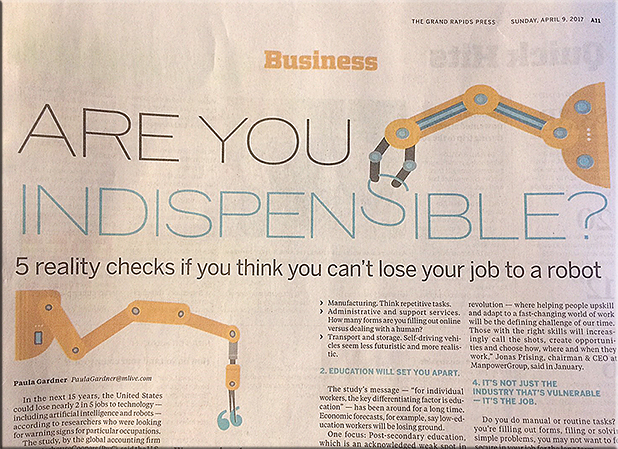
As found in the April 9th, 2017 edition of our local newspaper here:

When even our local newspaper is picking up on this trend, you know it is real and has some significance to it.


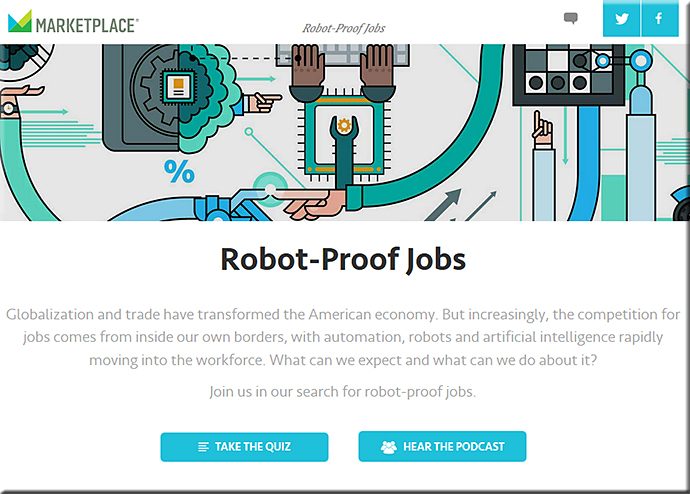
Then, as I was listening to the radio a day or two after seeing the above article, I heard of another related piece on NPR.  NPR is having a journalist travel across the country, trying to identify “robot-safe” jobs.  Here’s the feature on this from MarketPlace.org


What changes do institutions of traditional higher education
immediately need to begin planning for? Initiating?

What changes should be planned for and begin to be initiated
in the way(s) that we accredit new programs?


Keywords/ideas that come to my mind:

  • Change — to society, to people, to higher ed, to the workplace
  • Pace of technological change — no longer linear, but exponential
  • Career development
  • Staying relevant — as institutions, as individuals in the workplace
  • Reinventing ourselves over time — and having to do so quickly
  • Adapting, being nimble, willing to innovate — as institutions, as individuals
  • Game-changing environment
  • Lifelong learning — higher ed needs to put more emphasis on microlearning, heutagogy, and delivering constant/up-to-date streams of content and learning experiences. This could happen via the addition/use of smaller learning hubs, some even makeshift learning hubs that are taking place at locations that these institutions don’t even own…like your local Starbucks.
  • If we don’t get this right, there could be major civil unrest as inequality and unemployment soar
  • Traditional institutions of higher education have not been nearly as responsive to change as they have needed to be; this opens the door to alternatives. There’s a limited (and closing) window of time left to become more nimble and responsive before these alternatives majorly disrupt the current world of higher education.


Addendum from the corporate world (emphasis DSC):


From The Impact 2017 Conference:

The Role of HR in the Future of Work – A Town Hall

  • Josh Bersin, Principal and Founder, Bersin by Deloitte, Deloitte Consulting LLP
  • Nicola Vogel, Global Senior HR Director, Danfoss
  • Frank Møllerop, Chief Executive Officer, Questback
  • David Mallon, Head of Research, Bersin by Deloitte, Deloitte Consulting LLP

Massive changes spurred by new technologies such as artificial intelligence, mobile platforms, sensors and social collaboration have revolutionized the way we live, work and communicate – and the pace is only accelerating. Robots and cognitive technologies are making steady advances, particularly in jobs and tasks that follow set, standardized rules and logic. This reinforces a critical challenge for business and HR leaders—namely, the need to design, source, and manage the future of work.

In this Town Hall, we will discuss the role HR can play in leading the digital transformation that is shaping the future of work in organizations worldwide. We will explore the changes we see taking place in three areas:

  • Digital workforce: How can organizations drive new management practices, a culture of innovation and sharing, and a set of talent practices that facilitate a new network-based organization?
  • Digital workplace: How can organizations design a working environment that enables productivity; uses modern communication tools (such as Slack, Workplace by Facebook, Microsoft Teams, and many others); and promotes engagement, wellness, and a sense of purpose?
  • Digital HR: How can organizations change the HR function itself to operate in a digital way, use digital tools and apps to deliver solutions, and continuously experiment and innovate?
 

Retailers cut tens of thousands of jobs. Again. — from money.cnn.com by Paul R. La Monica
The dramatic reshaping of the American retail industry has, unfortunately, led to massive job losses in the sector.

Excerpt (emphasis DSC):

The federal government said Friday that retailers shed nearly 30,000 jobs in March. That follows a more than 30,000 decline in the number of retail jobs in the previous month.

So-called general merchandise stores are hurting the most.

That part of the sector, which includes struggling companies like Macy’s, Sears, and J.C. Penney, lost 35,000 jobs last month. Nearly 90,000 jobs have been eliminated since last October.

“There is no question that the Amazon effect is overwhelming,” said Scott Clemons, chief investment strategist of private banking for BBH. “There has been a shift in the way we buy things as opposed to a shift in the amount of money spent.”

To that end, Amazon just announced plans to hire 30,000 part-time workers.


From DSC:
One of the reasons that I’m posting this item is for those who say disruption isn’t real…it’s only a buzz word…

A second reason that I’m posting this item is because those of us working within higher education should take note of the changes in the world of retail and learn the lesson now before the “Next Amazon.com of Higher Education*” comes on the scene. Though this organization has yet to materialize, the pieces of its foundation are beginning to come together — such as the ingredients, trends, and developments that I’ve been tracking in my “Learning from the Living [Class] Room” vision.

This new organization will be highly disruptive to institutions of traditional higher education.

If you were in an influential position at Macy’s, Sears, and/or at J.C. Penney today, and you could travel back in time…what would you do?

We in higher education have the luxury of learning from what’s been happening in the retail business. Let’s be sure to learn our lesson.


* Effective today, what I used to call the “Forthcoming Walmart of Education — which has already been occurring to some degree with things such as MOOCs and collaborations/partnerships such as Georgia Institute of Technology, Udacity, and AT&T — I now call the “Next Amazon.com of Higher Education.”

Cost. Convenience. Selection. Offering a service on-demand (i.e., being quick, responsive, and available 24×7). <– These all are powerful forces.


P.S. Some will say you can’t possibly compare the worlds of retail and higher education — and that may be true as of 2017. However, if:

  • the costs of higher education keep going up and we continue to turn a deaf ear to the struggling families/students/adult learners/etc. out there
  • alternatives to traditional higher education continue to come on the landscape
  • the Federal Government continues to be more open to financially supporting such alternatives
  • technologies such as artificial intelligence, machine learning, deep learning continue to get better and more powerful — to the point that they can effectively deliver a personalized education (one that is likely to be fully online and that utilizes a team of specialists to create and deliver the learning experiences)
  • people lose their jobs to artificial intelligence, robotics, and automation and need to quickly reinvent themselves

…I can assure you that people will find other ways to make ends meet. The Next Amazon.com of Education will be just what they are looking for.


The Blockchain Revolution and Higher Education — from er.educause.edu by Don Tapscott and Alex Tapscott
The blockchain provides a rich, secure, and transparent platform on which to create a global network for higher learning. This Internet of value can help to reinvent higher education in a way the Internet of information alone could not.

Excerpt:

What will be the most important technology to change higher education? In our view, it’s not big data, the social web, MOOCs, virtual reality, or even artificial intelligence. We see these as components of something new, all enabled and transformed by an emerging technology called the blockchain.

OK, it’s not the most sonorous word ever, sounding more like a college football strategy than a transformative technology. Yet, sonorous or not, the blockchain represents nothing less than the second generation of the Internet, and it holds the potential to disrupt money, business, government, and yes, higher education.

The opportunities for innovators in higher education fall into four categories:

  • Identity and Student Records: How we identify students; protect their privacy; measure, record, and credential their accomplishments; and keep these records secure
  • New Pedagogy: How we customize teaching to each student and create new models of learning
  • Costs (Student Debt): How we value and fund education and reward students for the quality of their work
  • The Meta-University: How we design entirely new models of higher education so that former MIT President Chuck Vest’s dream can become a reality1

The blockchain may help us change the relationships among colleges and universities and, in turn, their relationship to society.

Let us explain.


What if there was an Internet of value — a global, distributed, highly secure platform, ledger, or database where we could store and exchange things of value and where we could trust each other without powerful intermediaries? That is the blockchain.


From DSC:
The quote…

In 2006, MIT President Emeritus Vest offered a tantalizing vision of what he called the meta-university. In the open-access movement, he saw “a transcendent, accessible, empowering, dynamic, communally constructed framework of open materials and platforms on which much of higher education worldwide can be constructed or enhanced.”

…made me wonder if this is where a vision that I’m tracking called Learning from the Living [Class] Room is heading. Also, along these lines, futurist Thomas Frey believes

“I’ve been predicting that by 2030 the largest company on the internet is going to be an education-based company that we haven’t heard of yet,” Frey, the senior futurist at the DaVinci Institute think tank, tells Business Insider. (source)

Blockchain could be a key piece of this vision.


The Living [Class] Room -- by Daniel Christian -- July 2012 -- a second device used in conjunction with a Smart/Connected TV


From DSC:
Hmmm…how true: “…the digital age rewards change and punishes stasis.” (
source)

Which reminds me of a photo I took just yesterday morning at one of the malls in our area, where a local Sears store is closing.

It made me wonder…if Sears could do it all over again, what would they do differently? If they had a time machine, would they go back in time and work to become the new Amazon.com?


By the way, this picture is for those people who continue to dismiss the need to change and to adapt.  Surveying the relevant landscapes is an increasingly important thing for all of us to do, especially given that we are now on an exponential pace of technological change.


Companies must be open to radical reinvention to find new, significant, and sustainable sources of revenue. Incremental adjustments or building something new outside of the core business can provide real benefits and, in many cases, are a crucial first step for a digital transformation. But if these initiatives don’t lead to more profound changes to the core business and avoid the real work of rearchitecting how the business makes money, the benefits can be fleeting and too insignificant to avert a steady march to oblivion.


Addendum on 2/10/17

  • Macy’s earnings: Shifts in retail are hurting major players — from marketwatch.com by Tonya Garcia
    Macy’s has assets like real estate and brand identity, but shifts in the sector are putting pressure on earningsExcerpt:
    Even a major player like Macy’s M, +1.51%   isn’t immune to retail’s struggles. The sector is experiencing a dramatic shift to e-commerce and changes in consumer tastes and shopping behavior that have put pressure on department store earnings, and on the industry as a whole. Macy’s has already announced 100 store closures and thousands of job cuts, in addition to a reassessment of its real-estate assets. Now there’s buzz from reports about buyout talks with Hudson’s Bay Co. HBC, parent to Lord & Taylor and Saks Fifth Avenue.


With Uber Freight, it’s not just truck drivers whose jobs are at risk — from linkedin.com by John McDermott
The bane of taxi drivers everywhere is now taking on logistics

Excerpts (emphasis DSC):

At the end of December Uber debuted Uber Freight, its foray into the un-sexy yet lucrative world of logistics. Many saw Uber’s entry into freight as a death knell for trucking companies, as Uber is looking to build a fleet of driverless trucks.

And while the threat to trucking is real, Uber Freight poses a more immediate risk to the thousands of mid-level, white-collar support staff jobs in the industry.

Uber is uniquely positioned to streamline the industry, though. Much like the company’s ride-hailing app cuts out the taxi dispatcher and allows people to hail rides directly from drivers, Uber Freight can create a platform where shippers and truckers broker shipping orders directly with one another, effectively rendering obsolete thousands of 3PL (third party logistics) workers. It replaces people with software, and configures a labor-intensive industry into a SaaS business.

Famed venture capitalist Marc Andreessen is fond of the phrase “software is eating the world,” meaning that it’s replacing many of the post-industrial, pre-internet jobs once thought to be essential. Problem is, one man’s efficiency is another’s unemployment.


Problem is, one man’s efficiency is another’s unemployment.


© 2025 | Daniel Christian