The following information is from Rebecca West, Founder and CEO, Helium Communications

Make School is working to level the playing field for underrepresented groups in tech.

In the San Francisco Bay Area, scarcity of technology talent is an acute point of pain for many organizations. The SF Bay Area has experienced a remarkable 90% growth in tech employment and a 36.5% expansion in STEM jobs in the past decade. California’s tech workforce grew by more than 51,500 jobs in 2018, with well over half of them in the Bay Area. In the current business climate, the biggest barrier to growth for many organizations is their inability to find qualified job candidates, particularly in technical fields such as coding and computer science.

Ironically, many students graduating from US colleges and universities are still having trouble finding work because they don’t possess the skills required in the actual workplace.  According to the most recent Global Information Workforce Study, the skills gap is only going to become more pronounced in coming years, with as many as 1.8 million IT jobs that could be left unfilled by 2022, a 20 percent bump from what the same study revealed two years earlier.

Make School is a college in San Francisco that’s working to level the playing field for underrepresented groups in tech. Make School is changing the higher education landscape with a unique model of deferred tuition that makes it possible for computer science students to gain the skills they need in order to find employment in the technology market without saddling themselves with huge amounts of debt.

Make School serves high school students entering college and transfer students (either from community colleges or from other four-year institutions). Accessibility to diverse populations is a key component of their offering. Make School offers a Bachelor’s degree in Applied Computer Science, teaching students to design, program, and launch software products while providing a foundation of liberal arts to ensure a lasting career. Students who graduate from Make School do not pay tuition until they have secured employment and are earning an annual salary of at least $60K.

With four years of positive student outcomes comparable to schools like Stanford and MIT, Make School has demonstrated the success of its model. Alumni currently work at companies including Facebook, Google, Apple, Zendesk, Y Combinator startups, and other leading technology innovators.

Fall and Spring semester tuition is $15,000. Summer semester tuition is $10,000. Total tuition for the bachelor’s program is $70,000.


From DSC:
I’d like to see the tuition come down for this school — especially as they are marketing themselves as a school that aims to help underrepresented groups in tech. Perhaps they’ll need to develop some satellite branches/campuses outside the San Francisco area in order to make that tuition reduction happen. As it stands, this is not much of a discount. That said, I do appreciate that they are trying to address the gorillas of debt on our graduates’ backs. Plus they are pursuing new business models, alternatives to the status quo, and are making efforts to address some of the numerous gaps in our society.

 

Virtual access to legal assistance becoming mainstream is hopefully not far off!

From DSC:
Along these lines, we’ll likely see more bots and virtual legal assistants that we will be able to ask questions of.

#A2J #AccessToJustice #legal #lawyers #society #legaltech #bots #videoconferencing #AI #bots #VirtualAssistants

Along these lines, also see:

Innovative and inspired: How this US law school is improving access to justice — from studyinternational.com

Excerpt:

Though court and other government websites in the US provide legal information, knowing what to search for and understanding legal jargon can be difficult for lay people.

Spot, software that is being developed at the LIT Lab, aims to fix this.

“You know you have a housing problem. But very few people think about their housing problems in terms of something like constructive eviction,” explains David Colarusso, who heads the LIT Lab. “The idea is to have the tool be able to spot those issues based upon people’s own language.”

Developed by Colarusso and students, Spot uses a machine-based algorithm to understand legal queries posed by lay persons. With Spot, entering a question in plain English like “My apartment is so moldy I can’t stay there anymore. Is there anything I can do?” brings up search results that would direct users to the right legal issue. In this case, the query is highly likely to be related to a housing issue or, more specifically, to the legal term “constructive eviction.”


Lastly, here’s an excerpt from INSIGHT: What’s ‘Innovative’ in BigLaw? It’s More Than the Latest Tech Tools — from news.bloomberglaw.com by Ryan Steadman and Mark Brennan

Top Innovation Factors for Success

  • The first step is always to observe and listen.
  • True innovation is about rigorously defining a client problem and then addressing it through a combination of workflow process, technology, and people.
  • Leave aside the goal of wholesale transformation and focus instead on specific client use cases.

Before revving the engines in the innovation process, the safety check comes first. Successful innovation requires a deliberate, holistic approach that takes into consideration people, process, and technology. Firms and vendors that listen and learn before implementing significant change will stand apart from competitors—and help ensure long-term success.


Technology is increasingly being used to provide legal services, which demands a new breed of innovative lawyer for the 21st century. Law schools are launching specialist LL.M.s in response, giving students computing skills — from llm-guide.com by Seb Murray

Excerpts:

Junior lawyers at Big Law firms have long been expected to work grueling hours on manual and repetitive tasks like reviewing documents and doing due diligence. Increasingly, such work is being undertaken by machines – which can be faster, cheaper and more accurately than humans. This is the world of legal technology – the use of technology to provide legal services.

The top law schools recognize the need to train not just excellent lawyers but tech-savvy ones too, who understand the application of technology and its impact on the legal market. They are creating specialist courses for those who want to be more involved with the technology used to deliver legal advice.

“Technology is changing the way we live, work and interact,” says Alejandro Touriño, co-director of the course. “This new reality demands a new breed of lawyers who can adapt to the emerging paradigm. An innovative lawyer in the 21st century needs not only to be excellent in law, but also in the sector where their clients operate and the technologies they deal with.” 

The rapid growth in Legal Tech LL.M. offerings reflects a need in the professional world. Indeed, law firms know they need to become digital businesses in order to attract and retain clients and prospective employees.


From DSC:
In case it’s helpful or interesting, a person interested in a legal career needs to first get a Juris Doctor (J.D.) Degree, then pass the Bar. At that point, if they want to expand their knowledge in a certain area or areas, they can move on to getting an LL.M. Degree if they choose to.

As in the world of higher ed and also in the corporate training area, I have it that the legal field will need to move more towards the use of teams of specialists. There will be several members of the team NOT having law degrees. For example, technologists, programmers, user experience designers, etc. should be teaming up with lawyers more and more these days.


TECHREPORT 2019: Practice Management — from lawtechnologytoday.org by Alexander Paykin

Excerpt (emphasis DSC):

The American Bar Association’s Legal Technology Resource Center surveyed a sample size of 53,252 attorneys regarding the technology and software both available and utilized in their firms. This TECHREPORT analyzes both the responses of these attorneys on a variety of technological developments and changes occurring in the legal industry and the existing trepidation to adopt certain technologies.
…
The world continues to shift towards a more technological focus, while the legal industry has not followed suit in many aspects. The use of practice management systems has not seen any real growth throughout the last four years despite high satisfaction ratings. There still remains a need for an all-inclusive practice management system that would not require firms to purchase a variety of different programs for specific tasks, and the switching costs of practice management systems remain a concern for many firms—particularly solo and large firms.
…
Overall, technology continues to be developed for the legal industry in abundance, however, in many sectors of the industry, various sized firms are hesitant to adopt these advancements, leading to steady or declining growth rates for much of these technologies. The size of the firm also has a large influence on the technologies a firm may adopt, and this makes it hard to predict what technologies may appeal to what firms.

Most law technology is still fairly new, and it has quite far to go before being developed enough to displace traditional ways of accomplishing tasks that many firms value now. There still exists a desire for more and newer technologies that will make this switch easier, and without the feasibility to switch to these software programs more efficiently and effectively, the legal industry will still wait to adapt to the evolving technological world around us.


Five principles for thinking like a futurist — from er.educause.edu by Marina Gorbis
Thinking about the future allows us to imagine what kind of future we want to live in and how we can get there.

Excerpt:

In my twenty years at the Institute, I’ve developed five core principles for futures thinking:

  • Forget about predictions.
  • Focus on signals.
  • Look back to see forward.
  • Uncover patterns.
  • Create a community.


As the microcredential market booms, don’t forget the learner — from edsurge.com by Kathleen deLaski

Excerpt:

While this system of microcredentials theoretically will make learning more affordable, portable and relevant, will a diverse range of learners know how and why to take advantage of it? And perhaps more importantly, will they trust it?

The simple answer: only if we intentionally focus on designing around that question.


Also see:

  • The Learner Revolution — from eddesignlab.org
    Reflections from five years of applied human-centered design at 100+ institutions

Excerpt:

Higher education is in the throes of a Learner Revolution that will fundamentally change the way students and institutions interact. We see the beginning of this movement now and will see all colleges and universities responding —- or not, at their peril — within a decade. Trends ranging from declining numbers of traditional students, to the rise of artificial intelligence, to the shrinking half-life of job skills have conspired toward this wake-up call moment for all but the most exclusive global higher education brands. At the same time, and partly because of the pressure, leaders are addressing the needs and goals of a changing student population. The calls for “student-centered” design can be heard throughout the ecosystem today, in a way that was just beginning when we started the Education Design Lab.

Colleges and universities must be much more deeply attuned to the twin pressures of learners’ decreasing appetite for debt and employers’ honing of their hiring requirements. That means, in part, an increasing focus on work-relevant skills and competencies—both technical skills and soft skills such as communication and systems thinking. Degrees as the most valuable workforce currency are beginning to give way to more nuanced competencies.

…

Yet, for the estimated three-quarters of students with at least one non-traditional characteristic, higher education has been in need of serious redesign for at least two decades.


Can you make AI fairer than a judge? Play our courtroom algorithm game — from technologyreview.com by Karen Hao and Jonathan Stray
Play our courtroom algorithm game The US criminal legal system uses predictive algorithms to try to make the judicial process less biased. But there’s a deeper problem.

Excerpt:

As a child, you develop a sense of what “fairness” means. It’s a concept that you learn early on as you come to terms with the world around you. Something either feels fair or it doesn’t.

But increasingly, algorithms have begun to arbitrate fairness for us. They decide who sees housing ads, who gets hired or fired, and even who gets sent to jail. Consequently, the people who create them—software engineers—are being asked to articulate what it means to be fair in their code. This is why regulators around the world are now grappling with a question: How can you mathematically quantify fairness? 

This story attempts to offer an answer. And to do so, we need your help. We’re going to walk through a real algorithm, one used to decide who gets sent to jail, and ask you to tweak its various parameters to make its outcomes more fair. (Don’t worry—this won’t involve looking at code!)

The algorithm we’re examining is known as COMPAS, and it’s one of several different “risk assessment” tools used in the US criminal legal system.


But whether algorithms should be used to arbitrate fairness in the first place is a complicated question. Machine-learning algorithms are trained on “data produced through histories of exclusion and discrimination,” writes Ruha Benjamin, an associate professor at Princeton University, in her book Race After Technology. Risk assessment tools are no different. The greater question about using them—or any algorithms used to rank people—is whether they reduce existing inequities or make them worse.


You can also see change in these articles as well:


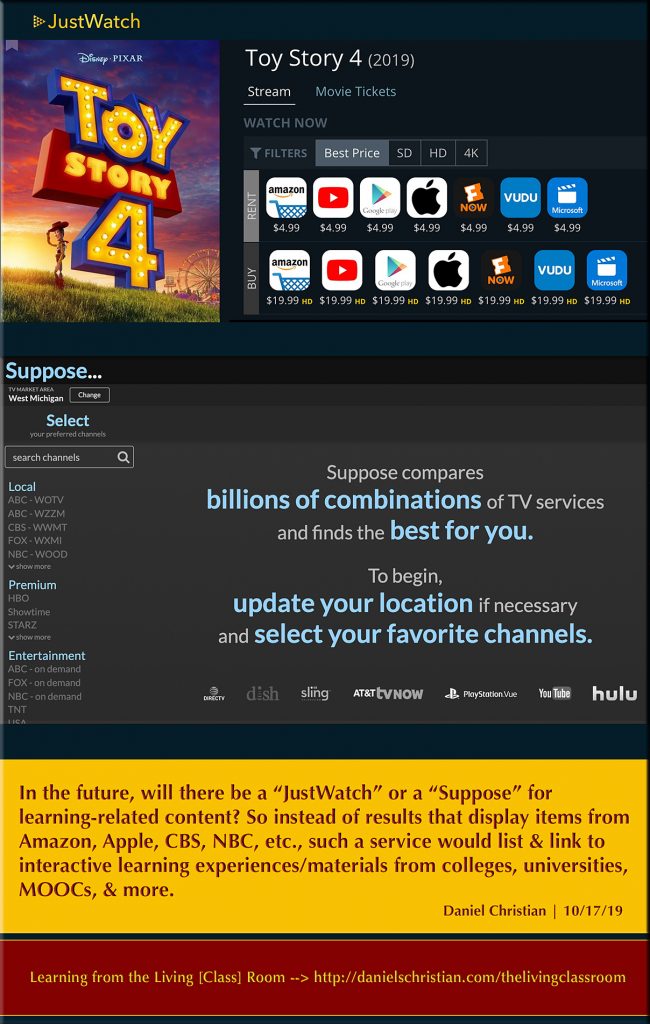
DC: In the future…will there be a “JustWatch” or a “Suppose” for learning-related content?

DC: In the future...will there be a JustWatch or a Suppose for learning-related content?


Priorities for new lawyers are changing. Can the legal industry keep up? — — from law.com by Annie Datesh, Natasha Allen, and Nicole Hatcher, Atrium
As the legal field continues to move forward, it is well-primed to place greater value on technological advancements, diverse leadership, and healthy work cultures over settling for the status quo.

Excerpts:

Yet the legal industry these lawyers are joining is evolving, and now increasingly hosts a new cohort of professionals—those shaped by technology and innovation, and who value diversity, mentorship, and efficiency over homogeneous workplaces with minimal coaching and exhausted capacities.
…
Amid a strengthening job market, why are jobs in a generally well-respected industry being looked over in favor of other industries? One reason could be the legal industry’s notorious lack of progressiveness. The industry’s technology landscape is one such area of slow growth; its lack of diversity is another.

The legal industry’s long-standing dismissal of technology, while slowly changing, is fairly well known. While legal technology holds enormous potential for law firms, the industry as a whole has been famously slow to adopt modern technologies or meaningfully innovate on the traditional law firm business model. Why? For smaller firms, money can be tight, and solutions can be expensive.


The good news is that the legal industry is slowly but surely becoming more receptive to the benefits of evolving its traditional approach to the business and practice of law. Legal technologies continue to offer increased efficiencies to law firms, should they elect to adopt them, and the call for diversity and other cultural improvements within firms and the legal industry more broadly is on the rise.
…
Those players in the legal industry who are able to recognize prevailing industry trends now will be in the best position to act on them.


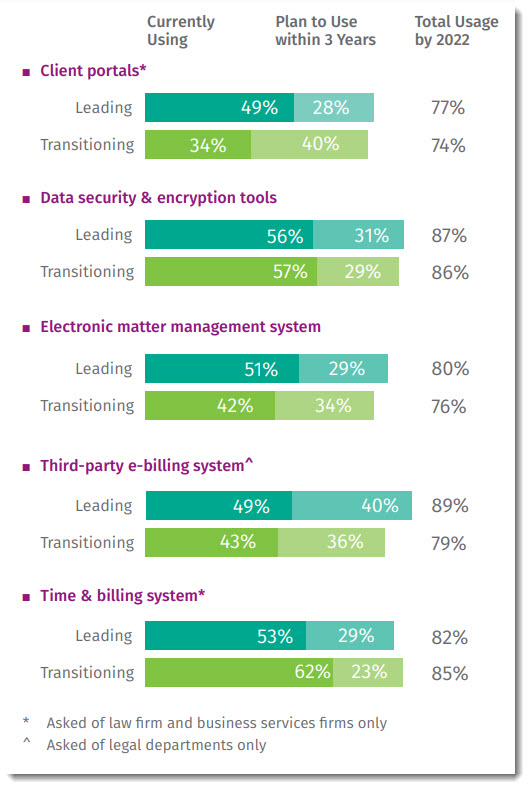
An inserted graphic from DSC:


The Future Ready Lawyer — from Wolters Kluwer

Excerpts:

Leveraging technology as a strategic advantage is characteristics of high-performing businesses and professionals around the world. The same is true for the legal sector. Technology is a differentiator, and will become even more important as legal professionals recognize and leverage the unprecedented insights, capabilities and efficiencies that technology delivers. In addition, the emerging legal ecosystems will demand it, as tech-empowered players outside of the traditional legal profession continue to enter and disrupt the market.


Excerpt from the Future Ready Lawyer


From DSC:
It’s interesting to note how many times the words “technology” (205 times) and/or the word “technologies” (77 times) appear in that report.


Big money is betting on legal industry transformation — from forbes.com by Mark Cohen

Excerpts:

Law has been big business for decades, but only recently has significant venture capital, private equity, and entrepreneur money been pumped into the legal sector. Last year saw an eye-popping 718% increase in legal industry investment, and this year’s capital infusion through the third-quarter has already surpassed last year’s $1 billion total and could well double it. Capital is turbocharging customer-centric providers that are leveraging technology, process, new skillsets, and data to transform the legal function and the delivery of legal services.

…
Teaser alert: what’s to prevent Amazon, Google, or some other tech giant from entering the legal space, creating a global platform, injecting billions into infrastructure and talent, creating a global legal services hub that connects consumers with global legal delivery sources as never before imagined? Short answer: the inclination to do so.


Legal delivery has morphed into a three-legged stool supported by legal, technological, and business expertise. 


The rise of the lawyer  — from law21.ca by Jordan Furlong

Per Jordan:

Earlier this year, I received an invitation to write the epilogue for a book called New Suits: Appetite for Disruption in the Legal World, by Michele DeStefano (founder of the groundbreaking Law Without Walls program based at the University of Miami Law School) and Guenther Dobrauz-Saldapenna (partner and leader of PwC Legal Switzerland and leader of PwC’s global legal tech efforts). New Suits is an enormously ambitious and illuminating exploration of the frontiers of technology-powered legal practice, especially for large enterprise clients and their outside counsel, and I highly recommend that you read it.

Of course, I’m no technology expert, and I felt supremely unqualified to say anything useful about the impact of blockchain, AI, RegTech, and so on. But I thought that lawyers who read New Suits, especially newly called lawyers or law students, might reach the end of the book feeling a little overwhelmed by the scale of change facing them, and wondering whether the legal world of the future would in any way resemble the one they had already entered — and if that world would need, want, or even welcome lawyers.

So I wrote what was essentially a message to those lawyers, to explain what all the forthcoming changes would mean for them, what the new legal world was going to demand of them, and what they should feel both empowered and required to demand in return. With the kind permission of the authors, and with a few small edits, here is that lengthy but heartfelt message. 


So here’s what I’d very much like you to remember: What you do matters. Who you are matters. When you speak out, it has an impact. When you fall silent, that has an impact too. Do not let yourself get lost in the noise and complexity of the machine; do not lose sight of the primacy and power of true service; do not lose who you are, and who you could be, amid the upheaval and disruption to come. Out of this chaos, you can forge new meaning and greater purpose. Out of the end of one era in the legal profession’s history, you can launch the start of another.


Also see:


A momentous change in the legal industry garnering little attention — from forbes.com by Hendrik Pretorius

Excerpt:

The needed evolution in legal service delivery may receive a big push in the near future. Surprisingly, this issue seems to be flying under the radar for many in the legal industry.

The California Bar, through its Task Force on Access Through Innovation of Legal Services, created in 2018, seeks to “identify possible regulatory changes to enhance the delivery of, and access to, legal services through the use of technology, including artificial intelligence and online legal service delivery models.”

A report commissioned by this task force stated that “[m]odifying the ethics rules to facilitate greater collaboration across law and other disciplines will (1) drive down costs; (2) improve access; (3) increase predictability and transparency of legal services; (4) aid the growth of new businesses; and (5) elevate the reputation of the legal profession.”


Herein lies one of the fundamental challenges within the legal industry: viewing the law as the delivery of a legal product, and understanding that this delivery needs to revolve around the user, not the lawyer. There is a real and growing divide between the current model of legal service delivery put forth by a traditional law firm model and what the public wants. Consumers have raised the bar based on what they are experiencing in interacting with other businesses in other industries.
…
I love what many of these legal tech companies are doing: They are applying standards from outside the entrenched legal industry and changing entire delivery models. This should be a real wake-up call. But how can law firms truly compete and play a role?


Reflections on “DIY Mindset Reshaping Education” [Schaffhauser]

DIY Mindset Reshaping Education — from campustechnology.com by Dian Schaffhauser

Excerpt:

A do-it-yourself mindset is changing the face of education worldwide, according to new survey results. Learners are “patching together” their education from a “menu of options,” including self-teaching, short courses and bootcamps, and they believe that self-service instruction will become even more prevalent for lifelong learning. In the United Sates specifically, 84 percent of people said learning would become even more self-service the older they get.

Among those who have needed to reskill in the last two years to continue doing their jobs, 42 percent found information online and taught themselves and 41 percent took a course or training offered by their employers, a professional association or bootcamp, compared to just 28 percent who pursued a professional certification program, 25 percent who enrolled in a university-level degree program or 12 percent who did nothing.

If people had to learn something new for their career quickly, they said they would be more likely turn to a short training program (47 percent), followed by access to a free resource such as YouTube, Lynda.com or Khan Academy (33 percent). A smaller share (20 percent) would head to an accredited university or college.


From DSC:
This is why the prediction from Thomas Frey carries weight and why I’ve been tracking a new learning platform for the 21st century. Given:

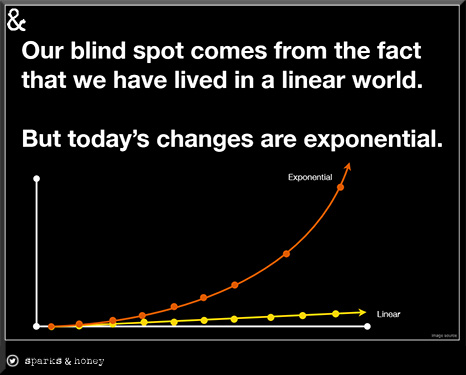
  • The exponential pace of technological change occurring in many societies throughout the globe

  • That emerging technologies are game-changers in many industries
  • That people will need to learn about those emerging technologies and how to leverage/use them <– if they want to remain marketable/employed
  • That people need to reinvent themselves quickly, efficiently, and cost-effectively
  • That many people can’t afford the time nor the funding necessary these days to acquire a four-year higher ed degree
  • That running new courses, programs, etc. through committees, faculty senates, etc. takes a great deal of time…and time is something we no longer have (given this new pace of change)

…there needs to be a new, up-to-date, highly responsive, inexpensive learning-related platform for the 21st century. I call this learning platform of the future, “Learning from the Living [Class] Room.” And while it requires subject matter experts / humans in significant ways, AI and other technologies will be embedded throughout such a platform.


“I’ve been predicting that by 2030 the largest company on the internet is going to be an education-based company that we haven’t heard of yet,” Frey, the senior futurist at the DaVinci Institute think tank, tells Business Insider.

— source


Addendum on 9/18/19:

For $400 per course, students will be able to gain access to course videos that are cinematically filmed and taught by “some of the brightest minds in academia.” Outlier.org students will also have access to problem sets, one-on-one tutoring and assessments proctored through artificial intelligence.


Digital workplaces are the future for the legal industry — from abovethelaw.com by James Lo
The speed of business is accelerating, and digital workplaces are answering the demand for a better way to work, by providing a single platform to manage content, people, and applications. 

Excerpt:

The consumerisation of enterprise technology has led to an increasing expectation from lawyers, clients, and business users alike that the legal technology they are using in the workplace for collaboration, knowledge management, transaction management, and more should be as useful, intuitive, and user-friendly as what they are already using at home on a day-to-day basis.

Digital workplaces are answering the demand for a better way to work, by providing a single platform to manage content, people, and applications. As law firms review their technology strategy for the next three to five years, there is an opportunity to create digital workplaces that will match how lawyers will want to work in the future. Within a digital workplace, a lawyer will have access to relevant data and content, collaborate with both clients and colleagues, share knowledge, and solve problems, all in real-time, from anywhere.

At the same time, clients are expecting firms to be using data, artificial intelligence and other technologies to predict outcomes, reduce costs, improve transparency and ultimately add value. 

 
© 2025 | Daniel Christian