The 3 instructional shifts that will redefine the college professor — from edsurge.com by Ryan Craig

Excerpts:

As faculty at colleges and universities are all too aware, it’s hard to do two jobs at the same time. Since the advent of the modern research university over a century ago, faculty have effectively held down two jobs: conducting (and publishing) research and teaching students.

Arguments for the dual-role professor seem logical. Knowledge production should make one a better instructor. Students should benefit from teachers producing the latest knowledge. But there’s precious little data to support that adding the research job to the instruction job improves student outcomes.

The downside is that both jobs require significant expertise and commitment to do well.

There is an emerging consensus as to what works best for onground instruction. It’s called the Dynamic Classroom, and it looks like this:

  • Flip classroom so “transfer of information” occurs ahead of class
  • Incorporate technology in the classroom (handheld clickers or smartphone apps) to quickly ascertain whether students have understood key concepts
  • Integrate active learning techniques to improve understanding of key concepts, including peer learning, group problem solving, project-based learning and experiential learning via studios and workshops
  • Include “perspective transformation” exercises wherein students change their frames of reference by critically reflecting on their assumptions


From DSC:
First of all, I second the idea of splitting up the responsibilities of researching and teaching. Both roles are full-time jobs and require different skillsets. With students paying ever higher tuition bills, students deserve to take their courses from professors who know how to teach (not an easy job by the way!). 

But the unbundling doesn’t — and shouldn’t — stop with the splitting up of the teaching and research roles.

Let’s look at another of the instructional shifts that Ryan considers — and that is the move towards the use of smartphones and apps:

In this environment, we can imagine one app for Economics 101 and another for Psychology 110. They are also the ideal platform for simulations and gamified learning and can tailor the user experience further by incorporating real-world inputs (e.g., location of the student) into the material. But, like the dynamic classroom, apps require an unparalleled level of development and instructional expertise—a full-time job for faculty who will be teaching online.

I think there’s some serious potential with this approach, especially given the trend towards more mobile computing and the affordances that come with using mobile technologies.

However, when we start delivering teaching and learning experiences that involve the digital/virtual realm like this, we’re instantly catapulted into a world that requires additional skills. As such, I highly doubt that the majority of faculty members have the time, interests, passions, or the abilities/gifts to code such apps.  They would have to simultaneously be (or become) a programmer/developer, an instructional designer, a graphic designer, a copyright expert, an expert in accessibility, instantly knowledgeable in user interface and user experience design, as well as continue to serve as the Subject Matter Expert (SME) — and I could list other roles as well. That is why we need TEAMS of specialists. If the trends towards moving more of our teaching and learning experiences online and/or into such digital realms continue, then our current models simply won’t cut it anymore, at least in the majority of cases.

I appreciate Ryan’s article and second the main idea of splitting up the teaching and researching responsibilities. But again, when we’re talking developing apps, we had better be talking employing the use of teams — or the students will likely not be better off.

—–

A related quote from “In Sign of the Times for Teaching, More Colleges Set Up Video-Recording Studios” — from The Chronicle

At some colleges, media teams sit down with professors ahead of time and lay out long-term strategies to determine how video may enhance the learning experience of students in their courses.

The media team offers instructors a number of planning worksheets to encourage them to think more about the purpose of videos in their courses.


 —–


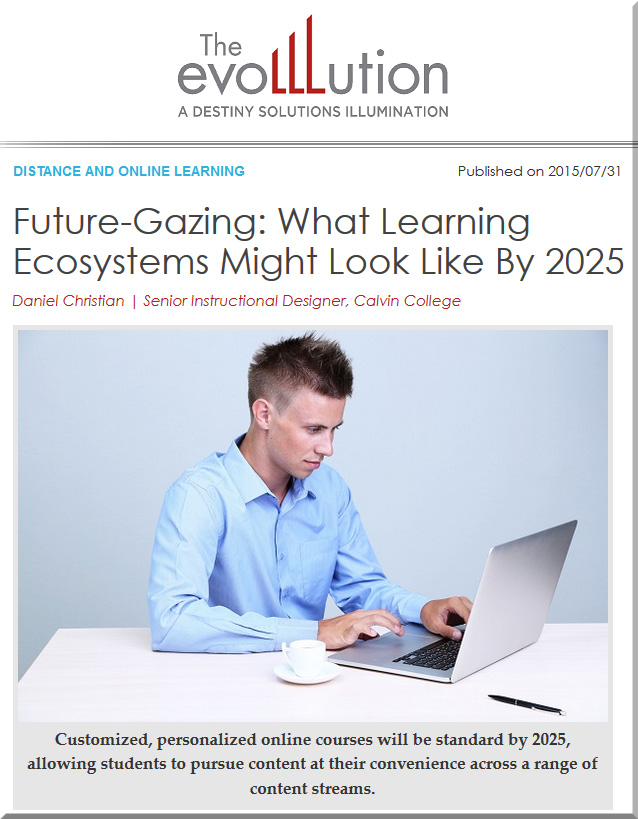
What might our learning ecosystems look like by 2025? [Christian]

This posting can also be seen out at evoLLLution.com (where LLL stands for lifelong learning):
DanielChristian-evoLLLutionDotComArticle-7-31-15


From DSC:
What might our learning ecosystems look like by 2025?

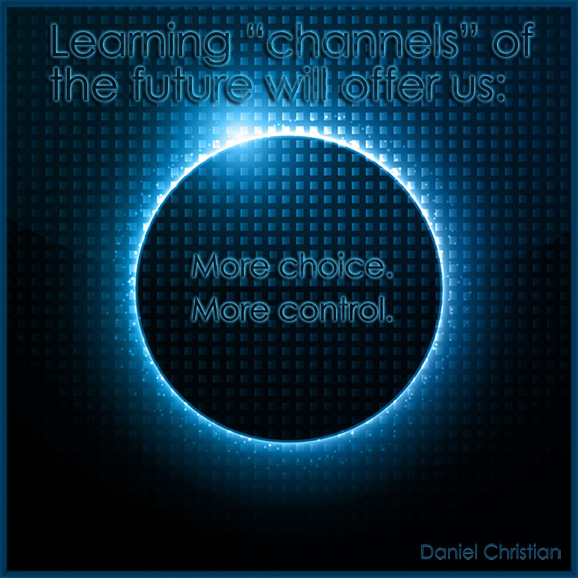
In the future, learning “channels” will offer more choice, more control.  They will be far more sophisticated than what we have today.
 

MoreChoiceMoreControl-DSC


That said, what the most important aspects of online course design end up being 10 years from now depends upon what types of “channels” I think there will be and what might be offered via those channels. By channels, I mean forms, methods, and avenues of learning that a person could pursue and use. In 2015, some example channels might be:

  • Attending a community college, a college or a university to obtain a degree
  • Obtaining informal learning during an internship
  • Using social media such as Twitter or LinkedIn
  • Reading blogs, books, periodicals, etc.

In 2025, there will likely be new and powerful channels for learning that will be enabled by innovative forms of communications along with new software, hardware, technologies, and other advancements. For examples, one could easily imagine:

  • That the trajectory of deep learning and artificial intelligence will continue, opening up new methods of how we might learn in the future
  • That augmented and virtual reality will allow for mobile learning to the Nth degree
  • That the trend of Competency Based Education (CBE) and microcredentials may be catapulted into the mainstream via the use of big data-related affordances

Due to time and space limitations, I’ll focus here on the more formal learning channels that will likely be available online in 2025. In that environment, I think we’ll continue to see different needs and demands – thus we’ll still need a menu of options. However, the learning menu of 2025 will be more personalized, powerful, responsive, sophisticated, flexible, granular, modularized, and mobile.


Highly responsive, career-focused track


One part of the menu of options will focus on addressing the demand for more career-focused information and learning that is available online (24×7). Even in 2015, with the U.S. government saying that 40% of today’s workers now have ‘contingent’ jobs and others saying that percentage will continue climbing to 50% or more, people will be forced to learn quickly in order to stay marketable.  Also, the 1/2 lives of information may not last very long, especially if we continue on our current trajectory of exponential change (vs. linear change).

However, keeping up with that pace of change is currently proving to be out of reach for most institutions of higher education, especially given the current state of accreditation and governance structures throughout higher education as well as how our current teaching and learning environment is set up (i.e., the use of credit hours, 4 year degrees, etc.).  By 2025, accreditation will have been forced to change to allow for alternative forms of learning and for methods of obtaining credentials. Organizations that offer channels with a more vocational bent to them will need to be extremely responsive, as they attempt to offer up-to-date, highly-relevant information that will immediately help people be more employable and marketable. Being nimble will be the name of the game in this arena. Streams of content will be especially important here. There may not be enough time to merit creating formal, sophisticated courses on many career-focused topics.

 

StreamsOfContent-DSC


With streams of content, the key value provided by institutions will be to curate the most relevant, effective, reliable, up-to-date content…so one doesn’t have to drink from the Internet’s firehose of information. Such streams of content will also offer constant potential, game-changing scenarios and will provide a pulse check on a variety of trends that could affect an industry. Social-based learning will be key here, as learners contribute to each other’s learning. Subject Matter Experts (SMEs) will need to be knowledgeable facilitators of learning; but given the pace of change, true experts will be rare indeed.

Microcredentials, nanodegrees, competency-based education, and learning from one’s living room will be standard channels in 2025.  Each person may have a web-based learner profile by then and the use of big data will keep that profile up-to-date regarding what any given individual has been learning about and what skills they have mastered.

For example, even currently in 2015, a company called StackUp creates their StackUp Report to add to one’s resume or grades, asserting that their services can give “employers and schools new metrics to evaluate your passion, interests, and intellectual curiosity.” Stackup captures, categorizes, and scores everything you read and study online. So they can track your engagement on a given website, for example, and then score the time spent doing so. This type of information can then provide insights into the time you spend learning.

Project teams and employers could create digital playlists that prospective employees or contractors will have to advance through; and such teams and employers will be watching to see how the learners perform in proving their competencies.

However, not all learning will be in the fast lane and many people won’t want all of their learning to be constantly in the high gears. In fact, the same learner could be pursuing avenues in multiple tracks, traveling through their learning-related journeys at multiple speeds.


The more traditional liberal arts track


To address these varied learning preferences, another part of the menu will focus on channels that don’t need to change as frequently.  The focus here won’t be on quickly-moving streams of content, but the course designers in this track can take a bit more time to offer far more sophisticated options and activities that people will enjoy going through.

Along these lines, some areas of the liberal arts* will fit in nicely here.

*Speaking of the liberal arts, a brief but important tangent needs to be addressed, for strategic purposes. While the following statement will likely be highly controversial, I’m going to say it anyway.  Online learning could be the very thing that saves the liberal arts.

Why do I say this? Because as the price of higher education continues to increase, the dynamics and expectations of learners continue to change. As the prices continue to increase, so do peoples’ expectations and perspectives. So it may turn out that people are willing to pay a dollar range that ends up being a fraction of today’s prices. But such greatly reduced prices won’t likely be available in face-to-face environments, as offering these types of learning environment is expensive. However, such discounted prices can and could be offered via online-based environments. So, much to the chagrin of many in academia, online learning could be the very thing that provides the type of learning, growth, and some of the experiences that liberal arts programs have been about for centuries. Online learning can offer a lifelong supply of the liberal arts.

But I digress…
By 2025, a Subject Matter Expert (SME) will be able to offer excellent, engaging courses chocked full of the use of:

  • Engaging story/narrative
  • Powerful collaboration and communication tools
  • Sophisticated tracking and reporting
  • Personalized learning, tech-enabled scaffolding, and digital learning playlists
  • Game elements or even, in some cases, multiplayer games
  • Highly interactive digital videos with built-in learning activities
  • Transmedia-based outlets and channels
  • Mobile-based learning using AR, VR, real-world assignments, objects, and events
  • …and more.

However, such courses won’t be able to be created by one person. Their sophistication will require a team of specialists – and likely a list of vendors, algorithms, and/or open source-based tools – to design and deliver this type of learning track.


Final reflections


The marketplaces involving education-related content and technologies will likely look different. There could be marketplaces for algorithms as well as for very granular learning modules. In fact, it could be that modularization will be huge by 2025, allowing digital learning playlists to be built by an SME, a Provost, and/or a Dean (in addition to the aforementioned employer or project team).  Any assistance that may be required by a learner will be provided either via technology (likely via an Artificial Intelligence (AI)-enabled resource) and/or via a SME.

We will likely either have moved away from using Learning Management Systems (LMSs) or those LMSs will allow for access to far larger, integrated learning ecosystems.

Functionality wise, collaboration tools will still be important, but they might be mind-blowing to us living in 2015.  For example, holographic-based communications could easily be commonplace by 2025. Where tools like IBM’s Watson, Microsoft’s Cortana, Google’s Deepmind, and Apple’s Siri end up in our future learning ecosystems is hard to tell, but will likely be there. New forms of Human Computer Interaction (HCI) such as Augmented Reality (AR) and Virtual Reality (VR) will likely be mainstream by 2025.

While the exact menu of learning options is unclear, what is clear is that change is here today and will likely be here tomorrow. Those willing to experiment, to adapt, and to change have a far greater likelihood of surviving and thriving in our future learning ecosystems.


Opinion: Apple and IBM have big data plans for education— from computerworld.com by Jonny Evans
Apple and IBM are developing solutions that underpin a future of personalized mobile learning that lasts a lifetime.

Excerpt:

Apple and IBM have been developing the “Student Achievement App” for several months and this is due to enter real world tests this year. The partners recently began approaching US school districts to trial the new technologies. For example, in June a large delegation of Apple and IBM folk met with the Coppell ISD Board of Trustees.

They discussed a proposed partnership between IBM, Apple and CISD to develop these solutions, which are described as “content analytics for student learning”, according to the meeting minutes.


From DSC:
One paragraph reads:

It’s no surprise Apple wants to do what it can to improve the education industry. Co-founder Steve Jobs was famously frustrated with the way the sector works in the US. Speaking to Fortune, Denise Young Smith, Apple’s vice president of human resources said Apple CEO Tim Cook is also committed to and involved in the company’s educational technology programs. “Education and learning is our legacy but Tim goes above and beyond,” she says.

Though I’m a huge fan of Apple, I’d have to disagree here. I’m much more skeptical/dubious as to whether Apple’s leadership is as committed to education as they once were; and if they still are, it hasn’t been showing much these last few years. Instead, they’ve let Google make major inroads on this turf; to the point that I would even say that Google is blowing Apple out of the water in this space.

So from my edtech-based perspective, Apple has dropped the ball on education in recent years — instead, leadership focused far more on the iPhone, music, and other consumer-oriented goods and services. From a business standpoint, I get it. They’re the largest company in the world (by market cap) and their strategies are clearly working for them.

That said, I am encouraged when I see items like the one mentioned above and I hope that such education-related projects/endeavors — and the budgets and resources allocated to them — play a larger role at Apple in the future.


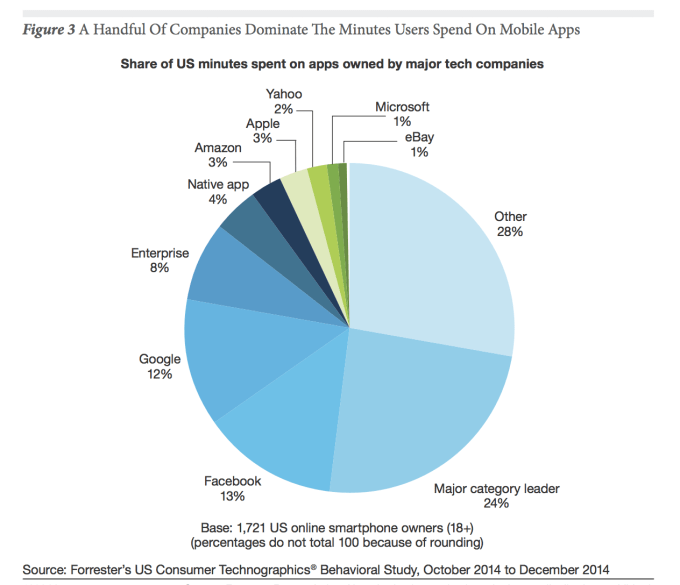
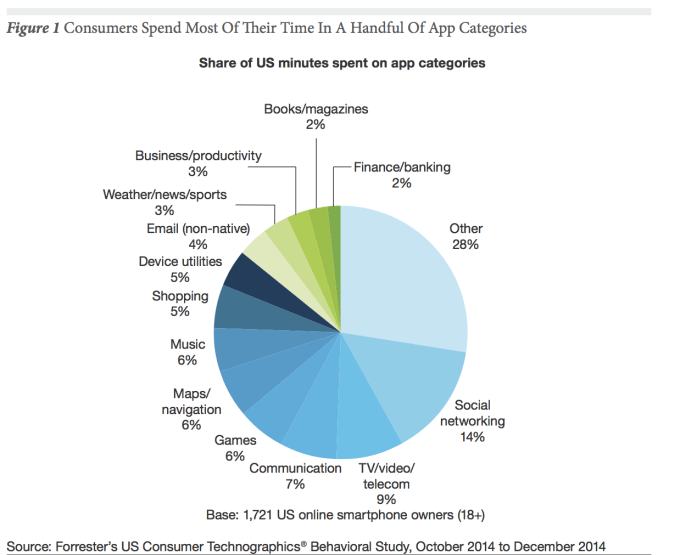
Consumers spend 85% of time on smartphones in apps, but only 5 apps see heavy use — from techcrunch.com by Sarah Perez — with a shout out to @visionmobile for the original heads-up on it; information per Forrester Research

Excerpts:


Screen Shot 2015-06-22 at 12.06.29 PM


Screen Shot 2015-06-22 at 12.06.13 PM


Also see:


EdX and Qualcomm to build the next generation mobile learning experience — from marketwatch.com
Collaboration will help edX increase access to education for millions around the world

Excerpt:

CAMBRIDGE, Mass. and SAN DIEGO, May 13, 2015 /PRNewswire/ — EdX, a nonprofit learning destination, and Qualcomm Education, Inc., a subsidiary of Qualcomm Incorporated QCOM, +1.37% the leading global provider of wireless technology, today announced a collaboration to further develop edX’s MOOC (massive open online course) mobile capabilities and enhance its open source platform to benefit connected learners around the world. As part of the collaboration, Qualcomm Education will contribute engineering resources and will license elements of its SDK code, which edX will distribute to the Open edX community.

This collaboration brings together two industry leaders who share a common vision that mobile technologies are a critical enabler for open access to education for everyone. Together they will harness the power of more than 7 billion mobile connections globally, with more than 1 million being added daily, to meet the growing demand for mobile learning.


From DSC:
Someone in your organization needs to be getting up to speed on sensors and machine-to-machine communications — and looking for potential applications.  This goes for schools, colleges, universities, and corporate training departments as well. Already such technologies are being applied within museums, art galleries, and for self-guided tours.

Is that student, teacher, professor, or trainer not around to talk about their poster, project, or artwork hanging in the hallway?  Why not use an app like Locly along with Estimote beacons to allows visitors to hear what they had in mind?


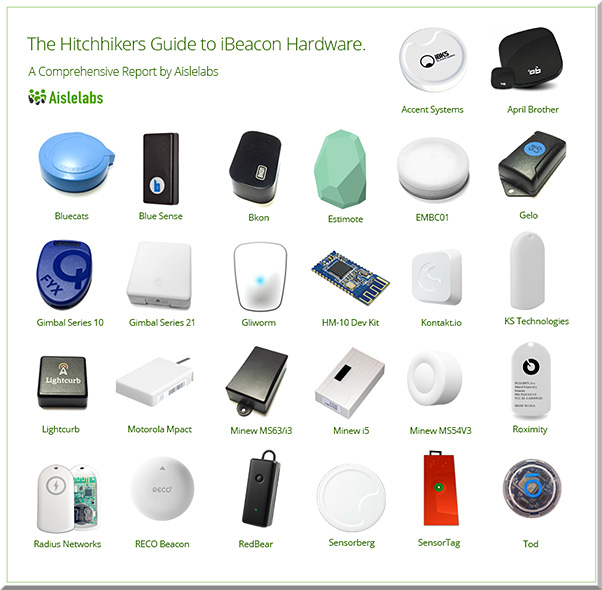
The Hitchhikers Guide to iBeacon Hardware: A Comprehensive Report by Aislelabs (2015) — from aislelabs.com

Excerpt:

In this report we examine 26 different iBeacon hardware vendors, including Estimote, Kontakt, and Gimbal. Over the past nine months, we have stress tested the beacons under many conditions examining every aspect of them. This is the most comprehensive report of its kind, covering every major beacon manufacturer, and providing an independent benchmark of each.


HitchhikersGuideToiBeaconHW-May2015


 Addendum on 5/6/15:


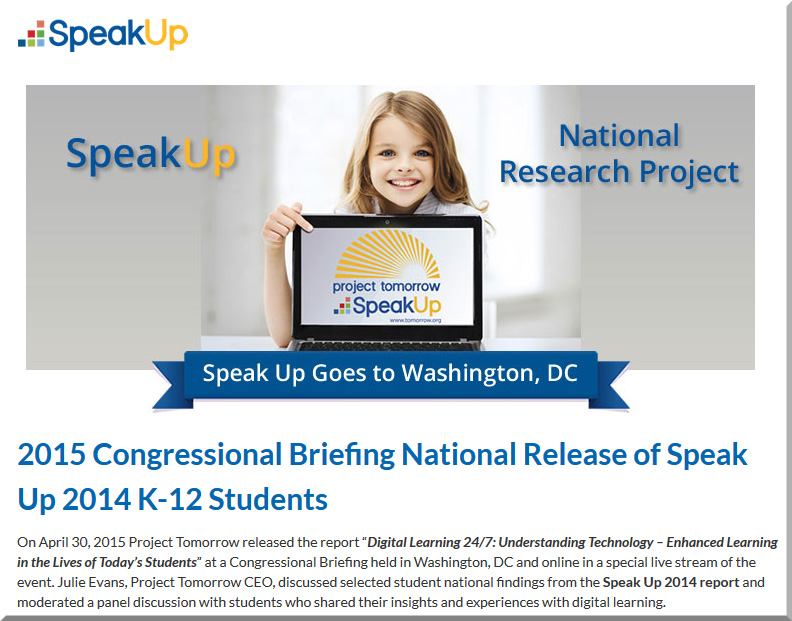
2015SpeakUp


Click here to download the PDF of the report.
Click here to view the report in HTML.


Also see:

Key findings from [the April 30th, 2015 Project Tomorrow] briefing include — from projecttomorrowblog.blogspot.com

Excerpt (emphasis DSC):

  • When students have access to technology as part of their learning, especially school-provided or enabled technology, their use of the digital tools and resources is deeper and more sophisticated.
  • The availability of online learning continues to increase with only 27 percent of high school principals reporting that they are not yet offering any online courses for students. Interest among students continues to grow, with 24% of high school students saying they wish they could take all their classes online – a large increase from 8% in 2013.
  • Almost three-quarters of students with school-provided devices as well as students with limited or non-existent technology access at school agreed that every student should be able to use a mobile device during the school day for learning.
  • Students connect the use of technology tools within learning to the development of college, career, and citizenship skills that will empower their future capabilities.
  • Digital experiences for students in a 100 percent virtual environment are much different than those in traditional schools. For instance, 72 percent of high school students in virtual schools take online tests, compared with 58 percent of traditional students.
  • Students see the smartphone as the ideal device for communicating with teachers (46%) and classmates (72%) and for social media (64%).
  • A gender bias exists in STEM interest –middle school girls are 38% less likely and high school girls are 32% less likely than their male peers to say they are very interested in a STEM career.


Excerpt from Press Release (emphasis DSC):

Students Report Digital Learning Supports Goals of Self-Directed and Collaborative Education, National Survey Finds
Nearly 60 Percent of High School Students Report Using Their Own Mobile Devices in School for Learning
Report Explores Differences Among Students in Blended Learning, Online Learning, STEM Learning and School-Sponsored Mobile Device Environments

Washington, D.C. – The ultimate learning experience for students is both highly collaborative and extremely personalized, supported by mobile devices and digital content, reports Project Tomorrow in their latest Speak Up report.

Over the last few years of the Speak Up survey, more students and administrators have signaled the importance of being able to access mobile devices in the classroom, whether through Bring Your Own Device policy consideration and implementation or through school-provided technology. This year, nearly half of teachers (47 percent) said their students have regular access to mobile devices in their classrooms. Among high school students, 58 percent said they now use their own mobile device at school to support learning activities.


From DSC:
This is a great pulse check on students’ use of ed tech — and on some things that they might be coming to expect.


From DSC:
What applications and implications might this type of setup mean for libraries? For classrooms?


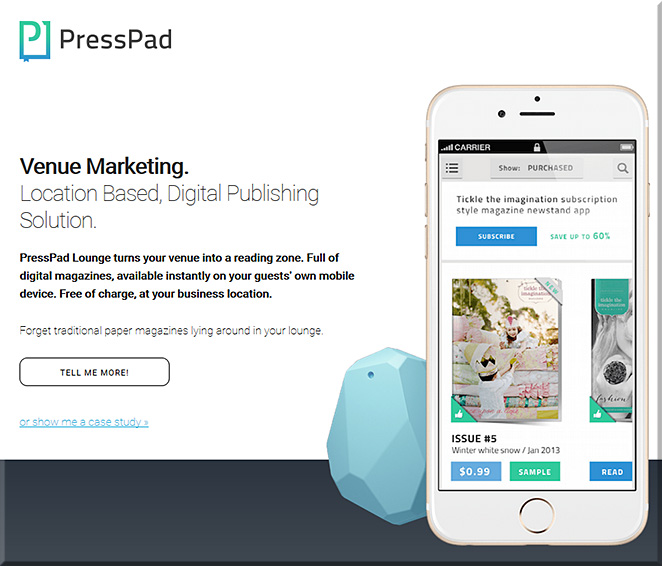
PressPad Lounge: new digital press corner that utilizes iBeacon technology — from talkingnewmedia.com by D.B. Hebbard

Excerpt:

The idea behind PressPad Lounge is that the service allows a business to turn a space into a reading zone, allowing those with mobile devices to access digital publications for free.


PPLounge-1


Also see:
PressPad-April2015

Excerpt:

With PressPad Lounge, people visiting your venue are able to install the magazine app of their choice, and read every issue for free while remaining PHYSICALLY within your venue.

Whether it’s a hotel lobby, a shopping mall, restaurant or a booth, PressPad Lounge enables a slick marriage of digital publishing with location marketing. People located within the range of the reading zone will be able to read magazines on their mobile devices, for free.


Leeds College of Music educates students with Junaio — from blog.metaio.com

Excerpt:

If you’ve ever seen a mixing console before, then you already know what I’m talking about. Those consoles can be a headache to prospective sound engineers in the industry, and to the laymen, it’s nearly impossible to figure out how to maneuver all the knobs and buttons. It’s no wonder that Ruth Clark and Craig Golding of Leeds College of Music set out to come up with a better solution to make audio equipment approachable for their undergraduate students.

First of all, using an e-learning software package called Articulate Storyline, they provided the students with an interactive manual that taught them how to use audio mixing equipment. But this application alone didn’t satisfy Clark and Golding. They also reached out to Matt Ramirez, Senior Augmented Reality Developer at Jisc, the charity offering digital services and solutions to UK education and research, to create something that was far beyond the original scope of the project. The manual was enhanced with Augmented Reality – deployed in Junaio – giving students an easy and innovative way to visualize the various panels and buttons on the mixer console with color-coded overlays: by tapping on the colored parts, students were then able to get additional information for each panel in real time.


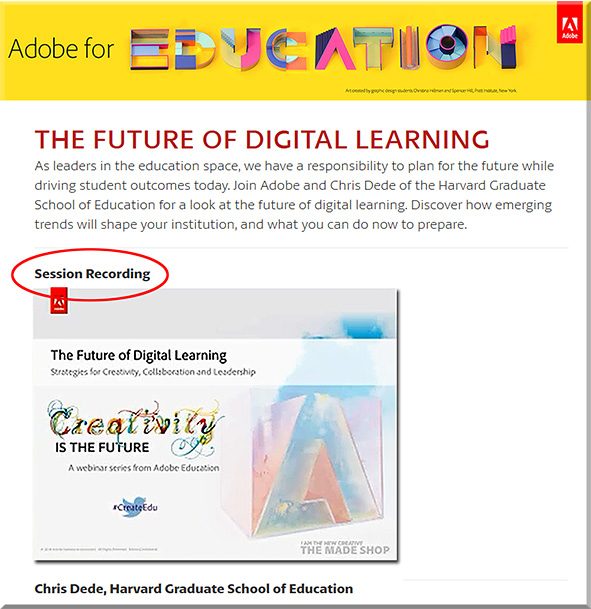
FutureDigitalLearningDede-Adobe-April2015


From DSC:
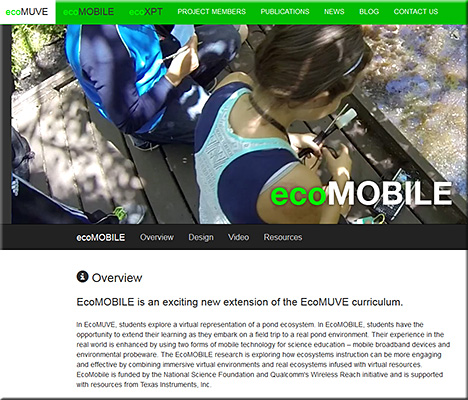
Chris uses ecoMOBILE and ecoMUVE to highlight the powerful partnerships that can exist between tools and teachers — to the benefits of the students, who can enjoy personalized learning that they can interact with.  Pedagogical approaches such as active learning are discussed and methods of implementing active learning are touched upon.

Chris pointed out the National Research Council’s book from 2012 entitled, “Education for Life and Work: Developing Transferable Knowledge & Skills in the 21st Century” as he spoke about the need for all of us to be engaged in lifelong learning (Chris uses the term “life-wide” learning).

Also, as Chris mentioned, we often teach as we were taught…so we need communities that are able to UNlearn as well as to learn.


ecomobile-april2015


Also see:


AdobeCreate-YouTubeChannel


FinallyAdoptHTML5


7 powerful reminders to finally adopt HTML5 in corporate eLearning  — from elearningindustry.com by Alfredo Leone

Excerpt:

Mobility, ubiquity and portability are key requirements for any type of learning as the market fully embraces to the demand of learners to access knowledge when and where is needed. Learners today expect access to relevant and useful information on various types of mobile devices connected via networks of ever cheaper and faster bandwidth.

This trend toward multi-device and multi-access learning is solidifying day after day, making responsive content design one of the most critical components of any production process for online training material. The premise today is for learning to “follow” the person and not the other way around.

In this dynamic online learning scenario, HTML5 is finally going mainstream as the leading technology to structure and present learning content online. Here are some powerful reasons to adopt HTML5 today even when legacy constrains seem to favor a “wait and see” approach:


———–


Also see:

2015 Business eLearning Trends Infographic — from elearninginfographics.com


Addendum on 4/28/15:

How soon is now for the mobile web? — from visionmobile.com by Matt Asay

Excerpt:

That’s one primary takeaway from VisionMobile’s “How Can HTML5 Compete With Native?” report. As report author Dimitris Michalakos concludes, “The question is no longer *whether* HTML5 can produce quality apps, but *how* easy it is to create quality web apps.” Given that “HTML5 is like driving a car without a dashboard,” the key is to deliver better dashboards, or tools, to make it easier to build great web apps.


New from Educause:
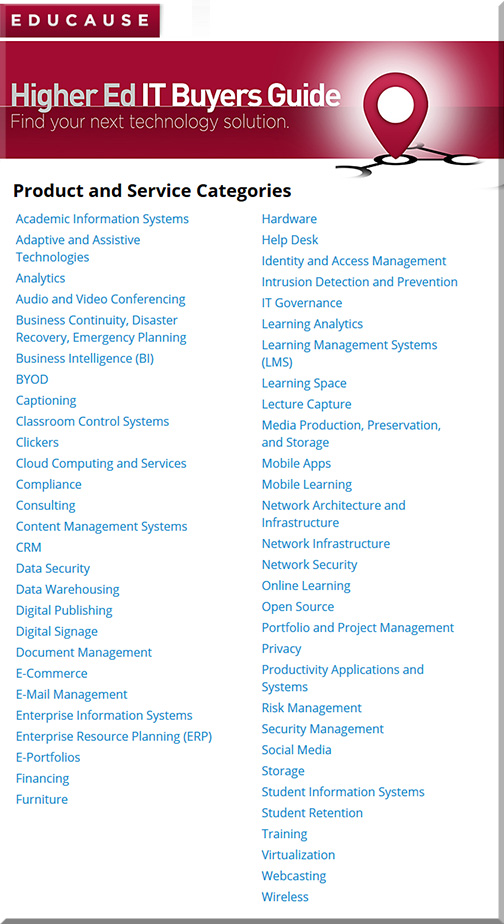
Higher Ed IT Buyers Guide


HEITBuyersGuideEducauseApril2015


Excerpt:

Quickly search 50+ product and service categories, access thousands of IT solutions specific to the higher ed community, and send multiple RFPs—all in one place. This new Buyers Guide provides a central, go-to online resource for supporting your key purchasing decisions as they relate to your campus’s strategic IT initiatives.

Find the Right Vendors for Higher Education’s Top Strategic Technologies

Three of the Top 10 Strategic Technologies identified by the higher education community this year are mobile computing, business intelligence, and business performance analytics.* The new Buyers Guide connects you to many of the IT vendors your campus can partner with in the following categories related to these leading technologies, as well as many more.

View all 50+ product and service categories.


MobileLearningInContext-April2015

New eBook: Mobile Learning in Context — from learningsolutionsmag.com, Janet Clarey, & others; with thanks to Mayra Aixa Villar for this item

Excerpt:

Mobile learning is here to stay: Why be tied to a computer when you can spend the day where you want and learn at the same time? But mLearning isn’t just eLearning on a smaller screen. It has specific demands and offers unique opportunities. Are you making the most of your mLearning? The eLearning Guild’s free eBook, Mobile Learning in Context, might inspire you to rethink your approach.

Rethink your approach
For Mobile Learning in Context, contributing editor Janet Clarey assembled a group of mobile learning thought leaders and asked for their take on the range of mLearning topics. Each of the essays will make you consider the possibilities of mobile learning in a whole new light. Among the eBook’s highlights:


Watch out for these trends in mobile learning: 2015 and beyond — from blog.originlearning.com

Excerpt:

  • Global mobile data traffic grew 69 percent in 2014 and was nearly 30 times the size of the entire global Internet in 2000
  • Mobile video traffic exceeded 50 percent of total mobile data traffic for the first time in 2012
  • Mobile network (cellular) connection speeds grew 20 percent in 2014
  • In 2014, on an average, a smart device generated 22 times more traffic than a non-smart device.

These are just some excerpts from Cisco’s Visual Networking Index: Global Mobile Data Traffic Forecast Update for 2014 to 2019, but they clearly prove a point. That, the usage of mobiles is growing faster than ever before, backed by the rolling out of quicker internet speeds and smarter phones at affordable prices.

  • The research has also made important forecasts for the next 5 years, such as:
  • The number of mobile-connected devices exceeded the world’s population in 2014.
  • 4G traffic will be more than half of the total mobile traffic by 2017.
  • Because of increased usage on smartphones, smartphones will reach three-quarters of mobile data traffic by 2019.

Now against the backdrop of such information, it is interesting to explore what role mobiles are playing in shaping up the workplace learning scenario. These trends with mobile learning are evidence to the fact that we are on the brink of a new era of learning – through the mobile device.


Learning in a Multi-device World (Infographic) — from upsidelearning.com by Pranjalee Thanekar; with thanks to Mayra Aixa Villar for this item

Excerpt:

According to the Verto Analytics’ Device Ecosystem US 2014 report, the average number of smartphones, tablets and computers used by an average US adult is 2.8 devices. Further, consumers show an increasingly polarised preference towards a particular device and platform as technology evolves. This indicates the increasing dependency on devices, generated by the ease in switching between tasks and the leverage it provides.


© 2025 | Daniel Christian