A first look at how educators are really using Google Glass — from by Stephen Noonoo

Excerpts (emphasis DSC):

Per Andrew Vanden Heuvel:

What Glass does offer, Vanden Heuvel said, is a shift in perspective, particularly because teachers can use it as a tool to engage students faster and more easily than before. After returning from Geneva, Vanden Heuvel launched a YouTube channel devoted to his experiments with science–and Glass–called STEMBite. To date, in more than two dozen videos, he’s guided viewers through the physics of ball spin on the tennis court to the polarization of light through (appropriately enough) a pair of glasses.

“What I’m excited by making these videos is not only that they’re filmed with Google Glass, but they’re high engagement videos, so they’re meant to be really short and to get kids to think about how math and science is all around,” he said. “I suppose I could have done that before, but it’s just so easy now.”

Per Hanna Brown:

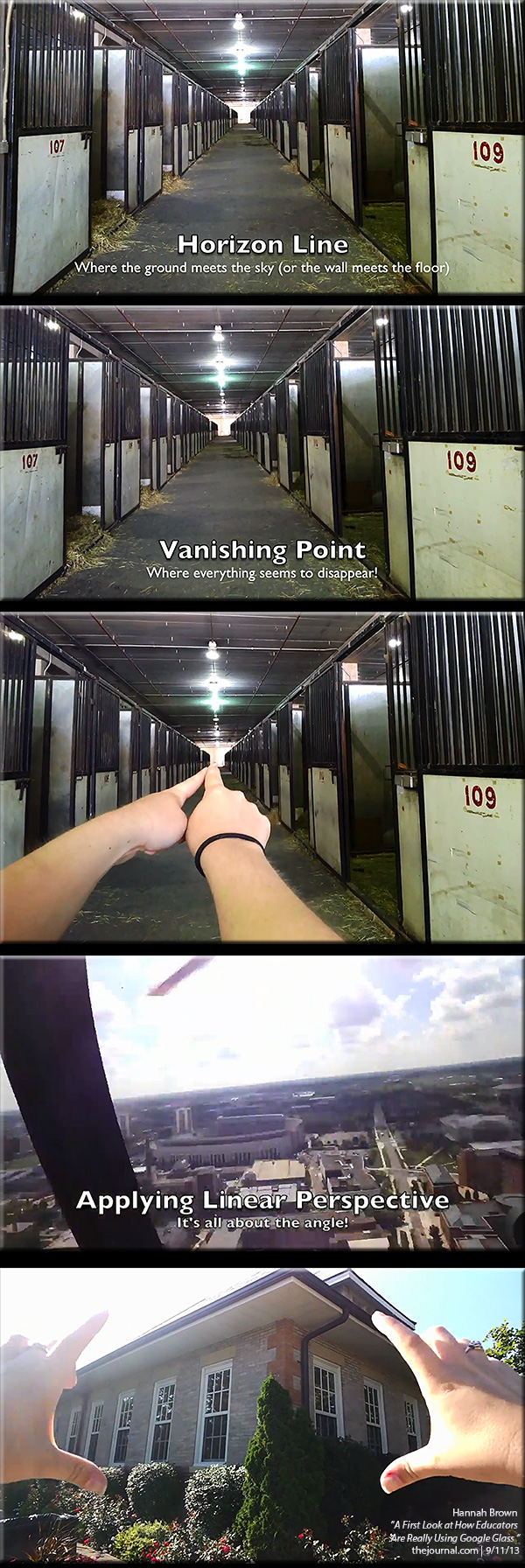
“I’ve had videos in my classroom before–that’s not a novel thing–but I’ve never been able to take a video from my eye perspective,” said Hannah Brown, another early Glass adopter who works as a high school art teacher at Electronic Classroom of Tomorrow, an all-online statewide charter school in Ohio.
 

HannahBrown-9-11-13-Art-and-Google-Glass-thejournal


From DSC:
Virtual field trips, mobile learning, videoconferencing, web-based collaboration, Human Computer Interaction (HCI), and other topics come to my mind when I see this.


Yahoo! Screen: A new app that helps you find entertaining videos on an iPhone, iPad, and/or an iPod touch


Yahoo-Screen-Sept2013


Combine that with:


Mindsy-29DollarsPerMthLearning-Sept2013


…and you have one powerful learning/discovering setup!!!!


Transmedia stories and games explained — from splash.abc.net.au by Dr. Christy Dena; with thanks to The Digital Rocking Chair for Scooping this onto Transmedia: Storytelling for the Digital Age
Opportunity abounds in the area of ‘transmedia projects’, or stories and games that span more than one medium or artform. Dr Christy Dena explains this evolving area of education. This is Part 1 in her blog series.

Excerpt:

One of the areas I work in is ‘transmedia’ or ‘cross-media’ writing and design. I work in the area as a practitioner, and also as an educator for industry professionals and undergraduate students. Transmedia or cross-media fundamentally refers to projects that span more than one medium; for example, a book and computer. I work in creating transmedia stories and games, and so also teach students about making their own. Over my two articles for ABC Splash, I share some of the approaches I use when giving students the opportunity to make their own transmedia stories and games.

Opening the door to transmedia projects — from splash.abc.net.au by Dr. Christy Dena
In her second article on transmedia projects, Dr Christy Dena shares the guidelines she’s created to open the door to this form of education in schools.

Excerpt:

It is important that students are given at least two media locations to work with, such as a website and poster. I always include a live event of some kind as well.


From DSC:
The massive convergence of the telephone, the television, and the computer continues.  How that media gets to us is also changing (i.e. the cord cutting continues). 

What types of innovative learning experiences can be crafted as “TV” becomes more interactive, participatory, and engaging? What happens if technologies like WebRTC make their way into our browsers and we can videoconference with each other without having to download anything?

What doors open for for us when Google, Apple, or an Amazon.com delivers your “shows” vs. NBC/ABC/CBS/etc.?

 The items below cause me to reflect on those questions…


.

Streaming devices lead the way to Smart TV — from nytimes.com by Brian Stelter

Julia Yellow


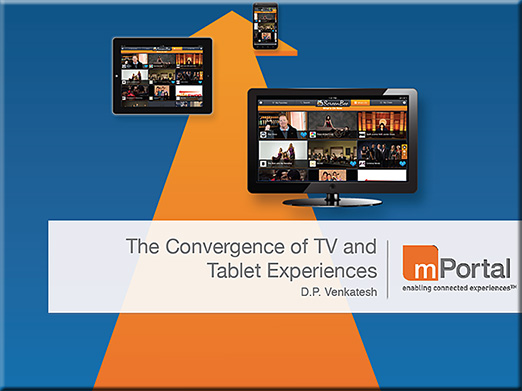
ConvergenceTVTablet-DPVenkatesh-Aug2013


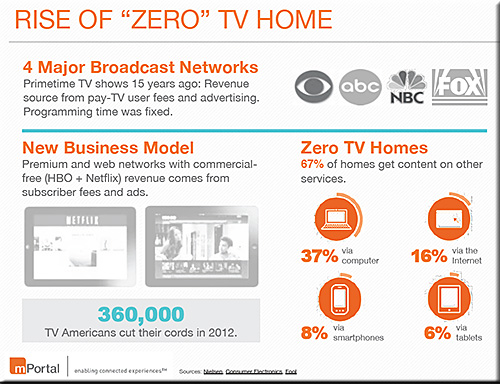
ConvergenceTVTablet2-DPVenkatesh-Aug2013


.

Is Google ready to buy its way into TV with an NFL deal? — from allthingsd.com by Peter Kafka

Excerpt:

Here’s a fun combination to ponder: The world’s most powerful media company and America’s most popular sport.

That could happen if Google buys the rights to the NFL’s Sunday Ticket package, the all-you-can-eat subscription-TV service currently owned by DirecTV.


Cord Cliff Coming: What happens to TV when Netflix streams live events? — from allthingsd.com by Ben Elowitz, CEO, Wetpaint


 Addendums on 8/22/13:


The tv of tomorrow and the living room of the future

by beutlerink.
Explore more infographics like this one on the web’s largest information design community – Visually.


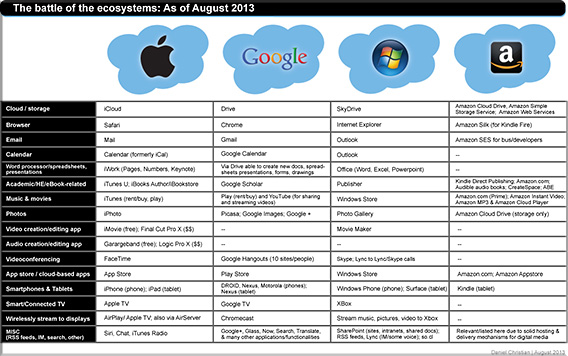
The battle of the ecosystems: Apple, Google, Microsoft, & Amazon.com — by Daniel Christian with thanks to Krista Spahr, Michael Mandeville, Bill Vriesema, and Adam Tozer from Calvin College for their feedback/inputs on this.


BattleOfTheEcosystems-DanielChristian-August2013

PDF version here [1.35MB]


Also see:


Ecosystem value metrics


Ecosystem value metrics - developer perspective


Addendums on 8/13/13:


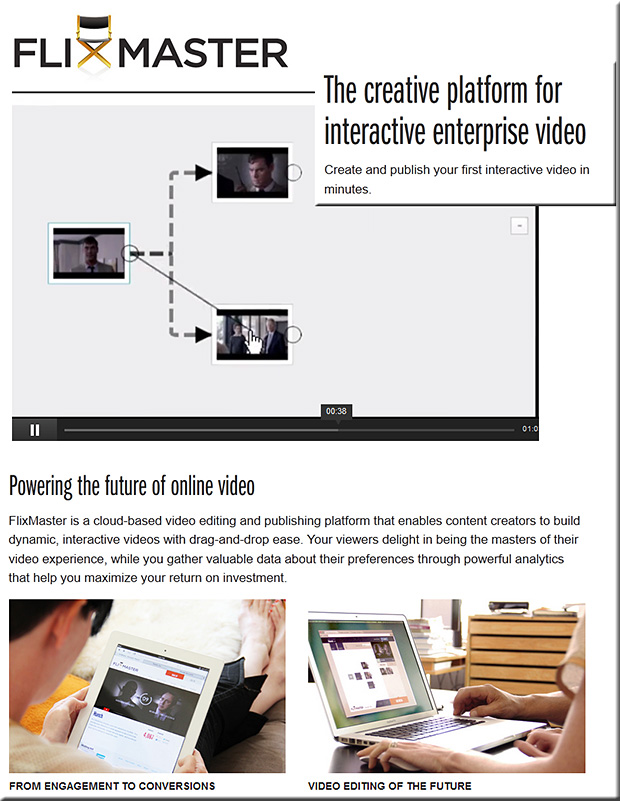
FlixMaster changes model; becomes Rapt — from bcbr.com by Joshua Lindenstein

Excerpts:

BOULDER – Highlighting a shift toward a new model for its interactive online video platform, Boulder-based FlixMaster Inc. this week announced that it is changing its name to Rapt Media Inc.

…

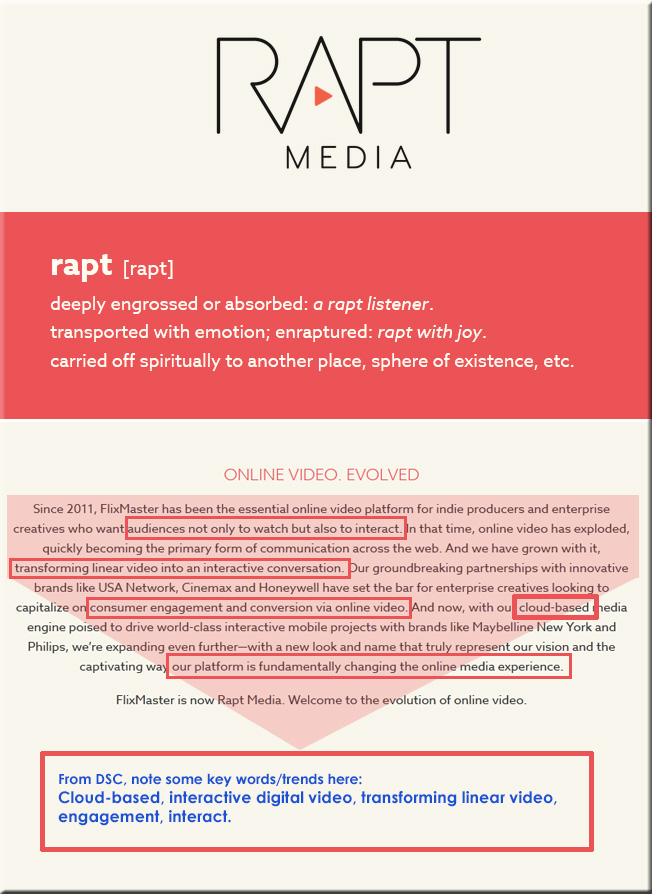
“When we founded FlixMaster, we set out to create the best toolset for video creators wanting to build interactive videos, and we succeeded in doing that that,” Rapt co-founder and chief executive Erika Trautman said in an email.  “But as we partnered with really sophisticated companies (like HBO and Maybelline), we realized that our platform and the opportunity it posed was bigger than just interactive video. It was about improving online communication and storytelling through interactivity of all kinds, with video as the central component. Our company had already transitioned to this bigger vision, and we wanted a name that could reflect that vision.


FlixMasterBecomingRapt-August2013


Additional thought from DSC:
This item relates to the convergence of the television, the computer, and the telephone that I’m pulse-checking. I’m hopeful that such a convergence will provide students in the future with 24×7, highly-engaging, interactive, customized/personalized content:

.

More choice. More control.


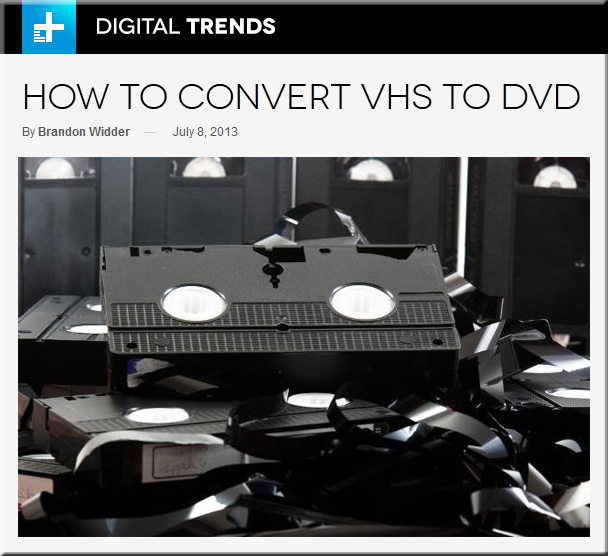
Digital-Trends-How-To-ConvertVHS-to-DVD-July2013


Excerpt:

Here’s our guide on how to convert VHS to DVD using a combo player, an analog-to-digital adapter, two separate boxes or a conversion service so you can save that 20-year-old footage of you faceplanting on your first bicycle. If not for you, do it for posterity’s sake.


From DSC:
The way we interact with digital video may never be the same again.  Consider the following developments/items:


.

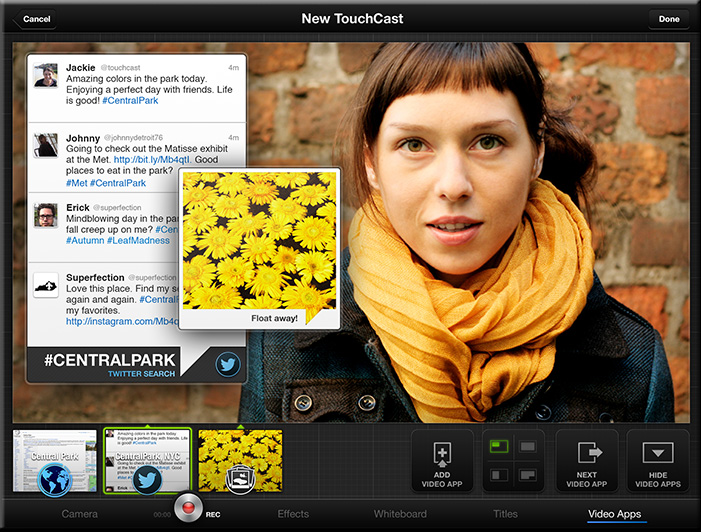
Touchcast2-July2013

Touchcast.com

.

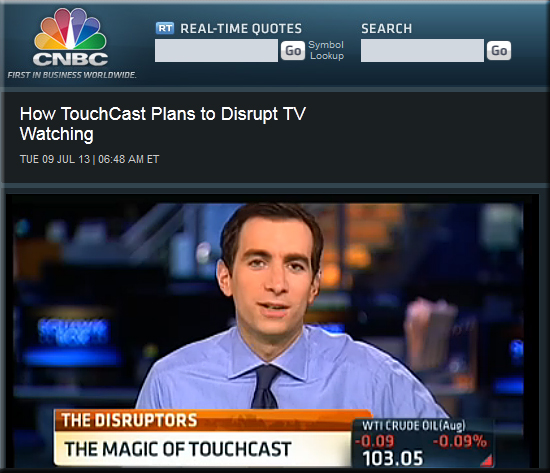
TouchcastDisruptsTVWatching-July2013

How TouchCast plans to disrupt TV watching

.

TouchCast: a television studio in your iPad — from agbeat.com by Jennifer Walpole .


Interlude2-July2013


interlude.fm

.

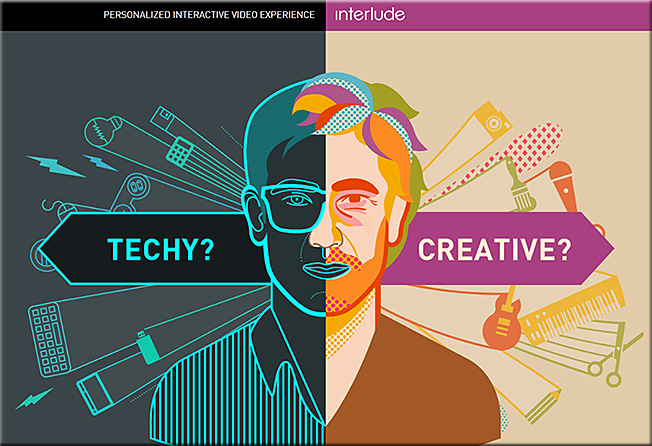
Interlude-July2013

.

Interactive video startup Interlude raises $16m from Intel, Sequoia and other big names — from thenextweb.com by Robin Wauters

.


FlixMaster2-July2013

Flixmaster.com


.
  • What is MTEVIDEO?
    The Motion Touch Enabled Video platform allows you touch on the things that interest you as they move within video, adding them to your personal boutique so you can learn, shop, and share from any MTEVIDEO whenever you want.


With Cinematique’s ‘touch-enabled’, shoppable videos, product placement might not be so bad — from techcrunch.com by Anthony Ha


From DSC:
I sure hope that we can use these sorts of tools, concepts, and technologies within the educational/training-related realms! More choice. More control. Participation. Interactivity. Engagement.


The New Storytelling Frontier — from huffingtonpost.ca by Katherine Brodsky

Excerpts (emphasis DSC):

Long gone are the days of static content. Consumers are looking for more and transmedia storytelling offers an increasingly popular approach for creating property-based universes. Transmedia content itself is also evolving. It’s becoming more dynamic, more interactive, offering greater opportunities to engage audiences with creative user-generated content that adds to the storytelling experience. It is becoming more communal.

…

Although traditional models allow for greater control of content, strategies that can engage fans more actively and allow them to express themselves and even contribute to the development of a show, get them more involved and, ultimately, more willing to buy in.


From DSC:
As the use of storytelling is a powerful tool for learning, I can’t help but wonder…

  • What might be some creative possibilities arising from the developing world of transmedia that students and/or educational organizations could develop?
  • In what ways could we build more interactivity and social networking into our “digital textbooks” and mobile-based applications?
  • Would transmedia-based content help maintain interest, engagement, attention?
  • Would it help establish longer term memories/recall?
  • How might it help build students creativity and foster more experimentation/play/participation?
  • What roles might students play? (Writer, videographer, sound designer, actress, programmer, game designer, project manager, entrepreneur, etc.)
  • What tools and skills would students need to create their own transmedia-based experiences?
  • What new forms of storytelling might evolve from these efforts?
  • Could transmedia work its way into blended learning models?
  • Are new opportunities for immersing oneself in a particular subject matter becoming more available through transmedia-based experiences?
  • Could streams of content be wrapped in transmedia-based experiences?


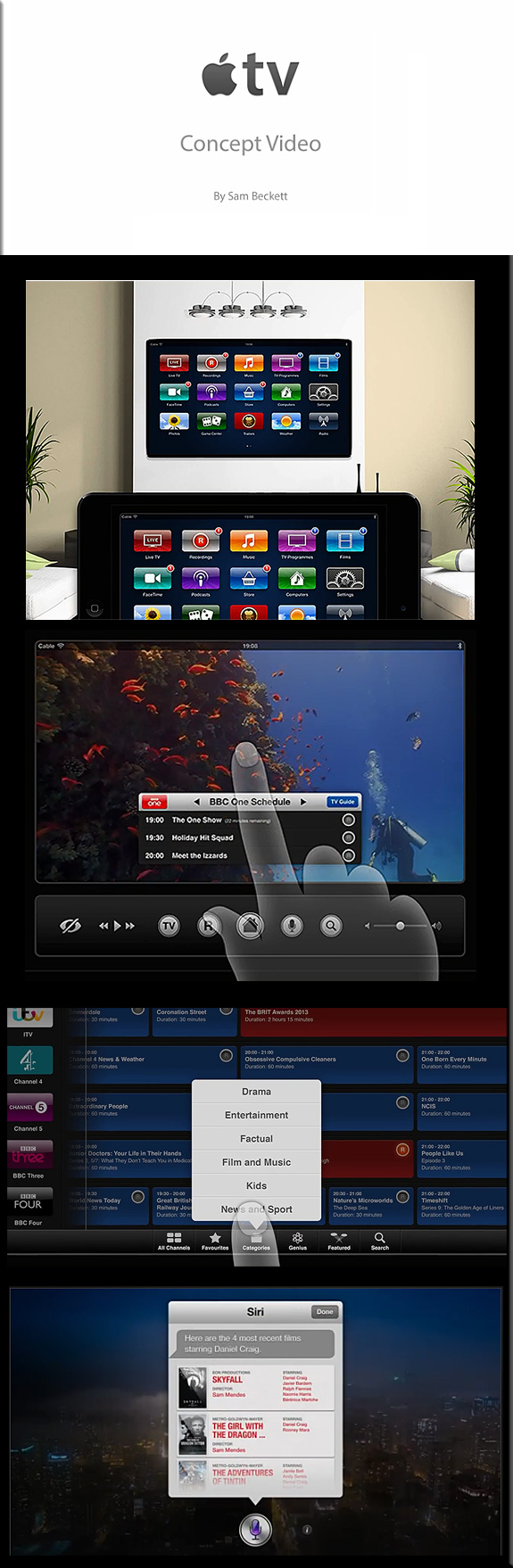
Heads up Jony Ive! You need to see this brilliant concept for the Apple TV! Superb work by Sam Beckett!

BrilliantTVConceptBySamBeckett-May2013


.

From DSC:
Now picture this from the educational standpoint — and what MOOCs could morph into.  The foundation for some serious learning power (from the living room) seems to be developing!

Streams of content/learning channels/cloud-based applications that each of us can create and make available.

Voice recognition, learning analytics, machine-to-machine communications, transmedia and more!  Wow!


.


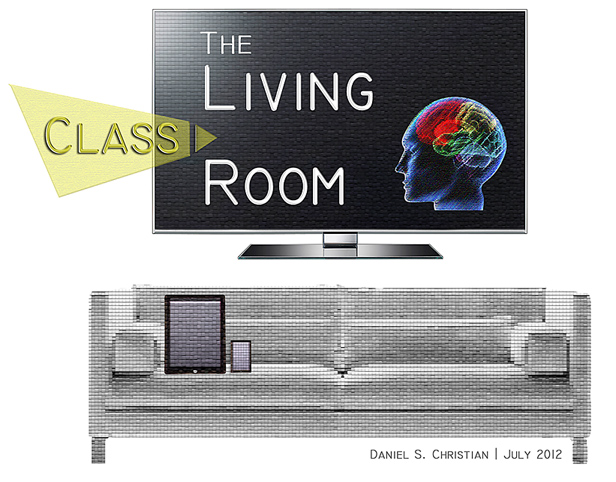
The Living [Class] Room -- by Daniel Christian -- July 2012 -- a second device used in conjunction with a Smart/Connected TV


Netflix CEO: ‘TV in the future will be like a giant iPad’ [Ligaya ]

Netflix CEO: ‘TV in the future will be like a giant iPad’ — from business.financialpost.com by Armina Ligaya

Excerpt (emphasis DSC):

Q: What do you think is going to happen over the next five or 10 years in internet video?

A: Well, you know, the fundamental thing is the internet has been getting faster. And now it’s video capable, which is really a last-five-years phenomenon. And, internet video will be very transformative across all societies for telemedicine, for online learning, for education. For communication of various sorts. And it brings, whether it’s person to person, or a recorded video like a movie or a TV show, to a person it will be very transformative.

And, TV in the future will be like a giant iPad. It will have a bunch of apps on it, each app will have a unique experience.

…

So we’re getting beyond just a stream of video, which is all broadcast technology can do, to really try to be innovative about the interaction.

.

The Living [Class] Room -- by Daniel Christian -- July 2012 -- a second device used in conjunction with a Smart/Connected TV


Part 3: Transmedia is a mindset, not a science — from by Matt Doherty — thanks to the Scoop from siobhan-o-flynn  at Tracking Transmedia
The end of TV as we know it & the rise of transmedia

.

.

Also see:

The end of TV as we know it & the birth of transmedia — slideshare by Ogilvy & Mather

Doug Scott, President, OgilvyEntertainment and Matt Doherty, Transmedia Architect, Ogilvy & Mather Worldwide presented The End of TV as We Know It & The Birth of Transmedia at the 21st Century Storytelling Conference: Content, Context and Conversations sponsored by Microsoft, Ogilvy & BrainJuicer on July 31, 2012 in Chicago.

Throughout history, we have told stories. Stories are what connect us across geographies, cultures and experiences; stories demonstrate that we share the same hope, dreams, fears, challenges and desires. Today’s complex, digtally connected consumer universe makes brand storytelling more challenging, but also creates opportunities for brands to tell their stories in new ways.

Doug Scott and Matt Doherty discussed how the idea of TV might be a thing of the past, but the stories that drive our content will always be our constant. Our variable? Telling. Telling has evolved due to the primary role of digital in our lives and disruptive innovation which has given us the ability to craft transmedia experiences. Transmedia has brought about a new set of creative tools and narratives that are rooted in content, formed by context and crossed by all things culture. Are you a story? Or are you a teller?


Lake Forest school unveils high-tech classroom — from by Danielle Gensburg

Excerpt (emphasis DSC):

The new space, previously home to administrative offices, is colored with blues, greens, oranges and yellows and contains movable furniture, a green room for recording and filming movie projects, three large monitors, iPads, computers, digital recording equipment and library bookshelves.

“They wanted it to be set up where it would be more of a learning lab for life-long learners to engage and have student-directed learning,” Zeeman said.

.


Deerpath Middle School unveiled “The Cube,” a new technology classroom, in April.

22-Filmmaking-Apps-for-the-iPadiPhone-May2013

Tagged with: • •  
© 2025 | Daniel Christian