Ed-Tech advances poised to revolutionize higher ed from all angles — from evolllution.com by Michael Horn

Excerpt:

There’s a flip side to unbundling, however, that receives far less attention. As a service’s architecture becomes modular, its performance becomes determined by the raw performance of its subcomponents, which consequently become interdependent — or re-bundled — as the entities making these subcomponents need to wring every ounce of performance out of them. In other words, as one stage becomes modular, an adjacent stage becomes interdependent.

In education, as elements such as content become unbundled, there will exist a need for subcomponents that bundle together — coaching, mentoring, communities, personal learning plans and employer connections, for example, as these areas are critical for student success, but the ways in which they fit together are not yet well enough understood such that there can be clear standards at their various interfaces. Standalone, modular solutions in these areas will struggle to succeed. Creating standards at their interfaces before we know what the standards should be will similarly suffer.
..
Similarly, too few are thinking about how to help students make sense of and navigate this emerging, unbundled world and integrate the modular pieces together in ways that help them carve out a coherent and sensible life path. This is critical because it appears that in a personalized learning future, every single learner will have a custom-fit educational pathway.


Bundling and Re-bundling — from elearnspace.com by George Siemens

Excerpt:

There are a few things wrong with the idea of unbundling in education:

1. Unbundling is different in social systems than it is in a content only system. An album can be unbundled without much loss. Sure, albums like The Wall don’t unbundle well, but those are exceptions. Unbundling a social system has ripple effects that cannot always be anticipated. The parts of a social system are less than the whole of a social system. Unbundling, while possible in higher education, is not a zero sum game. The pieces on the board that get rearranged will have a real impact on learners, society, and universities.

2. When unbundling happens, it is only temporary. Unbundling leads to rebundling. And digital rebundling results in less players and less competition. What unbundling represents then is a power shift. Universities are today an integrated network of products and services. Many universities have started to work with partners like Pearson (ASU is among the most prominent) to expand capacity that is not evident in their existing system.
.
Rebundling is what happens when the pieces that are created as a sector moves online become reintegrated into a new network model. It is most fundamentally a power shift. The current integrated higher education system is being pulled apart by a range of companies and startups. Currently the university is in the drivers seat. Eventually, the unbundled pieces will be integrated into a new network model that has a new power structure. For entrepreneurs, the goal appears to be to become part of a small number of big winners like Netflix or Google. When Sebastian Thrun stated that Udacity would be one of only 10 universities in the future, he was exhibiting the mentality that has existed in other sectors that have unbundled. Unbundling is not the real story: the real issue is the rebundling and how power structures are re-architected. Going forward, rebundling will remove the university from the drivers seat and place the control into the re-integrated networks.


————

Addendums:


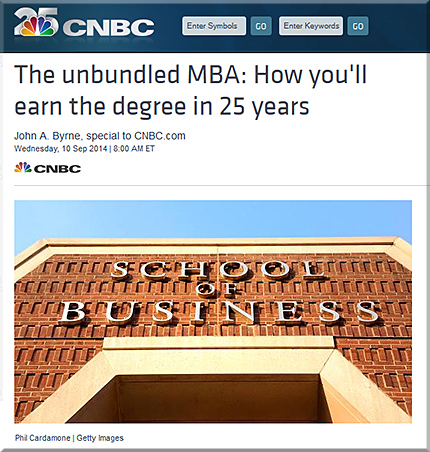
unbundledMBA-CNBC-Sept2014


Addendum on 9/17/14:
Ed tech’s next wave rolls into view — from by Roger Novak

Excerpt:

If the second wave was about the unbundling of colleges and providing learning as a service, the third wave of companies will be involved in reassembling educational component pieces from various sources to help make students’ learning portfolios more meaningful to both individuals and employers. While we are starting to see colleges taking similar steps to become more student-centered, private-sector companies can act nimbly to fill gaps and create new technologies to help accomplish these goals.
 

Does Studying Fine Art = Unemployment? Introducing LinkedIn’s Field of Study Explorer — from LinkedIn.com by Kathy Hwang

Excerpt:

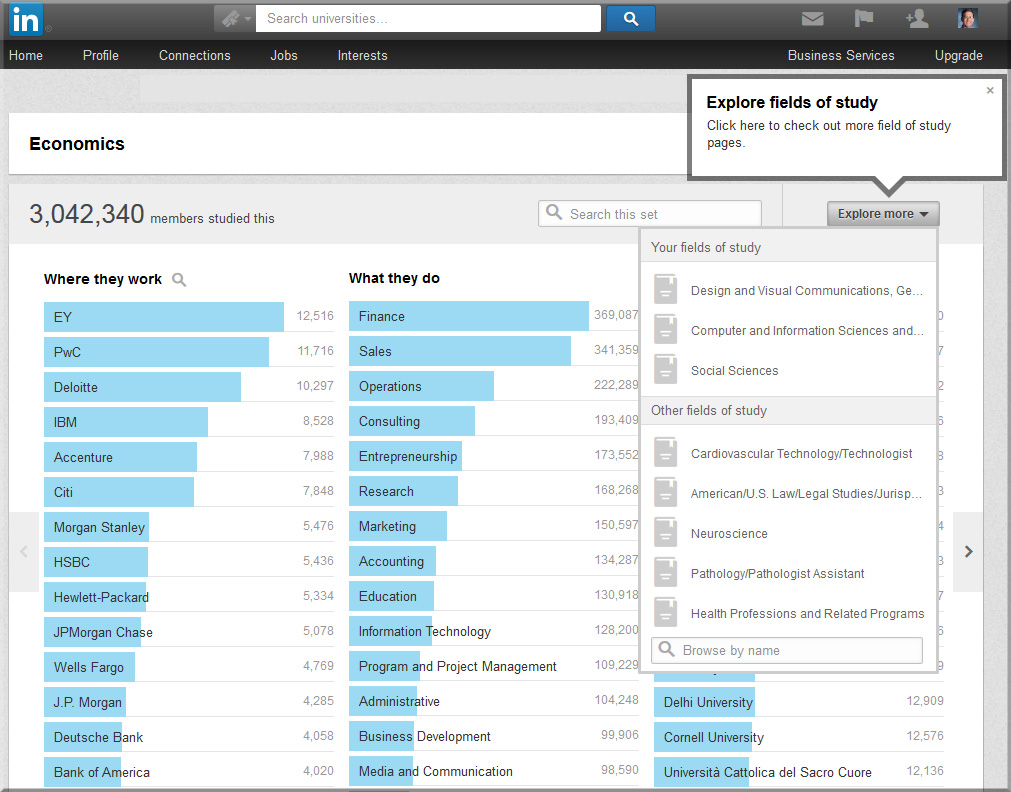
[On July 28, 2014], we are pleased to announce a new product – Field of Study Explorer – designed to help students like Candice explore the wide range of careers LinkedIn members have pursued based on what they studied in school.

So let’s explore the validity of this assumption: studying fine art = unemployment by looking at the careers of members who studied Fine & Studio Arts at Universities around the world. Are they all starving artists who live in their parents’ basements?


LinkedInDotCom-July2014-FieldofStudyExplorer


Also see:

The New Rankings? — from insidehighered.com by Charlie Tyson

Excerpt:

Who majored in Slovak language and literature? At least 14 IBM employees, according to LinkedIn.

Late last month LinkedIn unveiled a “field of study explorer.” Enter a field of study – even one as obscure in the U.S. as Slovak – and you’ll see which companies Slovak majors on LinkedIn work for, which fields they work in and where they went to college. You can also search by college, by industry and by location. You can winnow down, if you desire, to find the employee who majored in Slovak at the Open University and worked in Britain after graduation.


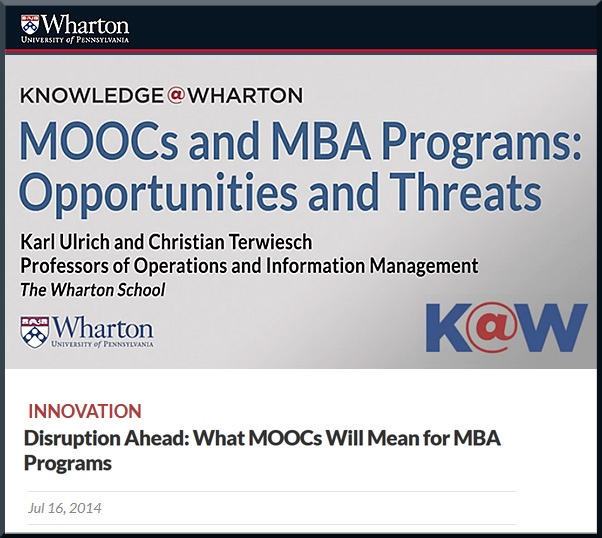
MOOCs-MBAs--threats-opps-july2014


From DSC:
A paraphrased excerpt:

When I watch my teenagers do their math, they use their laptops, smartphones (to text their friends), and they watch YouTube videos to explain how to do the problems.

This statement made me reflect on the vision that I’m pursuing re: the use of second screen apps in learning as it relates to Learning from the Living [Class] Room.

The video was interesting to watch, and the topic grabbed my eye — i.e., will MOOCs impact MBA programs and if so, what might the potential scenarios look like?

I appreciated the excellent example of peering into the future, developing some scenarios, and planning for those scenarios NOW.


Also see:

Excerpt:

Learning continues long after college ends. What if being enrolled in college was also a lifelong condition?

That is how Christian Terwiesch, a professor at the University of Pennsylvania’s Wharton School, thinks graduate business programs might work in the future.

He and a colleague, Karl T. Ulrich, vice dean of innovation at Wharton, have published a paper on how the ascent of short video lectures—the kind popularized by massive open online courses and Khan Academy—might change the cost and structure of top business programs like Wharton’s. The short answer is that they probably won’t, at least not anytime soon.

The business school eventually might have to provide chunks of its curriculum on demand over a student’s whole career, he said, rather than during a two-year stretch at the beginning.


From DSC:
I like that question — Would graduate school work better if you never graduated from it? — as it speaks to me of tapping into the streams of content that are constantly flowing by us now…and doing so throughout our lifetimes. That’s one possible scenario for the delivery mechanism for some of our educational programs in the future.


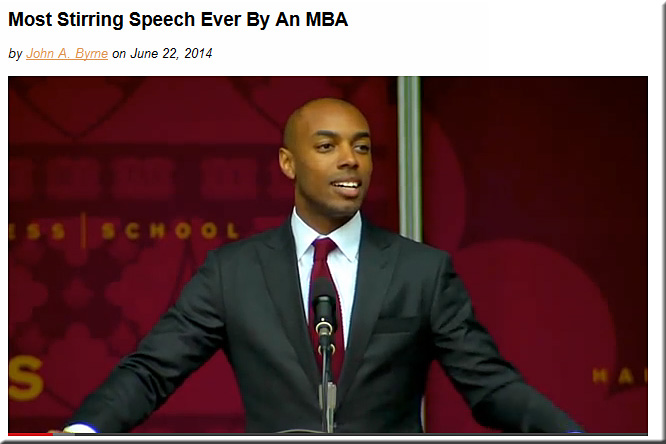
The most extraordinary speech ever by a graduating MBA — from LinkedIn.com by John Byrne

Excerpt (emphasis DSC):

Gerald spoke movingly about a near-death experience with armed gunmen in his hometown of Dallas, and how that changed his life forever. “A strange thing happened as I accepted that I was about to die: I stopped being afraid.” He then decided to “give my life to a cause greater than myself.”

After arriving at Harvard Business School from Yale, Gerald said that HBS “changed who we were; it reminded us who we could be. It reminded us that we didn’t have to wait until we were rich or powerful, or until we actually knew finance, to make a difference. We could act right now.”

With three classmates, Casey founded a non-profit, MBAs Across America, which is a movement of MBAs and entrepreneurs working together to revitalize America. “We saw the signs for hope in entrepreneurs who were on the front lines of change. They showed us that the new ‘bottom line’ in business is the impact you have on your community and the world around you — that no amount of profit could make up for purpose.”


See also:

CaseyGerald-HBS-Commencement-2014


From DSC:
Though the use of the word “ever” in John Byrne’s posting on LinkedIn.com may be a stretch for some, Casey Gerald did give an incredibly powerful, deep, well-articulated message at Harvard Business School’s 2014 Commencement. 

I really appreciated what Casey was getting at — a higher calling for business.  A higher calling for one’s life.  If it’s only about making a living — vs making a life and a contribution — it comes up short.  We can do better.  Businesses can do better.  Wall Street can do better.  With corporations sitting on a trillion+ dollars, how might those massive resources be put towards helping society at large?  Here are 2 ideas:

  1. Don’t lay people off so quickly.  Take some of those funds and use them to retrain/reinvent people.  Keep America’s households running. Help keep peoples’ skillsets relevant, and help keep people employed.  Better yet, do this now for those people that you know you will be replacing in the future with algorithms and/or with robotics.
    .
  2. Fund/outfit educational institutions.  For example, it would benefit society greatly if the large tech companies would outfit the K-12 classrooms across the country (yes, I’m mainly thinking of you Apple, Google, & Cisco).  Many districts are struggling to implement ed tech and this would be of huge service to the country.


See also:


MBAsAcrossAmerica-June2014


Business School, Disrupted — from nytimes.com by Jerry Useem

Excerpt:

The question: Should Harvard Business School enter the business of online education, and, if so, how?

Universities across the country are wrestling with the same question — call it the educator’s quandary — of whether to plunge into the rapidly growing realm of online teaching, at the risk of devaluing the on-campus education for which students pay tens of thousands of dollars, or to stand pat at the risk of being left behind.


From the WSJ’s Morning Ledger:

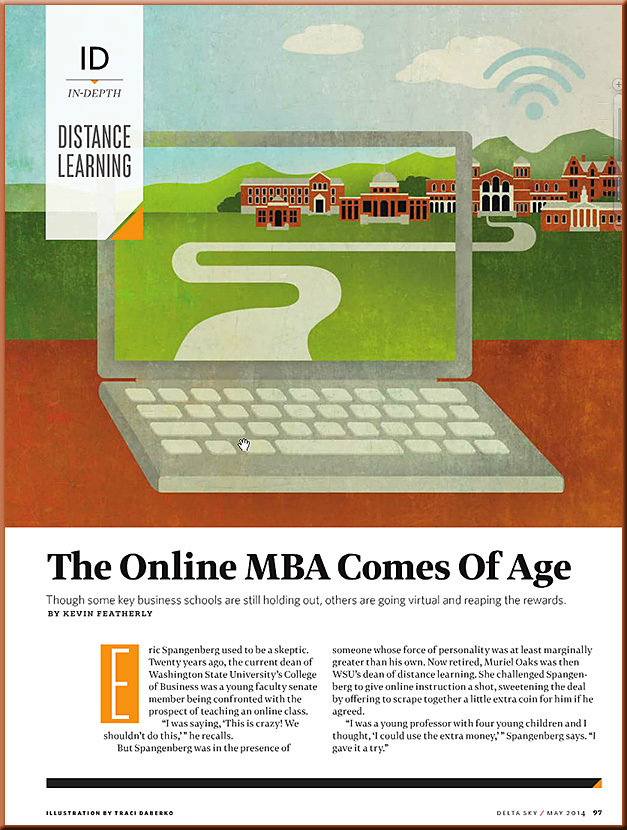
The online MBA comes of age.
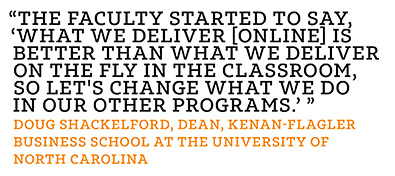
You’d think that of all the academic pursuits, business school would remain most immune to online learning. Beyond studies, MBA programs offer up-and-coming C-suiters access to the graduate-level schmoozing that could come in handy later on. Nevertheless, the online MBA program is growing, Delta Sky Magazine’s Kevin Featherly reports. What they lack in post-exam cordials with the professor, they make up for in a more diverse, more experienced student body, say advocates. “In ground-based programs, you’re connected to a more local audience,” the dean of the University of Bridgeport’s Ernest C. Trefz School of Business tells Delta. “In the online program, you’re interacting with business professionals from around the world.” But not everything is so encouraging. A professor at Kenan-Flagler Business School at the University of North Carolina tells Mr. Featherly how surprised he was “when a course designer suggested he use a cartoon character to illustrate a hard-core economics principle.”


Also see:

TheOnlineMBAComesOfAge-Featherly-May2014


QuoteFromFeatherlyArticleMay2014


From DSC:
Consider this. Steve Jobs lived by the philosophy of cannibalizing Apple’s own business, as he held that Apple needed to cannibalize itself or someone else would do it for them.  And here’s the key thing to consider:  Apple is the largest company in the world, based on market cap (505.92B as of this morning) and market value.

The point is, we in higher ed can’t be afraid of change. We must change. It’s time for more Trimtab Groups within higher education.


From DSC:
This posting is especially meant for two audiences (but also has wider ramifications for the vast majority of us living in the United States)

  1. Those students who are majoring in economics
  2. Those of us working within higher education


To the students studying economics out there:

  • What parts from the articles listed below are true? False? Is anything being minimized or exaggerated — or is the information factual and accurate?
  • How are the topics of these articles/discussions relevant to your lives today? In the future?.
  • Do ethics come into play here? If so, how?
    .


Fed to the Sharks, Part 2: Housing & the Death of the Middle Class  — from oftwominds.com by Charles Hugh Smith

Excerpts:

The Fed sacrificed the foundation of middle class wealth — stable housing values — to boost bank profits.

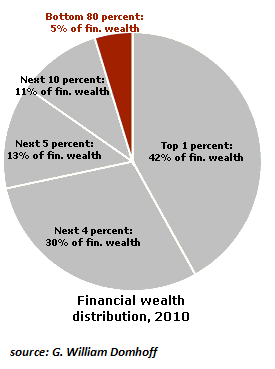
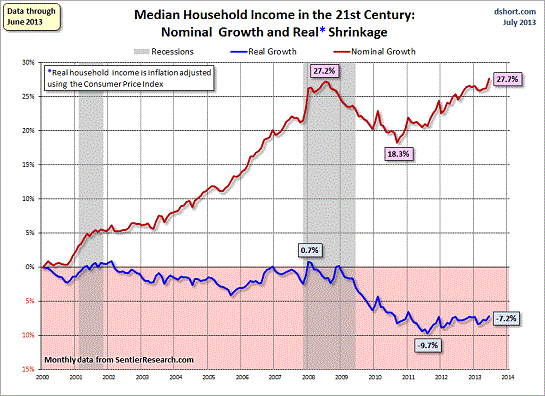
Lest you think the phrase “death of the middle class” is hyperbole, please examine these two charts, keeping in mind the middle class by definition must be in the middle of income/wealth distribution — conventionally, between 40% and 80%, i.e. the 40% between the bottom 40% and the top 20%.


See that little red wedge?
That’s the bottom 80% — the entire middle class
and everyone below the middle class.


Fed to the Sharks, Part 1: The Fed takes our money, gives it to banks who loan it back to us at 16%  — from oftwominds.com by Charles Hugh Smith

Excerpt:

We’re being Fed to the sharks, every day, one morsel at a time. What a way to go….

What can we say about the Federal Reserve’s policies that hasn’t been said a million times? How about simplifying the two primary purposes of Fed policies? I will cover one today and the second one tomorrow. Both involve feeding the 99.5% to the financier/ Wall Street/bank sharks.


To institutions of higher education:

  • If what Charles Hugh Smith is saying is true and the middle class continues to be hollowed out, how does — or should — this affect us?
  • How might this impact our strategies? Our offerings? Our pricing structures?


Management and the Liberal Arts
Management is a liberal art.

Management is what tradition used to call a liberal art — “liberal” because it deals with the fundamentals of knowledge, self-knowledge, wisdom, and leadership; “art” because it deals with practice and application. Managers draw upon all of the knowledges and insights of the humanities and social sciences on psychology and philosophy, on economics and history, on the physical sciences and ethics. But they have to focus this knowledge on effectiveness and results-on healing a sick patient, teaching a student, building a bridge, designing and selling a “user-friendly” software program.

ACTION POINT:
What is your plan to develop yourself in the humanities and social sciences? Develop such a plan today.

The New Realities


Drucker, P. (2004). The Daily Drucker (p. 15). New York, NY: HarperBusiness.


Harvard Business School Launches HBX — from harvardmagazine.com

Excerpt:

Harvard Business School (HBS) [on 3/21/14] announced HBX, its venture into online learning.  It differs in two significant ways from edX, the Harvard-MIT online learning partnership through which HarvardX has offered massive open online courses (MOOCs) from diverse schools for free to a worldwide audience:

  • HBX uses proprietary technology, not the edX platform.
  • HBX is pioneering fee-based courses, which hold the promise of significant new revenue streams.


Also see:

Harvard Business enters online education fray — from bostonglobe.com by Callum Borchers

Excerpt:

The foundational classes are financial accounting, business analytics, and economics for managers. All courses will be taught in the case-based learning principles of classroom courses at Harvard Business School and be led by members of the current faculty, though teaching assistants will help with instruction and feedback.

A final exam covering all three courses will conclude the term, but assessments will be based heavily on the level of mastery students display in online discussions. The grading system may resemble that of the business school, which divides students into four tiers of performance instead of assigning letter grades, but has not been finalized, said Bharat Anand, a professor of business administration who will serve as faculty director of HBX.


A new digital ecology is evolving, and humans are being left behind — from io9.com by George Dvorsky


Excerpt (emphasis DSC):

Incomprehensible computer behaviors (<– Can we use the word behavior here? It seems an odd word to describe computer-related actions…) have evolved out of high-frequency stock trading, and humans aren’t sure why. Eventually, it could start affecting high-tech warfare, too. We spoke with a researcher at University of Miami who thinks humans will be outpaced by a new “machine ecology.”

For all intents and purposes, this genesis of this new world began in 2006 with the introduction of legislation which made high frequency stock trading a viable option. This form of rapid-fire trading involves algorithms, or bots, that can make decisions on the order of milliseconds (ms). By contrast, it takes a human at least one full second to both recognize and react to potential danger. Consequently, humans are progressively being left out of the trading loop.

“What we see with the new ultrafast computer algorithms is predatory trading,” he says. “In this case, the predator acts before the prey even knows it’s there.”

Johnson describes this new ecology as one consisting of mobs of ultrafast bots that frequently overwhelm the system. When events last less than a second, the financial world transitions to a new one inhabited by packs of aggressively trading algorithms.

.

From DSC:
I’m getting concerned about the power of emerging technologies and who is using these technologies — and how they are using them.  It took humans to program these algorithms.  It still takes humans to oversee these issues/trends (at least at this point in time!).  Therefore, values — and hearts — come into play here — with very real effects.  Quoting from the article:

“There is real money being gained and lost here — even a few thousand dollars every millisecond, which is a tiny amount on the market, is a million dollars per second,” he told us. “This money could be pension fund money, and so on. So somebody needs to understand what is going on, and if it is ‘fair’.”

Who’s involved here? Who’s making sure things are “fair?” Also…what are MBA programs teaching along these lines?  Computer Science teachers/professors?  What values are we instilling in the people who will be programming the algorithms that overlook such processes? That are/will be creating this new “machine ecology?”


Harvard Business School launching online learning initiative — from businessweek.com by Louis Lavelle and Erin Zlomek

Excerpt:

Harvard Business School is quietly developing its first online learning initiative, which it hopes will make HBS the world’s top provider of high quality online business education.

The move has the potential to shake up the nascent online education market and give the elite business school a toehold  in the world of MOOCs, or massive open online courses.  It’s a high-stakes gamble for HBS, which has one of the world’s best-known—and carefully burnished—educational brands.


Students seeing need for social media classes — from usatoday.com by Lexy Gross
At least two colleges have launched M.B.A.s in social media, and students across the country are discovering its utility.

Also related/see:


Wharton puts first-year MBA courses online for free — from businessweek.com by Louis Lavelle

Excerpt:

Getting a Wharton MBA involves taking off from work for two years, moving to Philadelphia, and spending about $200,000 on tuition and expenses. Now, with the addition of three new courses on the online learning platform Coursera, you can get much of the course content for free.

While you won’t get the full Wharton on-campus experience—or an internship, career services, or alumni network, for that matter—the new courses in financial accounting, marketing, and corporate finance duplicate much of what you would learn during your first year at the elite business school, says Don Huesman, managing director of the innovation group at Wharton.


From DSC:
The two items mentioned below — which I recently ran across — took me back to a nagging thought: 

In the United States, we need for our businesses to pursue a higher calling and purpose. We need businesses to ask how they might best be serving society/others; and I, as an individual, need to be asking the same thing.  

It’s tough to do. It’s easy to loose our footing here.  But if culture eats strategy for breakfast — and if strategies are so key in navigating/surviving in a quickly-changing world — then why don’t we work more on our cultures?  Our hearts?  Our reasons for existing and working?

My guess is that employees would also find their work more meaningful if they saw how their companies were making significant contributions and differences in the world.  For example, when I worked at Kraft (Foods) in the 90’s, we did some things like sending food to areas in crisis; but it wasn’t highlighted that much and it certainly wasn’t our reason for being.  Can you imagine how we would have felt if it was one of our top goals to provide food to every single person in the world?  I wonder how much more energy, commitment, creativity, innovation, etc. would have been generated with that sort of aim in mind? How would such a perspective/drive have affected the company’s culture?  (Instead, Philip Morris purchased Kraft and had a negative affect on the company’s culture.)


The new marketing strategy: Company culture — from kristakotrla.com on March 17, 2013

Excerpt:

Dear Corporate Leadership
Please get back to being a business of people… serving people. Sounds a tad cheesy but seriously. Stop trying to be a big “corporatey,” over-processed, over-mechanized, over-bureaucratic, over-org-charted machine. Smoke and mirrors and perfection is out. Authentic, human, collaboration and innovation from real-time engagement is in.

If you treat your business like a machine then don’t be surprised when your employees act like passionless robots. Ever find yourself scratching your head wondering why on earth your machine-like, killer strategy isn’t thriving? Check your culture (and check your heart).


This one tweet reveals what’s wrong with American business — from LinkedIn.com by Henry Blodget

Excerpt (emphasis DSC):

The real problem is that American corporations, which are richer and more profitable than they have ever been in history (see chart below), have become so obsessed with “maximizing short-term profits” that they are no longer investing in their future, their people, and the country.

This short-term greed can be seen in many aspects of corporate behavior, from scrimping on investment to obsessing about quarterly earnings to fretting about daily fluctuations in stock prices. But it is most visible in the general cultural attitude toward average employees.

Employees are human beings. They devote their lives to creating value for customers, shareholders, and colleagues. And, in return, at least in theory, they share in the rewards of the value created by their team.

In theory.

In practice, American business culture has become so obsessed with maximizing short-term profits that employees aren’t regarded as people who are members of a team.

Rather, they are regarded as “costs.”


Corporate profits and profit margins are at the highest level in history…


The management revolution that’s already happening — from forbes.com by Steve Denning

From DSC:
Note how the following excerpts might also apply to higher education in the future (emphasis DSC):

Then globalization and the Internet changed everything. Customers suddenly had real choices, access to instant reliable information and the ability to communicate with each other. Power in the marketplace shifted from seller to buyer. Customers started insisting on “better, cheaper, quicker and smaller,” along with “more convenient, reliable and personalized.” Continuous, even transformational, innovation have become requirements for survival.

Initially mature products and firms were wiped out by upstarts that offered cheap substitutes to their products, first capturing low-end customers, and gradually moving upmarket to pick off higher-end customers.

Even as hierarchical bureaucracy was failing in the private sector, its practices were infecting government, non-profits, education and health. “Reforms” here usually involved stricter implementation of hierarchical bureaucracy rather than a shift towards more productive management practices. As a result, performance was pushed even further from the frontier of what is possible. Since the public is coming to expect responsiveness from these sectors similar to that of the private sector, satisfaction steadily declined.

Their virtue lies in the creative energy with which they are pioneering new ways of adding value.


.

asdfsadf


© 2025 | Daniel Christian