From DSC:
The items below reminded me that things aren’t looking good for higher education these days. Having a son a quarter of the way through college makes this even more relevant/personal for our family.


The Big Quit | Even tenure-line professors are leaving academe. — from chronicle.com by Joshua Doležal

Excerpts:

We have become accustomed to the exodus of graduate students, postdocs, and adjuncts, but before Covid it was still possible to see tenured and tenure-track faculty members as relatively immune from the stresses of working in higher ed. No more. A 2020 study by The Chronicle and Fidelity Investments found that more than half of all faculty members surveyed were seriously weighing options outside of higher education: either changing careers entirely or retiring early.
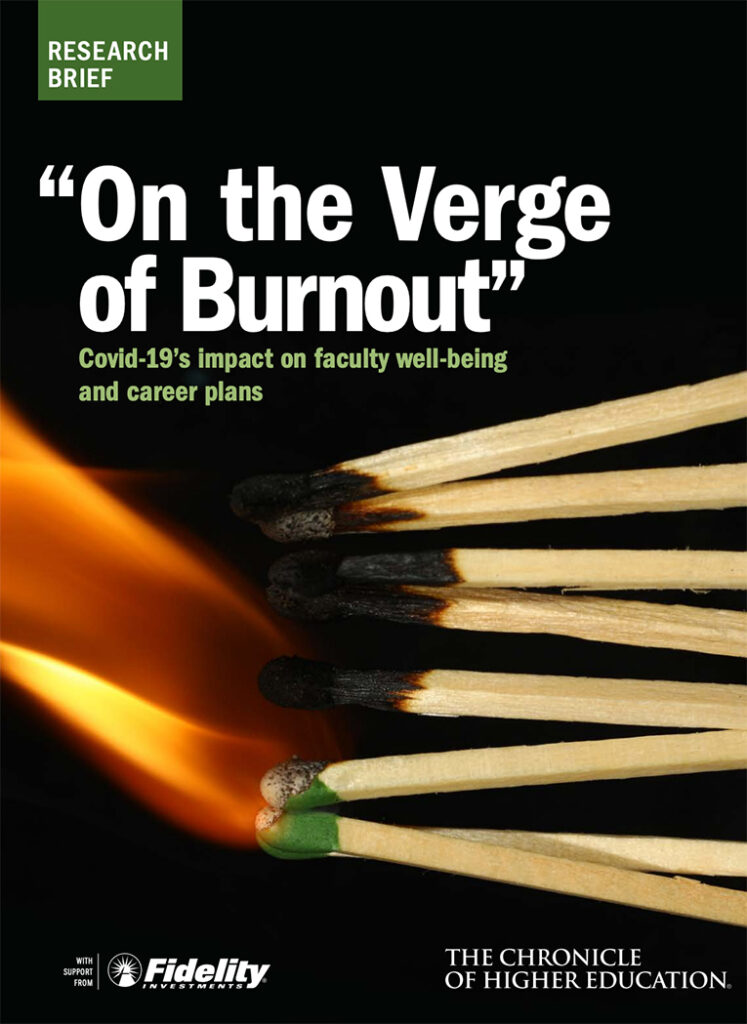
“If a return to normal simply means restoring the burnout conditions that the pandemic inflamed, then the rumble of faculty members leaving may build to a roar that no amount of magical thinking can explain away.”

Here’s a relevant quote from a weekly newsletter — Teaching — from The Chronicle of Higher Education (by Becky Supiano)

The bottom line? “You don’t get student success,” McClure says, “unless you have invested in faculty well-being.”

The quote is from Kevin McClure, who is “trying to get the challenges front-line faculty and staff face on the radar of more college leaders.” As primarily a former staff member, I appreciate that he’s including staff members here. Staff are important members of the academe as well.


Drop in Spring-2022 Enrollment Is Worse Than Expected — from chronicle.com byAudrey Williams June

Excerpt:

New data from the National Student Clearinghouse Research Center provide a final tally on enrollment for the spring of 2022 — and reveal a persistent trend: College attendance continues to decline.

Undergraduate enrollment fell 4.7 percent from a year earlier, a shortfall of more than 662,000 students. Since the pandemic began, the undergraduate student body has dropped by almost 1.4 million students.

But also in play, he said, are students who increasingly question the value of college, are wary about taking out student loans to pay for it, and who have options to join the labor market instead.


Michigan colleges experience nation’s worst spring enrollment dive, new report shows — from mlive.com by Samuel Dodge

Excerpt:

College enrollment across Michigan plummeted 15% during the spring semester this year, dragged down by a 20% hit to four-year public universities, a new report shows. Spring enrollment across all sectors dropped to 360,220 students, a decrease of more than 62,000 from 2021 to this year, according to data released Thursday, May 26, by the National Student Clearinghouse.


[Cost of Inequity]  The Student Loan Crisis — from businessinsidre.com by various
How the student loan industry put a $1.7 trillion price tag on the American dream and the proposed reforms that could pay the bill.


A somewhat-related item:

The Future of Higher Education Is the Hybrid Campus — from campustechnology.com by Dr. Jeffrey R. Docking
Blending the best of face-to-face instruction with the flexibility of online learning can enhance the higher ed experience for all types of learners, lower the cost of a degree and better prepare students for the workforce.

Excerpts (emphasis DSC):

What Students Want
Students and families are increasingly rethinking whether a traditional college education is worth the investment, leaving higher ed leaders searching for innovative ways to showcase their school’s value and entice students. When we think about what students really want, they want more than a degree — they want skills training that will ensure a well-paying, rewarding career. In fact, 62% of college students say they would be more likely to re-enroll if their institution offered “new programs and certificates tailored to the new economy” with high-demand majors and education that connects them to employability. This makes sense since employers are continuing to find value in students developing a “broad skill base that can be applied across a range of contexts.”

But over the last several years, and after seeing the success of it at Adrian College, I’ve become convinced that the future of residential colleges is not face-to-face or online, but an intelligent blend of both modalities.


A somewhat-related item:

Navigating career turbulence — from ted.com by Adam Grant; with thanks to Deirdre Honner for this resource

Description:

Everyone’s career will hit some turbulence at some point. Instead of pushing harder against the headwinds, we’re sometimes better off tilting our rudder and charting a new course. In this episode, host Adam Grant speaks with people who have taken unusual steps to battle uncertainty, rethought their approach to finding and landing a job and reached out for help in unexpected places — as well as an expert on recessions who forecasts the future by looking to the past. Listen and subscribe to WorkLife with Adam Grant and more podcasts from the TED Audio Collective wherever you’re listening to this.
 

The Science of Learning: Research Meets Practice — from the-learning-agency-lab.com by Alisa Cook and Ulrich Boser; with thanks to Learning Now TV for this resource
Six Research-Based Teaching Practices Are Put Into Practice

Excerpt:

For the nation’s education system, though, the bigger question is: How do we best educate our children so that they learn better, and learn how to learn, in addition to learning what to learn? Additionally, and arguably just as challenging, is: How do we translate this body of research into classroom practice effectively?

Enter the “Science of Learning: Research Meets Practice.” The goal of the project is to get the science of learning into the hands of teaching professionals as well as to parents, school leaders, and students.


A Rubric for Selecting Active Learning Technologies — from er.educause.edu by Katie Bush, Monica Cormier, and Graham Anthony
A rubric can be an invaluable aid in evaluating how well technologies support active learning.

Excerpt:

Because the use of active learning is characterized by a broad range of activities in the classroom, comparing technology and determining which option provides more benefit to an active learning classroom can be difficult. The Rubric for Active Learning Technology Evaluation can provide some differentiation when comparing technology offerings. It has been designed to reveal subtle but impactful differences between technology in the context of active learning. The rubric was designed to be a tool for comparative technology evaluation and as such should be quick to use when comparing similar technologies. It is freely available to use and adapt under a Creative Commons license.


How to integrate storytelling as design thinking in your classroom — from bookcreator.com by Michael Hernandez

Excerpt:

I’ve been thinking a lot about the need to prepare my students for their future and how I can help develop the skills and mindset they’ll need to solve some pretty big global challenges we now face.

While I see my STEM and science colleagues integrating skills like creativity, problem-solving and ideation, technology use and innovation, I often wondered how I could integrate these skills into my journalism, film and photography classes.

Until I realized that I already do.

Often thought of as either a frivolous hobby during our downtime, or a one-way fire hydrant of information from textbooks in school, working with student storytellers over the past 23 years has illuminated the idea that, if done right, student-made digital stories can be a powerful learning experience and creative problem solving exercise.


Technology for HyFlex Classrooms: Major Considerations — from hyflexlearning.org by Brian Beatty

Excerpts:

This post describes four aspects of classroom technology that are very important to address when developing a HyFlex approach that can be effective at scale.
…

The classroom technology needs can be organized into four areas:

  1. two-way audio stream (connection),
  2. incoming video presentation of remote learners
  3. outgoing video presentation of classroom and learners
  4. interactive technology to support interaction, engagement, and formative assessment

Also re: hyflex teaching — where some students are physically present and some are coming into the class remotely– see:

Part I – Motivating Learners by Building Efficacy (Confidence) through Scaffolding and Support— from hyflexlearning.org by Jeanne Samuel

Excerpts:

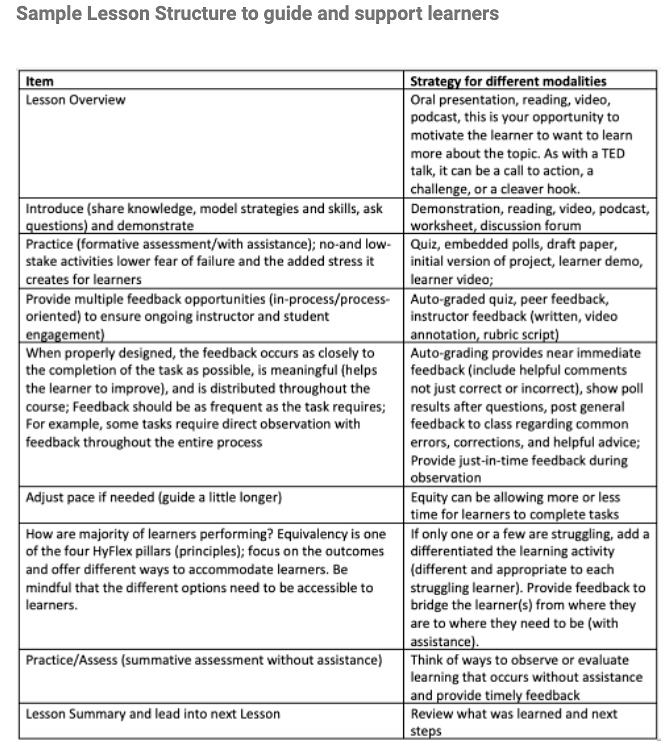
HyFlex delivery may be new to many learners. Therefore, it is important to provide them with the supports they need to be successful. Regardless of the delivery mode, learners are motivated by success and by instructor presence. In part one of this topic post, we will write about how instructor support and feedback (a form of guidance) can motivate learners and build learner confidence.

PART II- Feedback for Improving Student Success and Satisfaction — from hyflexlearning.org by Jeanne Samuel

Excerpt:

In part 1 of this post, we focused on how feedback and support promote learner confidence. Learner confidence can lead to improved learner retention, progression, and success regardless of the class delivery mode. In part 2, we focus on feedback strategies.


College & Career Guide for Students with Disabilities — from study.com by Jamie Julh, Lisa Keith, Nicole Nicholson, Taylor McGillis; with thanks to Alysson Webb for this resource

Excerpt (emphasis DSC):

Students with disabilities made up 19.4% of enrolled undergraduate students in the U.S. according to the most recent data release from the Department of Education (DoE). However, many of these students may be afraid to or not know how to advocate for themselves and obtain the assistance they need. Data on graduation rates for students with disabilities can be hard to come by, but based on a recent study by the DoE National Center of Education Statistics, only 54.2% had graduated with a bachelor’s degree after six years. One possible reason for this low graduation rate is that only 35% of students with disabilities chose to disclose those disabilities to the college or university they attended, and only 24% chose to utilize accommodations. This guide is intended to help students with disabilities learn about their rights, the laws that protect them, and the resources available to help them see through their goal of obtaining higher education.

Also relevant/see:


From DSC:
Hmmm…many colleges and universities keep a close eye on their peers and often respond with similar strategies that their peers are pursuing. But who is an organization’s peer? The Chronicle of Higher Education‘s posting below — “How a College Decides Who Its Peers Are” — stated that “there is clearly no shared definition of what constitutes a peer institution.” 

Plus, I found this item especially interesting:

Harvard University selected only three peer institutions: Yale, Princeton, and Stanford. But 22 institutions, including Bowdoin, named Harvard as a peer. Bowdoin, a small, liberal-arts college with about 1,800 undergraduate students and no graduate programs, chose 98 “peers,” including the entire Ivy League and many large universities, some of which enroll more than 10,000 students. Bowdoin itself was picked by 35 institutions as a peer. All of them were small, liberal-arts colleges or universities that primarily serve undergraduates.

I have often thought that colleges and universities should care far less about what their peers are doing. Rather, they should move forward with their own solid visions, bold actions, and well-thought-through strategies — as there can be a great deal of danger and risk in the status quo.

Too many alternatives have been appearing — and will likely continue to appear — on the lifelong learning landscapes. Most likely, these new organizations will offer in-demand credentials/skills as well as the capabilities of helping people constantly reinvent themselves — with far less expensive price tags associated with these types of offerings.


How a College Decides Who Its Peers Are — from chronicle.com by Susan Poser
Questions of institutional identity are at the core of the process.

Excerpt (emphasis DSC):

The mismatch between whom an institution chose as peers, and the colleges that reciprocated, pervades the data set. It raises the question of how institutions designate peers, which is a mystery. In some cases it is likely to be decided by someone in the Office of Institutional Research or the provost’s office in response to the Ipeds survey, while in others perhaps some process leads to a consensus among administrators. Regardless, there is clearly no shared definition of what constitutes a peer institution.

Also relevant/see:


Zoom Announces New Education Features, Enhancing Hybrid [Hyflex] Learning Experience for Educators & Students — from edtechreview.in by Stephen Soulunii

Excerpt:

According to a news release, the features span Zoom’s Chat and Meeting offerings and are designed to support teachers who need to engage and manage students joining class remotely or submitting homework assignments.
…
Breakout Rooms Enhancements
Breakout rooms, a popular education feature, also received enhancements in this latest release. Program Audio allows meeting hosts to share content with audio to breakout rooms, adding the ability to share videos with audio. With the LTI Pro integration enhancement, educators can populate breakout rooms from the course roster. This can be used to assign breakout rooms in advance, and then automatically sort students into breakout rooms.

Anywhere Polls
Anywhere Polls will allow polling content to live in a central repository that can be accessed from any meeting on an account, instead of being associated with a particular meeting. This will make it easier for instructors to reuse polls and will also be beneficial for grading. This feature will be available this year.


Reflections on “Do We Really Want Academic Permanent Records to Live Forever on Blockchain?” [Bohnke]

From DSC:
Christin Bohnke raises a great and timely question out at edsurge.com in her article entitled:
Do We Really Want Academic Permanent Records to Live Forever on Blockchain?

Christin does a wonderful job of addressing the possibilities — but also the challenges — of using blockchain for educational/learning-related applications. She makes a great point that the time to look at this carefully is now:

Yet as much as unchangeable education records offer new chances, they also create new challenges. Setting personal and academic information in stone may actually counter the mission of education to help people evolve over time. The time to assess the benefits and drawbacks of blockchain technology is right now, before adoption in schools and universities is widespread.

As Christin mentions, blockchain technology can be used to store more than formal certification data. It could also store such informal certification data such as “research experience, individual projects and skills, mentoring or online learning.”

The keeping of extensive records via blockchain certainly raises numerous questions. Below are a few that come to my mind:

  • Will this type of record-keeping help or hurt in terms of career development and moving to a different job?
  • Will — or should — CMS/LMS vendors enable this type of feature/service in their products?
  • Should credentials from the following sources be considered relevant?
    • Microlearning-based streams of content
    • Data from open courseware/courses
    • Learning that we do via our Personal Learning Networks (PLNs) and social networks
    • Learning that we get from alternatives such as bootcamps, coding schools, etc.
  • Will the keeping of records impact the enjoyment of learning — or vice versa? Or will it depend upon the person?
  • Will there be more choice, more control — or less so?
  • To what (granular) level of competency-based education should we go? Or from project-based learning?
  • Could instructional designers access learners’ profiles to provide more personalized learning experiences?
  • …and I’m certain there are more questions than these.

All that said…

To me, the answers to these questions — and likely other questions as well — lie in:

  1. Giving a person a chance to learn, practice, and then demonstrate the required skills (regardless of the data the potential employer has access to)
    .
  2. Giving each user the right to own their own data — and to release it as they see fit. Each person should have the capability of managing their own information/data without having to have the skills of a software engineer or a database administrator. When something is written to a blockchain, there would be a field for who owns — and can administer — the data.

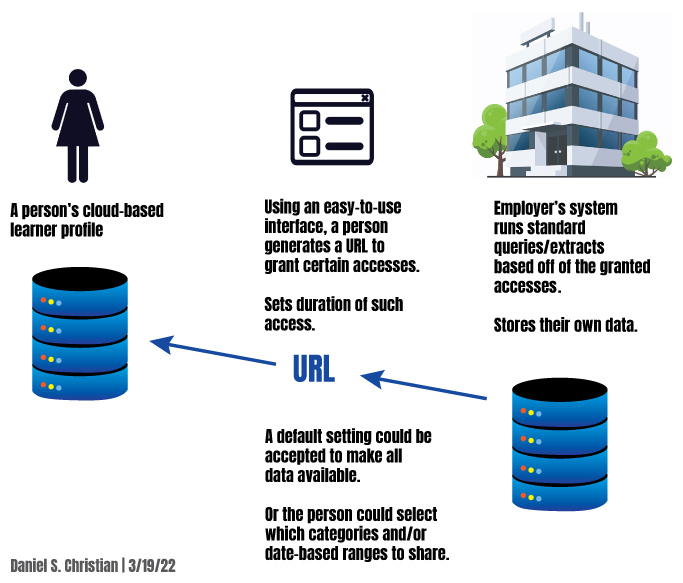
In the case of finding a good fit/job, a person could use a standardized interface to generate a URL that is sent out to a potential employer. That URL would be good for X days. The URL gives the potential employer the right to access whatever data has been made available to them. It could be full access, in which case the employer is able to run their own queries/searches on the data. Or the learner could restrict the potential employer’s reach to a more limited subset of data.

Visually, speaking:


Each learner can say who can access what data from their learner's profile


I still have a lot more thinking to do about this, but that’s where I’m at as of today. Have a good one all!


<blockquote class=”twitter-tweet”><p lang=”en” dir=”ltr”>Questions that provoke critical thinking: <a href=”https://t.co/AgSkJbOXO7″>https://t.co/AgSkJbOXO7</a> <a href=”https://twitter.com/hashtag/instructionaldesign?src=hash&amp;ref_src=twsrc%5Etfw”>#instructionaldesign</a> <a href=”https://twitter.com/hashtag/instructionaldesigners?src=hash&amp;ref_src=twsrc%5Etfw”>#instructionaldesigners</a></p>&mdash; Instructional Design Lady (@instructlady) <a href=”https://twitter.com/instructlady/status/1504664266661679104?ref_src=twsrc%5Etfw”>March 18, 2022</a></blockquote> <script async src=”https://platform.twitter.com/widgets.js” charset=”utf-8″></script>


The following is a brief excerpt from Beth McMurtrie’s weekly Teaching newsletter from The Chronicle of Higher Education — from the Breaking Bad Habits section:

In a recent Twitter thread, Lindsay Masland, interim director for faculty professional development at Appalachian State University, asked people to describe “pedagogical sins” that they no longer commit. “I’m wondering,” she wrote, “are there things you used to do in your teaching that now fill you with cringe?”


Majority of workers who quit a job in 2021 cite low pay, no opportunities for advancement, feeling disrespected — from pewresearch.org by Kim Parker and Juliana Menasce Horowitz

Excerpt:

A new Pew Research Center survey finds that low pay, a lack of opportunities for advancement and feeling disrespected at work are the top reasons why Americans quit their jobs last year. The survey also finds that those who quit and are now employed elsewhere are more likely than not to say their current job has better pay, more opportunities for advancement and more work-life balance and flexibility.

Also relevant/see:

EDUCAUSE QuickPoll Results: The Workforce Shakeup — from by Mark McCormack
A sizable wave of staff departures is headed toward higher education. Staff cite either institutional or personal reasons for staying or leaving, suggesting a range of institutional strategies for attracting and retaining talent.

Excerpt:

Middle-managers and middle-tenure staff, in particular, may be at risk of leaving, suggesting a number of solutions institutions might deploy to help attract and retain needed talent.

Addendum on 3/13/22:


How Art Class Became a Rare Bright Spot for Students and Families During the Pandemic — from edsurge.com by Daniel Lempres

Excerpt:

When schools went remote two years ago, the National Art Education Association (NAEA) was quick to offer guidance on how best to reach students who have experienced trauma. They offered strategies for remote learning, as well as mental and emotional wellbeing.

Now more than ever, art educators must employ the tenets of social emotional learning, the NAEA says. In a recent report, the association recommended trauma-informed teaching strategies to promote mental health through self-expression—for their students’ sake and their own.

But with asynchronous lessons and virtual events, the amount of parental participation skyrocketed, she says.


Power Lesson: Poetry Gallery Walk — from cultofpedagogy.com by Marcus Luther

Excerpt:

So three months into the school year, it was time to “pay the piper” in our AP Literature classroom in a major way. This meant veering away from normal processes of literary analysis and having students not only write their own reflective narrative poems, but spend time in an incredible, silent space moving around the library and writing notes of affirmation on each other’s writing.

Here is “how” we made it happen, then, as well as “why.”

 
© 2025 | Daniel Christian