Why Aren’t Professors Taught to Teach? — from techlearning.com by Erik Ofgang
Professors are experts in their subject matters but many have limited training in actually teaching their students.

Excerpt:

“A lot of faculty are just modeling their instruction after the instruction they’ve received as an undergraduate or graduate student,” says Tanya Joosten, senior scientist and director of digital learning at University of Wisconsin-Milwaukee and the lead of the National Research Center for Distance Education and Technological Advancements.

As a perpetually short-on-time adjunct professor, I understand those who worry about mandatory training and required course reviews, but Pelletier stresses that she’s advocating for a more organic shift and that a top-down approach isn’t best. “That’s not as collaborative and generative as really just embracing that we have these two different kinds of experts, one type of expert is an expert in their subject, and the other expert is an expert in teaching and learning,” she says. More attention is needed to meld these two kinds of expertise. 

From DSC:
It’s not just that colleges and universities are big business — if you have any remaining doubts about that perspective, take a moment to look at this new, interactive database to see what I mean. But it’s also that this type of business often rewards research, not teaching. And yet the students over the last several decades have continued to pay ever-increasing prices for skilled researchers, instead of increasingly skilled teachers. 
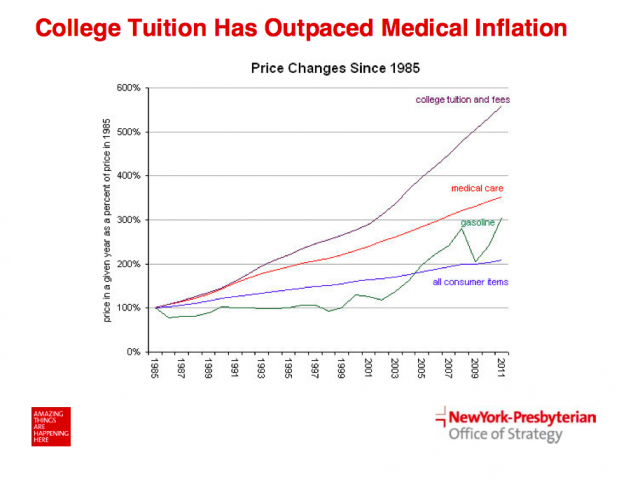
Healthcare and higher education face similar challenges and transformations -- costs continue to soar

Image from Inside Higher Ed


Would people put up with this with other types of purchases? I don’t think so. I wouldn’t want to…would you?  Would we like to pay for something that we aren’t getting — like paying for all the extra options on a new car, but not getting them?

What goes around, comes around.
But by allowing this to have occurred, a backlash against the value of higher education has been building for years now. In many learners’ minds, they are questioning whether it’s worth taking on (potentially) decades’ worth of debt. At a minimum, the higher the price of obtaining degrees and/or other credentials becomes, the less Return on Investment (ROI) is realized by the learners (i.e., the purchasers of these goods and services). So while getting a degree is often still worth it, the ROI is going down.
And this doesn’t address how relevant/up-to-date the educations are that these learners are receiving, which the employers out there will take issue with.

From an Instructional Designer’s perspective, it isn’t just time that’s the issue here. There continues to exist a tiered hierarchy within higher education. Faculty see themselves as more knowledgeable because they are teaching and because they are the Subject Matter Experts (SMEs). But they are not expert teachers. Many full-time faculty members don’t listen to people who are knowledgeable in the learning science world, and they often don’t value that expertise. (This can be true of administrators as well.) But when a fellow faculty member (i.e., their “true peer” from their perspective) suggests the same idea that Instructional Designers have been recommending for years, they suddenly open their eyes and ears to see and hear this seemingly new, wonderful approach.

Some possible scenarios
Thus, a wave has been building against traditional institutions of higher education — readers of this blog will have picked up on this years ago. Once alternatives significantly hit the radar — ones that get the learners solid, good-paying jobs — there could be a mass exodus out of what we think of as traditional higher education. At least that’s one potential scenario.

For example, if a next-generation learning platform comes along that offers teams and individuals the ability to deliver lifelong learning at 50% or more off the price of an average degree, then be on the lookout for massive change. If professors and/or teams of specialists — those who are skilled in instructional design and teaching —  can go directly to their learners — it could be an interesting world indeed. (Outschool is like this, by the way.) In that scenario, below are two potential methods of providing what accreditation agencies used to provide:

  • Obtaining the skills and competencies being requested from the workplace to “pass the tests” (whatever those assessments turn out to be)
  • Voting a course up or down (i.e., providing crowd-sourced rating systems)

Other possible scenarios
Another scenario is that traditional institutions of higher education really kick their innovation efforts into high gear. They reward teaching. They develop less expensive methods of obtaining degrees. They truly begin delivering more cost-effective means of obtaining lifelong learning and development “channels” for educating people.

And there are other possible scenarios, some of which I could think of and many I would likely miss. But to even ask the solid and highly-relevant question as plainly stated in the article above — Why Aren’t Professors Taught to Teach? — that is something that must be dealt with. Those organizations that use a team-based approach are likely to be able to better answer and address that question.


 

Timnit Gebru Says Artificial Intelligence Needs to Slow Down — from wired.com by Max Levy
The AI researcher, who left Google last year, says the incentives around AI research are all wrong.

Excerpt:

ARTIFICIAL INTELLIGENCE RESEARCHERS are facing a problem of accountability: How do you try to ensure decisions are responsible when the decision maker is not a responsible person, but rather an algorithm? Right now, only a handful of people and organizations have the power—and resources—to automate decision-making.

Since leaving Google, Gebru has been developing an independent research institute to show a new model for responsible and ethical AI research. The institute aims to answer similar questions as her Ethical AI team, without fraught incentives of private, federal, or academic research—and without ties to corporations or the Department of Defense.

“Our goal is not to make Google more money; it’s not to help the Defense Department figure out how to kill more people more efficiently,” she said.

From DSC:
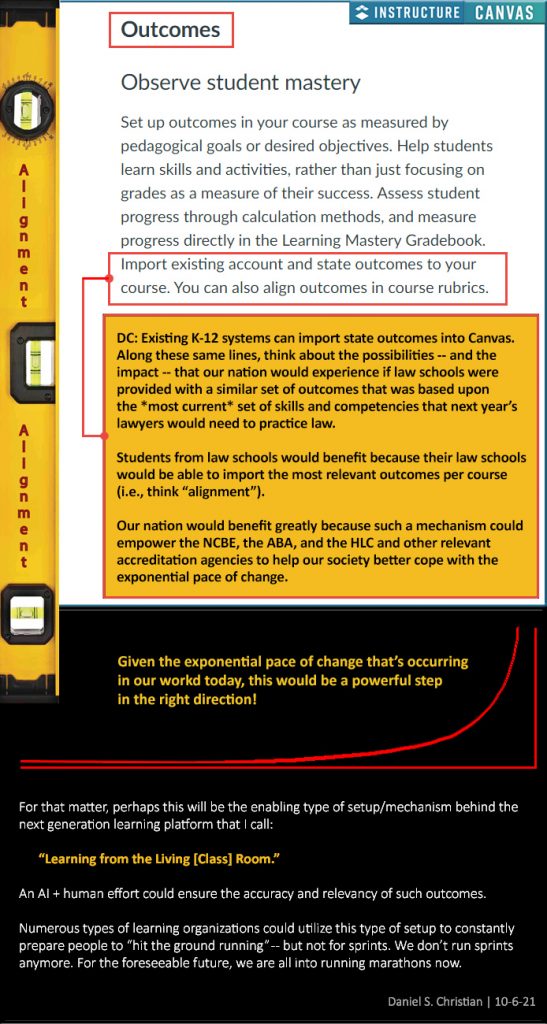
What does our society need to do to respond to this exponential pace of technological change? And where is the legal realm here?

Speaking of the pace of change…the following quote from The Future Direction And Vision For AI (from marktechpost.com by Imtiaz Adam) speaks to massive changes in this decade as well:

The next generation will feature 5G alongside AI and will lead to a new generation of Tech superstars in addition to some of the existing ones.

In future the variety, volume and velocity of data is likely to substantially increase as we move to the era of 5G and devices at the Edge of the network. The author argues that our experience of development with AI and the arrival of 3G followed by 4G networks will be dramatically overshadowed with the arrival of AI meets 5G and the IoT leading to the rise of the AIoT where the Edge of the network will become key for product and service innovation and business growth.

Also related/see:


We Need to Make Schools Human Again. That Means Treating Teachers With Respect. – from edsurge.com by Jennifer Yoo-Brannon

Excerpts:

The first thing I noticed when we returned to school after remote learning was that my conversations with teachers got real deep real fast.

But we are not just educators, of course. We are mothers of multiple school-aged children, parents of special needs students who need a high level of support, individuals with anxiety disorders exacerbated by the worldwide anxiety of the pandemic. We are human too. While we transform our schools into welcoming spaces for students, we must also make them a human place to work for educators as well. We can’t forget that we saw each other’s humanity—shared a universal human experience—and then return to business as usual. We must make schools human again.

Avoid toxic positivity. Toxic positivity is the belief that no matter how bad a situation is, we should all have a positive mindset about it. Toxic positivity isn’t optimism. Toxic positivity rejects or refuses to acknowledge how difficult things can be. This message is for administrators in particular.

From DSC:
When I read this…

In other words, the question is not “How do we get teachers to participate in professional development?” but rather, “How can we create a context in which everyone will want to engage in professional learning?” To feel human in our workplace, we all need to feel like we have choices and teachers need to feel trusted and empowered to make those choices.

…I’m thinking to myself…isn’t this the same for our students?

 
  • From DSC:
    This is what true strength and confidence look like. That is, the LORD doesn’t mind putting complaints, issues, pleas, anger, frustration, sadness, and similar emotions in His Word. I guess that’s part of relationships…part of communications. To me, that’s true strength.


Three Steps to Building a Learning Culture That Delivers Innovation — from sloanreview.mit.edu by Ori Mor
To create technological solutions for grand challenges, companies must foster cultures that support continuous learning and team optimism.

Excerpt:

Now that we’re on the other side, with our system up and running in retail outlets, helping to reduce e-waste (such as cords and batteries), we’re able to look back and see what it took to get here. While the skills of our team were essential, the biggest reason we ultimately succeeded was our culture of continuous learning. Three steps in particular allowed that culture to thrive.

Also relevant — especially to those working in higher education — see:


 The new frontier: Why visionary CLOs are switching focus to developing technical teams rather than people managers — from chieflearningofficer.com by Alastair Gordon
The new frontier for CLOs is this: How do we unleash the untapped potential of our technical experts to gain competitive advantage or community benefit? 

Excerpt:

The race to develop talent is changing its focus.

Historically, success relied on developing extraordinary leaders to inspire and lead large groups of people. But today, and in the future, the new challenge for learning teams is to create an edge for their organization by radically improving their development of technical specialists.

Engineers, economists, researchers, software developers and data scientists — they’re in the vanguard of innovation. No other group has the same potential to create value, cut costs or introduce better processes. This trend is seeing early adopter organizations in the vanguard of a shift to rebalance the annual learning budget toward developing technical experts in nontechnical capabilities.

Also relevant/see:


The Great Education Unbundling and How Learning Will be Rebundled — from gettingsmart.com by Nate McClennen, Tom Vander Ark

Key Points

  • The pandemic accelerated the great unbundling of learning – at least for those with access, agency, and advocates.
  • While unbundling will expand, how learning is rebundled will emerge as the next innovation — accessible, personalized, accountable and massive.

Excerpts:

By removing the barrier of full credit/school offered, schools become more robust in terms of richness of offerings as well as more personalized to meet the needs of students and communities.

The majority of unbundled experiences still fall back on the course level as the smallest granular level of choice. Following the lead of industry, unbundling in schools should mean a reduction in grain size so that skills are the level of unbundling rather than courses.


From DSC:
What if you were working in the law office that these folks came into for help, representation, and counsel…what would you do?

Or if someone “stole” your voice for a bit:

You can see the critical role that the American Bar Association plays in helping our nation deal with these kinds of things. They are the pace-setters on the [legal] track.


The Disruption Of Legal Services Is Here — from forbes.com by John Arsneault

Excerpt:

For the first time in those 12 years, I am now convinced we are on the precipice of the promised disruption in legal. Not because anyone in the law firms are driving toward this — but because venture capital and tech innovators have finally turned their attention to the industry.

Legal services are a much smaller overall market than, say, retail, financial services or biotech. In the world of disruption and the promised gold rush for the companies that do the disrupting, size matters. Legal has just been low on the industry list. Its number is now up.

It’s easy to Monday morning quarterback that industry now. Easy to see how big of a threat Amazon was to those companies. But when you are being rewarded for doing what you have always done and what your predecessors always did, it’s easy to miss what is around the bend. By the time those companies’ executives realized Amazon was a direct competitor with a much better fulfillment model, it was too late.


Surviving Among the Giants — from chronicle.com by Scott Carlson
As growth has become higher ed’s mantra, some colleges seek to stay small.

Excerpts:

The pressures on the higher-education business model are changing those attitudes. The Council of Independent Colleges’ fastest-growing initiative is the Online Course Sharing Consortium, which allows small colleges to offer certain courses to students at other institutions. Currently, there are 2,200 enrollments among almost 6,000 courses on the platform.

“The higher-ed business model is broken,” says Jeffrey R. Docking, who has been president of Adrian College for 16 years. “But where it’s most broken — and the first ones that are going to walk the plank — are the small private institutions. The numbers just don’t work.” Combining some backroom functions or arranging consortial purchases is just “dabbling around the edges” — and won’t get close to driving down the cost of tuition by 30 to 40 percent over the next several years, which is what Docking believes is necessary.

From DSC:
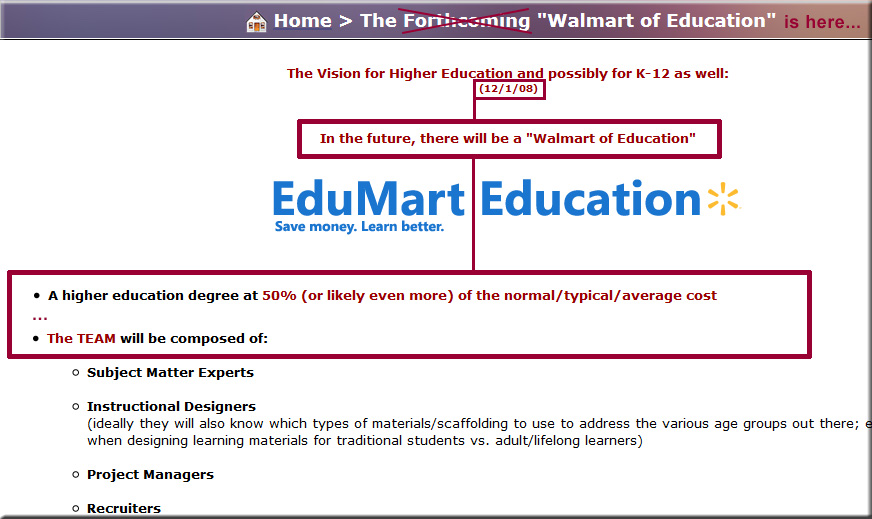
Docking’s last (highlighted) sentence above reminds me of what I predicted back in 2008 when I was working for Calvin College. The vision I relayed in 2008 continues to come to fruition — albeit I’ve since changed the name of the vision.

Back in 2008 I predicted that we would see the days of tuition being cut by 50% or more

From DSC (cont’d):
I was trying to bring down the cost of higher education — which we did with Calvin Online for 4-5 years…before the administration,  faculty members, and even the leadership within our IT and HR Departments let Calvin Online die on the vine. This was a costly mistake for Calvin, as they later became a university — thus requiring that they get into more online-based learning in order to address the adult learner. Had they supported getting the online-based learning plane off the runway, they could have dovetailed nicely into becoming a university. But instead, they dissed the biggest thing to happen within education in the last 500 years (since the invention of the printing press). 

Which brings me to one last excerpted quote here:

“For so many years,” Docking says, “all of these really smart people in Silicon Valley, at the University of Phoenix, at for-profits were saying, We’re going to do it better” — and they came around with their “solutions” in the form of MOOCs, or massive open online courses, and other scaling plans. Small colleges didn’t want to hear it, and, Docking says, maybe it was to their peril.


5 Ideas to Soothe IT Staff Burnout — from campustechnology.com by David Raths
The COVID-19 pandemic has taken its toll on the mental health of students, faculty and staff alike. But IT in particular has borne the brunt of keeping institutions’ technology infrastructure afloat through relentless change, often in the face of budget cuts and staffing shortages. Here are ways to help mitigate stress and better support IT teams during this challenging time.

Excerpt:

Faced with an increasingly stressed-out IT workforce, CIOs are trying to find innovative ways to boost morale, maintain work/life balance and enhance communication among teams. We spoke to three IT leaders who offered the following five suggestions, based on their own experiences over the past year and a half.


College Was Supposed to Close the Wealth Gap for Black Americans. The Opposite Happened. — from wsj.com by Rachel Louise Ensign and Shane Shifflett
Black college graduates in their 30s have lost ground over three decades, the result of student debt and sluggish income growth

Excerpt:

The drop is driven by skyrocketing student debt and sluggish income growth, which combine to make it difficult to build savings or buy a home. Now, the generation that hoped to close the racial wealth gap is finding it is only growing wider.

More than 84% of college-educated Black households in their 30s have student debt, up from 35% three decades ago, when many baby boomers were at the same age. The younger generation owes a median of $44,000, up from less than $6,000. By comparison, 53% of white college-educated households in their 30s have debt, up from 27% three decades earlier. The median amount rose to $35,000 from $8,000. All figures are adjusted for inflation.

Also see:

American Talent Initiative 2021 | Third Annual Progress Report — from sr.ithaka.org by Martin Kurzweil, Tania LaViolet, Elizabeth Davidson Pisacreta, Adam Rabinowitz, Emily Schwartz, Joshua Wyner; with thanks to Goldie Blumenstyk at The Chronicle of Higher Education for this resource

Excerpt:

The progress report includes new enrollment data from the 2019-20 academic year as well as Fall 2020. The pre-COVID and COVID era data reveal four key findings:

  1. Before the pandemicbetween 2015-16 and 2019-20, ATI members (130 during this data collection period) collectively increased Pell enrollment by 10,417
  2. In the years leading up to the pandemic, 2018-19 and 2019-20, ATI’s progress leveled off and began to reverse, with an enrollment decline of 3,873 Pell students, attributable to two main factors: (1) substantial declines at a set of ATI member institutions that enroll very high shares of Pell students, and (2) insufficient progress at a set of institutions with lower Pell
  3. Fall 2020 enrollment data for 115 ATI members show a single-year drop of 7,166 Pell students (compared to Fall 2019). Driven in large part by declines in first-time and transfer Pell student enrollment at public institutions, and decreased Pell student retention rates at private
  4. COVID-era declines have nearly returned Pell enrollment levels among ATI members to 2015-16
 
© 2025 | Daniel Christian