Majority of workers who quit a job in 2021 cite low pay, no opportunities for advancement, feeling disrespected — from pewresearch.org by Kim Parker and Juliana Menasce Horowitz

Excerpt:

A new Pew Research Center survey finds that low pay, a lack of opportunities for advancement and feeling disrespected at work are the top reasons why Americans quit their jobs last year. The survey also finds that those who quit and are now employed elsewhere are more likely than not to say their current job has better pay, more opportunities for advancement and more work-life balance and flexibility.

Also relevant/see:

EDUCAUSE QuickPoll Results: The Workforce Shakeup — from by Mark McCormack
A sizable wave of staff departures is headed toward higher education. Staff cite either institutional or personal reasons for staying or leaving, suggesting a range of institutional strategies for attracting and retaining talent.

Excerpt:

Middle-managers and middle-tenure staff, in particular, may be at risk of leaving, suggesting a number of solutions institutions might deploy to help attract and retain needed talent.

Addendum on 3/13/22:


Corporate Leaders Lag in Digital Skills; L&D Can Help — from learningsolutionsmag.com by Pamela Hogle

Excerpt:

As we move into a reality where digital skills dominate and the pandemic has pushed many organizations to accelerate their digital transitions, a yawning skills gap has become apparent: Fewer than a third of digital leaders rate themselves as “effective in digital acumen” according to the DDI Global Leadership Forecast.

But HR and leaders rank digital acumen, which is seen as “a significant predictor not only for digital transformation readiness, but also for innovation and responding to the competitive environment,” as a must-have skill, the DDI report said.

This gap is bad for business. “The world’s most digitally mature companies lead all other companies in value creation. They also have proved much more resilient during the crisis,” research by the Boston Consulting Group found.

Also from learningsolutionsmag.com see:


Rebalancing: Children first — from brookings.edu by Natasha Cabrera, David Deming, Veronique de Rugy, Lisa A. Gennetian, Ron Haskins, Dayna Bowen Matthew, Richard V. Reeves, Isabel V. Sawhill, Diane Whitmore Schanzenbach, Kosali Simon, Katharine B. Stevens, Michael R. Strain, Ryan Streeter, James Sullivan, W. Bradford Wilcox, and Lauren Bauer

A report of the AEI-Brookings Working Group on Childhood in the United States

Excerpts (emphasis DSC):

The future of America rests in part on how the country prepares the next generation to live and to lead. Childhood is a consequential and cost-effective time to make investments that last a lifetime. Yet, many children in the United States do not have the resources or relationships they need to build a strong foundation for their future.

Yet, one area of resounding agreement among this diverse group is the need to rebalance national investments toward children. What follows is a consensus report on our conclusions, laying out actionable policies across a range of policy areas to improve the life of every child in the United States.

Along these lines, also see:


What can institutions do to get ahead of a fast-changing higher ed market? — from highereddive.com by Laura Spitalniak

Excerpts:

  • Universities must prepare for a future where students could demand degrees, low-cost options or asynchronous learning. Otherwise, institutions risk becoming obsolete, according to a recent report from consulting firm EY.
  • Four key recommendations to education leaders are highlighted: Be clear about long-term purpose, consider possible future scenarios when making today’s choices, find leadership talent from other sectors that have already had to reinvent themselves, and invest across current and future time horizons.
 

How Schools and Families Can Work Together to Strengthen Students’ Social-Emotional Health — from blog.edmentum.com by Nicole Plegge

Excerpts:

While it took a worldwide health crisis for the general public to embrace the importance of devoting resources to nurturing the mental health of our youth, educators were already integrating social-emotional learning (SEL) into their classrooms to support whole child development. By continuing to proactively promote positive mental health—even in the best of times—schools help students better comprehend their emotions, build necessary skills to cope with adversity, and form positive relationships with others.

To strengthen students’ resiliency and confidence, schools, teachers, and parents must work together as an unwavering support system. Here are six ways that districts can get all stakeholders on board to provide a solid foundation moving forward.


Exemplar of successful implementation of tech in schools — from donaldclarkplanb.blogspot.com by Donald Clark

Excerpts:

It was impressive to find a school network that took technology as seriously as Curro, in South Africa. They had invited me to give a keynote on AI for Learning, based on my book and experience but I hung around as the teacher sessions were so damn good. This is what I learnt, as I think it is a recipe for success.

This was the big surprise. There were glowing testimonials from teachers about the power of adaptive learning, using AI, to personalise learning for students. It was described as a ‘gamechanger’ by the teacher who presented, with clear targeting, so that efficient and relevant, individual interventions could be made for students. It was clear that they knew why they wanted this technology, had implemented it well and were using teacher feedback to spread the word internally.

I was giving a talk as part of that process. The day’s activities were under the banner of ‘Imagining 2022’. It’s hard enough to Imagine what any year will bring these days but it was clear that this was a learning organisation, willing to learn from their mistakes and make the effort to plan forward.

Also see:


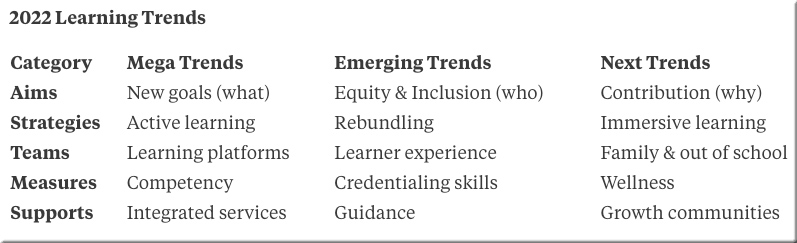
Trends Shaping Education in 2022 — from gettingsmart.com by Tom Vander Ark

Key Points:

  • It’s hard to see trends in a crisis.
  • Around the edges and behind the scenes three important shifts accelerated: new learning goals, team tools and staffing, and active learning.


2022 Learning Trends


14 Predictions for Higher Education in 2022 [Schaffhauser]

14 Predictions for Higher Education in 2022

14 Predictions for Higher Education in 2022 — from campustechnology.com by Dian Schaffhauser

Excerpt:

Ask people working in higher education what they expect will happen in the new year, and the outlook is filled with visions that build on what we’ve been experiencing on college and university campuses for the last two years: a major focus on learning formats; continued exploitation of new technology; and the use of new digital models that move users “beyond Zoom.” Here we present the collective predictions of 14 IT leaders, instructional folks and a student about what they anticipate seeing in 2022. As one put it, “Let’s go, 2022! We have work to do!”

From DSC:
I’d like to thank Dian Schaffhauser, Rhea Kelly, and Mary Grush for letting me contribute some thoughts to the various conversations that Campus Technology Magazine hosts and/or initiates. I inserted some reflections into the above article and I hope that you’ll take a moment to read my and others’ thoughts out there.


6 Elements of Thriving Learners — from gettingsmart.com by Randy Fielding

Key points:

  • Schools aren’t to blame for last year’s Insurrection, but they can be part of the long-term solution.
  • After nearly two decades of designing creative schools around the world, Fielding International has defined six elements for thriving learners.
  • Each thriving element is mapped to a series of design patterns at SchoolPatterns.com to help schools shape environments where learners thrive.


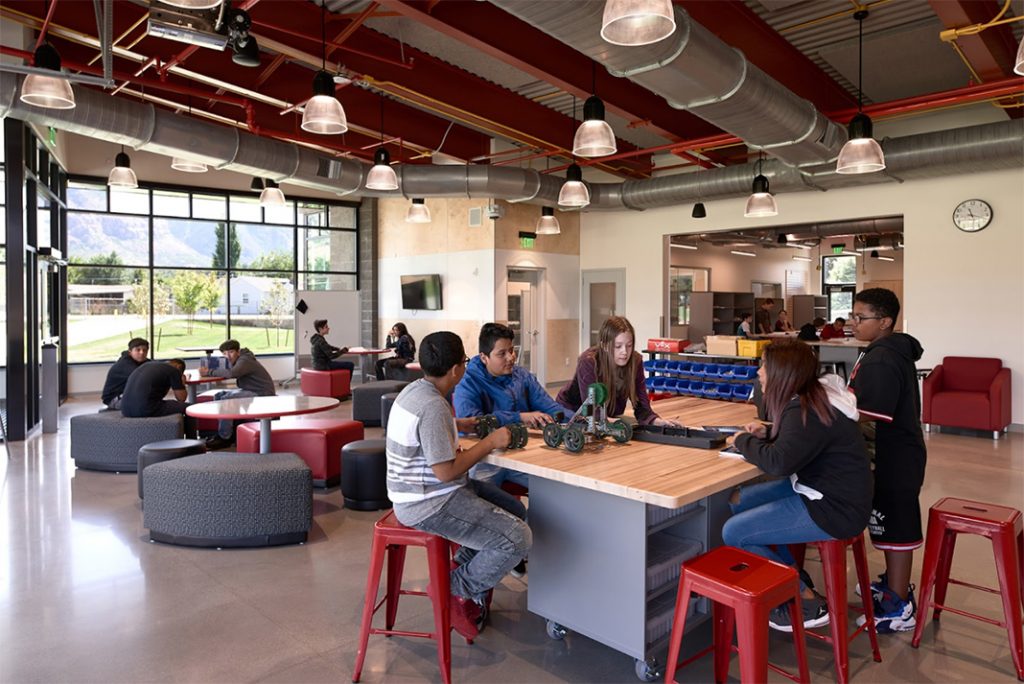
Mound Fort Innovation Center, an environment where curiosity & mastery are nurtured


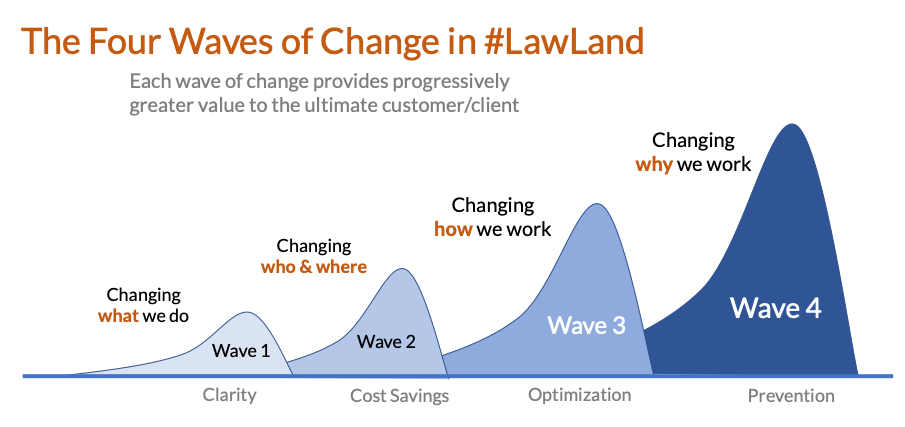
Four waves of change in #LawLand (282) — from legalevolution.org by Jeff Carr

To get to the view of true “better” in legal service delivery, it is useful to return to first principles.  We are not here for ourselves, for the guild.  We are here to promote and protect the social good called “the law” for the benefit and service of those we call clients.   As such, when access to legal assistance is too difficult, too expensive, too unpredictable — and yes, too unfair — it is our job to fix the imbalance. To the extent we — members of the legal profession — ignore the imbalance in order to make another dollar out of a broken status quo, we have become corrupt guardians who betray our professional values.

Unfortunately, the more broken the status quo becomes, the greater our eventual professional reckoning. Thus, in my view, we have no time to waste.

Four waves of change in #LawLand


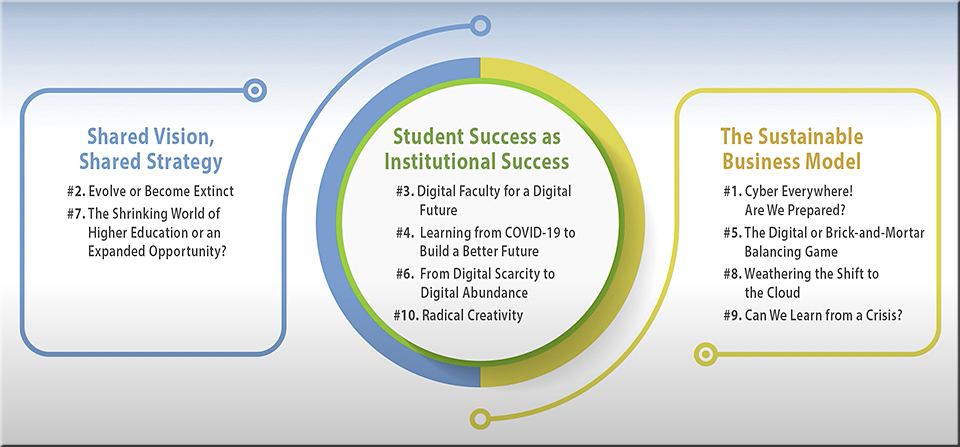
EDUCAUSE 2022 Top 10 IT Issues — from educause.edu
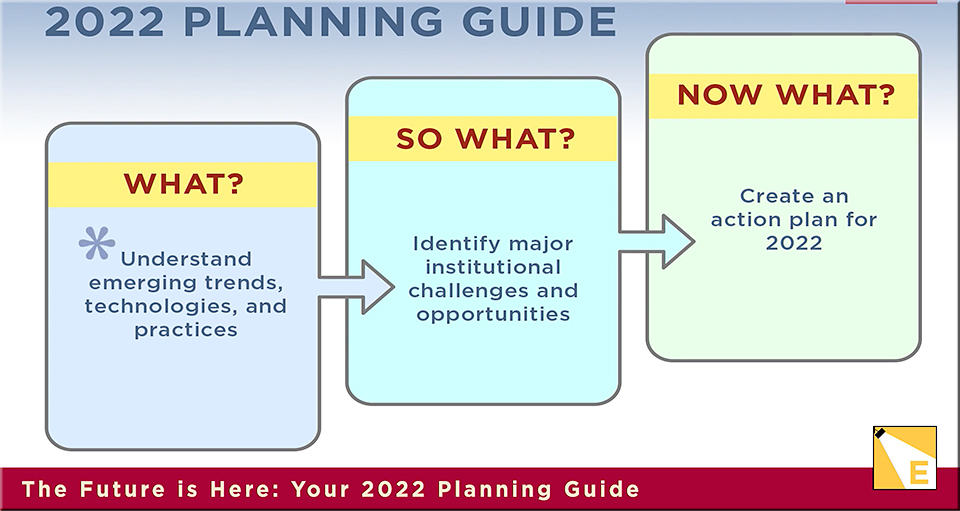
EDUCAUSE's 2022 Top 10 IT Issues


EDUCAUSE's 2022 Top 10 IT Issues

Excerpt (emphasis DSC):

The EDUCAUSE 2022 Top 10 IT Issues take an optimistic view of how technology can help create the higher education we deserve —through a shared transformational vision and strategy for the institution, a recognition of the need to place student success at the center, and a sustainable business model that redefines “the campus.”

See the 2022 Top 10 IT Issues

Almost two years into a global pandemic, it’s clear the higher education we knew will never return and now we can focus on getting the higher education we deserve.


From DSC:
I’m assuming that the we in the we deserve (as highlighted above) includes the students, as *the students* are the ones who most need for things to change.

That said, I’m doubtful such profound change will occur within higher education as it stands today. The existing cultures may prevent such significant and necessary change from occurring — and higher ed isn’t used to dealing with the current exponential pace of change that we’re experiencing. Plus, the downward spirals that many institutions are in don’t always allow for the new investments, programs, and/or experiments to occur. But who knows? When institutions of traditional higher education have their backs pressed up against the walls, perhaps such institutions and the people within them will be forced to change. There are innovative individuals and institutions out there. (I’m just not sure how much they’ve been listened to in many cases.)

To help students truly succeed means to change one’s core products/services — one’s story. But higher ed loves to play around the edges…rarely letting the core products/services get touched. 

To me, student success includes having students pay far less and, while still getting a solid liberal arts education/foundation, can get solid jobs immediately upon graduation. At least that’s my hope as we head into 2022. 

But what student success looks like may be different in the future.

Perhaps in 5 years, we will have moved much more towards a lifelong learning situation. Individuals may have joined a global, next-generation learning platform whereby one teaches for X minutes of the day, and learns for Y minutes of that same day. AI-based dashboards let people know which skills are in high demand, and then offer a menu of choices for how to acquire those skills.

A couple of lasts comments:

  • Being data-driven won’t save an institution. Vision might. But being data-driven has its limits.
  • The digital transformations being talked about within institutions of traditional higher education may be too little, too late. This conversation should have taken place a decade or more ago. (I think I just heard an “Amen!” from some folks who used to work at Blockbuster. They didn’t think a transformation was necessary either….but they learned their lesson the hard way. We should have learned from their situation…a long time ago. And I’m sure that you can think of other examples as well.)


The State of Student Success & Engagement in Higher Education -- from Instructure

The State of Student Success & Engagement in Higher Education — from instructure.com (authors of the Canvas LMS)
Our 2021 Global Student engagement and success study uncovers vital stats and key trends to help education institutions thrive through today’s education challenges.

Excerpt:

  • Connect students with alumni and potential employers through virtual networking, internships/externships, mentorship programs, and strategic partnerships.
  • Align curriculum with workforce outcomes and offer opportunities for students to showcase skill sets.
  • Close the perceived awareness gap of work/career readiness programs on campus with alumni programming highlighting the success of campus career resources.
  • Embed career exploration throughout the higher education experience and provide actionable insights into employment trends.


8 tech and leadership podcasts to add to your playlist — from enterprisersproject.com by Stephanie Overby
Check out these podcasts to keep up to date on CIO lessons learned, emerging tech trends, leadership best practices, and more

From DSC:
This article does a great job of providing a description of each podcast, why you should listen to it, and a list of recent episodes so you can see some of the topics that they are talking about.


Ohio State U. Unveils a Plan for All Students to Graduate Debt-Free — from chronicle.com by Eric Kelderman

Excerpt:

Nearly half of all undergraduates at Ohio State University take out loans to help pay the costs of attending college, borrowing an average of more than $27,000. Kristina M. Johnson, the new president of the land-grant university, wants to reduce that proportion to zero.

Johnson announced a plan on Friday, at her investiture, to reach that goal within a decade.

Instead of offering students federal direct loans as part of their financial-aid packages, the university will use a combination of grants, internships, and opportunities to assist with research.

“People without family means, which includes many of the country’s minority students, start their adult lives in a financial hole,” Johnson said during her investiture speech. “I want all of our graduates to be free to say yes to every great opportunity that comes their way.”


One Year Later . . . and Counting: Reflections on Emergency Remote Teaching and Online Learning — from er.educause.edu by Stephanie Moore, Torrey Trust, Barb Lockee, Aaron Bond and Charles Hodges

Excerpts (emphasis DSC):

Colleges with significant previous investments in online education, and ones that have worked to embed that experience into the campus’s mainstream, have seen the biggest jumps in enrollment.” In asking the question “When should a college invest heavily in online education?,” Hill concluded: “It seems increasingly clear that the answer is: at least a decade ago.” A view from “one year later” must include consideration of what college and university leaders chose to do years ago, when the decisions that created this reinforcing feedback loop were made.

Then there are the colleges and universities that resisted online learning for years or invested only in very isolated instances. These institutions were less prepared and suffered steeper enrollment and budget declines than their counterparts.

Aesop’s fable “The Oak and the Reeds” offers us ancient wisdom. In the story, the Oak mocks the Reeds that bend in the breezes. But when hit by a hurricane, the Reeds flex with the wind and survive while the Oak is beaten and broken. Some colleges and universities were more like the Oak, stubbornly resisting and finding that they could not resist the hurricane that was the pandemic. Other institutions proved more like the Reeds and were more agile in the winds, allowing flexibility and survival during a time of crisis.


© 2025 | Daniel Christian