PROOF POINTS: Plenty of Black college students want to be teachers, but something keeps derailing them — from hechingerreport.org by Jill Barshay
Study inside Michigan’s teacher preparation programs sheds light on some of the reasons for the scarcity of Black teachers in America

There are many reasons for the paucity of Black teachers. But a June 2023 analysis of college students in Michigan highlights a particularly leaky part of the teacher pipeline: teacher preparation programs inside colleges and universities.


Gen Z values education — but doesn’t think a four-year degree is the only option — from highereddive.com by Laura Spitalniak

Dive Brief:

  • The current cohort of high school students, part of Generation Z, values postsecondary education but is increasingly interested in alternatives to four-year colleges, according to a new report from ECMC Group, a nonprofit focused on student success, and Vice Media.
  • In 2023, 65% of surveyed students said they would need education beyond high school, compared to 59% pre-pandemic, the report said. But 59% said they could be successful if they don’t get a four-year degree
  • Almost half, 48%, of high schoolers said their postsecondary education would ideally take three years or less, and just over a third, 35%, said it should take two years or less.

From DSC:
And some further comments on that article:

Rather than looking to modify the traditional higher education structures for 18-year-olds fresh out of high school, the College for Adult Learners and Continuing Education will establish its own processes for the nontraditional student.

The average age of students enrolled in the Center for Distance Education is 32, and many have kids or other life responsibilities that impact their time and ability to focus on education, Seal explains.

“It’s not so much that we’re competing with other institutions [for adult learners], it’s that we’re competing with life,” Seal says. “They’re not leaving to go to another institution—they’re leaving because of life things.”


Some resources and reflections from Stephen Downes:


Online Learning Still in High Demand at Community Colleges — from insidehighered.com by Sara Weissman
Some colleges are still offering half or the majority of their classes online in response to student demand.

East Los Angeles College, the most populous campus in the California Community College system, offered 60 percent of its courses in a hybrid or online format this past spring, most of them asynchronous. Prior to the COVID-19 pandemic, fewer than a quarter of courses were offered online.

He said students have made their preferences clear via their enrollment trends—online course sections at the college have filled much more quickly lately than in-person courses.


Teaching: Does higher education value good teaching? — from chronicle.com by Beth McMurtrie; possible paywall but at least must have an account

Excerpt:

But the bigger question hanging over the conference was this: Do colleges actually value good teaching? On the one hand, it would seem obvious that they must. Undergraduate education is the central reason most colleges exist. How could you not value your core product?

But look below the surface and what do you see? An industry in which the majority of instructors are adjuncts who are often low-paid and unlikely to receive any sort of professional development, let alone an office in which to meet with students after class. At research universities you will find many tenure-track professors who were warned not to devote too much time to teaching before securing tenure, since scholarship is what’s rewarded. Promotion and tenure policies on many campuses, research-intensive or not, over-rely on student evaluations when it comes to judging teaching expertise or commitment. Finally, given that most doctoral programs devote a nominal amount of time to teaching students how to teach, it’s easy to see why many professors stick to how they were taught as students, whether or not those methods were effective.


Why Colleges Should Pay Attention to Strikes by Their Most Precarious Teachers — from edsurge.com by Robert Ubell
There’s a news story in higher ed that’s not getting enough attention. The nation’s adjuncts are rising up.

Excerpts:

But a recent survey of contingent faculty reveals the more uncertain situation most adjuncts find themselves in. A third of respondents earn less than $25,000 a year, falling below federal poverty guidelines for a family of four. Fewer than half receive university-provided health insurance, with nearly 20 percent on Medicaid.

In a stinging irony, many tenured faculty teach courses on equity and social justice, where students learn about oppression engendered by privilege. Yet just down the hall, someone else with the same level of education is teaching a similar course for vastly less pay and with little or no benefits.


Accenture announces jaw-dropping $3 billion investment in AI — from venturebeat.com by Carl Franzen; via Superhuman

Excerpt:

The generative AI announcements are coming fast and furious these days, but among the biggest in terms of sheer dollar commitments just landed: Accenture, the global professional services and consulting giant, today announced it will invest $3 billion (with a “b”!) in AI over the next three years in building out its team of AI professionals and AI-focused solutions for its clients.

“There is unprecedented interest in all areas of AI, and the substantial investment we are making in our Data & AI practice will help our clients move from interest to action to value, and in a responsible way with clear business cases,” said Julie Sweet, Accenture’s chairwoman and CEO.

Also related/see:

Artificial intelligence creates 40,000 new roles at Accenture — from computerweekly.com by Karl Flinders
Accenture is planning to add thousands of AI experts to its workforce as part of a $3bn investment in its data and artificial intelligence practice

Why leaders need to evolve alongside generative AI — from fastcompany.com by Kelsey Behringer
Even if you’re not an educator, you should not be sitting on the sidelines watching the generative AI conversation being had around you—hop in.

Excerpts (emphasis DSC):

Leaders should be careful to watch and support education right now. At the end of the day, the students sitting in K-12 and college classrooms are going to be future CPAs, lawyers, writers, and teachers. If you are parenting a child, you have skin in the game. If you use professional services, you have skin in the game. When it comes to education, we all have skin in the game.

Students need to master fundamental skills like editing, questioning, researching, and verifying claims before they can use generative AI exceptionally well.

GenAI & Education: Enhancement, not Replacement — from drphilippahardman.substack.com by Dr. Philipa Hardman
How to co-exist in the age of automation

Excerpts (emphasis DSC):

[On 6/15/23, I joined] colleagues from OpenAI, Google, Microsoft, Stanford, Harvard and other others at the first meeting of the GenAI Summit. Our shared goal [was] to help to educate universities & schools in Europe about the impact of Generative AI on their work.

how can we effectively communicate to education professionals that generative AI will enhance their work rather than replace them?

A recent controlled study found that ChatGPT can help professionals increase their efficiency in routine tasks by ~35%. If we keep in mind that the productivity gains brought by the steam engine in the nineteenth century was ~25%, this is huge.

As educators, we should embrace the power of ChatGPT to automate the repetitive tasks which we’ve been distracted by for decades. Lesson planning, content creation, assessment design, grading and feedback – generative AI can help us to do all of these things faster than ever before, freeing us up to focus on where we bring most value for our students.

Google, one of AI’s biggest backers, warns own staff about chatbots — from reuters.com by Jeffrey Dastin and Anna Tong

Excerpt:

SAN FRANCISCO, June 15 (Reuters) – Alphabet Inc (GOOGL.O) is cautioning employees about how they use chatbots, including its own Bard, at the same time as it markets the program around the world, four people familiar with the matter told Reuters.

The Google parent has advised employees not to enter its confidential materials into AI chatbots, the people said and the company confirmed, citing long-standing policy on safeguarding information.

The economic potential of generative AI: The next productivity frontier — from mckinsey.com
Generative AI’s impact on productivity could add trillions of dollars in value to the global economy—and the era is just beginning.


Preparing for the Classrooms and Workplaces of the Future: Generative AI in edX — from campustechnology.com by Mary Grush
A Q&A with Anant Agarwal


Adobe Firefly for the Enterprise — Dream Bigger with Adobe Firefly.
Dream it, type it, see it with Firefly, our creative generative AI engine. Now in Photoshop (beta), Illustrator, Adobe Express, and on the web.


Apple Vision Pro, Higher Education and the Next 10 Years — from insidehighered.com by Joshua Kim
How this technology will play out in our world over the next decade.


Zoom can now give you AI summaries of the meetings you’ve missed — from theverge.com by Emma Roth


Mercedes-Benz Is Adding ChatGPT to Cars for AI Voice Commands — from decrypt.co by Jason Nelson; via Superhuman
The luxury automaker is set to integrate OpenAI’s ChatGPT chatbot into its Mercedes-Benz User Experience (MBUX) feature in the U.S.


What new grads can expect as they enter the working world — from mckinsey.com by Patrick Guggenberger, Dana Maor, Michael Park, and Patrick Simon

Excerpt:

May 21, 2023 It’s officially the season of caps, gowns, and stoles—and new grads are gearing up for entry into the world of work at a time when organizations are undergoing massive shifts. “The shifts include complex questions about how to organize for speed to shore up resilience, find the right balance between in-person and remote work models, address employees’ declining mental health, and build new institutional capabilities at a time of rapid technological change, among others,” write Patrick Guggenberger, Dana Maor, Michael Park, and Patrick Simon in a new report. These changes have significant implications for structures, processes, and people. How can new grads set themselves up for success in a quickly evolving environment? If you’re a soon-to-be new grad or know one, check out our newly refreshed special collection for insights and interviews on topics including productivity, hybrid work models, worker preferences, tech trends, and much more.


On a somewhat relevant posting (it has to do with career development as well), also see:

From Basic to Brand: How to Build and Use a Purposeful LinkedIn Profile — from er.educause.edu by Ryan MacTaggart and Laurie Burruss
Developing a professional brand helps higher education professionals establish meaningful work-related connections and build credibility in their area of expertise.


Trend No. 3: The business model faces a full-scale transformation — from www2.deloitte.com by Cole Clark, Megan Cluver, and Jeffrey J. Selingo
The traditional business model of higher education is broken as institutions can no longer rely on rising tuition among traditional students as the primary driver of revenue.

Excerpt:

Yet the opportunities for colleges and universities that shift their business model to a more student-centric one, serving the needs of a wider diversity of learners at different stages of their lives and careers, are immense. Politicians and policymakers are looking for solutions to the demographic cliff facing the workforce and the need to upskill and reskill generations of workers in an economy where the half-life of skills is shrinking. This intersection of needs—higher education needs students; the economy needs skilled workers—means that colleges and universities, if they execute on the right set of strategies, could play a critical role in developing the workforce of the future. For many colleges, this shift will require a significant rethinking of mission and structure as many institutions weren’t designed for workforce development and many faculty don’t believe it’s their job to get students a job. But if a set of institutions prove successful on this front, they could in the process improve the public perception of higher education, potentially leading to more political and financial support for growing this evolving business model in the future.

Also see:

Trend No. 2: The value of the degree undergoes further questioning — from www2.deloitte.com by Cole Clark, Megan Cluver, and Jeffrey J. Selingo
The perceived value of higher education has fallen as the skills needed to keep up in a job constantly change and learners have better consumer information on outcomes.

Excerpt:

Higher education has yet to come to grips with the trade-offs that students and their families are increasingly weighing with regard to obtaining a four-year degree.

But the problem facing the vast majority of colleges and universities is that they are no longer perceived to be the best source for the skills employers are seeking. This is especially the case as traditional degrees are increasingly competing with a rising tide of microcredentials, industry-based certificates, and well-paying jobs that don’t require a four-year degree.

Trend No. 1: College enrollment reaches its peak — from www2.deloitte.com by Cole Clark, Megan Cluver, and Jeffrey J. Selingo
Enrollment rates in higher education have been declining in the United States over the years as other countries catch up.

Excerpt:

Higher education in the United States has only known growth for generations. But enrollment of traditional students has been falling for more than a decade, especially among men, putting pressure both on the enrollment pipeline and on the work ecosystem it feeds. Now the sector faces increased headwinds as other countries catch up with the aggregate number of college-educated adults, with China and India expected to surpass the United States as the front runners in educated populations within the next decade or so.

Plus the other trends listed here >>


Also related to higher education, see the following items:


Number of Colleges in Distress Is Up 70% From 2012 — from bloomberg.com by Nic Querolo (behind firewall)
More schools see falling enrollement and tuition revenue | Small private, public colleges most at risk, report show

About 75% of students want to attend college — but far fewer expect to actually go — from highereddive.com by Jeremy Bauer-Wolf

There Is No Going Back: College Students Want a Live, Remote Option for In-Person Classes — from campustechnology.com by Eric Paljug

Excerpt:

Based on a survey of college students over the last three semesters, students understand that remotely attending a lecture via remote synchronous technology is less effective for them than attending in person, but they highly value the flexibility of this option of attending when they need it.

Future Prospects and Considerations for AR and VR in Higher Education Academic Technology — from er.educause.edu by Owen McGrath, Chris Hoffman and Shawna Dark
Imagining how the future might unfold, especially for emerging technologies like AR and VR, can help prepare for what does end up happening.

Black Community College Enrollment is Plummeting. How to Get Those Students Back — from the74million.org by Karen A. Stout & Francesca I. Carpenter
Stout & Carpenter: Schools need a new strategy to bolster access for learners of color who no longer see higher education as a viable pathway

As the Level Up coalition reports ,“the vast majority — 80% — of Black Americans believe that college is unaffordable.” This is not surprising given that Black families have fewer assets to pay for college and, as a result, incur significantly more student loan debt than their white or Latino peers. This is true even at the community college level. Only one-third of Black students are able to earn an associate degree without incurring debt. 

Repairing Gen Ed | Colleges struggle to help students answer the question, ‘Why am I taking this class?’ — from chronicle.com by Beth McMurtrie
Students Are Disoriented by Gen Ed. So Colleges Are Trying to Fix It.

Excerpts:

Less than 30 percent of college graduates are working in a career closely related to their major, and the average worker has 12 jobs in their lifetime. That means, he says, that undergraduates must learn to be nimble and must build transferable skills. Why can’t those skills and ways of thinking be built into general education?

“Anyone paying attention to the nonacademic job market,” he writes, “will know that skills, rather than specific majors, are the predominant currency.”

Micro-credentials Survey. 2023 Trends and Insights. — from holoniq.com
HolonIQ’s 2023 global survey on micro-credentials

3 Keys to Making Microcredentials Valid for Learners, Schools, and Employers — from campustechnology.com by Dave McCool
To give credentials value in the workplace, the learning behind them must be sticky, visible, and scalable.

Positive Partnership: Creating Equity in Gateway Course Success — from insidehighered.com by Ashley Mowreader
The Gardner Institute’s Courses and Curricula in Urban Ecosystems initiative works alongside institutions to improve success in general education courses.

American faith in higher education is declining: one poll — from bryanalexander.org by Bryan Alexander

Excerpt:

The main takeaway is that our view of higher education’s value is souring.  Fewer of us see post-secondary learning as worth the cost, and now a majority think college and university degrees are no longer worth it: “56% of Americans think earning a four-year degree is a bad bet compared with 42% who retain faith in the credential.”

Again, this is all about one question in one poll with a small n. But it points to directions higher ed and its national setting are headed in, and we should think hard about how to respond.



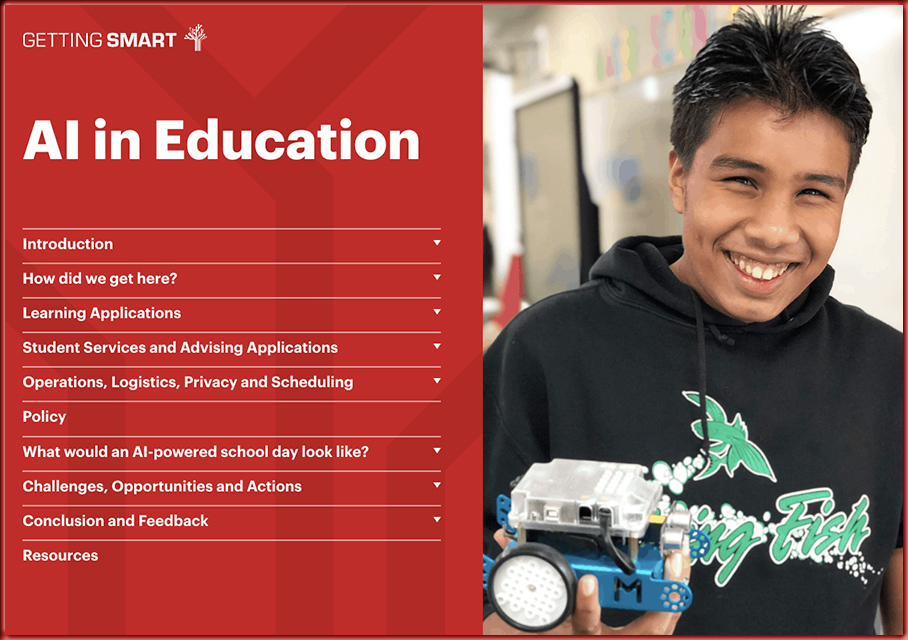
AI In Education -from Getting Smart -- May 2023

AI in Education — from gettingsmart.com

Some core takeaways for school leaders are:

  • AI has the potential to personalize learning experiences for students, improve student outcomes, and reduce the administrative burden on educators.
  • Addressing issues of data privacy, bias, and equity is crucial for responsible AI integration in education.
  • Collaboration between educators and AI developers is important to ensure that AI tools align with educational goals and values.
  • Professional development for educators is essential to effectively integrate AI tools in the classroom.
 

Upskilling the top priority for L&D leaders, LinkedIn report finds — from hcamag.com by Ksenia Stepanova; with thanks to GSV for this resource
L&D is becoming critical to business strategy – but are leaders keeping up? LinkedIn reveals its latest insights

Excerpt:

Learning and development (L&D) has taken centre stage in recent years, and has become vital to business strategy across the globe. In Singapore, upskilling employees has become the number one priority for L&D professionals in 2023, according to LinkedIn’s 2023 Workplace Learning Report.


OPINION: Post pandemic, it’s time for a bold overhaul of U.S. public education, starting now — from hechingerreport.org by William Hite and Kirsten Baesler
Personalized learning can restore public faith and meet the diverse needs of our nation’s students

Excerpt:

Across all socioeconomic and racial groups, Americans want an education system that goes beyond college preparation and delivers practical skills for every learner, based on their own needs, goals and vision for the future.

We believe that this can be achieved by making the future of learning more personalized, focused on the needs of individual learners, with success measured by progress and proficiency instead of point-in-time test scores.

Change is hard, but we expect our students to take risks and fail every day. We should ask no less of ourselves.


Introducing Teach AI — Empowering educators to teach w/ AI & about AI [ISTE & many others]


Teach AI -- Empowering educators to teach with AI and about AI


Also relevant/see:


2023 EDUCAUSE Horizon Report | Teaching and Learning Edition

2023 EDUCAUSE Horizon Report | Teaching and Learning Edition — from library.educause.edu

Excerpt:

The Future of Teaching and Learning
Artificial intelligence (AI) has taken the world by storm, with new AI-powered tools such as ChatGPT opening up new opportunities in higher education for content creation, communication, and learning, while also raising new concerns about the misuses and overreach of technology. Our shared humanity has also become a key focal point within higher education, as faculty and leaders continue to wrestle with understanding and meeting the diverse needs of students and to find ways of cultivating institutional communities that support student well-being and belonging.

For this year’s teaching and learning Horizon Report, then, our panelists’ discussions oscillated between these seemingly polar ideas: the supplanting of human activity with powerful new technological capabilities, and the need for more humanity at the center of everything we do. This report summarizes the results of those discussions and serves as one vantage point on where our future may be headed.


A Culture of No: How to Get Past Fear and Risk-Aversion to Make Things Happen — from gettingsmart.com by Trace Pickering

Key Points

  • What are a few other straightforward moves an educational leader can make to ensure they can push break-the-mold, innovative changes needed in education today?
  • Is the culture of education simply too deep and unmovable to be creative and move forward?

I’ve had the unique privilege of moving between business and education throughout my career, including getting to work with some highly dynamic and influential business leaders in my community. One of the biggest differences between business leaders and school and district leaders has been how quickly and easily business gets to “yes” while education seems to wallow in the purgatory of the “yeah but…” and the “no.”


Verified Skills — from the-job.beehiiv.com by Paul Fain
Hunting for a common thread amid the hype around skills.

Excerpt:

The glitzy ASU+GSV gathering this week was titled “Brave New World.” But Tim Knowles wanted to talk about 1906.

That was when the organization Knowles leads, the Carnegie Foundation for the Advancement of Teaching, created the credit-hour standard. The time has arrived, argue Knowles and Amit Sevak, CEO of ETS, to move away from the Carnegie Unit and toward a new currency of education based on meaningful skills and accomplishments, demonstrated through assessment.

Our old way of training Americans for ‘good jobs’ is past its sell-by date — from workshift.opencampusmedia.org by JB Holston
We’re at a pivot point in education and workforce development. Employers in the U.S. and its allies have an opportunity to accelerate their economies by collaborating to scale new pathways to prosperity. They need to seize that opportunity, writes JB Holston, former CEO of the Greater Washington Partnership.

The country is at a pivot point. COVID’s acceleration of remote work and training; an increased dedication to inclusion, equity, and diversity since the murder of George Floyd; the inexorable pace of technological change; and America’s new, well-funded industrial policy have created an opportunity for the most significant re-set in the relationship between employers and our education systems in the last 150 years.

The old path to family-supporting career positions—which depended on large employers recruiting graduates from a small universe of ranked colleges whose education stopped with that degree—is past its sell-by date.

AI in Hiring and Evaluating Workers: What Americans Think — from pewresearch.org by Lee Rainie, Monica Anderson, Colleen McClain, Emily A. Vogels, and Risa Gelles-Watnick
62% believe artificial intelligence will have a major impact on jobholders overall in the next 20 years, but far fewer think it will greatly affect them personally. People are generally wary and uncertain of AI being used in hiring and assessing workers

Excerpt:

A new Pew Research Center survey finds crosscurrents in the public’s opinions as they look at the possible uses of AI in workplaces. Americans are wary and sometimes worried. For instance, they oppose AI use in making final hiring decisions by a 71%-7% margin, and a majority also opposes AI analysis being used in making firing decisions. Pluralities oppose AI use in reviewing job applications and in determining whether a worker should be promoted. Beyond that, majorities do not support the idea of AI systems being used to track workers’ movements while they are at work or keeping track of when office workers are at their desks.


From DSC:
Regarding the core curricula of colleges and universities…

For decades now, faculty members have taught what they wanted to teach and what interested them. They taught what they wanted to research vs. what the wider marketplace/workplace needed. They were not responsive to the needs of the workplace — nor to the needs of their students!

And this situation has been all the more compounded by the increasing costs of obtaining a degree plus the exponential pace of change. We weren’t doing a good job before this exponential pace of change started taking place — and now it’s (almost?) impossible to keep up.

The bottom line on the article below: ***It’s sales.***

Therefore, it’s about what you are selling — and at what price. The story hasn’t changed much. The narrative (i.e., the curricula and more) is pretty much the same thing that’s been sold for years.

But the days of faculty members teaching whatever they wanted to are over, or significantly waning.

Faculty members, faculty senates, provosts, presidents, and accreditors are reaping what they’ve sown.

The questions are now:

  • Will new seeds be sown?
  • Will new crops arise in the future?
  • Will there be new narratives?
  • Will institutions be able to reinvent themselves (one potential example here)? Or will their cultures not allow such significant change to take place? Will alternatives to institutions of traditional higher education continue to pick up steam?

A Profession on the Edge — from chronicle.com by Eric Hoover
Why enrollment leaders are wearing down, burning out, and leaving jobs they once loved.

Excerpts:

Similar stories are echoing throughout the hallways of higher education. Vice presidents for enrollment, as well as admissions deans and directors, are wearing down, burning out, and leaving jobs they once loved. Though there’s no way to compile a chart quantifying the churn, industry insiders describe it as significant. “We’re at an inflection point,” says Rick Clark, executive director of undergraduate admission at Georgia Tech. “There have always been people leaving the field, but not in the numbers we’re seeing now.”

Some are being shoved out the door by presidents and boards. Some are resigning out of exhaustion, frustration, and disillusionment. And some who once sought top-level positions are rethinking their ambitions. “The pressures have ratcheted up tenfold,” says Angel B. Pérez, chief executive of the National Association for College Admission Counseling, known as NACAC. “I talk with someone each week who’s either leaving the field or considering leaving.”


From DSC:
This quote points to what I’m trying to address here:

Dahlstrom and other veterans of the field say they’ve experienced something especially disquieting: an erosion of faith in the transformational power of higher education. Though she sought a career in admissions to help students, her disillusionment grew after taking on a leadership role. She became less confident that she was equipped to effect positive changes, at her institution or beyond, especially when it came to the challenge of expanding college access in a nation of socioeconomic disparities: “I felt like a cog in a huge machine that’s not working, yet continues to grind while only small, temporary fixes are made.”

 
© 2025 | Daniel Christian