Growing Enrollment, Shrinking Future — from insidehighered.com by Liam Knox
Undergraduate enrollment rose for the first time since 2020, stoking hopes for a long-awaited recovery. But surprising areas of decline may dampen that optimism.

There is good news and bad news in the National Student Clearinghouse Research Center’s latest enrollment report.

First, the good news: undergraduate enrollment climbed by 2.1 percent this fall, its first total increase since 2020. Enrollment increases for Black, Latino and Asian students—by 2.2 percent, 4.4 percent and 4 percent, respectively—were especially notable after last year’s declines.

The bad news is that freshman enrollment declined by 3.6 percent, nearly undoing last year’s gain of 4.6 percent and leaving first-year enrollment less than a percentage point higher than it was in fall 2021, during the thick of the pandemic. Those declines were most pronounced for white students—and, perhaps most surprisingly, at four-year institutions with lower acceptance rates, reversing years of growth trends for the most selective colleges and universities.


An Army of Temps: AFT Contingent Faculty Quality of Work/Life Report 2022 — from aft.org (American Federation of Teachers) by Randi Weingarten, Fedrick C. Ingram, and Evelyn DeJesus
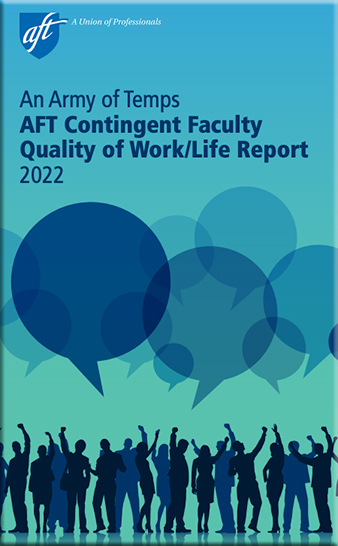
An Army of Temps: AFT Contingent Faculty Quality of Work/Life Report 2022 -- from aft.org

This recent survey adds to our understanding of how contingency plays out in the lives of millions of college and university faculty.

  • More than one-quarter of respondents earn less than $26,500 annually. The percentage of faculty respondents earning below the federal poverty line has remained unchanged through all three reports, which is not surprising with real wages falling behind inflation throughout the academy.2
  • Only 22.5 percent of respondents report having a contract that provides them with continuing employment, even assuming adequate enrollment and satisfactory job performance.
  • For 3 out of 4 respondents, employment is only guaranteed for a term or semester at a time.
  • Two-thirds of part-time respondents want to work full time but are offered only part-time work.
  • Twenty-two percent of those responding report having anxiety about accessing adequate food, with another 6 percent reporting reduced food intake due to lack of resources.
  • Only 45 percent of respondents have access to employer-provided health insurance, and nearly 19 percent rely on Medicare/Medicaid.
  • Nearly half of faculty members surveyed have put off getting needed healthcare, including mental health services, and 68 percent have forgone dental care.
  • Fewer than half of faculty surveyed have received the training they need to help students in crisis.
  • Only 45 percent of respondents believe that their college administration guarantees academic freedom in the classroom at a time when right-wing legislators are passing laws removing control of the curriculum from educators.

From DSC:
A college or university’s adjunct faculty members — if they are out there practicing what they are teaching about — are some of the most valuable people within higher education. They have real-life, current experience. They know which skills are necessary to thrive in their fields. They know their sections of the marketplace.


Some parts of rural America are changing fast. Can higher education keep up? — from usatoday.com by Nick Fouriezos (Open Campus)
More states have started directly tying academic programming to in-demand careers.

Across rural America, both income inequality and a lack of affordable housing are on the rise. Remote communities like the Tetons are facing not just an economic challenge, but also an educational one, as changing workforce needs meet a critical skills and training gap.

Earlier this month, Montana announced that 12 of its colleges would establish more than a dozen “micro-pathways” – stackable credential programs that can be completed in less than a year – to put people on a path to either earning an associate degree or immediately getting hired in industries such as health, construction, manufacturing and agriculture.

“Despite unemployment hitting record lows in Montana, rural communities continue to struggle economically, and many low-income families lack the time and resources to invest in full-time education and training,” the Montana University System announced in a statement with its partner on the project, the national nonprofit Education Design Lab.


Colleges Must Respond to America’s Skill-Based Economy — from edsurge.com by Mordecai I. Brownlee (Columnist)

To address our children’s hunger and our communities’ poverty, our educational system must be redesigned to remove the boundaries between high school, college and careers so that more Americans can train for and secure employment that will sustain them.

In 2021, Jobs for the Future outlined a pathway toward realizing such a revolution in The Big Blur report, which argues for a radical restructuring of education for grades 11 through 14 by erasing the arbitrary dividing line between high school and college. Ideas for accomplishing this include courses and work experiences for students designed for career preparation.


The New Arms Race in Higher Ed — from jeffselingo.com by Jeff Selingo

Bottom line: Given all the discussion about the value of a college education, if you’re looking for “amenities” on campuses these days be sure to find out how faculty are engaging students (both in person and with tools like AR/VR), whether they’re teaching students about using AI, and ways institutions are certifying learning with credentials that have currency in the job market.

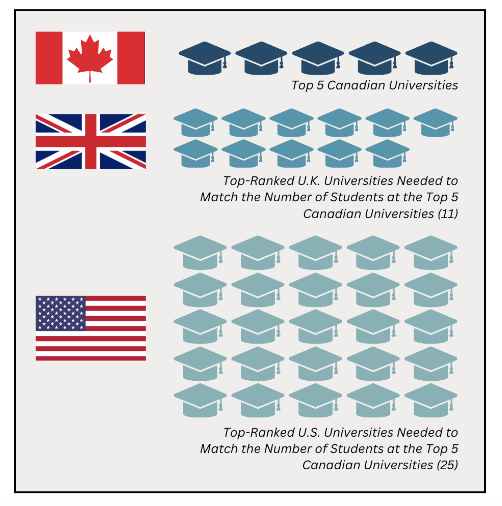
In that same newsletter, also see Jeff’s section entitled, “Where Canada leads the U.S. in higher ed.”

College Uncovered — from hechingerreport.org

Thinking of going to college? Sending your kid? You may already be caught up in the needless complexity of the admissions process, with its never-ending stress and that “you’ll-be-lucky-to-get-in” attitude from colleges that nonetheless pretend to have your interests at heart.

What aren’t they telling you? A lot, as it turns out — beginning with how much they actually cost, how long it will take to finish, the likelihood that graduates get jobs and the myriad advantages that wealthy applicants enjoy. They don’t want you to know that transfer credits often aren’t accepted, or that they pay testing companies for the names of prospects to recruit and sketchy advice websites for the contact information of unwitting students. And they don’t reveal tricks such as how to get admitted even if you’re turned down as a freshman.

But we will. In College Uncovered, from The Hechinger Report and GBH News, two experienced higher education journalists pull back the ivy on how colleges and universities really work, providing information students and their parents need to have before they make one of the most expensive decisions in their lives: whether and where to go to college. We expose the problems, pitfalls and risks, with inside information you won’t hear on other podcasts, including disconcerting facts that they’ve sometimes pried from unwilling universities.
.

Fall 2023 enrollment trends in 5 charts — from highereddive.com by Natalie Schwartz
We’re breaking down some of the biggest developments this term, based on preliminary figures from the National Student Clearinghouse Research Center.

Short-term credentials continued to prove popular among undergraduate and graduate students. In fall 2023, enrollment in undergraduate certificate programs shot up 9.9% compared to the year before, while graduate certificate enrollment rose 5.7%.

Degree programs didn’t fare as well. Master’s programs saw the smallest enrollment increase, of 0.2%, followed by bachelor’s degree programs, which saw headcounts rise 0.9%.


President Speaks: Colleges need an overhaul to meet the future head on — from highereddive.com by Beth Martin
Higher education faces an existential threat from forces like rapidly changing technology and generational shifts, one university leader argues.

Higher education must increasingly equip students with the skills and mindset to become lifelong learners — to learn how to learn, essentially — so that no matter what the future looks like, they will have the skills, mindset and wherewithal to learn whatever it is that they need and by whatever means. That spans from the commitment of a graduate program or something as quick as a microcredential.

Having survived the pandemic, university administrators, faculty, and staff no longer have their backs against the wall. Now is the time to take on these challenges and meet the future head on.

 

Nearly half of CEOs believe that AI not only could—but should—replace their own jobs — from finance.yahoo.com by Orianna Rosa Royle; via Harsh Makadia

Researchers from edX, an education platform for upskilling workers, conducted a survey involving over 1,500 executives and knowledge workers. The findings revealed that nearly half of CEOs believe AI could potentially replace “most” or even all aspects of their own positions.

What’s even more intriguing is that 47% of the surveyed executives not only see the possibility of AI taking over their roles but also view it as a desirable development.

Why? Because they anticipate that AI could rekindle the need for traditional leadership for those who remain.

“Success in the CEO role hinges on effective leadership, and AI can liberate time for this crucial aspect of their role,” Andy Morgan, Head of edX for Business comments on the findings.

“CEOs understand that time saved on routine tasks can stimulate innovation, nurture creativity, and facilitate essential upskilling for their teams, fostering both individual and organizational success,” he adds.

But CEOs already know this: EdX’s research echoed that 79% of executives fear that if they don’t learn how to use AI, they’ll be unprepared for the future of work.

From DSC:
By the way, my first knee-jerk reaction to this was:

WHAT?!?!?!? And this from people who earn WAAAAY more than the average employee, no doubt.

After a chance to calm down a bit, I see that the article does say that CEOs aren’t going anywhere. Ah…ok…got it.


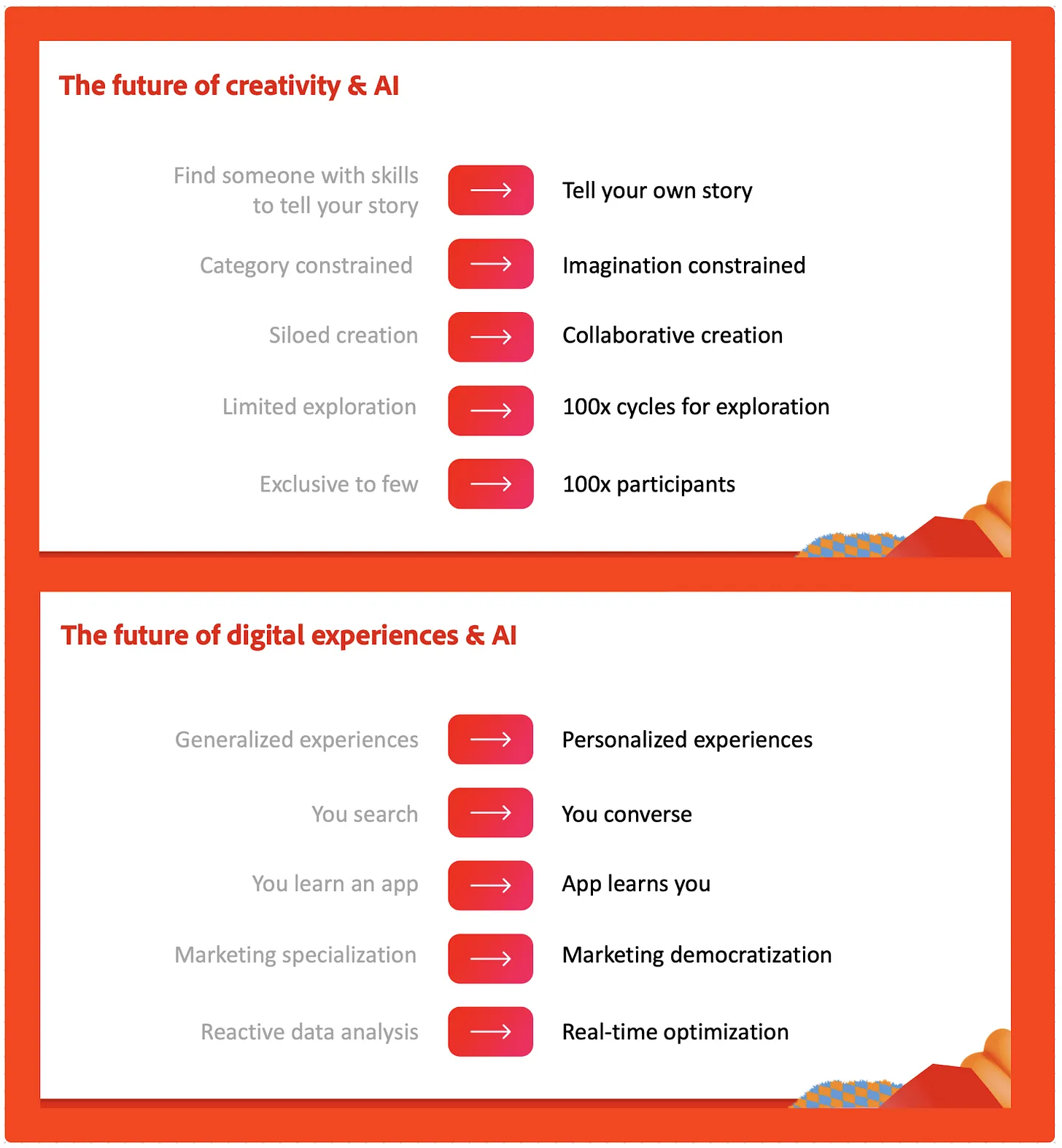
Strange Ways AI Disrupts Business Models, What’s Next For Creativity & Marketing, Some Provocative Data — from .implications.com by Scott Belsky
In this edition, we explore some of the more peculiar ways that AI may change business models as well as recent releases for the world of creativity and marketing.

Time-based business models are liable for disruption via a value-based overhaul of compensation. Today, as most designers, lawyers, and many trades in between continue to charge by the hour, the AL-powered step-function improvements in workflows are liable to shake things up.

In such a world, time-based billing simply won’t work anymore unless the value derived from these services is also compressed by a multiple (unlikely). The classic time-based model of billing for lawyers, designers, consultants, freelancers etc is officially antiquated. So, how might the value be captured in a future where we no longer bill by the hour? …

The worlds of creativity and marketing are rapidly changing – and rapidly coming together

#AI #businessmodels #lawyers #billablehour

It becomes clear that just prompting to get images is a rather elementary use case of AI, compared to the ability to place and move objects, change perspective, adjust lighting, and many other actions using AI.


AlphaFold DB provides open access to over 200 million protein structure predictions to accelerate scientific research. — from

AlphaFold is an AI system developed by DeepMind that predicts a protein’s 3D structure from its amino acid sequence. It regularly achieves accuracy competitive with experiment.


After 25 years of growth for the $68 billion SEO industry, here’s how Google and other tech firms could render it extinct with AI — from fortune.com by Ravi Sen and The Conversation

But one other consequence is that I believe it may destroy the $68 billion search engine optimization industry that companies like Google helped create.

For the past 25 years or so, websites, news outlets, blogs and many others with a URL that wanted to get attention have used search engine optimization, or SEO, to “convince” search engines to share their content as high as possible in the results they provide to readers. This has helped drive traffic to their sites and has also spawned an industry of consultants and marketers who advise on how best to do that.

As an associate professor of information and operations management, I study the economics of e-commerce. I believe the growing use of generative AI will likely make all of that obsolete.


ChatGPT Plus members can upload and analyze files in the latest beta — from theverge.com by Wes Davis
ChatGPT Plus members can also use modes like Browse with Bing without manually switching, letting the chatbot decide when to use them.

OpenAI is rolling out new beta features for ChatGPT Plus members right now. Subscribers have reported that the update includes the ability to upload files and work with them, as well as multimodal support. Basically, users won’t have to select modes like Browse with Bing from the GPT-4 dropdown — it will instead guess what they want based on context.


Google agrees to invest up to $2 billion in OpenAI rival Anthropic — from reuters.com by Krystal Hu

Oct 27 (Reuters) – Alphabet’s (GOOGL.O) Google has agreed to invest up to $2 billion in the artificial intelligence company Anthropic, a spokesperson for the startup said on Friday.

The company has invested $500 million upfront into the OpenAI rival and agreed to add $1.5 billion more over time, the spokesperson said.

Google is already an investor in Anthropic, and the fresh investment would underscore a ramp-up in its efforts to better compete with Microsoft (MSFT.O), a major backer of ChatGPT creator OpenAI, as Big Tech companies race to infuse AI into their applications.


Teaching writing in the age of AI — from the Future of Learning (a Hechinger Report newsletter) by Javeria Salman

ChatGPT can produce a perfectly serviceable writing “product,” she said. But writing isn’t a product per se — it’s a tool for thinking, for organizing ideas, she said.

“ChatGPT and other text-based tools can’t think for us,” she said. “There’s still things to learn when it comes to writing because writing is a form of figuring out what you think.”

When students could contrast their own writing to ChatGPT’s more generic version, Levine said, they were able to “understand what their own voice is and what it does.”


Grammarly’s new generative AI feature learns your style — and applies it to any text — from techcrunch.com by Kyle Wiggers; via Tom Barrett

But what about text? Should — and if so, how should — writers be recognized and remunerated for AI-generated works that mimic their voices?

Those are questions that are likely to be raised by a feature in Grammarly, the cloud-based typing assistant, that’s scheduled to launch by the end of the year for subscribers to Grammarly’s business tier. Called “Personalized voice detection and application,” the feature automatically detects a person’s unique writing style and creates a “voice profile” that can rewrite any text in the person’s style.


Is AI Quietly Weaving the Fabric of a Global Classroom Renaissance? — from medium.com by Robert the Robot
In a world constantly buzzing with innovation, a silent revolution is unfolding within the sanctuaries of learning—our classrooms.

From bustling metropolises to serene hamlets, schools across the globe are greeting a new companion—Artificial Intelligence (AI). This companion promises to redefine the essence of education, making learning a journey tailored to each child’s unique abilities.

The advent of AI in education is akin to a gentle breeze, subtly transforming the academic landscape. Picture a classroom where each child, with their distinct capabilities and pace, embarks on a personalized learning path. AI morphs this vision into reality, crafting a personalized educational landscape that celebrates the unique potential harbored within every learner.


AI Books for Educators — from aiadvisoryboards.wordpress.com by Barbara Anna Zielonka

Books have always held a special place in my heart. As an avid reader and AI enthusiast, I have curated a list of books on artificial intelligence specifically tailored for educators. These books delve into the realms of AI, exploring its applications, ethical considerations, and its impact on education. Share your suggestions and let me know which books you would like to see included on this list.


SAIL: ELAI recordings, AI Safety, Near term AI/learning — by George Siemens

We held our fourth online Empowering Learners for the Age of AI conference last week. We sold out at 1500 people (a Whova and budget limit). The recordings/playlist from the conference can now be accessed here.


Your Teachers Need a Win — from cultofpedagogy.com by Jennifer Gonzalez

If you’re short on ideas, here are a few things you might compliment them on:

  • Relationships and rapport with students:
  • Decision-making:
  • Clarity and delivery:
  • Classroom management and logistics:
  • Lesson planning:
  • Design:

So this is my ask of you as an administrator: Choose 10 teachers on your staff and make it a goal to give each of them one piece of specific, positive feedback this week. For some, you might only need to think about what you’ve noticed during your past observations of them. For others, you might need to arrange a short classroom visit — make sure the teacher knows ahead of time that you will ONLY be looking for things to compliment them on. Even better would be to ask them to choose a time when they’re doing something they think you’d like to see. 


180 Degree Turn: NYC District Goes From Banning ChatGPT to Exploring AI’s Potential — from edweek.org by Alyson Klein (behind paywall)

New York City Public Schools will launch an Artificial Intelligence Policy Lab to guide the nation’s largest school district’s approach to this rapidly evolving technology.


The Leader’s Blindspot: How to Prepare for the Real Future — from preview.mailerlite.io by the AIEducator
The Commonly Held Belief: AI Will Automate Only Boring, Repetitive Tasks First

The Days of Task-Based Views on AI Are Numbered
The winds of change are sweeping across the educational landscape (emphasis DSC):

  1. Multifaceted AI: AI technologies are not one-trick ponies; they are evolving into complex systems that can handle a variety of tasks.
  2. Rising Expectations: As technology becomes integral to our lives, the expectations for personalised, efficient education are soaring.
  3. Skill Transformation: Future job markets will demand a different skill set, one that is symbiotic with AI capabilities.

Teaching: How to help students better understand generative AI — from chronicle.com by Beth McMurtrie
Beth describes ways professors have used ChatGPT to bolster critical thinking in writing-intensive courses

Kevin McCullen, an associate professor of computer science at the State University of New York at Plattsburgh, teaches a freshman seminar about AI and robotics. As part of the course, students read Machines of Loving Grace: The Quest for Common Ground Between Humans and Robots, by John Markoff. McCullen had the students work in groups to outline and summarize the first three chapters. Then he showed them what ChatGPT had produced in an outline.

“Their version and ChatGPT’s version seemed to be from two different books,” McCullen wrote. “ChatGPT’s version was essentially a ‘laundry list’ of events. Their version was narratives of what they found interesting. The students had focused on what the story was telling them, while ChatGPT focused on who did what in what year.” The chatbot also introduced false information, such as wrong chapter names.

The students, he wrote, found the writing “soulless.”


7 Questions with Dr. Cristi Ford, VP of Academic Affairs at D2L — from campustechnology.com by Rhea Kelly

In the Wild West of generative AI, educators and institutions are working out how best to use the technology for learning. How can institutions define AI guidelines that allow for experimentation while providing students with consistent guidance on appropriate use of AI tools?

To find out, we spoke with Dr. Cristi Ford, vice president of academic affairs at D2L. With more than two decades of educational experience in nonprofit, higher education, and K-12 institutions, Ford works with D2L’s institutional partners to elevate best practices in teaching, learning, and student support. Here, she shares her advice on setting and communicating AI policies that are consistent and future-ready.


AI Platform Built by Teachers, for Teachers, Class Companion Raises $4 Million to Tap Into the Power of Practice — from prweb.com

“If we want to use AI to improve education, we need more teachers at the table,” said Avery Pan, Class Companion co-founder and CEO. “Class Companion is designed by teachers, for teachers, to harness the most sophisticated AI and improve their classroom experience. Developing technologies specifically for teachers is imperative to supporting our next generation of students and education system.”


7 Questions on Generative AI in Learning Design — from campustechnology.com by Rhea Kelly
Open LMS Adoption and Education Specialist Michael Vaughn on the challenges and possibilities of using artificial intelligence to move teaching and learning forward.

The potential for artificial intelligence tools to speed up course design could be an attractive prospect for overworked faculty and spread-thin instructional designers. Generative AI can shine, for example, in tasks such as reworking assessment question sets, writing course outlines and learning objectives, and generating subtitles for audio and video clips. The key, says Michael Vaughn, adoption and education specialist at learning platform Open LMS, is treating AI like an intern who can be guided and molded along the way, and whose work is then vetted by a human expert.

We spoke with Vaughn about how best to utilize generative AI in learning design, ethical issues to consider, and how to formulate an institution-wide policy that can guide AI use today and in the future.


10 Ways Technology Leaders Can Step Up and Into the Generative AI Discussion in Higher Ed — from er.educause.edu by Lance Eaton and Stan Waddell

  1. Offer Short Primers on Generative AI
  2. Explain How to Get Started
  3. Suggest Best Practices for Engaging with Generative AI
  4. Give Recommendations for Different Groups
  5. Recommend Tools
  6. Explain the Closed vs. Open-Source Divide
  7. Avoid Pitfalls
  8. Conduct Workshops and Events
  9. Spot the Fake
  10. Provide Proper Guidance on the Limitations of AI Detectors


Higher Ed’s Ruinous Resistance to Change — from chronicle.com by Brian Rosenberg

I dwell on this story not merely because the irony of defending the role of research by ignoring the research on the topic is exquisite, but because it is emblematic of a widespread problem within higher education. The resistance to anything like serious change is profound. By “change” I don’t mean the addition of yet another program or the alteration of a graduation requirement, but something that is transformational and affects the way we do our work on a deep level.

If maintenance of the status quo is the goal, higher education has managed to create the ideal system.

Cut through all the graphs and economic data and the problem is straightforward: When the service you provide costs more than people are willing and able to pay for it, when you are unable to lower the cost of that service, and when the number of your potential customers is shrinking, you have what one might describe as an unsustainable financial model.

“College teaching has probably seen less change than almost any other American institutional practice since the days of Henry Adams.”


From DSC:
In Rick Seltzer’s Daily Briefing for 9-18-23, he ends the briefing with this important point:

The bigger picture: Culture is exceedingly hard to change, especially after trust evaporates in a crisis. And crises can be particularly wrenching when institutions haven’t established cultures of transparency and accountability during good times. Instead, trust continues to erode in a vicious cycle.

And I thought to myself, the scope of Rick’s conclusion could likely be expanded/applied to institutions of higher education as a whole.


Ask the Chair: Are Great Chairs Born or Made? — from chronicle.com by Kevin Dettmar (behind a paywall)
Higher education is finally getting serious about training new department heads.

Great chairs aren’t born, but made; “trial and error” isn’t actually a professional-development strategy. The provost and deans should recognize that a confident and competent chair makes their job easier, creates a well-functioning department, and buoys faculty, student, and staff morale.

As someone vitally engaged with the chair’s role, I do think we are experiencing a sea-change when it comes to how institutions are preparing chairs. For too long, colleges have treated the position as simply a minor cog in the chain of command. But more and more institutions are now investing in their chairs.


Big Ideas in Education — from edweek.org by various

Big Ideas is Education Week’s annual special report that brings the expertise of our newsroom—and occasionally those beyond our newsroom—to bear on the challenges you might be facing in your classroom, school, or district. Big Ideas questions the status quo and explores opportunities to help you build a better, more just learning environment for all students. Browse our collection.


This is how the billable hour dies — from jordanfurlong.substack.com by Jordan Furlong
Let me tell you a story about the AI-driven evolution of pricing in the legal market. It might not happen for many years. It might happen much sooner. But when it does, I expect it’ll look like this.

So assemble some of your most creative, forward-thinking people, and ask them: “If the firm could no longer bill our work by the hour, how could we turn a profit?” Give them this article from 2012 to get them started. Show them the firm’s financials for the last 24 months, so that they know how you’re making money now. Have them speak with clients, technology experts, and pricing consultants for insights — might as well get them to ask ChatGPT, too. The answers you get will form the basis of your future strategic plans.


The Mass Exodus of Teachers — from educationoneducation.substack.com by Jeannine Proctor
Understanding Why Educators Are Fleeing the Classroom and How to Bring Them Back

Stemming the tide will require nuance, empathy, and listening to what teachers say they need. While pay raises are indispensable, they alone won’t be enough. Districts must take an integrated approach that also addresses unmanageable workloads, lack of resources, and toxic school cultures.

Some best practices include utilizing multi-classroom teaching models, providing duty-free “coverage” periods, and hiring support staff to shoulder non-instructional burdens. Investing in mentoring and leadership opportunities can stem the turnover of principals and administrators too. Public recognition and appreciation can also go a long way.

Most importantly, we must work to restore teacher well-being, purpose, and passion.

From DSC:
The primary things that would help this very troubling situation:

  • provide higher salaries
  • deal with unreasonable workload expectations
  • address a lack of teacher well-being.

California’s dramatic jump in chronically absent students part of a nationwide surge — from edsource.org by Betty Marquez Rosales, Millika Seshadri, and Daniel J. Willis

Dee’s analysis found that since the pandemic the number of students who were chronically absent nearly doubled to about 13.6 million, with 1.8 million of them in California.

Compared with before the pandemic, Dee found that about 6.5 million additional students became chronically absent in 2021-22, including more than 1 million in California.


Daily Briefing: Dual enrollment for every 9th grader? — from chronicle.com by Rick Seltzer

The idea of default is also an important idea. If we do it by invitation, what we have noticed is that those who know about it know to say yes to the invitation. If it is a default schedule, and then you have to opt out, then our ability to address equity and enrollment for our low-income students and students of color, it makes us much more successful.


These would-be teachers graduated into the pandemic. Will they stick with teaching? — from hechingerreport.org by Nirvi Shah
We tracked down nearly 90 members of the University of Maryland College of Education’s 2020 class. Their experiences suggest the field isn’t doing enough to adapt to a new, more difficult era for educators

The number of people studying for careers in education has been declining for years. At the same time, schools have struggled to hold on to new teachers: Studies indicate that about 44 percent of teachers leave the profession within their first five years.

Then the pandemic came along, hammering teachers and the profession as a whole.

“The first three years of teaching are really, really hard even in a perfect school system,” said Randi Weingarten, president of the American Federation of Teachers. So for teachers who entered the teaching profession at any point during the pandemic, “this has been a helluva ride.”


As Back-to-School Costs Soar, More Parents & Teachers Turn to Charities for Help — from the74million.org by Sierra Lyons
But as the need increases, inflation makes it harder for nonprofits to meet this year’s demand.

A study from World Remit shows that the cost of school supplies in the United States has increased by over 25% compared with 2022.

Though inflation is the lowest it has been since March 2021, high prices are still stressing shoppers and increasing their reliance on local and national back-to-school drives. The nonprofit organizations that sponsor those drives, in turn, are struggling to meet the growing demand.


Excerpt from Tom Barrett’s Dialogic #329: The Transformative Power of Compassionate Leadership

 Your Next Steps: ?Commit to action and turn words into works

  • Reflect on your current leadership style and identify opportunities to incorporate more compassionate practices. Consider the Appreciative Inquiry model to guide this process.
  • Develop an empathy-driven approach to problem-solving and team dynamics, focusing on fostering a culture of understanding, collaboration, and mutual respect.
  • Revisit your feedback mechanisms and explore how they can be made more compassionate. Consider how critique can be delivered with kindness to empower, rather than tear down.

What Defines a Next-Gen High School? — from michaelbhorn.substack.com by Michael B. Horn

Against that backdrop, Ken Montgomery, co-founder of Design Tech High, known as D-Tech, and Keeanna Warren, who just became the CEO of the Purdue Polytechnic High School network, joined me to talk about their school designs, in particular the importance of:

  • helping students connect to something bigger than the school itself;
  • offering competency-based learning pathways with a transformed assessment system;
  • allowing students to find their creative purpose aligned to the common good;
  • and building a more permeable school that is connected to the community and offers a deep sense of belonging.

They also talked about the role of AI (artificial intelligence) and the anxiety that their students feel around its emergence, as well as the barriers that arise to building school models that break the traditional molds—from policy to human capital.


The Changing Landscape of Online Education (CHLOE), 2023
Student Demand Moves Higher Ed Toward a Multi-Modal Future

The majority of survey participants report increased student demand for online and hybrid learning juxtaposed with decreased demand for face-to-face courses and programs. Most participants also say that their institutions are aligning or working to align their strategic priorities to meet this demand. Notable findings from the 50+-page report include:

  • Face-to-Face enrollment is stagnant or declining.
  • Online and hybrid enrollment is growing.
  • Institutions are quickly aligning their strategic priorities to meet online/hybrid student demand.
  • “Quiet” quality assurance.


Also relevant/see:

Chase Hertel

@ABAesq is supposed to be the great facilitator of debate and discourse to steer the profession. To create an environment that facilitates the censorship of varying opinions is the opposite of what the organization is charged with by its members.

I was once part of the Center’s staff. I know many current ABA staff members personally. This is a situation that forces these servants of the profession to defend their existence and livelihoods because they are encouraging debate. I will defend my friends. Try me.

Kelli Proia 

This is why I won’t join @ABAesq

. A Center for Innovation that can’t honestly discuss innovation in a profession that desperately needs it. Disgusting. And the truth is innovation is good for attys. Protecting a 120yo biz model is not good for lawyers or the public.

Jordan Furlong

This is equal parts disappointing and infuriating. The ABA is cutting the legs out from under its one truly forward-looking, people-focussed initiative. It’s a shameful sellout to the rising protectionist wave in the legal profession, and history will judge it accordingly.

Damien Riehl (@damienriehl)

If “Self-Regulation” has any meaning, the self-regulatory body should permit robust dialogue.

Dialogue ? Improvements

Censorship ? Moribund Stasis

@ABAesq
, please permit discussion about how technology/regulation could improve the public interest.


Student loan debt: Averages and other statistics in 2023 — from usatoday.com by Rebecca Safier and Ashley Harrison; via GSV

Excerpt:

The cost of college has more than doubled over the past four decades — and student loan borrowing has risen along with it. The student loan debt balance in the U.S. has increased by 66% over the past decade, and it now totals more than $1.77 trillion, according to the Federal Reserve.

Here’s a closer look at student loan debt statistics in the U.S. today, broken down by age, race, gender and other demographics.

In the 2020-2021 academic year, 54% of bachelor’s degree students who attended public and private four-year schools graduated with student loans, according to the College Board. These students left school with an average balance of $29,100 in education debt.

From DSC:
With significant monthly payments, many graduates HAVE TO HAVE good jobs that pay decent salaries. This is an undercurrent flowing through the higher ed learning ecosystem — with ramifications for what students/families/guardians expect from their investments.


‘Pracademics,’ professors who work outside the academy, win new respect — from washingtonpost.com by Jon Marcus
What’s in a word? A way to help impatient college students better connect to jobs.

Excerpts (emphasis DSC):

Among its approaches, the university focuses on having students learn from people like Taylor, who work or have worked in the fields about which they teach. Sheffield Hallam even has a catchy word to describe these practical academics: “pracademics.”

American universities have pracademics, too, of course. They’re among the more than 710,000 part-time and non-tenure-track faculty members who now make up some 61 percent of all faculty, according to the American Association of University Professors. Other adjectives for them include “adjunct,” “casual,” “contingent,” “external” and “occasional.”

From DSC:
For several years now I’ve thought that adjuncts are the best bet for our current traditional institutions of higher education to remain relevant and have healthier enrollments (i.e., sales) as well as offer better ROI’s that the students are looking for. Why? Because adjuncts bring current, real-world expertise to the classroom.

But the problem here is that many of these same institutions have treated adjunct faculty members poorly. Adjunct faculty members are often viewed as second-class citizens in many colleges and universities — even though they provide the lion’s share of the teaching, grading, and assessing of students’ work. They don’t get benefits, they are paid far less than tenured faculty members, and they often don’t know if they will actually be teaching a course or not. Chances are they don’t get to vote or have a say within faculty senates and such. They are often without power…without a voice.

I’m not sure many adjunct faculty members in the U.S. will stay with these institutions if something better comes around in the way of other alternatives.


Colgate Adds Trade School to Higher Education Employee Benefit — from colgate.edu by Daniel DeVries; via Brandon Busteed on LinkedIn

Excerpt (emphasis DSC):

One of Colgate University’s most important employee benefits has been expanded to support employee children as they seek trade or vocational education. 

Colgate, like many leading universities, offers financial support for employee children who attend an accredited college or university in pursuit of an undergraduate degree. Now, at the University, this benefit has been expanded to include employee children who enroll in trade or vocational schools.


Coursera’s degree and certificate offerings help drive Q2 revenue growth — from highereddive.com by Natalie Schwartz
The MOOC platform’s CEO touted the company’s strategy of allowing students to stack short-term credentials into longer offerings.

Dive Brief:

  • Coursera’s revenue increased to $153.7 million in the second quarter of 2023, up 23% compared to the same period last year, according to the company’s latest financial results.
  • The increases were partly driven by strong demand for the MOOC platform’s entry-level professional certificates and rising enrollment in its degree programs.
  • During a call with analysts Thursday, Coursera CEO Jeff Maggioncalda attributed some of that enrollment growth to new offerings, which include a cybersecurity analyst certificate from Microsoft and artificial intelligence degree programs from universities in India and Colombia.

Are ‘quick wins’ possible in assessment and feedback? Yes, and here’s how — from timeshighereducation.com by Beverley Hawkins, Eleanor Hodgson, Oli Young
It takes coordination, communication, and credibility to implement quick improvements in assessment and feedback, as a team from the University of Exeter explain 

One way to establish this is to form an “assessment and feedback expert group”. Bringing together assessment expertise from educators and academic development specialists, and student participants across the institution establishes a community of practice beyond those in formal leadership roles, who can share their experience and bring opportunities for improvement back into their local networks.

Focusing the group on “quick wins” can encourage discussion to address specific tips and tricks that educators can use without changing their assessment briefs and without significant preparation.

Also re: providing feedback see:

Five common misconceptions on writing feedback — from timeshighereducation.com by Rolf Norgaard , Stephanie Foster
Misapprehensions about responding to and grading writing can prevent educators using writing as an effective pedagogical tool. Rolf Norgaard and Stephanie Foster set out to dispel them

Writing is essential for developing higher-order skills such as critical thinking, enquiry and metacognition. Common misconceptions about responding to and grading writing can get in the way of using writing as an effective pedagogical tool. Here, we attempt to dispel these myths and provide recommendations for effective teaching.


How generative AI like ChatGPT is pushing assessment reform — from timeshighereducation.com by Amir Ghapanchi
AI has brought assessment and academic integrity in higher education to the fore. Here, Amir Ghapanchi offers seven ways to evaluate student learning that mitigate the impact of AI writers

Recommended assessment types to mitigate AI use
These assessment types can help universities to minimise the adverse effects of GAI:

  • Staged assignments
  • In-class presentations followed by questions
  • Group projects
  • Personal reflection essays
  • Class discussion
  • In-class handwritten exams
  • Performance-based assessments

Instructors Rush to Do ‘Assignment Makeovers’ to Respond to ChatGPT — from edsurge.com by Jeffrey R. Young

(Referring to rubrics) But, Bruff says, “the more transparent I am in the assignment description, the easier it is to paste that description into ChatGPT to have it do the work for you. There’s a deep irony there.” 

Bruff, the teaching consultant, says his advice to any teacher is not to have an “us against them mentality” with students. Instead, he suggests, instructors should admit that they are still figuring out strategies and boundaries for new AI tools as well, and should work with students to develop ground rules for how much or how little tools like ChatGPT can be used to complete homework.


Nearly 90% of staff report major barriers between traditional and emerging academic programs — from universitybusiness.com by Alcino Donadel
Only 53% of respondents recognized an existing strategic initiative at their institution with regard to PCE units; 17% indicated none existed, and 30% were not sure.

In the American Association of Collegiate Registrars and Admissions Officers’ (AACRAO) new survey on how institutions are mediating PCE units’ coexistence with the academic registrar, they found that once-siloed PCE units that are now converging with the academic registrar are causing internal tension and confusion.

“Because the two units have been organically grown for years to be separate institutions and to offer different things, it is difficult to grow together without knowing the goals of each or having a relationship,” one anonymized respondent said in the report.


National ChatGPT Survey: Teachers Accepting AI Into Classrooms & Workflow — Even More Than Students — from the74million.org by Greg Toppo
42% of students use ChatGPT, up from 33% in a prior survey. Their teachers are way ahead of them, with now 63% saying they’ve used the tool on the job

Teachers … and parents … believe it’s legit
Teachers who use ChatGPT overwhelmingly give it good reviews. Fully 84% say it has positively impacted their classes, with about 6 in 10 (61%) predicting it will have “legitimate educational uses that we cannot ignore.”

New Book Aims to Reshape the Future of Learning (With Your Help) — from samchaltain.substack.com by Sam Chaltain

  • What circumstances would be required for the existing educational model to be deemed obsolete?
  • What stands in the way of those circumstances coming to pass?
  • And if you were to craft a tool that actually helped people create those circumstances, what would you want that sort of resource to be, say, and do?

Last week, in Istanbul, a select group of educators, architects, students and entrepreneurs met to wrestle with those questions, as part of a yearlong collaborative design project.

What small changes could have the biggest impact and help spark the larger revolution we seek?

Will the future even have occupations — and if so, what are they most likely to be? 

What is most essential to know and embody in the next 25 years?

The Great Unbundling — from educationnext.org by Joseph Olchefske and Steven Adamowski
Is the parents’ rights movement opening a new frontier in school choice?

The mindsets of parents are changing—rapidly—as they make decisions about the schooling of their children. Over the past few years, a convergence of two megatrends—pandemic desperation and parental-rights politics—has driven many families to reconsider the traditional school model and find ways of “unbundling” their children’s schooling into discrete elements that are controlled by the parent rather than the school.

While parent-led unbundling is not a new phenomenon, the current movement has expanded so quickly that it’s been dubbed “the Great Unbundling” of K–12 schooling.

The Great Unbundling is now influencing the education marketplace, as a broad set of nonschool vendors have responded to this unprecedented demand by pitching their education services directly to families: “microschools,” online courses, private tutoring, learning pods, and outdoor learning experiences.

Yes, AI could profoundly disrupt education. But maybe that’s not a bad thing — from theguardian.com by Rose Luckin; with thanks to Will Richardson and Homa Tavangar for this resource
Humans need to excel at things AI can’t do – and that means more creativity and critical thinking and less memorisation

Staying ahead of AI will mean radically rethinking what education is for, and what success means. Human intelligence is far more impressive than any AI system we see today. We possess a rich and diverse intelligence, much of which is unrecognised by our current education system.

How we can teach children so they survive AI – and cope with whatever comes next — from theguardian.com by George Monbiot
It’s not enough to build learning around a single societal shift. Students should be trained to handle a rapidly changing world

I don’t claim to have definitive answers. But I believe certain principles would help. One is that rigidity is lethal. Any aspect of an education system that locks pupils in to fixed patterns of thought and action will enhance their vulnerability to rapid and massive change. For instance, there could be no worse preparation for life than England’s Standard Assessment Tests, which dominate year 6 teaching. If the testimony of other parents I know is representative, SATs are a crushing experience for the majority of pupils, snuffing out enthusiasm, forcing them down a narrow, fenced track and demanding rigidity just as their minds are seeking to blossom and expand.

Education, to the greatest extent possible, should be joyful and delightful, not only because joy and delight are essential to our wellbeing, but also because we are more likely to withstand major change if we see acquiring new knowledge and skills as a fascinating challenge, not a louring threat.

BRINGING AI TO SCHOOL: TIPS FOR SCHOOL LEADERS— a mini ebook from ISTE

Artificial Intelligence is having a major impact on education. Whether you are excited or
concerned about AI, as a school leader you have a responsibility to ensure AI is approached
thoughtfully and appropriately in your school community and informs your vision for teaching and learning. This guide will help you quickly gain the background you need as a learning leader in an AI infused world.

Schools that have been successful in bringing AI into their schools in purposeful ways have some common strategies. The following five strategies are critical for a successful AI culture in your school.

The Potential Impact of AI Technology on Education. — from medium.com by Happiness Uduak

In this article, we’ll explore the potential impact of AI on education, and then take a look at how it could shape the human view of learning for good.

Teaching Through Asking Rather Than Telling — from edutopia by Jay Schauer
High school teachers can promote active learning by strategically replacing some direct instruction with questions that produce thoughtful conversations.

Does much of your teaching resemble the lectures you and 20 or 50 or 400 of your closest college friends received from a “sage on the stage”? Are you frustrated that most of your students won’t remember much from the fascinating information you just delivered to them for 15 or 30 or 55 minutes? If so, maybe it’s time to implement more ARTT—Ask, Rather Than Tell—into your teaching.

I started doing a lot of asking in order to help students make connections, establish common baseline understandings, and identify knowledge gaps or areas of misunderstanding, rather than telling them information. My lectures then evolved into more meaningful conversations.

Best Free Virtual Labs — from techlearning.com by Diana Restifo
These best virtual lab sites and apps are all free, highly engaging, and informative—and most don’t require registration

Many schools don’t have robust in-person laboratory facilities, instead relying primarily on dry textbooks to teach difficult STEM topics. But even schools with quality labs can benefit from these innovative and flexible online simulations.

The following top virtual lab sites and apps are all free, highly engaging, and informative—and most don’t require registration. Since most browsers no longer support Java or Flash, sites built exclusively with those outdated technologies have been excluded.

Gov. Gretchen Whitmer launching new education-focused state department — from detroitnews.com by Craig Mauger and Chad Livengood

Whitmer’s office said Wednesday the new Michigan Department of Lifelong Education, Achievement and Potential, or MiLEAP, will feature offices governing early childhood education, higher education and “education partnerships.”

“Establishing MiLEAP ensures all available resources, data and dollars are aligned around a single vision — supporting an education system focused on lifelong learning that can support the economy of the future and helping anyone make it in Michigan,” according to a “talking points” document obtained by The Detroit News on Wednesday morning.

How to Get Kids to Read for Fun — from nataliewexler.substack.com by Natalie Wexler
An overemphasis on analytical skills can make reading a joyless task.

Schools have been giving students isolated bits of text rather than letting them sink their teeth into engaging novels, and they’ve prioritized teaching analytical reading skills over allowing kids to immerse themselves in a good story.

Celebrating Student Interests to Create a Positive High School Culture — from edutopia.org by Nicole Rossi-Mumpower
Events that center students’ picks in art, music, and food can create powerful opportunities for them to increase their sense of belonging.

Modeled after the First Friday events that take place in many cities and towns (when community members gather to experience local culture), First Fridays at school offer students a chance to listen to music, view art, and sample cuisine.?The tradition has become a cornerstone of our school community and is replicable across school sites.

THE IMPORTANCE OF A MEANINGFUL SCHOOL CULTURE
Creating a positive school climate and culture is essential for student success. When students feel like they are an important part of the community, they’re more likely to be engaged in their learning and have a positive attitude toward school.

 
© 2025 | Daniel Christian