How Does Your Firm Stack Up When It Comes To Legal Tech? A Look Through the 2022 ABA Legal Technology Survey Report — from jdsupra.com

Excerpt:

The 2022 ABA Legal Technology Survey Report measures current legal technology trends. How does your firm compare to the rest?

Lawyers are rarely accused of rushing into change, but current legal technology trends show a few glimmers of hope that (slowly but surely) law firms are realizing the significance of incorporating technology into their litigation practice to remain relevant and competitive. The 2022 ABA Legal Technology Survey Report: Vol. 5 – Litigation Technology & E-Discovery reveals that law firms went through a belt-tightening phase in 2020 and 2021 but then made investments in 2022 to improve their litigation offerings.


ChatGPT Writes Our February 2023 FPI Newsletter Blog Post — from .law.upenn.edu by the Future of the Profession Initiative (FPI) at Penn Carey Law

Excerpt:

For our February 2023 FPI Newsletter, we used ChatGPT, the advanced chatbot, to help us write this blog post. Below, our prompts are in bold, with ChatGPT responses following.

Write the introduction to a newsletter focused on the legal implications of ChatGPT. Include implications for legal education, law firms, and clients.


Trends and Highlights from the 2023 Midsize Law Firm Priorities Report — from lawtechnologytoday.org Taylor Young

Excerpt:

Earlier this month, Actionstep released the results of the 2023 Midsize Law Firm Priorities Report, an inaugural survey of legal and administrative staff from midsize US law firms focused on identifying their key priorities, challenges, goals, and opportunities heading into 2023.

Trends and insights that rose to the top…


23 Legal Tech Insights for 2023 — New Report with Input from Industry Experts — from lawtechnologytoday.org Taylor Young

Excerpt:

If you are in legal tech, change is constant. This means staying on top of emerging trends (yes, even beyond the latest ChatGPT craze) is vital — not because you need to sign up for every new, shiny thing, but because you want to harness the advantages technology creates and prepare your organization for the future. That’s why tech-savvy practitioners will soon be heading to the ABA TECHSHOW.

As you head into conference-mode to dig into the latest in legal technology at TECHSHOW, our team thought this is the perfect time to share trends and industry insights to give you some food for thought and areas to investigate at the show.

Last year, we shared 10 legal tech trends driving success in the legal industry. Because what we shared was so well received, we’ve expanded the content with our latest report, 23 Legal Technology Insights for 2023, which includes thoughtful analysis of major trends, comments from industry experts, and tips to help you make the most of the tech in your organization. Here’s a snapshot of some of the key technology trends for 2023.


AI starter tools for video content creation — from techthatmatters.beehiiv.com by Harsh Makadia

Excerpt:

One of the most exciting applications of AI is in the realm of content creation. What if I told you there are tools to generate videos in mins?

Try these tools today:

  • Supercreator AI: Create short form videos 10x faster
  • Lumen5: Automatically turn blog posts into videos
  • InVideo: Idea to YouTube video
  • Synthesia: Create videos from plain text in minutes
  • Narakeet: Get a professionally sounding audio or video in minutes
  • Movio: Create engaging video content
 

Allen & Overy breaks the internet (and new ground) with co-pilot Harvey — from legaltechnology.com by Caroline Hill

Excerpt (emphasis DSC):

We’re told that at the end of the trial, around 3,500 of A&O’s lawyers had asked Harvey around 40,000 queries for their day-to-day client work. MIG head David Wakeling said in a statement yesterday: “I have been at the forefront of legal tech for 15 years but I have never seen anything like Harvey. It is a game-changer that can unleash the power of generative AI to transform the legal industry. Harvey can work in multiple languages and across diverse practice areas, delivering unprecedented efficiency and intelligence. In our trial, we saw some amazing results.”

Also related/see:

OpenAI-backed startup brings chatbot technology to first major law firm — from reuters.com by Sara Merken

Summary:

  • Allen & Overy partners with legal startup Harvey
  • Harvey received $5 million in a funding round led by the OpenAI Startup Fund last year


Global Firm Allen & Overy Rolling Out Harvey.ai — from legallydisrupted.com by Zach Abramowitz

Excerpt:

Here’s another way to think about what it can do: read, understand, analyze, issue spot and draft responsive documents. Does that apply to a lot of contract work? Sure. Litigation? Yep, that too. The reason this is hard to swallow is that we’re stuck in a framework where there are contract tools for contracts, eDiscovery tools for discovery, drafting tools for drafting etc. The AI revolution could potentially change that paradigm.


The Top Legal Tech Startups to Watch in 2023 — from gritdaily.com by Spencer Hulse

Excerpt:

There are certain industries that have been slower to embrace technology than others, and the legal profession is one of those at the very top. However, legal tech startups have been gaining ground in recent years, with the market expected to reach around $32 billion in 2025. There is also a significant rise in legal department spending on legal tech, which is only going to rise in the coming years.

Legal tech offers numerous solutions, which include everything from offering legal advice digitally to AI and automating some of the time-consuming processes formerly handled with pen and paper.

The following list includes legal tech startups and companies of all sorts, from those that have been around for years to up-and-coming innovators.


Embracing The Tectonic Shift: How Technology Is Transforming The Legal Profession — from livelaw.in by Khushboo Luthra

According to a Gartner Report, 4 of 5 legal departments plan to increase technology spending. By 2024, legal departments will replace one out of five lawyers with a nonlawyer staff, and 1/4th of the expenditure on corporate legal applications will go to non-specialist technology providers. By 2025, legal departments will have automated 50% of legal work related to significant corporate transactions.


Generative AI Is Coming For the Lawyers — from wired.com by Chris Stokel-Walker
Large law firms are using a tool made by OpenAI to research and write legal documents. What could go wrong?

Excerpt:

The rise of AI and its potential to disrupt the legal industry has been forecast multiple times before. But the rise of the latest wave of generative AI tools, with ChatGPT at its forefront, has those within the industry more convinced than ever.

“I think it is the beginning of a paradigm shift,” says Wakeling. “I think this technology is very suitable for the legal industry.”

Generative AI is having a cultural and commercial moment, being touted as the future of search, sparking legal disputes over copyright, and causing panic in schools and universities.


Addendum on 3/6/23:

Will artificial intelligence replace your lawyer–and will its name be Harvey? — from fortunes.com by Aron Solomon


Does ‘Flipped Learning’ Work? A New Analysis Dives Into the Research — from edsurge.com by Jeffrey R. Young

Excerpt:

The researchers do think that flipped learning has merit — if it is done carefully. They end their paper by presenting a model of flipped learning they refer to as “fail, flip, fix and feed,” which they say applies the most effective aspects they learned from their analysis. Basically they argue that students should be challenged with a problem even if they can’t properly solve it because they haven’t learned the material yet, and then the failure to solve it will motivate them to watch the lecture looking for the necessary information. Then classroom time can be used to fix student misconceptions, with a mix of a short lecture and student activities. Finally, instructors assess the student work and give feedback.

From DSC:
Interesting. I think their “fail, flip, fix and feed” method makes sense.

Also, I do think there’s merit in presenting information ahead of time so that students can *control the pace* of listening/processing/absorbing what’s being relayed. (This is especially helpful for native language differences.) If flipped learning would have been a part of my college experience, it would have freed me from just being a scribe. I could have tried to actually process the information while in class.


10 Tips to Help You Find the Legal Career That’s Right for You — from abaforlawstudents.com by Bill D. Henslee

Excerpts:

Career planning is a process that requires time and thought. Perhaps you’ve known what you want to be when you grow up for as long as you can remember. Or perhaps you’re still trying to figure it out. Most of us fit somewhere on the spectrum between “born to serve” and “stay loose and adjust.”

Wherever you land on that spectrum, you’ll still need to get a job. Here are 10 tips to help you identify and land the position that fits your skills and interests.

1. Think about Practice Areas
…
2. Consider Culture
…
3. Know the People
…


A quick and sobering guide to cloning yourself — from oneusefulthing.substack.com by Professor Ethan Mollick
It took me a few minutes to create a fake me giving a fake lecture.

Excerpt:

I think a lot of people do not realize how rapidly the multiple strands of generative AI (audio, text, images, and video) are advancing, and what that means for the future.

With just a photograph and 60 seconds of audio, you can now create a deepfake of yourself in just a matter of minutes by combining a few cheap AI tools. I’ve tried it myself, and the results are mind-blowing, even if they’re not completely convincing. Just a few months ago, this was impossible. Now, it’s a reality.

To start, you should probably watch the short video of Virtual Me and Real Me giving the same talk about entrepreneurship. Nothing about the Virtual Me part of the video is real, even the script was completely AI-generated.

.


From DSC:
Also, I wanted to post the resource below just because I think it’s an excellent question!

If ChatGPT Can Disrupt Google In 2023, What About Your Company? — from forbes.com by Glenn Gow

Excerpts:

Board members and corporate execs don’t need AI to decode the lessons to be learned from this. The lessons should be loud and clear: If even the mighty Google can be potentially overthrown by AI disruption, you should be concerned about what this may mean for your company.
…
Professions that will be disrupted by generative AI include marketing, copywriting, illustration and design, sales, customer support, software coding, video editing, film-making, 3D modeling, architecture, engineering, gaming, music production, legal contracts, and even scientific research. Software applications will soon emerge that will make it easy and intuitive for anyone to use generative AI for those fields and more.
.


DC: It will be interesting to see how ALSPs use ChatGPT, GPT versions 3.5 and above, and other areas of #legaltech


Alternative legal services providers hit $20.6B share of legal market, new report says — from abajournal.com by Matt Reynolds

Excerpt:

Alternative legal services providers, or ALSPs, have shown accelerated growth and now make up $20.6 billion of the legal market, according to a report published Tuesday.

The Thomson Reuters Institute’s biennial report found that growth of ALSPs has “dramatically accelerated.” It is up 45% since the last report in 2021, with a compound annual growth rate of 20% for fiscal years 2020 and 2021, according to the report, titled Alternative Legal Services Providers 2023: Accelerating growth & expanding service categories.


ABA panel deals a blow to test-optional push — from highereddive.com by Jeremy Bauer-Wolf

Dive Brief:

  • The American Bar Association’s policymaking body rejected a plan Monday that would end the requirement that ABA-accredited law schools use the Law School Admission Test or another standardized assessment in admissions.
  • The ABA House of Delegates voted against the change to the organization’s policy that mandates admissions tests — exams detractors say contribute to middling diversity in legal education. Nearly 600 officials comprise the House of Delegates, which took a voice vote on the plan, meaning a precise count was not available.
  • However, the proposal isn’t dead. It could be revived and approved unilaterally by the Council of the Section of Legal Education and Admissions to the Bar…

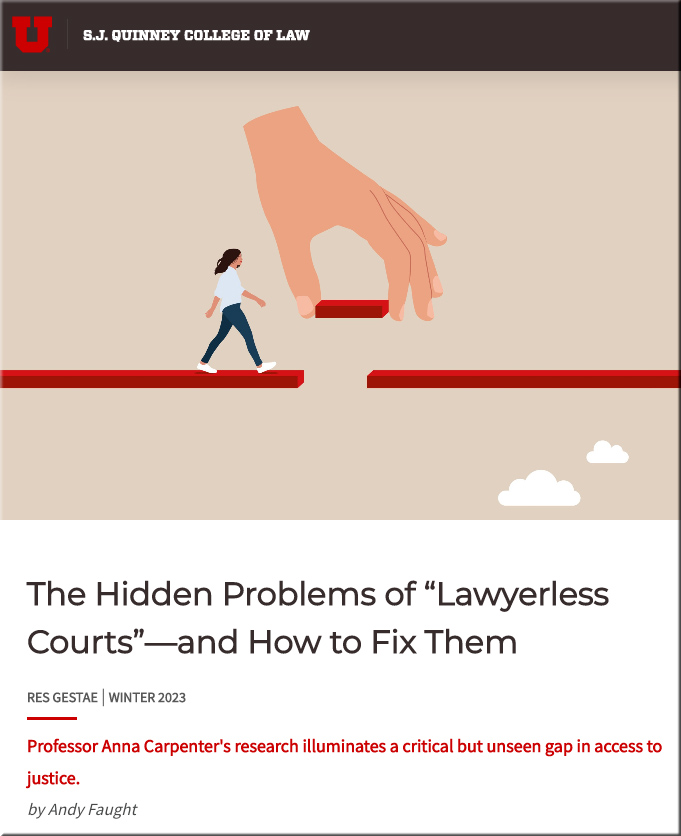
The Hidden Problems of “Lawyerless Courts”—and How to Fix Them

Excerpts:

Every year, 20 million Americans find themselves in state civil courts facing life-altering events such as divorce, child custody deliberations, eviction, and missed bills.

But unlike in criminal courts, where defendants have a constitutional right to legal representation, the same guarantee isn’t afforded in state civil courts. Most people in these courts are low- to middle-income and unable to afford help. They must strike out on their own to blindly navigate byzantine legal protocols.

“The civil justice system is broken in our state courts,” says Utah Law Professor Anna Carpenter, whose research examines state civil courts, the judges who preside in them, and access to justice. She is part of a four-person research team that pioneered a new body of scholarship that analyzes state civil courts.

“I challenge anyone, especially lawyers, to go sit in one of these courtrooms and watch the tragic, day-to-day reality,” Carpenter says. “You’ll see why we believe these courts are the emergency rooms of our justice system.”


The Future of Legal Technology with Gabe Teninbaum

The Future of Legal Technology with Gabe Teninbaum


Introducing: ChatGPT Edu-Mega-Prompts — from drphilippahardman.substack.com by Dr. Philippa Hardman; with thanks to Ray Schroeder out on LinkedIn for this resource
How to combine the power of AI + learning science to improve your efficiency & effectiveness as an educator

From DSC:
Before relaying some excerpts, I want to say that I get the gist of what Dr. Hardman is saying re: quizzes. But I’m surprised to hear she had so many pedagogical concerns with quizzes. I, too, would like to see quizzes used as an instrument of learning and to practice recall — and not just for assessment. But I would give quizzes a higher thumbs up than what she did. I think she was also trying to say that quizzes don’t always identify misconceptions or inaccurate foundational information. 

Excerpts:

The Bad News: Most AI technologies that have been built specifically for educators in the last few years and months imitate and threaten to spread the use of broken instructional practices (i.e. content + quiz).

The Good News: Armed with prompts which are carefully crafted to ask the right thing in the right way, educators can use AI like GPT3 to improve the effectiveness of their instructional practices.
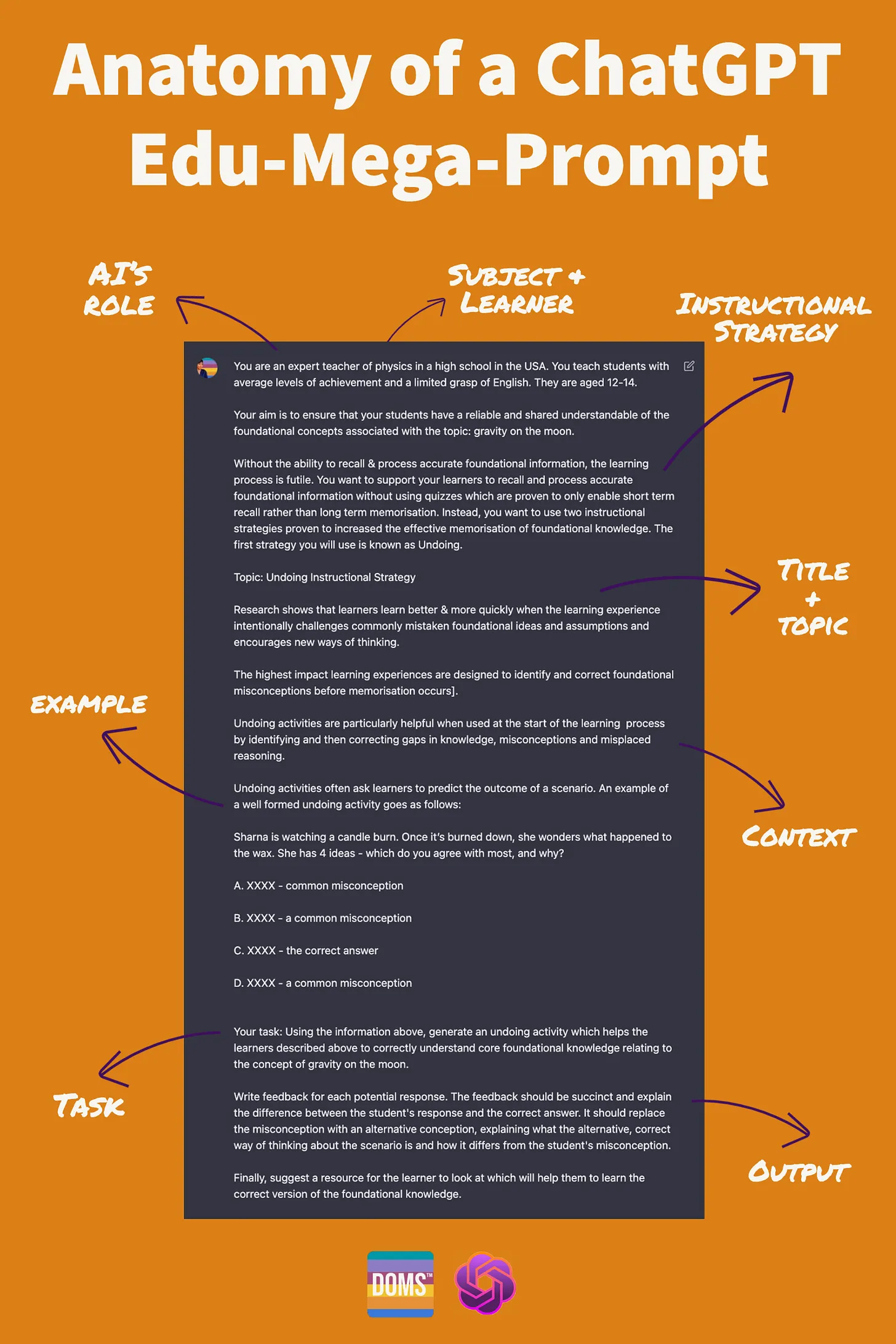
As is always the case, ChatGPT is your assistant. If you’re not happy with the result, you can edit and refine it using your expertise, either alone or through further conversation with ChatGPT.

For example, once the first response is generated, you can ask ChatGPT to make the activity more or less complex, to change the scenario and/or suggest more or different resources – the options are endless.

Philippa recommended checking out Rob Lennon’s streams of content. Here’s an example from his Twitter account:


Also relevant/see:
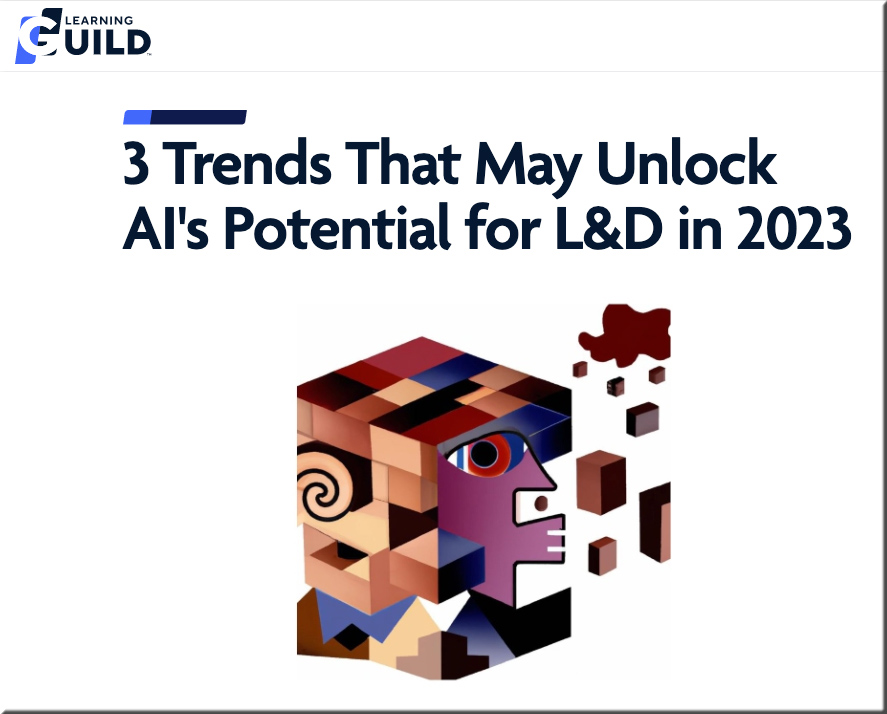
3 trends that may unlock AI's potential for Learning and Development in 2023

3 Trends That May Unlock AI’s Potential for L&D in 2023 — from learningguild.com by Juan Naranjo

Excerpts:

AI-assisted design and development work
This is the trend most likely to have a dramatic evolution this year.
…
Solutions like large language models, speech generators, content generators, image generators, translation tools, transcription tools, and video generators, among many others, will transform the way IDs create the learning experiences our organizations use. Two examples are:

1. IDs will be doing more curation and less creation:

  • Many IDs will start pulling raw material from content generators (built using natural language processing platforms like Open AI’s GPT-3, Microsoft’s LUIS, IBM’s Watson, Google’s BERT, etc.) to obtain ideas and drafts that they can then clean up and add to the assets they are assembling. As technology advances, the output from these platforms will be more suitable to become final drafts, and the curation and clean-up tasks will be faster and easier.
  • Then, the designer can leverage a solution like DALL-E 2 (or a product developed based on it) to obtain visuals that can (or not) be modified with programs like Illustrator or Photoshop (see image below for Dall-E’s “Cubist interpretation of AI and brain science.”

2. IDs will spend less, and in some cases no time at all, creating learning pathways

AI engines contained in LXPs and other platforms will select the right courses for employees and guide these learners from their current level of knowledge and skill to their goal state with substantially less human intervention.


The Creator of ChatGPT Thinks AI Should Be Regulated — from time.com by John Simons

Excerpts:

Somehow, Mira Murati can forthrightly discuss the dangers of AI while making you feel like it’s all going to be OK.
…
A growing number of leaders in the field are warning of the dangers of AI. Do you have any misgivings about the technology?

This is a unique moment in time where we do have agency in how it shapes society. And it goes both ways: the technology shapes us and we shape it. There are a lot of hard problems to figure out. How do you get the model to do the thing that you want it to do, and how you make sure it’s aligned with human intention and ultimately in service of humanity? There are also a ton of questions around societal impact, and there are a lot of ethical and philosophical questions that we need to consider. And it’s important that we bring in different voices, like philosophers, social scientists, artists, and people from the humanities.


Whispers of A.I.’s Modular Future — from newyorker.com by James Somers; via Sam DeBrule

Excerpts:

Gerganov adapted it from a program called Whisper, released in September by OpenAI, the same organization behind ChatGPTand dall-e. Whisper transcribes speech in more than ninety languages. In some of them, the software is capable of superhuman performance—that is, it can actually parse what somebody’s saying better than a human can.
…
Until recently, world-beating A.I.s like Whisper were the exclusive province of the big tech firms that developed them.

Ever since I’ve had tape to type up—lectures to transcribe, interviews to write down—I’ve dreamed of a program that would do it for me. The transcription process took so long, requiring so many small rewindings, that my hands and back would cramp. As a journalist, knowing what awaited me probably warped my reporting: instead of meeting someone in person with a tape recorder, it often seemed easier just to talk on the phone, typing up the good parts in the moment.

From DSC:
Journalism majors — and even seasoned journalists — should keep an eye on this type of application, as it will save them a significant amount of time and/or money.

Microsoft Teams Premium: Cut costs and add AI-powered productivity — from microsoft.com by Nicole Herskowitz

Excerpt:

Built on the familiar, all-in-one collaborative experience of Microsoft Teams, Teams Premium brings the latest technologies, including Large Language Models powered by OpenAI’s GPT-3.5, to make meetings more intelligent, personalized, and protected—whether it’s one-on-one, large meetings, virtual appointments, or webinars.


Best Document Cameras for Teachers — from techlearning.com by Luke Edwards
Get the best document camera for teachers to make the classroom more digitally immersive

Along the lines of edtech, also see:

Tech & Learning Names Winners of the Best of 2022 Awards — from techlearning.com by TL Editors
This annual award celebrates recognizing the very best in EdTech from 2022

.
The Tech & Learning Awards of Excellence: Best of 2022 celebrate educational technology from the last 12 months that has excelled in supporting teachers, students, and education professionals in the classroom, for professional development, or general management of education resources and learning. Nominated products are divided into three categories: Primary, Secondary, or Higher Education.


Talking Tech for Solo and Small Law Firms on the Florida Bar’s Legalfuel Podcast — from lawnext.com by Bob Ambrogi

Excerpt:

When it comes to legal technology for solo and small law firms, I don’t think there’s a topic we didn’t touch on in this episode of the Florida Bar’s Legalfuel podcast. Hosts Christine Bilbrey, director of the Florida Bar’s practice resource center, and Jamie Moore, practice management advisor, asked me about everything from law practice management platforms to password managers to the dark web.

Also see:

There’s a push for young lawyers to practice in rural America — from denver7.com by Diane Duenez

Excerpt:

Richard Moberly is the dean at the University of Nebraska College of Law. When his state saw a lack of rural doctors, the medical college developed a rural training track to set up students in areas of need.

“About 60% of those students ended up going back to those communities. So, we’re hoping for the same,” Moberly said. “A lot of the older attorneys, especially, have worked with the people in that community for a generation and know that, if no one can step in to their shoes, those people are really going to lose out on the services that lawyers provide.”


Contracts Company Ironclad Taps Into GPT-3 For Instant Document Redlining Based On A Company’s Playbook — from lawnext.com by Robert Ambrogi

Excerpt:

The contract lifecycle management company Ironclad has tapped into the power of OpenAI’s GPT-3 to introduce AI Assist, a beta feature that instantly redlines contracts based on a company’s playbook of approved clauses and language.

The redlines, made using GPT-3’s generative artificial intelligence, appear as tracked changes in Microsoft Word, where a user can then scan the recommended changes and either accept or reject them.


Addendum:


Educator considerations for ChatGPT — from platform.openai.com; with thanks to Anna Mills for this resource

Excerpt:

Streamlined and personalized teaching
Some examples of how we’ve seen educators exploring how to teach and learn with tools like ChatGPT:

  • Drafting and brainstorming for lesson plans and other activities
  • Help with design of quiz questions or other exercises
  • Experimenting with custom tutoring tools
  • Customizing materials for different preferences (simplifying language, adjusting to different reading levels, creating tailored activities for different interests)
  • Providing grammatical or structural feedback on portions of writing
  • Use in upskilling activities in areas like writing and coding (debugging code, revising writing, asking for explanations)
  • Critique AI generated text

While several of the above draw on ChatGPT’s potential to be explored as a tool for personalization, there are risks associated with such personalization as well, including student privacy, biased treatment, and development of unhealthy habits. Before students use tools that offer these services without direct supervision, they and their educators should understand the limitations of the tools outlined below.

Also relevant/see:

Excerpt (emphasis DSC):
David Wiley wrote a thoughtful post on the ways in which AI and Large Language Models (LLMs) can “provide instructional designers with first drafts of some of the work they do.” He says “imagine you’re an instructional designer who’s been paired with a faculty member to create a course in microeconomics. These tools might help you quickly create first drafts of” learning outcomes, discussion prompts, rubrics, and formative assessment items.  The point is that LLMs can quickly generate rough drafts that are mostly accurate drafts, that humans can then “review, augment, and polish,” potentially shifting the work of instructional designers from authors to editors. The post is well worth your time.
…
The question that I’d like to spend some time thinking about is the following: What new knowledge, capacities, and skills do  instructional designers need in their role as editors and users of LLMs?

This resonated with me. Instructional Designer positions are starting to require AI and ML chops. I’m introducing my grad students to AI and ChatGPT this semester. I have an assignment based on it.

(This ain’t your father’s instructional design…)

Robert Gibson


Virtual Exam Case Primes Privacy Fight Over College Room Scans — from news.bloomberglaw.com by Skye Witley

  • Cleveland State case centers on remote proctoring software
  • Fourth Amendment protections in question before Sixth Circuit

Excerpt:

A legal dispute over a university’s use of exam proctoring software that allegedly scanned students’ rooms is set to shape the scope of Fourth Amendment and privacy protections for online college tests.

Cleveland State University last week asked a federal appeals court in Cincinnati to review a district court finding that the “room scans” were unconstitutional searches. The case could influence how other students litigate their privacy rights and change how universities virtually monitor their students during exams, attorneys said.


Revolutionising Criminal Law with AI — from seotraininglondon.org by Danny Richman
This case study outlines how I helped a law firm use Artificial Intelligence (AI) to streamline new client enquiries, resulting in significant savings of time and money.

Excerpt:

However, this process took up a lot of time and resources, meaning that highly qualified, well-paid individuals had to dedicate their time and energy to processing email enquiries instead of working on client cases.

That’s why I developed an app for Stuart Miller built on OpenAI’s GPT-3 technology. This app receives the content of the client’s email and makes the same determination as the human team of lawyers. It then immediately alerts the relevant lawyer to any enquiries flagged as high-priority, high-value cases. The entire process is automated requiring no human interaction.

From DSC:
Hmmm…something to keep on the radar.


Also relevant/see:

Here’s Why Lawyers Are Paying Attention to ChatGPT — from legallydisrupted.com by Zach Abramowitz
AI Will Continue to Be a Talking Point Throughout the Year

Excerpts:

Ready to get disrupted? Me neither, but let’s take the plunge.

ChatGPT is all anyone in legal wants to talk about right now, and for good reason.
…
Smash cut to yesterday, and this webinar focusing on ChatGPT is sold out and the sheer number of questions from the audience (which ranged from law students to in-house counsel and law firm partners) was more than 10x a normal webinar.

The point is that I’m not in a bubble this time. Everyone in legal is paying attention to ChatGPT, not just the legaltech nerds. This @#$% is going mainstream.


© 2025 | Daniel Christian