Send in another victim of industrial disease — from jordanfurlong.substack.com
The legal profession is drowning in psychological and emotional distress. One change, right now, could help save the next generation of lawyers from the flood.

Excerpt:

But don’t make the mistake of thinking this is a problem just at Paul Hastings or in the AmLaw 100. It’s everywhere. Mental distress and emotional anguish are endemic throughout the legal profession, driven by pathologies inextricably intertwined with our malignant cultural impulses and exploitative business models. And it’s getting much worse, very fast.

Take a deep breath, and then work your way through this list of findings from seven separate reports into the legal profession’s state of mental and emotional sickness:

  • Massachusetts: 77% of lawyers reported burnout from their work; almost half thought about leaving their job. 40% considered leaving the profession entirely due to stress. 7% experienced suicide ideation in the weeks before the survey.
  • California and DC: Lawyers were twice as likely as the general population to experience thoughts of suicide, and those with high stress were 22 times more likely to have such thoughts.
  • Midsized law firms: Nearly 3/4 of lawyers, paralegals and administrative professionals at midsized law firms report feeling stress, burnout, or being overwhelmed in the past year.
  • Canada: 59% of legal professionals report psychological distress. 56% report burnout. 24% say they’ve experienced suicidal thoughts at least once since starting practice.
  • UK: 62% of lawyers have experienced burnout as a result of their work in the last year. 57% put “an unmanageable caseload” at the top of their list of stressors at work, followed by a lack of work/life balance (42%).
  • In-house counsel: Legal department lawyers face burnout and attrition internally, and supply chain issues and high inflation externally. “The environment legal departments are operating in now is an extremely challenging one.”
  • Law students: Over 75% reported increased anxiety because of law school-related issues; over 50% reported experiencing depression. A majority reported experiencing anxiety (77%), disrupted sleep (71%), and depression (51%).

Every one of the percentages laid out above is higher for new lawyers, higher for women, higher for visible minorities, and higher for members of the LGBTQ+ community. And all but one of these reports were released just in the first two months of 2023.


From DSC:
One of the enormous surprises that I learned about while working at a law school (from 2018-2021) is the state of mental health within the legal industry. It’s not good. Beware!

Students in college — or to anyone who is thinking about entering law school and then practicing some area of law — get educated on things. Talk to lawyers of all kinds — especially in the area(s) that you are thinking of going into.

Then go forward into your decision with your eyes wide open. Know that you will need to put up some serious boundaries; if you don’t do that, you too may suffer the consequences that many lawyers have had to deal with.

I caught up with an old college friend of mine a year or so ago. He was absolutely exhausted. He was emotionally at the end of his rope. He was the owner of his own law firm and was working non-stop. He didn’t want to disappoint his clients, so he kept saying yes to things…to almost everything in fact. He later got out of owning his own firm — thank God — and went to work for an insurance company.

Furlong: Law school curricula and bar admission programs in every jurisdiction should be upgraded, starting today, to include significant instruction to aspiring lawyers about the deadly serious threats to their lives and health posed by choosing a legal career.

I just want to pass this along because I don’t think many younger students realize the state of mental health and stress within the legal field. And while you’re reflecting on that, you should also pulse-check how AI is impacting the legal field. Along these lines — and also from Jordan Furlong — see:


Introducing Teach AI — Empowering educators to teach w/ AI & about AI [ISTE & many others]


Teach AI -- Empowering educators to teach with AI and about AI


Also relevant/see:


Fresh Voices on Legal Tech – New Podcast Interview Series — from legaltechmonitor.com by Dennis Kennedy and Tom Mighell

Here are the episodes so far:

  • Fresh Voices on Legal Tech with Kristen Sonday – Kristen talks about her platform at Paladin connecting lawyers to pro bono work; weighs in on ChatGPT, AI, tech adoption, and more; and shares her top tip for using technology in legal practice.
  • Fresh Voices on Legal Tech with Chase Hertel – Chase discusses his career path and offers tips for helping attorneys engage with technology to improve their practice. They dig into the potential uses and dangers of ChatGPT and other AI tech in the profession, discuss Chase’s work in immigration legal tech, and survey the outlook of legal tech’s future.
  • Fresh Voices on Legal Tech with Natalie Knowlton – Natalie discusses the current state of legal services, the justice gap, and ways technology is helping attorneys provide better and more affordable services to consumers.
 

An Open Letter from a Future Lawyer Now Studying for the Bar Exam — from abaforlawstudents.com by Megan Parker

Excerpt:

The Uniform Bar Exam (UBE) spans two days, with closed-book testing comprising three components prepared by the National Conference of Bar Examiners.

On the first day (a Tuesday), I’ll write six multistate essay exam (MEE) responses in the morning. The MEE questions can pertain to any one of the following areas of law: business associations, conflicts of law, constitutional law, contracts/sales, criminal law and procedure, evidence, family law, federal civil procedure, real property, secured transactions, torts, and trusts and estates.

In the afternoon, I’ll write two multistate performance test (MPT)responses that require composing two real-life practice documents from a “file” and “library” of approximately 25 pages each that I must read, analyze, and digest on the spot.

On the second day (a Wednesday), I’ll need to answer 200 multistate bar examination (MBE)multiple-choice questions covering six subject areas: constitutional law, contracts/sales, criminal law and procedure, evidence, federal civil procedure, real property, and torts.

Also relevant/see:

Q&A with a Bar Exam Tutor—Frequently Asked Questions about the Bar Exam — from abaforlawstudents.com by JD Advising

Excerpts:

What is the best advice for passing the bar exam the first time?

  • What everyone says is true: studying for the bar is a marathon, not a sprint. Investing the time early in your studies to be diligent and sticking to your study schedule will reward you in the long run.
  • Be Consistent
  • Take Care of Yourself
  • Make a Schedule
  • Use the Strategies That Work for You
 

7 reasons to get rid of the law degree — from jordanfurlong.substack.com by Jordan Furlong
Requiring a law degree for bar admission imposes unfair burdens on new lawyers and blocks innovation in legal education. Here’s what we can do instead.

Excerpt:

Hey there, legal sector participant! Do you feel that law school is too expensive? That law students graduate too heavily in debt and deeply stressed? That legal education seems impossible to reform? That the whole lawyer development and bar admission system in general is an enormous hot mess?

If so, you’re like thousands of others who’ve grown massively frustrated with the profession’s broken-down approach to developing new lawyers. But I’m here with some good news! There’s a simple and straightforward path to resolving these and many other problems with legal education and bar admission.

We start by getting rid of the law degree.

Now, hold on, let me be clear — I don’t mean kill the law degree itself. That would be crazy.

No, I mean, let’s get rid of the law degree as a mandatory element of the lawyer licensing process. Law schools should continue to offer whatever sort of degree programs they like — but legal regulators and bar admission authorities should no longer require everybody who wants to be a lawyer to get one.

From DSC:
I need to think on this further, but Jordan could be onto something here…

A better pathway to lawyer licensing — from jordanfurlong.substack.com by Jordan Furlong
No law degree; a single knowledge exam; training in legal, business and professional skills; and a term of supervised practice. This is how we do it.

Excerpt:

Previously here at Substack, I provided a pretty comprehensive takedown of the law degree requirement for lawyer licensing. It generated a ton of fascinating and gratifying feedback, here and especially at LinkedIn, with a few objections but mostly a lot of support.

Of course, it’s easy to criticize legal education — fun, too — but look, most people in the legal profession already know all the problems with the law degree, and complaining about it is kind of a vacuous pastime. What I’m really interested in here is a bigger and more important question: How does — how should — someone become a lawyer?


EdTech Is Going Crazy For AI — from joshbersin.com by Josh Bersin

Excerpts:

This week I spent a few days at the ASU/GSV conference and ran into 7,000 educators, entrepreneurs, and corporate training people who had gone CRAZY for AI.

No, I’m not kidding. This community, which makes up people like training managers, community college leaders, educators, and policymakers is absolutely freaked out about ChatGPT, Large Language Models, and all sorts of issues with AI. Now don’t get me wrong: I’m a huge fan of this. But the frenzy is unprecedented: this is bigger than the excitement at the launch of the i-Phone.

Second, the L&D market is about to get disrupted like never before. I had two interactive sessions with about 200 L&D leaders and I essentially heard the same thing over and over. What is going to happen to our jobs when these Generative AI tools start automatically building content, assessments, teaching guides, rubrics, videos, and simulations in seconds?

The answer is pretty clear: you’re going to get disrupted. I’m not saying that L&D teams need to worry about their careers, but it’s very clear to me they’re going to have to swim upstream in a big hurry. As with all new technologies, it’s time for learning leaders to get to know these tools, understand how they work, and start to experiment with them as fast as you can.


Speaking of the ASU+GSV Summit, see this posting from Michael Moe:

EIEIO…Brave New World
By: Michael Moe, CFA, Brent Peus, Owen Ritz

Excerpt:

Last week, the 14th annual ASU+GSV Summit hosted over 7,000 leaders from 70+ companies well as over 900 of the world’s most innovative EdTech companies. Below are some of our favorite speeches from this year’s Summit…

***

Also see:

Imagining what’s possible in lifelong learning: Six insights from Stanford scholars at ASU+GSV — from acceleratelearning.stanford.edu by Isabel Sacks

Excerpt:

High-quality tutoring is one of the most effective educational interventions we have – but we need both humans and technology for it to work. In a standing-room-only session, GSE Professor Susanna Loeb, a faculty lead at the Stanford Accelerator for Learning, spoke alongside school district superintendents on the value of high-impact tutoring. The most important factors in effective tutoring, she said, are (1) the tutor has data on specific areas where the student needs support, (2) the tutor has high-quality materials and training, and (3) there is a positive, trusting relationship between the tutor and student. New technologies, including AI, can make the first and second elements much easier – but they will never be able to replace human adults in the relational piece, which is crucial to student engagement and motivation.


A guide to prompting AI (for what it is worth) — from oneusefulthing.org by Ethan Mollick
A little bit of magic, but mostly just practice

Excerpt (emphasis DSC):

Being “good at prompting” is a temporary state of affairs. The current AI systems are already very good at figuring out your intent, and they are getting better. Prompting is not going to be that important for that much longer. In fact, it already isn’t in GPT-4 and Bing. If you want to do something with AI, just ask it to help you do the thing. “I want to write a novel, what do you need to know to help me?” will get you surprisingly far.
…

The best way to use AI systems is not to craft the perfect prompt, but rather to use it interactively. Try asking for something. Then ask the AI to modify or adjust its output. Work with the AI, rather than trying to issue a single command that does everything you want. The more you experiment, the better off you are. Just use the AI a lot, and it will make a big difference – a lesson my class learned as they worked with the AI to create essays.

From DSC:
Agreed –> “Being “good at prompting” is a temporary state of affairs.” The User Interfaces that are/will be appearing will help greatly in this regard.


From DSC:
Bizarre…at least for me in late April of 2023:


Excerpt from Lore Issue #28: Drake, Grimes, and The Future of AI Music — from lore.com

Here’s a summary of what you need to know:

  • The rise of AI-generated music has ignited legal and ethical debates, with record labels invoking copyright law to remove AI-generated songs from platforms like YouTube.
  • Tech companies like Google face a conundrum: should they take down AI-generated content, and if so, on what grounds?
  • Some artists, like Grimes, are embracing the change, proposing new revenue-sharing models and utilizing blockchain-based smart contracts for royalties.
  • The future of AI-generated music presents both challenges and opportunities, with the potential to create new platforms and genres, democratize the industry, and redefine artist compensation.

The Need for AI PD — from techlearning.com by Erik Ofgang
Educators need training on how to effectively incorporate artificial intelligence into their teaching practice, says Lance Key, an award-winning educator.

“School never was fun for me,” he says, hoping that as an educator he could change that with his students. “I wanted to make learning fun.”  This ‘learning should be fun’ philosophy is at the heart of the approach he advises educators take when it comes to AI. 


Coursera Adds ChatGPT-Powered Learning Tools — from campustechnology.com by Kate Lucariello

Excerpt:

At its 11th annual conference in 2023, educational company Coursera announced it is adding ChatGPT-powered interactive ed tech tools to its learning platform, including a generative AI coach for students and an AI course-building tool for teachers. It will also add machine learning-powered translation, expanded VR immersive learning experiences, and more.

Coursera Coach will give learners a ChatGPT virtual coach to answer questions, give feedback, summarize video lectures and other materials, give career advice, and prepare them for job interviews. This feature will be available in the coming months.

From DSC:
Yes…it will be very interesting to see how tools and platforms interact from this time forth. The term “integration” will take a massive step forward, at least in my mind.


The Good and the Bad of Solo Practice, Per Clio’s Latest Legal Trends Report for Solos — from lawnext.com by Bob Ambrogi

Excerpt:

As a solo myself, I can tell you that there is much to be said for practicing on your own – freedom and independence not least among them. In fact, during 2022’s “Great Resignation,” a third of lawyers who quit their jobs did so to start their own solo practices, according to Legal Trends for Solo Law Firms, a report published today by law practice management company Clio.

But there are also disadvantages to practicing alone and challenges unique to solo lawyers, as this latest report documents.


A New Era for Education — from linkedin.com by Amit Sevak, CEO of ETS and Timothy Knowles, President of the Carnegie Foundation for the Advancement of Teaching

Excerpt (emphasis DSC):

It’s not every day you get to announce a revolution in your sector. But today, we’re doing exactly that. Together, we are setting out to overturn 117 years of educational tradition.
…
The fundamental assumption [of the Carnegie Unit] is that time spent in a classroom equals learning. This formula has the virtue of simplicity. Unfortunately, a century of research tells us that it’s woefully inadequate.


From DSC:
It’s more than interesting to think that the Carnegie Unit has outlived its usefulness and is breaking apart. In fact, the thought is very profound.

It's more than interesting to think that the Carnegie Unit has outlived its usefulness and is breaking apart. In fact, the thought is very profound.

If that turns out to be the case, the ramifications will be enormous and we will have the opportunity to radically reinvent/rethink/redesign what our lifelong learning ecosystems will look like and provide.

So I appreciate what Amit and Timothy are saying here and I appreciate their relaying what the new paradigm might look like. It goes with the idea of using design thinking to rethink how we build/reinvent our learning ecosystems. They assert:

It’s time to change the paradigm. That’s why ETS and the Carnegie Foundation have come together to design a new future of assessment.

    • Whereas the Carnegie Unit measures seat time, the new paradigm will measure skills—with a focus on the ones we know are most important for success in career and in life.
    • Whereas the Carnegie Unit never leaves the classroom, the new paradigm will capture learning wherever it takes place—whether that is in after-school activities, during a work-experience placement, in an internship, on an apprenticeship, and so on.
    • Whereas the Carnegie Unit offers only one data point—pass or fail—the new paradigm will generate insights throughout the learning process, the better to guide students, families, educators, and policymakers.

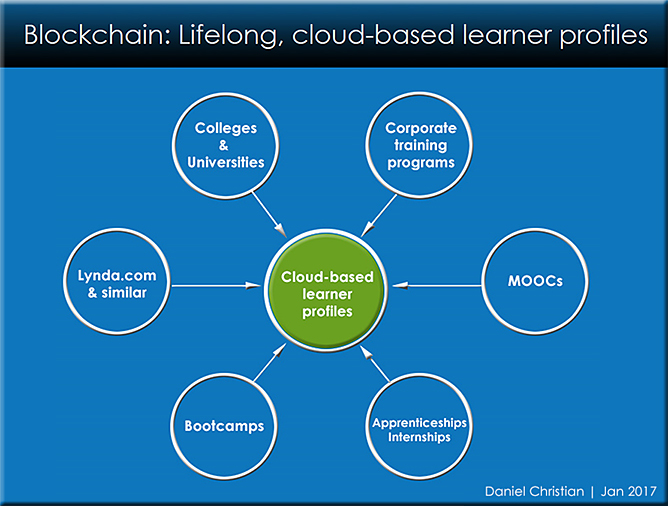
I could see this type of information being funneled into peoples’ cloud-based learner profiles — which we as individuals will own and determine who else can access them. I diagrammed this back in January of 2017 using blockchain as the underlying technology. That may or may not turn out to be the case. But the concept will still hold I think — regardless of the underlying technology(ies).

Perhaps blockchain will be the underlying technology to provide us with cloud-based learner profiles

For example, we are seeing a lot more articles regarding things like Comprehensive Learner Records (CLR) or Learning and Employment Records (LER; example here), and similar items.

LER — The Learning and Employment Record for a Skills-Based Economy


Speaking of reinventing our learning ecosystems, also see:


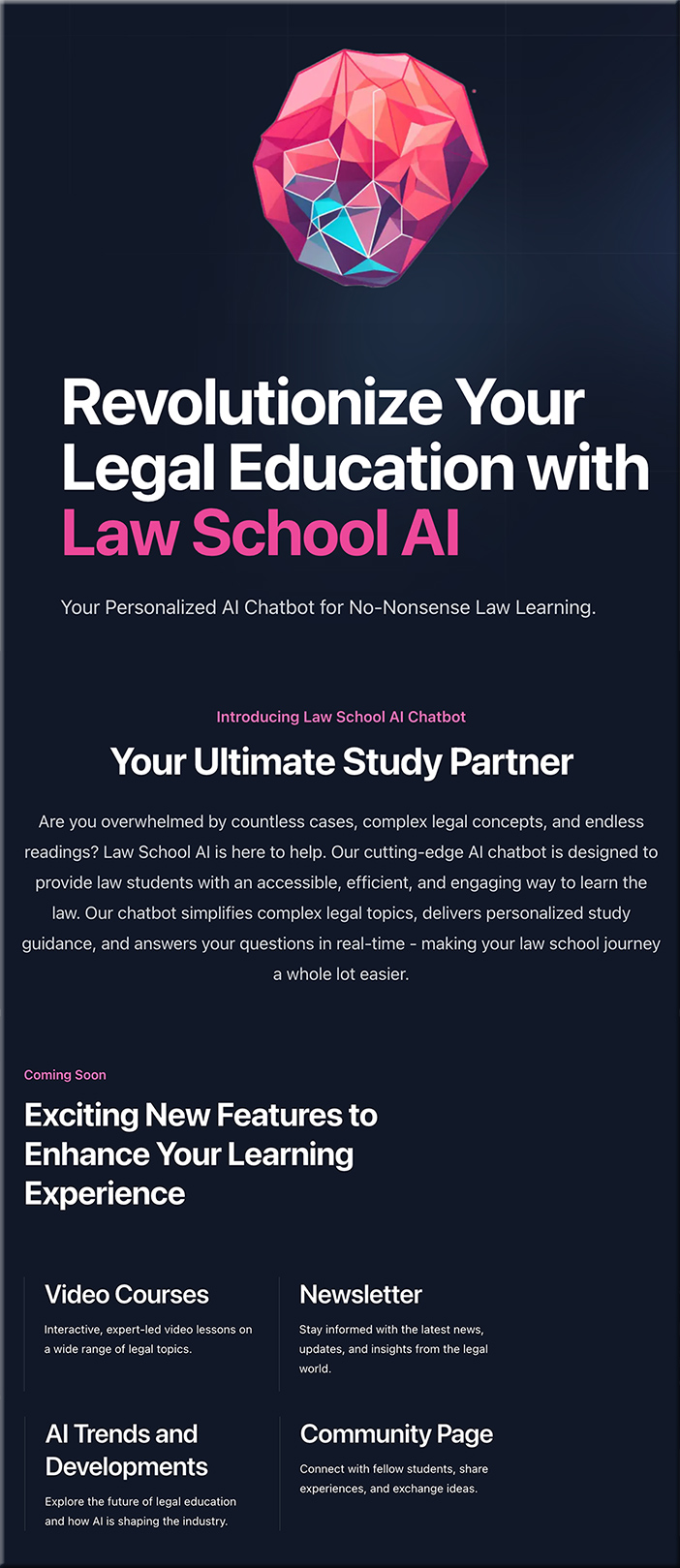
law-school-ai.vercel.app -- Your Personalized AI Chatbot for No-Nonsense Law Learning.


From DSC:
I haven’t used this app or their website (which seems to have a lot of broken links!). But my question/reflection is…is this a piece of legal education’s future? Or even larger than that? I can easily see a LegalGPT type of service out there for ***society at large.***


‘Legal Tech Lists’: The 10 Most Significant Legal Tech Developments Since 2010 — from abovethelaw.com by Robert Ambrogi
Startups, AI, the cloud, and much more.

Excerpt:

Every year, I write a year-end wrap-up of the most significant developments in legal technology.

At the end of the past decade, I decided to look back on the most significant developments of the 2010s as a whole. It may well have been the most tumultuous decade ever in changing how legal services are delivered.

Here, I revisit those changes — and add a few post-2020 updates.


Justice Through Code — from centerforjustice.columbia.edu by ; via Matt Tower
Unlocking Potential for the 80+ Million Americans with a Conviction History.

Excerpt:

A world where every person, regardless of past convictions or incarceration can access life-sustaining and meaningful careers.

We are working to make this vision a reality through our technical and professional career development accelerators.

Our Mission: We educate and nurture talent with conviction histories to create a more just and diverse workforce. We increase workplace equity through partnerships that educate and prepare teams to create supportive pathways to careers that end the cycle of poverty that contributes to incarceration and recidivism.

JTC is jointly offered by Columbia University’s Center for Justice, and the Tamer Center for Social Enterprise at the Columbia Business School.


The future of education in a world of AI — from oneusefulthing.org by Ethan Mollick
A positive vision for the transformation to come

Excerpt:

Imagine introducing high-quality AI tutors into the flipped classroom model. These AI-powered systems have the potential to significantly enhance the learning experience for students and make flipped classrooms even more effective. They provide personalized learning, where AI tutors can tailor instruction to each student’s unique needs while continually adjusting content based on performance. This means that students can engage with the content at home more effectively, ensuring they come to class better prepared and ready to dive into hands-on activities or discussions.

With AI tutors taking care of some of the content delivery outside of class, teachers can devote more time to fostering meaningful interactions with their students during class. They can also use insights from the AI tutors to identify areas where students might need extra support or guidance, enabling them to provide more personalized and effective instruction. And with AI assistance, they can design better active learning opportunities in class to make sure learnings stick.


Also relevant/see:

ChatGPT is going to change education, not destroy it — from technologyreview.com by Will Douglas Heaven
The narrative around cheating students doesn’t tell the whole story. Meet the teachers who think generative AI could actually make learning better.

Advanced chatbots could be used as powerful classroom aids that make lessons more interactive, teach students media literacy, generate personalized lesson plans, save teachers time on admin, and more.

Will ChatGPT Change How Professors Assess Learning? — from chronicle.com by Becky Supiano
It won’t be easy without their colleges’ support.

What the Past Can Teach Us About the Future of AI and Education — from campustechnology.com by Dr. David Wiley
Current attitudes toward generative AI hearken back to early skepticism about the impact of the internet on education. Both then and now, technology has created challenges but also opportunities that can’t be ignored.


How Easy Is It/Will It Be to Use AI to Design a Course? — from wallyboston.com by Wally Boston

Excerpt:

Last week I received a text message from a friend to check out a March 29th Campus Technology article about French AI startup, Nolej. Nolej (pronounced “Knowledge”) has developed an OpenAI-based instructional content generator for educators called NolejAI.

Access to NolejAI is through a browser. Users can upload video, audio, text documents, or a website url. NolejAI will generate an interactive micro-learning package which is a standalone digital lesson including content transcript, summaries, a glossary of terms, flashcards, and quizzes. All the lesson materials generated is based upon the uploaded materials.


From DSC:
I wonder if this will turn out to be the case:

I am sure it’s only a matter of time before NolejAI or another product becomes capable of generating a standard three credit hour college course. Whether that is six months or two years, it’s likely sooner than we think.


Also relevant/see:

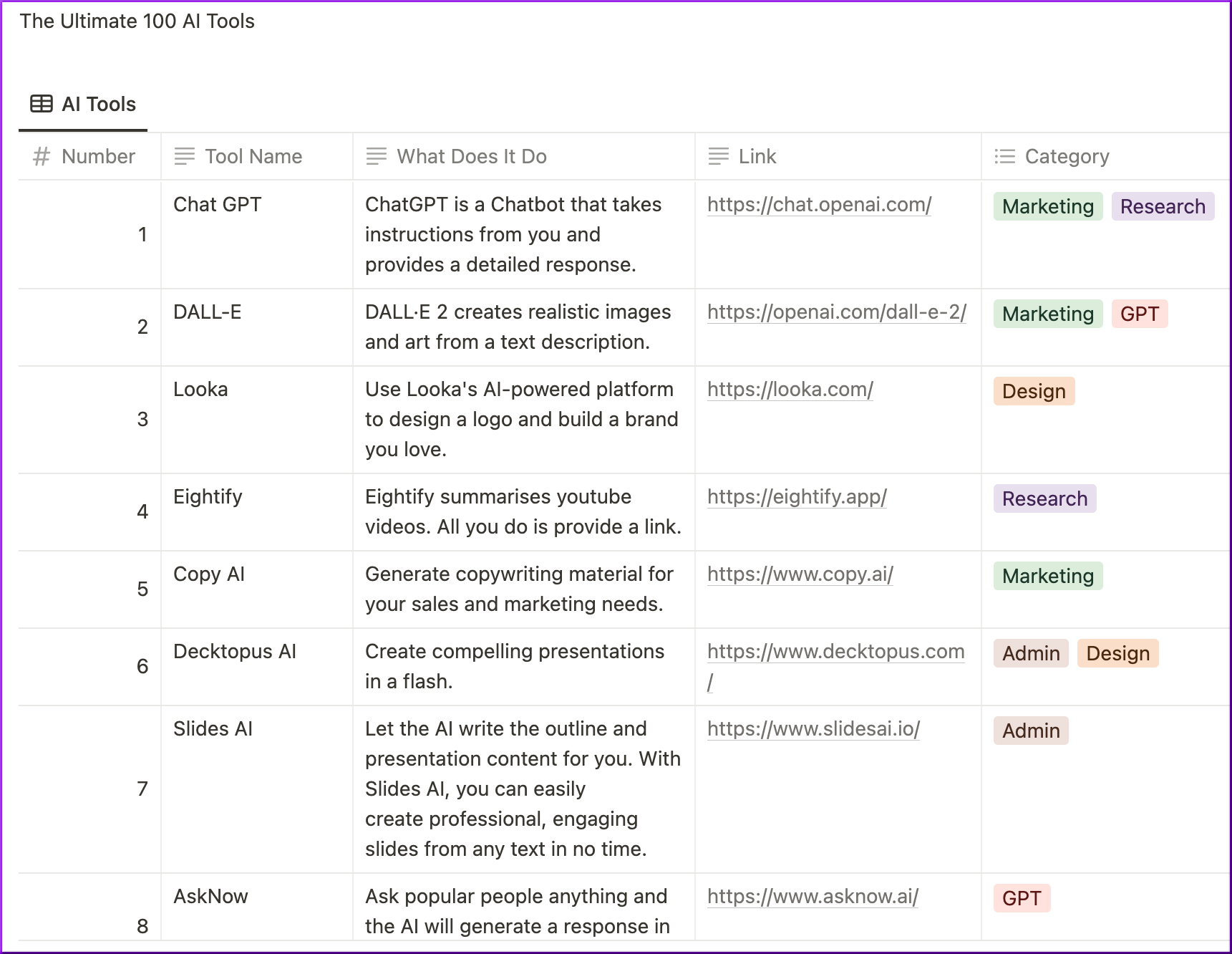
The Ultimate 100 AI Tools

The Ultimate 100 AI Tools -- as of 4-12-23


© 2025 | Daniel Christian