DC: Likely a piece of our future learning ecosystems… #AI #LearningEcosystems #Learning #LifelongLearning #Platforms https://t.co/rIISC4BQ8b via @YouTube
— Daniel Christian (@dchristian5) July 5, 2019
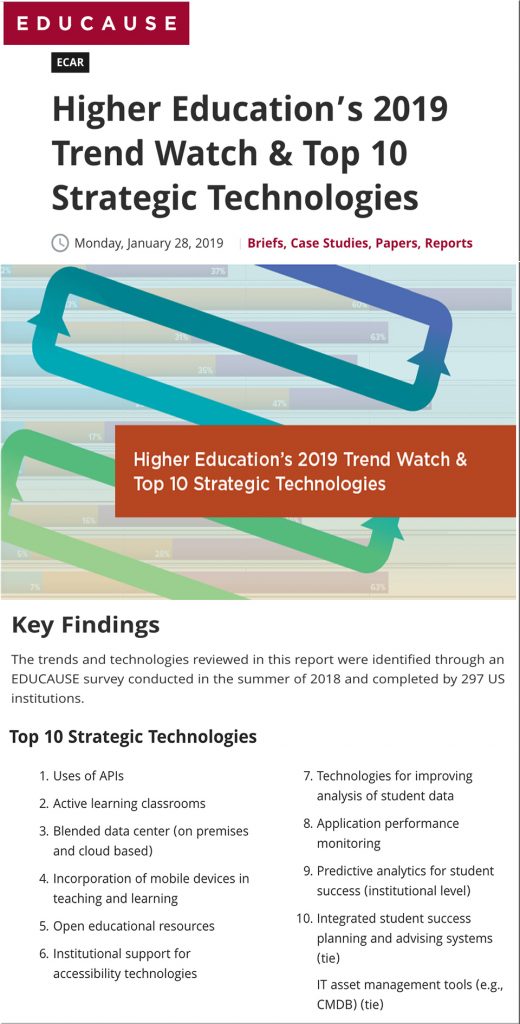
Higher Education’s 2019 Trend Watch & Top 10 Strategic Technologies — from EDUCAUSE Center for Analysis and Research (ECAR)
Most Influential Trends
From DSC:
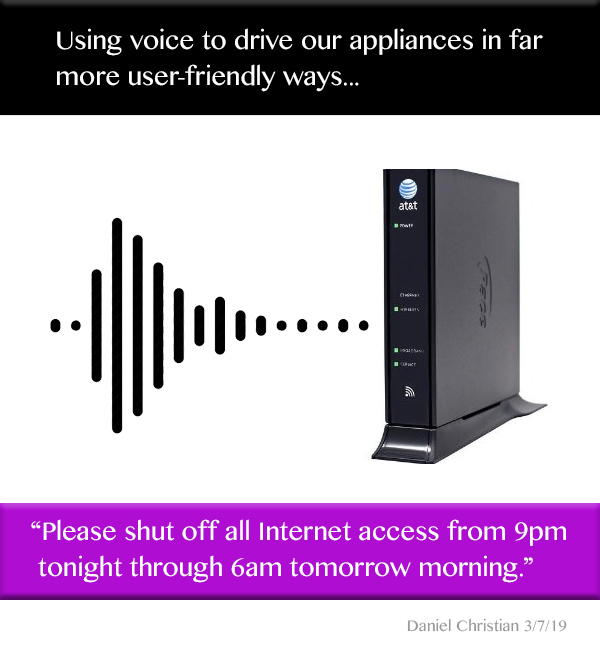
Our family uses AT&T for our smartphones and for our Internet access. What I would really like from AT&T is to be able to speak into an app — either located on a smartphone or have their routers morph into Alexa-type of devices — to be able to speak to what I want my router to do:
“Turn off Internet access tonight from 9pm until 6am tomorrow morning.”
“Only allow Internet access for parents’ accounts.”
“Upgrade my bandwidth for the next 2 hours.”
Upon startup, the app would ask whether I wanted to setup any “admin” types of accounts…and, if so, would recognize that voice/those voices as having authority and control over the device.
Would you use this type of interface? I know I would!
P.S. I’d like to be able to speak to our
thermostat in that sort of way as well.
Amazon has 10,000 employees dedicated to Alexa — here are some of the areas they’re working on — from businessinsider.com by Avery Hartmans
Summary (emphasis DSC):
From DSC:
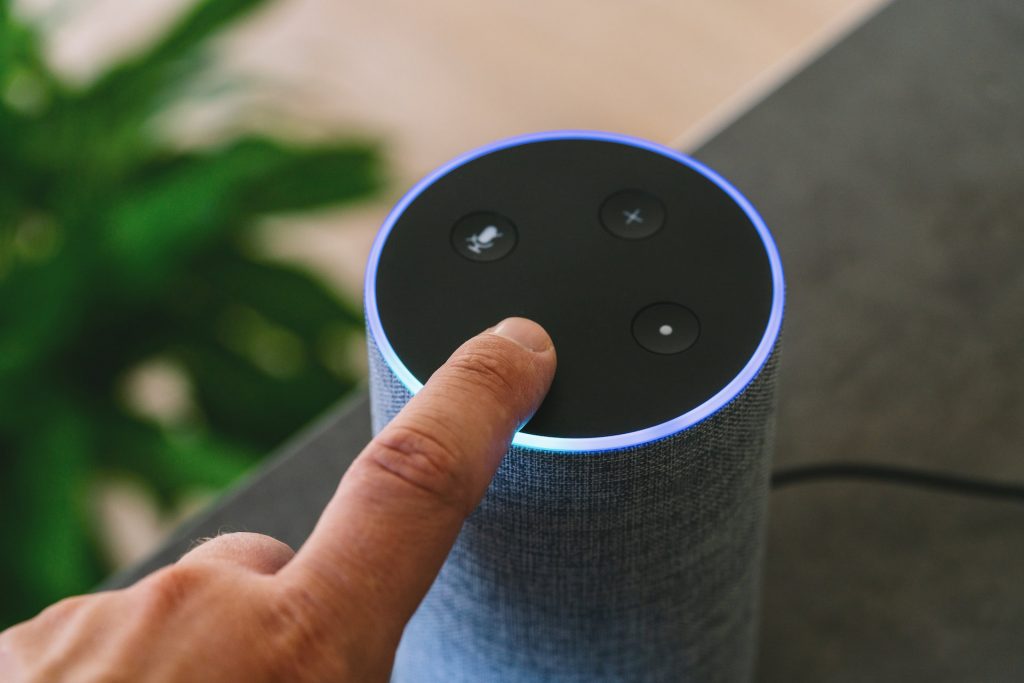
How might this trend impact learning spaces? For example, I am interested in using voice to intuitively “drive” smart classroom control systems:
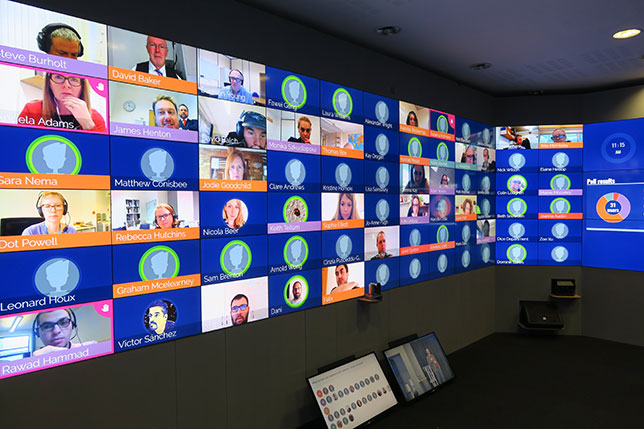
Creating an Immersive, Global Experience for Business Education — from campustechnology.com by Meg Lloyd
The University of Oxford’s Saïd Business School is using cutting-edge videoconferencing technology to connect students and academic scholars in a truly global classroom.
From DSC:
I have often reflected on differentiation or what some call personalized learning and/or customized learning. How does a busy teacher, instructor, professor, or trainer achieve this, realistically?
It’s very difficult and time-consuming to do for sure. But it also requires a team of specialists to achieve such a holy grail of learning — as one person can’t know it all. That is, one educator doesn’t have the necessary time, skills, or knowledge to address so many different learning needs and levels!
Educators and trainers have so many things on their plates that it’s very difficult to come up with _X_ lesson plans/agendas/personalized approaches, etc. On the other side of the table, how do students from a vast array of backgrounds and cognitive skill levels get the main points of a chapter or piece of text? How can they self-select the level of difficulty and/or start at a “basics” level and work one’s way up to harder/more detailed levels if they can cognitively handle that level of detail/complexity? Conversely, how do I as a learner get the boiled down version of a piece of text?
Well… just as with the flipped classroom approach, I’d like to suggest that we flip things a bit and enlist teams of specialists at the publishers to fulfill this need. Move things to the content creation end — not so much at the delivery end of things. Publishers’ teams could play a significant, hugely helpful role in providing customized learning to learners.
Some of the ways that this could happen:
Use an HTML like language when writing a textbook, such as:
<MainPoint> The text for the main point here. </MainPoint>
<SubPoint1>The text for the subpoint 1 here.</SubPoint1>
<DetailsSubPoint1>More detailed information for subpoint 1 here.</DetailsSubPoint1>
<SubPoint2>The text for the subpoint 2 here.</SubPoint2>
<DetailsSubPoint2>More detailed information for subpoint 2 here.</DetailsSubPoint2>
<SubPoint3>The text for the subpoint 3 here.</SubPoint3>
<DetailsSubPoint3>More detailed information for subpoint 3 here.</DetailsSubPoint1>
<SummaryOfMainPoints>A list of the main points that a learner should walk away with.</SummaryOfMainPoints>
<BasicsOfMainPoints>Here is a listing of the main points, but put in alternative words and more basic ways of expressing those main points. </BasicsOfMainPoints>
<Conclusion> The text for the concluding comments here.</Conclusion>
<BasicsOfMainPoints> could be called <AlternativeExplanations>
Bottom line: This tag would be to put things forth using very straightforward terms.
Another tag would be to address how this topic/chapter is relevant:
<RealWorldApplication>This short paragraph should illustrate real world examples
of this particular topic. Why does this topic matter? How is it relevant?</RealWorldApplication>
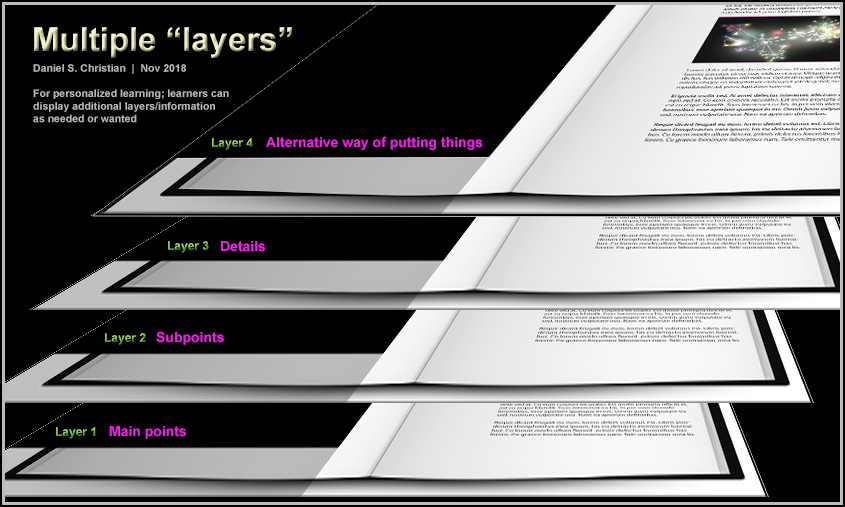
On the students’ end, they could use an app that works with such tags to allow a learner to quickly see/review the different layers. That is:
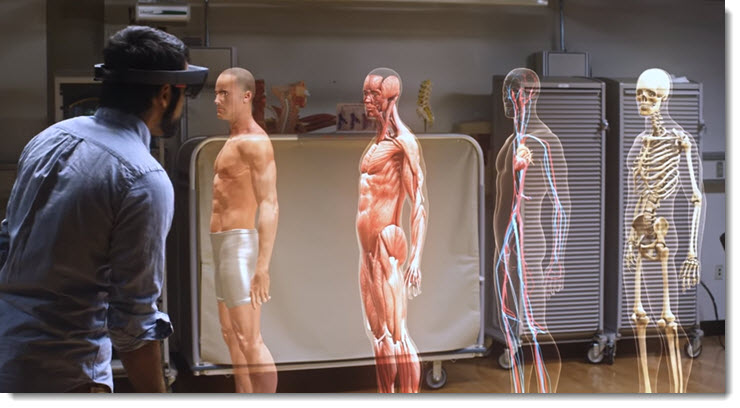
It’s like the layers of a Microsoft HoloLens app of the human anatomy:
Or it’s like different layers of a chapter of a “textbook” — so a learner could quickly collapse/expand the text as needed:
This approach could be helpful at all kinds of learning levels. For example, it could be very helpful for law school students to obtain outlines for cases or for chapters of information. Similarly, it could be helpful for dental or medical school students to get the main points as well as detailed information.
Also, as Artificial Intelligence (AI) grows, the system could check a learner’s cloud-based learner profile to see their reading level or prior knowledge, any IEP’s on file, their learning preferences (audio, video, animations, etc.), etc. to further provide a personalized/customized learning experience.
To recap:

Global installed base of smart speakers to surpass 200 million in 2020, says GlobalData
The global installed base for smart speakers will hit 100 million early next year, before surpassing the 200 million mark at some point in 2020, according to GlobalData, a leading data and analytics company.
The company’s latest report: ‘Smart Speakers – Thematic Research’ states that nearly every leading technology company is either already producing a smart speaker or developing one, with Facebook the latest to enter the fray (launching its Portal device this month). The appetite for smart speakers is also not limited by geography, with China in particular emerging as a major marketplace.
Ed Thomas, Principal Analyst for Technology Thematic Research at GlobalData, comments: “It is only four years since Amazon unveiled the Echo, the first wireless speaker to incorporate a voice-activated virtual assistant. Initial reactions were muted but the device, and the Alexa virtual assistant it contained, quickly became a phenomenon, with the level of demand catching even Amazon by surprise.”
Smart speakers give companies like Amazon, Google, Apple, and Alibaba access to a vast amount of highly valuable user data. They also allow users to get comfortable interacting with artificial intelligence (AI) tools in general, and virtual assistants in particular, increasing the likelihood that they will use them in other situations, and they lock customers into a broader ecosystem, making it more likely that they will buy complementary products or access other services, such as online stores.
Thomas continues: “Smart speakers, particularly lower-priced models, are gateway devices, in that they give consumers the opportunity to interact with a virtual assistant like Amazon’s Alexa or Google’s Assistant, in a “safe” environment. For tech companies serious about competing in the virtual assistant sector, a smart speaker is becoming a necessity, hence the recent entry of Apple and Facebook into the market and the expected arrival of Samsung and Microsoft over the next year or so.”
In terms of the competitive landscape for smart speakers, Amazon was the pioneer and is still a dominant force, although its first-mover advantage has been eroded over the last year or so. Its closest challenger is Google, but neither company is present in the fastest-growing geographic market, China. Alibaba is the leading player there, with Xiaomi also performing well.
Thomas concludes: “With big names like Samsung and Microsoft expected to launch smart speakers in the next year or so, the competitive landscape will continue to fluctuate. It is likely that we will see two distinct markets emerge: the cheap, impulse-buy end of the spectrum, used by vendors to boost their ecosystems; and the more expensive, luxury end, where greater focus is placed on sound quality and aesthetics. This is the area of the market at which Apple has aimed the HomePod and early indications are that this is where Samsung’s Galaxy Home will also look to make an impact.”
Information based on GlobalData’s report: Smart Speakers – Thematic Research

From DSC:
Ever notice how effective Ted Talks begin? They seek to instantly grab your attention with a zinger question, a somewhat shocking statement, an interesting story, a joke, an important problem or an issue, a personal anecdote or experience, a powerful image/photo/graphic, a brief demonstration, and the like.
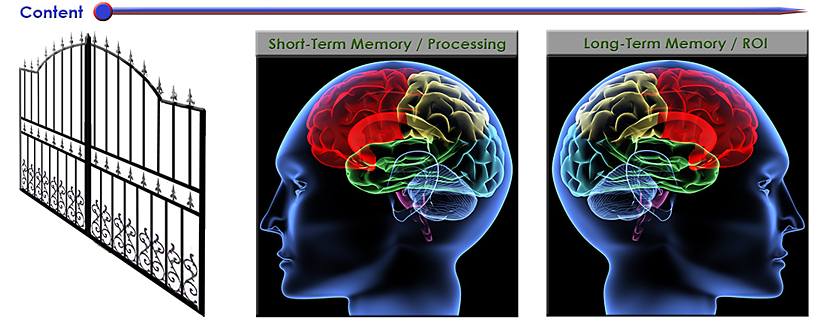
Grabbing someone’s attention is a key first step in getting a piece of information into someone’s short-term memory — what I call getting through “the gate.” If we can’t get through the gate into someone’s short-term memory, we have zero (0) chance of having them actually process that information and to think about and engage with that piece of content. If we can’t make it into someone’s short-term memory, we can’t get that piece of information into their long-term memory for later retrieval/recall. There won’t be any return on investment (ROI) in that case.
So why not try starting up one of your classes this week with a zinger question, a powerful image/photo/video, or a story from your own work experience? I’ll bet you’ll grab your students’ attentions instantly! Then you can move on into the material for a greater ROI. From there, offering frequent, low-stakes quizzes will hopefully help your students slow down their forgetting curves and help them practice recalling/retrieving that information. By the way, that’s why stories are quite powerful. We often remember them better. So if you can weave an illustrative story into your next class, your students might really benefit from it come final test time!
Also relevant/see:
Ready, set, speak: 5 strong ways to start your next presentation — from abovethelaw.com by Olga Mack, with thanks to Mr. Otto Stockmeyer for this resource
No matter which of these five ways you decide to launch your presentation, ensure that you make it count, and make it memorable.
Excerpts:
Inside Amazon’s artificial intelligence flywheel — from wired.com by Steven Levy
How deep learning came to power Alexa, Amazon Web Services, and nearly every other division of the company.
Excerpt (emphasis DSC):
Amazon loves to use the word flywheel to describe how various parts of its massive business work as a single perpetual motion machine. It now has a powerful AI flywheel, where machine-learning innovations in one part of the company fuel the efforts of other teams, who in turn can build products or offer services to affect other groups, or even the company at large. Offering its machine-learning platforms to outsiders as a paid service makes the effort itself profitable—and in certain cases scoops up yet more data to level up the technology even more.
It took a lot of six-pagers to transform Amazon from a deep-learning wannabe into a formidable power. The results of this transformation can be seen throughout the company—including in a recommendations system that now runs on a totally new machine-learning infrastructure. Amazon is smarter in suggesting what you should read next, what items you should add to your shopping list, and what movie you might want to watch tonight. And this year Thirumalai started a new job, heading Amazon search, where he intends to use deep learning in every aspect of the service.
“If you asked me seven or eight years ago how big a force Amazon was in AI, I would have said, ‘They aren’t,’” says Pedro Domingos, a top computer science professor at the University of Washington. “But they have really come on aggressively. Now they are becoming a force.”
Maybe the force.
From DSC:
When will we begin to see more mainstream recommendation engines for learning-based materials? With the demand for people to reinvent themselves, such a next generation learning platform can’t come soon enough!
![The Living [Class] Room -- by Daniel Christian -- July 2012 -- a second device used in conjunction with a Smart/Connected TV](http://danielschristian.com/learning-ecosystems/wp-content/uploads/2012/07/The-Living-Class-Room-Daniel-S-Christian-July-2012.jpg)

We’re about to embark on a period in American history where career reinvention will be critical, perhaps more so than it’s ever been before. In the next decade, as many as 50 million American workers—a third of the total—will need to change careers, according to McKinsey Global Institute. Automation, in the form of AI (artificial intelligence) and RPA (robotic process automation), is the primary driver. McKinsey observes: “There are few precedents in which societies have successfully retrained such large numbers of people.”
Also relevant/see:
Online education’s expansion continues in higher ed with a focus on tech skills — from educationdive.com by James Paterson
Dive Brief:
The Top 30 Emerging Technologies (2018–2028)
#emergingtech #emergingtechnology #tech #technology by @SeanMoffitt HT @SpirosMargaris MT @MikeQuindazzi #AI #IoT #MobileApps #SocialMedia #BigData #Blockchain #Robots pic.twitter.com/Hxd6hNw2Vi— Fred Steube (@steube) October 7, 2018
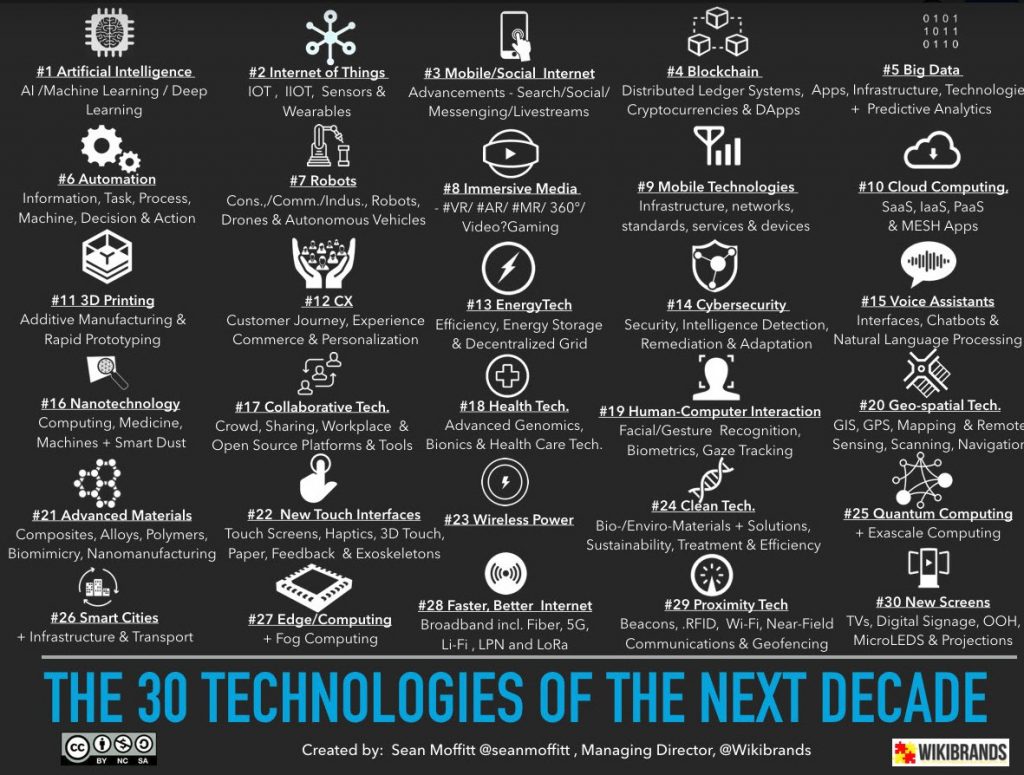
Excerpt:
Mae Jemison, the first woman of color to go into space, stood in the center of the room and prepared to become digital. Around her, 106 cameras captured her image in 3-D, which would later render her as a life-sized hologram when viewed through a HoloLens headset.
Jemison was recording what would become the introduction for a new exhibit at the Intrepid Sea, Air, and Space Museum, which opens tomorrow as part of the Smithsonian’s annual Museum Day. In the exhibit, visitors will wear HoloLens headsets and watch Jemison materialize before their eyes, taking them on a tour of the Space Shuttle Enterprise—and through space history. They’re invited to explore artifacts both physical (like the Enterprise) and digital (like a galaxy of AR stars) while Jemison introduces women throughout history who have made important contributions to space exploration.
Interactive museum exhibits like this are becoming more common as augmented reality tech becomes cheaper, lighter, and easier to create.
Oculus will livestream it’s 5th Connect Conference on Oculus venues — from vrscout.com by Kyle Melnick
Excerpt (emphasis DSC):
Using either an Oculus Go standalone device or a mobile Gear VR headset, users will be able to login to the Oculus Venues app and join other users for an immersive live stream of various developer keynotes and adrenaline-pumping esports competitions.
From DSC:
What are the ramifications of this for the future of webinars, teaching and learning, online learning, MOOCs and more…?
10 new AR features in iOS 12 for iPhone & iPad — from mobile-ar.reality.news by Justin Meyers
Excerpt:
Apple’s iOS 12 has finally landed. The big update appeared for everyone on Monday, Sept. 17, and hiding within are some pretty amazing augmented reality upgrades for iPhones, iPads, and iPod touches. We’ve been playing with them ever since the iOS 12 beta launched in June, and here are the things we learned that you’ll want to know about.
For now, here’s everything AR-related that Apple has included in iOS 12. There are some new features aimed to please AR fanatics as well as hook those new to AR into finally getting with the program. But all of the new AR features rely on ARKit 2.0, the latest version of Apple’s augmented reality framework for iOS.
Berkeley College Faculty Test VR for Learning— from campustechnology.com by Dian Schaffhauser
Excerpt:
In a pilot program at Berkeley College, members of a Virtual Reality Faculty Interest Group tested the use of virtual reality to immerse students in a variety of learning experiences. During winter 2018, seven different instructors in nearly as many disciplines used inexpensive Google Cardboard headsets along with apps on smartphones to virtually place students in North Korea, a taxicab and other environments as part of their classwork.
Participants used free mobile applications such as Within, the New York Times VR, Discovery VR, Jaunt VR and YouTube VR. Their courses included critical writing, international business, business essentials, medical terminology, international banking, public speaking and crisis management.
Pixar co-founder teleported live into a virtual classroom with students in Slough — from pressreleases.responsesource.com
Game-changing ENGAGE platform beams in the best teachers from around the world.
Excerpt:
25 April 2018: Today, the boring classroom lesson finally gets consigned to the history books when technology pioneers, Immersive VR Education, beam experts from California and Dubai into a virtual classroom to teach students at Langley College near Slough, via a short trip to the moon.
Pixar co-founder, Loren Carpenter, will be ‘beamed’ in to the virtual reality (VR) classroom live from the US so that IT and gaming students at Langley College, part of the Windsor Forest Colleges Group, can learn from one of the founding fathers of computer programming for animation and film.
David Whelan, CEO of Immersive VR Education, says, “This is a pivotal moment in the history of learning. ENGAGE allows students to not only experience the environment they are learning about in virtual reality, but have the best teachers from around the globe join them in a virtual classroom.”
Unleash the Power of Storytelling With These New AR and VR Tools — from edsurge.com by Jaime Donally
Excerpt:
A compelling use for using immersive technology, like augmented and virtual reality, is learning through storytelling. Stories are a powerful way to deliver meaningful and relevant content. The learning is heightened when paired with a story that penetrates the heart of the student. Let’s explore some of the newest and best tools out there and see if we can’t get students to create their happily ever after.
Amazon Embraces AR and VR With Sumerian Platform — from vrfocus.com by Rebecca Hills-Duty
Amazon is developing a new platform for creating VR and AR apps as part of Amazon Web Services.
Excerpt:
Amazon is no stranger to changing company direction and expanding into new markets. Starting out as an online bookstore, Amazon is now one of the giants of technology, with fingers in almost every conceivable pie. Small wonder, then, that the company is working towards a new platform for augmented reality (AR) and virtual reality (VR).
The platform has been named Sumerian, and is designed to be an all-in-one development platform for the building for VR and AR apps for both smartphones and VR headsets, and eventually, VR and AR apps that can run direct from the web browser.
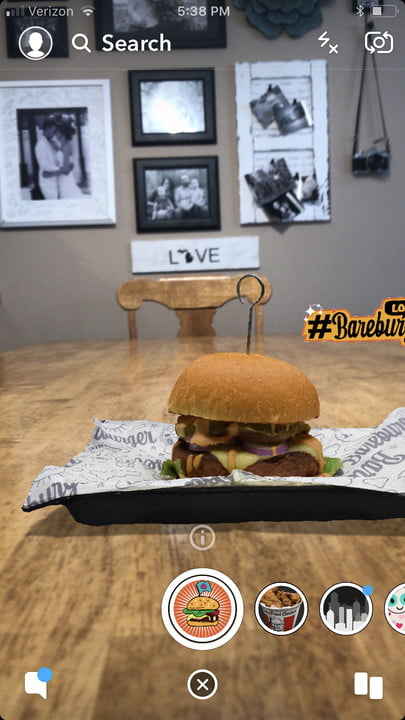
You AR what you eat — augmented reality menus are coming to Snapchat — from digitaltrends.com by Hillary Grigonis
Excerpt:
The smells wafting from the kitchen, a crinkled and torn paper menu, and the fleeting glimpses of orders the waiter is deftly balancing on his way to another table may no longer be the only ways to preview what you eat at a restaurant. Start-up Kabaq is aiming to bring the next big technology-influenced change for restaurants and foodies since Instagram sparked a surge in food photography: an augmented reality menu.
Burger chain Bareburger will be among the first restaurants to allow customers to see their meal right in front of them — before ever placing an order.