Temperament-Inclusive Pedagogy: Helping Introverted and Extraverted Students Thrive in a Changing Educational Landscape — from onlinelearningconsortium.org by Mary R. Fry

Excerpt (emphasis DSC):

So how do we take these different approaches to learning into account and foster a classroom environment that is more inclusive of the needs of both extraverts and introverts? Let’s first distinguish between how extraverts and introverts most prefer to learn, and then discuss ways to meet the needs of both. Extraverts tend to learn through active and social engagement with the material (group work, interactive learning experiences, performing and discussing). Verbalizing typically helps extraverts to think through their ideas and to foster new ones. They often think quickly on their feet and welcome working in large groups. It can be challenging for extraverts to generate ideas in isolation (talking through ideas is often needed) and thus working on solitary projects and writing can be challenging.

In contrast, introverts thrive with solitary/independent work and typically need this time to sort through what they are learning before they can formulate their thoughts and articulate their perspectives. Introverted learners often dislike group work (or at least the group sizes and structures that are often used in the classroom (more on this in a moment)) and find their voice drowned out in synchronous discussions as they don’t typically think as fast as their extroverted counterparts and don’t often speak until they feel they have something carefully thought out to share. Introverted learners are often quite content, and can remain attentive, through longer lectures and presentations and prefer engaging with the material in a more interactive way only after a pause or break.

From DSC:
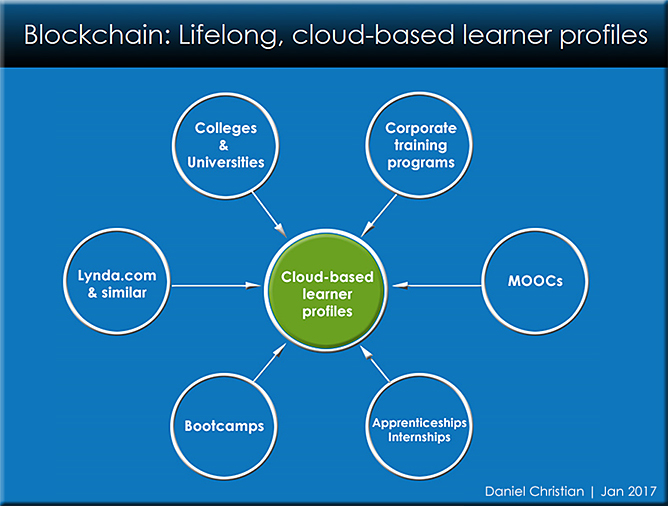
Could/would a next-generation learning platform that has some Artificial Intelligence (AI) features baked into it — working in conjunction with a cloud-based learner profile — be of assistance here?

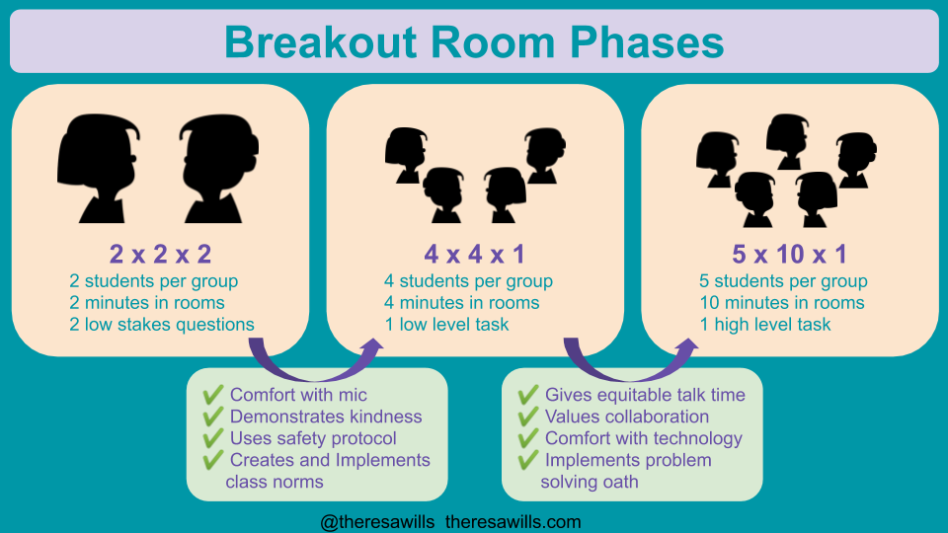
That is, maybe a learner could self-select the type of learning that they are: introverted or extroverted. Or perhaps they could use a sliding scaled to mix learning activities up to a certain degree. Or perhaps if one wasn’t sure of their preferences, they could ask the AI-backed system to scan for how much time they spent doing learning activities X, Y, and Z versus learning activities A, B, and C…then AI could offer up activities that meet a learner’s preferences.

(By the way, I love the idea of the “think-ink-pair-share” — to address both extroverted and introverted learners. This can be done digitally/virtually as well as in a face-to-face setting.)

All of this would further assist in helping build an enjoyment of learning. And wouldn’t that be nice? Now that we all need to learn for 40, 50, 60, 70, or even 80 years of our lives?

The 60-Year Curriculum: A Strategic Response to a Crisis


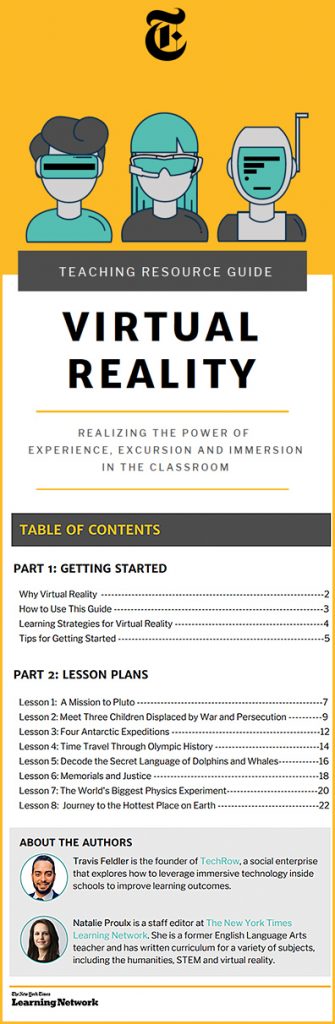
Virtual Reality: Realizing the Power of Experience, Excursion and Immersion in the Classroom — from nytimes.com
A framework for teaching with New York Times 360 V.R. videos, plus eight lesson plans for STEM and the humanities.

A Guide for Using NYT VR With Students

  • Getting Started With V.R. in the Classroom
  • Lesson 1: A Mission to Pluto
  • Lesson 2: Meet Three Children Displaced by War and Persecution
  • Lesson 3: Four Antarctic Expeditions
  • Lesson 4: Time Travel Through Olympic History
  • Lesson 5: Decode the Secret Language of Dolphins and Whales
  • Lesson 6: Memorials and Justice
  • Lesson 7: The World’s Biggest Physics Experiment
  • Lesson 8: Journey to the Hottest Place on Earth


Many students complain that online-based learning doesn’t engage them. Well, check this idea out! [Christian]


From DSC…by the way, another title for this blog could have been:

WIN-WIN situations all around! The Theatre Departments out there could collaborate with other depts/disciplines to develop highly engaging, digitally-based learning experiences! 


The future of drama and the theatre — as well as opera, symphonies, and more — will likely include a significant virtual/digital component to them. While it’s too early to say that theatre needs to completely reinvent itself and move “the stage” completely online, below is an idea that creates a variety of WIN-WIN situations for actors, actresses, stage designers, digital audio/video editors, fine artists, graphic designers, programmers, writers, journalists, web designers, and many others as well — including the relevant faculty members!

A new world of creative, engaging, active learning could open up if those involved with the Theatre Department could work collaboratively with students/faculty members from other disciplines. And in the end, the learning experiences and content developed would be highly engaging — and perhaps even profitable for the institutions themselves!

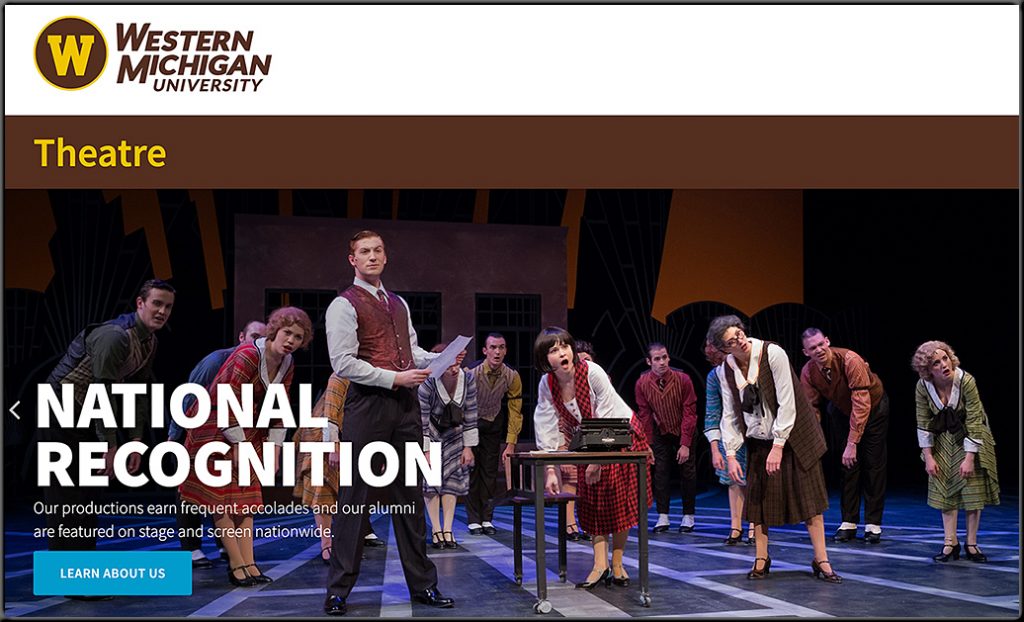
A WIN-WIN situation all around! The Theatre Department could collaborate with other depts/disciplines to develop highly engaging learning experiences!

[DC: I only slightly edited the above image from the Theatre Department at WMU]


Though the integration of acting with online-based learning materials is not a new idea, this post encourages a far more significant interdisciplinary collaboration between the Theatre Department and other departments/disciplines.

Consider a “Dealing with Bias in Journalism” type of topic, per a class in the Digital Media and Journalism Major.

  • Students from the Theatre Department work collaboratively with the students from the most appropriate class(es?) from the Communications Department to write the script, as per the faculty members’ 30,000-foot instructions (not 1000-foot level/detailed instructions)
  • Writing the script would entail skills involved with research, collaboration, persuasion, creativity, communication, writing, and more
  • The Theatre students would ultimately act out the script — backed up by those learning about sound design, stage design, lighting design, costume design, etc.
  • Example scene: A woman is sitting around the kitchen table, eating breakfast and reading a posting — aloud — from a website that includes some serious bias in it that offends the reader. She threatens to cancel her subscription, contact the editor, and more. She calls out to her partner why she’s so mad about the article. 
  • Perhaps there could be two or more before/after scenes, given some changes in the way the article was written.
  • Once the scenes were shot, the digital video editors, programmers, web designers, and more could take that material and work with the faculty members to integrate those materials into an engaging, interactive, branching type of learning experience. 
  • From there, the finished product would be deployed by the relevant faculty members.

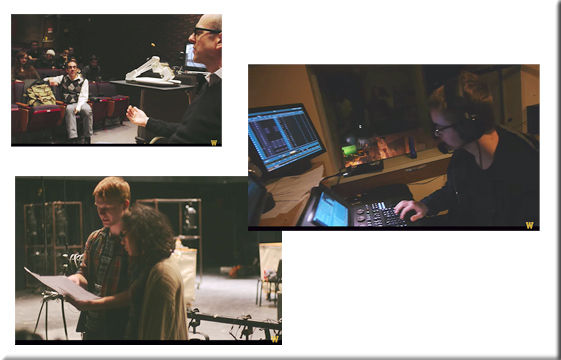
Scenes from WMU's Theatre Department

[DC: Above images from the Theatre Department at WMU]


Colleges and universities could share content with each other and/or charge others for their products/content/learning experiences. In the future, I could easily see a marketplace for buying and selling such engaging content. This could create a needed new source of revenue — especially given that those large auditoriums and theaters are likely not bringing in as much revenue as they typically do. 

Colleges and universities could also try to reach out to local acting groups to get them involved and continue to create feeders into the world of work.

Other tags/categories could include:

  • MOOCs
  • Learning from the Living[Class]Room
  • Multimedia / digital literacy — tools from Adobe, Apple, and others.
  • Passions, participation, engagement, attention.
  • XR: Creating immersive, Virtual Reality (VR)-based experiences
  • Learning Experience Design
  • Interaction Design
  • Interface Design
  • …and more

Also see:

What improv taught me about failure: As a teacher and academic — from scholarlyteacher.com by Katharine Hubbard

what improv taught me about failure -as a teacher and academic

In improv, the only way to “fail” is to overthink and not have fun, which reframed what failure was on a grand scale and made me start looking at academia through the same lens. What I learned about failure through improv comes back to those same two core concepts: have fun and stop overthinking.

Students are more engaged when the professor is having fun with the materials (Keller, Hoy, Goetz, & Frenzel, 2016), and teaching is more enjoyable when we are having fun ourselves.


Zoom, but for X: How startups are building for our new video normal  — from protocol.com by Biz Carson
Meet the startups building the next take on video.

Excerpt (emphasis DSC):

Trying to liven up the monotony of Zoom meetings, Phil Libin hung up a green towel behind his desk and started projecting images onto it, like Dr. Anthony Fauci hovering over his shoulder, just to make his team laugh. At first, it was a bit of a performance and a way to break up the monotony as Zoom fatigue set in a few months into the pandemic at the end of May. But then Libin, the former CEO of Evernote and founder of startup studio All Turtles, realized the “Weekend Update” style could be more than just a gimmick.

A bit of coding and a fantastic demo later, Libin closed a seed round of $4.5 million to launch his new company, Mmhmm. His big belief is that we’re moving to a hybrid world where things don’t fit neatly into boxes like in-person or online or live or recorded. Instead, it’s all going to be a mix.

Also see:


Teaching in a Hybrid Classroom – What’s Working, What’s Not — from derekbruff.org by Derek Bruff

Excerpt:

Now that we’re a few weeks into the semester, I wanted to know what was working and what was a continuing challenge for instructors, so I convened a conversation on teaching earlier this week attended by 18 of my faculty colleagues representing a range of disciplines. They were excited to be back in the classroom this fall. “There’s a different energy when we’re face-to-face,” one of them said. We had a lively discussion via Zoom about hybrid teaching, including what made it exciting and what made it frustrating, and I wanted to share a few highlights here on the blog.

I waited a minute or two while the participants thought and typed, and when it was clear that most of the participants were no longer typing, I said, “Ready, set, go!” Everyone hit enter, and a slew of responses appeared in the chat at the same time. At this point, we all spent a couple of minutes reading through the responses. I selected a couple that were particularly interesting and called on those participants to elaborate via video.

Also see:

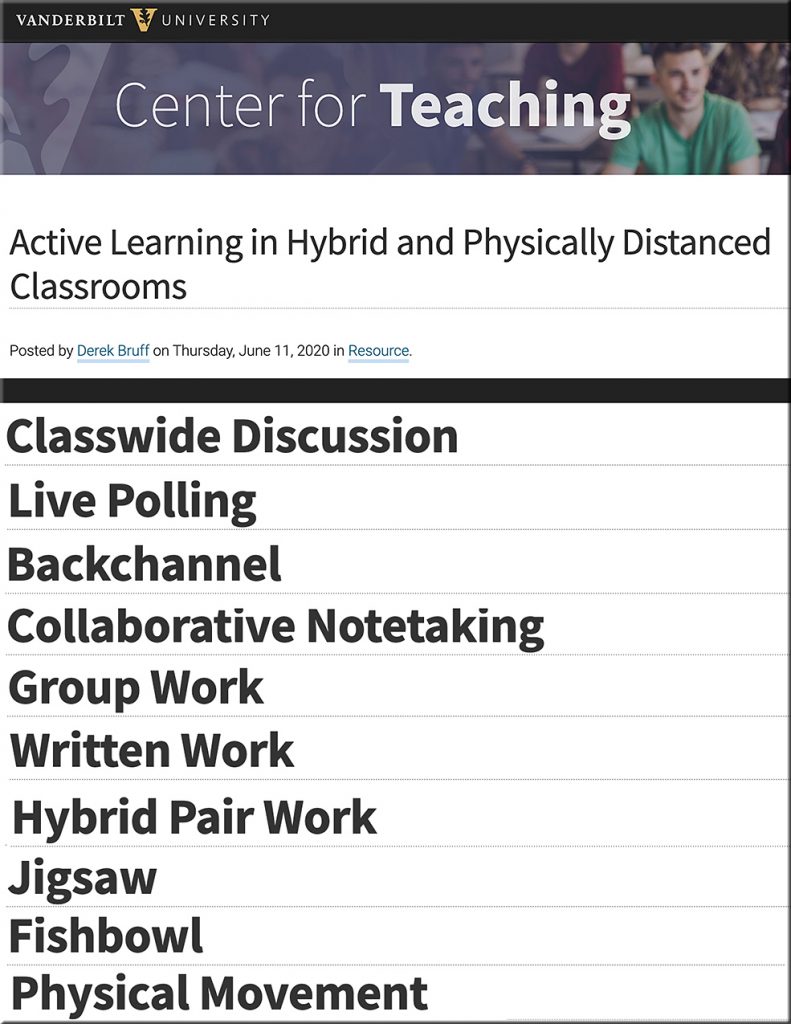
Active Learning in Hybrid and Physically Distanced Classrooms — from cft.vanderbilt.edu by Derek Bruff


If I’m standing at the front of the classroom with half or a third of my students in the room with me, but sitting six feet apart from each other and wearing masks, while the rest of my students are joining class by videoconference, what strategies might I employ to engage all of my students in meaningful learning?

I’m going to try to outline some options here in this blog post, drawing on ideas and resources from across the higher education community, but I would enthusiastically welcome additional approaches in the comments below or via Hypothesis annotations.

Derek Bruff


Per this week’s Lecture Breakers Weekly! from Dr. Barbi Honeycutt:

Break up your online lectures with the Watch Party! Here’s how you can do it: 

  • Pre-record your mini-lecture or find a video you want to use for your lesson. 
  • Instead of asking students to watch the video on their own, play it during your synchronous/live class time.
  • Explain to your students that they are watching the video all at the same time and that you will be facilitating the chat and answering their questions as they watch the video together. It’s a watch party!
  • Option: Take the conversation out of Zoom or your LMS. Create a hashtag for your course on Twitter and invite other experts, colleagues, or friends to join the conversation.

Instead of presenting during the synchronous class time, you can now focus completely on managing the chat, prompting discussion, and responding to students’ questions and ideas in real-time. And be sure to record and save the chat for students who couldn’t attend the live session or want to review it later.

From DSC:
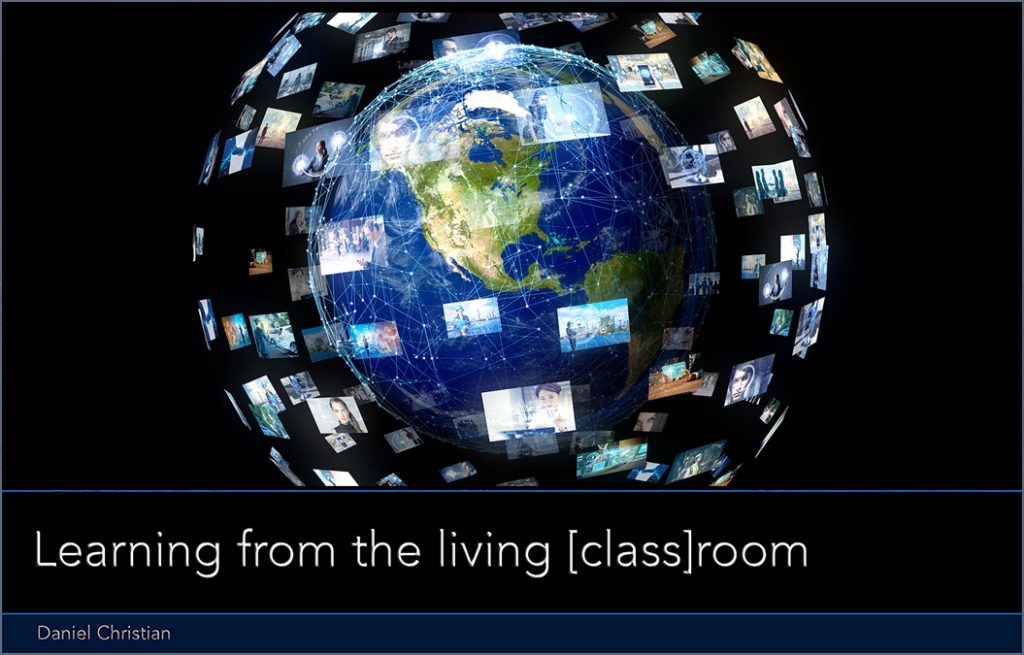
This is one of the kind of things that I envisioned with Learning from the living class[room] — a next-generation, global learning platform.

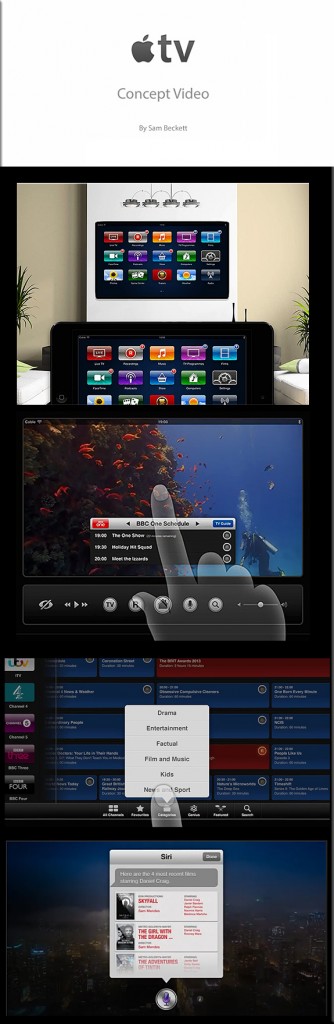
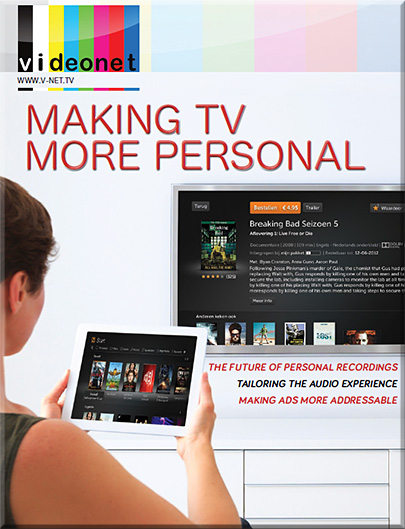
Learners could be watching a presentation/presenter, but communicating in real-time with other learners. Perhaps it will be a tvOS-based app or something similar. But TV as we know it is changing, right? It continues to become more interactive and on-demand all the time. Add videoconferencing apps like Zoom, Cisco Webex Meetings, Blackboard Collaborate, Microsoft Teams, Adobe Connect and others, and you have real-time, continuous, lifelong, relevant/timely, affordable, accessible, up-to-date learning.

Also, you have TEAM-BASED learning. 

Add videoconferencing apps like Zoom, Cisco Webex Meetings, Blackboard Collaborate, Microsoft Teams, Adobe Connect and others, and you have real-time, continuous, lifelong, up-to-date learning.


8 innovative virtual learning design tips to engage your remote teams — from elearningindustry.com by Shannon Hart
Virtual learning is an essential component in the Learning and Development toolkit, and it is widely used for training and educational purposes. It is not, however, always high quality or effective. Here are some design tips from the instructional and visual perspectives to give your virtual learning a real boost.

Excerpt:

With more employees working remotely than ever before, it is crucial that we create learning assets that really engage. Let’s talk about two aspects of design that are equally important if you want to provide virtual learning that really gets results—Instructional Design and visual design.

#visualdesign #instructionaldesign
#elearning #simulations #interaction
#corporatelearning
#graphicdesign

From DSC:
Notice the variety of necessary skillsets involved in Shannon’s article! This is one of the reasons I’m for the use of team-based content creation and delivery.


Best Content Awards 2020 — from elearninfo247.com by Craig Weiss

Excerpts:

Judging Areas

  • Video
  • Animation
  • Audio Quality
  • One that is very important, but way too many vendors lacked it…ADA508 or similar (depending on the country, but most countries have it) support.
  • Usefulness
  • Interactivity (Quality and Usability)
  • Engagement
  • Scenarios (if applicable)
  • Description
  • Objectives

What was excluded

  • Assessments

And now… the awards.


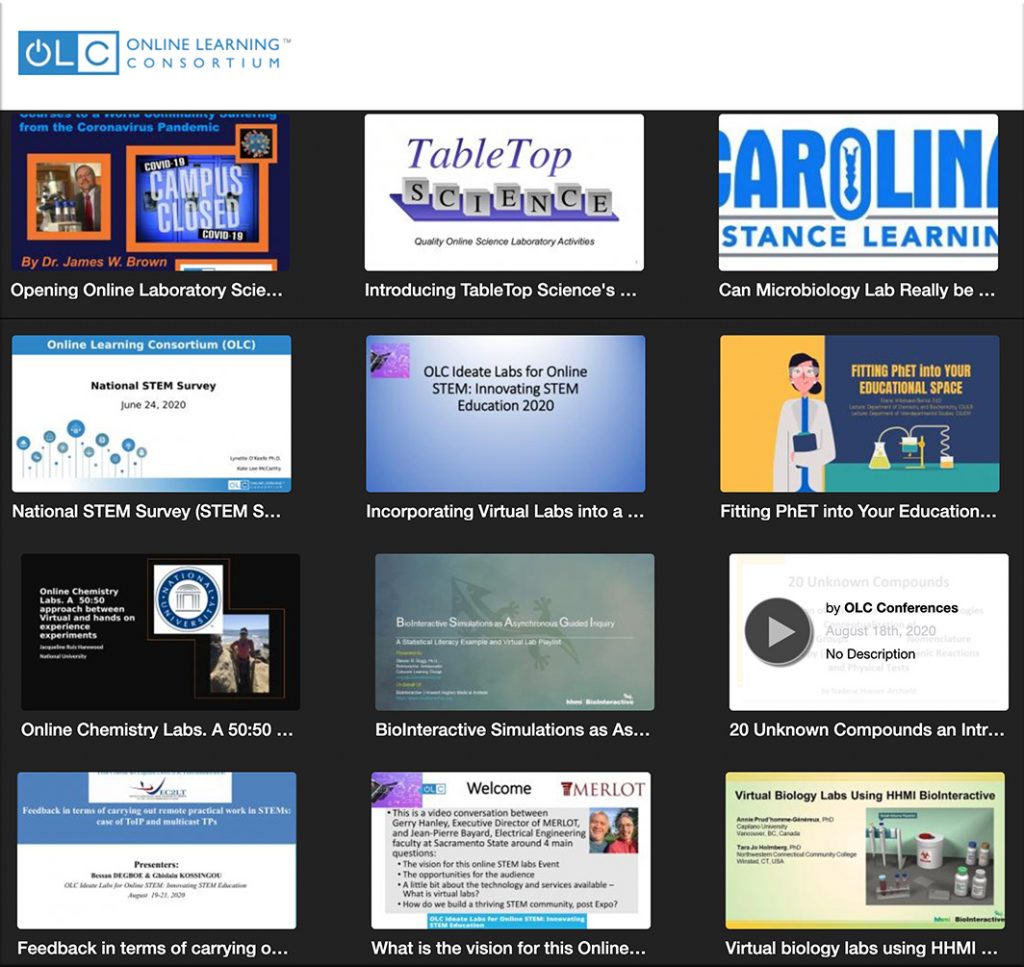
Information re: virtual labs from the Online Learning Consortium


 7 Things You Should Know About Virtual Labs — from library.educause.edu

Excerpt:

Virtual labs are interactive, digital simulations of activities that typically take place in physical laboratory settings. Virtual labs simulate the tools, equipment, tests, and procedures used in chemistry, biochemistry, physics, biology, and other disciplines. Virtual labs allow students to participate in lab-based learning exercises without the costs and limitations of a physical lab. Virtual labs can be an important element in institutional efforts to expand access to lab-based courses to more and different groups of students, as well as efforts to establish contingency plans for natural disasters or other interruptions of campus activities.


Addendum on 8/27/20:


From edsurge.com today:

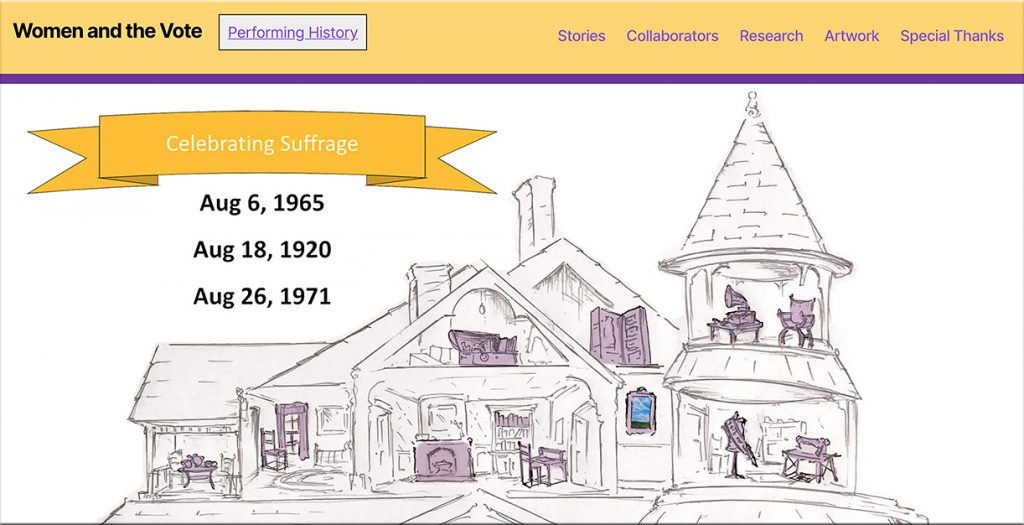
THOROUGHLY MODERN MEDIA: This spring, a college theater course about women’s voting rights aimed to produce a new play about the suffrage struggle. When the pandemic scuttled those plans, professors devised a new way to share suffragist stories by creating an interactive, online performance set in a virtual Victorian mansion. And their students were not the only ones exploring women’s voting rights as the country marks the 100th anniversary of the Nineteenth Amendment.

…which linked to:

The Pandemic Made Their Women’s Suffrage Play Impossible. But the Show Went on— Virtually — from edsurge.com by Rebecca Koenig

Excerpts:

Then the pandemic hit. Students left Radford and Virginia Tech. Live theater was canceled.

But the class wasn’t.

“Neither of us ever said, ‘Forget it,’” Hood says. “Our students, they all wanted to know, ‘What are we doing?’ We came to them with this insane idea.”

They would create an interactive, online production staged in a virtual Victorian mansion.

“Stage performance is different than film or audio. If you just have audio, you only have your voice. Clarity, landing sentences, really paying attention to the structure of a sentence, becomes important,” Nelson says. “Students got a broader sense of the skills and approaches to different mediums—a crash course.”


From DSC:
Talk about opportunities for interdisciplinary learning/projects!!!  Playwrights, directors, actors/actresses, set designers, graphic designers, fine artists, web designers and developers, interactivity/interface designers, audio designers, video editors, 3D animators, and more!!!


The performance website, “Women and the Vote,” premiered on May 18, 2020


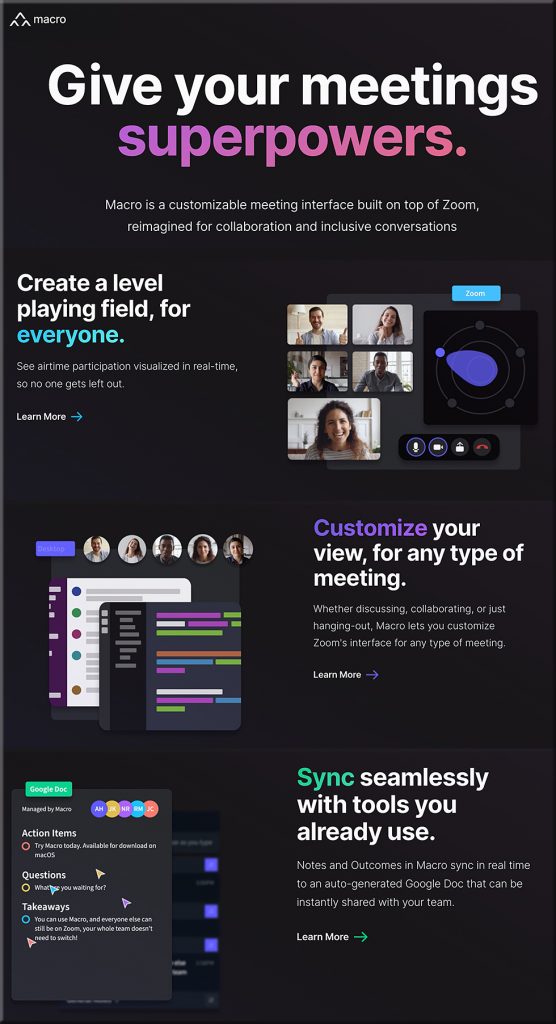
“Existing meeting interfaces had been designed with a singular goal, to simply enable virtual conversations. How could we build a meeting interface from the ground-up that intentionally facilitates engaging, productive, and inclusive conversations?”


What will tools like Macro.io bring to the online-based learning table?!


Learning experience designs of the future!!! [Christian]

From DSC:
The article below got me to thinking about designing learning experiences and what our learning experiences might be like in the future — especially after we start pouring much more of our innovative thinking, creativity, funding, entrepreneurship, and new R&D into technology-supported/enabled learning experiences.


LMS vs. LXP: How and why they are different — from blog.commlabindia.com by Payal Dixit
LXPs are a rising trend in the L&D market. But will they replace LMSs soon? What do they offer more than an LMS? Learn more about LMS vs. LXP in this blog.

Excerpt (emphasis DSC):

Building on the foundation of the LMS, the LXP curates and aggregates content, creates learning paths, and provides personalized learning resources.

Here are some of the key capabilities of LXPs. They:

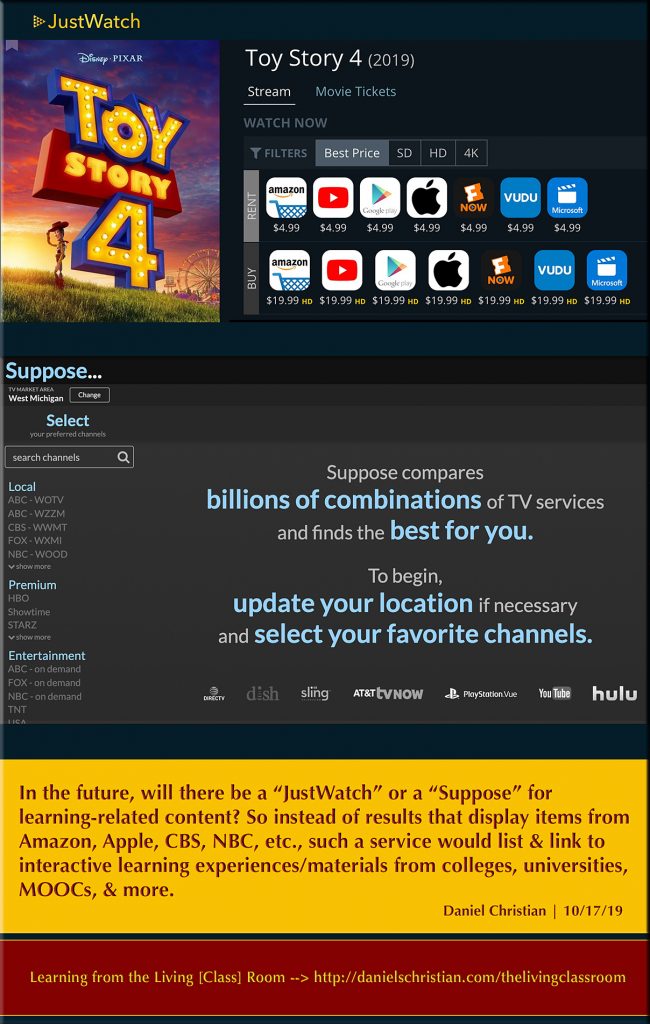
  • Offer content in a Netflix-like interface, with suggestions and AI recommendations
  • Can host any form of content – blogs, videos, eLearning courses, and audio podcasts to name a few
  • Offer automated learning paths that lead to logical outcomes
  • Support true uncensored social learning opportunities

So, this is about the LXP and what it offers; let’s now delve into the characteristics that differentiate it from the good old LMS.


From DSC:
Entities throughout the learning spectrum are going through many changes right now (i.e., people and organizations throughout K-12, higher education, vocational schools, and corporate training/L&D). If the first round of the Coronavirus continues to impact us, and then a second round comes later this year/early next year, I can easily see massive investments and interest in learning-related innovations. It will be in too many peoples’ and organizations’ interests not to.

I highlighted the bulleted points above because they are some of the components/features of the Learning from the Living [Class] Room vision that I’ve been working on.

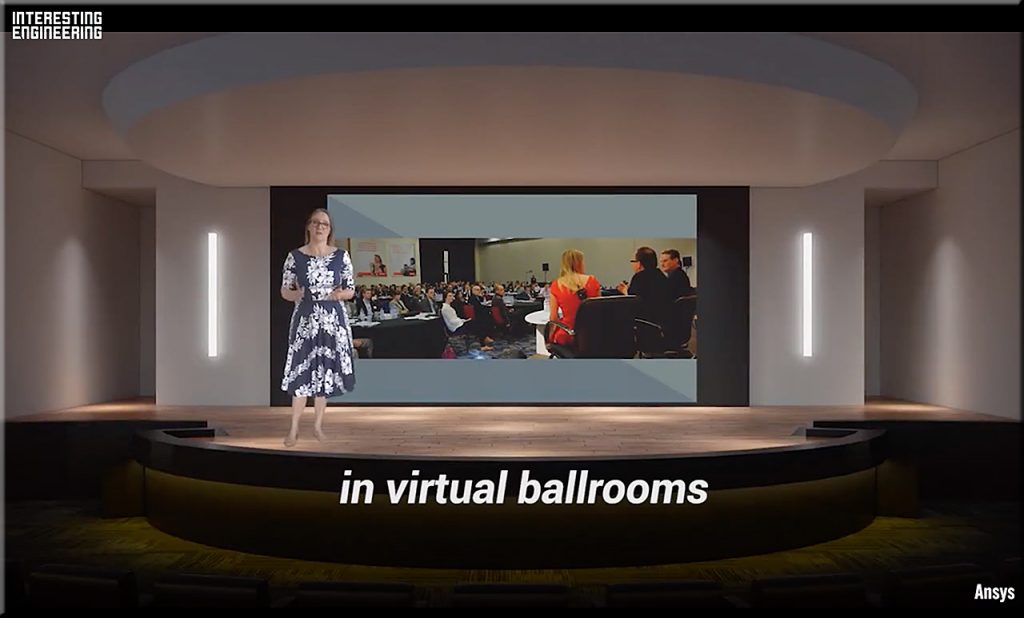
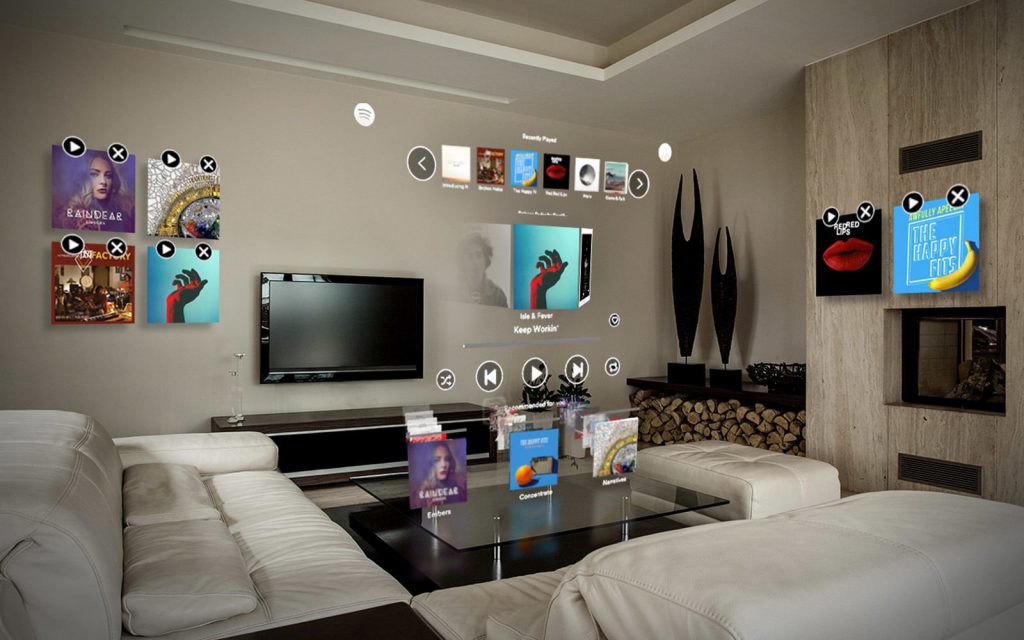
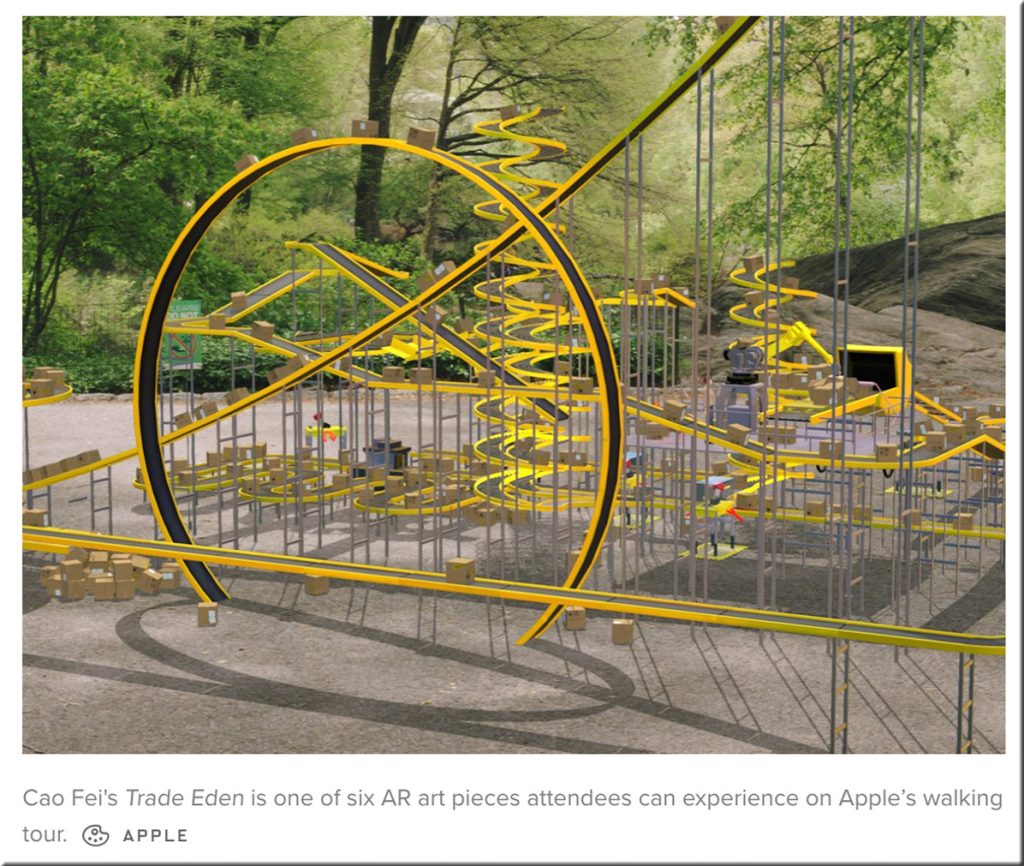
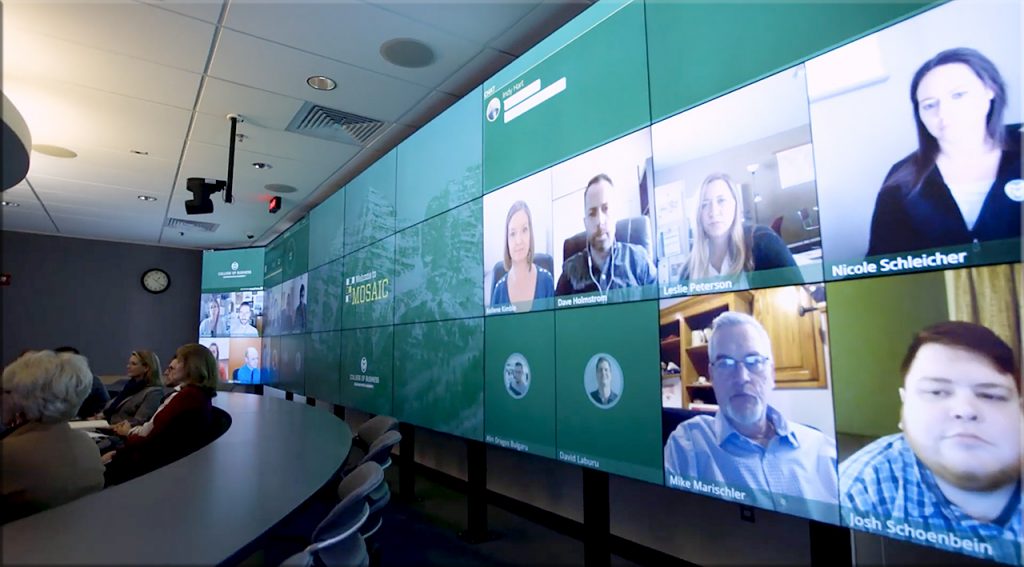
Below are some technologies, visuals, and ideas to supplement my reflections. They might stir the imagination of someone out there who, like me, desires to make a contribution — and who wants to make learning more accessible, personalized, fun, and engaging. Hopefully, future generations will be able to have more choice, more control over their learning — throughout their lifetimes — as they pursue their passions.

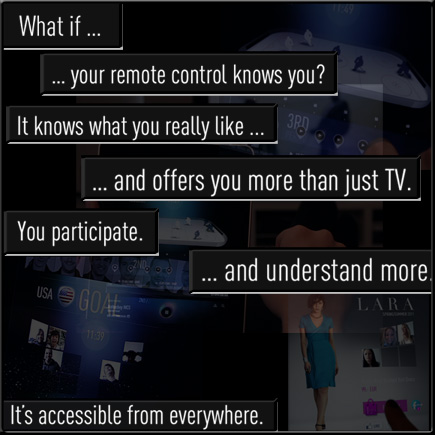
Learning from the living class room

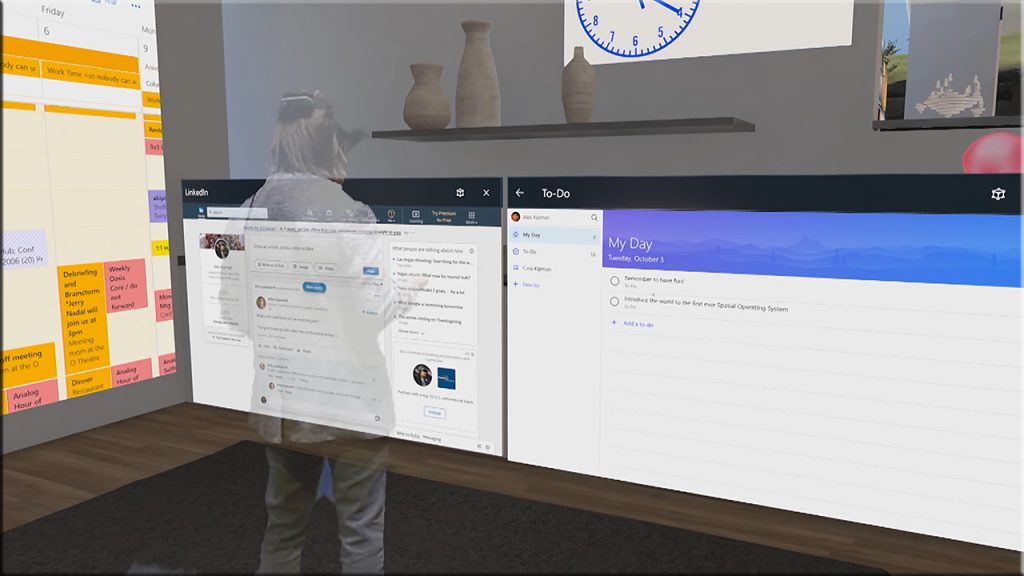
In the future, we may be using MR to walk around data and to better visualize data


AR and VR -- the future of healthcare


© 2025 | Daniel Christian