AI’s New Conversation Skills Eyed for Education — from insidehighered.com by Lauren Coffey The latest ChatGPT’s more human-like verbal communication has professors pondering personalized learning, on-demand tutoring and more classroom applications.
ChatGPT’s newest version, GPT-4o ( the “o” standing for “omni,” meaning “all”), has a more realistic voice and quicker verbal response time, both aiming to sound more human. The version, which should be available to free ChatGPT users in coming weeks—a change also hailed by educators—allows people to interrupt it while it speaks, simulates more emotions with its voice and translates languages in real time. It also can understand instructions in text and images and has improved video capabilities.
…
Ajjan said she immediately thought the new vocal and video capabilities could allow GPT to serve as a personalized tutor. Personalized learning has been a focus for educators grappling with the looming enrollment cliff and for those pushing for student success.
There’s also the potential for role playing, according to Ajjan. She pointed to mock interviews students could do to prepare for job interviews, or, for example, using GPT to play the role of a buyer to help prepare students in an economics course.
A Guide to the GPT-4o ‘Omni’ Model — from aieducation.substack.com by Claire Zau The closest thing we have to “Her” and what it means for education / workforce
Today, OpenAI introduced its new flagship model, GPT-4o, that delivers more powerful capabilities and real-time voice interactions to its users. The letter “o” in GPT-4o stands for “Omni”, referring to its enhanced multimodal capabilities. While ChatGPT has long offered a voice mode, GPT-4o is a step change in allowing users to interact with an AI assistant that can reason across voice, text, and vision in real-time.
Facilitating interaction between humans and machines (with reduced latency) represents a “small step for machine, giant leap for machine-kind” moment.
Everyone gets access to GPT-4: “the special thing about GPT-4o is it brings GPT-4 level intelligence to everyone, including our free users”, said CTO Mira Murati. Free users will also get access to custom GPTs in the GPT store, Vision and Code Interpreter. ChatGPT Plus and Team users will be able to start using GPT-4o’s text and image capabilities now
ChatGPT launched a desktop macOS app: it’s designed to integrate seamlessly into anything a user is doing on their keyboard. A PC Windows version is also in the works (notable that a Mac version is being released first given the $10B Microsoft relationship)
In a surprise launch, OpenAI dropped GPT-4 Omni, their new leading model. They also made a bunch of paid features in ChatGPT free and announced a new desktop app. Pete breaks down what you should know and what this says about AI.
Generative AI is fundamentally changing how we’re approaching learning and education, enabling powerful new ways to support educators and learners. It’s taking curiosity and understanding to the next level — and we’re just at the beginning of how it can help us reimagine learning.
Today we’re introducing LearnLM: our new family of models fine-tuned for learning, based on Gemini.
On YouTube, a conversational AI tool makes it possible to figuratively “raise your hand” while watching academic videos to ask clarifying questions, get helpful explanations or take a quiz on what you’ve been learning. This even works with longer educational videos like lectures or seminars thanks to the Gemini model’s long-context capabilities. These features are already rolling out to select Android users in the U.S.
… Learn About is a new Labs experience that explores how information can turn into understanding by bringing together high-quality content, learning science and chat experiences. Ask a question and it helps guide you through any topic at your own pace — through pictures, videos, webpages and activities — and you can upload files or notes and ask clarifying questions along the way.
The Gemini era
A year ago on the I/O stage we first shared our plans for Gemini: a frontier model built to be natively multimodal from the beginning, that could reason across text, images, video, code, and more. It marks a big step in turning any input into any output — an “I/O” for a new generation.
Google is integrating AI into all of its ecosystem: Search, Workspace, Android, etc. In true Google fashion, many features are “coming later this year”. If they ship and perform like the demos, Google will get a serious upper hand over OpenAI/Microsoft.
All of the AI features across Google products will be powered by Gemini 1.5 Pro. It’s Google’s best model and one of the top models. A new Gemini 1.5 Flash model is also launched, which is faster and much cheaper.
Google has ambitious projects in the pipeline. Those include a real-time voice assistant called Astra, a long-form video generator called Veo, plans for end-to-end agents, virtual AI teammates and more.
Google just casually announced Veo, a new rival to OpenAI’s Sora.
It can generate insanely good 1080p video up to 60 seconds.
Today at Google I/O we’re announcing new, powerful ways to get more done in your personal and professional life with Gemini for Google Workspace. Gemini in the side panel of your favorite Workspace apps is rolling out more broadly and will use the 1.5 Pro model for answering a wider array of questions and providing more insightful responses. We’re also bringing more Gemini capabilities to your Gmail app on mobile, helping you accomplish more on the go. Lastly, we’re showcasing how Gemini will become the connective tissue across multiple applications with AI-powered workflows. And all of this comes fresh on the heels of the innovations and enhancements we announced last month at Google Cloud Next.
Google is improving its AI-powered chatbot Gemini so that it can better understand the world around it — and the people conversing with it.
At the Google I/O 2024 developer conference on Tuesday, the company previewed a new experience in Gemini called Gemini Live, which lets users have “in-depth” voice chats with Gemini on their smartphones. Users can interrupt Gemini while the chatbot’s speaking to ask clarifying questions, and it’ll adapt to their speech patterns in real time. And Gemini can see and respond to users’ surroundings, either via photos or video captured by their smartphones’ cameras.
Generative AI in Search: Let Google do the searching for you — from blog.google With expanded AI Overviews, more planning and research capabilities, and AI-organized search results, our custom Gemini model can take the legwork out of searching.
Hello GPT-4o — from openai.com We’re announcing GPT-4o, our new flagship model that can reason across audio, vision, and text in real time.
GPT-4o (“o” for “omni”) is a step towards much more natural human-computer interaction—it accepts as input any combination of text, audio, image, and video and generates any combination of text, audio, and image outputs. It can respond to audio inputs in as little as 232 milliseconds, with an average of 320 milliseconds, which is similar to human response time in a conversation. It matches GPT-4 Turbo performance on text in English and code, with significant improvement on text in non-English languages, while also being much faster and 50% cheaper in the API. GPT-4o is especially better at vision and audio understanding compared to existing models.
Providing inflection, emotions, and a human-like voice
Understanding what the camera is looking at and integrating it into the AI’s responses
Providing customer service
With GPT-4o, we trained a single new model end-to-end across text, vision, and audio, meaning that all inputs and outputs are processed by the same neural network. Because GPT-4o is our first model combining all of these modalities, we are still just scratching the surface of exploring what the model can do and its limitations.
This demo is insane.
A student shares their iPad screen with the new ChatGPT + GPT-4o, and the AI speaks with them and helps them learn in *realtime*.
Imagine giving this to every student in the world.
Trends
As a first activity, we asked the Horizon panelists to provide input on the macro trends they believe are going to shape the future of postsecondary teaching and learning and to provide observable evidence for those trends. To ensure an expansive view of the larger trends serving as context for institutions of higher education, panelists provided input across five trend categories: social, technological, economic, environmental, and political. Given the widespread impacts of emerging AI technologies on higher education, we are also including in this year’s report a list of “honorary trends” focused on AI. After several rounds of voting, the panelists selected the following trends as the most important:
the internet eliminated time and place as barriers to education, and
generative AI eliminates access to expertise as a barrier to education.
Just as instructional designs had to be updated to account for all the changes in affordances of online learning, they will need to be dramatically updated again to account for the new affordances of generative AI.
The Curious Educator’s Guide to AI | Strategies and Exercises for Meaningful Use in Higher Ed — from ecampusontario.pressbooks.pub by Kyle Mackie and Erin Aspenlieder; via Stephen Downes
This guide is designed to help educators and researchers better understand the evolving role of Artificial Intelligence (AI) in higher education. This openly-licensed resource contains strategies and exercises to help foster an understanding of AI’s potential benefits and challenges. We start with a foundational approach, providing you with prompts on aligning AI with your curiosities and goals.
The middle section of this guide encourages you to explore AI tools and offers some insights into potential applications in teaching and research. Along with exposure to the tools, we’ll discuss when and how to effectively build AI into your practice.
The final section of this guide includes strategies for evaluating and reflecting on your use of AI. Throughout, we aim to promote use that is effective, responsible, and aligned with your educational objectives. We hope this resource will be a helpful guide in making informed and strategic decisions about using AI-powered tools to enhance teaching and learning and research.
Annual Provosts’ Survey Shows Need for AI Policies, Worries Over Campus Speech — from insidehighered.com by Ryan Quinn Many institutions are not yet prepared to help their faculty members and students navigate artificial intelligence. That’s just one of multiple findings from Inside Higher Ed’s annual survey of chief academic officers.
Only about one in seven provosts said their colleges or universities had reviewed the curriculum to ensure it will prepare students for AI in their careers. Thuswaldner said that number needs to rise. “AI is here to stay, and we cannot put our heads in the sand,” he said. “Our world will be completely dominated by AI and, at this point, we ain’t seen nothing yet.”
Is GenAI in education more of a Blackberry or iPhone? — from futureofbeinghuman.com by Andrew Maynard There’s been a rush to incorporate generative AI into every aspect of education, from K-12 to university courses. But is the technology mature enough to support the tools that rely on it?
In other words, it’s going to mean investing in concepts, not products.
This, to me, is at the heart of an “iPhone mindset” as opposed to a “Blackberry mindset” when it comes to AI in education — an approach that avoids hard wiring in constantly changing technologies, and that builds experimentation and innovation into the very DNA of learning.
…
For all my concerns here though, maybe there is something to being inspired by the Blackberry/iPhone analogy — not as a playbook for developing and using AI in education, but as a mindset that embraces innovation while avoiding becoming locked in to apps that are detrimentally unreliable and that ultimately lead to dead ends.
Randomized-controlled experiments investigating novice and experienced teachers’ ability to identify AI-generated texts.
Generative AI can simulate student essay writing in a way that is undetectable for teachers.
Teachers are overconfident in their source identification.
AI-generated essays tend to be assessed more positively than student-written texts.
Can Using a Grammar Checker Set Off AI-Detection Software? — from edsurge.com by Jeffrey R. Young A college student says she was falsely accused of cheating, and her story has gone viral. Where is the line between acceptable help and cheating with AI?
ChatGPT shaming is a thing – and it shouldn’t be — from futureofbeinghuman.com by Andrew Maynard There’s a growing tension between early and creative adopters of text based generative AI and those who equate its use with cheating. And when this leads to shaming, it’s a problem.
Excerpt (emphasis DSC):
This will sound familiar to anyone who’s incorporating generative AI into their professional workflows. But there are still many people who haven’t used apps like ChatGPT, are largely unaware of what they do, and are suspicious of them. And yet they’ve nevertheless developed strong opinions around how they should and should not be used.
From DSC: Yes…that sounds like how many faculty members viewed online learning, even though they had never taught online before.
OpenAI rolls out Memory feature for ChatGPT
OpenAI has introduced a cool update for ChatGPT (rolling out to paid and free users – but not in the EU or Korea), enabling the AI to remember user-specific details across sessions. This memory feature enhances personalization and efficiency, making your interactions with ChatGPT more relevant and engaging.
.
Key Features
Automatic Memory Tracking
ChatGPT now automatically records information from your interactions such as preferences, interests, and plans. This allows the AI to refine its responses over time, making each conversation increasingly tailored to you.
Enhanced Personalization
The more you interact with ChatGPT, the better it understands your needs and adapts its responses accordingly. This personalization improves the relevance and efficiency of your interactions, whether you’re asking for daily tasks or discussing complex topics.
Memory Management Options
You have full control over this feature. You can view what information is stored, toggle the memory on or off, and delete specific data or all memory entries, ensuring your privacy and preferences are respected.
Memory is now available to all ChatGPT Plus users. Using Memory is easy: just start a new chat and tell ChatGPT anything you’d like it to remember.
Memory can be turned on or off in settings and is not currently available in Europe or Korea. Team, Enterprise, and GPTs to come. pic.twitter.com/mlt9vyYeMK
From DSC: The ability of AI-based applications to remember things about us will have major and positive ramifications for us when we think about learning-related applications of AI.
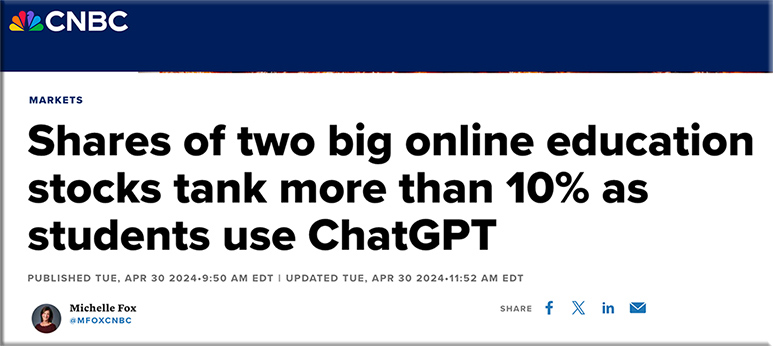
The rapid rise of artificial intelligence appears to be taking a toll on the shares of online education companies Chegg and Coursera.
Both stocks sank by more than 10% on Tuesday after issuing disappointing guidance in part because of students using AI tools such as ChatGPT from OpenAI.
“Combining AI Literacy with Core Humanities Learning Goals: Practical, Critical, and Playful Approaches”
It was amazing to get to do an in-person keynote at @csunorthridge‘s AI Pedagogy Showcase.
Sharing slides: https://t.co/LDIGAZ3ORO 1/2
— Anna Mills, annamillsoer.bsky.social, she/her (@AnnaRMills) May 3, 2024
Synthetic Video & AI Professors— from drphilippahardman.substack.com by Dr. Philippa Hardman Are we witnessing the emergence of a new, post-AI model of async online learning?
TLDR: by effectively tailoring the learning experience to the learner’s comprehension levels and preferred learning modes, AI can enhance the overall learning experience, leading to increased “stickiness” and higher rates of performance in assessments.
…
TLDR: AI enables us to scale responsive, personalised “always on” feedback and support in a way that might help to solve one of the most wicked problems of online async learning – isolation and, as a result, disengagement.
…
In the last year we have also seen the rise of an unprecedented number of “always on” AI tutors, built to provide coaching and feedback how and when learners need it.
Perhaps the most well-known example is Khan Academy’s Khanmigo and its GPT sidekick Tutor Me. We’re also seeing similar tools emerge in K12 and Higher Ed where AI is being used to extend the support and feedback provided for students beyond the physical classroom.
Given the potential ramifications of artificial intelligence (AI) diffusion on matters of diversity, equity, inclusion, and accessibility, now is the time for higher education institutions to adopt culturally aware, analytical decision-making processes, policies, and practices around AI tools selection and use.
The theme of the day was Human Connection V Innovative Technology. I see this a lot at conferences, setting up the human connection (social) against the machine (AI). I think this is ALL wrong. It is, and has always been a dialectic, human connection (social) PLUS the machine. Everyone had a smartphone, most use it for work, comms and social media. The binary between human and tech has long disappeared.
I recently created an AI version of myself—REID AI—and recorded a Q&A to see how this digital twin might challenge me in new ways. The video avatar is generated by Hour One, its voice was created by Eleven Labs, and its persona—the way that REID AI formulates responses—is generated from a custom chatbot built on GPT-4 that was trained on my books, speeches, podcasts and other content that I’ve produced over the last few decades. I decided to interview it to test its capability and how closely its responses match—and test—my thinking. Then, REID AI asked me some questions on AI and technology. I thought I would hate this, but I’ve actually ended up finding the whole experience interesting and thought-provoking.
From DSC: This ability to ask questions of a digital twin is very interesting when you think about it in terms of “interviewing” a historical figure. I believe character.ai provides this kind of thing, but I haven’t used it much.
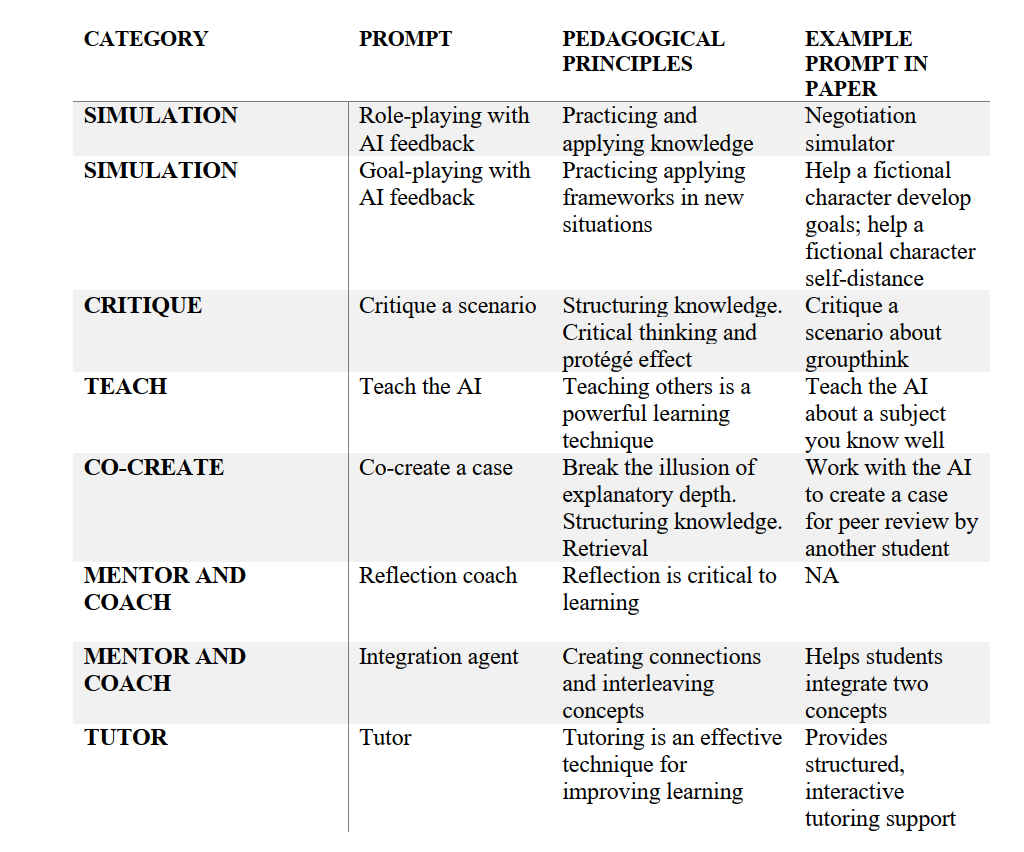
This paper explores how instructors can leverage generative AI to create personalized learning experiences for students that transform teaching and learning. We present a range of AI-based exercises that enable novel forms of practice and application including simulations, mentoring, coaching, and co-creation. For each type of exercise, we provide prompts that instructors can customize, along with guidance on classroom implementation, assessment, and risks to consider. We also provide blueprints, prompts that help instructors create their own original prompts. Instructors can leverage their content and pedagogical expertise to design these experiences, putting them in the role of builders and innovators. We argue that this instructor-driven approach has the potential to democratize the development of educational technology by enabling individual instructors to create AI exercises and tools tailored to their students’ needs. While the exercises in this paper are a starting point, not a definitive solutions, they demonstrate AI’s potential to expand what is possible in teaching and learning.
Since AI in education has been moving at the speed of light, we built this AI Tools in Education database to keep track of the most recent AI tools in education and the changes that are happening every day. This database is intended to be a community resource for educators, researchers, students, and other edtech specialists looking to stay up to date. This is a living document, so be sure to come back for regular updates.
The day started out with a short talk about AI (slides). Some of it is my usual schtick where I do a bit of Q&A with folks around myths and misunderstandings of generative AI in order to establish some common ground. These are often useful both in setting the tone and giving folks a sense of how I come to explore generative AI: with a mixture of humor, concern, curiosity, and of course, cat pics.
From there, we launched into a series of mini-workshops where folks had time to first play around with some previously created prompts around teaching and learning before moving onto prompts for administrative work. The prompts and other support materials are in this Workshop Resource Document. The goal was to just get them into using one or more AI tools with some useful prompts so they can learn more about its capabilities.
The Edtech Insiders Rundown of ASU+GSV 2024 — from edtechinsiders.substack.com by by Sarah Morin, Alex Sarlin, and Ben Kornell And more on Edtech Insiders+, upcoming events, Gauth, AI Reading Tutors, The Artificial Intelligence Interdisciplinary Institute, and TeachAI Policy Resources
Alex Sarlin
4. Everyone is Edtech Now This year, in addition to investors, entrepreneurs, educators, school leaders, university admins, non-profits, publishers, and operators from countless edtech startups and incumbents, there were some serious big tech companies in attendance like Meta, Google, OpenAI, Microsoft, Amazon, Tiktok, and Canva. Additionally, a horde of management consultancies, workforce organizations, mental health orgs, and filmmakers were in attendance.
Edtech continues to expand as an industry category and everyone is getting involved.
It was such a delight to chat with Ana. She’s brilliant and passionate, a talented educator, and an advocate for better ways of learning for children and adults. We cover ways to transform schools so that students get real-world skills, learn resilience and how to embrace challenges, and are prepared for an unpredictable future. And we go hard on why we must keep learning no matter our age, become generalists, and leverage technology in order to adapt to the fast-changing world.
The Texas Tribune reports an “automated scoring engine” that utilizes natural language processing — the technology that enables chatbots like OpenAI’s ChatGPT to understand and communicate with users — is being rolled out by the Texas Education Agency (TEA) to grade open-ended questions on the State of Texas Assessments of Academic Readiness (STAAR) exams. The agency is expecting the system to save $15–20 million per year by reducing the need for temporary human scorers, with plans to hire under 2,000 graders this year compared to the 6,000 required in 2023.
Debating About AI: An Easy Path to AI Awareness and Basic Literacy — from stefanbauschard.substack.com by Stefan Bauschard If you are an organization committed to AI literacy, consider sponsoring some debate topics and/or debates next year and expose thousands of students to AI literacy.
Resolved: Teachers should integrate generative AI in their teaching and learning.
The topic is simple but raises an issue that students can connect with.
While helping my students prepare and judging debates, I saw students demonstrate an understanding of many key issues and controversies.
These included—
*AI writing assessment/grading
*Bias
*Bullying
*Cognitive load
*Costs of AI systems
*Declining test scores
*Deep fakes
*Differentiation
*Energy consumption
*Hallucinations
*Human-to-human connection
*Inequality and inequity in access
*Neurodiversity
*Personalized learning
*Privacy
*Regulation (lack thereof)
*The future of work and unemployment
*Saving teachers time
*Soft skills
*Standardized testing
*Student engagement
*Teacher awareness and AI training; training resource trade-offs
*Teacher crowd-out
*Transparency and explainability
*Writing detectors (students had an exaggerated sense of the workability of these tools).
[Per Chris Dede] We often think of the product of teaching as the outcome (e.g. an essay, a drawing, etc.). The essence of education, in my view, lies not in the products or outcomes of learning but in the journey itself. The artifact is just a symbol that you’ve taken the journey.
The process of learning — the exploration, challenges, and personal growth that occur along the way — is where the real value lies. For instance, the act of writing an essay is valuable not merely for the final product but for the intellectual journey it represents. It forces you to improve and organize your thinking on a subject.
This distinction becomes important with the rise of generative AI, because it uniquely allows us to produce these artifacts without taking the journey.
As I’ve argued previously, I am worried that all this hype around LLMs renders them a “type of digital duct-tape to hold together an obsolete industrial-era educational system”.
Speaking of AI in our learning ecosystems, also see:
Usage Guidelines for AI Generative Tools at College Unbound These guidelines were created and reviewed by College Unbound students in Spring 2023 with the support of Lance Eaton, Director of Faculty Development & Innovation. The students include S. Fast, K. Linder-Bey, Veronica Machado, Erica Maddox, Suleima L., Lora Roy.
A recent study has found that scientific citations generated by ChatGPT often do not correspond to real academic work. The study, published in the Canadian Psychological Association’s Mind Pad, found that “false citation rates” across various psychology subfields ranged from 6% to 60%. Surprisingly, these fabricated citations feature elements such as legitimate researchers’ names and properly formatted digital object identifiers (DOIs), which could easily mislead both students and researchers.
…
MacDonald found that a total of 32.3% of the 300 citations generated by ChatGPT were hallucinated. Despite being fabricated, these hallucinated citations were constructed with elements that appeared legitimate — such as real authors who are recognized in their respective fields, properly formatted DOIs, and references to legitimate peer-reviewed journals.