From DSC:
After seeing the postings below, it made me wonder:

  • Will Starbucks, Apple Stores, etc. be “learning hubs” of the future?
    i.e., places that aren’t really what we think of as a school, college, or university, but where people can go to learn something with others in the same physical space; such locations will likely tie into online or blended-based means of learning as well.

“Today at Apple” bringing new experiences to every Apple Store

Excerpt:

Cupertino, California — Apple today announced plans to launch dozens of new educational sessions next month in all 495 Apple stores ranging in topics from photo and video to music, coding, art and design and more. The hands-on sessions, collectively called “Today at Apple,” will be led by highly-trained team members, and in select cities world-class artists, photographers and musicians, teaching sessions from basics and how-to lessons to professional-level programs.

Apple will also offer special programs for families and educators. Teachers can come together for Teacher Tuesday to learn new ways to incorporate technology into their classrooms, or aspiring coders of all ages can learn how to code in Swift, Apple’s programming language for iOS and Mac apps. Families can join weekend Kids Hour sessions ranging from music making to coding with robots. Small business owners can engage with global and local entrepreneurs in the new Business Circuits program.

We’re creating a modern-day town square, where everyone is welcome in a space where the best of Apple comes together to connect with one another, discover a new passion, or take their skill to the next level.

Apple wants kids to hang out at Apple stores — from qz.com by Mike Murphy

Excerpt:

If you’ve just gotten out of school for the day and want to hang out with your friends before you head home, where would you go? In the US, there’s a near-infinite selection of chain restaurants, coffee shops, diners, bookstores, movie theaters, and comic book stores to choose from. But Angela Ahrendts, Apple’s head of retail, wants the answer to be an Apple store.

Apple is in the process of revamping the look and feel of its retail outlets across the world, and to highlight some of the recent changes (including rebranding the “Genius Bar” to the “Genius Grove” and adding foliage everywhere), Ahrendts gave an interview to CBS This Morning, this morning. Ahrendts told CBS that she will see her work as a success when Generation Z, the catchall term for the generation behind the equally amorphous Millennials, decides of their own volition to hang out at Apple stores. As CBS reported…
 

From DSC:
The recent pieces below made me once again reflect on the massive changes that are quickly approaching — and in some cases are already here — for a variety of nations throughout the world.

They caused me to reflect on:

  • What the potential ramifications for higher education might be regarding these changes that are just starting to take place in the workplace due to artificial intelligence (i.e., the increasing use of algorithms, machine learning, and deep learning, etc.), automation, & robotics?
  • The need for people to reinvent themselves quickly throughout their careers (if we can still call them careers)
  • How should we, as a nation, prepare for these massive changes so that there isn’t civil unrest due to soaring inequality and unemployment?

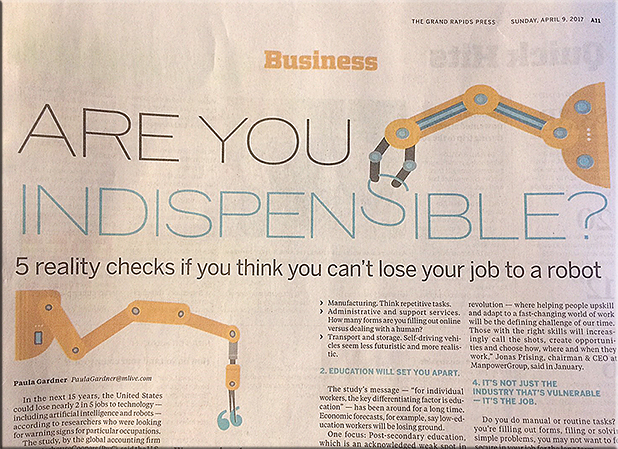
As found in the April 9th, 2017 edition of our local newspaper here:

When even our local newspaper is picking up on this trend, you know it is real and has some significance to it.


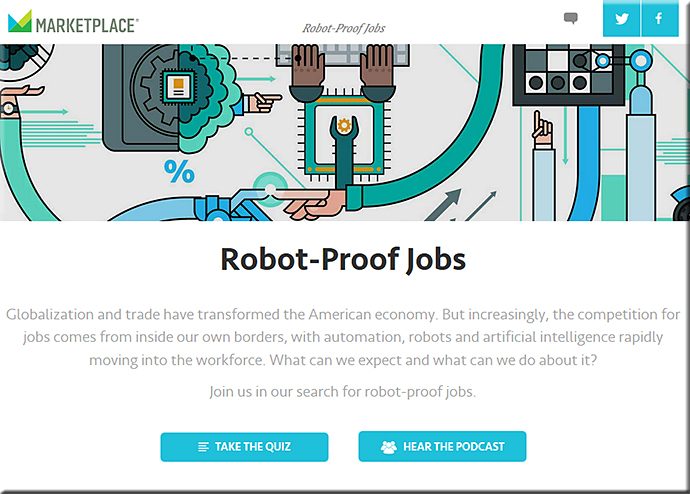
Then, as I was listening to the radio a day or two after seeing the above article, I heard of another related piece on NPR.  NPR is having a journalist travel across the country, trying to identify “robot-safe” jobs.  Here’s the feature on this from MarketPlace.org


What changes do institutions of traditional higher education
immediately need to begin planning for? Initiating?

What changes should be planned for and begin to be initiated
in the way(s) that we accredit new programs?


Keywords/ideas that come to my mind:

  • Change — to society, to people, to higher ed, to the workplace
  • Pace of technological change — no longer linear, but exponential
  • Career development
  • Staying relevant — as institutions, as individuals in the workplace
  • Reinventing ourselves over time — and having to do so quickly
  • Adapting, being nimble, willing to innovate — as institutions, as individuals
  • Game-changing environment
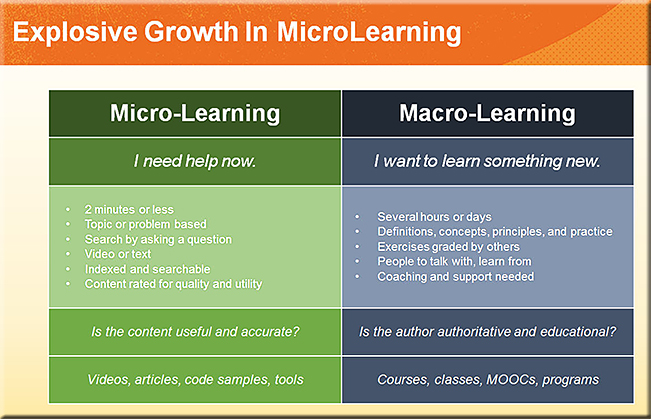
  • Lifelong learning — higher ed needs to put more emphasis on microlearning, heutagogy, and delivering constant/up-to-date streams of content and learning experiences. This could happen via the addition/use of smaller learning hubs, some even makeshift learning hubs that are taking place at locations that these institutions don’t even own…like your local Starbucks.
  • If we don’t get this right, there could be major civil unrest as inequality and unemployment soar
  • Traditional institutions of higher education have not been nearly as responsive to change as they have needed to be; this opens the door to alternatives. There’s a limited (and closing) window of time left to become more nimble and responsive before these alternatives majorly disrupt the current world of higher education.


Addendum from the corporate world (emphasis DSC):


From The Impact 2017 Conference:

The Role of HR in the Future of Work – A Town Hall

  • Josh Bersin, Principal and Founder, Bersin by Deloitte, Deloitte Consulting LLP
  • Nicola Vogel, Global Senior HR Director, Danfoss
  • Frank Møllerop, Chief Executive Officer, Questback
  • David Mallon, Head of Research, Bersin by Deloitte, Deloitte Consulting LLP

Massive changes spurred by new technologies such as artificial intelligence, mobile platforms, sensors and social collaboration have revolutionized the way we live, work and communicate – and the pace is only accelerating. Robots and cognitive technologies are making steady advances, particularly in jobs and tasks that follow set, standardized rules and logic. This reinforces a critical challenge for business and HR leaders—namely, the need to design, source, and manage the future of work.

In this Town Hall, we will discuss the role HR can play in leading the digital transformation that is shaping the future of work in organizations worldwide. We will explore the changes we see taking place in three areas:

  • Digital workforce: How can organizations drive new management practices, a culture of innovation and sharing, and a set of talent practices that facilitate a new network-based organization?
  • Digital workplace: How can organizations design a working environment that enables productivity; uses modern communication tools (such as Slack, Workplace by Facebook, Microsoft Teams, and many others); and promotes engagement, wellness, and a sense of purpose?
  • Digital HR: How can organizations change the HR function itself to operate in a digital way, use digital tools and apps to deliver solutions, and continuously experiment and innovate?
 

Retailers cut tens of thousands of jobs. Again. — from money.cnn.com by Paul R. La Monica
The dramatic reshaping of the American retail industry has, unfortunately, led to massive job losses in the sector.

Excerpt (emphasis DSC):

The federal government said Friday that retailers shed nearly 30,000 jobs in March. That follows a more than 30,000 decline in the number of retail jobs in the previous month.

So-called general merchandise stores are hurting the most.

That part of the sector, which includes struggling companies like Macy’s, Sears, and J.C. Penney, lost 35,000 jobs last month. Nearly 90,000 jobs have been eliminated since last October.

“There is no question that the Amazon effect is overwhelming,” said Scott Clemons, chief investment strategist of private banking for BBH. “There has been a shift in the way we buy things as opposed to a shift in the amount of money spent.”

To that end, Amazon just announced plans to hire 30,000 part-time workers.


From DSC:
One of the reasons that I’m posting this item is for those who say disruption isn’t real…it’s only a buzz word…

A second reason that I’m posting this item is because those of us working within higher education should take note of the changes in the world of retail and learn the lesson now before the “Next Amazon.com of Higher Education*” comes on the scene. Though this organization has yet to materialize, the pieces of its foundation are beginning to come together — such as the ingredients, trends, and developments that I’ve been tracking in my “Learning from the Living [Class] Room” vision.

This new organization will be highly disruptive to institutions of traditional higher education.

If you were in an influential position at Macy’s, Sears, and/or at J.C. Penney today, and you could travel back in time…what would you do?

We in higher education have the luxury of learning from what’s been happening in the retail business. Let’s be sure to learn our lesson.


* Effective today, what I used to call the “Forthcoming Walmart of Education — which has already been occurring to some degree with things such as MOOCs and collaborations/partnerships such as Georgia Institute of Technology, Udacity, and AT&T — I now call the “Next Amazon.com of Higher Education.”

Cost. Convenience. Selection. Offering a service on-demand (i.e., being quick, responsive, and available 24×7). <– These all are powerful forces.


P.S. Some will say you can’t possibly compare the worlds of retail and higher education — and that may be true as of 2017. However, if:

  • the costs of higher education keep going up and we continue to turn a deaf ear to the struggling families/students/adult learners/etc. out there
  • alternatives to traditional higher education continue to come on the landscape
  • the Federal Government continues to be more open to financially supporting such alternatives
  • technologies such as artificial intelligence, machine learning, deep learning continue to get better and more powerful — to the point that they can effectively deliver a personalized education (one that is likely to be fully online and that utilizes a team of specialists to create and deliver the learning experiences)
  • people lose their jobs to artificial intelligence, robotics, and automation and need to quickly reinvent themselves

…I can assure you that people will find other ways to make ends meet. The Next Amazon.com of Education will be just what they are looking for.


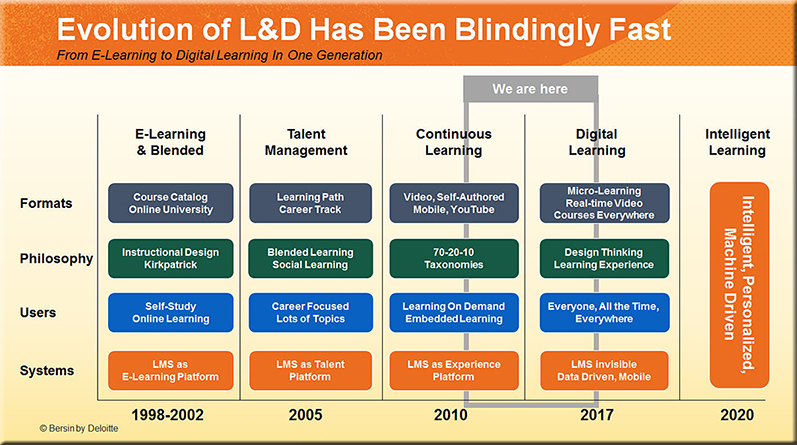
The disruption of digital learning: Ten things we have learned — from joshbersin.com

Excerpt:

Over the last few months I’ve had a series of meetings with Chief Learning Officers, talent management leaders, and vendors of next generation learning tools. My goal has been simple: try to make sense of the new corporate learning landscape, which for want of a better word, we can now call “Digital Learning.” In this article I’d like to share ten things to think about, with the goal of helping L&D professionals, HR leaders, and business leaders understand how the world of corporate learning has changed.


Digital Learning does not mean learning on your phone, it means “bringing learning to where employees are.” 

It is a “way of learning” not a “type of learning.”


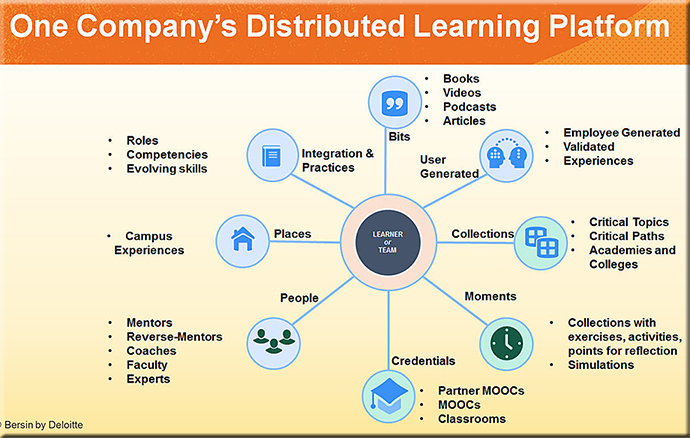
The traditional LMS is no longer the center of corporate learning, and it’s starting to go away.


What Josh calls a Distributed Learning Platform, I call a Learning Ecosystem:


Also see:

  • Watch Out, Corporate Learning: Here Comes Disruption — from forbes.com by Josh Bersin
    Excerpt:
    The corporate training market, which is over $130 billion in size, is about to be disrupted. Companies are starting to move away from their Learning Management Systems (LMS), buy all sorts of new tools for digital learning, and rebuild a whole new infrastructure to help employees learn. And the impact of GSuite,  Microsoft Teams, Slack, and Workplace by Facebook could be enormous.

    We are living longer, jobs are changing faster than ever, and automation is impinging on our work lives more every day. If we can’t look things up, learn quickly, and find a way to develop new skills at work, most of us would prefer to change jobs, rather than stay in a company that doesn’t let us reinvent ourselves over time.


HarvardX rolls out new adaptive learning feature in online course — from edscoop.com by Corinne Lestch
Students in MOOC adaptive learning experiment scored nearly 20 percent better than students using more traditional learning approaches.

Excerpt:

Online courses at Harvard University are adapting on the fly to students’ needs.

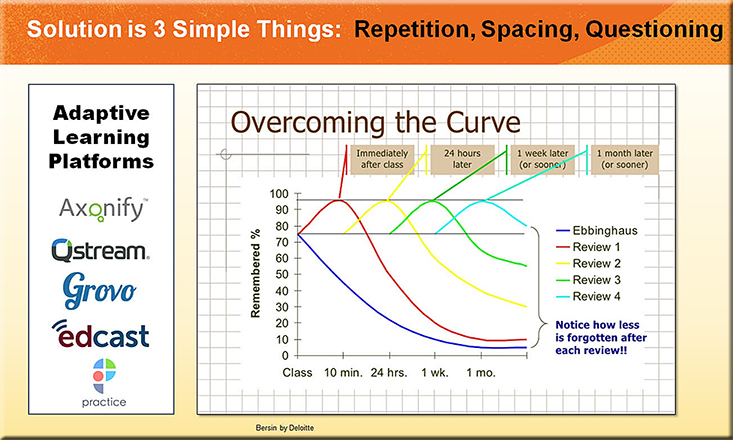
Officials at the Cambridge, Massachusetts, institution announced a new adaptive learning technology that was recently rolled out in a HarvardX online course. The feature offers tailored course material that directly correlates with student performance while the student is taking the class, as well as tailored assessment algorithms.

HarvardX is an independent university initiative that was launched in parallel with edX, the online learning platform that was created by Harvard and Massachusetts Institute of Technology. Both HarvardX and edX run massive open online courses. The new feature has never before been used in a HarvardX course, and has only been deployed in a small number of edX courses, according to officials.


From DSC:
Given the growth of AI, this is certainly radar worthy — something that’s definitely worth pulse-checking to see where opportunities exist to leverage these types of technologies.  What we now know of as adaptive learning will likely take an enormous step forward in the next decade.

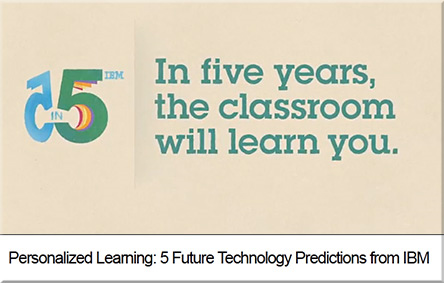
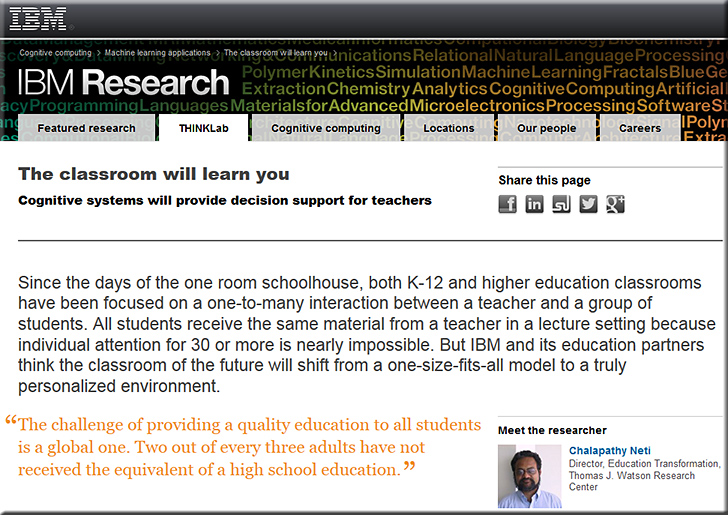
IBM’s assertion rings in my mind:


I’m cautiously hopeful that these types of technologies can extend beyond K-12 and help us deal with the current need to be lifelong learners, and the need to constantly reinvent ourselves — while providing us with more choice, more control over our learning. I’m hopeful that learners will be able to pursue their passions, and enlist the help of other learners and/or the (human) subject matter experts as needed.

I don’t see these types of technologies replacing any teachers, professors, or trainers. That said, these types of technologies should be able to help do some of the heavy teaching and learning lifting in order to help someone learn about a new topic.

Again, this is one piece of the Learning from the Living [Class] Room that we see developing.


Networks for Lifelong Learning: A Tale of Two Students — from novemberlearning.com by Alan November

Excerpts:

Where to begin in leading this shift? There are many possible first steps. This article focuses on two broad areas of digital design that can provide the foundation for an empowered culture of learning:

  • Multimedia content
  • Online communities of social interaction with classmates and professors

I have experienced this transformative shift of expanding the boundaries of learning with my own college-age children. My daughter, Jessica, graduated from university in 2010 and my son, Dan, will graduate in 2017. They both will earn equivalent grades at two different but highly competitive universities. How they studied, how they were supported in their learning, and how they interacted with classmates and professors represent two different worlds. Both of my children are convinced that Dan, the younger sibling, will be much better prepared for the world of work because of this transformation.

Here are five guidelines for leaders who are planning to maximize the investment in network technologies to improve teaching and learning:

  • Provide all students with immediate access to subject content in all formats (full text, video, audio)
  • Support a community of learners who can continuously help one another
  • Provide educators with insights into how students are thinking in online communities
  • Encourage educators to teach students to “learn how to learn”
  • Allow students to continue to tap their campus networks as a lifelong resource


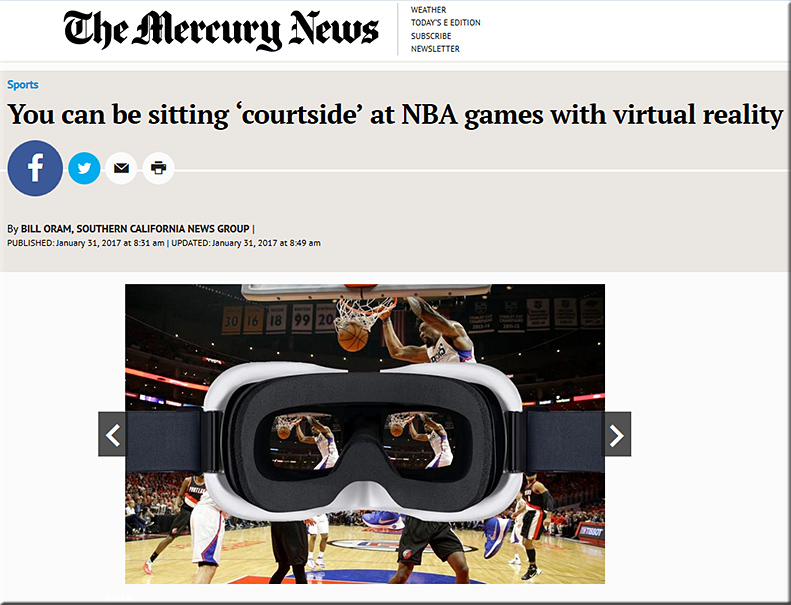
You can be sitting ‘courtside’ at NBA games with virtual reality — from mercurynews.com by Bill Oram

Excerpt:

“The result is a really strong sense of presence,” said David Cole, who helped found NextVR as a 3D company in 2009. “A vivid sense.”


“In some ways, we could still be at a point in time where a lot of people don’t yet know that they want this in VR,” said David Cramer, NextVR’s chief operating officer. “The thing that we’ve seen is that when people do see it, it just blows away their expectations.”


From DSC:
Hmm…the above piece from The Mercury News on #VR speaks of presence.  A vivid sense of presence.

If they can do this with an NBA game, why cant’ we do this with remote learners & bring them into face-to-face classrooms? How might VR be used in online learning and distance education? Could be an interesting new revenue stream for colleges and universities…and help serve more people who want to learn but might not be able to move to certain locations and/or not be able to attend face-to-face classrooms. Applications could exist within the corporate training/L&D world as well.


Also related/see:


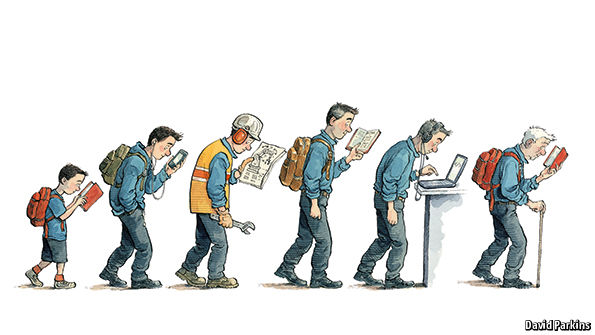
Equipping people to stay ahead of technological change — from economist.com by
It is easy to say that people need to keep learning throughout their careers. The practicalities are daunting.

Excerpt (emphasis DSC):

WHEN education fails to keep pace with technology, the result is inequality. Without the skills to stay useful as innovations arrive, workers suffer—and if enough of them fall behind, society starts to fall apart. That fundamental insight seized reformers in the Industrial Revolution, heralding state-funded universal schooling. Later, automation in factories and offices called forth a surge in college graduates. The combination of education and innovation, spread over decades, led to a remarkable flowering of prosperity.

Today robotics and artificial intelligence call for another education revolution. This time, however, working lives are so lengthy and so fast-changing that simply cramming more schooling in at the start is not enough. People must also be able to acquire new skills throughout their careers.

Unfortunately, as our special report in this issue sets out, the lifelong learning that exists today mainly benefits high achievers—and is therefore more likely to exacerbate inequality than diminish it. If 21st-century economies are not to create a massive underclass, policymakers urgently need to work out how to help all their citizens learn while they earn. So far, their ambition has fallen pitifully short.

At the same time on-the-job training is shrinking. In America and Britain it has fallen by roughly half in the past two decades. Self-employment is spreading, leaving more people to take responsibility for their own skills. Taking time out later in life to pursue a formal qualification is an option, but it costs money and most colleges are geared towards youngsters.


The classic model of education—a burst at the start and top-ups through company training—is breaking down. One reason is the need for new, and constantly updated, skills.


Lifelong learning is becoming an economic imperative — from economist.com
Technological change demands stronger and more continuous connections between education and employment, says Andrew Palmer. The faint outlines of such a system are now emerging

Excerpt:

A college degree at the start of a working career does not answer the need for the continuous acquisition of new skills, especially as career spans are lengthening. Vocational training is good at giving people job-specific skills, but those, too, will need to be updated over and over again during a career lasting decades. “Germany is often lauded for its apprenticeships, but the economy has failed to adapt to the knowledge economy,” says Andreas Schleicher, head of the education directorate of the OECD, a club of mostly rich countries. “Vocational training has a role, but training someone early to do one thing all their lives is not the answer to lifelong learning.”

To remain competitive, and to give low- and high-skilled workers alike the best chance of success, economies need to offer training and career-focused education throughout people’s working lives. This special report will chart some of the efforts being made to connect education and employment in new ways, both by smoothing entry into the labour force and by enabling people to learn new skills throughout their careers. Many of these initiatives are still embryonic, but they offer a glimpse into the future and a guide to the problems raised by lifelong reskilling.


Individuals, too, increasingly seem to accept the need for continuous rebooting.


Don’t discount the game-changing power of the morphing “TV” when coupled with AI, NLP, and blockchain-based technologies! [Christian]

From DSC:

Don’t discount the game-changing power of the morphing “TV” when coupled with artificial intelligence (AI), natural language processing (NLP), and blockchain-based technologies!

When I saw the article below, I couldn’t help but wonder what (we currently know of as) “TVs” will morph into and what functionalities they will be able to provide to us in the not-too-distant future…?

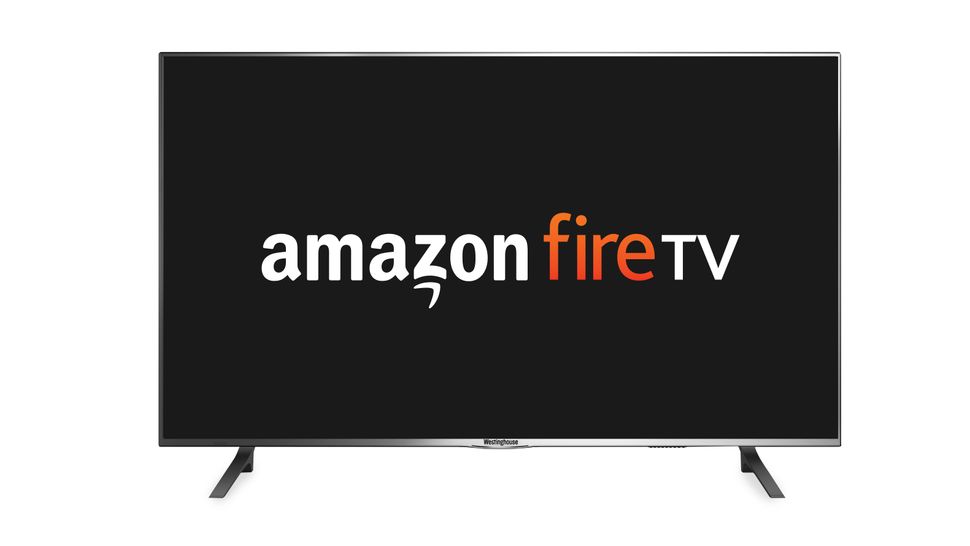
For example, the article mentions that Seiki, Westinghouse, and Element will be offering TVs that can not only access Alexa — a personal assistant from Amazon which uses artificial intelligence — but will also be able to provide access to over 7,000 apps and games via the Amazon Fire TV Store.

Some of the questions that come to my mind:

  • Why can’t there be more educationally-related games and apps available on this type of platform?
  • Why can’t the results of the assessments taken on these apps get fed into cloud-based learner profiles that capture one’s lifelong learning? (#blockchain)
  • When will potential employers start asking for access to such web-based learner profiles?
  • Will tvOS and similar operating systems expand to provide blockchain-based technologies as well as the types of functionality we get from our current set of CMSs/LMSs?
  • Will this type of setup become a major outlet for competency-based education as well as for corporate training-related programs?
  • Will augmented reality (AR), virtual reality (VR), and mixed reality (MR) capabilities come with our near future “TVs”?
  • Will virtual tutoring be one of the available apps/channels?
  • Will the microphone and the wide angle, HD camera on the “TV” be able to be disconnected from the Internet for security reasons? (i.e., to be sure no hacker is eavesdropping in on their private lives)


Forget a streaming stick: These 4K TVs come with Amazon Fire TV inside — from techradar.com by Nick Pino

Excerpt:

The TVs will not only have access to Alexa via a microphone-equipped remote but, more importantly, will have access to the over 7,000 apps and games available on the Amazon Fire TV Store – a huge boon considering that most of these Smart TVs usually include, at max, a few dozen apps.


The Living [Class] Room -- by Daniel Christian -- July 2012 -- a second device used in conjunction with a Smart/Connected TV


Addendums


“I’ve been predicting that by 2030 the largest company on the internet is going to be an education-based company that we haven’t heard of yet,” Frey, the senior futurist at the DaVinci Institute think tank, tells Business Insider.

.

  • Once thought to be a fad, MOOCs showed staying power in 2016 — from educationdive.com
    Dive Brief:

    • EdSurge profiles the growth of massive online open courses in 2016, which attracted more than 58 million students in over 700 colleges and universities last year.
    • The top three MOOC providers — Coursera, Udacity and EdX — collectively grossed more than $100 million last year, as much of the content provided on these platforms shifted from free to paywall guarded materials.
    • Many MOOCs have moved to offering credentialing programs or nanodegree offerings to increase their value in industrial marketplaces.
 

From DSC:
Recently, my neighbor graciously gave us his old Honda snowblower, as he was getting a new one. He wondered if we had a use for it.  As I’m definitely not getting any younger and I’m not Howard Hughes, I said, “Sure thing! That would be great — it would save my back big time!  Thank you!” (Though the image below is not mine, it might as well be…as both are quite old now.)


Anyway…when I recently ran out of gas, I would have loved to be able to take out my iPhone, hold it up to this particular Honda snowblower and ask an app to tell me if this particular Honda snowblower takes a mixture of gas and oil, or does it have a separate container for the oil? (It wasn’t immediately clear where to put the oil in, so I’m figuring it’s a mix.)

But what I would have liked to have happen was:

  1. I launched an app on my iPhone that featured machine learning-based capabilities
  2. The app would have scanned the snowblower and identified which make/model it was and proceeded to tell me whether it needed a gas/oil mix (or not)
  3. If there was a separate place to pour in the oil, the app would have asked me if I wanted to learn how to put oil in the snowblower. Upon me saying yes, it would then have proceeded to display an augmented reality-based training video — showing me where the oil was to be put in and what type of oil to use (links to local providers would also come in handy…offering nice revenue streams for advertisers and suppliers alike).

So several technologies would have to be involved here…but those techs are already here. We just need to pull them together in order to provide this type of useful functionality!


Developing Self-Directed Learners — from blogs.edweek.org by Tom Vander Ark and Emily Liebtag

Excerpt:

High engagement schools start from a different conception: knowledge co-creation and active production. They design a very different learner experience and support it with a student-centered culture and opportunities to improve self-regulation, initiative and persistence–all key to self-directed learning.

Why Does Self-Direction Matter?
Growth of the freelance- and gig-economy makes self-direction an imperative. But it’s also increasingly important inside organizations. David Rattray of the LA Chamber said, “Employees need to change their disposition toward employers away from work for someone else to an attitude of working for myself–agency, self-discipline, initiative, and risk-taking are all important on the job.

Many adults are working in roles where they need to be more independent and efficiently manage their own time often through a series of projects. Employers are looking for candidates that on their own are able to identify a driving question, determine a team they need to help answer that question, able to effectively work with that team, execute and manage the project–through multiple iterations with lots of feedback–and then reflect and evaluate their work. Students should be developing self-direction by learning in the same way.

Where to Start
If you’re a teacher or parent, you can ask good questions rather than provide simple answers; you can help students use a to-do list, develop a personal learning plan and a portfolio of their best work.

If you’re a principal, you can propose advisory period to promote self-direction and other success skills. You can make time in the schedule for more self-directed work. For example, Singapore American School added a makerspace with a genius hour and independent study courses to encourage to pursue self-directed learning.


Women of Foresight: Changes in Education for Future Student Success — from leadingthought.us.com by Dr. Liz Alexander


Excerpt:

Education. A topic that remains hotly debated all over the world. Especially now, as we struggle to find our footing as our futures hurtle towards us, faster and more profoundly different than ever before.

What changes do existing schools and colleges need to make to better prepare students for the trends we already see? Together with those “weak signals” that suggest other, possible futures? In “trying to adapt education for what the American economy is evolving into,” is mandating “coding classes” part of the answer?  Are we doing enough to take into account contrarian perspectives like this one? Who gets to decide what the purpose of education should be, in any case?

These are just some of the questions everyone–from policy makers to parents, academics to students themselves–need to think about.

Intrigued as to what the global futurist and foresight communities might have in mind, I posed them the following question:

If there was one thing I could change in education to better prepare students for the future of work, it would be…

The twenty women that responded to my call are either professional futurists or apply foresight in their roles as leaders in global firms and consultancies, think tanks and foundations. They’re from countries as geographically disperse as Australia, Egypt, Germany, India, New Zealand, Norway, United Arab Emirates, United Kingdom, and United States.

(If you’re wondering why I only asked women, it was a deliberate move to broaden commentary on “our futures,” so people don’t think it’s the sole purview of older, white men. Also, because I believe women’s natural inclinations toward relationships and collaboration, communities and mutual support, are the future!)


One example/answer:

“…to put more emphasis on HOW students will contribute, rather than WHAT their expertise will be, by helping them answer these three questions:

  • How do I most want to contribute to something larger than myself, aka my ‘mission in life’?
  • In what work environment will I be able to make the meaningful contributions I’m capable of?
  • How do I interact with others? What might derail my ambitions, dreams, and wishes? What can I do about it?”


If you doubt that we are on an exponential pace of change, you need to check these articles out! [Christian]

exponentialpaceofchange-danielchristiansep2016


From DSC:
The articles listed in
this PDF document demonstrate the exponential pace of technological change that many nations across the globe are currently experiencing and will likely be experiencing for the foreseeable future. As we are no longer on a linear trajectory, we need to consider what this new trajectory means for how we:

  • Educate and prepare our youth in K-12
  • Educate and prepare our young men and women studying within higher education
  • Restructure/re-envision our corporate training/L&D departments
  • Equip our freelancers and others to find work
  • Help people in the workforce remain relevant/marketable/properly skilled
  • Encourage and better enable lifelong learning
  • Attempt to keep up w/ this pace of change — legally, ethically, morally, and psychologically


PDF file here


One thought that comes to mind…when we’re moving this fast, we need to be looking upwards and outwards into the horizons — constantly pulse-checking the landscapes. We can’t be looking down or be so buried in our current positions/tasks that we aren’t noticing the changes that are happening around us.


From DSC:
After seeing the items below, I couldn’t help but wonder…what are the learning-related implications/applications of chatbots?

  • For K-12
  • For higher ed?
  • For corporate training/L&D?


Nat Geo Kids’ T-Rex chatbot aims to ‘get into the mindset of readers’ — from digiday.com by Lucinda Southern

Excerpt (emphasis DSC):

It seems even extinction doesn’t stop you from being on Facebook Messenger.

National Geographic Kids is the latest publisher to try out chatbots on the platform. Tina the T-Rex, naturally, is using Messenger to teach kids about dinosaurs over the summer break, despite a critical lack of opposable thumbs.

Despite being 65 million years old, Tina is pretty limited in her bot capabilities; she can answer from a pre-programmed script, devised by tech company Rehab Studio and tweaked by Chandler, on things like dinosaur diet and way of life.


Also see:


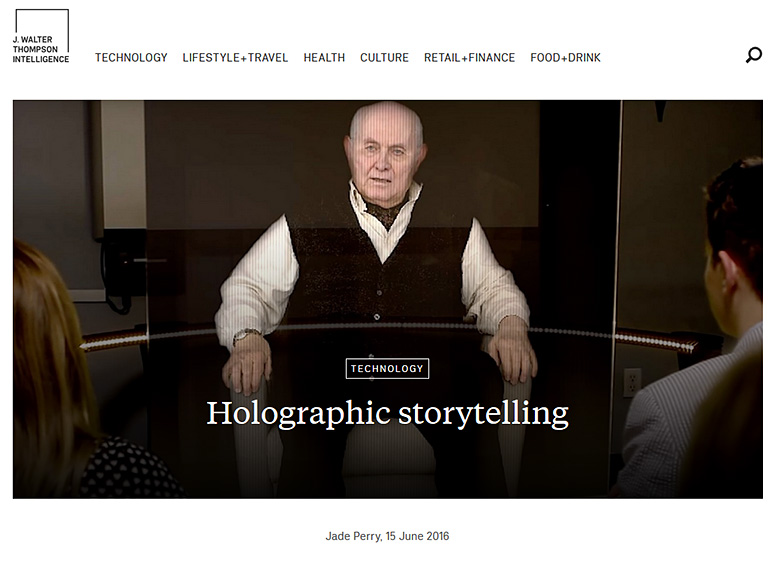
HolographicStorytellingJWT-June2016

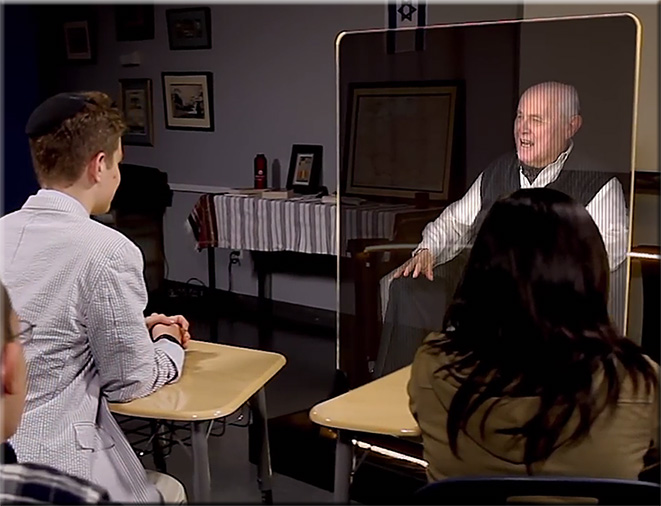
HolographicStorytellingJWT-2-June2016


Holographic storytelling — from jwtintelligence.com by Jade Perry

Excerpt (emphasis DSC):

The stories of Holocaust survivors are brought to life with the help of interactive 3D technologies.

New Dimensions in Testimony’ is a new way of preserving history for future generations. The project brings to life the stories of Holocaust survivors with 3D video, revealing raw first-hand accounts that are more interactive than learning through a history book.

Holocaust survivor Pinchas Gutter, the first subject of the project, was filmed answering over 1000 questions, generating approximately 25 hours of footage. By incorporating natural language processing from Conscience Display, viewers were able to ask Gutter’s holographic image questions that triggered relevant responses.


How might these enhancements to Siri and tvOS 10 impact education/training/learning-related offerings & applications? [Christian]

From DSC:
I read the article mentioned below.  It made me wonder how 3 of the 4 main highlights that Fred mentioned (that are coming to Siri with tvOS 10) might impact education/training/learning-related applications and offerings made possible via tvOS & Apple TV:

  1. Live broadcasts
  2. Topic-based searches
  3. The ability to search YouTube via Siri

The article prompted me to wonder:

  • Will educators and trainers be able to offer live lectures and training (globally) that can be recorded and later searched via Siri? 
  • What if second screen devices could help learners collaborate and participate in active learning while watching what’s being presented on the main display/”TV?”
  • What if learning taken this way could be recorded on one’s web-based profile, a profile that is based upon blockchain-based technologies and maintained via appropriate/proven organizations of learning? (A profile that’s optionally made available to services from Microsoft/LinkedIn.com/Lynda.com and/or to a service based upon IBM’s Watson, and/or to some other online-based marketplace/exchange for matching open jobs to potential employees.)
  • Or what if you could earn a badge or prove a competency via this manner?

Hmmm…things could get very interesting…and very powerful.

More choice. More control. Over one’s entire lifetime.

Heutagogy on steroids.

Micro-learning.

Perhaps this is a piece of the future for MOOCs…


MoreChoiceMoreControl-DSC


The Living [Class] Room -- by Daniel Christian -- July 2012 -- a second device used in conjunction with a Smart/Connected TV


StreamsOfContent-DSC


Apple TV gets new Siri features in tvOS 10 — from iphonefaq.org by Fred Straker

Excerpt:

The forthcoming update to Apple TV continues to bring fresh surprises for owners of Apple’s set top box. Many improvements are coming to tvOS 10, including single-sign-on support and an upgrade to Siri’s capabilities. Siri has already opened new doors thanks to the bundled Siri Remote, which simplifies many functions on the Apple TV interface. Four main highlights are coming to Siri with tvOS 10, which is expected to launch this fall.


Addendum on 7/17/16:

CBS News Launches New Apple TV App Designed Exclusively for tvOS — from macrumors.com

Excerpt:

CBS today announced the launch of an all-new Apple TV app that will center around the network’s always-on, 24-hour “CBSN” streaming network and has been designed exclusively for tvOS. In addition to the live stream of CBSN, the app curates news stories and video playlists for each user based on previously watched videos.

The new app will also take advantage of the 4th generation Apple TV’s deep Siri integration, allowing users to tell Apple’s personal assistant that they want to “Watch CBS News” to immediately start a full-screen broadcast of CBSN. While the stream is playing, users can interact with other parts of the app to browse related videos, bookmark some to watch later, and begin subscribing to specific playlists and topics.


© 2025 | Daniel Christian