“But what’s happening right now is exponential.” — from linkedin.com by Josh Cavalier

Excerpt:

I need to be honest with you. I’ve been running experiments this week with Claude Code and Opus 4.6, and we have reached the precipice in the collapse of time required to produce high-quality text-based ID outputs.

This includes performance consulting reports, learning needs analyses, action mapping, scripts, storyboards, facilitator guides, rubrics, and technical specs.

I just mapped the entire performance consulting process into a multimodal AI integration architecture (diagram image). Every phase. Entry and contracting. Performance analysis. Cause analysis. Solution design. Implementation. Evaluation. Thirty files. System specifications for each. The next step is to vet out each “skill” with an expert performance consultant.

Then I attempted a learning output: an 8-module course built with a cognitive scaffold that moves beyond content delivery to facilitate deliberate practice, meaning-making, and guided reflection within the learner’s own context.

The result:


AI and human-centered learning — from linkedin.com by Patrick Blessinger

Democratizing opportunities

AI adaptive learning can adapt learning in real-time. These tools have the potential to provide a more personalized learning experience, but only if used properly.

The California State University system uses ChatGPT Edu (OpenAI, 2025). Students use it for AI-assisted tutoring, study aids, and writing support. These resources provide 24/7 availability of subject-matter expertise tailored to students’ learning needs. It is not a replacement for professors. Rather, it extends the reach of mentorship by reducing access barriers.

However, we must proceed with intellectual humility and ethical responsibility. Even though AI can customize messages, it cannot replace the encouragement of a teacher or professor, or the social and emotional aspects of learning. It’s at the intersection of humanistic values and knowledge development that education must find its balance.


Something Big Is Happening — from shumer.dev by Matt Shumer; see below from the BIG Questions Institute, where I got this article from

I’ve spent six years building an AI startup and investing in the space. I live in this world. And I’m writing this for the people in my life who don’t… my family, my friends, the people I care about who keep asking me “so what’s the deal with AI?” and getting an answer that doesn’t do justice to what’s actually happening. I keep giving them the polite version. The cocktail-party version. Because the honest version sounds like I’ve lost my mind. And for a while, I told myself that was a good enough reason to keep what’s truly happening to myself. But the gap between what I’ve been saying and what is actually happening has gotten far too big. The people I care about deserve to hear what is coming, even if it sounds crazy.


They’ve now done it. And they’re moving on to everything else.

The experience that tech workers have had over the past year, of watching AI go from “helpful tool” to “does my job better than I do”, is the experience everyone else is about to have. Law, finance, medicine, accounting, consulting, writing, design, analysis, customer service. Not in ten years. The people building these systems say one to five years. Some say less. And given what I’ve seen in just the last couple of months, I think “less” is more likely.

The models available today are unrecognizable from what existed even six months ago. The debate about whether AI is “really getting better” or “hitting a wall” — which has been going on for over a year — is over. It’s done. Anyone still making that argument either hasn’t used the current models, has an incentive to downplay what’s happening, or is evaluating based on an experience from 2024 that is no longer relevant. I don’t say that to be dismissive. I say it because the gap between public perception and current reality is now enormous, and that gap is dangerous… because it’s preventing people from preparing.


What “Something Big Is Happening” Means for Schools — from/by the BIG Questions Institute
Matt Shumer’s newsletter post Something Big is Happening has been read over 80 million times within the week when it was published, on February 9.

Still, it’s worth reading Shumer’s post. Given the claims and warnings in Something Big Is Happening (and countless other articles), how would you truly, honestly respond to these questions:

  • What will the purpose of school be in 5 years?
  • What are we doing now that we must leave behind right away?
  • What can we leave behind gradually?
  • What does rigor look like in this AI-powered world?
  • Does our strategy look like making adjustments at the margins or are we preparing our students for a fundamental shift?
  • What is our definition of success? How do the the implications of AI and jobs (and other important forces, from geopolitical shifts and climate change, to mental health needs and shifting generational values) impact the outcomes we prioritize? What is the story of success we want to pass on to our students and wider community?
 

The Campus AI Crisis — by Jeffrey Selingo; via Ryan Craig
Young graduates can’t find jobs. Colleges know they have to do something. But what?

Only now are colleges realizing that the implications of AI are much greater and are already outrunning their institutional ability to respond. As schools struggle to update their curricula and classroom policies, they also confront a deeper problem: the suddenly enormous gap between what they say a degree is for and what the labor market now demands. In that mismatch, students are left to absorb the risk. Alina McMahon and millions of other Gen-Zers like her are caught in a muddled in-between moment: colleges only just beginning to think about how to adapt and redefine their mission in the post-AI world, and a job market that’s changing much, much faster.

“Colleges and universities face an existential issue before them,” said Ryan Craig, author of Apprentice Nation and managing director of a firm that invests in new educational models. “They need to figure out how to integrate relevant, in-field, and hopefully paid work experience for every student, and hopefully multiple experiences before they graduate.”


Jim VandeHei’s note to his kids: Blunt AI talk — from axios.com by CEO Jim VandeHei
Axios CEO Jim VandeHei wrote this note to his wife, Autumn, and their three kids. She suggested sharing it more broadly since so many families are wrestling with how to think and talk about AI. So here it is …

Dear Family:
I want to put to words what I’m hearing, seeing, thinking and writing about AI.

  • Simply put, I’m now certain it will upend your work and life in ways more profound than the internet or possibly electricity. This will hit in months, not years.
  • The changes will be fast, wide, radical, disorienting and scary. No one will avoid its reach.

I’m not trying to frighten you. And I know your opinions range from wonderment to worry. That’s natural and OK. Our species isn’t wired for change of this speed or scale.

  • My conversations with the CEOs and builders of these LLMs, as well as my own deep experimentation with AI, have shaken and stirred me in ways I never imagined.

All of you must figure out how to master AI for any specific job or internship you hold or take. You’d be jeopardizing your future careers by not figuring out how to use AI to amplify and improve your work. You’d be wise to replace social media scrolling with LLM testing.

Be the very best at using AI for your gig.

more here.


Also see:


Also relevant/see:


Farewell to Traditional Universities | What AI Has in Store for Education

Premiered Jan 16, 2026

Description:

What if the biggest change in education isn’t a new app… but the end of the university monopoly on credibility?

Jensen Huang has framed AI as a platform shift—an industrial revolution that turns intelligence into infrastructure. And when intelligence becomes cheap, personal, and always available, education stops being a place you go… and becomes a system that follows you. The question isn’t whether universities will disappear. The question is whether the old model—high cost, slow updates, one-size-fits-all—can survive a world where every student can have a private tutor, a lab partner, and a curriculum designer on demand.

This video explores what AI has in store for education—and why traditional universities may need to reinvent themselves fast.

In this video you’ll discover:

  • How AI tutors could deliver personalized learning at scale
  • Why credentials may shift from “degrees” to proof-of-skill portfolios
  • What happens when the “middle” of studying becomes automated
  • How universities could evolve: research hubs, networks, and high-trust credentialing
  • The risks: cheating, dependency, bias, and widening inequality
  • The 3 skills that become priceless when information is everywhere: judgment, curiosity, and responsibility

From DSC:
There appears to be another, similar video, but with a different date and length of the video. So I’m including this other recording as well here:


The End of Universities as We Know Them: What AI Is Bringing

Premiered Jan 27, 2026

What if universities don’t “disappear”… but lose their monopoly on learning, credentials, and opportunity?

AI is turning education into something radically different: personal, instant, adaptive, and always available. When every student can have a 24/7 tutor, a writing coach, a coding partner, and a study plan designed specifically for them, the old model—one professor, one curriculum, one pace for everyone—starts to look outdated. And the biggest disruption isn’t the classroom. It’s the credential. Because in an AI world, proof of skill can become more valuable than a piece of paper.

This video explores the end of universities as we know them: what AI is bringing, what will break, what will survive, and what replaces the traditional path.

In this video you’ll discover:

  • Why AI tutoring could outperform one-size-fits-all lectures
  • How “degrees” may shift into skill proof: portfolios, projects, and verified competency
  • What happens when the “middle” of studying becomes automated
  • How universities may evolve: research hubs, networks, high-trust credentialing
  • The dark side: cheating, dependency, inequality, and biased evaluation
  • The new advantage: judgment, creativity, and responsibility in a world of instant answers
 

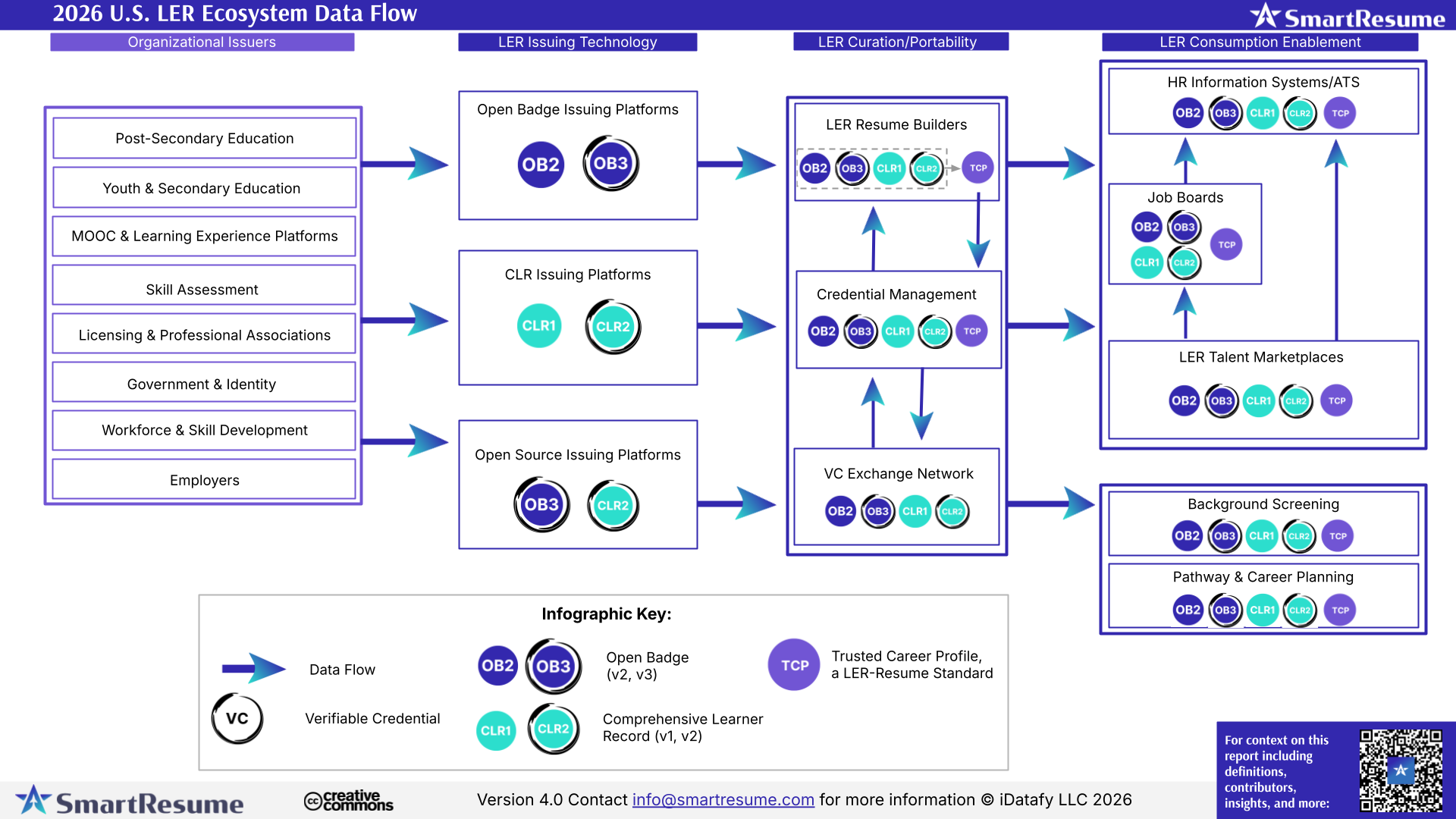
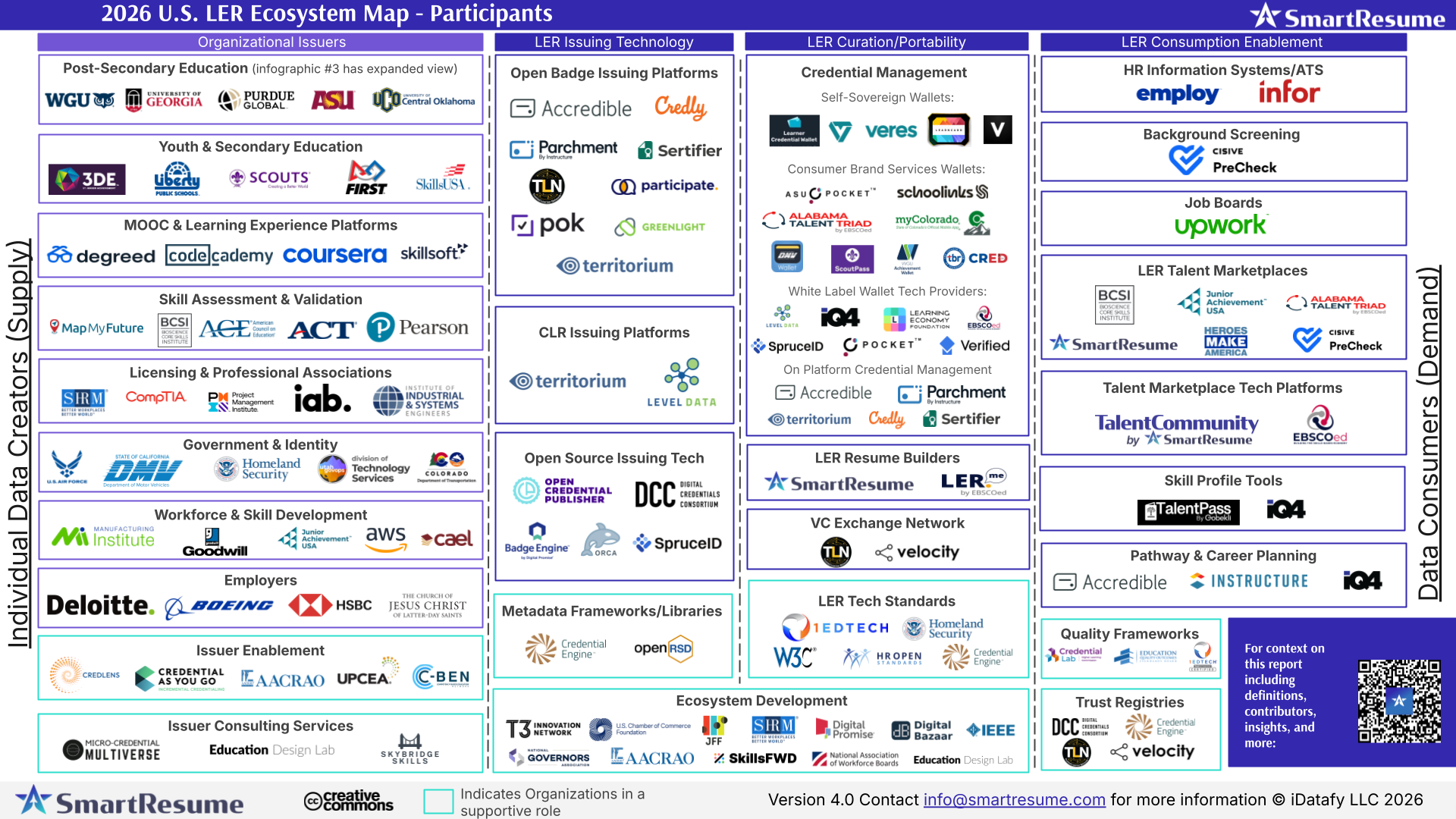
The Learning and Employment Records (LER) Report for 2026: Building the infrastructure between learning and work — from smartresume.com; with thanks to Paul Fain for this resource

Executive Summary (excerpt)

This report documents a clear transition now underway: LERs are moving from small experiments to systems people and organizations expect to rely on. Adoption remains early and uneven, but the forces reshaping the ecosystem are no longer speculative. Federal policy signals, state planning cycles, standards maturation, and employer behavior are aligning in ways that suggest 2026 will mark a shift from exploration to execution.

Across interviews with federal leaders, state CIOs, standards bodies, and ecosystem builders, a consistent theme emerged: the traditional model—where institutions control learning and employment records—no longer fits how people move through education and work. In its place, a new model is being actively designed—one in which individuals hold portable, verifiable records that systems can trust without centralizing control.

Most states are not yet operating this way. But planning timelines, RFP language, and federal signals indicate that many will begin building toward this model in early 2026.

As the ecosystem matures, another insight becomes unavoidable: records alone are not enough. Value emerges only when trusted records can be interpreted through shared skill languages, reused across contexts, and embedded into the systems and marketplaces where decisions are made.

Learning and Employment Records are not a product category. They are a data layer—one that reshapes how learning, work, and opportunity connect over time.

This report is written for anyone seeking to understand how LERs are beginning to move from concept to practice. Whether readers are new to the space or actively exploring implementation, the report focuses on observable signals, emerging patterns, and the practical conditions required to move from experimentation toward durable infrastructure.


“The building blocks for a global, interoperable skills ecosystem are already in place. As education and workforce alignment accelerates, the path toward trusted, machine-readable credentials is clear. The next phase depends on credentials that carry value across institutions, industries, states, and borders; credentials that move with learners wherever their education and careers take them. The question now isn’t whether to act, but how quickly we move.”

– Curtiss Barnes, Chief Executive Officer, 1EdTech


The above item was from Paul Fain’s recent posting, which includes the following excerpt:

SmartResume just published a guide for making sense of this rapidly expanding landscape. The LER Ecosystem Report was produced in partnership with AACRAO, Credential Engine, 1EdTech, HR Open Standards, and the U.S. Chamber of Commerce Foundation. It was based on interviews and feedback gathered over three years from 100+ leaders across education, workforce, government, standards bodies, and tech providers.

The tools are available now to create the sort of interoperable ecosystem that can make talent marketplaces a reality, the report argues. Meanwhile, federal policy moves and bipartisan attention to LERs are accelerating action at the state level.

“For state leaders, this creates a practical inflection point,” says the report. “LERs are shifting from an innovation discussion to an infrastructure planning conversation.”


AI and the Work of Centers for Teaching and Learning — from derekbruff.org by Derek Bruff

  • Penelope Adams Moon suggested that instead [of] framing a workshop around “How can we integrate AI into the work of teaching?” we should ask “Given what we know about learning, how might AI be useful?” I love that reframing, and I think it connects to the students’ requests for more AI knowhow. Students have a lot of options for learning: working with their instructor, collaborating with peers, surfing YouTube for explainer videos, university-provided social annotation platforms, and, yes, using AI as a kind of tutor. I think our job (collectively) isn’t just to teach students how to use AI (as they’re requesting) but also to help them figure out when and how AI is helpful for their learning. That’s highly dependent on the student and the learning task! I wrote about this kind of metacognition on my blog.

In the same way, when I approach any kind of educational technology, I’m looking for tools that can be responsive to my pedagogical aims. The pedagogy should drive the technology use, not the other way around.


What’s Happening to Jobs for New Grads — from linkedin.com by Jeff Selingo

No matter where you go to college, the job market math for new graduates is grim right now, as I write in a new article out yesterday in New York magazine.

There were 15% fewer entry-level and internship job postings in 2025 than the year before, according to Handshake, a job-search platform popular with college students; meanwhile, applications per posting rose 26%.

How much AI is to blame for the fragile entry-level job market is unclear. Several research studies show AI is hitting young college-educated workers disproportionately, but broader economic forces are part of the story, too.

As Christine Y. Cruzvergara, Handshake’s chief education strategy officer, told me, AI isn’t “taking” jobs so much as employers are “choosing” to replace parts of jobs with automation rather than redesign roles around workers. “They’re replacing people instead of enabling their workforce,” she said.

Today’s graduates are stuck in an in-between moment. Many started college before AI mattered and graduated into a labor market reshaped almost overnight, where entry-level roles are disappearing faster than students can adapt.


© 2025 | Daniel Christian