China Is About to Regulate AI—and the World Is Watching — from wired.com by Jennifer Conrad
Sweeping rules will cover algorithms that set prices, control search results, recommend videos, and filter content.

Excerpt:

On March 1, China will outlaw this kind of algorithmic discrimination as part of what may be the world’s most ambitious effort to regulate artificial intelligence. Under the rules, companies will be prohibited from using personal information to offer users different prices for a product or service.

The sweeping rules cover algorithms that set prices, control search results, recommend videos, and filter content. They will impose new curbs on major ride-hailing, ecommerce, streaming, and social media companies.


Living in a world of unicorns — from pwc.com by Vicki Huff Eckert
Venture-backed giants are scaling up and transforming markets as varied fintech, electric vehicles, and healthcare.

Excerpt:

During the pandemic, edtech unicorns raised (on an annualized basis) eight times the annual amount raised from 2016 through 2019. Tutoring platforms Byju (based in India) and Yuanfudao and Zuoyebang (based in China) received massive investment (each attracted $3 billion to $4 billion in funding between 2016 and 2021). The Business Standard reported that Byju had 100 million registered students and 6.5 million paid subscribers as of September 2021.

This trend is just getting started—the convergence of the metaverse, crypto, and 5G has the potential to create a web 3.0 economy that we can’t yet fully envision, and that will evolve over the course of the decade.


Metaverse vs. employment law: The reality of the virtual workplace — from arstechnica.com by Kate Beoiley
It is unclear how employee protections apply in the universal digital realm.

Excerpt:

When it comes to employment laws, however, it is unclear what rules of engagement apply in a universal digital realm. What counts as harassment in the metaverse? Can an avatar be discriminated against, or worse? Will national legislation protect employees or does working in the metaverse require a new rule book altogether?

Lack of legal framework
But the metaverse takes hybrid working a step further and brings with it a host of thorny employment law issues. These range from practical challenges, such as how employees are paid, to more philosophical ones, like whether avatars have a legal identity. “The legal conundrums are about as diverse as the possibilities of the metaverse itself,” says Jonathan Newman, managing associate at law firm Simmons & Simmons.


Six Unaddressed Legal Concerns For The Metaverse — from forbes.com by Nitin Kumar; with thanks to Ori Inbar on Twitter for this resource

The metaverse is an extremely exciting space with many opportunities. It is also a shift that breaks down conventional legal thinking and frameworks built for the old economy, creating new legal, regulatory and technical issues that need resolution.
 

A whole new world: Education meets the metaverse — from brookings.edu by Kathy Hirsh-Pasek, Jennifer M. Zosh, Helen Shwe Hadani, Roberta Michnick Golinkoff, Kevin Clark, Chip Donohue, and Ellen Wartella

Excerpt:

The metaverse is upon us. Soon it will be as omnipresent as TikTok, Instagram, and Facebook (now Meta). As technology advances to bring us new immersive and imaginary worlds, how we educate children and prepare teachers must also advance to meet these new opportunities. When education lags the digital leaps, the technology rather than educators defines what counts as educational opportunity. This is largely what happened with the introduction of “educational” apps designed to be used on smartphones and tablets meant for adults. Today, as the metaverse infrastructure is still under construction, researchers, educators, policymakers, and digital designers have a chance to lead the way rather than get caught in the undertow. To leverage the potential of the metaverse as a 3D, global, interconnected, immersive, and real-time online space, we need new ways to connect the physical world with augmented and virtual reality (VR) experiences.

In the end, we challenge those creating educational products for the metaverse to partner with educators and scientists to ensure that children experience real human social interaction as they navigate virtual spaces, children’s agency is supported as they explore these spaces, and there is a real eye to diversity in the representation and access to what is created.  

Also relevant/see:

The metaverse can provide a whole new opportunity for education. Here’s what to consider — from fastcompany.com by Stephen Fromkin
The cofounder of Talespin looks at an existing immersive learning program that delivers results and says our next priority should be getting it into the hands of as many learners as possible through the metaverse.


The Lifecycle of a Breakthrough — from digitaltonto.com by  Greg Satell

Excerpt:

When we look back through history, we see a series of inventions. It seems obvious to us that things like the internal combustion engine and electricity would change the world. Still, as late as 1920, roughly 40 years after they were invented, most American’s lives remained unchanged. For practical purposes, the impact of those two breakthroughs were negligible.

What made the difference wasn’t so much the inventions themselves, but the ecosystems that form around them. For internal combustion engines it took a separate networks to supply oil, to build roads, manufacture cars and ships and so on. For electricity, entire industries based on secondary inventions, such as household appliances and radios, needed to form to fully realize the potential of the underlying technology.

From DSC:
I wonder what our learning ecosystems will look 5-10 years from now…?

#learningfromthelivingclassroom
#learningecosystems


What can institutions do to get ahead of a fast-changing higher ed market? — from highereddive.com by Laura Spitalniak

Excerpts:

  • Universities must prepare for a future where students could demand degrees, low-cost options or asynchronous learning. Otherwise, institutions risk becoming obsolete, according to a recent report from consulting firm EY.
  • Four key recommendations to education leaders are highlighted: Be clear about long-term purpose, consider possible future scenarios when making today’s choices, find leadership talent from other sectors that have already had to reinvent themselves, and invest across current and future time horizons.
 

Holograms? Check! Now what? — from blog.webex.com by Elizabeth Bieniek

Excerpt (emphasis DSC):

Two years ago, I wrote about the Future of Meetings in 2030 and hinted at an effort my team was building to make this a reality. Now, we have publicly unveiled Webex Hologram and brought the reality of a real-time, end-to-end holographic meeting solution to life.

With Webex Hologram, you can feel co-located with a colleague who is thousands of miles away. You can share real objects in incredible multi-dimensional detail and collaborate on 3D content to show perspective, share, and approve design changes in real-time, all from the comfort of your home workspace.

As the hype dies down, the focus on entirely virtual experiences in fanciful environments will abate and a resurgence in focus on augmented experiences—interjecting virtual content into the physical world around you for an enhanced experience that blends the best of physical and virtual—will emerge.

The ability to have curated information at one’s fingertips, still holds an incredible value prop that has yet to be realized. Applying AI to predict, find, and present this type of augmented information in both 2D and 3D formats will become incredibly useful. 

From DSC:
As I think of some of the categories that this posting about establishing a new kind of co-presence relates to, there are many relevant ones:

  • 21st century
  • 24x7x365
  • 3D
  • Audio/Visual (A/V)
  • Artificial Intelligence (AI)
  • Cloud-based
  • Collaboration/web-based collaboration
  • Intelligent tutoring
  • Law schools, legal, government
  • Learning, learning agents, learning ecosystems, Learning from the Living [Class] Room, learning spaces/hubs/pods
  • Libraries/librarians
  • K-12, higher education, corporate training
  • Metaverse
  • Online learning
  • Telelegal, telemedicine
  • Videoconferencing
  • Virtual courts, virtual tutoring, virtual field trips
  • Web3
 

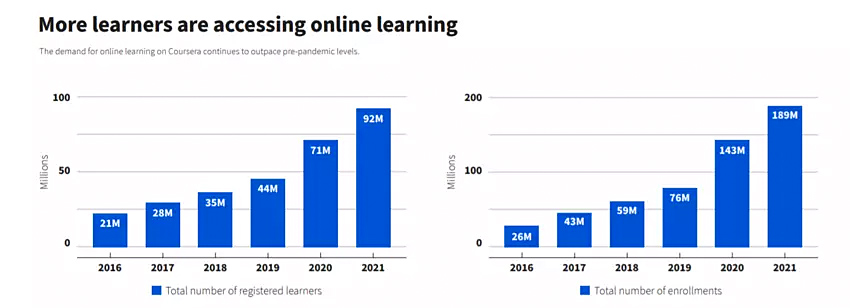
These 3 charts show the global growth in online learning — from weforum.org by Johnny Wood; with thanks to Ray Schroeder out on LinkedIn

Example chart:

Also relevant/see:

The company has launched 13 new degrees with colleges since 2021, bringing the total number of bachelor’s, master’s and postgraduate degrees up to 38, according to Maggioncalda.

2U saw $152.4 million from its degree segment in 2021’s fourth quarter, about 11 times the revenue Coursera brought in from its degree business over the same period. 


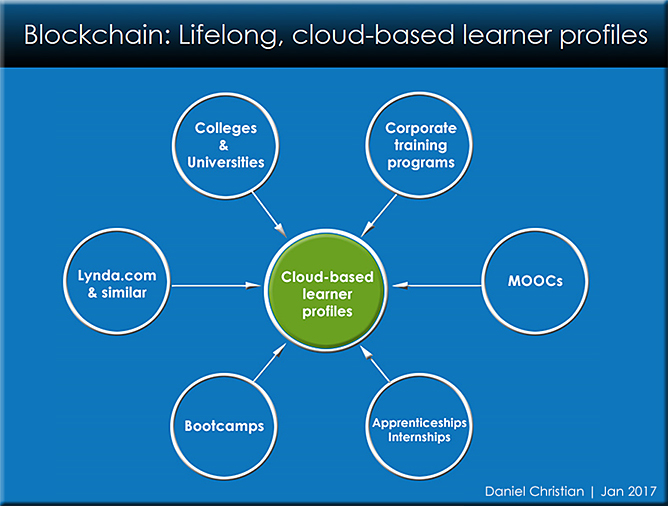
Technology We Need: Documenting the complete Learner Record — from gettingsmart.com by Nate McClennen and Rebecca Midles

Key Points

  • Most innovative schools and a number of states have built Graduate Profiles/Learner Profiles and a handful have created K12 competency progressions that articulate pathways towards meeting the profile.
  • These learning organizations are using a learning management system (LMS) that does not accommodate comprehensive Learner Records, does not capture or report transparent growth to learners or their families and does not capture out-of-course learning experiences.
  • We issue a challenge to those building and creating solutions.

From DSC:
The above posting reminds me of the following graphic:


What It Takes to Recruit Future Teachers During the Pandemic — from edsurge.com by Rebecca Koenig

Excerpts:

“Efforts that seem to be working have had a common ingredient: close ties between colleges and local K-12 school districts.”

“Taking out loans to earn a college degree, then entering a profession where they can’t pay those loans off—that’s a challenge,” she explains.

So for the first time, this academic year education students are eligible to receive a stipend during their student-teaching internships. Based on a recommendation made in 2019 by a “teacher shortage task force” commissioned by the Oklahoma department of education, the state allocated some of its COVID-relief money to pay student-teachers a total of $3,250—half up front, and half after they’re hired into a teaching job by a school district.

#highereducation #K12 #education #studentteaching
#learningecosystems #teachingandlearning


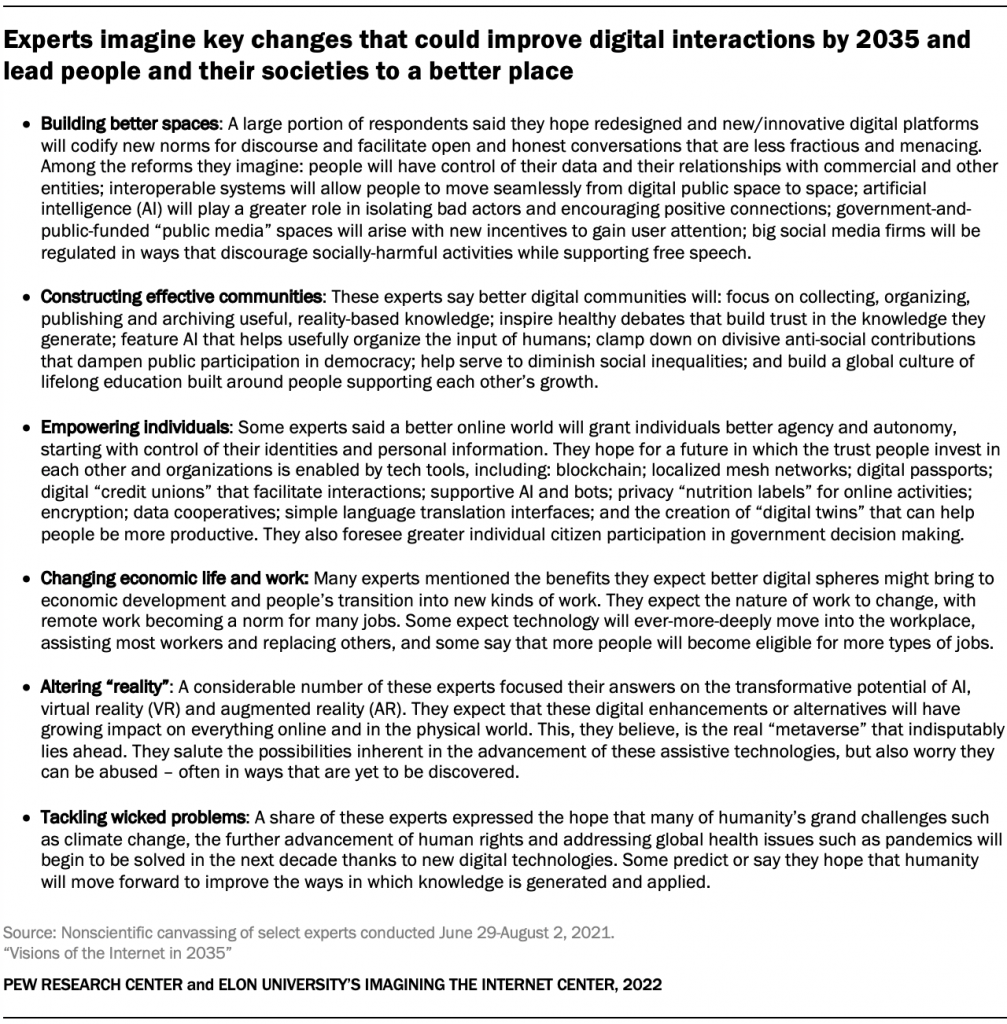
Visions of the Internet in 2035 — from pewresearch.org

Excerpt:

This report is the second of two analyzing the insights of hundreds of technology experts who responded in the summer of 2021 to a canvassing of their predictions about the evolution of online public spaces and their role in democracy in the coming years. In response to the primary research question, many said they expect that these forums will be significantly improved by 2035 if reformers, big technology firms, governments and activists tackle the problems created by misinformation, disinformation and toxic discourse. At the same time, they expressed ongoing concerns about the destructive forces in culture and technology that could continue to plague online life and disrupt beneficial change in the coming years.

Visions of the Internet in 2035


As seen/accessible from this page.

A brief insert from DSC:
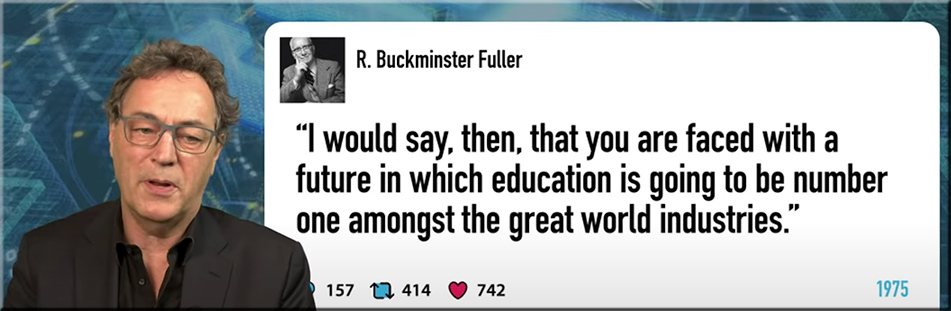
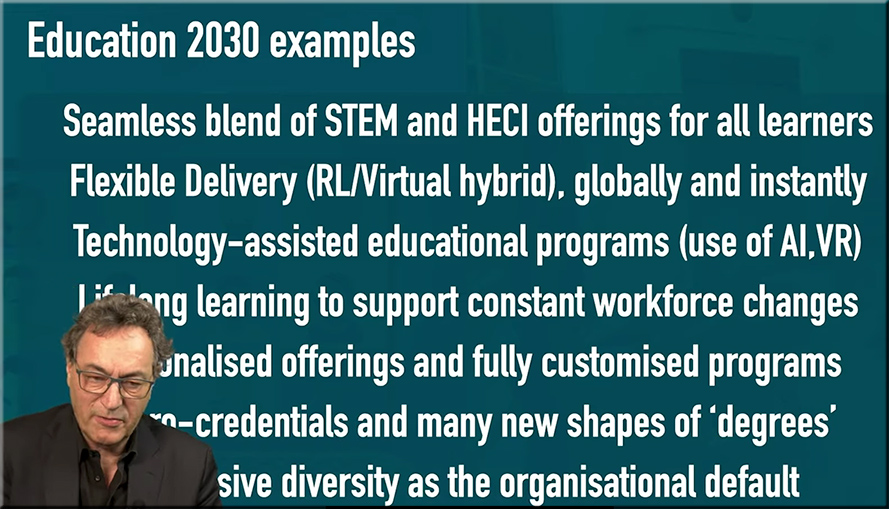
Another futurist Thomas Frey has some thoughts along this same line.

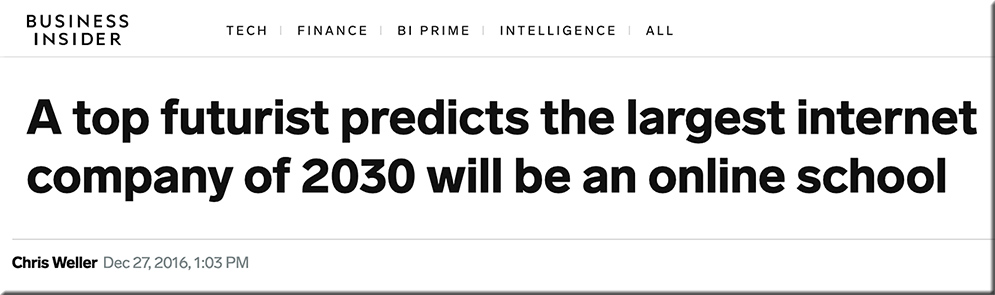
A top futurist predicts the largest internet company of 2030 will be an online school

#Canada #education #future #trends #careerdevelopment #change #paceofchange #automation #robotics #education #AI #learnhowtolearn #unlearn #learningecosystems #lifelonglearning #endofroutine #experientiallearning


Machines are for answers. Humans are for questions. 


Also relevant/see:


Skill assessments: The future of personalization in learning — from edyoucated.org by Julian Rasch

The future of personalization in professional online learning lies in detailed, but fast and effective skill assessments. Here’s how we do it at edyoucated.


22 Augmented Reality Trends to Keep an Eye on for 2022 — from linkedin.com by Tom Emrich

Excerpts:

#1 Metaverse remains at peak hype as the next iteration of the Internet feels so close but is actually much further away

#2 The smartphone continues to become an even more powerful augmented reality machine with advancements in chips, displays and connectivity

#3 Early consumer smartglasses reinforce the need for smartphones rather than attempt to replace them

The metaverse is defined differently by different people but for me, the metaverse is an aha moment. It is a realization by industry that the next wave of computing is comprised of a stack of emerging technologies (including blockchain, AI, IoT, AR and VR) that will all work together to create a fundamental shift in our relationship with technology. 


Also see:

 
© 2025 | Daniel Christian