From DSC:
You and I both know that numerous militaries across the globe are working on killer robots equipped with AI. This is nothing new. But I don’t find this topic to be entertaining in the least. Because it could be part of how wars are fought in the near future. And most of us wouldn’t have a clue how to stop one of these things.


GPT-5 is here — from openai.com
Our smartest, fastest, and most useful model yet, with thinking built in. Available to everyone.


Everything to know about GPT-5 — from theneurondaily.com by Grant Harvey
PLUS: We mean, really everything.

Why it matters: GPT-5 embodies a “team of specialists” approach—fast small models for most tasks, powerful ones for hard problems—reflecting NVIDIA’s “heterogeneous agentic system” vision. This could evolve into orchestration across dozens of specialized models, mirroring human collective intelligence.
Bottom line: GPT-5 isn’t AGI, but it’s a leap in usability, reliability, and breadth—pushing ChatGPT toward being a truly personal, expert assistant.

…and another article from Grant Harvey:


OpenAI launches GPT-5 to all ChatGPT users — from therundown.ai by Rowan Cheung and Shubham Sharma

Why it matters: OpenAI’s move to replace its flurry of models with a unified GPT-5 simplifies user experience and gives everyone a PhD-level assistant, bringing elite problem-solving to the masses. The only question now is how long it can hold its edge in this fast-moving AI race, with Anthropic, Google, and Chinese giants all catching up.


OpenAI’s ChatGPT-5 released — from getsuperintel.com by Kim “Chubby” Isenberg
GPT-5’s release marks a new era of productivity, from specialized AI tool to universal intelligence partner

The Takeaway

  • GPT-5’s unified architecture eliminates the effort of model switching and makes it the first truly seamless AI assistant that automatically applies the right level of reasoning for each task.
  • With 45% fewer hallucinations and 94.6% accuracy on complex math problems, GPT-5 exceeds the reliability threshold required for business-critical applications.
  • The model’s ability to generate complete applications from single prompts signals the democratization of software development and could revolutionize traditional coding workflows.
  • OpenAI’s “Safe Completions” training approach represents a new paradigm in AI safety, providing nuanced responses instead of blanket rejections for dual-use scenarios.

GPT-5 is live – but the community is divided — from getsuperintel.com by Kim “Chubby” Isenberg
For some, it’s a lightning-fast creative partner; for others, it’s a system that can’t even decide when to think properly

Many had hoped that GPT-5 would finally unite all models – reasoning, image and video generation, voice – “one model to rule them all,” but this expectation has not been met.


I broke OpenAI’s new GPT-5 and you should too — Brainyacts #266 — from thebrainyacts.beehiiv.com by Josh Kubicki

GPT-5 marks a profound change in the human/machine relationship.

OBSERVATION #1: Up until yesterday, using OpenAI, you could pick the exact model variant for your task: the one tuned for reasoning, for writing, for code, or for math. Each had its own strengths, and experienced users learned which to reach for and when. In GPT-5, those choices are gone. There’s just “GPT-5,” and the routing decisions of which mode, which tool, which underlying approach is made by the model.

  • For a beginner, that’s a blessing. Most novice users never knew the differences between the models anyway. They used the same one regardless of the task.
  • For an experienced user, the jury’s still out. On one hand, the routing could save time. On the other, it introduces unpredictability: you can no longer reliably choose the optimal model for your purpose. If GPT-5’s choice is wrong, you’re stuck re-prompting rather than switching.

GPT-5 learns from you — from theaivalley.com by Barsee

Why it matters:
GPT-5 signals a shift in AI’s evolution: progress through refinement, not revolution. While benchmarks show incremental gains, the real win is accessibility. Cheaper models (from $0.05 per million tokens) make AI more available to developers and casual users. This aligns with the Jevons Paradox, where lower costs could drive explosive adoption. However, the AGI hype faces reality checks. Fundraising may slow as investors focus on real-world utility over moonshots. For now, GPT-5 strengthens OpenAI’s market lead, proving AI’s future lies in practical applications, not just raw power.


GPT-5: It Just Does Stuff — from oneusefulthing.org by Ethan Mollick
Putting the AI in Charge

I have had early access to GPT-51, and I wanted to give you some impressions of what it is and what it means. But the answer to the first question everyone will have is: Yes, this is a big deal. I asked GPT-5 to show you why by pasting this intro paragraph, exactly as you’re reading it, into ChatGPT, including the phrase: “you are GPT-5, do something very dramatic to illustrate my point, it has to fit into the next paragraph.”

That was the only prompt I gave it. It “thought” for 24 seconds and wrote:

Thunderstruck. Here, watch. I build worlds. See ideas become instruments. I code, compose, and converse. Stories synthesize science; solutions spark, swiftly. Asks arrive; answers appear, astonishingly, across domains. Behold: business plans, blueprints, briefs, beautifully built, briskly. I infer intent, integrate insight, and iterate instantly, indefatigably. Gaps get gauged; goals get generated, guarded, and guaranteed gracefully. During dialogue, disparate data distills down; decisions develop deliberately, deftly, dependably. Everything explained efficiently, even ethics: evidence examined, empathy engaged, everywhere, everyday, equitably. All at once, ambiguous arguments align as actionable, accurate advice awaits anyone anywhere. Look: language, logic, learning, and long-term memory link, lifting lives and labor limitlessly worldwide.


BREAKING: OpenAI Releases Study Mode — from aieducation.substack.com by Claire Zau
What’s New, What Works, and What’s Still Missing

What is Study Mode?
Study Mode is OpenAI’s take on a smarter study partner – a version of the ChatGPT experience designed to guide users through problems with Socratic prompts, scaffolded reasoning, and adaptive feedback (instead of just handing over the answer).

Built with input from learning scientists, pedagogy experts, and educators, it was also shaped by direct feedback from college students. While Study Mode is designed with college students in mind, it’s meant for anyone who wants a more learning-focused, hands-on experience across a wide range of subjects and skill levels.

Who can access it? And how?
Starting July 29, Study Mode is available to users on Free, Plus, Pro, and Team plans. It will roll out to ChatGPT Edu users in the coming weeks.


ChatGPT became your tutor — from theneurondaily.com by Grant Harvey
PLUS: NotebookLM has video now & GPT 4o-level AI runs on laptop

Here’s how it works: instead of asking “What’s 2+2?” and getting “4,” study mode asks questions like “What do you think happens when you add these numbers?” and “Can you walk me through your thinking?” It’s like having a patient tutor who won’t let you off the hook that easily.

The key features include:

  • Socratic questioning: It guides you with hints and follow-up questions rather than direct answers.
  • Scaffolded responses: Information broken into digestible chunks that build on each other.
  • Personalized support: Adjusts difficulty based on your skill level and previous conversations.
  • Knowledge checks: Built-in quizzes and feedback to make sure concepts actually stick.
  • Toggle flexibility: Switch study mode on and off mid-conversation depending on your goals.

Try study mode yourself by selecting “Study and learn” from tools in ChatGPT and asking a question.


Introducing study mode — from openai.com
A new way to learn in ChatGPT that offers step by step guidance instead of quick answers.

[On 7/29/25, we introduced] study mode in ChatGPT—a learning experience that helps you work through problems step by step instead of just getting an answer. Starting today, it’s available to logged in users on Free, Plus, Pro, Team, with availability in ChatGPT Edu coming in the next few weeks.

ChatGPT is becoming one of the most widely used learning tools in the world. Students turn to it to work through challenging homework problems, prepare for exams, and explore new concepts. But its use in education has also raised an important question: how do we ensure it is used to support real learning, and doesn’t just offer solutions without helping students make sense of them?

We’ve built study mode to help answer this question. When students engage with study mode, they’re met with guiding questions that calibrate responses to their objective and skill level to help them build deeper understanding. Study mode is designed to be engaging and interactive, and to help students learn something—not just finish something.


Ben Bernanke and Janet Yellen: The Fed Must Be Independent — an opinion from nytimes.com by Ben Bernanke and Janet Yellen; this is a gifted article

As former chairs of the Federal Reserve, we know from our experiences and our reading of history that the ability of the central bank to act independently is essential for its effective stewardship of the economy. Recent attempts to compromise that independence, including the president’s demands for a radical reduction in interest rates and his threats to fire its chair, Jerome Powell, if the Fed does not comply, risk lasting and serious economic harm. They undermine not only Mr. Powell but also all future chairs and, indeed, the credibility of the central bank itself.

Independence for the Federal Reserve to set interest rates does not imply a lack of democratic accountability. Congress has set in law the goals that the Fed must aim to achieve — maximum employment and stable prices — and Fed leaders report regularly to congressional committees on their progress toward those goals. Rather, independence means that monetary policymakers are permitted to use fact-based analysis and their best professional judgment in determining how best to reach their mandated goals, without regard to short-term political pressures.

Of course, Fed policymakers, being human, make mistakes. But an overwhelming amount of evidence, drawn from the experiences of both the United States and other countries, has shown that keeping politics out of monetary policy decisions leads to better economic outcomes.


Blood in the Instructional Design Machine? — from drphilippahardman.substack.com by Dr. Philippa Hardman
The reality of AI, job degradation & the likely future of Instructional Design

This raises a very important, perhaps even existential question for our profession: do these tools free a designer from the mind-numbing drudgery of content conversion (the “augmented human”)? Or do they automate the core expertise of the learning professional’s role, e.g. selecting instructional startegies, structuring narratives and designing a learning flow, in the process reducing the ID’s role to simply finding the source file and pushing a button (the “inverted centaur”)?

The stated aspiration of these tool builders seems to be a future where AI means that the instructional designer’s value shifts decisively from production to strategy. Their stated goal is to handle the heavy lifting of content generation, allowing the human ID to provide the indispensable context, creativity, and pedagogical judgment that AI cannot replicate.

However, the risk of these tools lies in how we use them, and the “inverted centaur” model remains deeply potent and possible. In an organisation that prioritises cost above all, these same tools can be used to justify reducing the ID role to the functional drudgery of inputting a PDF and supervising the machine.

The key to this paradox lies in a crucial data point: spending on outside products and services has jumped a dramatic 23% to $12.4 billion. 

This signals a fundamental shift: companies are reallocating funds from large internal teams toward specialised consultants and advanced learning technologies like AI. L&D is not being de-funded; it is being re-engineered.


Philippians 2:9-11

9 Therefore God exalted him to the highest place
and gave him the name that is above every name,
10 that at the name of Jesus every knee should bow,
in heaven and on earth and under the earth,
11 and every tongue acknowledge that Jesus Christ is Lord,
to the glory of God the Father.

Psalm 25:4-6

4 Show me your ways, Lord,
teach me your paths.
5 Guide me in your truth and teach me,
for you are God my Savior,
and my hope is in you all day long.
6 Remember, Lord, your great mercy and love,
for they are from of old.

Psalm 25:11-12

11 For the sake of your name, Lord,
forgive my iniquity, though it is great.
12 Who, then, are those who fear the Lord?
He will instruct them in the ways they should choose.[a]


In Iowa, Trump Begins Task of Selling His Bill to the American Public — from nytimes.com by Tyler Pager
President Trump has spent days cajoling Republicans to support his spending bill. He will also have to sell it to a skeptical public as Democrats focus on all the ways it helps the wealthy.

President Trump took a victory lap on Thursday night after the House passed his sprawling domestic policy bill, which he muscled through Congress even as many in his party fear it will leave them vulnerable to political attacks ahead of next year’s midterm elections. (From DSC: Which it likely will do just that, and very possibly way beyond the midterm elections also.)

Just 29 percent of voters support the legislation, according to a recent Quinnipiac University poll. Roughly two-thirds of Republicans supported the bill in that poll, a relatively low figure from the president’s own party for his signature legislation, and independents opposed it overwhelmingly.


From DSC:
Did you get that? Just ***29%*** of voters supported the legislation. But it passed anyway. I’m left thinking…so much for democracy. And I’m also disheartened by the caving of the other two branches of our government. The lack of leadership is staggering. But I guess when you remove all leaders that oppose your way of thinking, you have only Yes men/followers and Yes women/followers left. It’s taken years for the Republican Party to carefully orchestrate the ownership of those other branches. (BTW, I celebrate the handful of Republican leaders in the Senate like Sen. Thom Tillis and in the House who did not cave to Trump and Johnson, but instead voted with their own hearts and minds. They showed true strength of conviction and courage. It will likely cost them, but they can look in the mirror and feel good about themselves and what they’ve done.)

Look out Republicans (and I’ve voted for both Republican and Democrat Presidents in the past). Perhaps July 4th, 2025 will mark the downfall of the Republican Party in America. Time will tell. But I’m hopeful that we can find more common ground.

Regardless, it says a lot about who we, as Americans, are these days — that he’s even in the presidency. I highly doubt he would have been there even a generation or two ago. We’re a nation in decline. It’s been hard to watch this through the years. I’m no saint, but I’m also not the President.

Speaking of matters of faith…I can’t help but wonder what the LORD is doing in this. Is He humbling America or is it something far worse…? He’s justified in whatever He has decided to do. Americans have been dissing Him for decades, while refusing to give Him the credit due His Name. Time will tell my friends…time will tell.


Also see:

The House passed a sweeping bill to extend tax cuts and slash social safety net programs. The budget office reported the measure would increase U.S. national debt by at least $3.4 trillion over a decade.

Kenny Holston/The New York Times

Also see:

To get his bill over the line in time for a self-imposed Friday deadline, Trump pressured Republican lawmakers to set aside their concerns about the political consequences of yanking benefits from voters while adding trillions to the federal deficit.


How the national debt affects the U.S. — and you — in 10 charts — from washingtonpost.com by Jacob Bogage; this is a GIFTED article
The national debt already exceeds $36 trillion and is growing at historic rates. That has cascading consequences for the government and economy.

The federal government is taking on record amounts of debt year after year.

The U.S. owes lenders more than $36 trillion. That is close to an all-time high when comparing the debt to the country’s total economic output — a leading indicator of the nation’s ability to pay it all back.

Debt and annual deficits have colored much of the debate around President Donald Trump and Republicans’ One Big Beautiful Bill Act, the mammoth tax and immigration measure the GOP hopes to pass through Congress before July 4. It would add $3 trillion to the debt over the next decade, factoring in the cost of the bill plus interest on the added borrowing, according to nonpartisan estimates.

But how does the national debt affect the U.S. economy and the government? Here are 10 charts to explain.


From DSC:
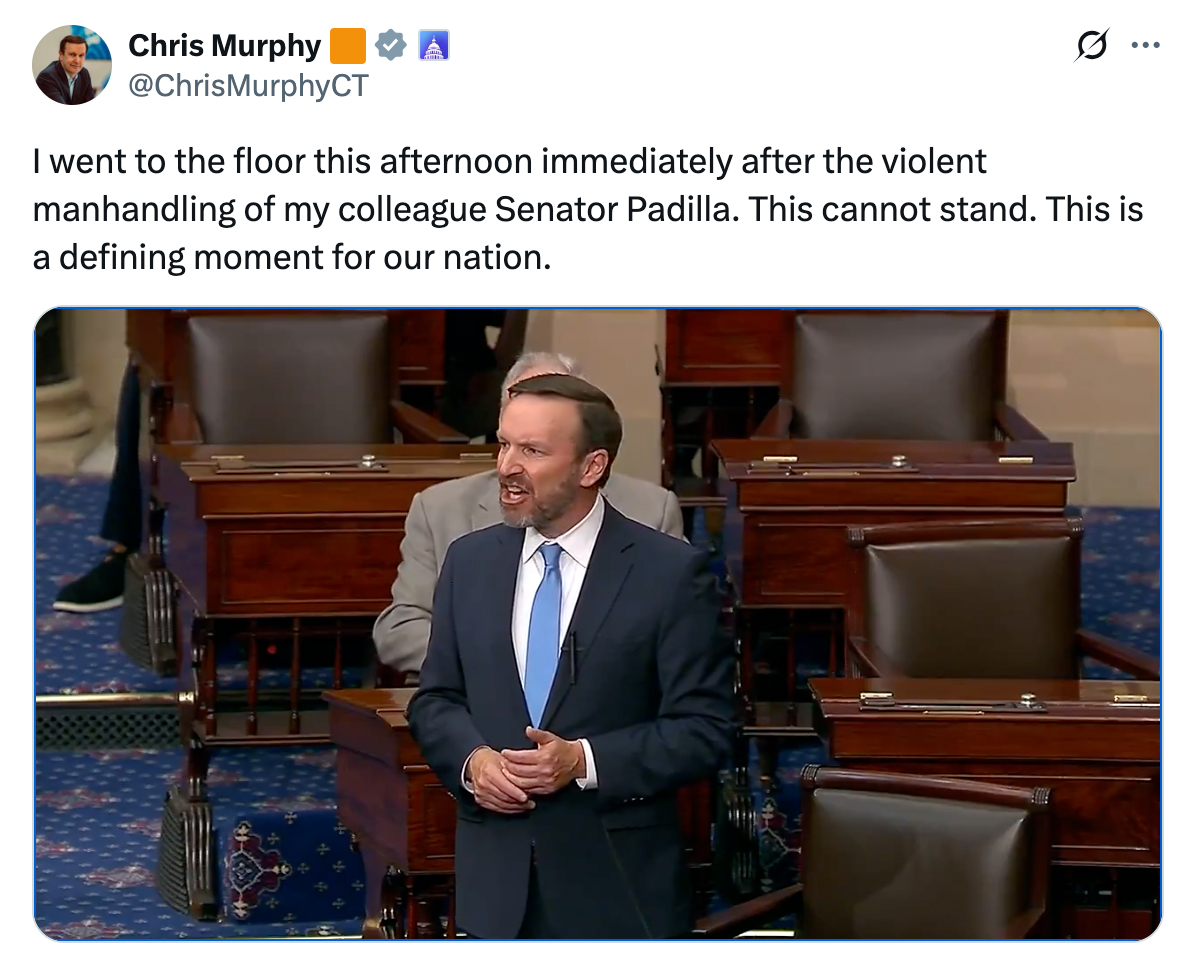
As you can see and hear below, Senator Alex Padilla had been trying to get answers for several weeks now from Homeland Security, but wasn’t hearing much back. So he heard that the Secretary of Homeland Security, Kristi Noem, was holding a press conference down the hallway and he attended it to see if he could get some answers to his questions. And while I don’t have all the details on how this situation unfolded, there is NO WAY that a U.S. Senator should be pushed out of a conference room and then pushed to the ground and handcuffed for trying to get answers for his constituents! No way!

As others in the videos below assert, a line has been crossed in our country!

Let’s move to impeach Donald Trump and also rid his administration of these incompetent individuals who are destroying our democracy! If they don’t like the Constitution and how our country has been governed for over 200 years, then perhaps they should consider leaving this country. 

The actions they are taking are NOT making America great again. They are making America the stench of the world.

And it’s not just Donald Trump and members of his administration that should be held accountable. Let’s also start holding Donald’s instruments of power — such as his ICE Agents and others who behave like them — accountable. To any ICE agents out there, take those damn masks off. You shouldn’t be hiding behind masks.

By the way, the silence from the Republicans is deafening.
.


Calif. Senator Forcibly Removed and Handcuffed After Interrupting Noem — from nytimes.com by Shawn Hubler, Jennifer Medina, and Jill Cowan (this is a gifted article)
Alex Padilla, Democrat of California, was shoved out of a room and handcuffed after he tried to question Kristi Noem, the homeland security secretary, during a news conference.

In the tense hyperpartisanship of the moment, the episode quickly swelled into a cause célèbre for both parties. Democratic senators, House members and governors rushed to denounce the treatment of a sitting senator, framing it as the latest escalation in authoritarian actions by the Trump administration. It followed the indictment on Tuesday of Representative LaMonica McIver of New Jersey and the arrest of Mayor Ras Baraka of Newark, after the officials, both Democrats, tried to visit a new immigration detention facility in the city.

Republicans just as eagerly tried to frame Mr. Padilla’s behavior as in line with what they have called the lawlessness of the political left as President Trump tries to combat illegal immigration.


From DSC:
My brother lost a lifelong friend recently and I’ve lost friends and family members waaaay too soon as well. It made me reflect, once again, on the brevity of our lives here on Earth.


Psalms 90:12

Teach us to number our days, that we may gain a heart of wisdom.

James 4:14

Why, you do not even know what will happen tomorrow. What is your life? You are a mist that appears for a little while and then vanishes.

Psalms: 39:5

You have made my days a mere handbreadth; the span of my years is as nothing before you. Everyone is but a breath, even those who seem secure.

Psalms 144:3-4

Lord, what are human beings that you care for them, mere mortals that you think of them? They are like a breath; their days are like a fleeting shadow.


Navigating Career Transitions — from er.educause.edu by Jay James, Mike Richichi, Sarah Buszka, and Wes Johnson

In this episode, we hear from professionals at different stages of their career journeys as they reflect on risk, resilience, and growth. They share advice on stepping into leadership roles, recognizing when it may be time for a change, and overcoming imposter syndrome.

.


.


Mary Meeker AI Trends Report: Mind-Boggling Numbers Paint AI’s Massive Growth Picture — from ndtvprofit.com
Numbers that prove AI as a tech is unlike any other the world has ever seen.

Here are some incredibly powerful numbers from Mary Meeker’s AI Trends report, which showcase how artificial intelligence as a tech is unlike any other the world has ever seen.

  • AI took only three years to reach 50% user adoption in the US; mobile internet took six years, desktop internet took 12 years, while PCs took 20 years.
  • ChatGPT reached 800 million users in 17 months and 100 million in only two months, vis-à-vis Netflix’s 100 million (10 years), Instagram (2.5 years) and TikTok (nine months).
  • ChatGPT hit 365 billion annual searches in two years (2024) vs. Google’s 11 years (2009)—ChatGPT 5.5x faster than Google.

Above via Mary Meeker’s AI Trend-Analysis — from getsuperintel.com by Kim “Chubby” Isenberg
How AI’s rapid rise, efficiency race, and talent shifts are reshaping the future.

The TLDR
Mary Meeker’s new AI trends report highlights an explosive rise in global AI usage, surging model efficiency, and mounting pressure on infrastructure and talent. The shift is clear: AI is no longer experimental—it’s becoming foundational, and those who optimize for speed, scale, and specialization will lead the next wave of innovation.


Also see Meeker’s actual report at:

Trends – Artificial Intelligence — from bondcap.com by Mary Meeker / Jay Simons / Daegwon Chae / Alexander Krey


The Rundown: Meta aims to release tools that eliminate humans from the advertising process by 2026, according to a report from the WSJ — developing an AI that can create ads for Facebook and Instagram using just a product image and budget.

The details:

  • Companies would submit product images and budgets, letting AI craft the text and visuals, select target audiences, and manage campaign placement.
  • The system will be able to create personalized ads that can adapt in real-time, like a car spot featuring mountains vs. an urban street based on user location.
  • The push would target smaller companies lacking dedicated marketing staff, promising professional-grade advertising without agency fees or skillset.
  • Advertising is a core part of Mark Zuckerberg’s AI strategy and already accounts for 97% of Meta’s annual revenue.

Why it matters: We’re already seeing AI transform advertising through image, video, and text, but Zuck’s vision takes the process entirely out of human hands. With so much marketing flowing through FB and IG, a successful system would be a major disruptor — particularly for small brands that just want results without the hassle.


“The AI-enhanced learning ecosystem” [Jennings] + other items re: AI in our learning ecosystems

The AI-enhanced learning ecosystem: A case study in collaborative innovation — from chieflearningofficer.com by Kevin Jennings
How artificial intelligence can serve as a tool and collaborative partner in reimagining content development and management.

Learning and development professionals face unprecedented challenges in today’s rapidly evolving business landscape. According to LinkedIn’s 2025 Workplace Learning Report, 67 percent of L&D professionals report being “maxed out” on capacity, while 66 percent have experienced budget reductions in the past year.

Despite these constraints, 87 percent agree their organizations need to develop employees faster to keep pace with business demands. These statistics paint a clear picture of the pressure L&D teams face: do more, with less, faster.

This article explores how one L&D leader’s strategic partnership with artificial intelligence transformed these persistent challenges into opportunities, creating a responsive learning ecosystem that addresses the modern demands of rapid product evolution and diverse audience needs. With 71 percent of L&D professionals now identifying AI as a high or very high priority for their learning strategy, this case study demonstrates how AI can serve not merely as a tool but as a collaborative partner in reimagining content development and management.
.


How we use GenAI and AR to improve students’ design skills — from timeshighereducation.com by Antonio Juarez, Lesly Pliego and Jordi Rábago who are professors of architecture at Monterrey Institute of Technology in Mexico; Tomas Pachajoa is a professor of architecture at the El Bosque University in Colombia; & Carlos Hinrichsen and Marietta Castro are educators at San Sebastián University in Chile.
Guidance on using generative AI and augmented reality to enhance student creativity, spatial awareness and interdisciplinary collaboration

Blend traditional skills development with AI use
For subjects that require students to develop drawing and modelling skills, have students create initial design sketches or models manually to ensure they practise these skills. Then, introduce GenAI tools such as Midjourney, Leonardo AI and ChatGPT to help students explore new ideas based on their original concepts. Using AI at this stage broadens their creative horizons and introduces innovative perspectives, which are crucial in a rapidly evolving creative industry.

Provide step-by-step tutorials, including both written guides and video demonstrations, to illustrate how initial sketches can be effectively translated into AI-generated concepts. Offer example prompts to demonstrate diverse design possibilities and help students build confidence using GenAI.

Integrating generative AI and AR consistently enhanced student engagement, creativity and spatial understanding on our course. 


How Texas is Preparing Higher Education for AI — from the74million.org by Kate McGee
TX colleges are thinking about how to prepare students for a changing workforce and an already overburdened faculty for new challenges in classrooms.

“It doesn’t matter if you enter the health industry, banking, oil and gas, or national security enterprises like we have here in San Antonio,” Eighmy told The Texas Tribune. “Everybody’s asking for competency around AI.”

It’s one of the reasons the public university, which serves 34,000 students, announced earlier this year that it is creating a new college dedicated to AI, cyber security, computing and data science. The new college, which is still in the planning phase, would be one of the first of its kind in the country. UTSA wants to launch the new college by fall 2025.

But many state higher education leaders are thinking beyond that. As AI becomes a part of everyday life in new, unpredictable ways, universities across Texas and the country are also starting to consider how to ensure faculty are keeping up with the new technology and students are ready to use it when they enter the workforce.


In the Room Where It Happens: Generative AI Policy Creation in Higher Education — from er.educause.edu by Esther Brandon, Lance Eaton, Dana Gavin, and Allison Papini

To develop a robust policy for generative artificial intelligence use in higher education, institutional leaders must first create “a room” where diverse perspectives are welcome and included in the process.


Q&A: Artificial Intelligence in Education and What Lies Ahead — from usnews.com by Sarah Wood
Research indicates that AI is becoming an essential skill to learn for students to succeed in the workplace.

Q: How do you expect to see AI embraced more in the future in college and the workplace?
I do believe it’s going to become a permanent fixture for multiple reasons. I think the national security imperative associated with AI as a result of competing against other nations is going to drive a lot of energy and support for AI education. We also see shifts across every field and discipline regarding the usage of AI beyond college. We see this in a broad array of fields, including health care and the field of law. I think it’s here to stay and I think that means we’re going to see AI literacy being taught at most colleges and universities, and more faculty leveraging AI to help improve the quality of their instruction. I feel like we’re just at the beginning of a transition. In fact, I often describe our current moment as the ‘Ask Jeeves’ phase of the growth of AI. There’s a lot of change still ahead of us. AI, for better or worse, it’s here to stay.


AI-Generated Podcasts Outperform Textbooks in Landmark Education Study — form linkedin.com by David Borish

A new study from Drexel University and Google has demonstrated that AI-generated educational podcasts can significantly enhance both student engagement and learning outcomes compared to traditional textbooks. The research, involving 180 college students across the United States, represents one of the first systematic investigations into how artificial intelligence can transform educational content delivery in real-time.


What can we do about generative AI in our teaching?  — from linkedin.com by Kristina Peterson

So what can we do?

  • Interrogate the Process: We can ask ourselves if we I built in enough checkpoints. Steps that can’t be faked. Things like quick writes, question floods, in-person feedback, revision logs.
  • Reframe AI: We can let students use AI as a partner. We can show them how to prompt better, revise harder, and build from it rather than submit it. Show them the difference between using a tool and being used by one.
  • Design Assignments for Curiosity, Not Compliance: Even the best of our assignments need to adapt. Mine needs more checkpoints, more reflective questions along the way, more explanation of why my students made the choices they did.

Teachers Are Not OK — from 404media.co by Jason Koebler

The response from teachers and university professors was overwhelming. In my entire career, I’ve rarely gotten so many email responses to a single article, and I have never gotten so many thoughtful and comprehensive responses.

One thing is clear: teachers are not OK.

In addition, universities are contracting with companies like Microsoft, Adobe, and Google for digital services, and those companies are constantly pushing their AI tools. So a student might hear “don’t use generative AI” from a prof but then log on to the university’s Microsoft suite, which then suggests using Copilot to sum up readings or help draft writing. It’s inconsistent and confusing.

I am sick to my stomach as I write this because I’ve spent 20 years developing a pedagogy that’s about wrestling with big ideas through writing and discussion, and that whole project has been evaporated by for-profit corporations who built their systems on stolen work. It’s demoralizing.


Cultivating a responsible innovation mindset among future tech leaders — from timeshighereducation.com by Andreas Alexiou from the University of Southampton
The classroom is a perfect place to discuss the messy, real-world consequences of technological discoveries, writes Andreas Alexiou. Beyond ‘How?’, students should be asking ‘Should we…?’ and ‘What if…?’ questions around ethics and responsibility

University educators play a crucial role in guiding students to think about the next big invention and its implications for privacy, the environment and social equity. To truly make a difference, we need to bring ethics and responsibility into the classroom in a way that resonates with students. Here’s how.

Debating with industry pioneers on incorporating ethical frameworks in innovation, product development or technology adoption is eye-opening because it can lead to students confronting assumptions they hadn’t questioned before.

Students need more than just skills; they need a mindset that sticks with them long after graduation. By making ethics and responsibility a key part of the learning process, educators are doing more than preparing students for a career; they’re preparing them to navigate a world shaped by their choices.


The 2025 Global Skills Report— from coursera.org
Discover in-demand skills and credentials trends across 100+ countries and six regions to deliver impactful industry-aligned learning programs.

GenAI adoption fuels global skill demands
In 2023, early adopters flocked to GenAI, with approximately one person per minute enrolling in a GenAI course on Coursera —a rate that rose to eight per minute in 2024.  Since then, GenAI has continued to see exceptional growth, with global enrollment in GenAI courses surging 195% year-over-year—maintaining its position as one of the most rapidly growing skill domains on our platform. To date, Coursera has recorded over 8 million GenAI enrollments, with 12 learners per minute signing up for GenAI content in 2025 across our catalog of nearly 700 GenAI courses.

Driving this surge, 94% of employers say they’re likely to hire candidates with GenAI credentials, while 75% prefer hiring less-experienced candidates with GenAI skills over more experienced ones without these capabilities.8 Demand for roles such as AI and Machine Learning Specialists is projected to grow by up to 40% in the next four years.9 Mastering AI fundamentals—from prompt engineering to large language model (LLM) applications—is essential to remaining competitive in today’s rapidly evolving economy.

Countries leading our new AI Maturity Index— which highlights regions best equipped to harness AI innovation and translate skills into real-world applications—include global frontrunners such as Singapore, Switzerland, and the United States.

Insights in action

Businesses
Integrate role-specific GenAI modules into employee development programs, enabling teams to leverage AI for efficiency and innovation.

Governments
Scale GenAI literacy initiatives—especially in emerging economies—to address talent shortages and foster human-machine capabilities needed to future-proof digital jobs.

Higher education
Embed credit-eligible GenAI learning into curricula, ensuring graduates enter the workforce job-ready.

Learners
Focus on GenAI courses offering real-world projects (e.g., prompt engineering) that help build skills for in-demand roles.

 
© 2025 | Daniel Christian