3 Ways AR Can Benefit the Enterprise: 1. Advanced ways to interact with data and training materials: In today’s world of Big Data, knowledge workers, manufacturing employees, and others are required to take on a number of data-intensive tasks: accessing, analyzing, and acting on large quantities of information, all while tackling the everyday collaboration and communication tasks of a normal work day. For employees in a number of industries, AR has the potential to be a game-changer in how employees interact with and share information because the technology overlays digital information over a user’s view of the real world.
…
2. Increased sales opportunities: For those brands who want to deliver richer customer experiences and increase sales, AR offers plenty of opportunities to transform the way that ustomers purchase products.
…
3. Enhanced model visualization: One useful ability of AR’s technological potential for the enterprise revolves around its 3D technology.
It’s something the theater is hoping to change with the help of Epson’s latest smart glasses. This week it launched a trial that will see deaf and hearing-impaired customers supplied with the eyewear, which displays subtitles in their field of vision wherever they’re sitting.
“The problem we’re aiming to solve is the lack of choice and the customer experience — it’s twofold,” Jonathan Suffolk, the theater’s technical director, said in an interview. The smart glass tech, he said, “gives customers the chance to come anytime they want, matinee or evening, and sit anywhere they want in any size theater.”
Like other technologies, AR has the potential to be a powerful constructivist learning technology that supports the personalized learning goals of students by bringing scannable content to life in an engaging and cost effective manner.
For a generation that’s been raised on interactive technologies, bringing AR into the classroom and curriculum can also help encourage active engagement and contribute to student retention.
…
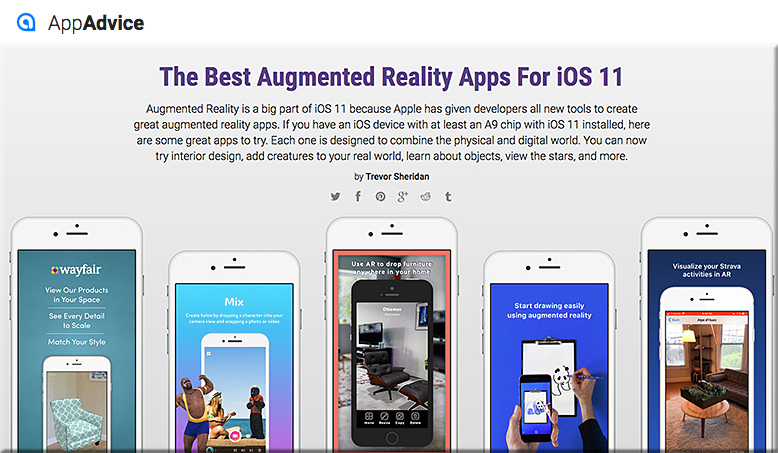
Here are a few top picks for introducing and creating AR experiences in the classroom.
I strongly believe that presence is the quality that makes Virtual Reality unique as a medium. Yet, analytical approaches to presence from a creative standpoint have been lacking. Let’s fix that.
The Top 200 Tools for Learning 2017 (11th Annual Survey) has been compiled by Jane Hart of the Centre for Learning & Performance Technologies from the votes of 2,174 learning professionals worldwide, together with 3 sub-lists
Top 100 Tools for Personal & Professional Learning (PPL)
66 tools moved up the list. Top 3 risers are Unsplash (up 71 places), Grammarly (up 70 places) and Snapchat (up 64 places
Messaging apps and team tools are particularly on the rise: Slack is now up 8 places to #12, Trello is up 21 places to #22, Microsoft Teams is another new tool in at #79
52 NEW tools appear on the list this year – the highest entry is Typeform in at #55.
2 interesting new tools for augmented and virtual reality join the list – Aurasma, ENTiTi – as well as a chatbot system – Ultra Hal Assistant.
Some observations on what the Top Tools list tells us personal and professional learning As in previous years, individuals continue to using a wide variety of:
networks, services and platforms for professional networking, communication and collaboration
web resources and courses for self-improvement and self-development
tools for personal productivity
All of which shows that many individuals have become highly independent, continuous modern professional learners – making their own decisions about what they need to learn and how to do it.
If you are at all interesting in emerging technologies and what several pieces
of our future learning ecosystems — and meeting spaces — could easily look like,
you NEED to watch the entire presentation.
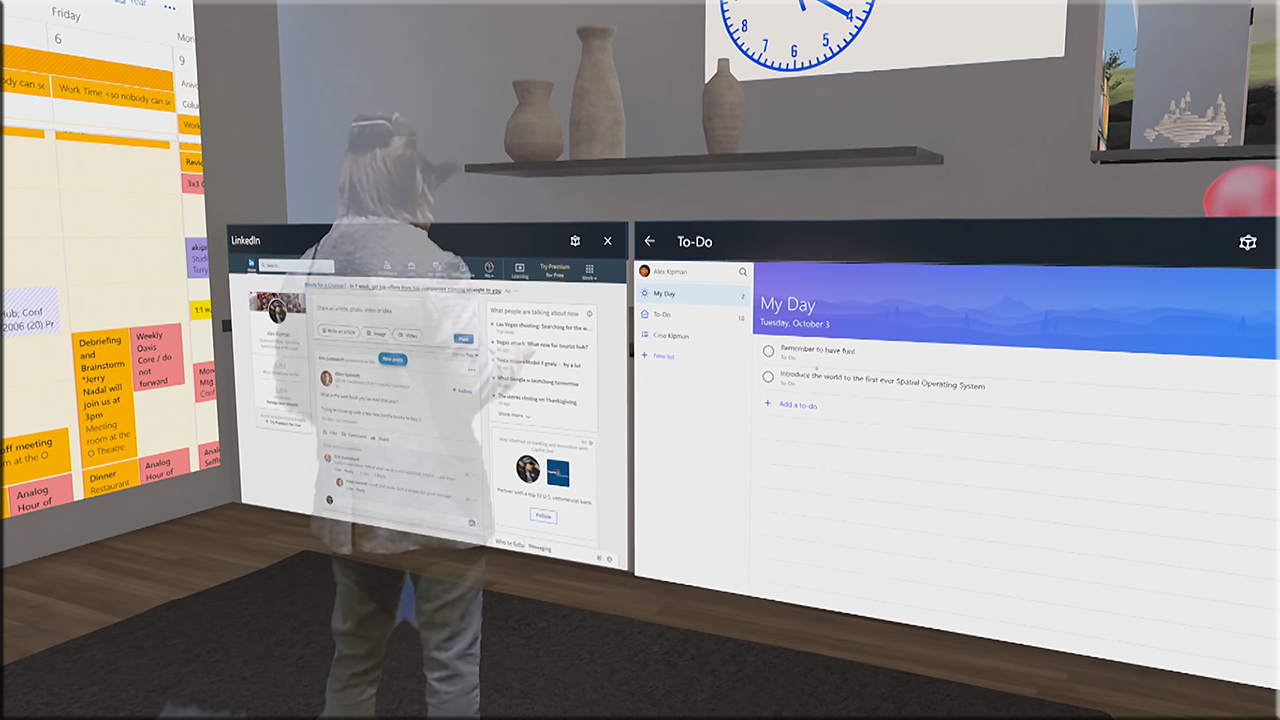
The era of Windows Mixed Reality begins October 17— from blogs.windows.com by Alex Kipman Samsung unveils Windows Mixed Reality headset, AltSpaceVR joins Microsoft, SteamVR catalog coming to Windows Mixed Reality this holiday.
At an event in San Francisco we unveiled our vision for Windows Mixed Reality, announced SteamVR and AltSpaceVR are coming to Windows Mixed Reality, introduced the new Samsung Odyssey HMD, and kicked off the holiday shopping season by announcing the availability of pre-orders for Windows Mixed Reality headsets at the Microsoft Store.
Microsoft held its long-awaited launch of Windows 10 Mixed Reality yesterday, and while most of the new devices and products had been leaked earlier, there were still some big takeaways. Here are some of them:
Mixed Reality: Microsoft gave a demo of what its new platform will do, covering the AR/VR spectrum with games, apps, and experiences. One such experience is Cliff House, a virtual work space and entertainment room.
Altspace VR: When the pioneering social VR app shut down this summer and was rescued by a “third party,” people wondered who that was. Turns out it was Microsoft, which acquired Altspace VR for an undisclosed amount. The acquisition was announced yesterday.
Steam VR and Halo: Microsoft had previously announced that its new Mixed Reality headsets would support Steam VR titles. Developers can now access that support, and consumers will be able to access it later this year. In addition to the hundreds of VR titles available on Steam, on Oct. 17, Microsoft will offer free downloads of Halo Recruit.
Odyssey and other headsets: The new Windows 10 platform is launching alongside a host of new headsets. In addition to the new Odyssey, which was made in partnership with Samsung, there are other headsets forthcoming from Acer, HP, Dell, Lenovo, and Asus.
2018 Olympics: This was announced previously in June, but yesterday Microsoft briefed the press that Intel is partnering with the International Olympic Committee to bring Windows Mixed Reality experiences to the 2018 games.
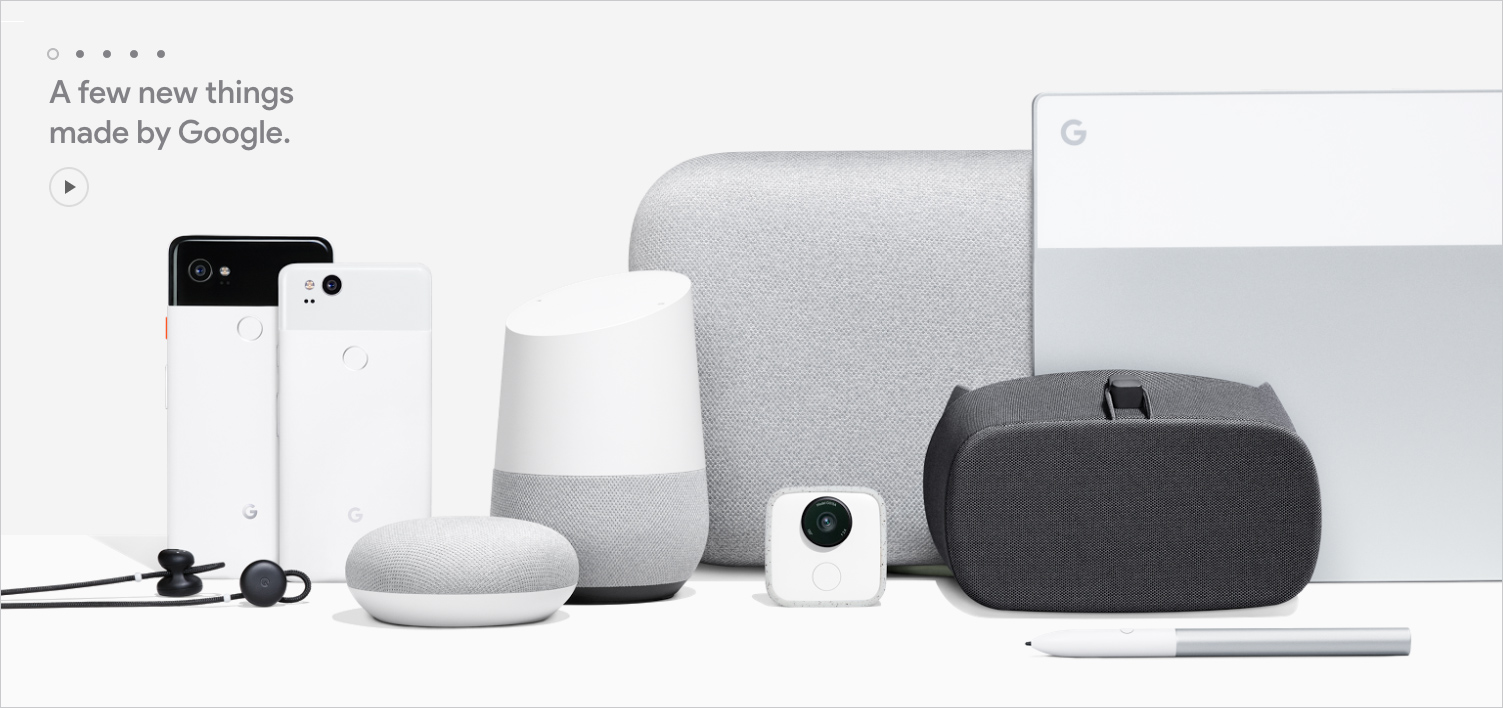
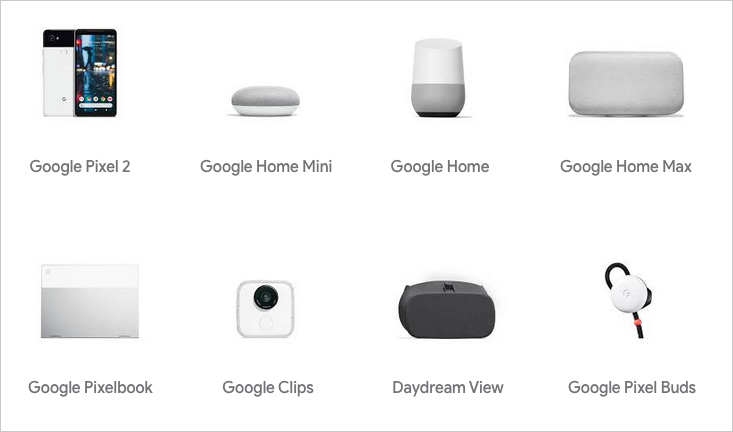
Watch the Google Pixel 2 event in 19 minutes — from the verge.com by Natt Garun The Google Pixel event has wrapped and we got a good look at a bunch of new hardware lineup this year: the second generation of Pixel smartphones, new Google Homes, a Pixelbook, and a surprise new Google camera that uses artificial intelligence to snap pictures and videos of your family. Is it as weird as it sounds? If you missed the keynote where Google presented everything, here’s a recap of everything Google announced in about two hours cut into a 19-minute video so you can see for yourself if these new products will make it to your shopping list this holiday season.
As L&D, we need to change the way we manage learning and training for our new and existing workforce. In fact, you should give up the idea of managing their learning at all! It is not your responsibility anymore. Instead, aim to create a culture of continuous learning and curiosity. Equip your employees with technology and tools that encourage them to collaborate, connect, and learn when they need to. You can no longer treat work and learning as different entities, because your employees need to learn all the time if you want to retain your competitive edge. They need to soak in all the information coming to them from all around and apply it to their work.
You will need to help build a technology-enabled learning ecosystem to support this trend of self-learning.
…
Your employees are no longer limited to learning at a specific time in a physical venue. Mobile devices and learning apps have ensured that learners can access learning content whenever and wherever they wish. They can choose their own learning path and mode of learning—videos, podcasts, text-based content, game-based modules, and so on. Learning should be a personal endeavor. If you allow your learners to choose what they wish to learn, then they can decide on the skills they need in order to excel in the real world. This gives more power to your content and makes learning meaningful to the learners.
Here are the top four trends that you should keep in mind while working on your corporate training strategy.
Ginni Rometty on the End of Programming — from bloomberg.com by Megan Murphy The IBM chief dares to imagine what Watson will be when it grows up, and reaffirms her pledge to hire 25,000 people over the next four years.
Excerpt (emphasis DSC):
Do you feel we’re going to get to a point where AI will displace more jobs than it creates and we’re not doing enough to push forward with the jobs of the future?
I do believe that when it comes to complete job replacement, it will be a very small percentage. When it comes to changing a job and what you do, it will be 100 percent.“Whoa, different skills. Everybody is going to have to have a different skill because it’s going to be a threat in all our jobs.” Let me just park that thought. I want to come back to something I think that’s far more important and is related. The issue of skills is front and center in this country and many countries in the world right now without AI. We already have a world that’s bifurcating between haves and have-nots, and a lot of that is based on education and skills. This country has 5 million to 6 million jobs open. That’s about skill. This is not being caused by AI. We’ve got to revamp education for this era of man and machine. And that means you cannot insist that every person needs to be a university or a Ph.D. graduate to be productive in society. You cannot. It’s not true by the way. We’ve proven that.
You started a six-year high school program. This is a program where they take people through four years of high school, two years of a college equivalent, and then hopefully give them preference in getting into the workforce, again to work with IBM.
In the U.S., in 2015, half of our young people didn’t have an associate’s degree or a college degree. That’s the problem today: the number of people that need to be retrained. I’m far more optimistic that public-private partnerships can solve this dilemma. There will be a hundred pathways to technology becoming viral, driven by governors and states. I always remember when President Obama came to the first one, he goes, “Where are all the computers?” We’re like, “That’s not what we teach these kids.” We’re teaching them a skill about math and problem-solving that’s going to transcend any technology they deal with. The first part is a very simple formula: a curriculum of math, science. The second, give the kids a mentor and then you give them a chance at a job. We will be up to 50,000 kids, and 300 other companies have volunteered. I have a whole bunch of these kids over in Silicon Alley where we have our Watson headquarters.
I do believe that when it comes to complete job replacement, it will be a very small percentage. When it comes to changing a job and what you do, it will be 100 percent.
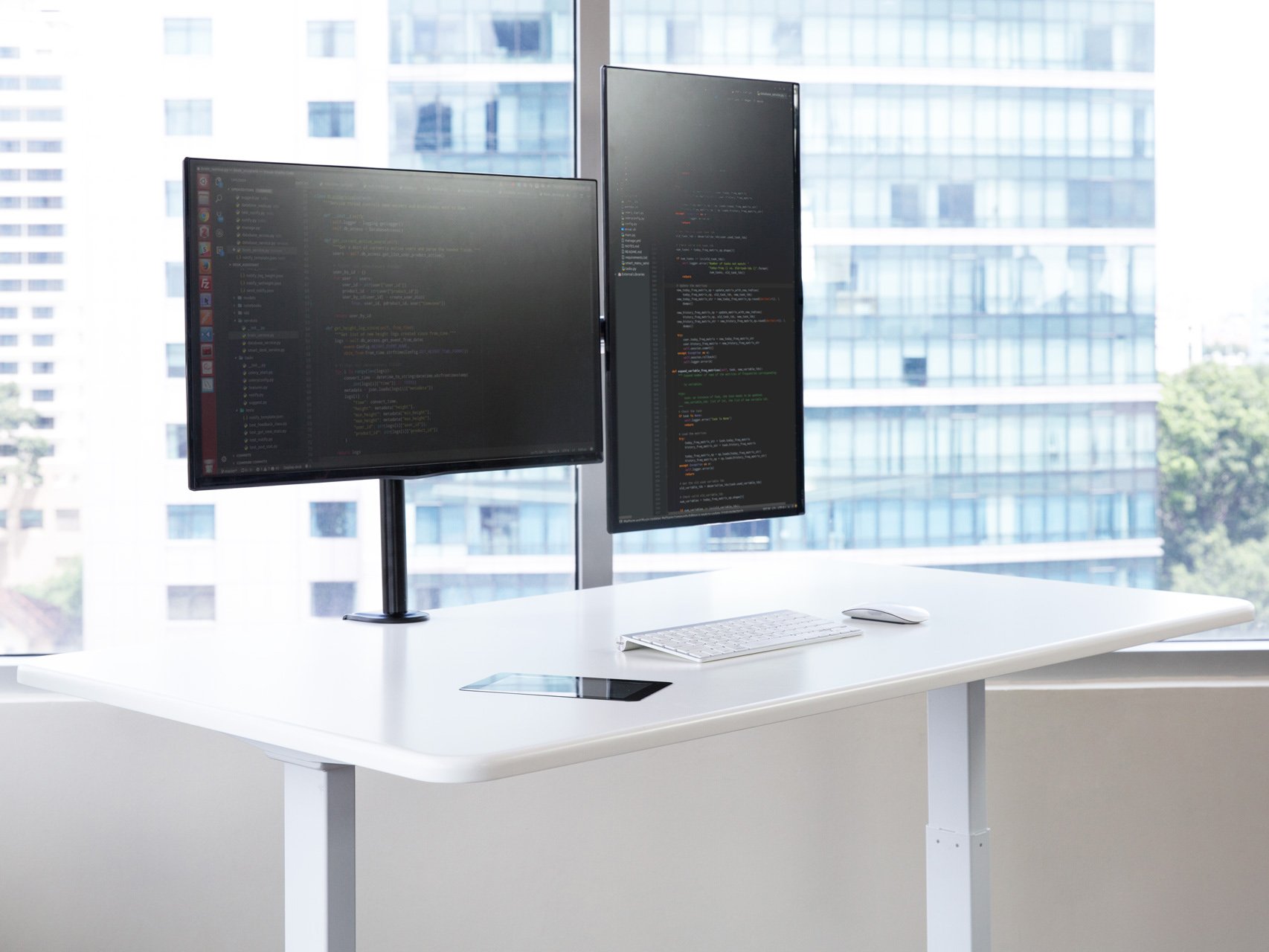
Can your desk encourage you to stand, remind you to drink water and order you a pizza? No? Well SmartDesk 3 can.
Autonomous announced the launch of the newest iteration of its SmartDesk in a press release today, and is claiming it’s “the world’s most powerful AI-powered standing desk.”
…
The embedded tablet has a 7″ display and is powered by Autonomous’ own OS platform, and has both Bluetooth and WiFi capabilities so it can interact with the apps on your phone. It features many of its own shortcuts, too – you can make coffee, order food, check the weather, play Spotify playlists, and even request a ride from Uber. Because the tablet syncs with Google Calendar, it will remind you of any meetings you might have throughout the day. And in addition to all of that, SmartDesk 3 monitors how long you sit or stand and reminds you to either stretch your legs or take a break to relax when it feels you need it. After using the AI for a week or so, it will learn your habits – say, when you usually start getting hungry – and begin to anticipate your needs.
Unity Technologies released the open beta version of its Unity Machine Learning Agents, an artificial intelligence toolkit developers and researchers can use to virtually train agents —whether video game characters, autonomous vehicles or robots.
“Machine learning is a disruptive technology that is important to all types of developers and researchers to make their games or systems smarter, but complexities and technical barriers make it out of reach for most,” vice president of AI and machine learning Danny Lange said in a press release. “This is an exciting new chapter in AI’s history as we are making an end-to-end machine learning environment widely accessible, and providing the critical tools needed to make more intelligent, beautiful games and applications. Complete with Unity’s physics engine and a 3D photorealistic rendering environment, our AI toolkit also offers a game-changing AI research platform to a rapidly growing community of AI enthusiasts exploring the frontiers of Deep Learning.”
Rather, today’s connected consumers want a seamless online experience that immediately allows them to self-serve when they have a quick question or choose a hybrid approach when they need that personal touch from a live representative.
Chatbots empower consumers to take charge of their own brand experience and efficiently get the answers they need. Consumers demand accuracy and convenience, and chatbots provide the perfect balance of speed, personalization, and human touch necessary for improved customer experiences.
…
The key to implementing chatbots that go beyond scripted responses is Natural Language Processing (NLP). Chatbots equipped with this advanced technology can understand situational context and can therefore get to the root of customer questions without putting customers on hold or redirecting them.
One way to measure Microsoft’s AI bet: In its first year of operation, the AI and Research group has grown by 60 percent — from 5,000 people originally to nearly 8,000 people today — through hiring and acquisitions, and by bringing aboard additional teams from other parts of the company.
The creation of Microsoft AI and Research also underscores the intense competition in artificial intelligence. Microsoft is gearing up to compete against the likes of Google, Amazon, Salesforce, Apple, and countless AI startups and research groups, all of them looking to lead the tech industry in this new era of artificial intelligence.
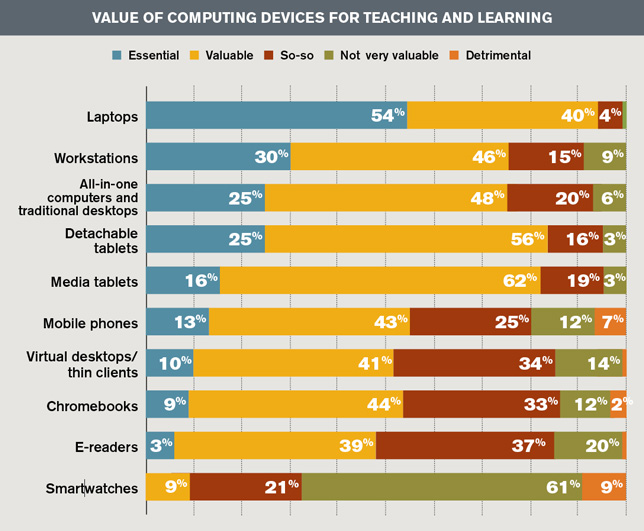
Smartwatches Deemed Least Valuable Technology in the Classroom — from campustechnology.com by Rhea Kelly In our second annual Teaching with Technology Survey, faculty revealed what technologies they use in the classroom, the devices they most value, what they wish for and more.
Excerpts:
Smartwatches may be one of the hottest gadgets in the consumer market — making up nearly a third of all wearables sales this year — but the climate in the classroom is noticeably cooler for the wrist-worn devices. In our 2017 Teaching with Technology Survey, smartwatches came in dead last in the list of technologies faculty consider essential or valuable for teaching and learning. Just 9 percent of faculty called the devices “valuable” (an increase from 5 percent in 2016), and not a one deemed them “essential.” What’s more, 9 percent of respondents considered smartwatches “detrimental.”
When we asked faculty what computing devices were most valuable for teaching and learning, laptops came out on top, considered “essential” by 54 percent of respondents (up from 49 percent in 2016). Workstations (defined as higher-end computers with faster processors, more RAM, more storage and dedicated graphics cards) came in second, followed by all-in-one computers, traditional desktops and detachable tablets. (The lineup was similar last year.)
As you read their reflections you’ll find several themes emerge over and over:
Our current system is unsustainable and ill-suited for a globally connected world that is constantly changing.
Colleges and universities will have to change their current business model to continue to thrive, boost revenue and drive enrollment.
The “sage on the stage” and the “doc in the box” aren’t sustainable; new technologies will allow faculty to shift their focus on the application of learning rather than the acquisition of knowledge.
Data and the ability to transform that data into action will be the new lifeblood of the institution.
Finally, the heart and soul of any institution are its people. Adopting new technologies is only a small piece of the puzzle; institutions must also work with faculty and staff to change institutional culture.
Some quotes are listed below.
“What’s more, next-generation digital learning environments must bridge the divide between the faculty-directed instructivist model our colleges and universities have always favored and the learner-centric constructivist paradigm their students have come to expect and the economy now demands.”
…
It will be at least 10 years before systems such as this become the standard rather than the exception. Yet to achieve this timeline, we will have to begin fostering a very different campus culture that embraces technology for its experiential value rather than its transactional expediency, while viewing education as a lifelong pursuit rather than a degree-driven activity.
Susan Aldridge
Q: What are the biggest challenges facing higher education right now?
A: I think it is a difficult time for decisionmakers to know how to move boldly forward. It’s almost funny, nobody’s doing five-year strategic plans anymore. We used to do ten-year plans, but now it’s “What’s our guiding set of principles and then let’s sort of generally go towards that.” I think it’s really hard to move an entire institution, to know how to keep it sustainable and serving your core student population. Trying to figure out how to keep moving forward is not as simple as it used to be when you hired faculty and they showed up in the classroom. It’s time for a whole new leadership model. I’m not sure what that is, but we have to start reimagining our organizations and our institutions and even our leadership.
Marie Cini
One of the things that is frustrating to me is the argument that online learning is just another modality. Online learning is much more than that. It’s arguably the most transformative development since the G.I. Bill and, before that, the establishment of land-grant universities. … I don’t think we should underestimate the profound impact online education has had and will continue to have on higher education. It’s not just another modality; it’s an entirely new industry.
Robert Hansen
From DSC: And I would add (to Robert’s quote above) that not since the printing press was invented close to 500 years ago have we seen such an enormously powerful invention as the Internet. To bypass the Internet and the online-based learning opportunities that it can deliver is to move into a risky, potentially dangerous future. If your institution is doing that, your institution’s days could be numbered. As we move into the future — where numerous societies throughout the globe will be full of artificial intelligence, big data, robotics, algorithms, business’ digital transformations, and more — your institutions’ credibility could easily be at stake in a new, increasingly impactful way. Parents and students will want to know that there’s a solid ROI for them. They will want to know that a particular college or university has the foundational/core competencies and skills to prepare the learner for the future that the learner will encounter.
Q: What are the biggest challenges facing higher education right now?
A: I think the biggest challenge is the stubborn refusal of institutions to acknowledge that the 20th century university paradigm nolonger works, or at least it doesn’t work anymore for the majority of our institutions. I’m not speaking on behalf of our members, but I think it’s fair to say that institutions are still almost entirely faculty-centered and not market-driven. Faculty, like so many university leaders today who come from faculty ranks, are so often ill-equipped to compete in the Wild West that we’re seeing today, and it’s not their fault. They’re trained to be biologists and historians and philosophers and musicians and English professors, and in the past there was very little need to be entrepreneurial. What’s required of university leadership now looks very much like what’s required in the fastpaced world of private industry.
…
If you are tuition dependent and you haven’t figured out how to serve the adult market yet, you’re in trouble.
Robert Hansen
It’s not just enough to put something online for autodidacts who already have the time, energy, and prior skills to be able to learn on their own. You really need to figure out how to embed all the supports that a student will need to be successful, and I don’t know if we’ve cracked that yet.
Amy Laitinen
The other company is Amazon. Their recent purchase of Whole Foods really surprised everybody. Now you have a massive digital retailer that has made billions staying in the online world going backwards into brick-and-mortar. I think if you look at what you can do on Amazon now, who’s to say in three years or five years, you won’t say, “You know what, I want to take this class. I want to purchase it through Amazon,” and it’s done through Amazon with their own LMS? Who’s to say they’re not already working on it?
Justin Louder
We are focused on four at Laureate. Probably in an increasing order of excitement to me are game-based learning (or gamification), adaptive learning, augmented and virtual reality, and cognitive tutoring.
Darrell Luzzo
I would wave my hand and have people lose their fear of change and recognize that you can innovate and do new things and still stay true to the core mission and values. My hope is that we harness our collective energy to help our students succeed and become fully engaged citizens.
The most innovative AI breakthroughs, and the companies that promote them – such as DeepMind, Magic Pony, Aysadi, Wolfram Alpha and Improbable – have their origins in universities. Now AI will transform universities.
We believe AI is a new scientific infrastructure for research and learning that universities will need to embrace and lead, otherwise they will become increasingly irrelevant and eventually redundant.
Through their own brilliant discoveries, universities have sown the seeds of their own disruption. How they respond to this AI revolution will profoundly reshape science, innovation, education – and society itself.
…
As AI gets more powerful, it will not only combine knowledge and data as instructed, but will search for combinations autonomously. It can also assist collaboration between universities and external parties, such as between medical research and clinical practice in the health sector.
The implications of AI for university research extend beyond science and technology.
…
When it comes to AI in teaching and learning, many of the more routine academic tasks (and least rewarding for lecturers), such as grading assignments, can be automated. Chatbots, intelligent agents using natural language, are being developed by universities such as the Technical University of Berlin; these will answer questions from students to help plan their course of studies.
Virtual assistants can tutor and guide more personalized learning. As part of its Open Learning Initiative (OLI), Carnegie Mellon University has been working on AI-based cognitive tutors for a number of years. It found that its OLI statistics course, run with minimal instructor contact, resulted in comparable learning outcomes for students with fewer hours of study. In one course at the Georgia Institute of Technology, students could not tell the difference between feedback from a human being and a bot.
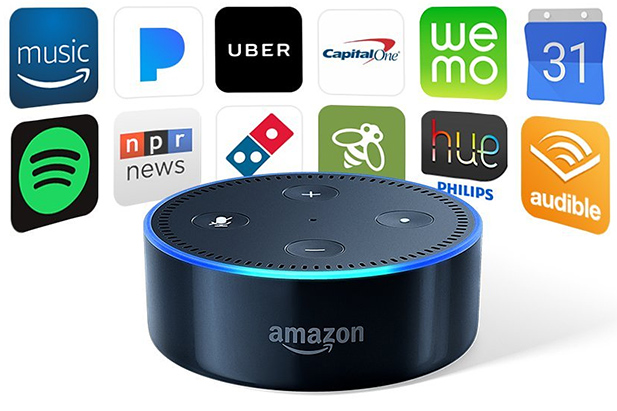
I built an Amazon Alexa skill called Introduction to Computing Flashcards. In using the skill, or Amazon Alexa app, students are able to listen to Alexa and then answer questions. Alexa helps students prepare for an exam by speaking definitions and then waiting for their identification. In addition to quizzing the student, Alexa is also keeping track of the correct answers. If a student answers five questions correctly, Alexa shares a game code, which is worth class experience points in the course gamification My Game app.
…
Certainly, exam preparation apps are one way to use digital assistants in education. As development and publishing of Amazon Alexa skills becomes easier, faculty will be able to produce such skills just as easily as they now create PowerPoints. Given the basic code available through Amazon tutorials, it takes 20 minutes to create a new exam preparation app. Basic voice experience Amazon Alexa skills can take as much as five minutes to complete.
Universities can publish their campus news through the Alexa Flash Briefing. This type of a skill can publish news, success stories, and other events associated with the campus.
…
If you are a faculty member, how can you develop your first Amazon Alexa skill? You can use any of the tutorials already available. You can also participate in an Amazon Alexa classroom training provided by Alexa Dev Days. It is possible that schools or maker spaces near you offer in-person developer sessions. You can use meetup.com to track these opportunities.
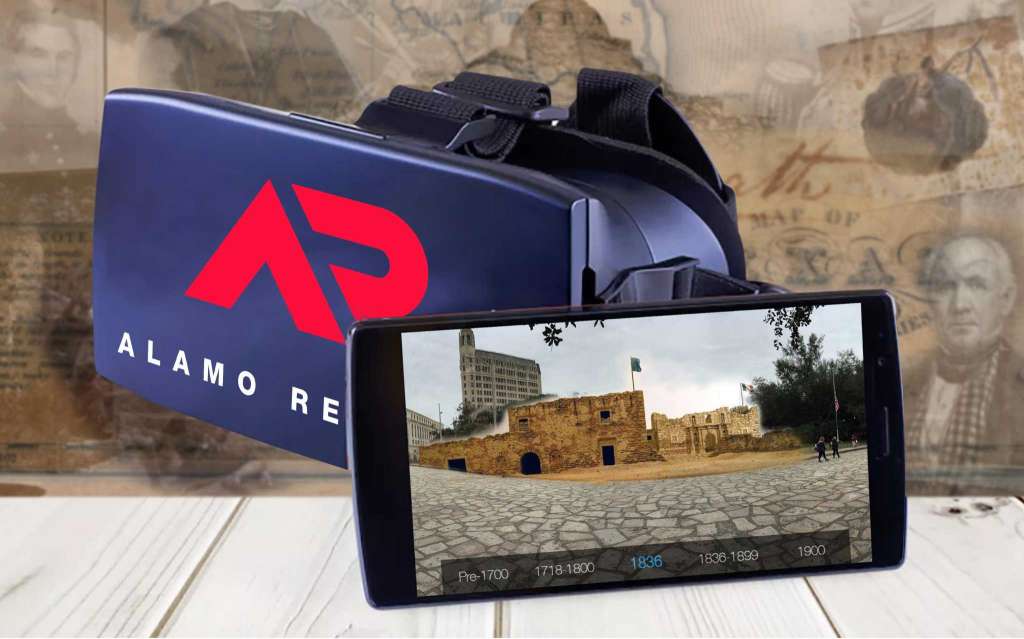
Using a smart phone, users will be able to see and interact with computer-generated people and scenes from the past — overlayed on top of the very real and present-day Alamo. The app will also show the Alamo as it was at different points in history, and tell the story of the historic battle through different perspectives of the people (like Crockett) who were there. The app includes extra features users can buy, much like Pokémon Go.
“We’re making this into a virtual time machine so that if I’m standing on this spot and I look at, oh well there’s Davy Crockett, then I can go back a century and I can see the mission being built,” Alamo Reality CEO Michael McGar said. The app will allow users to see the Alamo not only as it was in 1836, but as it was before and after, McGar said.
“We’re developing a technology that’s going to be able to span across generations to tell a story”
Adobe is killing Flash, the software that millions used in the early 2000s to play web games and watch video in their web browsers.
The company announced the software was “end-of-life” in a blog post on Tuesday. From the blog post:
“Given this progress, and in collaboration with several of our technology partners – including Apple, Facebook, Google, Microsoft and Mozilla – Adobe is planning to end-of-life Flash. Specifically, we will stop updating and distributing the Flash Player at the end of 2020 and encourage content creators to migrate any existing Flash content to these new open formats.”
A 2016 report funded by the Gates Foundation found that in the U.S. alone, there are 13,000 instructional designers. Yet, when I graduated from college in 2008, I didn’t know this field existed. Surely a lot has changed!
Instructional design is experiencing a renaissance. As online course platforms proliferate, institutions of all shapes and sizes realize that they’ll need to translate content into digital forms. Designing online learning experiences is essential to training employees, mobilizing customers, serving students, building marketing channels, and sustaining business models.
The field has deep roots in distance education, human computer interaction, and visual design. But I’ve come to believe that contemporary instructional design sits at the intersection of three core disciplines: learning science, human-centered design, and digital marketing. It requires a deep respect for the pedagogical practices that teachers have honed for decades, balanced with fluency in today’s digital tools.
…
Below are some of the lessons and resources that I wish I knew of when I first went on the job market—a combination of the academic texts you read in school along with practical tools that have been essential to practicing instructional design in the real world. This is not a complete or evergreen list, but hopefully it’s a helpful start.
Good listener. People person. Lifelong learner. Sound like you? No, we’re not trying to arrange a first date. These are some common traits of people with successful careers in a booming job market: instructional design.
Colleges, K-12 schools and companies increasingly turn to instructional designers to help them improve the quality of teaching in in-person, online or blended-learning environments.
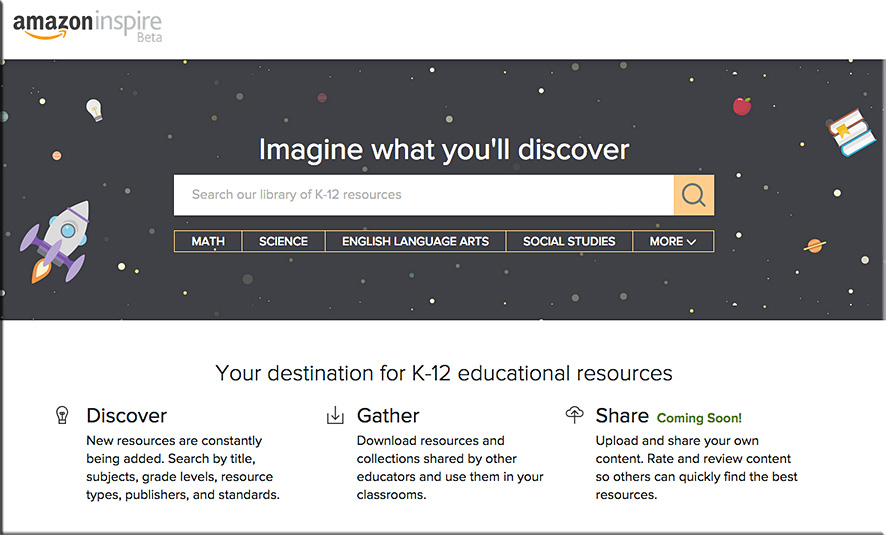
Amazon relaunches Inspire after a year of re-tooling— from edscoop.com/ by Emily Tate The content repository offers tens of thousands of downloadable educational resources. The “upload and share” feature is expected to follow soon.
Excerpts:
More than a year after Amazon debuted — and then suddenly retracted — its free library of open educational resources, Amazon Inspire is back.
The content repository — seen by many as Amazon’s first major attempt to edge into the competitive education technology space that tech giants like Google and Microsoft now comfortably occupy — was quietly reintroduced to educators on Monday [7/17/17] as a way to store and find tens of thousands of downloadable educational materials that teachers can use in their classrooms.
Over the last year, groups across the country have been working with Amazon to vet digital content to ensure it complies with state standards, quality indicators and, perhaps most importantly, intellectual property and copyright laws.
…
Similarly, if you want to teach a lesson on Romeo and Juliet, for example, you could search Inspire by grade, subject, content format and standards to begin pulling “ingredients,” or resources, off the shelves and putting them in your “grocery cart,” or your collection.
Grush: Then what are some of the implications you could draw from metrics like that one?
Christian: As we consider all the investment in those emerging technologies, the question many are beginning to ask is, “How will these technologies impact jobs and the makeup of our workforce in the future?”
While there are many thoughts and questions regarding the cumulative impact these technologies will have on our future workforce (e.g., “How many jobs will be displaced?”), the consensus seems to be that there will be massive change.
Whether our jobs are completely displaced or if we will be working alongside robots, chatbots, workbots, or some other forms of AI-backed personal assistants, all of us will need to become lifelong learners — to be constantly reinventing ourselves.This assertion is also made in the aforementioned study from McKinsey: “AI promises benefits, but also poses urgent challenges that cut across firms, developers, government, and workers. The workforce needs to be re-skilledto exploit AI rather than compete with it…”
A side note from DSC: I began working on this vision prior to 2010…but I didn’t officially document it until 2012.
Learning from the Living [Class] Room:
A global, powerful, next generation learning platform
What does the vision entail?
A new, global, collaborative learning platform that offers more choice, more control to learners of all ages – 24×7 – and could become the organization that futurist Thomas Frey discusses here with Business Insider:
“I’ve been predicting that by 2030 the largest company on the internet is going to be an education-based company that we haven’t heard of yet,” Frey, the senior futurist at the DaVinci Institute think tank, tells Business Insider.
A learner-centered platform that is enabled by – and reliant upon – human beings but is backed up by a powerful suite of technologies that work together in order to help people reinvent themselves quickly, conveniently, and extremely cost-effectively
A customizable learning environment that will offer up-to-date streams of regularly curated content (i.e., microlearning) as well as engaging learning experiences
Along these lines, a lifelong learner can opt to receive an RSS feed on a particular topic until they master that concept; periodic quizzes (i.e., spaced repetition) determines that mastery. Once mastered, the system will ask the learner whether they still want to receive that particular stream of content or not.
A Netflix-like interface to peruse and select plugins to extend the functionality of the core product
An AI-backed system of analyzing employment trends and opportunities will highlight those courses and streams of content that will help someone obtain the most in-demand skills
A system that tracks learning and, via Blockchain-based technologies, feeds all completed learning modules/courses into learners’ web-based learner profiles
A learning platform that provides customized, personalized recommendation lists – based upon the learner’s goals
A platform that delivers customized, personalized learning within a self-directed course (meant for those content creators who want to deliver more sophisticated courses/modules while moving people through the relevant Zones of Proximal Development)
Notifications and/or inspirational quotes will be available upon request to help provide motivation, encouragement, and accountability – helping learners establish habits of continual, lifelong-based learning
(Potentially) An online-based marketplace, matching learners with teachers, professors, and other such Subject Matter Experts (SMEs)
(Potentially) Direct access to popular job search sites
(Potentially) Direct access to resources that describe what other companies do/provide and descriptions of any particular company’s culture (as described by current and former employees and freelancers)
(Potentially) Integration with one-on-one tutoring services
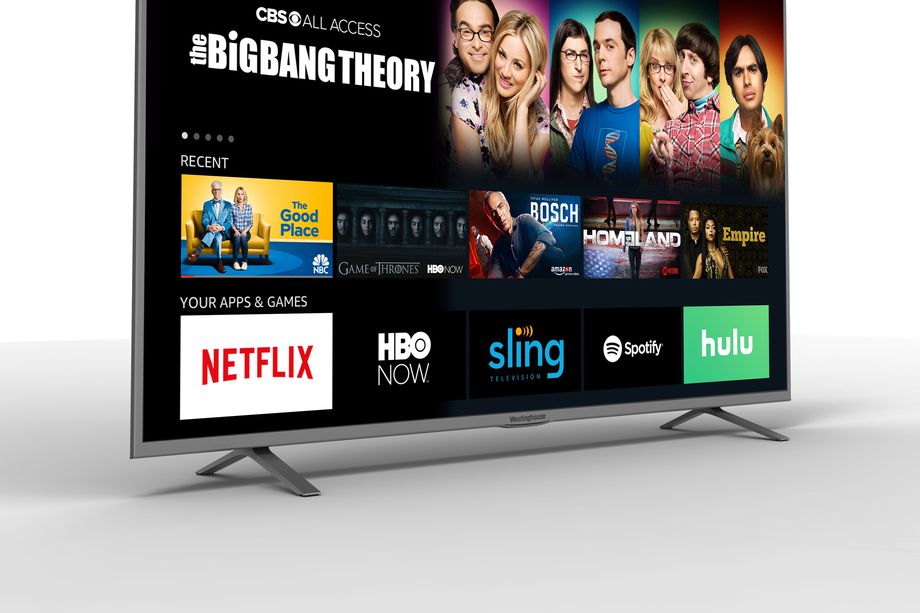
Addendum from DSC (regarding the resource mentioned below): Note the voice recognition/control mechanisms on Westinghouse’s new product — also note the integration of Amazon’s Alexa into a “TV.”
The key selling point, of course, is the built-in Amazon Fire TV, which is controlled with the bundled Voice Remote and features Amazon’s Alexa assistant.
Holographic storytelling— from jwtintelligence.com The stories of Holocaust survivors are brought to life with the help of interactive 3D technologies. New Dimensions in Testimony is a new way of preserving history for future generations. The project brings to life the stories of Holocaust survivors with 3D video, revealing raw first-hand accounts that are more interactive than learning through a history book. Holocaust survivor Pinchas Gutter, the first subject of the project, was filmed answering over 1000 questions, generating approximately 25 hours of footage. By incorporating natural language processing from the USCInstitute for Creative Technologies (ICT), people are able to ask Gutter’s projected image questions that trigger relevant responses.
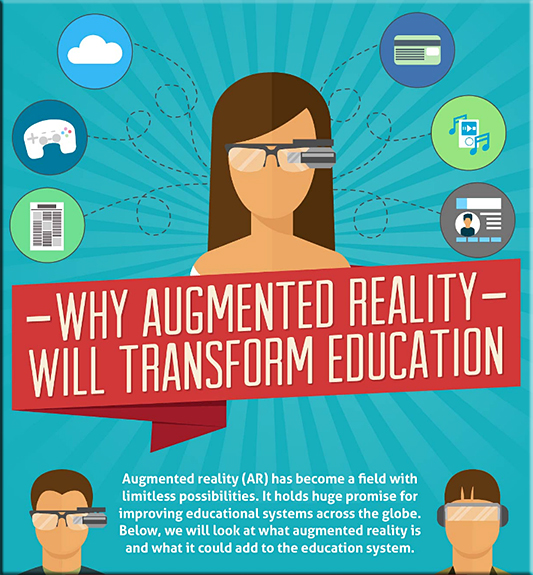
Augmented reality has become a field with limitless possibilities. It holds huge promise for improving educational systems across the globe. In the last 2 to 3 years, augmented reality (AR) has grown into a technology that is set to revolutionize numerous sectors, most importantly education. To learn more, check out the infographic created by the New Jersey Institute of Technology’s Online Masters in Computer Science program.




![The Living [Class] Room -- by Daniel Christian -- July 2012 -- a second device used in conjunction with a Smart/Connected TV](http://danielschristian.com/learning-ecosystems/wp-content/uploads/2012/07/The-Living-Class-Room-Daniel-S-Christian-July-2012.jpg)