100 Universities established an OPM, Bootcamp or Pathways partnership in Q1 2022 — from holoniq.com
Bootcamps are directing more resources B2B and B2G, OPMs are growing existing partnerships further and evolving their technology and healthcare programs.

Excerpt:

Higher Education, like the broader economy, is awkwardly emerging from an almost exclusively digital, isolated and stimulus fuelled environment into… well it’s not clear yet. University Partnerships continued to be established at pace through Q1 2022, albeit at a much slower rate than through 2021.


Also relevant/see:

College contracts with OPMs need better oversight, watchdog says — from highereddive.com by Natalie Schwartz

Excerpt from Dive Brief:

  • The U.S. Department of Education should strengthen oversight of colleges’ relationships with companies that help them launch and build online programs, according to a new report from the U.S. Government Accountability Office, an auditing agency for Congress.

Addendum on 5/11/22:


From DSC:
For the last few years, I’ve been thinking that we need to make learning science-related information more accessible to students, teachers, professors, trainers, and employees — no matter what level they are at.

One idea on how to do this — besides putting posters up in the hallways, libraries, classrooms, conference rooms, cafeterias, etc. — is that we could put a How best to study/learn link in all of the global navigation bars and/or course navigation bars out there in organizations’ course management systems and learning management systems. Learners of all ages could have 24 x 7 x 365, easy, instant access as to how to be more productive as they study and learn about new things.

For example, they could select that link in their CMS/LMS to access information on:

  • Retrieval practice
  • Spacing
  • Interleaving
  • Metacognition
  • Elaboration
  • The Growth Mindset
  • Accessibility-related tools / assistive technologies
  • Links to further resources re: learning science and learning theories

What do you think? If we started this in K12, kept it up in higher ed and vocational programs, and took the idea into the corporate world, valuable information could be relayed and absorbed. This is the kind of information that is highly beneficial these days — as all of us need to be lifelong learners now.


A Podcast Listening Strategy for Learning — from learntrepreneurs.com by Eva Keiffenheim
Three steps to make the most of your podcast time

Excerpt (emphasis DSC):

Use apps that help you remember more
You won’t remember much from a podcast if you only listen to it. Your brain needs repetition and elaboration to make new knowledge stick.

Unlike books, you can’t highlight audio?—?or can you?

I listen to my podcasts while biking or walking. Hence, an extremely uncomfortable situation to open a notepad or Roam Research whenever I hear an interesting idea.

But two applications have transformed how I listen to podcasts: Snipd and Airr. Both are audio highlighting tools.


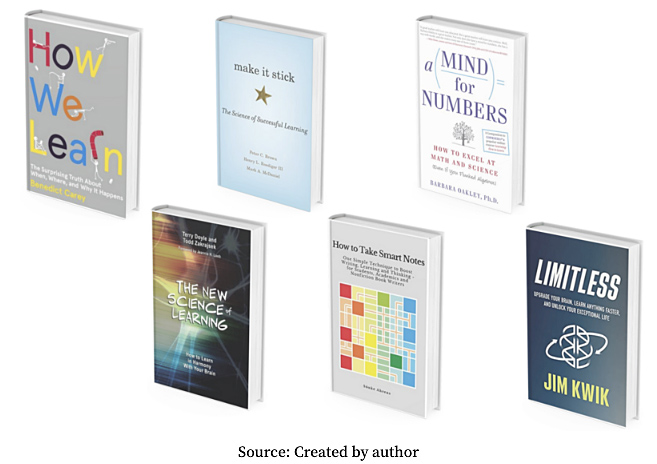
The Key Idea All Great Books on Learning Have in Common — from learntrepreneurs.com by Eva Keiffenheim
And how you can implement the powerful way to learn.
.

teaching in public is the principle all great books on learning agree on


The amazing opportunities of AI in the future of the educational metaverse [Darbinyan]

The amazing opportunities of AI in the future of the educational metaverse — from forbes.com by Rem Darbinyan

Excerpt:

Looking ahead, let’s go over several potential AI-backed applications of the metaverse that can empower the education industry in many ways.

Multilingual Learning Opportunities
Language differences may be a real challenge for students from different cultures as they may not be able to understand and keep up with the materials and assignments. Artificial intelligence, VR and AR technologies can enhance multilingual accessibility for learners no matter where they are in the world. Speech-to-text, text-to-speech and machine translation technologies enrich the learning process and create more immersive learning environments.

AI can process multiple languages simultaneously and provide real-time translations, enabling learners to engage with the materials in the language of their choice. With the ability to instantly transcribe speech across multiple languages, artificial intelligence removes any language barriers for students, enabling them to be potentially involved, learn and communicate in any language.

Artificial Intelligence (AI) in Education Market size exceeded USD 1 billion in 2020 and is expected to grow at a CAGR of over 40% between 2021 and 2027. (source)

Along the lines of innovation within our educational learning ecosystems, see:

3 Questions for Coursera’s Betty Vandenbosch & U-M’s Lauren Atkins Budde on XR — from insidehighered.com by Joshua Kiim
How might extended reality shape the future of learning?

Excerpts (emphasis DSC):

[Lauren Atkins Budde] “Being able to embed quality, effective extended reality experiences into online courses is exponentially a game-changer. One of the persistent constraints of online learning, especially at scale, is how do learners get hands-on practice? How do they experience specific contexts and situations? How do they learn things that are best experienced? XR provides that opportunity for actively doing different kinds of tasks, in various environments, in ways that would otherwise not be possible. It will open up  Lauren Atkins Buddeboth how we teach online and also what we teach online.”

These courses are really exciting and cover a broad range of disciplines, which is particularly important. To choose the right subjects, we did an extensive review of insights from industry partners, learners and market research on in-demand and emerging future-of-work skills and then paired that with content opportunities where immersive learning is really a value-add and creates what our learning experience designers call “embodied learning.”

Addendum on 5/1/22:
Can the Metaverse Improve Learning? New Research Finds Some Promise — from edsurge.com by Jeffrey R. Young

“The findings support a deeper understanding of how creating unique educational experiences that feel real (i.e., create a high level of presence) through immersive technology can influence learning through different affective and cognitive processes including enjoyment and interest,” Mayer and his colleagues write.


From DSC:
There are many things that are not right here — especially historically speaking. But this is one WE who are currently living can work on resolving.

*******

The Cost of Connection — from chronicle.com by Katherine Mangan
The internet is a lifeline for students on far-flung tribal campuses. Too often, they’re priced out of learning.

Excerpt:

Affordable and reliable broadband access can be a lifeline for tribal colleges, usually located on or near Native American reservations, often in remote, rural areas across the Southwest and Midwest. Chartered by their respective tribal governments, the country’s 35 accredited tribal colleges operate in more than 75 campus sites across 16 states, serving more than 160,000 American Indians and Alaska Natives each year. They emphasize and help sustain the culture, languages, and traditions of their tribal communities and are often the only higher-education option available for Native students in some of the nation’s poorest rural regions.

Also relevant/see:

Tribal Colleges Will Continue Online, Despite Challenges — from chronicle.com by Taylor Swaak
Other institutions could learn from their calculus.

Excerpt:

Two years after tribal colleges shuttered alongside institutions nationwide, many remain largely, if not fully, online, catering to students who’ve historically faced barriers to attending in person. Adult learners — especially single mothers who may struggle to find child care, or those helping to support multigenerational households — make up the majority of students at more than half of the 32 federally recognized institutions in the Tribal Colleges and Universities Program. These colleges are also often located in low-income, rural areas, where hours of daily commute time (and the cost of gas) can prove untenable for students simultaneously working part- or full-time jobs.

Also relevant/see:

Why Tribal Colleges Struggle to Get Reliable Internet Service — from chronicle.com by Katherine Mangan and Jacquelyn Elias
For tribal colleges across the country, the pandemic magnified internet-access inequities. Often located on far-flung tribal lands, their campuses are overwhelmingly in areas with few broadband service providers, sometimes leaving them with slow speeds and spotty coverage.

“You can be driving from a nearby town, and as soon as you hit the reservation, the internet and cellphone signals drop off,” said Cheryl Crazy Bull, president of the American Indian College Fund and a member of the Sicangu Lakota Nation. “Students would be in the middle of class and their Wi-Fi access dropped off.”

Worsening matters, many students have been limited by outdated equipment. “We had students who were trying to take classes on their flip phones,” Crazy Bull said. Such stories were cropping up throughout Indian territory.


We need to use more tools — that go beyond screen sharing — where we can collaborate regardless of where we’re at. [Christian]

From DSC:
Seeing the functionality in Freehand — it makes me once again think that we need to use more tools where faculty/staff/students can collaborate with each other REGARDLESS of where they’re coming in to partake in a learning experience (i.e., remotely or physically/locally). This is also true for trainers and employees, teachers and students, as well as in virtual tutoring types of situations. We need tools that offer functionalities that go beyond screen sharing in order to collaborate, design, present, discuss, and create things.  (more…)


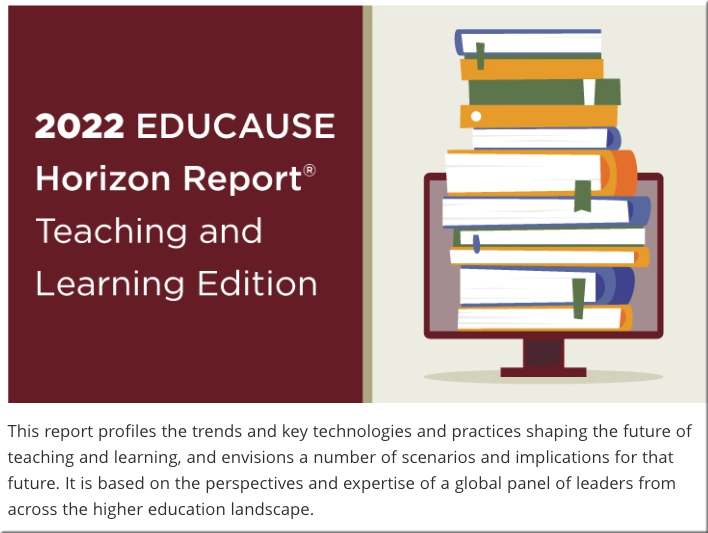
2022 EDUCAUSE Horizon Report | Teaching and Learning Edition


2022 EDUCAUSE Horizon Report | Teaching and Learning Edition — from library.educause.edu

Sections include:

  • Trends: Scanning the Horizon
  • Key Technologies & Practices
  • Scenarios
  • Implications: What Do We Do Now?

 Also relevant/see:


Also relevant/see:

2022 Educause Horizon Report Suggests Change Is Here to Stay; No Return to ‘Normal’ — from campustechnology.com by Rhea Kelly

Excerpt:

If the COVID-19 pandemic has been a time of unprecedented change in higher education — characterized by rapid pivots to remote work and learning and an explosion in the use of technology across the institution — the future is about reframing those changes into long-term realities, according to the 2022 Educause Horizon Report Teaching and Learning Edition, released this week. Colleges and universities are shifting their mindsets to “reflect an evolution from short-term ’emergency’ or ‘reactive’ modes of offering education during extraordinary circumstances to making strategic and sustainable investments in a future that will be very much unlike our past,” the report suggested.

6 Technologies and Practices Impacting the Future of Higher Education — from campustechnology.com by Rhea Kelly


The Digital versus Brick-and-Mortar Balancing Game — from educause.edu

Excerpt:

The blended campus required after two years of upheaval calls for out-of-the box thinking about what to keep and what to discard from both digital and physical work and learning spaces. Technology leaders face critical decisions regarding workplace culture, physical classroom design, and traditional campus spaces.

Making the move from fully in-person instruction to a learning environment that also accommodates remote students (and remote faculty) requires rethinking and redesigning physical learning spaces to provide an equitable experience for all learners. Technology leaders will need to overcome sizable obstacles to create inclusive classrooms that enable faculty and students to reap the many benefits of hybrid [hyflex] learning.

Also see some of the other most urgent issues in higher education here:

The EDUCAUSE showcase series spotlights the most urgent issues in higher education.


Podcasts For High School Students — from teachthought.com by Dennis Lee,

Categories covered include:

  • Academic Related Podcasts
  • General and Special Interest Podcasts
  • Entrepreneurship
  • Inspirational & Motivational
 

Zoom Announces New Education Features, Enhancing Hybrid [Hyflex] Learning Experience for Educators & Students — from edtechreview.in by Stephen Soulunii

Excerpt:

According to a news release, the features span Zoom’s Chat and Meeting offerings and are designed to support teachers who need to engage and manage students joining class remotely or submitting homework assignments.

Breakout Rooms Enhancements
Breakout rooms, a popular education feature, also received enhancements in this latest release. Program Audio allows meeting hosts to share content with audio to breakout rooms, adding the ability to share videos with audio. With the LTI Pro integration enhancement, educators can populate breakout rooms from the course roster. This can be used to assign breakout rooms in advance, and then automatically sort students into breakout rooms.

Anywhere Polls
Anywhere Polls will allow polling content to live in a central repository that can be accessed from any meeting on an account, instead of being associated with a particular meeting. This will make it easier for instructors to reuse polls and will also be beneficial for grading. This feature will be available this year.


Bridging the digital divide in online learning — from tonybates.ca by Tony Bates

Excerpt:

The problem
At the start of the pandemic, in Oakland, California, 40 miles north of Silicon Valley, only 12 percent of low-income students, and 25 percent of all students, in Oakland’s public schools had devices at home and a strong internet connection.

The outcome
Two years into the pandemic, Oakland has been able to connect 98 percent of the students in the district. As of February, the city had provided nearly 36,000 laptops and more than 11,500 hot spots to low-income public school students.

Also from Tony, see:

Getting into the online learning industry

Three years ago, I wrote a blog post called ‘So you want to be an educational technologist…’ in which gave some advice on how to get into and develop a career as an educational technologist. In that article, I noted that I didn’t have much experience to guide people going into the corporate training area, and this article by Matthew Lynch does exactly that. This article complements nicely what I wrote earlier.


Teaching: Fresh Approaches to Faculty Development — from chronicle.com by Beckie Supiano

Excerpt:

Baranovic can’t imagine returning to the old model: He’s sticking to panels in Zoom. Among the benefits, he says: “This arrangement breaks institutional silos, allows faculty to talk more about their experiences, shares effective practices from sources faculty trust (their peers), creates a stronger sense of community, makes it easy for panelists (they receive the questions ahead of time if they want to prepare, but because they’re speaking to experience, they don’t really have to prepare), and creates a form of support that works like therapy but doesn’t feel like therapy.”

Next, Baranovic hopes to turn the panels into a podcast format for professors unable to attend in real time.

From DSC:
As someone who had been involved with Teaching & Learning Centers for years, I can tell you that it’s very disheartening to put together a training session for faculty members and have very few — if any — people show up for it. It’s a waste of time and it leaves the T&L staff and/or IT staff members feeling discouraged and unvalued.

Over the years, I developed a preference for putting things into an asynchronous digital format for faculty members and adjunct faculty members to access per their own schedules. The institutions that I was working for got a greater ROI from those sessions and they were able to visit an internal “course” or website to reference those materials on-demand.

I also like the idea of podcasting here, but that takes a lot of time and effort — and isn’t always possible when you are one person trying to assist hundreds of faculty members (from a technical support and an LMS admin standpoint).

As an Instructional Designer, I also want to comment that it’s hard to help steer a car if you can’t even get into the car. Those institutions that are using team-based approaches will be far more successful in designing and developing more polished, effective, accessible learning experiences. Very few people can do it all.


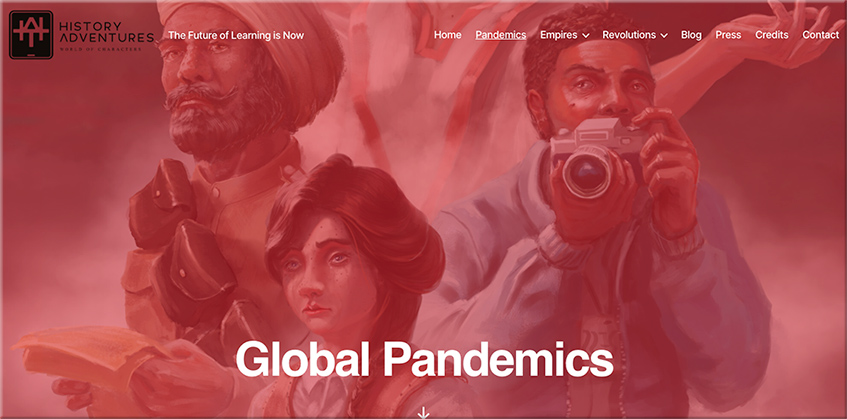
Global Pandemics is a cutting-edge, browser-based, digital learning experience—designed to enhance student understanding of the role of pandemics in world history.

Global Pandemics — from historyadventures.co with thanks to Andrea Boros for the resource

Excerpts:

Global Pandemics is “a cutting-edge, browser-based, digital learning experience—designed to enhance student understanding of the role of pandemics in world history. One year in the making, and involving a talented, interdisciplinary team from around the world—the new product features cutting-edge digital learning design, web animation, interaction design, and digital storytelling.”

This browser-based digital learning experience introduces multiple novel technologies, including:

  • 3D Motion Design to Recreate History
  • Advanced Web Animation to Simulate Pathogens
  • Immersive 360 Panoramas of Historical Locations
  • Animated Historical Timeline & Maps
  • Choice-based Narrative Design
  • Interactive Original Historical Documents
  • Media-Rich Adaptive Assessments

Also see:


The Argos Education Blog is Up — from eliterate.us by Michael Feldstein

Per Michael:

I’m trying to maintain some separation between my writing on e-Literate and content about Argos (the startup I co-founded with Curtiss Barnes). It won’t be perfect because I write about what I think about and right now I’m thinking about Argos-related stuff a lot. But I’m going to post about Argos-centric topics—the design, the thinking behind the company, etc.—on the new Argos blog. You can read my posts, posts by my colleagues (like the great one by Anita Delahay that’s up now), and news updates.

Read and subscribe here.


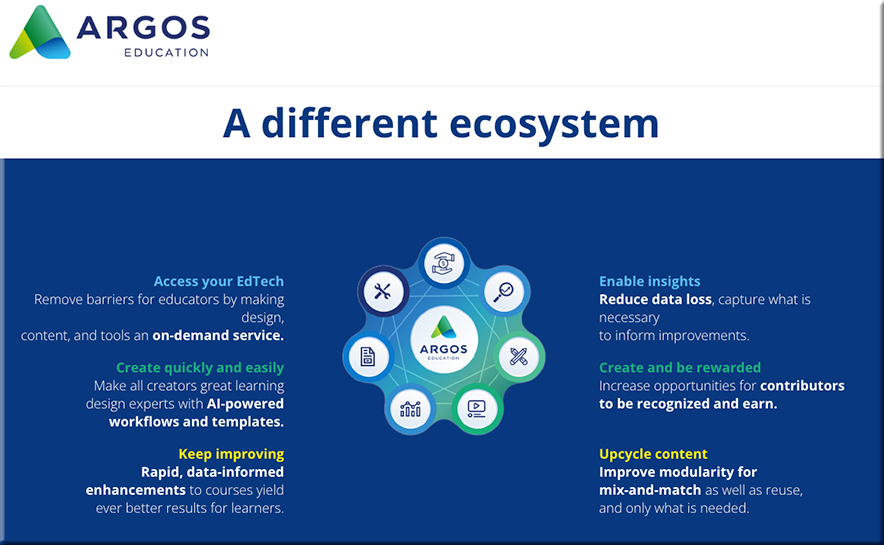
A different kind of ecosystem from Argos Education

From Argos Education:

Retaking textbooks
Several disruptive teams at Carnegie Mellon University and Arizona State University have been designing, building, and distributing next-generation digital textbook replacements.

Their products are provably effective, sell for significantly less than digital products from textbook publishers, and can generate more money for the programs creating them than they cost to create.

Argos believes this model is the future. We exist to bring that future into being.


From Instructional Design to Learning Experience Design: Understanding the Whole Student — a podcast out at campustechnology.com by Rhea Kelly, Mark Milliron, and Kim Round

Excerpt:

These days, we hear a lot about the “new normal” in higher education. Remote and hybrid learning is here to stay, offering students more flexibility in their learning journeys. But what if the new normal is not enough? It’s time to go beyond the new normal and consider the “new possible” — how to put together the best of face-to-face, online and hybrid to create powerful learning experiences based on a deep understanding of the whole student. We spoke to Mark Milliron, senior vice president of Western Governors University and executive dean of the Teachers College, and Kim Round, academic programs director and associate dean of the Teachers College, about their vision for reimagining education and why learning experience design is essential to student success.

Another interesting podcast:

 
© 2025 | Daniel Christian