Major Changes Reshape Law Schools Nationwide in 2026 — from jdjournal.com by Ma Fatima

Law schools across the United States are entering one of the most transformative periods in recent memory. In 2026, legal education is being reshaped by leadership turnover, shifting accreditation standards, changes to student loan policies, and the introduction of a redesigned bar exam. Together, these developments are forcing law schools to rethink how they educate students and prepare future lawyers for a rapidly evolving legal profession.

Also from jdjournal.com, see:

  • Healthcare Industry Legal Careers: High-Growth Roles and Paths — from jdjournal.com by Ma Fatima
    The healthcare industry is rapidly emerging as one of the most promising and resilient sectors for legal professionals, driven by expanding regulations, technological innovation, and an increasingly complex healthcare delivery system. As hospitals, life sciences companies, insurers, and digital health platforms navigate constant regulatory change, demand for experienced legal talent continues to rise.
 

Community colleges are training the next generation of manufacturing workers — from manufacturingdive.com by Michelle No
Rutgers University explored how community colleges are responding to regional workforce training demands. Clark State College and Columbus State Community College are among those leading the way.

One underrated option may hold the most promise for workforce growth: the local community college.

That’s according to a series of reports by The Rutgers Education and Employment Research Center released in October, which examines the “hidden innovative structure” of America’s community colleges.

Community colleges excel in ways conducive to a successful manufacturing career, said Shalin Jyotishi, founder of the Future of Work & Innovation Economy Initiative at think tank New America.


Caring for Patients for 26 Years—and Still Not a Nurse — from workshift.org/ by Colleen Connolly

Arnett’s experience spending decades in a job she intended as a first step is common among CNAs, medical assistants, and other entry-level healthcare workers, many of them women of color from low-income backgrounds. Amid a nationwide nursing shortage, elevating those workers seems like an obvious solution, but the path from CNA to nurse isn’t so much a ladder as it is a huge leap.

And obstacle after obstacle is strewn in the way. The high cost of nursing school, lengthy prerequisite requirements, rigid schedules, and unpaid clinical hours make it difficult for many CNAs to advance in their careers, despite their willingness and ability and the dire need of healthcare facilities.

While there are no national statistics about the number of entry-level healthcare workers who move on to higher-paid positions, a study of federal grants for CNA training showed that only 3% of those who completed the training went on to pursue further education to become an LPN or RN. Only 1% obtained an associate degree or above. A similar study in California showed that 22% of people who completed CNA certificate programs at community colleges went on to get a higher-level educational credential in health, but only 13% became registered nurses within six years.

That reality perpetuates chronic shortages in nursing, and it also keeps hundreds of thousands of healthcare workers locked below a living wage, often for decades.


A New AI Career Ladder — from ssir.org (Stanford Social Innovation Review) by Bruno V. Manno; via Matt Tower
The changing nature of jobs means workers need new education and training infrastructure to match.

AI has cannibalized the routine, low-risk work tasks that used to teach newcomers how to operate in complex organizations. Without those task rungs, the climb up the opportunity ladder into better employment options becomes steeper—and for many, impossible. This is not a temporary glitch. AI is reorganizing work, reshaping what knowledge and skills matter, and redefining how people are expected to acquire them.

The consequences ripple from individual career starts to the broader American promise of economic and social mobility, which includes both financial wealth and social wealth that comes from the networks and relationships we build. Yet the same technology that complicates the first job can help us reinvent how experience is earned, validated, and scaled. If we use AI to widen—not narrow—access to education, training, and proof of knowledge and skill, we can build a stronger career ladder to the middle class and beyond. A key part of doing this is a redesign of education, training, and hiring infrastructure.

What’s needed is a redesigned model that treats work as a primary venue for learning, validates capability with evidence, and helps people keep climbing after their first job. Here are ten design principles for a reinvented education and training infrastructure for the AI era.

  1. Create hybrid institutions that erase boundaries. …
  2. Make work-based learning the default, not the exception. …
  3. Create skill adjacencies to speed transitions. …
  4. Place performance-based hiring at the core. 
  5. Ongoing supports and post-placement mobility. 
  6. Portable, machine-readable credentials with proof attached. 
  7. …plus several more…
 

Resilient by Design: The Future of America’s Community Colleges — from aacc.nche.edu

This report highlights several truths:

  • Leadership capacity must expand. Presidents and leaders are now expected to be fundraisers, policy navigators, cultural change agents, and data-informed strategists. Leadership can no longer be about a single individual—it must be a team sport. AACC is charged with helping you and your teams build these capacities through leadership academies, peer learning communities, and practical toolkits.
  • The strength of our network is our greatest asset. No college faces its challenges alone, because within our membership there are leaders who have already innovated, stumbled, and succeeded. Resilient by Design urges AACC to serve as the connector and amplifier of this collective wisdom, developing playbooks and scaling proven practices in areas from guided pathways to artificial intelligence to workforce partnerships.
  • Innovation in models and tools is urgent. Budgets must be strategic, business models must be reimagined, and ROI must be proven—not only to funders and policymakers, but to the students and communities we serve. Community colleges must claim their role as engines of economic vitality and social mobility, advancing both immediate workforce needs and long-term wealth-building for students.
  • Policy engagement must be deepened. Federal advocacy remains essential, but the daily realities of our institutions are shaped by state and regional policy. AACC will increasingly support members with state-level resources, legislative templates, and partnerships that equip you to advocate effectively in your unique contexts.
  • Employer engagement must become transformational. Students deserve not just degrees, but careers. The report challenges us to create career-connected colleges where employers co-design curricula, offer meaningful work-based learning, and help ensure graduates are not just prepared for today’s jobs but resilient for tomorrow’s.
 

70% of Americans say feds shouldn’t control admissions, curriculum — from highereddive.com by Natalie Schwartz
The Public Religion Research Institute poll comes as the Trump administration is pressuring colleges to change their policies.

Dive Brief: 

  • Most polled Americans, 70%, disagreed that the federal government should control “admissions, faculty hiring, and curriculum at U.S. colleges and universities to ensure they do not teach inappropriate material,” according to a survey released Wednesday by the Public Religion Research Institute.
  • The majority of Americans across political parties — 84% of Democrats, 75% of independents and 58% of Republicans — disagreed with federal control over these elements of college operations.
  • The poll’s results come as the Trump administration seeks to exert control over college workings, including in its recent offer of priority for federal research funding in exchange for making sweeping policy changes aligned with the government’s priorities.

Also see:


Entrepreneurship: The New Core Curriculum — from gettingsmart.com by Tom Vander Ark

Key Points

  • Entrepreneurship education fosters resilience, creativity, and financial literacy—skills critical for success in an unpredictable, tech-driven world.
  • Programs like NFTE, Junior Achievement, and Uncharted Learning empower students by offering real-world entrepreneurial experiences and mentorship.

“Entrepreneurship is the job of the future.”

— Charles Fadel, Education for the Age of AI

This shift requires a radical re-evaluation of what we teach. Education leaders across the country are realizing that the most valuable skill we can impart is not accounting or marketing, but the entrepreneurial mindset. This mindset—built on resilience, creative problem-solving, comfort with ambiguity, and the ability to pivot—is essential in startups, as an intrapreuer in big organizations, or as a citizen working for the common good.


Why Co-Teaching Will Be A Hot New Trend In Higher Education — from forbes.com by Brandon Busteed

When it comes to innovation in higher education, most bets are being placed on technology platforms and AI. But the innovation students, faculty and industry need most can be found in a much more human dimension: co-teaching. And specifically, a certain kind of co-teaching – between industry experts and educators.

While higher education has largely embraced the value of interdisciplinary teaching across different majors or fields of study, it has yet to embrace the value of co-teaching between industry and academia. Examples of co-teaching through industry-education collaborations are rare and underutilized across today’s higher ed landscape. But they may be the most valuable and relevant way to prepare students for success. And leveraging these collaborations can help institutions struggling to satisfy unfulfilled student demand for immersive work experiences such as internships.


From DSC:
It’s along these lines that I think that ADJUNCT faculty members should be highly sought after and paid much better — as the up-to-date knowledge and experience they bring into the classroom is very valuable. They should have equal say in terms of curriculum/programs and in the way a college or university is run.


Law Punx: The Future of the Legal Profession, With Electra Japonas — from artificiallawyer.com by Richard Tromans aand Electra Japonas

Takeaways:

  • The legal profession is undergoing significant changes due to AI.
  • Lawyers must adapt their skill sets to thrive in the future.
  • Drafting will become less important as AI takes over.
  • Understanding the ‘why’ behind legal work is crucial.
  • Lawyers will need to design systems and guardrails for AI.
  • The role of lawyers is shifting from executors to architects.
  • Law schools need to teach legal technology and systems design.
  • Client demands are changing the way law firms operate.
  • Law firms must adapt to new client expectations for efficiency.
  • The future of law will require a blend of legal knowledge and tech skills.

“We don’t want an opinion from you. We want a prompt from you.”


Legal Education Must Change Because of AI – Survey — from artificiallawyer.com
.


Guest Column: As AI Helps Close the Justice Gap, Will It Save the Legal Profession or Replace It? — from lawnexts.com by Bob Ambrogi
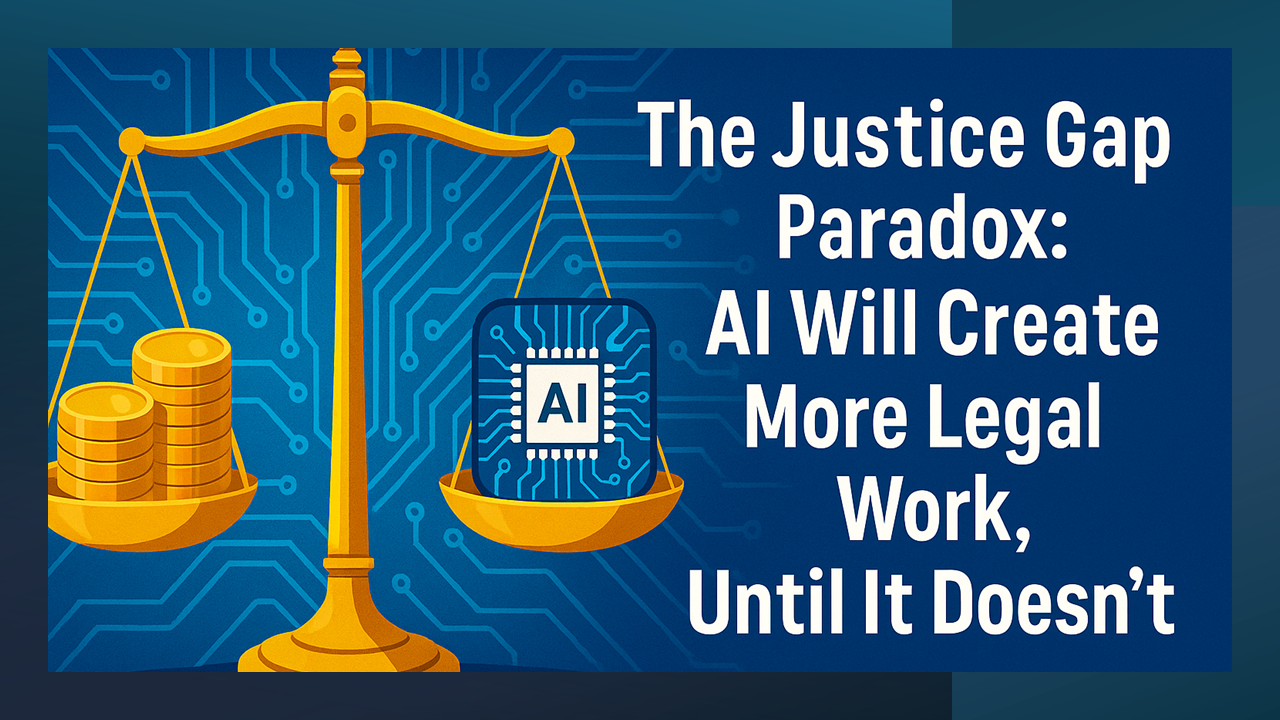
The numbers are stark: 92% of low-income Americans receive no help with substantial civil legal problems, while small claims filings have plummeted 32% in just four years. But AI is changing the game. By making legal procedures accessible to pro se litigants and supercharging legal aid organizations, these tools are reviving dormant disputes and opening courthouse doors that have been effectively closed to millions.


K-12 to Career — from the-job.beehiiv.com by Paul Fain
Ohio eases eligibility rules for high school students to pursue college-level coursework in high-demand fields.

Three Ohio community colleges offer free industry-recognized credentials in manufacturing to more high school students. Also, new career-connected AP courses designed with industry input, a partnership on skilled trade prep for K-12 students, and essays on the race to define the future of credentials and how data and research can inform Workforce Pell.


What today’s students really want — and what that means for higher ed — from highereddive.com by Ellucian

Cost is too high. Pathways are unclear. Options feel limited. For many prospective, current, or former students, these barriers define their relationship with higher education. As colleges and universities face the long-anticipated enrollment cliff, the question isn’t just how to recruit—it’s how to reimagine value, access, and engagement across the entire student journey.

Ellucian’s 2025 Student Voice Report offers one of the most comprehensive views into that journey to date. With responses from over 1,500 learners across the U.S.—including high school students, current undergrads, college grads, stop-outs, and opt-outs—the findings surface one clear mandate for institutions: meet students where they are, or risk losing them entirely.

What Are Learners Asking For?
Across demographics, four priorities rose to the top:
Affordability. Flexibility. Relevance. Clarity.

Students aren’t rejecting education—they’re rejecting systems that don’t clearly show how their investment leads to real outcomes. 


GRCC students to use AI to help businesses solve ‘real world’ challenges in new course — from www-mlive-com.cdn.ampproject.org by Brian McVicar; via Patrick Bailey on LinkedIn

GRAND RAPIDS, MI — A new course at Grand Rapids Community College aims to help students learn about artificial intelligence by using the technology to solve real-world business problems.

In a release, the college said its grant application was supported by 20 local businesses, including Gentex, TwistThink and the Grand Rapids Public Museum. The businesses have pledged to work with students who will use business data to develop an AI project such as a chatbot that interacts with customers, or a program that automates social media posts or summarizes customer data.

“This rapidly emerging technology can transform the way businesses process data and information,” Kristi Haik, dean of GRCC’s School of Science, Technology, Engineering and Mathematics, said in a statement. “We want to help our local business partners understand and apply the technology. We also want to create real experiences for our students so they enter the workforce with demonstrated competence in AI applications.”

As Patrick Bailey said on LinkedIn about this article:

Nice to see a pedagogy that’s setting a forward movement rather than focusing on what could go wrong with AI in a curriculum.


Forecast for Learning and Earning in 2025-2026 report — from pages.asugsvsummit.com by Jennifer Lee and Claire Zau

In this look ahead at the future of learning and work, we aim to define:

  • Major thematic observations
  • What makes this moment an inflection point
  • Key predictions (and their precedent)
  • Short- and long-term projected impacts


The LMS at 30: From Course Management to Learning Management (At Last) — from onedtech.philhillaa.com; a guest post from Matthew Pittinsky, Ph.D.

As a 30 year observer and participant, it seems to me that previous technology platform shifts like SaaS and mobile did not fundamentally change the LMS. AI is different. We’re standing at the precipice of LMS 2.0, where the branding change from Course Management System to Learning Management System will finally live up to its name. Unlike SaaS or mobile, AI represents a technology platform shift that will transform the way participants interact with learning systems – and with it, the nature of the LMS itself.

Given the transformational potential of AI, it is useful to set the context and think about how we got here, especially on this 30th anniversary of the LMS.

LMS at 30 Part 2: Learning Management in the AI Era — from onedtech.philhillaa.com; a guest post from Matthew Pittinsky, Ph.D.

Where AI is disruptive is in its ability to introduce a whole new set of capabilities that are best described as personalized learning services. AI offers a new value proposition to the LMS, roughly the set of capabilities currently being developed in the AI Tutor / agentic TA segment. These new capabilities are so valuable given their impact on learning that I predict they will become the services with greatest engagement within a school or university’s “enterprise” instructional platform.

In this way, by LMS paradigm shift, I specifically mean a shift from buyers valuing the product on its course-centric and course management capabilities, to valuing it on its learner-centric and personalized learning capabilities.


AI and the future of education: disruptions, dilemmas and directions — from unesdoc.unesco.org

This anthology reveals how the integration of AI in education poses profound philosophical, pedagogical, ethical and political questions. As this global AI ecosystem evolves and becomes increasingly ubiquitous, UNESCO and its partners have a shared responsibility to lead the global discourse towards an equity- and justice-centred agenda. The volume highlights three areas in which UNESCO will continue to convene and lead a global commons for dialog and action particularly in areas on AI futures, policy and practice innovation, and experimentation.

  1. As guardian of ethical, equitable human-centred AI in education.
  2. As thought leader in reimagining curriculum and pedagogy
  3. As a platform for engaging pluralistic and contested dialogues

AI, copyright and the classroom: what higher education needs to know — from timeshighereducation.com by Cayce Myers
As artificial intelligence reshapes teaching and research, one legal principle remains at the heart of our work: copyright. Understanding its implications isn’t just about compliance – it’s about protecting academic integrity, intellectual property and the future of knowledge creation. Cayce Myers explains


The School Year We Finally Notice “The Change” — from americanstogether.substack.com by Jason Palmer

Why It Matters
A decade from now, we won’t say “AI changed schools.” We’ll say: this was the year schools began to change what it means to be human, augmented by AI.

This transformation isn’t about efficiency alone. It’s about dignity, creativity, and discovery, and connecting education more directly to human flourishing. The industrial age gave us schools to produce cookie-cutter workers. The digital age gave us knowledge anywhere, anytime. The AI age—beginning now—gives us back what matters most: the chance for every learner to become infinitely capable.

This fall may look like any other—bells ringing, rows of desks—but beneath the surface, education has begun its greatest transformation since the one-room schoolhouse.


How should universities teach leadership now that teams include humans and autonomous AI agents? — from timeshighereducation.com by Alex Zarifis
Trust and leadership style are emerging as key aspects of teambuilding in the age of AI. Here are ways to integrate these considerations with technology in teaching

Transactional and transformational leaderships’ combined impact on AI and trust
Given the volatile times we live in, a leader may find themselves in a situation where they know how they will use AI, but they are not entirely clear on the goals and journey. In a teaching context, students can be given scenarios where they must lead a team, including autonomous AI agents, to achieve goals. They can then analyse the situations and decide what leadership styles to apply and how to build trust in their human team members. Educators can illustrate this decision-making process using a table (see above).

They may need to combine transactional leadership with transformational leadership, for example. Transactional leadership focuses on planning, communicating tasks clearly and an exchange of value. This works well with both humans and automated AI agents.


From Content To Capability: How AI Agents Are Redefining Workplace Learning — from forbes.com by Nelson Sivalingam

Real, capability-building learning requires three key elements: content, context and conversation. 

The Rise Of AI Agents: Teaching At Scale
The generative AI revolution is often framed in terms of efficiency: faster content creation, automated processes and streamlined workflows. But in the world of L&D, its most transformative potential lies elsewhere: the ability to scale great teaching.

AI gives us the means to replicate the role of an effective teacher across an entire organization. Specifically, AI agents—purpose-built systems that understand, adapt and interact in meaningful, context-aware ways—can make this possible. These tools understand a learner’s role, skill level and goals, then tailor guidance to their specific challenges and adapt dynamically over time. They also reinforce learning continuously, nudging progress and supporting application in the flow of work.

More than simply sharing knowledge, an AI agent can help learners apply it and improve with every interaction. For example, a sales manager can use a learning agent to simulate tough customer scenarios, receive instant feedback based on company best practices and reinforce key techniques. A new hire in the product department could get guidance on the features and on how to communicate value clearly in a roadmap meeting.

In short, AI agents bring together the three essential elements of capability building, not in a one-size-fits-all curriculum but on demand and personalized for every learner. While, obviously, this technology shouldn’t replace human expertise, it can be an effective tool for removing bottlenecks and unlocking effective learning at scale.


The Jobs and Degrees Underemployed College Graduates Have — from stlouisfed.org by Heather Hennerich; via Ryan Craig

Economist Oksana Leukhina, an economic policy advisor at the Federal Reserve Bank of St. Louis, sat down for a conversation about underemployment, including:

  • The effects it has on college graduates’ income and careers
  • The kinds of degrees underemployed grads are more likely to have
  • The job amenities underemployed graduates have

On a somewhat-related note, also see:


Workers disagree with executives on outlook as labor market stall continues — from linkedin.com by Kory Kantenga

In this month’s edition of the State of the Labor Market, we dive deeper into recent hiring trends, including revisiting entry-level work. This edition also examines labor market churn and its importance to the overall health of a dynamic labor market. We end by taking a closer look at the growing divide between worker and executive sentiment.

 
© 2025 | Daniel Christian