Watch a Drone Swarm Fly Through a Fake Forest Without Crashing — from wired.com by Max Levy
Each copter doesn’t just track where the others are. It constantly predicts where they’ll go.

From DSC:
I’m not too crazy about this drone swarm…in fact, the more I thought about it, I find it quite alarming and nerve-racking. It doesn’t take much imagination to think what the militaries of the world are already doing with this kind of thing. And our son is now in the Marines. So forgive me if I’m a bit biased here…but I can’t help but wondering what the role/impact of foot soldiers will be in the next war? I hope we don’t have one. 

Anway, just because we can…


Radar trends to watch: June 2021 — from oreilly.com
Trends in AI, Security, Programming, and More

Excerpt:

Security
Morpheus is a microprocessor that randomly changes its architecture to foil attackers: This is a fascinating idea. In a 3-month long trial, 525 attackers were unable to crack it.


Nalukai Academy: Harvesting Hawai’i’s Next Generation of Leaders — from gettingsmart.com by Ashley Ranan

Excerpt:

Nalukai’s program curriculum includes 5 areas of interest:

  • Digital storytelling – branding & marketing, content creation, web design
  • Leadership – project management, collaboration, team dynamics
  • Entrepreneurship – networking, investor pitches, business plan development
  • Design thinking –  prototyping, mind-mapping, iteration
  • Technology – coding, web development, digital business tools

Also see:

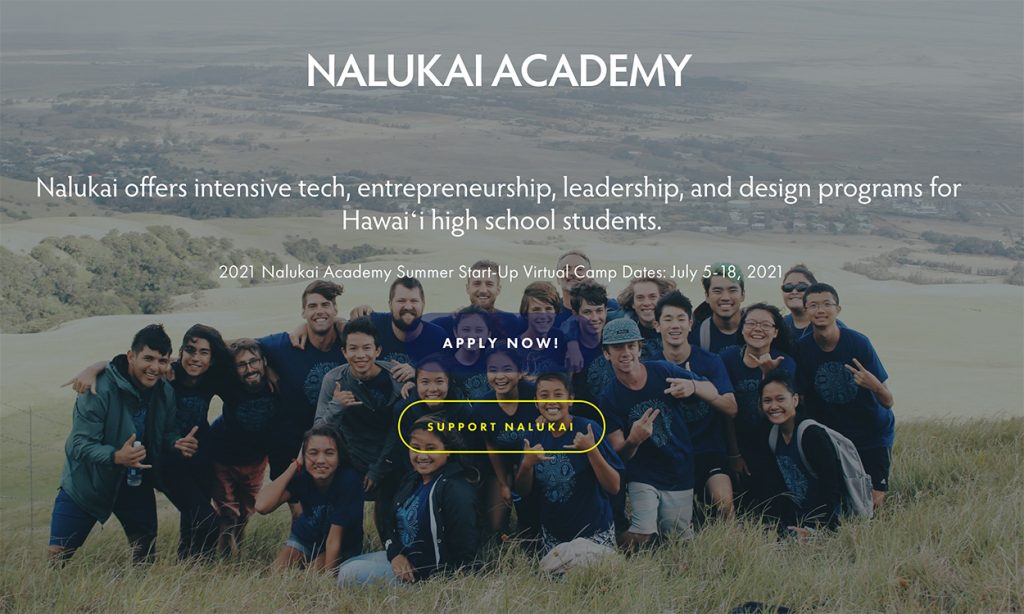
The Nalukai Academy offers intensive tech, entrepreneurship, leadership, and design programs for Hawai?i high school students. This image portrays some of those students.


Let’s Teach Computer Science Majors to Be Good Citizens. The Whole World Depends on It. — from edsurge.com by Anne-Marie Núñez, Matthew J. Mayhew, Musbah Shaheen and Laura S. Dahl

Excerpt:

To mitigate the perpetuation of these and related inequities, observers have called for increased diversification of the technology workforce. However, as books like “Brotopia” by Emily Chang and “Race after Technology” by Ruha Benjamin indicate, the culture of tech companies can be misogynistic and racist and therefore unwelcoming to many people. Google’s firing of a well-regarded Black scientist for her research on algorithmic bias in December 2020 suggests that there may be limited capacity within the industry to challenge this culture.

Change may need to start earlier in the workforce development pipeline. Undergraduate education offers a key opportunity for recruiting students from historically underrepresented racial and ethnic, gender, and disability groups into computing. Yet even broadened participation in college computer science courses may not shift the tech workforce and block bias from seeping into tech tools if students aren’t taught that diversity and ethics are essential to their field of study and future careers.

Also mentioned/see:

  • Teaching Responsible Computing Playbook
    The ultimate goal of Teaching Responsible Computing is to educate a new wave of students who bring holistic thinking to the design of technology products. To do this, it is critical for departments to work together across computing, humanistic studies, and more, and collaborate across institutions. This Playbook offers the lessons learned from the process of adapting and enhancing curricula to include responsible computing in a broad set of institutions and help others get started doing the same in their curricula. 
 

Chip funding of $50B would boost domestic jobs in construction, design, study says — from fierceelectronics.com by Matt Hamblen

Excerpt:

A new study projects a $50 billion federal investment in domestic chip plants would create 185,000 temporary American jobs and add nearly $25 billion to the U.S. economy each year until 2026 as new fabs are built.

The semiconductor industry currently employs 277,000 people in 49 states in the U.S. and supports 1.6 million U.S. jobs, according to the study by the Semiconductor Industry Association and Oxford Economics. In 2020, the industry’s total impact on the U.S. economy surpassed $246 billion.


Thursday, 5/20/21, is Global Accessibility Awareness Day!!!

Global Accessibility Awareness Day is this Thursday, May 20, 2021
Help us celebrate the tenth Global Accessibility Awareness Day (GAAD)! The purpose of GAAD is to get everyone talking, thinking and learning about digital access and inclusion, and the more than One Billion people with disabilities/impairments.

Global Accessibility Awareness Day is is Thursday, May 20th 2021

Also see:

Global Accessibility Awareness Day is Thursday, May 20, 2021


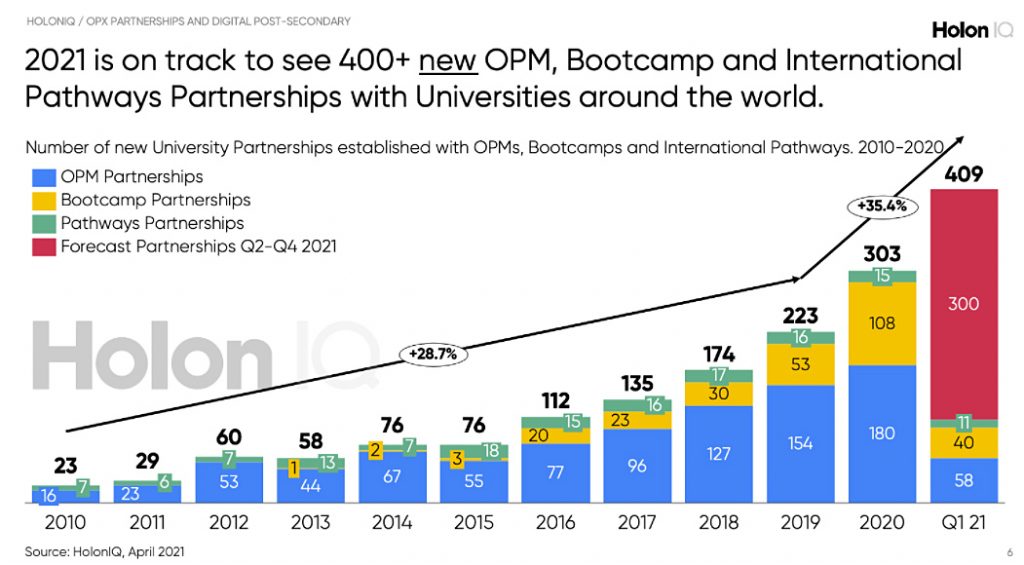
109 New University Partnerships with OPMs, Bootcamps and Pathways in Q1 2021 — from holoniq.com
Universities around the world are accelerating their adoption of Academic Public-Private Partnerships.

Excerpt:

Based on the rate of partnership growth in Q1, 2021 may deliver over 400 new academic partnerships if growth continues at the same rate.


Based on the rate of partnership growth in Q1, 2021 may deliver over 400 new academic partnerships if growth continues at the same rate.


Other key points:

  • The US led the development and growth of the OPM model, now we are seeing an acceleration in adoption of OPM partnerships in international markets across Australia, Asia and Europe
  • Bootcamp Partnerships are powering Universities with immersive, short-format programs in technology and new domains in business. Expert curriculum, deep industry relationships and hiring pathways are driving very fast growth in campus-based and online programs.
  • We expect the Global OPX Market to grow at 19% CAGR, reaching $13.3B by 2025.
 

A reasonable robot in the eyes of the law — from innovationaus.com by Stuart Corner

Excerpts:

“But what happens when an autonomous vehicle kills someone? A robot is not subject to the law. So is the car manufacturer liable, or the developer of the software? And how do you pinpoint the cause of such an accident?”

You can’t tax a robot worker
“If my employer, the University of Surrey could get a robot to automate my job, which they will someday, they would save money doing that, even if we were both equally good, because they have to make National Insurance contributions [a UK earnings tax that funds state pensions and other benefits] for my work and a host of other reasons, but the machine is taxed more favourably.


Penn students use digital platform Gather to imitate in-person office hours — from thedp.com by Isaac Lee; with thanks to Professor Sue Ellen Christian for this resource

Excerpt:

As students yearn for in-person interaction and the familiarity of their school buildings, platforms like Gather are filling the void — virtually.

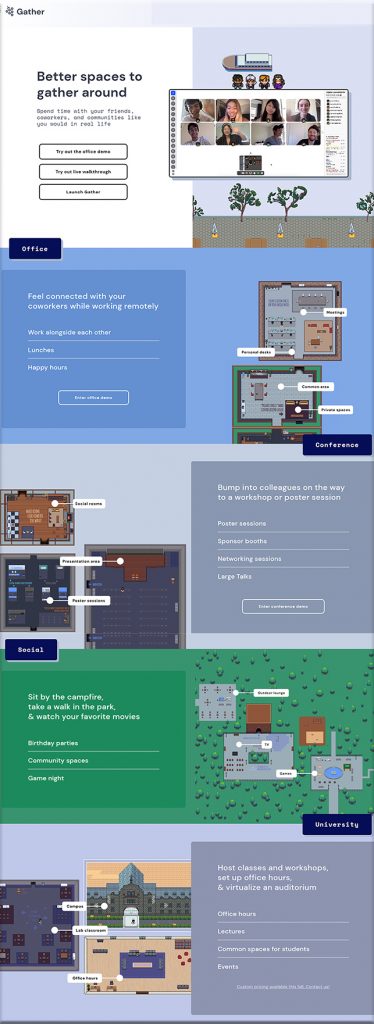
Gather, also known as Gather.town, simulates buildings and classrooms on campus where students, professors, and teaching assistants can interact with one another through personal avatars during office hours. Its main feature, “Interaction Distance,” launches a video call between users whose avatars are within five steps from each other in the virtual space. As the users’ avatars walk away from each other, their video and audio quality decrease, simulating an in-person interaction.

Also see:

Image shows how people can gather around at the office, in a conference room, at a university, other -- https://gather.town/

From DSC:
Now picture this in VR.


Supporting Students Where They Are: Bentley’s CIS Sandbox — from campustechnology.com by Mary Grush and Mark Frydenberg

Excerpt:

Frydenberg: …So, we started offering tutoring services in four ways: drop-in hours online; drop-in hours in person (following safety guidelines); online review sessions with a tutor assigned to each class; and tutoring on demand by appointment, which I like to call “Uber” tutoring.

Grush: Tutoring that follows an “Uber” model?

Frydenberg: Sure. When you reserve an Uber, you ask for a driver to pick you up at a specific place at a designated time. The same model applies here: Students complete an online form to request a tutor on a given topic and indicate when they want to meet with a tutor. Through a software application, the request is automatically routed to all tutors capable of tutoring in that subject. The first tutor who claims the request may contact the student to set up an appointment on Zoom. This creates an incentive for tutors to accept appointments, and offers flexibility as to when they choose to work. They don’t have to set aside a block of hours to be available and wait for someone to show up to meet with them. This model of reserving a tutor is available for students in 17 sections of upper level and graduate courses.


Apple CEO Tim Cook: AR Is “Critically Important” For The Company’s Future — from vrscout.com by Bobby Carlton

Excerpts:

When the subject of AR and it’s potential came up, Cook said “You and I are having a great conversation right now. Arguably, it could even be better if we were able to augment our discussion with charts or other things to appear.”

In Cook’s opinion, AR will change the way we communicate with our friends, colleagues, and family. It’ll reshape communication in fields such as health, education, gaming, and retail. “I’m already seeing AR take off in some of these areas with use of the phone. And I think the promise is even greater in the future,” said Cook.

Also see:

Woman using Augmented Reality to further learn about something.

And it is not enough to try to use existing VR/XR applications and tailor them to educational scenarios. These tools can and should be created with pedagogy, student experience, and learning outcomes as the priority.


Supreme Court sides with Google in Oracle’s API copyright case — from theverge.com by Russell Brandom and Adi Robertson
The ruling overturns a federal circuit decision favoring Oracle

Excerpt:

The court’s opinion concludes that APIs — which let programmers access other code — are significantly different from other kinds of computer programs. “As part of an interface, the copied lines are inherently bound together with uncopyrightable ideas … and the creation of new creative expression,” Justice Stephen Breyer writes in his opinion. Unlike many other computer programs, Breyer wrote, much of the copied lines’ value came from developers being invested in the ecosystem, rather than the actual operations of the program. Google used the API to let Java programmers build Android apps, which the court declared is a fundamentally transformative use.

“Google copied only what was needed to allow programmers to work in a different computing environment without discarding a portion of a familiar programming language. Google’s purpose was to create a different task-related system for a different computing environment (smartphones) and to create a platform — the Android platform — that would help achieve and popularize that objective.”

Also see:

SUPREME COURT OF THE UNITED STATES
Syllabus | GOOGLE LLC v. ORACLE AMERICA, INC. — from supremecourt.gov
CERTIORARI TO THE UNITED STATES COURT OF APPEALS FOR THE FEDERAL CIRCUIT No. 18–956.
Argued October 7, 2020—Decided April 5, 2021

Excerpt (emphasis DSC):

Held: Google’s copying of the Java SE API, which included only those lines of code that were needed to allow programmers to put their accrued talents to work in a new and transformative program, was a fair use of that material as a matter of law. Pp. 11–36.


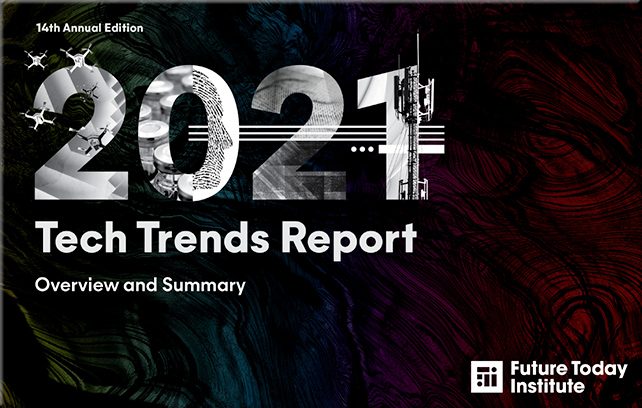
Clicking this image will take you to the 2021 Tech Trends Report -- from the Future Today Institute

14th Annual Edition | 2021 Tech Trends Report — from the Future Today Institute

Our 2021 Tech Trends Report is designed to help you confront deep uncertainty, adapt and thrive. For this year’s edition, the magnitude of new signals required us to create 12 separate volumes, and each report focuses on a cluster of related trends. In total, we’ve analyzed  nearly 500 technology and science trends across multiple industry sectors. In each volume, we discuss the disruptive forces, opportunities and strategies that will drive your organization in the near future.

Now, more than ever, your organization should examine the potential near and long-term impact of tech trends. You must factor the trends in this report into your strategic thinking for the coming year, and adjust your planning, operations and business models accordingly. But we hope you will make time for creative exploration. From chaos, a new world will come.

Some example items noted in this report:

  • Natural language processing is an area experiencing high interest, investment, and growth.
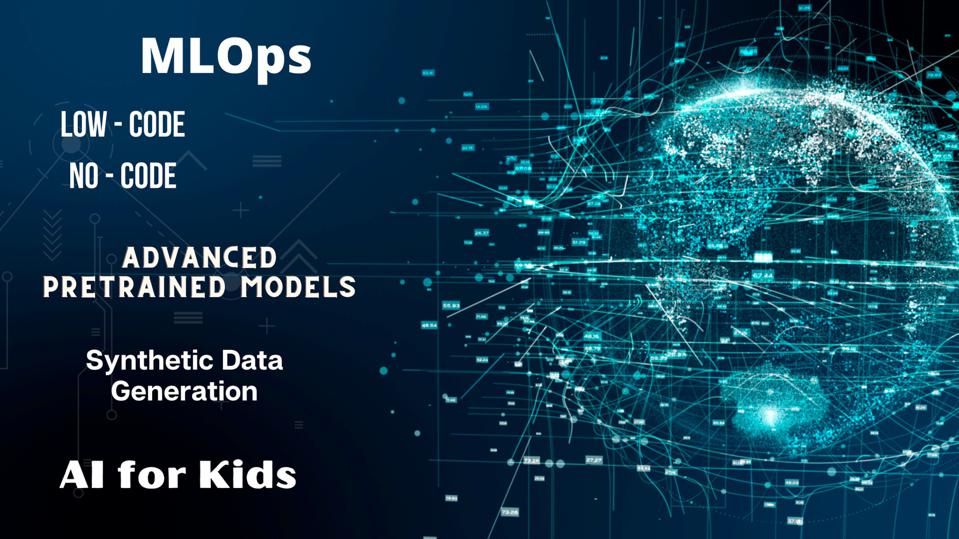
  • + No-code or low-code systems are unlocking new use cases for businesses.
  • Amazon Web Services, Azure, and Google Cloud’s low-code and no-code offerings will trickle down to everyday people, allowing them to create their own artificial intelligence applications and deploy them as easily as they could a website.
  • The race is on to capture AI cloudshare—and to become the most trusted provider of AI on remote servers.
  • COVID-19 accelerated the use of AI in drug discovery last year. The first trial of an AI-discovered drug is underway in Japan.
 

How Facebook got addicted to spreading misinformation — from technologyreview.com by Karen Hao

Excerpt (emphasis DSC):

By the time thousands of rioters stormed the US Capitol in January, organized in part on Facebook and fueled by the lies about a stolen election that had fanned out across the platform, it was clear from my conversations that the Responsible AI team had failed to make headway against misinformation and hate speech because it had never made those problems its main focus. More important, I realized, if it tried to, it would be set up for failure.

The reason is simple. Everything the company does and chooses not to do flows from a single motivation: Zuckerberg’s relentless desire for growth. Quiñonero’s AI expertise supercharged that growth. His team got pigeonholed into targeting AI bias, as I learned in my reporting, because preventing such bias helps the company avoid proposed regulation that might, if passed, hamper that growth. Facebook leadership has also repeatedly weakened or halted many initiatives meant to clean up misinformation on the platform because doing so would undermine that growth.

In other words, the Responsible AI team’s work—whatever its merits on the specific problem of tackling AI bias—is essentially irrelevant to fixing the bigger problems of misinformation, extremism, and political polarization. And it’s all of us who pay the price.

Artificial Intelligence In 2021: Five Trends You May (or May Not) Expect — from forbes.com by Nisha Talagala

5 trends for AI in 2021


ARHT Media Inc.
Access The Power Of HoloPresence | Hologram Technology | Holographic Displays | Hologram Events

Excerpt:

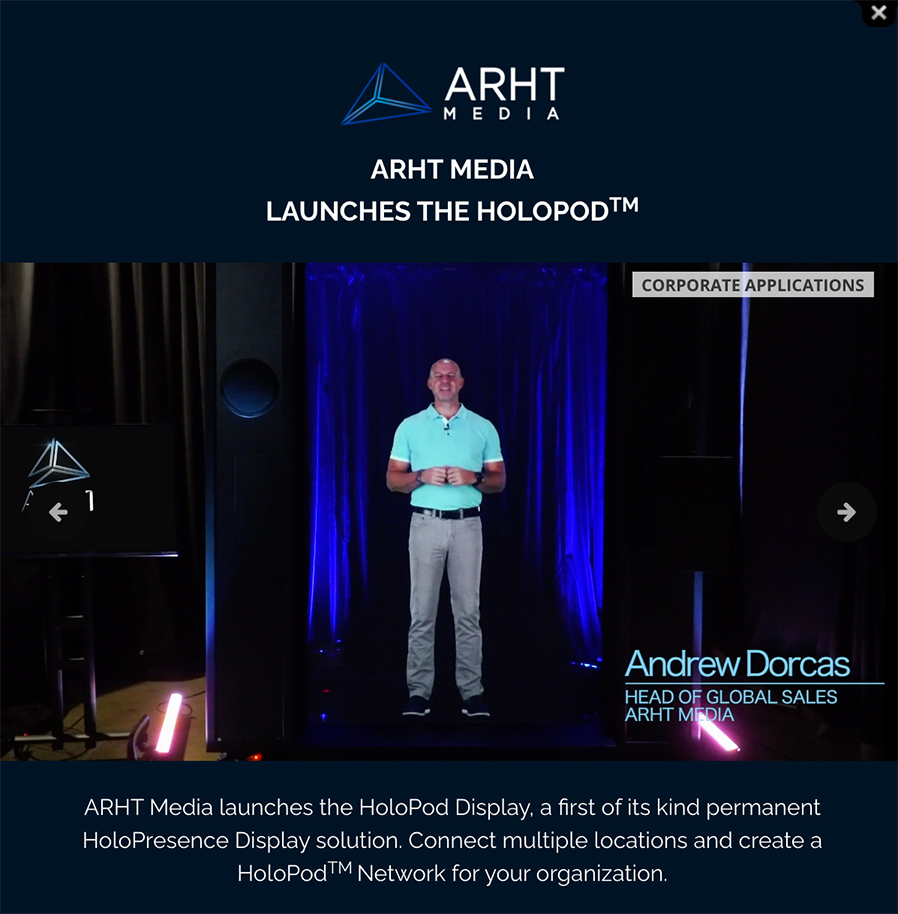
ARHT Media mounted a holographic display at the event in Vancouver and had Sunlife’s executive captured and transmitted live as a hologram to the event from our Toronto studio. He was able to see the audience and interact with them in realtime as if he was attending the event and present in the room.

ARHT Media Inc. launches the Holopod | A holograph of the head of global sales appears on stage. Access The Power Of HoloPresence | Hologram Technology | Holographic Displays | Hologram Events

From DSC:

  • Will holographic displays change what we mean by web-based collaboration?
  • Will this be a part of the future learning ecosystems inside of higher education? Inside of the corporate training world? Inside the world of events and webinars?
  • How will this type of emerging technology impact our communications? Levels of engagement?
  • Will this type of thing impact telehealth? Telelegal?
  • How will this impact storytelling? Media? Drama/acting? Games?
  • Will the price come down to where online and blended learning will use this type of thing?
  • Will streams of content be offered by holographic displays?


© 2025 | Daniel Christian